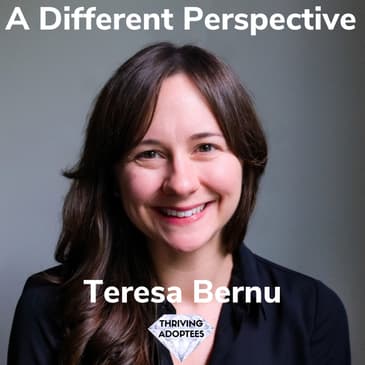
We don't know what we don't know. That's why other people's perspectives can help shift our perspective. Listen in as Teresa talks about opening ourselves up to new perspectives, exploring other people's perspectives and more.
Teresa Bernu has been a dedicated member of the ACI team since 2017. Before stepping into the role of Executive Director in October 2024, she served in various capacities, including Home Study Worker, Domestic Program Supervisor, and most recently, Associate Director. With over 15 years of experience in child welfare, Teresa has worked extensively in areas such as domestic infant adoption, foster care, and guardianship.
https://www.adoptioncenterofillinois.org/
https://www.linkedin.com/in/teresa-bernu-lcsw-50718261/
https://www.facebook.com/AdoptionCenterofIllinois
https://www.instagram.com/adoptillinois/
Guests and the host are not (unless mentioned) licensed pscyho-therapists and speak from their own opinion only. Seek qualified advice if you need help.
Want to learn more about thriving for you, your kids, your families or your colleagues? Pick a time to talk here
[00:00:02] Hello everybody, welcome to another episode of the Thriving Adoptees podcast. Today I'm delighted to be joined by Teresa, Teresa Bernu. Looking forward to our conversation today Teresa. Thanks for having me. Yeah, so Teresa works at the Adoption Centre of Illinois at the Family Resource Centre and she's the Executive Director and this is a fairly new role to you.
[00:00:29] So you were saying before we started there's been a lot of learning and growth. Is that central to thriving for you, that growth thing? Yeah, that's a great question. So I've been in this role for about a year and a half and prior to that was the Associate Director. And yes, the learning and growing is definitely a big part of what I consider thriving.
[00:00:58] I try to do a good job balancing, you know, work and the work-life balance. And so I try not to let work be my whole identity or my whole, you know, sense of how I'm doing in life. But certainly that growth mindset and continuing to learn health in the work capacity and how I feel I'm doing. Yeah. Yeah.
[00:01:25] I'm, you know, like, interesting point about making it our identity, you know, like, Yeah. It doesn't feel for me like what I do is my identity, but I do know that what I do kind of is a little bit different to my wife's view of what work is about. And sometimes I really detect that. Why, why is this so important?
[00:01:54] I want to tell you something about, you know, something else. I want to talk about something else. But you're just focused on keeping your head down in your office, you know, like, and I'm starting to detect, you know, a little bit of pushback on that, you know. Yeah. Yeah. Well, and it's interesting because I've always told people that, you know, I'm a social worker. And so I've always told people that social work is, you know, not just what you do, but part of who you are. And so I'm kind of contradicting myself there.
[00:02:24] But I think in this new role, there's a lot more administrative work and, you know, oversight. And so I think that's part of where I'm coming from. But yeah, it is. Yeah, it is really interesting. You bring up good points that, you know, when something you're passionate about or something that does impact you personally, intersects with your work. It adds another, another layer, another dimension.
[00:02:49] Yeah. I think for us, when we connect with other people who are like us in that fashion, in that way, it's easier. It's like kindred spirit stuff. Yeah. But then when you got somebody like my wife, my wife's retired, but I mean, she was pretty passionate about her jobs, but it was a job. It wasn't, it didn't encroach like it does into what I feel.
[00:03:19] So, so where, and also, you know, you mentioned the admin stuff. Does that, does that sometimes feel like a pull on the more exciting stuff? What, how, how do you come to terms with that shift, you know, from social worker to associate director to executive director? There's, there's less and less time at the coalface.
[00:03:50] Yeah. You know, it's been an interesting transition. I'm, we're a small enough agency that I'm fortunate enough to still be involved in case consultation and still know the families and interact with them. And so I'm, I'm grateful for that and have an incredible staff. And so I'm close with them and we talk all day, every day. So I still feel though I'm intimately involved in the clinical side of things, which is important to me.
[00:04:18] Well, learning a lot on the administrative side and you know, it takes the program administration and the funding, the budgeting, all of that helps. You know, it makes the program execution side of things. Yeah. So what does thriving mean for you outside these growth and learning spaces?
[00:04:47] What else, what else is within your take on, on this word that we bandy around, but rarely dive into? You know, I think oftentimes as a society, we look at it as succeeding and accomplishing, you know, goals and things in life.
[00:05:07] I know for me, and I think for a lot of people, it can mean you're at peace with who you are and where you are in life and wake up fulfilled and secure in who you are and knowing your values. Um, which, you know, goes to knowing who you are. So, and knowing what really matters in life. I think those are, that's the foundation.
[00:05:31] That's what you go back to regardless of whether you're accomplishing things in life, whether you are successful, um, being able to, um, have that foundation of who you are and what you stand for. Um, that for me is thriving. Yeah. So there's an interesting dynamic there of kind of personal stuff and career stuff. Is it all, does it, does it all sit together for you? Yeah. Yeah.
[00:06:00] I mean, they, one certainly impacts the other being able to, um, you know, I think you have to have a healthy sense of who you are in order to lead. And in order to, um, you know, you engage with people in such an intimate way in this work that you have to know yourself well and be confident in who you are in order to help others do the same. That makes sense. Yeah. Like a grounding thing. Yeah. Yeah.
[00:06:30] Yeah. Yeah. So, obviously identity from an adoptee perspective is kind of, can be tricky, can be complex. Yeah. Um, what, if, if I say thriving adoptees rather than just thriving. Yeah. What extra dimensions does that bring for you, Teresa?
[00:07:00] Yeah, of course the identity is a huge piece of that. I think feeling that identity integration and the wholeness. Um, one thing that comes to mind immediately for me is understanding inherent worth. And knowing that that worth is not, um, impacted by either positively or negatively having been adopted.
[00:07:26] Um, and that the, their worth simply exists. And it is. Um, I think that, I think that is a, um, a big part about thriving and just goes, you know, to my definition of thriving and what, what I believe is thriving.
[00:07:45] Um, of course I can't answer for these, but, um, you know, in my work with adoptees over the years, um, what I've heard from them is very much speaks to that. And, um, I think we'll get into what helps adoptees get to that place. Yeah.
[00:08:02] I think that identity integration and, um, the different factors that have allowed, um, or, you know, fostered an environment in which it is possible, um, is what allows them to thrive and what thriving really means. Um, as a story is popping into my head of, uh, uh, uh, an adoptee who has adopted, right.
[00:08:28] Um, a, uh, this was a conversation probably two or three years ago, but we got into this space of, she was talking about helping her daughter and she's got, if I remember rightly, she got three kids and names just escaping me at the minute. Um, it's come back. Yeah. Alison Olsen, she's called, and she, she's got, I think she's got three kids.
[00:08:53] She's got two biological kids and then a, a younger daughter who is an adoptee. Uh, and she, we, we got onto this, uh, we got onto this subject of self-worth for want of a, a better one. And, and it was about her pointing her daughter to, to, to her daughters, you know, pointing her daughter to, to her self-worth.
[00:09:23] And, and then this realization that the clearer we can see our self-worth. The, the, the easier it is to point our kids to their self-worth. Certainly. But there's two bits that there's kind of, well, my, my words were quite carefully chosen.
[00:09:50] We're pointing somebody else to their self-worth, but they have to see that for themselves. We can't give them that insight. Yeah. They have to see it, see it for themselves. So when, uh, and I, I guess, does that fit into the, the, the, you explain, you explained a couple of sentences and I kind of summed that up in grounding.
[00:10:16] Um, how, so how do you see all that, that kind of the interplay between the, the, the parent and, and, and the child or the clinician and the adult and this kind of self-worth? Yeah. Gosh, where do you even start with that one? Um, I, I guess it starts when it comes to adoption.
[00:10:44] I do view a huge responsibility line with the professionals. Um, you know, I often say, you don't know what you don't know. Um, and so, um, our role is the adoption professionals is to provide the education, the resources and the support to, um, you know, prospective adoptive parents as they start this journey.
[00:11:06] Um, and let them know the additional, um, um, joys, responsibilities, um, and work that comes along with adoptive parenting and make sure they have realistic expectations and understand what this is going to take to provide their children. What they need to have a healthy environment, to have the support and resources that they need.
[00:11:31] Um, and, you know, not all families are able to provide that. Excuse me. And so whether it's we're talking about transracial parenting or parenting kiddos who might have specialized medical needs, prenatal substance exposure, really there are endless different situations we could play out there.
[00:11:55] But but, yeah, I really think it starts with the adoption professionals providing that guidance. And then with the adoptive parents, so much of this has to go go to the environment in which they are creating in their home. And, you know, are the are they allowing their children to own their full their full story?
[00:12:20] Do they feel like they can talk openly about the full spectrum of emotions that they are feeling? I mean, love and loss and questions and anger and grief. Do their children feel safe asking questions, exploring their family of origin, exploring their cultural background? Or do they feel like they are only allowed to express gratitude?
[00:12:50] So, you know, I think the fostering an environment of openness, whether there's an ability to have a relationship with the birth family or not, is something we encourage families to do. And that openness can look like many different things. You know, it can be. Openness to talking about the biological family. So, you know, it can be something like, man, I wonder where you get those freckles. Like, do you think you get those freckles from your birth parents and making it something real?
[00:13:20] You aren't only talking about it in a very serious manner and making it sound like it's it's something to be that it's OK to be curious and pointing out beautiful things about the child that they got from their birth family. And that that birth family is a beautiful part of who they are. And, you know, using conversation to. To just welcome those those questions. And, of course, every kiddo can be different and some kids won't want to talk about it.
[00:13:51] Some kids will really struggle with it and other kids will not engage. And so but just making sure that children know it's OK to ask questions and have whatever feelings they have will set them up for an environment in which they can thrive. Yeah. The word that came to mind in the last part of the of your answer really was was tailoring.
[00:14:19] So tailoring and personalizing and parenting and in this in this sense, adopted parenting, adopted parenting as as art rather than rather than science. Yeah.
[00:14:39] And really, Simon, like so much of that comes along with having self-awareness and being open to lifelong learning and having the humility to accept them all those things. Those things are necessary when it comes to, you know, adopting and parenting a child who was adopted.
[00:14:58] The other thing that that that that sparks for me is tricky and tricky, tricky and in in in uncertainty. Right. So I'm think I'm thinking of a completely different area because I'm a member wife on parents. Right. So I can't talk about adoptive parenting.
[00:15:26] Can't even talk about parenting from the first time that experience. But I can I can think about insecurity around business and wanting to hold, you know, having a like I had a business coach for a while and wanting wanting guidance on uncertainty and a more scientific approach when it's not like that. Yeah.
[00:15:54] It's far more art than it is. Art than is silence, silence and sorry, than it is science. And if you're the more kind of grounded and secure you are as as a person, the more open you are to. Expressing. Expressing. That the art.
[00:16:20] Crafting the art of parenting rather than looking for security, whether is looking for scientific facts, you know, kind of tell me what to do sort of stuff. Right. And it's hard, man. Seeing a child in pain and seeing them grapple with those questions that you can't answer and just having so little control over it. It's challenging, especially when it's something that they struggle with for years. It's painful for parents.
[00:16:49] And I think that's really where the. The supportive community and others who are going through similar experiences can be tremendously helpful. And, you know, that's a resource that is invaluable and something that we we try really hard to offer our family. Yeah. How do you see the interplay between trauma and thriving?
[00:17:20] Yeah, it's an interesting question. Only deep questions, tricky questions here, Teresa. That's all right. That's all right. I'm used to it. You know, I think. When. With trauma, you know, it's. I hate to say that, you know, you have to work through your trauma or you have to heal your trauma in order to thrive because, you know, it's not. I don't view it as something where it's like, OK, check. I'm done with that.
[00:17:50] I can now go on my life. You know, I do believe it's something you need to acknowledge and something you need to you need to tend to. And, you know, everyone's going to feel a different way and handle it differently and even grieve or process it differently.
[00:18:16] And I know for some for some adult adoptees I've spoken with, you know, hearing the different ways, ways that they describe it. I think that's part of why this is a hard question to answer is just because it's been so the answers have been so profoundly different. You know, one adult adoptee said to me that she's learned to tend to it like a child and care for her trauma like a child.
[00:18:42] And for her, I think what she meant by that was, you know, kind of the inner child approach and recognizing that that trauma is always going to be with her and that she needs to be gentle and caring towards that trauma that she recognizes is never going to go away. And I think that's what she needs to be with her and that she needs to be with her.
[00:19:13] Yeah. Yeah. Does that make sense? Yeah, yeah, it does. It does. I think there's a, there's a, one of the reasons that that such approach is so powerful is what it's indicating. It, for me, it's kind of, it's not fighting the trauma. It's not suppressing the trauma. Yeah.
[00:19:42] It's not denying the trauma. It's not, it's not trying to push it away. It's, it's an, it's an embrace. Yeah. And it's also got the, if it's, it's got the sense that we are bigger than our trauma. Right.
[00:20:10] So this is something that we engulf it. It doesn't engulf us. Yeah, absolutely. And there was also, you know, I think an element of almost like preciousness to it, if that makes sense, where, you know, it's a, this is something that I had no control over. Um, and I am still precious.
[00:20:38] And this is something I need to take care of. Um, and I need to be gentle with myself because of this, this isn't something that makes me bad. Um, this isn't something that, you know, is even negative, so to speak. And this, you know, again, it was one person's experience, but I thought it was a really powerful way to, um, to process it and to put words to it. Um, it's, it's not, uh, it's something to be held rather than to exile.
[00:21:08] You know, I was listening to a podcast with, uh, Dick, Dick Schwartz, Richard Schwartz, talking, talking about him quite a lot on the, on the podcast, but not usually for his psychological. And, uh, he's, he's, he's, he's, he's, he's, he's, he's, he's, he's, he's, he's, he's, he's modality. His, his way of, way of, um, therapizing, you know, his therapy, therapy method.
[00:21:37] I'm just throwing a few words in case modality, because modality seems a bit jargony for you listeners. I'm sure it doesn't sound jargony at all for you, Teresa. Um, but he, he talks about exiles.
[00:21:54] Um, so putting the, putting the, the, it's casting out the inner child, locking the inner child in the basement, locking it away. And the, the, the reasons these are so powerful is because we're kind of, we're going into the brain part of it, aren't we? Like the suppression of it.
[00:22:18] Um, and then having these, and so there's these exiles that are so scary. We want to hide them away. And then there are these protector parts that are almost standing guard at the, at the entrance to the, to the cellar. Yeah. Keeping us, keeping us away with anger or, or, or violence and, and anger.
[00:22:47] And, you know, I'm thinking like a bouncer would do like a bouncer on the, you know, it's, it's violence. I, it, it, it, it, it, it, it's, it's violence, physical violence or, or verbal violence. Right.
[00:23:00] And that's the complete opposite of this nourishing approach that this particular adult adoptee, um, was, um, was, was talking about, you know, um, and I think also, I think of like a, like a therapy approach would be people talk about holding space. Yeah. Like a therapist holding space.
[00:23:27] So you're holding space for your clients in a child. Yeah. And this particular adoptee has learned to hold, has learned to hold her own space for her own little child. Yeah. Presumably on the back of some interventions and some therapy. Yeah. Yeah. It's pretty remarkable. Yeah.
[00:23:56] Rich, rich, isn't it? Yeah. Do, do other, I got the sense that you, you, you know, you, you took some time to answer the question because you were thinking back to different, what different adult adoptees had told you. Do other kind of stories pop into your head about what you've heard from other adoptees? Yeah.
[00:24:21] I mean, of course the, on the flip side, I'm sure we have all heard, um, of the challenges and how, you know, the trauma gets in the way of, um, of some people who, you know, people who are adopted being able to feel like they are thriving or, um, you know, it's every individual story when it comes to adoption is going to be different.
[00:24:48] And, um, yeah, there, there are a lot of stories about the, um, the pendulum swinging is probably a good way to, to describe it that, you know, in the adolescent years, maybe feeling a certain way about adoption and, um, and having been adopted and birth family.
[00:25:11] And then, um, you know, in twenties or thirties, having come, um, a significant way, not to say at all that, that pendulum has brought them to a place where it's all rainbow and sunshine. Um, but having gotten to a place of more peace and, um, acceptance, I would say.
[00:25:31] So the, you know, the adolescent years can be challenging for, for everyone, regardless of their, their upbringing or, you know, how they came into a family and adding that complexity of, you know, how adoption relates to identity.
[00:25:45] Um, you know, it's one more, um, very complicated factor for, for a lot of kids, especially if there's additional components of, um, of culture or transracial adoption or, um, relationships with birth family or lack thereof, or lack of knowledge of, you know, where they come from. So, yeah.
[00:26:09] The, the, the flip side of the, I'm, I'm, I'm, I'm bigger than my trauma. I'm nourishing my inner child. The metaphor that popped into my head, as you were describing the kind of tumultuous, is that the right word? Um, teen, teen words was, was, uh, the metaphor that popped into my head was, um, a, a surfer that's lost in, in the wave.
[00:26:39] That's gone under. Yep.
[00:26:41] And in the case of the, the adoptee that's got that distance and, and, and, well, yeah, the, the, the, the adoptee that's got that loving relationship with her inner child is completely different to the teen adoptee who is lost in the wave.
[00:27:10] The wave, the wave, the, the, the wave is, is the metaphor for the trauma and the trauma is bigger than they are. They're, they're engulfed. Right. Yep. Yep.
[00:27:20] And, I mean, I'd be curious for you, Simon, and for so many other adoptees or birth parents who, um, go on to work in this field and to, um, you know, either whether it's like a mentorship program or, um, you know, going around and speaking or training families or adoptees, um, or so in the mentorship realm.
[00:27:44] Um, you know, how the, what that like thriving feels like, um, whether it's like you feel like that trauma, if you do identify with the word trauma in relation to your adoption, um, which not everyone does. Like, like how that transition or journey has, um, has impacted your, um, your thriving and how you are thriving in life. I guess the same question back to you that you worded better than I just did.
[00:28:14] Well, I, you use the word pendulums, right?
[00:28:21] So for me, we, we, we had this tablo rossa blank sleigh rainbows and unicorns metaphor for, for adoption, uh, that didn't start to really change until primal wound 1993. Mm-hmm .
[00:28:49] And then as that took off and how, and, and trauma got, trauma got bigger. Right. So trauma wasn't a thing until the mid seventies, you know, uh, in, in the first world war. So it's often, it was the, off the back of the Vietnam war, the, the trauma became a big thing. Yeah.
[00:29:12] Um, so the trauma narrative has grown to give you an example of, I don't know if you've heard this, but, um, what, what was PTSD post Vietnam?
[00:29:28] If we go back 50 years before that, and we look at the first world war, so that's 1914 to 19, uh, 1914 to 19, 19, 19, 19, 19, 19, 19, um, people would, uh, the, the diagnosis was shell shock. Yeah. So shell shock became PTSD, right? So that, that's like a trauma narrative.
[00:29:53] So like the, the adoption world took that on, took that on board as well. And, and the, and the trauma narrative with, uh, that's very, I think in 1993. And now I, I feel that we have a, we have a, in parts, we've become trauma informed. Yeah. And, and we've become a little bit trauma obsessed. Yeah.
[00:30:25] And I see the reason I mentioned Dick, Dick Schwartz and Richard Schwartz and IFS is because, you know, his, I, I, I coined this term myself a couple of days ago. I was thinking about it.
[00:30:43] We can be, can't we be wholeness informed, you know, like, um, so pendulins swing too far. Like, so we've gone from rainbows and unicorns to, and, you know, look at the, the Bessel van der Kolk book, like Body Keeps the Skull, 19, uh, so that's published 2014, like, only 12 years ago, 5 million copies of that. Yeah.
[00:31:12] It's been on the New York Times bestseller list for quite a while. It's, it's, it's not just a, um, it, it, it, it's, it's not just the adoption world that is trauma obsessed. It's, you know, uh, and people are use overusing the word trauma. Yeah. So for me, I think it's time to be trauma informed and wholeness in informed and, and to look at the wholeness under our psychology.
[00:31:43] Yeah. I think that makes a lot of sense. And, um, I tend to agree with that. Yeah. And I, and I think one of the things that I I've seen is trauma as a, on a scale, right? Mm-hmm. So if there is a, if there is a primal wound, if there's a primal wound, I believe it, I believe it's, I believe it's psychological, not essential. Mm-hmm. Right?
[00:32:12] So it, it, I'm not denying it, but I'm saying that it's about our psychology, not our, not our essence. And I would, I would say it's a continuum. So mine feels like a paper cut. Mm-hmm. Whereas other people feel like, you know, they've, they've, they've had a gash, a severe gash to their hand and they've had to have four stitches.
[00:32:37] And for others, other, at the extreme ends, you've got the, it's like a shark attack, right? Yeah. Yeah. Yeah. So I, I see it as a continuum and I, I see it as layers, right? So you've talked about transracial adoption. So transracial adoption, trauma, trauma is in layers. Different people have different layers. Yeah.
[00:33:06] And those layers are a different thickness. So that, that's why it is so, as you say, personal. Yeah. Absolutely. And, and the, so my, my, my prime moment feels, feels like it's a, a paper cut, which means that I've got a little bit more distance from it.
[00:33:36] There's, there's, there's, there's, there's less veiling of my wholeness. Yeah. Yeah. That, that all makes sense. And I think it's a really beautiful thing. And we're so fortunate to have adoptees in this space who are, who are offering the incredible resources like, like you, Simon. Thank you. You know, and I think of Isaac Etter, Angela Tucker.
[00:34:03] There are so many people out there who really have changed the adoption field in my opinion. Um, it wasn't that long ago that we were sorely lacking adoptee voices. Um, we still have a way to go for sure.
[00:34:17] Um, but you know, being able to use the lived experience to offer that voice as a way for professionals, adoptive parents and adoptees to either learn and grow or feel seen and have that opportunity for community. Um, it's an incredible gift for all of us. The fact that Isaac does it with his mom. Yes, I know. So much. Yeah. Yeah.
[00:34:46] Um, yeah, I I've interviewed Isaac a couple of times and I met Angela for the first time a couple of weeks ago. We were on a, uh, a panel discussion in, uh, in Delaware. Well, on zoom, but for in Delaware. Um, so yeah, it definitely, that, that transracial adoption thing adds another layer as, you know, international adoption there.
[00:35:15] So losing your, losing your culture, losing your, the, the racial mirroring being, you know, being brought up in a, in a white area when you're not white. Yeah. And, and, and so feeling not only feeling disconnected from you or different to your family, feeling different to your community. Yeah.
[00:35:42] It, it all adds to the, it all adds to the, it all adds to the layers of trauma. And, and, and yet the, it's the same, I believe it's the same light underneath just have different layers. It's just different layers, different veils of our lightness or to put it a simpler way.
[00:36:10] If it's, if it's layers, it's like a layer cake, but, but we are the, we are the cake, not, sorry. We are the cake stand, not the cake. Yeah. So that for me, the, the fundamental thing is the separation from the trauma that we feel to, to the essence of, of who we are. I much prefer the cake, cake stand analogy versus the onion. Yeah.
[00:36:40] Okay. Yeah. Well, the onion is going to bring tears to your eyes, right? The cake is just going to add inches to your waist, not tears to your eyes, you know, but you know, all things in, all things in, in, in, in moderation. Yes. I'll take cake any day. Yeah. Take cake any day. Yeah.
[00:37:02] Um, so how, how do you see the kind of the relationship between the thriving of the kids, the thriving of the parents, the thriving of the professionals? How, how do you see, how do you see that dynamic?
[00:37:24] Yeah, I think, um, building off of what I said before, I think the, I think it takes a lot of work on the agency side of things to, um, a lot of work and a lot of, um, responsibility for us to make sure that we are in a good place. Um, and that we are operating from an ethical, um, in an ethical manner.
[00:37:52] Um, it's something that I, and we take incredibly seriously, um, and making sure that we are then preparing families to do the same, um, understand their responsibilities. Like I said before, um, so they can therefore meet the adoptee's needs.
[00:38:14] Um, so, I mean, it's kind of one making sure they're, they're set up for success to set the other one up for success to set the next one up for success, um, in a way. But, um, you know, there, I do believe that it starts, it starts here.
[00:38:33] It starts with the agency and making sure that we are operating with the right motives from a place of ethics, um, knowing what our values are and, um, and it'll, it all goes from there. Yeah. And what are the challenges do you see to that?
[00:38:59] You know, I think that for a long time, the adoptive parent voice was centered, um, and, you know, their interests are often, um, have, have often been prioritized by the adoption community at large. Um, I would say one of the things I'm most proud of our agency for is we have all voices represented on our board of directors.
[00:39:24] So we have, uh, adoptee birth parent, adoptive parent adoption attorney, all represented on our board. Um, and I think that's, you know, incredibly important just because, you know, for obvious reasons, everyone's going to bring a different lens, different perspective. I think it, there's a lot of accountability there and accountability factor, um, or the decisions that are made.
[00:39:50] And it's how our agency was formed with all of those, um, voices and representation. And we continue to be that way. So, um, I think that helps as an accountability mechanism. And I think, you know, not having that present can certainly get in the way and, um, can foster an environment where decisions are maybe made to, um, in favor of one party over another.
[00:40:21] You know, at the end of the day, we are a child welfare agency. And so what's in the child's best interest needs to be front and center. And whenever we are faced with a really hard decision as a team, we sit down and we talk it through and it can be a hard decision, but we go back to what is in the child's best interest. And it's usually pretty clear. And it often, it often might not be the decision that other parties want to hear.
[00:40:47] Um, and it can be challenging, but it usually, um, it's usually a pretty clear answer. And, you know, it's our guidepost for which I'm grateful. Yeah. Can you give us an example of what you mean? Oh, let me think of a good example. Um, trying to think of a good one that.
[00:41:17] That. You don't give too much information. Um, yeah, obviously. Yeah. You know, I would say. For instance, if, um, if we have a situation where a biological mother is wanting to place her child for adoption and is wanting to review profiles.
[00:41:39] And, um, you know, we know that there are only two families who might meet the criteria in which they, um, are open to or approved for the circumstances of that situation. So, you know, it could either be, you know, race, age, prenatal substance exposure, other medical situations. Um, and, you know, someone could say, well, this family, they might be open to it.
[00:42:08] They weren't approved for that. Um, and going back to, well, why was that family not approved for that? And should they be presented a situation or not? So, um, I'd say that's probably the easiest one to identify in when a family is not approved for a specific thing. And staying true to, um, to that decision that was originally made, which we do, it's hard. You certainly don't make people happy all the time.
[00:42:37] Um, even when certain situations come up where, you know, someone might be tempted to say, can we consider this family? Um, but you have to remember why the decision. Yeah. Integrity though, really. Yeah. Integrity and, um, you know, just remembering. Yeah. Integrity is a good way to, a good way to put it. Yeah. Yeah.
[00:43:04] So we started the conversation around learning and growth. What have, what have you learned about? You talked a little bit about your learning growth in terms of your, the, the different roles, the different, the changing role as, as you get more senior in the organization.
[00:43:32] What about the, I guess the learnings on integrity and ethics are another kind of part of the learning journey. What other parts come to mind? Yeah. Uh, that's a great question.
[00:43:57] Um, you know, we, we try to be incredibly transparent with who we are as an agency. Um, and when I took over this role, I, you know, it was important to me that I, um, make it clear that I will continue to uphold those values, um, to the community.
[00:44:25] And, um, I'm so fortunate to have the team that I do. They're fantastic. I, every single person here feels as strongly as I do about ethical practice. And, um, you know, there, I would say some of the things that really stick out to me that are kind of our, our guiding lights and things that we don't compromise on our relationships with birth family.
[00:44:49] So if a family comes to us and says that they 100% want a closed adoption, don't want any contact with the biological family, um, we won't work with them. We, we know that's not the child's best interest. And that's, um, you know, I think families would be hard pressed to find an agency nowadays that would accept that. But, um, that's one area that we don't bend on.
[00:45:14] And, um, you know, I think, I think transparency is really important in who we are, the process, how things operate. Um, giving the biological parents or birth parents agency over their choice, um, being welcoming to families of all shapes, sizes. And, um, you know, we are very welcoming to the LGBTQ community, single parents.
[00:45:44] Um, we are not religious, a religious organization. Um, so we welcome anyone of welcome folks of any background, um, from a religious standpoint. And, um, yeah, so those, those are a few things that we are uncompromising and really guide us.
[00:46:08] Um, what, um, it's a, it's a question that I have only found myself asking birth parents, actually. I haven't interviewed that many of them, maybe 10. Um, how, how do you see their, how do you see them growing? How do you see them growing? Yeah. How do you see, how do you see their growth?
[00:46:34] You know, we've, you, you talked about the different life stages of a, of a, an adoptee. So I only spent a lot of time talking about the, the, the teenage years and, and then getting older and some life experience and distance from our trauma. Um, some, it no longer engulfs us.
[00:47:03] Um, we have, we're, we see our, we see that we're bigger than it, not that it's bigger than us. Um, wondering what you, what you see in the phases of birth parents and especially birth moms. Yeah. I, yeah, again, not speaking for all birth mothers or birth parents, um, not having that lived experience.
[00:47:31] Um, and so only going off of conversations with those who I have had the privilege of knowing. Um, I think a lot of what we talked about with the adoptee experience, um, applies in terms of the, um, the identity. First of all, there is still a tremendous amount of shame surrounded with placing a child for adoption.
[00:47:58] And, um, you know, talk about that disenfranchised grief and there's not really a place or words or acknowledgement of that, um, that type of grief in society. And it's just, it's such a unique pain and, um, and grieving process.
[00:48:20] And, you know, for a lot of women and men who, who place, um, you know, I shouldn't say a lot for, for some who place, they really don't want to be involved with our agency anymore. And then that's probably the minority, you know, I think about it, but, and then there are some who want limited contact with the fan with the adopted family. Some who have a very beautiful, very open, regular contact.
[00:48:47] It really just, it depends on what that particular person wants and needs in that moment. And of course it's a relationship like no other in your life. Um, and so it's going to ebb and flow. It's going to be fluid. Um, but I do think, you know, I think there's an identity and a grief component just like there is for, for adoptees and that it's going to evolve over the years.
[00:49:13] And it's also not one of those checklist items where you can just say, okay, I'm done with that one going on with my life now. Yeah. Yeah. And I also think there's an incredible responsibility for agencies to be providing supportive resources, um, for life or people who place through the agency.
[00:49:38] The, the, the, the metaphor that I've come up with for adopt, adoptee grieving or whatever you resolution, healing, those different words is it. It's like a, it's like one of those spring loaded plate stackers.
[00:50:00] You know, when you go to a canteen and you take the plate off the top and you put it on the tray and then the next one comes up. Um, that, that, that's what it feels like. That, that's what it, that's the best metaphor that I've come up with for that as, as we become conscious of the next layer and then the next layer and the next layer and the impatient, the impatient ones like me, right?
[00:50:29] Um, you just want to be done, uh, but it's not, it's kind of not like that. Um, and, uh, I, I'm wondering if that. First off, if that metaphors, metaphor, um, how, how, how, to what extent that metaphor rings true from your experience of what you've seen in, in other adoptees? Um.
[00:50:59] For, for birth parents or adoptees? Well, for adoptees first really. And, and then, and then maybe we'll go on to birth parents afterwards. Yeah. Yeah. You know, it's interesting, um, again, hearing a variety of experiences and stories, but, um, it does seem like there's also a common theme of, um, forgetting there's a spring down there and taking a plate and, you know, being surprised that something comes up. Oh, right. Yeah.
[00:51:28] Maybe not needing another plate for quite a while. And then, uh, there it comes again. So I think that that metaphor probably resonates for a lot of people, you know, there can be seasons, the things. Um, and, um, you know, for birth parents in particular, you hear a lot about, um, you know, birthdays being particularly hard and holidays, um, and same for adoptees actually.
[00:51:54] So, um, so I think the, um, not expecting something to come up again or to still affect you in a certain way or, um, at different milestones in life, something, something new getting, um, triggered or surfacing that you weren't quite expecting. I think that, um, it's a pretty accurate experience that a lot of people, um, express. Yeah. Sometimes it's the same plate again. Exactly. Yeah. I thought you were done. I was done with you.
[00:52:25] Yeah. Often it's the, it's, it's the, it's the same learning yet at a deeper. Yeah. At a deeper level. It's, it, it's, yeah. I think, used to think that learning is a one, you know, one, it's a one or a zero, right? It's, it's like your computer. It's on or it's off, you know? Yeah.
[00:52:52] A silicon gate is a one or a zero binary. And that's not how, but that, uh, some of these learnings, the penny never reaches the bottom of the well. It's infinite. And that's a good thing. That's the other thing, right? Because it means that it means that life gets better.
[00:53:21] So rather than being impatient to be done over and done with our learning, then we're kind of relishing a little bit more and a little bit more and a little bit more. As it becomes, you know, I'm thinking about the birth mother and birth parent versus adoptee scenario on this.
[00:53:43] I'm seeing that maybe, you know, with a, with a, maybe it's a, it's a different story for those kind of like infant adoptions when it, when it's pre-verbal and when it's pre-memory and all that stuff. And that, that's not going to be, that's not going to be the same as a, as a birth parent because they, they knew what they were. They were conscious of it all, right? Right. Yep.
[00:54:12] So perhaps, perhaps kids that are adopted older and birth parents will have more in common in terms of how their healing journey looks because they're aware of it. They're aware of when the, when the separation happened. Right. Yeah. Such a variety of experiences. Yeah. So Teresa, kind of coming up on time here.
[00:54:41] Is there something that you'd like to share that I've not asked you about? I would like to ask you what you think thriving is and what thriving looks like. Yeah.
[00:54:58] So loving life more, you know, it's, so when I, when I look at thriving, I often think of healing as well. Some adoptees don't like that word healing, but the, the,
[00:55:25] the, the, the, the foundation is seeing for me, the foundational, the foundation is seeing our wholeness under, under our psychology.
[00:55:39] And then, so seeing, seeing our wholeness and then expressing and living from that wholeness more and more. Yeah. Yeah.
[00:55:58] So one is a, one is a discrete moment when we see our wholeness and, and the rest is, is the process, the ongoing process of, of that. And expressing rather than seeking. Interesting. Yeah. I like that.
[00:56:26] Expressing more into the, into the, into the world. Right. So one of my mentors said, says something beautiful like, I'm not sure if I can, rather than using the, using the world in service of our happiness, using our happiness in service of the world.
[00:56:56] Yeah. Yeah. So seeking versus expressing. Yeah. I like that a lot. Thank you. As always, listeners, check out the show notes, find out more about Teresa. There's lots of links in there to the website and the socials. And thank you for sharing the last hour with me. It's been great. Really enjoyed it. Thank you, Simon. Thank you listeners. We'll speak to you again very soon. Take care. Bye bye. Bye bye.