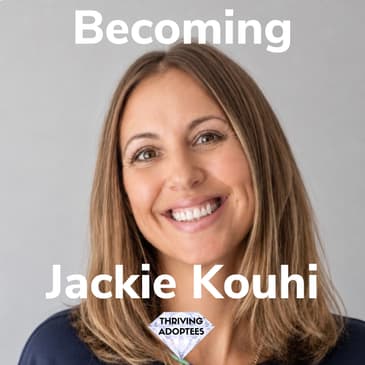
Are you happy with who you are? Or working on becoming that person? Listen in as we dive into self-actualisation, Michelle Obama, trauma and more on this deep exploration of self, freedom and more...
https://www.facebook.com/TriadFamilyServicesAgency
https://www.linkedin.com/in/jackalene-kouhi-63920632/
Guests and the host are not (unless mentioned) licensed pscyho-therapists and speak from their own opinion only. Seek qualified advice if you need help.
Want to learn more about thriving for you, your kids, your families or your colleagues? Pick a time to talk here
[00:00:02] Hello everybody, welcome to another episode of Thriving Adoptees podcast. Today I'm delighted to be joined by Jackie Kouhi from Triad Family Services. Looking forward to our conversation. We had such a great chat last time, Jackie. It was brilliant. I loved it. Yeah, yeah. I was looking forward to this. Yeah. So the biggie one, right? What does thriving mean to you?
[00:00:27] Well, Simon, this question. So I spent way too much time thinking about this. At first, if you remember our last conversation, we were talking about self-actualization to a certain degree, but then upon thinking about it, you know, animals don't self-actualize. Plants don't self-actualize. Children don't realize, you know, when they're thriving.
[00:00:48] So, you know, I think thriving is just doing so much better than surviving. And I think it's intrinsically personal to each and every one of us. So I know that this is a question that you ask your people. I wanted to lob it back to you. What do you see as thriving?
[00:01:07] Okay. So I've got a gazillion, a gazillion ones for that. I'm going to go with something from a kind of mentor of mine, a guy called George Pransky. And he talks about being grateful for the highs and graceful in the lows. I like that.
[00:01:33] Graceful in the lows. So I had, I had a couple of technical glitches this morning, technology glitches this morning. And I then as I do, I went to the swimming pool and the guy saw one of my, my pals that I often see that called Will. And I said, how are you doing?
[00:01:56] Will, he says, I'm doing, yeah, I'm okay. I'm okay. How are you doing? And how are you doing? I said, I'm doing, I'm tip top. I'm tip top. And he said, well, why? And I said, well, I've had some glitches this morning.
[00:02:10] Some of them are my making, but I didn't beat myself up like I used to do. So I'm going to take that as pro. I'm going to be tip top because they kind of the self kind of self self flagellation stuff.
[00:02:29] You know, why did they do that? Has been big, kind of big, big for me in the past. So yeah, I'm tip top because I stayed fairly grounded. Yeah. And I didn't, and I didn't beat myself up. So yeah, that seems.
[00:02:53] You used your, your coping skills. You have, and again, intrinsically personal and the perspective that you have to maintain that gratitude. That is, that's huge. That's huge progress. I wouldn't say I use coping skills. No, you were grounded.
[00:03:13] Yeah. I would say that I was more grounded, but that's down to my grounding. That's down to my, what I've learned rather than a skill that I chose to kind of exercise in that moment. Yeah. Was it conscious?
[00:03:40] Not really. I did feel, I felt, I felt anger trying to grab me in, to pull me in. I felt anger trying to pull me in. And it didn't. Yeah. It didn't do it. I'm going to call it coping skills, Simon. I really am. And here's why.
[00:04:08] You didn't have those skills previously. It was something that you had to consciously work on until this point where you can do it more of an unconscious level, where you know that that's going to grab you and how that's going to change your day. But instead you put measures in place and you stopped it right then and there. So I'm going to give you that. I'm going to give you that. Yeah. It's a win. It is a win. It is a win. And I'm going to go back with your question in terms of self-actualization.
[00:04:38] So if I remember rightly, that's the top of the Maslow's hierarchy of needs. The only thing that I can remember from my second year in psychology, a psychology option in a degree like 1987 or something like that. So I know, I kind of know what, I know the word, but I couldn't, I couldn't put it into, I couldn't put it into words. What does, what does self-actualization mean?
[00:05:08] And that's such a good, a good question because again, it's one of those things that to each of us, we reach the point where, you know, we're so conscious of our progress and our behaviors and who we're becoming and who we were, who we want to be.
[00:05:25] So not, you know, we're of course based on products, based on our environment, nature versus nurture, you know, whatever, whatever bag we had to carry to adulthood, to where we are now. I think it's really reaching this point where you are so much more comfortable with yourself. You have a very clear idea of who you're becoming and what you need to work on, who you are around other people, who you are in relationships, who you are as a professional.
[00:05:54] And the world around you. So that's not something that you can do when you're in survival mode. You're just trying to survive. You're just trying to get to the next day. But when you don't have those fears of survival, then you are able to move into this place of where, okay, now it's about me. Now it's about who I'm becoming. Yeah. The whole becoming and being thing is, fascinates me.
[00:06:23] And whenever I hear the word becoming, I think of the Michelle Obama's book. Absolutely. It's called Becoming. Yeah. And was she talking about becoming Michelle Obama? I mean, have you got a clue why she was, where that title came from?
[00:06:52] And she was really challenged over the years. And especially during the presidency, she was challenged to look at herself as a mother, as a first lady, as a human. She had things coming at her left and right. And that's why she said, you know, when they go low, we go high. And she constantly had to do that, even though they were tearing her down. So when you have so much coming at you, external forces coming at you saying, you're this, you're that, you're this.
[00:07:21] But you know, no, this is who I am. And this is who I'm becoming amongst all of that drama. And she was able to look at her. She's incredible. She's a role model to so many. Yeah. Yeah. What do you think? What do you think she means by becoming? Well, I love the, I don't know. I love listening to the book. It was probably, I don't know, three, four years ago that I listened to it. I mean, I know she did a massive tour. She was touring it forever, that book.
[00:07:51] Yeah. She went so many places with her. You know, I, the, the, I've mentioned that this chap, George Pransky, earlier on, he would talk about thriving being a, he wouldn't talk about becoming. He would, he would talk about it in a subtractive way. Right.
[00:08:15] So what I mean by subtractive way is it, we, we are, we are the diamond, right? The thriving adoptees logo is a, is a, is a diamond, but the, the diamond is, diamonds are often covered in, in dirt. Right. And so it's a subtraction bit. It's, it's actually, it's about removing, removing what isn't the diamond, removing the dirt to reveal.
[00:08:45] Yeah. Reveal who, who we are. And so we're diamond mining in a way, right? So if you, if you, if you, if you, if you, if we're diamond mining in South Africa or wherever we're looking for our diamonds, then we've got to go through levels of rock and, and, and dirt and all sorts of different stuff to get to the diamond. It's there, it's there already. We, we just haven't, we just haven't seen it.
[00:09:13] So for me becoming, it doesn't quite fit with that. I, I, I would say it's, uh, I, my philosophy would be more of removing, uh, removing our trauma, right? Going through the layers of trauma, going through the, the, uh, the, the layers of, of our conditioning.
[00:09:41] People use that word, like our psychology and the, the bad stuff, the, the, uh, the, the self-limiting beliefs that we've, that we've taken on board. So I would say it's more about uncovering than becoming. That would be more of a metaphor for, for my, for my, for my take. So self-actualization would be about removing the bit that isn't Simon, true Simon, the diamond.
[00:10:11] Yeah. Yeah. You said a couple of things I want to go back to. So, uh, you know, working, we work around trauma. Trauma never really goes away, but we work around it. And, you know, going back to Michelle Obama, she also, she was also a mother first, a wife first before she was ever herself. And this is a pretty important aspect to discuss, especially for women around that age and women who are coming out of devoting their entire lives to other people.
[00:10:42] Before we were ever able to even say this life is about me. I'm at the point now where my, my children are old enough to drive themselves to school and to work. And it's wild. And I've been realizing now I get my life back to myself. What does that even look like for me? Who, who am I outside of being a parent, a wife, uh, you know, a professional, who am I?
[00:11:05] And so that really resonated with me, especially because we do tend to lose ourselves with the world tugging at us. Everybody needs something from us all the time. And I'm not saying that it is so drastically different from your friend who is a male, but there, there are differences that do have to be acknowledged when becoming. And for women, we have multiple lives that we live, especially, you know, the latter half of our life. You know, it speeds up and this is really where we do the real work.
[00:11:36] And for men, you know, I can't speak to that. I'm not a man, but, you know, I do see that it's, it's a similar struggle of who are we outside of all of these other things. And then can we be with that person? Can we sit with ourselves by ourselves? That isn't something I used to be able to do. I don't know if you were able to do it, but now I love it. Yeah. I think there's, you make a great point.
[00:12:05] Mums versus dads. But the, and there's another point for me in terms of like me and my wife haven't got any kids. Right. So I don't even have, we have our dogs and they're a sufficient logistical challenge for us. But, you know, I, I don't have that dad. I don't even have dad shit pulling on me.
[00:12:32] I know mum shit pulls a lot heavier than dad shit pulls, but I don't have that. So that would be another kind of another distinction. Huge. Huge. And they say that, you know, when you're a mother, you, you never, you're never alone in your thoughts. You have to think once for yourself and once for your child. And it's true. It doesn't matter how old they are. First, you're thinking is my child. Okay. Do they have everything that they need?
[00:13:00] Or at least you'd hope that's what, you know, that that's what people are thinking. You know, that's not what everybody's situation is. I understand that, but it's still, there's still so many fundamental differences between men and women. In the latter half of their lives. Yeah.
[00:13:17] I, I, I remember a, a profound moment when it's a, a friend, for some friends of ours that we kind of fell out with, but she, she really defines herself through, through her motherhood. And, and this was the first time I'd really seen this up, up close.
[00:13:41] Um, and, and, and then I had a realization that I, I defined myself in those days. I defined myself through my business. So for her, her, her, um, motherhood was all encompassing. For me, business is, is all, uh, is all encompassing. And it was then, and it is now, it's just a different sort of business.
[00:14:10] What one was a publishing business. Now it's a social entrepreneur, social enterprise podcasting and training, right? It's, it's still, it's a different sort of enterprise, but that is all engulfing for, for me. And, you know, I, I'm thinking about the kind of empty nest thing.
[00:14:36] And, you know, I'm also, I'm laying down some massive gender stereotypes here, right? That's go for it. Go for it. That's a packet. I'm, I'm thinking, I'm, you know, I'm, I'm thinking empty, empty nesting mom, empty nest mom and, uh, person, uh, dad, who's just retired.
[00:15:00] And people, um, a friend of mine, who's not actually, let's just go with male, who's just retired. He, he struggled with that transition from an all encompassing career to no career, you know, on, on, on, on, on, on, on, on retirement. And it wasn't, you know, he'd been waiting for it forever.
[00:15:30] Right. You know, I remember talking to about, you know, slowing down, stepping back, retiring, whatever he, he'd been thinking. It was going to be so great for so long that when it wasn't great, it kind of flawed him. Yeah. What did he do?
[00:15:49] Uh, well, he, he went into a bit of depression and was in denial, in denial of that depression, really. Um, but then kind of came out, uh, out of it the other side. I don't know what, what happened, how, how that transition happened. He, I hadn't really asked him about it.
[00:16:14] We just, I'm just pleased to see him kind of back to his own side. Yeah. But see, there, there you go. That's such a good point. You, you, you were sustained by your business and what you're doing now sustains your heart because this is what your whole life brought you to this point. That's why you're doing this. So for this person who retired, what did he have for his soul? Like, what did he have that he could tap into?
[00:16:43] Doesn't sound like he really had much of anything. So when we're talking about self-actualization or thriving, how it's different for each of us, what that looks like for us. So for me, it looks like, you know, I do have something that sustains my soul outside of parenthood, which I definitely define myself by outside of social work, which I absolutely define myself by. And these are things that fuel me. I am so excited to wake up every day and to be a parent and to be a social worker. I'm so excited to do these things.
[00:17:12] I'm also excited to sustain my heart and go volunteer at the shelter. But I have these things to kind of combat all the negative and all the bad that's coming in. Because as you know, the world is tough and it is a lot to swallow. So you come out of retirement and you don't have anything. Of course, you're going to be depressed. Of course, you're going to be anxious. That makes sense to me. You don't have a social network. You don't have a support network. You know, what are you doing? We all need that. So I'm sure he found his fuel.
[00:17:42] I'd be curious to know what it was. Sorry? You'd be curious to know what it is that got him out of the house and doing better. Well, yeah. He loves his golf. And he'd always wanted to play more golf in retirement. It's not just a US stereotype. And we've met people on holiday.
[00:18:09] This guy had two houses, both by golf courses. So, yeah. I don't know what. It's the $20 million question. What leads to a turnaround.
[00:18:34] And from what I can gather, it's an insight or it's an epiphany. It's an aha moment. It's a series of insights or it's a random question. You know? Yeah.
[00:18:59] It's a random question that elicits a new answer. So, you know, I have a slight concern about gratitude, right? So many adoptees that I've interviewed have almost an allergy to gratitude.
[00:19:25] And that's the biggest part of it is gratitude. Because, yeah. But they've been told to be grateful for being adopted. And they don't feel grateful for being adopted. And so I have this idea that that somehow makes them allergic to gratitude in other areas of their life.
[00:19:56] It's a little bit of a theory. I don't know. You know, I bet that would make sense. Because throughout their lives, they didn't have a whole lot of control. And then you're adopted. And then you're told how to feel about it. The whole point is for these kids who are going through adoption to regain some of that control and autonomy. And to give them their lives back. That's the whole purpose. I don't know who's telling them that they should be grateful. But we don't believe in telling anybody how to feel, period. No. No. And yet it does.
[00:20:27] Maybe there's less of it than there used to be. But telling anybody how they should feel. Oh, here's one for you. A dad story about lack of emotional intelligence. She'll love this. So I mentioned earlier on, right? I swim a lot. So that's a little view into the world, right? So I go to the swimming pool.
[00:20:55] And I observe quite a lot of what's going on there. So this was about three months ago or something like that. There's a dad in a changing cubicle with his kid. And I can hear this kid creating complete, having a complete meltdown. And clearly really, really upset about something.
[00:21:18] And the dad was like, almost, what's wrong with you? Mm-hmm. So he was going for logic in the middle of this emotional meltdown. And I just thought, well, the first thought was, how can he be so emotionally unintelligent?
[00:21:43] And kind of the next thought would be, maybe I should look at my own stuff. Or I should start criticizing some dad, right? But being told, like, I think about that, you know, when in the history of mankind, or womankind, or people kind, has anybody that's been told to calm down actually calmed down?
[00:22:13] Oh, just the opposite. Actually, it's so funny that you say that. That's one of my triggers. And I'm not often in a state of, like, dysregulation. But if somebody says, calm down, just because they told me to. Just for that simple fact, it's a no. But, you know, I do feel like we keep on almost coming back to these gender stereotypes. However, you know, males do tend to want to fix things. And, you know, that's the age-old story in relationships where a woman is venting her feelings.
[00:22:42] And then he's like, well, why don't you do this? Why don't you try this? But they're not asking for solutions. They're just wanting somebody to hear them. So it's, that's, it's, that's an interesting dichotomy. Yeah. I'm curious to know also what was going on with that kiddo? And did he end up getting in the pool? Was he okay? I don't know. So many questions. You can't bring me a story without the follow-up. Yeah. Yeah. That's not good, is it?
[00:23:13] I don't know. They'd been swimming already, you know. Yeah. But we have, we have, we have meltdowns. A meltdown that I had at 40 set me down this route, right? I had this, I had this meltdown moment about my birth mother. I'd never had a meltdown moment till, till I was 40. And, yeah.
[00:23:41] And then I had a breakdown moment in a therapy room. And that, you know, that, that, that, that zipped me on to the next thing. And, and led me to getting my birth, getting, getting my file about my birth and finding, finding the truth.
[00:24:00] So, sometimes in the, the, the, the pits of the, or in, in the pit is, is where we, where we bounce back from, from the. Absolutely. Tough stuff. Tough stuff. Absolutely. Rock bottom, you either go up or, or you go in a way you don't want to go. That's, I, I find that to be absolutely true. And you get the best stuff out of it. Yeah.
[00:24:28] Is there any, can you, are there any examples that come to mind that you would share about that? Or is it too, is it too personal? No, no, no, not too personal. So, for me, my rock bottom was 2009. At that time, I was going through a divorce. I was pregnant with our second. And our daughter at the time, I think, was about two and a half. I didn't have a college degree. I really didn't have a support system.
[00:24:57] I mean, I was just left a mess. And that was the hardest year of my life. So, after spending the majority of the year kind of wallowing, I decided, well, I'm about to be a single mom to two children. I can either wallow in that or I can do something about it. And so, then I got my AA, my BA, and then my master's. And I really discovered along the way, which was so interesting, how your path that's meant for you just kind of comes into the picture when it's supposed to.
[00:25:26] My childhood was rife with trauma, but I never really put it together that social work was perfect for me. Because I understand a lot of what these kids go through. So, it wasn't until right around that same time that I started working for foster family agencies and mentoring youth who were going through things that, well, this feels very familiar. But these kids don't have the perspective that I did, that you are going to make your way through this. That the only way out is through.
[00:25:53] You cannot know that as a child, especially when you have people telling you you're ugly, you're stupid, you're selfish, you're all these things. And it's amazing how the world treats children. It's absolutely terrible. So, you know, I'm of the mind that childhood needs to be protected at all costs. So, for me, I came from this place of having absolutely nothing to thriving after that.
[00:26:21] Over the years, and it wasn't just the fact that I earned my academic degree, but the process of self-actualization and becoming who I am now. It's shedding all of these old, you know, these old issues that I had or old ideals and, you know, changing my perspective. And it all does go back to gratitude. I don't know if you've heard the good wolf versus the bad wolf. And the wolf that you feed is the one that takes over.
[00:26:51] So, if you're feeding the good wolf and you're saying, I am so grateful to wake up today with air conditioning, with a roof over my head, that everybody's healthy, that there's not a war outside of my door. If you wake up and you think of that instead of, oh, I don't have, my computer broke, I don't have this. Or, you know, my car has a flat and now I have to take it. You know, whatever it is, you focus on the negative and that's what you're going to get. You focus on the positive and that is what sustains you.
[00:27:19] So, that for me has been a huge guiding factor. Yeah. Shedding is a really good word. Shedding. Shedding. And we're constantly shedding. Who I am now isn't who I'm going to be in a few years. I know this. So, that shedding, that would be in line with my diamond in the dirt. Absolutely. Kind of analogy. We're shedding the dirt. We're, yeah. We're becoming. We're becoming. Yeah.
[00:27:50] Or realising. Yeah. Or self-actualising. Realising, actualising. Yeah. Yeah. What was the, do you remember the moment where the choice between wallowing and getting on became clear to you? That is a good question.
[00:28:11] I mean, there were a couple of, there were a couple moments with my daughter and seeing how she responded to my ex-husband's, my relationship at the time. And I could see the beginning of trauma. You know, she would hear an elevated voice and I'd see her start to cry. And that was the moment that was, you know, I have to change something. I heard once that whatever you don't heal in your lifetime gets relived through your kids.
[00:28:41] And that to me was the worst possible, worst possible thing I could hear. Because I did have a lot to shed. And my bag wasn't, it wasn't for my kids to pick up and carry. So I basically said, it's time to fix all your stuff. So I went to therapy. I went to EMDR therapy. Lifespan integration therapy. I spent years working on myself so that I could be a better parent to them. I didn't have that parent.
[00:29:10] And I knew the kind of parent I wanted to be to my kids. So they made it. Yeah, they made everything worth it. And then from that point, I started to become an autonomous individual, which was so cool for the first time in my life. That's, you know, I got to be that. I didn't, I wasn't that as a child. I moved out on my own at 15, you know, so I was self-sufficient.
[00:29:31] So the story that I had and the narrative that I constantly received, this negative narrative throughout my life that just really reaffirmed that I was not worth anything. That's a lot to have to shed. That's a lot to have to move past. And so doing that, man, there's such a sense of pride of if I can do that, I can do anything. And if my kids see me do that, they can do anything. And let me just tell you about this incredible moment when I got my AA.
[00:30:01] I was sitting on the field with the rest of the graduates. My daughter was in the stands. And then all of a sudden I look over and I see her and she's holding onto the gates and she is weeping. And the ceremony is underway. So I get up and I, you know, I walk over to her and I hold her hand and I say, what is it, honey? And she goes, and she's seven at this time. And she goes, I'm just so proud of you. And that moment, that cemented in my head, okay, I'm going to go on and I'm going to do everything I can to make the best life for them.
[00:30:32] So what gets in the way of us thriving? I think ourselves more than anything else. Listening to that narrative, the negative self-talk especially. And something that I tell my interns or my clients is, you know, treat how we speak to ourselves. How would we speak to a best friend?
[00:31:00] We wouldn't tell our best friend anything that we would tell ourselves. We are so hard on us, but we're kind to everybody else. What is that? What is that about? So instead, turning that kindness to ourselves. And this is something that we have to do many times before it even starts feeling comfortable. When somebody gives a compliment, for the most part, most people are really uncomfortable by that. And they take it like, oh, thank you. I don't know what to do with this. So it's getting comfortable with the positive.
[00:31:29] And so the people in my life, I pour that positivity into them and show them that I believe in them. Yeah. Somebody, you know, somebody in your corner makes a huge difference. Yeah. Have you heard of a lady called Jill Bolte-Taylor? You heard of that? I haven't. No.
[00:31:54] She's a neuroanatomist who had a left brain stroke. So she was studying strokes and she had a left brain stroke. And she almost died. It took her eight years to recover from it.
[00:32:15] But as she was almost dying, because her left brain had shut down, she was just in a state of bliss. Because the inner critic and the language center, there's a specific part of the left brain where the inner critic lives. Get rid of it. And it got rid of it.
[00:32:44] The stroke, because the left brain wasn't working. It was a left brain stroke. So it got rid of it. So she was in this state of bliss. And I've interviewed her. And she left me for dead. I mean, her energy is absolutely incredible. I heard of lit.
[00:33:11] I heard of interviewed by another Brit adoptee. No, not a Brit adoptee. Another Brit podcaster. He's got quite a big, quite a big following. So he, he's got a podcast called The Diary of the Sea. The Diary of the Sea. And he's like, you've got that Shark Tank program in the States, right? Where the people pitch for VC money, right? Venture company. So this guy, whose name escapes me at the moment.
[00:33:41] It'll come to me back. And he, he, he is the guy that runs The Diary of the Sea is on the British equivalent of Shark Tank, which is called Dragon's Den. And he interviewed Jill Bolte-Taylor. And so Jill Bolte-Taylor is just this huge ball of energy. Incredible lady after a left brain stroke.
[00:34:05] And she said, towards the end of the interview, the podcaster said, I love that you're bringing gratitude to this. And I thought, she's been speaking about awe. She has been true, you know, she has been awe-inspiring. Me listening to her has been awe-inspiring.
[00:34:29] And that awe is way bigger than gratitude. It's on a, it's gratitude multiplied by a factor of a thousand.
[00:34:49] The kind of the joyous, the joy, the awe, the celebration, celebration of life that often comes from having near-death experiences, right? Yeah.
[00:35:09] They are so, they are so profound at shifting our, shifting our mindsets. Yeah. Yeah. I actually had one of those. It was wild. But going back to this person, gratitude leads somebody to living in the present. And being in the present so fully brings that joy.
[00:35:33] I don't know if you, if you can think back to times where you were just so right there, you know, living in that moment. And there's nothing better than that because you're not thinking about the stressors of yesterday. You're not worrying about the concerns of tomorrow. You were just here in that moment. That really does lend to happiness. Yeah. It's a practice though. I mean, yeah, it takes a while. It takes a while before you get there. Have you read The Power of Now?
[00:36:02] The Eccar Tolley book? Yes, absolutely. And during that time in 2009, that was one of the things that actually got me through. The, I would repeat some of the things, some of the, the adages that he was talking about. You know, I would write on my mirror and crayon, you are enough. I boiled it all the way down to rebuilding who I was block by block. Yeah. Yeah. Sometimes that's what we have to do.
[00:36:33] Rebuilding, shedding, becoming. Mm-hmm. And near-death experiences give such a, sorry to cut you off, but near-death experiences give such different perspective to life. I was young. I actually drowned in Ireland. And it was, I fell in one of those anchor holes. I don't know if it's the same in England, but boats came all the way up and they dropped their anchor by the shore. Didn't know how to swim.
[00:37:01] Was wading out knee deep and fell in one of those holes. And for the longest time, I remember looking up and it was black, black, and I was waving my arms. And then I pulled myself up. There was a girl standing next to the hole and she didn't say anything. It was so, it was so strange. She looked at me. I looked at her and then I ran off. But I remember everything went completely black after that. And then I started having recurring dreams until I was 12. And this is a story for another day because there's something metaphysical about it. But from, I will never forget.
[00:37:30] I will never forget that experience. And I think it opened something, you know. It definitely opened up a different mindset even at that young age. Yeah. Yeah. What were you going to say? What's your favorite what? Your moment. But that's it. You said this is a story for a different time, different day. But those moments are metaphysical, are they? Is that what?
[00:38:00] Well, these recurring dreams sure were. Because this was, and this is why I'm saying it's a story for another day because it really is a lot to unpack. But the recurring dreams that happened until I was 12. And then there was a sense of just being deeply connected to things. I've always had that sense. Being like profoundly connected. That's not, and from what I understand, that's not a normal thing. That's not a typical thing. Is it an empath thing? Sure, it could be.
[00:38:30] But is it, you know, it's a feeling of connection of what's going on across the world? You know, those who are suffering, the wildfires that are affecting everybody. All those things. And it's like, I know it's not just for me to hold. I know that. I know that's a weight that's not meant for me to hold and carry. But these are things that, you know, that I do feel weighing down my soul.
[00:39:00] Separation is learned, though, right? It is. And compartmentalizing. And of course, depending on your job, depending on your trauma, can you put it in a box? Can you take it out later? Sure, people can put it in a box. But if you don't unpack that box and process it later, it's just going to come back and hit you at another time. Maybe when you least expect it. So there's that balance. We have to be able to, you know, put these emotions and the heavy stuff to the side.
[00:39:28] But we also have to be able to take it back out later and go, why did I respond this way? Or what was my reaction over here? And what could that be about? Or, you know, in the kids that I work with and making sure that my past trauma doesn't ever bleed into the service that I offer them. So there's just so many, so many aspects of this. And honestly, Simon, I feel like I could talk to you for several days straight. I feel like we have a lot to talk about. So I'm really appreciative for your time.
[00:39:58] Yeah. This separation, this connection, right? This connection that you're talking about, feeling connected. I'm wondering, have you talked to your daughter about this? Oh, all the time. She and I talk about everything. Our relationship is like she's kind of almost like an extension of myself. She's my phantom limb. But this is something that I talk about very openly. I understand that.
[00:40:27] I hear myself speak and it's almost like, oh, hippy dippy, you know, this really organic sort of crunchiness. There's all, again, that narrative, that negative narrative that says this isn't normal. You're happy. Why are you happy? So the reason that I'm happy is because I wake up every day and I think about these gratitudes and I go to bed every night thinking about these gratitudes. That's what I choose to focus on.
[00:40:50] I don't focus on the fact that I have a chronic illness or the fact that, you know, there's all these other personal, professional stressors going on. Why? Why would I focus on that as opposed to what is going to make my life and everyone else's around me make that better? Yeah. Choices. Choices. Shedding. Choices. Balance. Yeah.
[00:41:19] It feels like that's the place to bring you in. Yeah. Because otherwise we're into a longer story for another time. I just want to take us back slowly, slightly with this connection thing and separation being learned. So my, I don't know whether this is my experience.
[00:41:47] It's definitely my feeling now at 59 is that we're, we're, we're, we're born feeling connected and feeling, feeling one.
[00:42:04] And the, the sense of separation is something that happens as we, as we grow up and there. So everybody feels to a lesser, a lesser or greater extent connected.
[00:42:26] There's, there's that quote, we're not a human being having a spiritual experience. We're one spiritual being having 8 million human experiences, right? So there's that, that's the, that's the oneness.
[00:42:47] And somehow we, we, we, we learn to, we, we, we learn that we're not one. We, our sense, our sense of separation grows at some point. And my, my, my feeling is that we all do that.
[00:43:15] And adoptees just do it a little bit stronger than others. But like you, you were, you were sent off to Ireland, right? And my mother was adopted herself. But you know, that when you were talking about how everyone's born connected to some degree, and then I'm thinking attachment theory, my social worker brain goes straight to attachment theory. Yeah.
[00:43:43] Because so many children are born and then they are not responded to appropriately. And so they develop nervous, anxious, or avoidant detachments, whatever it is. But then you do have the world feeding into you as young as possible. Oh, you're different from that boy. He has a different skin color than you. Oh, we don't play with that one because of this. You know, all of the other, the vilified other, instead of this oneness that we are supposed to have.
[00:44:12] You know, when you have a connection with another person and you're looking in their eyes, you do feel that oneness. You do feel a connection with that person. But we don't have that as much anymore. And there's also the whole post-COVID experience of, you know, that separated people more than ever. And so you have all of these people living these different experiences and not realizing we are supposed to be one. That we are not different from this person with a different color skin or somebody who speaks another language.
[00:44:41] But that's what the amorphous they wants us to believe, right? Because separating us, and now we get into politics, which is again, that's a whole other story. But that benefits the amorphous they for us to be divided. So I'm just talking about on a personal level, on just, you know, on one-on-one. What is it that makes you feel connected for me? I stick my hands in the dirt and that's what makes me feel connected.
[00:45:09] I have a bee land on me, you know, and I'm in heaven connecting with other creatures. Whatever that is to each of us. But, you know, the work that we do, the work that you and I do is never done. We are always connecting with people. And feeding the positivity to them. Because everybody needs that and not everybody gets it. Cool, let's bring it in. Thank you, Jackie. Thank you. Listen, anything last words you want to share, Jackie?
[00:45:39] Because I know you've got a hard stop. Yeah, no, not so much. I do expect there needs to be a part two and a part three of this. Because we're nowhere near to being done. Yeah. Yeah. Yeah. I feel like we haven't even cracked the surface. We haven't really talked about adoption, which is my jam, my favorite thing to talk about. But I do really like this idea of becoming. And maybe we both need to read Michelle Obama's book again. And, you know, come back and kind of wrap that up with a bow.
[00:46:08] Yeah. Thank you, listeners. Thank you, Jackie. Thank you. We'll speak to you again very soon. Take care. Bye-bye. Bye-bye.