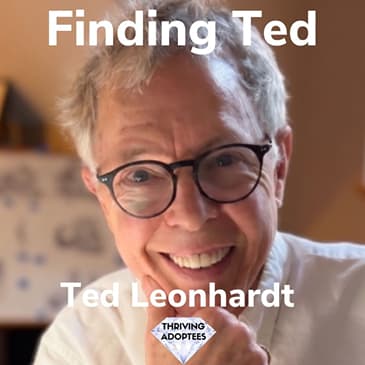
To what extent do you play a persona to fit in? It was second nature for adoptee Ted and something he did to extremes. And it brought success in the world. It became so core to the way he navigated life that he was oblivious to it, until he wasn't. Listen in as we talk authenticity, epiphanies and more...
Here's a bit about Ted from his website
"I was adopted. My place in the family was conditional from the start. I was parked with strangers off and on for years. I developed a deep passivity as a way to survive — hiding my real nature, curling into that little ball of shame that was always there when someone wanted to bully me. I became an expert at reading rooms, sensing when things were off, staying quiet when speaking up felt dangerous.
Those instincts, once liabilities, became the core of my practice. I know what freeze looks like from the inside. I know the difference between a person who's disengaged and one who's just afraid to speak. And I know — because I lived through it — that the passive behavior learned in unsafe environments doesn't stay in childhood. It follows people into conference rooms, client meetings, and conversations with their own teams for the rest of their lives.
Age as an assetI turned eighty recently, and I say that with genuine pride. I've watched the same cycles repeat across decades. Challenges that feel unprecedented usually follow familiar patterns. I've also learned what doesn't matter. I no longer chase growth for its own sake. I focus on a small number of engagements where I can have real impact — and I still have the energy for it. I can outrun my teenage grandsons."
https://www.linkedin.com/in/tedleonhardt/
Guests and the host are not (unless mentioned) licensed pscyho-therapists and speak from their own opinion only. Seek qualified advice if you need help.
Want to learn more about thriving for you, your kids, your families or your colleagues? Pick a time to talk here
[00:00:02] Hello everybody, welcome to another episode of Thriving Adoptees podcast. Today I'm delighted to be joined by Ted, Ted Leonhardt. Looking forward to our conversation today, Ted. I am as well Simon, thank you so much. You're welcome, you're very welcome. So, listeners, Ted's a creative guy and I asked him before we hit record if he's up for a creative approach on the podcast.
[00:00:28] Normally, the first time I meet a guest, we talk to and get to know each other. But I thought something gave me, I had this little intuition to ask Ted if he's okay to go straight into the interview. And he is, I'm delighted to hear that from him.
[00:00:51] So, Ted is, you're a doctor, you're in the States, but you spent some time in London, I think, listening to an interview with you. Yeah? Yes, yes, I worked in London in the late 90s and early 2000s.
[00:01:10] Yeah, yeah. Okay. And Ted's just published a memoir called The Work Beneath the Work. And you sum it up as saying that it's about how a difficult childhood became, without my knowing it, the professional methodology I used for 50 years in creative leadership. And that really jumped out at me. So, can you put a bit more flesh on the bone of that, Ted?
[00:01:39] Explain what that's about. I was adopted. I was fostered first and then adopted and then spent a bunch of time away from my adoptive parents in neighbors' homes. And I kind of lived in a manner of always trying to figure out what to do to survive.
[00:02:07] You know, which way to jump to please people, how to deal with this issue that comes up in this household versus that household, how to avoid violence, and desperately trying to make friends and kind of figure out how to survive in effect. And then, you know, my, and I was driven as a child to escape.
[00:02:37] I think most of my childhood was imaginary ways to escape. And, and, and as I got older, I realized that I simply needed to escape into adulthood. And when I became an adult and I began working as a professional, I realized that the social interactions of the corporate world that I lived in were not that hard for me to do.
[00:03:05] And, and so for years, so basically I, you know, fundamentally developed a business. I built my own company, sizable for a small, you know, creative services business, $10 million a year in fees. And then we sold it to a group in London and that's how I ended up in London. But through all of that period, I was very good at working with senior people in corporate organizations.
[00:03:34] Often CEOs. And I, I simply just knew how to do that. I kind of knew which way to jump, if you will. And then I had no idea that my childhood had shaped me that way. I mean, it never occurred to me. I just was. I was.
[00:03:56] And then it was looking back and writing and of course, therapy, lots of therapy that I began to realize that, you know, when we're little, our brains are very plastic. And so what happens is we pick up everything. We're trying to figure out how to, how to be. And, and the particular conditions of my childhood kind of shaped me into what's going on in this room. Is it dangerous?
[00:04:25] What should I do to succeed? What should I do to remain safe? So, and the word I came up with while I was writing my book was attunement. In effect, I developed kind of a sense of attunement, but I sure didn't know it until, you know, I'm, I just turned 81. You know, it's like the learning is really, really late. Yeah. Yeah.
[00:04:52] Um, the, I, I, I, attunement that, that word was occurring to me as you described it. Um, the, the, the other, uh, the other thing that popped into my head was, uh, the, the chameleon approach, right? So, um, we're changing our colors to, to suit our, uh, our surroundings and you're, you're, you're nodding away for that. Have you, have you thought of other kinds of metaphors for this? Hmm.
[00:05:23] Uh, well, I certainly always knew that I was developing an unreal me. So the word persona comes up. We all develop personas. I mean, it's a necessary survival technique for all humans, I think. But in my case, it was pretty extreme.
[00:05:53] And so I, I was extremely careful with how I appeared. Um, and extremely sensitive to what I wore, what I drove, who I married, who I hung out with, who I didn't hang out with. Um, and, uh, and where I lived and what kind of housing and what it looked like. And then the offices of course were, you know, deliberately fabulous.
[00:06:24] Um, and it was all about the outward appearance and message. Yeah. Which I, which I thought was required to, to be successful in that, in that world. And you might find this interesting, Simon. I've been thinking about this a bit lately. When I left my second wife, so I'm now in my third marriage. When I left my second wife, my therapist, Lana said,
[00:06:54] the reason that it broke down with her is that you were no longer the leading man. You, you sort of lived a movie life. And you, and then you stepped out of that and you wanted to be something else. And she didn't sign up for that. She signed up for the persona. So we were married for 18 years.
[00:07:23] We developed a hell of a business together. 18 years, 15 years, something like that. Um, we developed a hell of a business together. We were extremely successful executive team. But when I no longer wanted to do that, she couldn't go there. So you see the persona, this persona had been so good. It completely faked her, faked her out and me. Yeah.
[00:07:52] Um, were you, um, in the creative sector, were you like a, an art director? Yeah. Oh, are you, are you asking what I did? Yeah, I am. Yeah. Okay. Um, we, we were in brand design. So basically we, we helped large corporations shape their brands. Sometimes we named the organization. Sometimes we created logos.
[00:08:21] Sometimes we created messaging and, and communication strategy. And it was, and the work was writing and design and communication, strategic analysis and so on. Okay. And so the, and so my, but I started life as an illustrator. So I, I went to art school. I could always draw. And I, I, my first job was as an illustrator at the Boeing company.
[00:08:46] Um, and so I made my way early in my career because I could draw, but I quickly realized that illustrators had very little power in the world. And so I moved into design and then I'm, and then when I realized branding was such a power, powerful thing in the business world, we moved into brand. And so we, we began playing a role in branding. And so we did.
[00:09:13] So, so, you know what, you know, so yes, we employed art directors and designers and writers and strategists and so on. Yeah. I mean, when I was in London, we had, uh, 500 creatives. Yeah. I was supposedly responsible for the creative output for 500 people, which of course is ridiculous. Yeah. Yeah. Um, I, I guess persona and logo are the, the same, right? It's the outward looking.
[00:09:43] Yeah. Yeah. Yeah. Yeah. Projection. That's a projection. Yeah. And when, and when the outside projection doesn't. Doesn't match the authentic truth. It it's, it's a big issue, right? Exactly. Yeah. It's not a fit. It's not a fit. Yeah.
[00:10:08] So, you know, one of the things I, I, you know, when I think of the chameleon. Um, adapting to the, adapting to the circumstances. Sometimes that's a good thing. Yeah. It's a, it's a, it's sometimes, sometimes, sometimes that's a good thing, but then, you know, is there, is there a fine line between adapting to the circumstances and being inauthentic?
[00:10:37] Uh, I mean, how do you, how do you see that? Well, in my case, I, you know, left the work world, left the London thing. I had another gig as president of a U S company left that fired from that.
[00:11:00] Um, sitting by the swimming pool, drinking, you know, for a few years, kind of dawning on me. I hated it. I, you know, tried to start right, started writing, started picking up a few consulting clients.
[00:11:29] Uh, realized I, I needed to help people that I had all this experience. And I, and I was driven to want to help people, want to be engaged with people. So I, so I, and the persona didn't work anymore. It didn't give me any joy.
[00:11:50] And I, and I got all this feedback from my family that I was not a good writer and, uh, you know, negative feedback. I launched my first book, had a great book party. Um, but I was so uncomfortable with all the feelings about it, not being good enough that I didn't promote it.
[00:12:17] Um, so I was lost. I mean, I was really lost leaving the persona. I was lost. Um, and then I began to write. So with the help of a therapist who encouraged me to write, I just began to write the story. You know, I began to write a series of essays, which were basically childhood essays, memories from childhood.
[00:12:45] And that pulled me out of the persona. You know, it kind of, it made me realize that people appreciated me for being who I was, not, not what I drove, what I wore, how I appeared, what my house looked like, what my wife looked like, you know, whatever. Yeah. Um, but you've been lost in, you've been lost in the image world. Oh yeah.
[00:13:14] Lost in the image world and not knowing how to deal with the feelings. So I drank except, you know, major drinking problem. Um, and, and, you know, of course I found the image world as a child through media. So I saw one of my childhood escapes was believing in the projection that media had of people. So what do the cool people look like? What do they wear?
[00:13:44] What do they drive? How, how do they appear in life? My adoptive parents didn't look like that at all. Didn't behave like that at all. So clearly they were beneath me. So it was my way of saying I'm superior. I'm, I'm, my escape was seeing them as less than and me as more than. Um, they told me I was stupid, but I was sure I was smart. You know, the message always was you're stupid.
[00:14:13] And of course my grades were terrible. Um, but I knew I was smart. I always knew that somehow I always knew. Um, don't even know how I just knew it. Um, so, but I created this thing and it was based on media. It was based on the media I was exposed to as a child. Um, the illustrators who illustrated stories in mass market magazines, I thought were the coolest thing in the world.
[00:14:42] So of course I wanted to be an illustrator because they, they fabricated this beautiful, unreal, but idealistic world that captured people's imagination through the pages of, you know, these beautiful, large scale magazines.
[00:14:59] Um, and, and so I wanted to, I wanted to be that I want, and I wanted to know how that persuaded, why was that it was so duck seductive. I wanted to know that. Um, so, you know, I, so, so my whole career was based on an escape from childhood driven by media. Yeah.
[00:15:27] I mean, I, I, I'm, I'm, you know, the key word for, for me, and that last answer was, uh, fabrication. Fabrication. Fabrication. Fabrication. And I, I, I was, I was thinking about media from a, cause we've got adoption month coming up, right? Adoption week in the States. Adoption week in the UK. I, I, I, I forget, right? We, adoption months, adoption weeks, whatever they are. Right.
[00:15:54] And I'm thinking about the, the, the, the image that is portrayed in those adverts, right? Right. Um, and, uh, how saccharine, um, uh, over sweet and, and false, false, they, they are. Right. Especially when, uh, when the adoptive parents have got real issues and, and that's what it was like for you.
[00:16:24] You, you, you were out of, you, you were, you weren't at home because of the issues that were going on at home. Um, and, and for me, what, one of the things that fascinates me is the extent to which our, our, our trauma as adoptees is a factor of it. To me, it, it, it, it feels a bit like a, a multiplication, right?
[00:16:52] So what I mean by a multiplication is, uh, obviously we've got this, obviously, um, people, people talk about this, this wound of separation, but we, we, we've also got, uh, uh, another, the, the other factor in the mix to me seems to be the emotional talent intelligence of adopted pairings. Right. So, but it's a multiplication thing. It's not an addition thing, right?
[00:17:20] It's, so it's not, it's not one plus two equals, equals three. It's, well, no, that's something. It's not plus one, one plus six. I can't do the, I can't even do the sums. I started off the thing. Um, it, it, it, so three plus three is six, but three times three is nine and three times three plus six, three, three plus six is nine, three plus 15.
[00:17:46] I mean, like the, the second factor, the, the, the degree, the achievement, right? Our adopt, uh, at the, uh, the, uh, the achievement of adoptive parents to their kids, their, their
[00:18:05] emotional intelligence is a huge factor that can negate or multiply the, their relinquishment trauma. Yeah. Kind of how it seems to me. Um, yeah. So you're in communications. I, I made it.
[00:18:25] I, I, I garbled that, um, Ted, I'm wondering if you can, if you can put it in, in a, in a, in a, in a better way, in a, in a more concise way that somebody might listen and might hear that.
[00:18:38] Uh, parents that are deeply aware of the emotional trauma that any baby that's taken from its mother is going to suffer, um, will do way better in raising that baby than if they, than if they don't. Yeah.
[00:19:03] So my son, who is now 57 years old, uh, had adopted, he and his wife adopted two children who are now, uh, 17 and 21. Those boys are in pretty good shape emotionally. So that mom and dad, first of all, they knew my story. Um, um, um, but they were very, very focused on being close with those boys.
[00:19:30] And understanding the kind of love and attention that they really needed. They were desperate for. Yeah. And so they, they made it happen. So, you know, it's not, not, you know, my, my adoption was extreme. I'm in a psychodrama group or are you aware of psychodrama as a technique? Well, it's a, it's a way of psychologically acting out trauma in group settings. Um, and, uh, one of the members of my group, and I do this, uh, once a week, two hours a week.
[00:20:00] Uh, and it's my current training, my current, you know, mindfulness training, if you will. And, uh, one of the members of the group who's my age, she's just a tad younger than I am. Um, she was in foster care her whole life and it was, it destroyed her. I mean, her, in spite of a successful career as head of nursing in a large metropolitan hospital, which she was successful at.
[00:20:29] In our group, she is an emotional, she really, really struggles. So it was way worse for her being in and out of different foster homes than it was for me. Cause I was more or less with the same group of people just bounced all over the place. Um, so way worse for her. Um, so I have seen, you know, really extreme damage and, you know, and how it affects people.
[00:20:57] And then I've seen how extreme love can, and attention and just being there with the children, which my son is with his grandson's, his wife recently passed away sadly. Um, but in spite of that, these boys got a long string of a mom and a dad that were very close together. Um, sure they had their struggles and so on, but very close together. And we're very focused on the boys.
[00:21:24] Uh, and, and also, um, you're, you're, you're not talking about your own role in this Ted if right. If, if, if, if you're, if, if you're, if you're attuned as you clearly are, then you, you, you, you've attuned to your son. Yes. Yes. Yeah. Him, him growing up.
[00:21:43] So he's, yeah, in a way, you know, I, I saw this video that you did an interview where you talk about your, your, uh, adoptive father's, um, anger. And, and, um, you know, so it's, uh, let's not underestimate your role in. Yeah. I did. I tried to do a better job. Yeah. I was very focused. Yeah. Yeah. I got to show you something, Simon.
[00:22:13] Let me, let me hold this up. Yeah. So. This book was written in 1939. 1939. Yeah. 1939. It was 39 and it's called, it's called the chosen baby. Uh, listen, chosen baby by Valentina P. Wasson. Yes. And then it was republished several times.
[00:22:35] I've just found this recently, uh, a used copy online and it's filled with these beautiful illustrations of a husband and a wife and the kitty, I think, and a doggy and how they are dreaming of having a beautiful place, a beautiful home for a child. Yeah. And then they, and then they choose a child. Yeah.
[00:23:05] And, and they, and the child grows up and there's a happy doggy and a beautiful kitty and a warm place. And the child is happy and everything is just beautiful. This book was read to me over and over and over again by my adoptive mother. As the, I, the, the, my condition was special because I was chosen.
[00:23:34] But, uh, there's, there's, there's no indication that of your dad losing your, your adopted dad losing his, uh, his marbles and losing his H1T. Right. Right. Right. Like, like you did, you seem to be a really angry guy from what I heard you talk about.
[00:23:56] Well, she was trying to create this fantasy reality that she was aspiring to, but couldn't control or make it happen. And, and so her method was this little book. And I suspect that, uh, what I took away from the book was a, the beautiful illustrations, be the idealized life that I aspired to. So I decided to try and create it. Yes. Clearly it wasn't happening here. Yeah.
[00:24:27] But that is the supreme act of creation though. Yeah. Yeah. Yeah. Yeah, exactly. Yeah, exactly. I was just, I, I, you know, I immediately leap to this, make this fantasy real, how to make this fantasy real. Yeah. But it was, but it was, it was planned. It wasn't, you know, it was, it was constructed by me.
[00:24:56] Like my work, I constructed things. I constructed strategies. I, you know, we created logos and, and branding and advertising and film. And, you know, it was all, it's all made up. Yeah. And then people, I said. I knew the word you were going to say that Ted. Um, yeah.
[00:25:19] Um, so when did you realize that, uh, it was time for the unreal me to, um, leave the building? If, if we're going to go with Elvis left the building.
[00:25:37] I, it was the argument with my second wife that, that in my, in my attempt to invent myself as a creative individual who is not trying to sell soap, um, and be a person.
[00:26:00] And, and I had, you know, series of, over the last few years of our last few year or so of our marriage arguments with my wife where we couldn't get anywhere and alcohol was always involved. And, you know, um, and then finally I stuffed the two dogs in the car and left, you know, I got the dogs who clearly loved me, you know, it's unconditional love. Yeah. Yeah.
[00:26:30] Yeah. And how long ago was that Ted? How long ago was that? Oh, I think that was, I think that was 2013, late 2013. Yeah. So quite a while ago now. Yeah. So you were 67, 68 at that time. Yeah. Yeah. Wow. And, and, uh, and then I, you know, rented an apartment and, you know, and, and began to, began to try and plan, you know, so again, I tried to create another career persona.
[00:26:59] So that's what I tried to do. I immediately, I immediately went and tried to create a career persona. And so I, I thought I would be a training negotiator on the subject of, of negotiation for creatives. And I wrote a book titled, the title was Nail It.
[00:27:20] And I did a series of online training through CreativeLive and I gathered a group around me and we had meetings in my apartment, a big, gorgeous apartment with a view of Seattle. And I, um, but even there I was terribly lonely, um, and, uh, drinking less but still drinking.
[00:27:44] Um, and then, you know, a couple of years go by like that and I, uh, I'm dating and I meet Robin, who is my wife, my current wife. And Robin, by the way, is a psychoanalyst. Um, and I, I knew immediately she was the right one, although it scared the hell out of me.
[00:28:11] And, uh, we became a couple in 2016 and we, we married in 2018 and, you know, with her support and encouragement. And she's a writer. Um, and we, you know, so it, it was a transition, you know, it was a, a real, you know, multi-step time occurring transition.
[00:28:37] So from 2013 to 2016 and then the early days of our relationship, I was still grappling with trying to create this persona. Um, I created a one issue magazine also titled Nail. Um, you know, again, it wasn't me. Um, but I began to get more real. Right.
[00:28:59] And then I began writing, you know, writing more seriously, quit using editors and just because I realized that they took too much of me out of it. Yeah. And then, and then once I began really going back and writing down, remembered episodes, uh, with my childhood, that really got me on the path of discovering who I am and why I, why I was the way I was. Yeah.
[00:29:29] So, I mean, some people use the word cathartic for that, right? This writing, writing, uh, um, memoir is, is, is cathartic. It's cathartic. Yes. Yeah. Yeah. And, and you know, the, and the joy that I get in my life is from clients who love me, you know, I'm on zoom four days a week with four or five clients a day.
[00:29:54] Uh, you know, they, and they're what they're aged during their twenties, thirties, forties, fifties. Most of them are younger skew younger. Um, I can really help because I've seen all this shit. Um, and I, I'm engaged with them. I'm, you know, so that, that thriving with them.
[00:30:23] So, um, the, the, the, uh, matter of the metaphor that comes, comes to mind is, is, uh, mask, right? The persona, I think, I think is it great for mask or something, you know, like, yes, you know, um, so it, it is you, as you work about that, is it about unmasking? Unmasking. Yeah. Yes. I'm asking.
[00:30:49] So what, what have you learned that you could share with, with, with the listeners in terms of on often authenticity and unmasking and, and, and seeing their authentic self?
[00:31:13] What I, what has been successful for me is really remembering in great detail, visual detail events from my childhood and writing them as they occurred, like I'm writing a novel.
[00:31:39] Um, first person, this is happening narrative spoken language, what people are saying, conversation recorded, obviously made up, but it, but it reflects what actually happened.
[00:31:59] Um, and, and, and then thinking about why, how did this, I was 10 then, I was 15 then, I was three then. Of course I'm like this now. Of course this scares me. Of course I'm strong here and weak there.
[00:32:20] Um, go back and appreciate how you formed yourself because of all of the things that were occurring in your life or not occurring. You were desperately lonely. Um, write it down. Remember it in the writing. When I write it, I can feel it. I can feel what I was going through. I'm in a writing group. I lead a writing group here in Bellingham.
[00:32:50] And, um, one of the things we do is we read to each other every, in every session. And when people tell me that they visualized what was happening, they visualized, they felt they were in the room. They could see what was happening. I knew that I was successful in the writing. Yeah. Um, and so I think that we have to go back and experience it to really understand it.
[00:33:20] Yeah. Yeah. Um, one of the transformational. Um, one of the transformational experiences for me was that looking back, but I did it in a, I did it in a different setting. So I, I spent a week with eight other people and, um, a shout out to Liz Ivory and, um, Richard Wilkins.
[00:33:50] Uh, put a link into Liz's book in the show notes. So we, we, we spent a five days, five days together and about probably two of those days, maybe three of those days was spent. Um, sharing the stories of our lives. Um, in, in, in, in turn, right.
[00:34:15] And they went first, uh, in, in chronological, kind of our lives in chronological order, uh, and what had happened. And more importantly, how we'd felt about what had happened. Uh, I, I, and so that was a very, you know, you're talking about retelling it with a, with a keyboard or with a pen and paper.
[00:34:44] Uh, we were retelling it in a, in a, in a, in a group setting with, uh, and with our, with our words and feeling all the feelings and lots of, lots of crying. Right. Everybody. Everybody. And, uh, everybody. Learn about the degree to which they had been inauthentic.
[00:35:14] In their lives. And this, I was the only adoptee there. Right. So there were, we, we, we all, we all realized how in, in, in, in, in authentic we'd been. We all, we all realized how much we'd tried to fit in rather than stand out. We all realized that we've all got a voice in our heads that tells us that we're not good enough. Yeah.
[00:35:41] Uh, and, and so many other insights about our, uh, our essence, our essential selves, our essential, essential core authentic selves with de-masked, re- yeah. De-masked, no persona as it is. Yeah.
[00:36:08] And, and it's a hugely, it's a hugely powerful, it's a hugely powerful, um, process to, to, to, to go through. Especially, you know, and I'm thinking, you know, in, in therapy, that's one to one, right? But here you've got, we're, we're all together. We're, we're all together. Everybody's, everybody's equal. Everybody's got different sort of shit in their lives. Right. But, you know, but, yeah, but it's all shit.
[00:36:38] Yeah. That's, that sounds like psychodrama to me. So that's what I experience every week on Wednesday night for two hours is, uh, is a session like that. So, yeah. I'm wondering, have you done any somatic work, Ted? I have not. No. Have you got a clue why I might be asking that? Right.
[00:37:06] Have you, have you got a clue why I might be asking about somatic work? I don't, I'm clueless. No worries. No worries. It's, I'm going to, I'm going to say this really, really boldly. Yeah. Yeah. And, um, some people may take, uh, umbrage about this, right? Uh, talk therapy. Yeah.
[00:37:32] Talk therapy is powerless in the face of pre-verbal trauma. Yes. Yes. So that's a big, that's a big statement to, to, to make. And, uh, and I could water it down a bit, but I can put largely in, ineffective, but, um, I've
[00:37:54] heard a lot, that, that's one of the continuous themes that's come up over the last 700 interviews, right? Is the, talk therapy, talk therapy is ineffective with, with, uh, pre-verbal trauma, pre-verbal trauma, because we haven't got words for it. We haven't got words for it. Right. Um, and, uh, yeah, so that's why I asked about the somatic and somatic and EMDR stuff,
[00:38:23] people talk about quite a lot. I've, I've done, I've done, done, done, done some of that. And we're talking about getting to, getting to the stuff. People talk about the, the issue is in the tissue, right? So the issue that the trauma is in, in our tissues, which sounds really scary to me. Yeah.
[00:38:49] It's, it sounds, and, and I have a question around that. So if it's in our tissues, if it's in a tissue, why is it not showing all the time? You know, we, we all have moments of peace. We all have moments of peace. However troubled we are, maybe it's just a split second. So there must be something else going on.
[00:39:19] And, and for me, what's going on is, is our, our thinking in the moment. Mm-hmm. Our thinking in the moment. So that there is a, there is a factor, there is a intermediary factor.
[00:39:33] If, if life had, if, if trauma had damages beyond, beyond repair, had broken us, we would always be broken. But we, we don't always feel broken. We don't always think broken thoughts.
[00:39:55] There are moments in our day that are, perhaps when the, the, the, the, the, like at the moment, the leaves, the leaves, the color of the leaves, it's just taking my breath away at the moment. Right. So in, in, in, in, in that moment, I'm not, I'm not broken. So there must be an intermediary factor in, in, in my philosophy. And that philosophy is, is the, is the thinking.
[00:40:25] But it's, yeah. Um, well, I would say, I would say that, um, my biggest fear was always being given away. And I would say that that is in the tissue. And the body remembers is the book.
[00:40:50] Um, but, so I was given to a care mother at, right after birth, basically a foster parent. And the, in the documents, they called her a care mother. I don't know what her name is. And I was with her for five months.
[00:41:15] After my adoptive mother died, I found a baby book that my care mother had filled out almost every day of my time with her. She loved me. She talked to me. She recorded my grip of my fingers. She recorded my first smile. She recorded when I rolled over.
[00:41:44] She recorded when I giggled. She recorded my reactions to her. She called me my little Chucky. My birth name was Charles. So she called me my little Chucky. All of this was in that little book. So my first therapist said to me,
[00:42:08] Hey, if you had not had her, you would have been severely damaged. She saved your life. Babies need to be touched, held, loved, talked to lots of interaction. And she did that for you for those critical, almost six months, which we know is the critical time.
[00:42:36] And that, that gave you the burst, you know. And then of course, she gave you away too. Did she give you away? Yeah. I mean, I was given up for adoption then. Yeah. So I was taken away, but for a baby, I was like, here we were, now we're gone, you know. So I was, that's when the Lenharts, where I got my name, adopted me.
[00:43:08] So, and the Lenharts were completely unprepared for a baby. I mean, my mother's diaries and, and in fact, social worker reports that I got, they didn't even have a blanket to bring me home in. They had to borrow, you know, it was a train ride, a several hour train ride home. And they didn't have enough warm clothing for a baby.
[00:43:37] So like zero preparation. So I went from this extremely caring person, obviously, you know, in the big looping hand of a young woman's riding, to these people who basically had gotten a prize.
[00:43:57] I was like the prize, I was sort of the prize baby on the block when we, when they got home, you know, so it's, and then the mental breakdown of my father, my adoptive father, and I'm given away again, you know, it's like, so, but that care mother, I think in the tissue, in the tissue. Oh, and of course I've read enough about this now.
[00:44:25] I have a very ready smile. That's very typical of people who, who babies who are desperate to make an attachment. Yeah. You know, so I lose, I learned my salesman smile somewhere around five months or so. Yeah. So, and, and, and yet society says, fake it till we make it. Oh, I hate that term. But I did do that, I guess.
[00:45:03] Was there a moment when you realized it was toast for the unreal you?
[00:45:40] I think it was, again, I think it was little moments, little moments early with Robin, especially, because she's so real. And it took me a real while to realize I wasn't fooling her.
[00:46:03] I wasn't, you know, she saw something in me that was good for her. And it wasn't my persona.
[00:46:20] And, you know, so I, you know, I began giving up the things, the physical things, you know, the car collection sold off the, you know, ultimately we sold the yacht, you know.
[00:46:50] And then, of course, my, my son's wife came down with ALS and then slowly died in the living room. You know, it's a horrible way to die. You just sort of lose your ability to use your hands, then you can't move, then ultimately you can't breathe and you die. So it took her five years and we moved to Bellingham to, to help.
[00:47:12] And Robin just, when I told her about Amy Sue having ALS, she said, we got to move up there. Yeah. What's, sorry, excuse me. What's ALS? You know, I'm embarrassed to say, I can't remember the actual name, but ALS is a, is a slowly developed Lou Gehrig's disease. It's described as it's a slowly loss of your ability to control your muscles.
[00:47:41] And ultimately you can't breathe. And so she died slowly in a recliner in her living room, you know, with the family, with all of us around, basically over a five year period. So, you know, it's, you know, life gets very real. You begin to give up all the persona shit when, when you're dealing with life and death and seeing the effect that it has on your grandsons and your son and yourself.
[00:48:10] And, you know, so I, you know, there weren't, Simon, there weren't dramatic moments. There's always highlights like a, like a reader writing to me, you know, how important something I've written has been to her or that sort of thing. But, but there's, and I got one of those love notes yesterday, which made my day. But you know what I mean? It's just, it's just, it was a gradual transition.
[00:48:40] And, you know, I drive a Honda now, not a Jaguar, you know, I love my Honda. It's anonymous. It's wonderfully anonymous. It's gray. You know what I mean? It's just, you know, it was Cadillacs and Jaguars and, you know, et cetera, you know. Yeah.
[00:49:09] So, you know, a 60 foot yacht, you know, vintage, you know, I mean, it's just, you know, I didn't need any of it. So coming up on time, Ted, is there anything that you'd like to mention that I've not asked you about? When did you know this would be your calling, Simon?
[00:49:45] When did you know this work that you're doing would be your life work? The, the adoption stuff or back before then, right? So yeah, I, I, I realized that I was talking to, look, I mentioned this lady, Liz Ivory, Elizabeth Ivory.
[00:50:12] She goes on, I'm sorry, on a book. I was talking to her in early 2011, when I was on the way out of, you know, I decided that I wanted to get out of my business.
[00:50:35] And I, I just, it just came to me. I blurted it out. I want your job, Liz. I want to help other people. So, so that's the big, that was the big moment. And then, but I, I've done a few different things since then.
[00:50:55] So I did my first venture was kind of happiness for small business, small business owners, then, which didn't really work out. Then it was happiness for the employees of large corporates that didn't really work out.
[00:51:13] Then it was happiness for kids that, that, that worked with the kids, but, but didn't work out in terms of, yeah, the kids were thought it was fantastic, but the schools weren't really interested. And parents weren't really interested in, in, in what, what I was doing. And, and, and then the adoption stuff being going about five years.
[00:51:43] So yeah, I was, I was talking to a, I was talking to a mentor of mine one day, November 2020, probably. And I, she said, you seem to be frustrated about being able to get to, you seem to be frustrated about getting to, to, to scale the, the, the work that you've done with kids.
[00:52:06] And I said, yes. And I said, yes. And I said, yes. And the first thing that popped into my head was the adoption thing. So what writing a book about my teddy bear actually was the first thing. And, and that led to doing the podcast and our conversation today. And then interviewing Dr.
[00:52:35] Joyce McGuire Pavo who introduced us. Right. Yeah. She's a, she's a wonderful connector. Yeah. She's she's, I was so, I was so thrilled when she said she would write an endorsement for my book. I was like, Oh, right. Yeah. It's over the moon with that. Yeah. Um, and then we, she and I had, I don't know, two or three zoom calls, I think. Cool. Yeah.
[00:53:02] And, and listeners, there's a link in the show notes to, to Ted's book. So, uh, and anything else you'd like to share before we draw in? I, I, I, I can't think of the thing. I think we've covered it. We're done. Brilliant. Thank you, Ted. And thank you listeners. We'll speak to you again very soon.