Time isn't the greatest healer because if there's no change, there's no healing. So what IS the greatest healer? Realisations. Those profound insights that help us see differently, more clearly and better. Listen in as we talk realisations, grace and space...
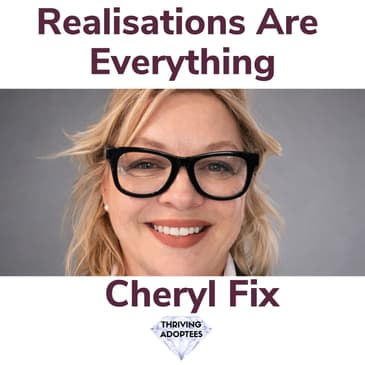
Cheryl Fix is Executive Director of the Alberta Foster and Kinship Association, find out more at:
https://www.linkedin.com/in/cheryl-fix-4b7b36b/
https://www.facebook.com/Albertafosterandkinshipassociation/
instagram.com/afka_caregiver_support
Guests and the host are not (unless mentioned) licensed pscyho-therapists and speak from their own opinion only. Seek qualified advice if you need help.
Want to learn more about thriving for you, your kids, your families or your colleagues? Pick a time to talk here
[00:00:02] Hello everybody, welcome to another episode of the Thriving Adoptees podcast. Today I'm delighted to be joined by Cheryl, Cheryl Fix. Looking forward to our conversation today Cheryl. It's going to be a unique background listeners, a unique background. So Cheryl runs, she's the Executive Director of Alberta Foster and Kinship Association in Alberta, Canada. And so she's a professional in this space.
[00:00:30] And she's also worked in the UK in the adoption world in the UK. So a fascinating, what do they call it? Transatlantic conversation? Yes, exactly. Yeah. So just to remind Michelle, how long did you spend, it was London I think if I remember rightly. Yes, that's correct. It was five years, five years in London, almost to the day. Right. Very good.
[00:01:00] Yeah, right in London, South London. And I worked for IAS, which later became a part of TACT, which I don't know if it still exists, but it was a foster care agency. IAS was an adoption agency. Okay, cool. So the question that we love to start with Cheryl, Thriving, what does thriving mean to you?
[00:01:22] I think thriving for anybody in this adoption constellation or otherwise is taking all of the things that are presented to you within your life and your context and your ecosystem and figuring out how to put them together to make the very best possible situation and scenario so that you are not only getting your needs met,
[00:01:50] but also the things that you've wanted in your life, the way you've designed your life or you thought out how you want your life to start going. Sorry. How you see your life moving forward, that those are the those goals and those plans start to come into reality. Yeah.
[00:02:08] So I think it's more than just, you know, we often think we just survive life, we go through each day, day by day. I think this is taking it to the next step. I think this is actually where you spend some time thinking about what you want of life, how you design your life, and then putting those places and people and things, experiences in place, so that you feel like you have.
[00:02:33] You have not just moments of joy, but huge pockets and bubbles of joy and meaning moving forward every day. Yeah. So like a forward facing kind of empowerment. Absolutely. Yeah, absolutely. Yeah. And, and you mentioned relationships as well. So how does that for you? How does that factor in?
[00:02:57] You know, people talk about a lot of different things that make people happy or that, that they want in life. But what I really have come down to understand is quite honestly, relationships are everything.
[00:03:09] On anybody's journey, I think, at the end of the day, relationships can make or break you. Relationships change people's lives. Relationships are the one thing. I think I was reading an article by Warren Buffett and he said, you know, looking back over the last 80 years, what he realized is the richest people, the wealthiest people are the ones who had the strongest, healthiest relationships.
[00:03:37] And at the end of the day, that's all that matters. So while we're busy working or we're busy at school or we're busy taking kids to sports events or, you know, playing sports, really what matters is the relationship in all of that. Our relationship with them, our relationship with others, their relationship with coaches, their relationships with their parents.
[00:03:59] At the end of the day, it's that relationship that you focus on. That is what really honestly can make you thrive beyond just surviving. Yeah. So I'm guessing Warren Buffett wasn't talking about financial success there.
[00:04:18] No, he it's funny because he has lots of financial advice and his comment was at the end of the day, all of that didn't matter. It really he was good at what he did. And he said, but at the end of the day, people you don't look back and look at your bank account or sit in your in your house wondering how much money you made that day. You sit in your house with the people that you love or you doing activities with the people that you have strong relationships with.
[00:04:46] And he realized and he was trying to make a point to younger people is just don't chase money as a dream. Focus on relationships because you'll be much wealthier at the end of your life for it. Yeah. And we see so much dysfunction amongst the rich anyway, right? Yeah, absolutely. And I think because we don't spend enough time for them, I would say there isn't enough time spent on thinking about people rather than things.
[00:05:14] And at the end of the day, I mean, I've watched it in my career and my personal life. But when I watch it through foster care or an adoption lens, what I can see is that relationship changes people's lives completely. One relationship can change the trajectory of a child's life in a minute. Yeah. And what have been the key moments when you've helped you see that?
[00:05:41] I think, you know, working in adoption over a number of years, watching children find adults that believed in them, that committed to them, that weren't walking away when things got tough and seeing that child go from almost shut down to completely blossoming.
[00:06:06] Watching teens who, you know, at the end of the day, they were so frustrated with a system that they went out looking for their own parents with advertisements and signs. And I remember seeing a young girl, she maybe was 15 on the ferry from Vancouver Island to Vancouver in British Columbia. And she had a sign and it said, I'm in foster care and I need parents.
[00:06:28] I'm looking to get adopted and handed out flyers that to every person she saw on that ferry about who she was, what what she was like, what she was looking for. And she took it into her own hands because I think even she realized how important it was to have somebody to be committed to, to belong to a family, to belong with another person. And at the end of the day, I mean, there was a book I was reading and someone said, you know, why do people get married?
[00:06:57] And they said, oh, company and all that. And they're like, no, it's somebody witnesses you in your life. And I think that part of a relationship being witnessed and being seen and heard is so critical. And I've seen that for kids in different moments, whether it be foster care or adoption, where the person they're with sees them, provides space for them, hears them what they need, sees them as a person. Not a number, not a report, not a policy, not a program as a person.
[00:07:27] And I think those were the moments, whether they were in whether they were in an orphanage in Russia or they were in foster care or or I've sat on a board for foster care in the United States. So anywhere in the States, in the UK, when when we've matched little ones with families and they meet and they're moving in, I can tell you, I mean, there's always that moment of fear on both sides.
[00:07:51] But when you go back to visit in three months and you see them, how they've melted into each other, you realize that those moments that relationships are everything. There is nothing else that really matters. Yeah. I interviewed somebody else earlier on today, an adoptive mom, and she was talking about we didn't it. This didn't come up on there during the course of the podcast, but she shared it with me afterwards.
[00:08:19] So she was talking about her daughter who's been through, you know, adopted from foster care as a baby, been through some tough stuff, especially with her birth family. And now is it come out of that. And she's a mom herself and she's a terrific mom. And so this lady had spoken to her daughter saying, I'm going on this. I'm going on this podcast.
[00:08:45] And, you know, what have been the most important things that have helped you get to where you are now? And the daughter said, well, you, you and dad. And so the mom dug a little bit deeper and she said, the daughter said, you never stopped believing in me. Never stopped believing in me. And that was the critical thing. So you mentioned the belief.
[00:09:16] Yes. Belief word. What helps us get through that? What supports that belief when, I know your son's a teen, right? We know teen years are tough for all kids. They are. Yeah. Raised by their biological parents or adults. Yeah. What helps, what garnishes? No, that's not the word, right?
[00:09:45] What garners that belief during the tough stuff? Yeah. You know, what I've seen is, and I can tell you from my own life, but what I've seen is that children, I mean, some have gone through tremendous adversity.
[00:10:04] Um, and what I've seen is that ordinary people, ordinary caregivers, adoptive parents, parents, uh, they will take on extraordinary situations and circumstances for love. And at the end of the day, what I've seen is once someone falls in love with a child, with a parent, with each other, is that you can tackle really hard things. You, you're on a journey.
[00:10:33] So you're, you kind of strap on your boots and you hook on together. And, uh, I think what garners that belief in each other and staying, I mean, we used to call it, uh, in adoption, we wanted to adoptive parents to be really sticky. Right. Because things are going to get tough. It's easy to walk away from tough situations, friendships, even marriages, but with children, we want you to be really sticky.
[00:10:59] And I think people have an, an extraordinary amounts of stickiness in them once they fall in love. And when you fall in love with a child, honestly, you can go through any challenge. You stick it in there, um, and stick with them. And because you can see that you're, that you're reshaping their journey and that gives you hope that there's a different outcome for them, for you.
[00:11:26] I mean, I used to say all the time that, um, when you're in an adoption, everybody is changing. Everybody is reshaping their journey. It's not just a child, uh, the, the adoptive parents or foster parents, even their whole identity is being shifted and changed at the same time. And I think that, that level of personal growth, I think that's, and that level of hope,
[00:11:54] I think that's what drives the belief in each other. Kids don't give up on their parents and parents don't give up on their kids. Yeah. So, cause humans don't have a great relationship with change. No, no. We find it. They, they want it all the time. Uh, they want it, but change is so hard at a personal level.
[00:12:18] Um, until you want something so desperately that it's so embedded in your DNA that you can't see yourself living without it. Um, and what I've seen and working in the UK with adoptive parents is, uh, once they saw whether it was a teenager, an 11 year old, a three year old, whatever. Uh, I remember it was, uh, a group of sisters, a sibling group of sisters, all with red hair.
[00:12:45] Once you fall in love with them, like it's, it, it literally changes your, at a cellular level. Uh, and I think at that point you're changing organically as much as that child is. They're healing in the relationship, but at the same time, you're healing in your relationship. And I remember someone saying a long time ago, maybe when I was in my twenties at university, all, all relationships are about healing.
[00:13:11] You heal every other wound that you've had in any other relationship in a new relationship. And I see that not just for children who get adopted or in foster care, that's where healing happens, right? It doesn't happen in a system. Doesn't happen at a place. It happens in that relationship that that's also true for the people. And I would say it's true for me as a parent. Um, you know, I think I had my son when I was a bit older and he's now a teenager and definitely there are challenges every single day.
[00:13:41] And I love him for that, but I would not be the person I am today if it hadn't been for that. Like, I think, uh, you change organically through that process, through that relationship. Yeah. So how has motherhood changed you then, Cheryl? Oh, I think probably I became a lot less perfectionist. I was a real perfectionist type eight. Uh, I really learned how to chill out, uh, having a baby, uh, being older.
[00:14:10] Um, and I think it also, um, you have to have some thick skin when you have a teenager. I'm sure all of those out there who've raised teenagers would say the same. Um, cause they will challenge you on your belief of yourself, your belief on how other people see you. Uh, and so you have to take a really strong reflective look on who am I, how am I role modeling myself for others?
[00:14:34] So I will say, uh, I became a much nicer person, like literally a kinder person. I don't think I was ever a mean person, but when I think about how I dealt with things, um, I didn't, whether it was like a bad server at a restaurant or, uh, you know, an issue at the airport, I just have become much more diplomatic person trying to role model how to solve problems in a healthier way.
[00:15:03] Because I realized when I watched my son deal with stuff, he's learning from me. So it doesn't matter what I say, he's just taking my behaviors. So, and I think that's what we all do. We learn the behaviors of others. So, uh, role modeling that good conflict resolution, role modeling, being kind to people. I mean, I remember once we were driving, there was someone on the corner, uh, had a sign, they needed some money. And, and I almost always stop at this corner at the red light.
[00:15:32] And I almost always roll down the window and find some change. And my son said one day, daddy never does that. And I said, I know your dad has a different perspective. But then one day I, my son was driving after he got his license. And sure enough, we hit that, that red light and he rolled down his window and gave change. And I thought, uh, my work here is done. You know, I, I've become, I think I've tried to role model more of what I was inside so
[00:15:59] that he could see that so that he could become the person that I want him to grow up to be as a, as a man in this society. Yeah. And when you were talking about, um, when you're talking about the, the 15 year old on the ferry, uh, looking for, looking for parents on one hand, that's such a sad story.
[00:16:23] And, and, and also on the other side of it, um, hats off to, to the, for, for that, for that teenager to take it within her, take it within herself to be that kind of self empowered person rather than waiting on the system to sort it out. Yeah.
[00:16:49] Um, I I'm wondering a bit of a, a, a cultural question really here. What are the only differences that you see across, um, from, from Canada to the States and the UK in terms of this, uh, empowerment or reliance on the system? Do you see any differences between the different countries?
[00:17:18] Um, I think the UK had a much, uh, stronger focus on the adoption of children that were in care versus international adoption in the U S they had a strong international adoption program. Canada sort of sat in between, uh, and then as the U S started to recognize how many kids they had in care and, uh, put some effort into it.
[00:17:46] Uh, they, I think adopted a lot of the UK methods. Uh, and they also spent a lot of time. I, and when I was in the UK, mostly the kids that I was working with were probably under the age of 12 here in the U S and Canada, a lot of the kids that we worked with. And I think it was partly because of, uh, uh, Wendy's, which is a, uh, hamburger, you know, like Burger King or McDonald's. They have a program called Wendy's wonderful children and they have ambassadors and they
[00:18:15] pay staff. They have funded trained staff to work with kids and teenagers to find families for adoption. Uh, it's one of their most successful things, uh, as a foundation. And they really focused for a while on teenagers and really looking at how do you not forget that teenagers are in the system that, you know, you don't want them to age out.
[00:18:43] You don't want them to leave the system with nobody. Um, and so really looking at finding permanent families for kids that were older and they did some fantastic, you know, whether it was, um, campaigns with photos or they trained a group of kids that were looking for families and they did speaker series and they would hold them at arts festivals and include celebrities, hockey players, whoever they could find to be ambassadors.
[00:19:09] And I think that was, um, an incredible piece. I would say the other difference is in the UK, you often have, um, patrons like celebrities or royalty for different charities. And that gives a lot more awareness than what we have in the U S or Canada. Uh, the U S was getting a little bit better. They had a program at Christmas called home for the holidays, and they would have a group
[00:19:37] of celebrities come, um, and talk about the importance of finding homes for kids in foster care, uh, and finding adoptive homes. So, you know, in different ways it's played out, but at the end of the day, I would say all three countries have done some very innovative and creative work. It's just keeping that level of energy up so that it doesn't become, well, we've done this for 30 years and the system's not changing. Absolutely. The system is never going to change. I feel like that.
[00:20:05] I can say that after 30 years, and this is about how do you find ways to innovate in and around that system. So you create your own ecosystem for those kids to get them what they need. Yeah. Well, systems aren't set up to change. They're set up to be. And they really do what they do well ish. You know, they, they move into biological families and investigations and bring children into care. And that's really what they were set up for.
[00:20:32] They were really never set up as a, uh, like a flow through. They either brought them in and thought they'd give them back. But when they got all these kids now staying and the majority of kids stay in care until they age out, they had to start thinking about, okay, this can't be good. First of all, financially for a, for a government, for any government that fiscally not responsible. But on top of that, then they started finding research that showed, ah, systems aren't good
[00:21:00] places for kids to grow up in. We better start doing something or we're going to have generations of kids who are really ill-equipped for society. Yeah. So back, back to the empowerment piece. Um, how, how do we empower our, our kids and, and our teens to, how do we help them to this level of self-reliance?
[00:21:28] I think all of that comes through relationships that kids have with, and it's not their workers. And honestly, it's probably not even their therapists. It's the, the relationships they build, the stability and predictability that they have within a foster care home or an adoptive home. I mean, honestly, that's the only place because workers come and go, therapists come and go, they move through the school. So they don't have the same teachers.
[00:21:58] So the only relationships that stay constant are, are usually their placements within a foster home. And, and we hope an adoptive home, right? We want them to have, I mean, and sometimes it's not legal permanency. Sometimes it's cultural permanency or relational permanency. It doesn't necessarily mean permanency, but that permanency of relationship is so critical
[00:22:22] for brain development, for healthy emotional development, for their physical development and for all their healing. I mean, moving through all the trauma that kids come in with into systems, whether they come internationally or children in care in the UK, US or Canada, the trauma that they've, they've dealt with can only be healed through a relationship. I really, truly believe that.
[00:22:48] And having someone that loves them and helps them reshape their journey and conversations about their identity and their belonging and their self-confidence. And I think that empowers kids as they move into teenage years, as they move into young adults to come, to become the people that they really have inside of them to become. Yeah.
[00:23:12] You talked about almost like a switching point or is it more of a process? You talked about kids being shut down to blossoming. What drives that turnaround within the relationship of the foster home or the adoptive home?
[00:23:36] I think it happens at different times, but I think when kids start feeling safe and like truly feeling safe, like safe, I'm not getting moved, safe, no one's taking me, safe, you're not leaving me. And their cortisol starts to drop because it's very high coming into a care system or even a new adoptive home. When that starts to drop and someone starts recognizing in that child who they are, what
[00:24:04] their strengths are, weaknesses are, and spending some time with them on that. And so realizing their identity, seeing them, and then helping them understand that they matter. Like whoever they are inside that little kiddo matters. Their experience mattered. Their grief mattered. Who they love mattered. Who their parents were mattered. Their joy matters. Their questions matter. Everything about them matters.
[00:24:30] And when they feel that, I think, and their safety net kind of dissolves a bit and they melt into that relationship, I think that's when you start to see a shift from survival mechanisms to a blossoming. And it can be at any age. I mean, I've seen little ones, but I have seen teenagers, you know, literally turn themselves around in a good relationship.
[00:24:56] Go from being scared and defiant because that's just survival to being, you know, like melting into the relationship. They literally come out of their shell. They, they're fantastic members of the community. They're going to school or starting jobs. I mean, it's quite incredible when they have a relationship of somebody who sees them and believes
[00:25:22] in them, how much that empowers somebody to be who they're meant to be in this life. Yeah. Because a lot of people talk about expectations and, you know, adoptive parents needing to be, what's the word they use? They've got not to have too high expectations and hold your expectations loosely.
[00:25:53] And I think that's crazy. I think that's crazy for two things. First of all, I would say, don't expect gratification. Like don't expect gratitude for the child to be grateful to you because you've just given them a different life. Often people like I saved them or I'm giving them a better life. Well, you're giving them a different life than they might've had, but you don't know what their alternate life might've looked like or where there would have been joys or sorrows.
[00:26:21] So I always say it's a different life, but you should have high expectations of yourself first to be the person that that kid needs. And high expectations aren't bad things, but they come with, you have to have high expectations because you believe in that child, not high expectations because you want them to do something for you. I want my child to be in the NHL because that would make me, you know, I'd be a really proud NHL mom.
[00:26:49] Well, that can't be the goal. The goal is I want my child to play a sport where he's happy and excelling and sees confidence in himself. And so I think the same goes for adoptive parents and foster parents is believe that that child can do anything, but believe it because you see it in the child, not because you need it to feed some part of what you need as a parent. Yeah. So me and my wife haven't got any kids.
[00:27:18] So I asked some slightly strange questions around parenting. That's right. From a naive point of view. But when I see something on telly about, you know, like in a film or a drama or whatever, about the parent being, say something, we're proud of you on an achievement, you know, about an achievement.
[00:27:42] I think, do we really want, shouldn't we just be proud of the person without the achievement? You know, do we need to keep on? It feels a bit like it's the first tiger parenting. Like, you know, we're encouraging the child to believe that they have to achieve for them to be, for us to be proud of them. Can't we just be?
[00:28:12] Yeah, it's interesting. I mean, society certainly has sculpted parenting in a certain way over the years around, you know, you're only somebody if you're successful. You're only somebody if you achieve this or this or this. And you're nobody if you just decide to do something you love. You know, how many parents over the last hundred years, you know, if your son didn't become successful, but they decided to be a painter, well, it was a terrible thing. Or they were going into acting or they wanted to write books.
[00:28:42] Like, that was a terrible thing compared to something that would be seen as an important career. But I think things are changing. And I think as society changes from career focus, and certainly everything's changing in society right now, quickly. Accomplishment focused more to what do the accomplishments that matter to you? Maybe it's climbing a mountain versus going to university and getting, you know, the best
[00:29:09] marks and getting a job at the best law firm or whatever it is, or making, you know, you're not going to go play for Fulham or Manchester United or whatever. You're just going to love football and you're going to play with your kids when you become a parent. So I think the shift in society about success, and I think it's happening, is also a shift in parenting around. It's less about the accomplishment and more about what did you put into it?
[00:29:39] So a professor at the University of Alberta here was talking about kids in the class, teenagers, not teenagers, like young adults using AI to put in their university papers. And he said, I don't care that they use AI. I want to know what prompt they used. Because AI is everywhere. Of course, they're using AI. It's not what AI told me. I'm not going to mark that. I want to know what prompt did they put into AI so I can see how their brain worked.
[00:30:06] So it's now not about you're getting an A on your assignment. It's about what did you do? What did you put into that? And I think that's the same as, oh, it's less that you got gold at your hockey tournament or at your football game. It's more about what did you put into it? Did you give it your all? Did you train hard? Did you focus? How did you prepare? What did you want from that? Did it satisfy you?
[00:30:36] And I think there's a shift in parenting around that so that you can see parents becoming more proud of who their kids are versus what their kids are doing. Yeah. I was just remembering a big moment for me growing up. I was probably about maybe 20, maybe 20, maybe 18.
[00:31:02] We were loading, I was doing some, you know, loading a skip, right? Loading a dumpster with some stone with my dad. And I was having a breather because it's hard work. And I'm looking at the cars. And I said to my dad, are you proud of what you achieved with the cars or whatever? And we didn't really normally talk about this sort of stuff. And he said, no, no. I said, well, what are you proud about?
[00:31:32] And he said, well, and I don't know whether I prompted him or maybe he just said it anyway. He said, I'm proud of you and your sister growing up. And he didn't say a lot of that sort of stuff, didn't my dad. So the, because it wasn't the, you know, the generation. Yeah. It wasn't him being mean. It was just how he was brought up, I think.
[00:31:57] But that really landed for me because it was so rare, you know? Yeah. Yeah. Well, and I think the funny thing is, I think often people don't have the words to say, and certain generations more so than now, the words to say what they felt or thought. Or maybe they didn't even think it. They felt it, but they didn't have the words.
[00:32:25] And they hadn't really thought through it until there's a moment where they're like, either someone prompts them or triggers it. And then they can say the words. And then you realize that it's there. It just doesn't come out. And I think now we see more parenting where it's coming out, where parents spend time talking about feelings and relationships.
[00:32:47] And I think specifically in foster care and adoption, because those kids often came from situations where they got mixed signals about what love was. I love you. But then there, you know, there was physical abuse or whether it's sexual abuse or whether it was neglect. They had a lot of mixed signaling. So I think really strong foster and adoptive parents often help by untangling the mixed messages.
[00:33:13] You can be safe and I care about you and I love you. And that is also not mixed with harmful things. And so re-triggering kind of good messaging that sinks in with good anchors versus a mixed messaging that they might have had before. And I think quite honestly, I mean, sometimes we can go overboard. Like I'm sure my son, he can't stand anymore when I say, oh, my God, I love you. I love you. I love you. He's like, oh, my God, please shut up.
[00:33:43] So, you know, they come to a stage where that's not what they want to hear. But I've decided I'm just going to keep saying it. It'll sink in. And over 16 years, I think he deeply knows, no matter what, that he is truly and deeply loved. And I think whether we're adults in a relationship, whether we're parents, whether we're foster parents, we're adoptive parents, whether we're kids, whether we're siblings,
[00:34:06] telling people that matter to us, that we love them, those words, because they are so critical, it becomes important to say. Yeah. The three words that you just said, the no matter what, those words had come to me when you were answering one of my earlier questions.
[00:34:32] And I want to link that back into the kind of the expectations thing, because I asked you about expectations and expectations of the kids. And you said, well, what about our, what about parents' expectations of themselves?
[00:34:52] Can you talk a little bit more about that, parents' expectations of themselves and perhaps focusing on us and our role modeling rather than our expectations of the kids? I think people sometimes dive into parenting thinking that that's like a natural thing, like eating or breathing. And whether it's your biological parent, a foster parent, an adoptive parent, what we realize is it's actually not a natural thing.
[00:35:21] I mean, we can keep kids alive generally, right? You feed them, you make sure nothing bad happens to them. But in fact, raising kids is as much about managing your own expectations of yourself and what you think parenting is going to be and who you think you're going to be in that situation as it is about the children. And I think thinking about parenting is something that people need to do.
[00:35:48] They need to think about who they are as a parent and what they want to be as a parent. And what does that look like when you design your parenting? Because we don't, sometimes we forget we have expectations about ourselves. Like we expect that our kids will be perfect and we will be perfect parents. And that's not true. Nobody is perfect. And we're not going to get it right all the time.
[00:36:10] And then what you don't want is to be beating yourself up or being disappointed when kids and yourself aren't perfect. Because there's no perfect. You get it roughly right. And that's the best you can do. That is fantastic. And I think it's being aware that we create expectations on ourselves. So being a bit reflective, being aware of expectations we have of each other in the parenting relationship. So other parents that are with us in our relationship.
[00:36:41] What those expectations, I expect that you'll be like this or I'll be like this. But that doesn't necessarily work out. So being aware of that, framing some ways that you meet your own needs so that your children aren't meeting your needs that way. Because a child can't be everything to a parent. Parent can't be everything to a child. We can't be everything to each other in a relationship.
[00:37:04] So building that out, finding good support systems as a parent, I think is really critical. Because parenting is maybe the toughest job there is. And if you don't create a support system, you will struggle through it. And you will pay the price and your child will pay the price. And I don't care whether it's biological parenting, foster parenting, adoptive parenting. Having a good support system is critical. It takes a village.
[00:37:33] For every parent, it takes a village. And that's just good ecosystem planning. Like that's just good self-care. It keeps your mental health. It keeps the family's mental health flourishing when you make sure that you have a good ecosystem. Yeah. What about adoptive parents being too tough on themselves? I think they are already. I mean, they come into adoption.
[00:38:04] Sorry to interrupt you because you probably had a question about that. I think often adoptive parents come in with a huge sense of grief and loss. So they often are already coming in, beating themselves up about how they got on this journey. So then they want perfection in themselves for the next role.
[00:38:26] I think often they're looking for the process to be smooth and they want to control it because they couldn't control the other things that led them here. And so often I think they have higher expectations of themselves and what that's going to look like. And I would say to every adoptive parent, the most important thing that you can do is love the child that you're with. See them. But love yourself first. You have to forgive yourself.
[00:38:56] You have to make space and grace for yourself. Because often I think they come in not recognizing that they have their own stuff going on. And getting a child, adopting a child, placing a child with adoption doesn't fix that. It just creates a family. Healing of your own self is really critical. But they're blind to that. Often. Often. Often. Often.
[00:39:24] I mean, if they are self-aware, you can see them struggle through the whole process, which is okay. Struggle is okay. It's okay to not be okay. And you can be okay and not okay at the same time. Through the whole parenting journey. Through the whole parenting journey. Through the whole parenting journey. At the beginning of the adoption, the middle, finalizing, and then raising a child to adulthood and beyond. Because often it's the beyond. That adopted child becomes an adult. They have kids.
[00:39:52] They may search out their birth family. The journey doesn't ever end. And so finding space and grace for yourself in that journey is really important. Because there will be things throughout that whole journey that make you question yourself. And make you question your mental health. And make you question who you are as a person. And so finding ways to support yourself is really critical. Yeah.
[00:40:20] So the relationships that you've talked about. So important making. Describing their importance at the start of the conversation. And then this support group. That seems to be where the space and grace are found. Yes. You know, often in adoption. And I would say in foster care as well. People come in and they already have a group of friends.
[00:40:48] They have sister-in-laws and their best friend. And I always say, and I think this is true. And I've seen it happen over and over. Is within months of becoming a foster parent or months of becoming an adoptive parent. That support group you thought you have does not exist. It will not exist in a year. So you need to be willing to look for new supports. And build new support groups. Which is hard as adults. And be willing to do that.
[00:41:18] Because those who you thought were going to be your tribe, your village. Doesn't exist anymore. So why do they move on? What goes on here? I think in foster care, I think what happens is your friends who are not foster parents don't really understand what it's like to be a foster parent or a kinship parent.
[00:41:41] They don't understand what it's like to not just pack up and go on a family camping trip or trip over to Greece for the weekend. They don't understand that because they're not dealing with a system that has to give them approval. Has to agree to pay. Has to say yes to a bike. Has to say no you can't because there's a bio family visit. Or no you can't do that because there's a therapy visit.
[00:42:05] And people who don't have that system in their life can't understand how a foster family now has to be beholden to a whole system for a child. And so I think the differences between foster families and non-foster families becomes, it's sort of like police officers and non-police officers. Pretty soon all their friends become other police officers because they just understand what it's like.
[00:42:31] And I think that's true for foster families is they just start to move towards other foster families who get it, who understand what it's like to be in this type of a world. And so also I think the other thing that happens is you fall in love with your foster children and you have family members or friends who are like, they could be racist. They could be homophobic.
[00:42:57] And it comes out when all of a sudden your child's coming to a family gathering and they're indigenous or they're African-American or whatever. And you have family members who are incredibly unwelcoming. So those things happen and you might not even noticed it or you knew it, but you really didn't see it in play until all of a sudden it's affecting your foster child.
[00:43:23] And your need to protect them becomes greater than your need to have a relationship with your brother-in-law. Yeah. Yeah. And for adoptive families. Yeah. Sorry. Go ahead. Yeah. So you preempted my question. Similar for adopted parents as well, I guess. I think it's absolutely similar. And I think the other thing is for adoptive parents is they're often, they have no children and they go to having children.
[00:43:48] They have a whole village that was relying on them to babysit, you know, their nieces and nephews or babysit their friends' kids or they were with other single families. And then all of a sudden they have children and they don't fit in that. And they can't come babysit your kids because they have their own kids and they're not single anymore. So they're not jumping on the weekend to go to whatever, New York for a quick trip.
[00:44:15] But they also have children who need more from them. So these are not children. It's not plug and play. It's not like an app that you install on your iPhone. These kids need more time. They need healing. They may not fit in well with other people quite yet. They may need extra medical attention or therapy or you don't leave them with strangers. You're not dropping them off at daycare. It changes your whole life.
[00:44:44] And some people just don't see how you're part of their lives anymore and they walk away. And so you tend to seek out people who also then understand what it's like to be an adoptive family, to have bio family potentially visits or to have lots of therapy visits or to be raising a child who might be a different culture and you're trying to learn a new culture and bring the child.
[00:45:10] So I think all of those things play into whether parents keep their support system or that support system sort of fizzles away in a new support system. And I think for the most part, people build a new support system. Yeah. So it's a natural kind of thing to happen. It's to do with logistics. You know, I'm thinking about us. So me and my wife don't have kids.
[00:45:37] We tend to hang around with other parents that don't have kids. And we have dogs. They have dogs. And it's just that seems there was no there's no kind of malice around there. It's a natural kind of thing. Yeah, I think it's very true. I mean, just like the leaves fall off of a tree. I think families move through different seasons and sometimes things fall away and new things replace them. And that's just a natural of all families.
[00:46:05] Like, I mean, I think about who my friends were generally when I was younger, who my friends were before I became an adult, and who my friends are now that I have a child. And that system just changes. That group of people that are part of your life just changes. Yeah. So, Cheryl, we're coming up on time here. I'm wondering, is there anything you'd like to share that I've not asked you about?
[00:46:30] I think just that caregivers, whether they're foster or adoptive parents, should know that they don't they're not alone in this journey. They shouldn't ever think that they're alone. There are other families. There's organizations. There's research. There's podcasts. There's books. Like, don't ever feel alone in that journey. And I think that every adoptee, every child that comes into care, I think for them to know that they matter,
[00:46:59] that their history does not write their future, that their story is different from everybody's story, and it belongs to them, it's important. And that I think for everyone to know how important those relationships are and to spend the time building their relationships, and that, you know, honestly, thank God for the Beatles. Like, love is everything. Love is it.
[00:47:28] So, yeah. I often, people, I often hear that phrase that love isn't enough, and I was just thinking, well, it's a pretty good place to start from, though, isn't it? It is. I mean, I'm not going to say it's all you need, but I do think it's, it is a beautiful place to start. Yeah. That feels like a beautiful place to end. Bye-bye. Perfect. Perfect. Thank you. Thank you, Cheryl. Thank you, listeners. We'll speak to you again very soon.