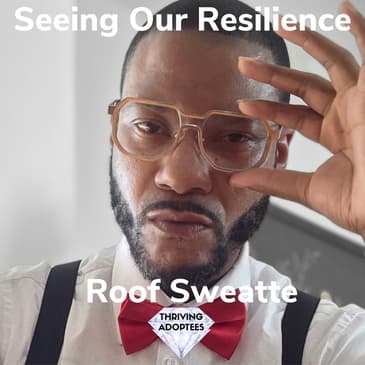
Would you like to bounce back faster from setbacks in your life? What if resilience is seen not strengthened? Revealed in a moment not built over years? Instantaneous? Listen in as adoptee Roof shares what he's seen about resilience, mindset and more. His insights could catalyse yours.
Here's a bit about Roof from his website
"I didn't learn about resilience, openness, and foundation from a workshop. I learned it growing up.
My parents, Mr. and Mrs. Gentle, were two selfless human beings who offered over 40 children shelter a home where young children could be cared for when their biological parents couldn't. They opened their arms to a panoply of cultures, even when people disagreed with their decision to foster and care for other children on top of raising their own six biological kids. I am one of four children they adopted, totaling ten.
My adoptive father, Mr. Gentle, passed away in 2020 during COVID—a day I'll never forget. The last thing I remember him saying was to " You’ve got it Big Guy!,Never Give Up." My parents taught me patience, presence, and what unconditional love actually looks like.
I grew up with a brother navigating mental health challenges and a sister with Down syndrome who showed me that strength doesn't always look the way people expect and that support means meeting people where they are, not where you think they should be. I grew up in a blended family with white siblings, biological family, and all the complexity that comes with navigating multiple identities and cultures under one roof. I learned early that wholeness requires access to all parts of who you are, not just the parts that are convenient or comfortable for others."
https://www.linkedin.com/in/roof-sweatte-194a13153/
https://www.facebook.com/Roof.sweatte/
Guests and the host are not (unless mentioned) licensed pscyho-therapists and speak from their own opinion only. Seek qualified advice if you need help.
Want to learn more about thriving for you, your kids, your families or your colleagues? Pick a time to talk here
[00:00:02] Hello everybody, welcome to another episode of the Thriving Adoptees podcast. Today, you've got such a great guest today. I spoke to Roof last week, the week before. He's just a ball of fire, a ball of energy. So welcome to the show, Roof Sweat. Looking forward to our conversation today, my friend. Roof Sweat Hey, good morning. Thanks for having me. I really appreciate you taking the time to come speak with me. I think it's super duper exciting to share, you know, the story and
[00:00:34] hopefully land some really good content with the people who are listening. So excited about that. Me too. Yeah. And how often do we hear the word super duper? Not enough, right? Not enough, Roof. So Roof's an adoptee and I don't feel like we've had any adoptees on the show for the last few episodes. So good to be connecting with you.
[00:00:59] And Roof is joining us like, it's still like six o'clock in the morning with you, is it? It is. It's not so, but you're an early bird. You're an early riser, right? Early riser. Want to get early, get the day started and tackle ahead, you know? Yeah. Amazing. So Roof, the big question, right? What does thriving mean to you?
[00:01:26] Thriving. Well, I think what thriving means to me would be in conjunction with having resilience, right? Because you got to be thriving from somewhere. And I think that you've gone through some things when you begin to start to thrive and you had to learn quite a bit in order to start making progress moving forward.
[00:01:53] So my take of the word thriving, thriving means to me is to be resilient, focused, and to accept the challenges along the journey. Love it, man. Love it. So what have you learned along the journey? I'm asking you an intentionally big question there, right? So you can go wherever you want, my friend.
[00:02:22] Yeah. Quite a bit, actually. Through the journey, there's so much suspense along the way, you have no idea what kind of challenges you may face, right?
[00:02:35] So, you know, with some of the losses I've taken in terms of the one of the closest person to me, very close people to me, actually, I've lost along the way, like my adopted father, my biological father, and a woman who I was extremely close with,
[00:03:00] all lost within several, within a few years apart of each other. And that wasn't expected. And I think when you have traumatic situations like that, you need to take a step back and reflect on what that means to you and how you're going to grieve and accept that and move forward. And wear it as a badge and not just soak and swim in the sorrow of the loss.
[00:03:31] So I think what I learned is, which is the framework that I created, was to live that out first. I didn't have a name of it at first, but that's what the Roof framework was actually about, was I needed it first before I can actually decide to share that with others. And then I became so aware of the names I could use with it, which is resilience, openness, ownership and foundation.
[00:03:59] And I needed to have all four of those pillars in order to overcome these challenges, especially the ones that were unexpected like that. I saw something yesterday about how learnings become clear after the event, after the initial shock,
[00:04:26] also after the initial rush of perhaps post-traumatic growth. We put it into words afterwards. Right. It doesn't come. Like the framework, from how I'm hearing it, right?
[00:04:51] The framework is a rationalization of what happened for you more emotively, more intrinsically, more close to me. I mean, I'm not making any sense, Ruth. Yeah, you're making complete sense. You need to have, I mean, like there's no better experience in life.
[00:05:13] So I remember there's a quote that I seen and it said, forgive yourself for what only time can teach you. Or forgive yourself for what only time can teach, right?
[00:05:32] And I think that we sometimes allow the trauma and the hurt swarming our minds and let those thoughts keep a swimmer in, circling around our minds so much that we don't get a chance to try to collect ourselves and try to figure out what it is that we're going to need most to be able to move forward.
[00:06:01] And in one of my books, I say that the best thing to do is when you're unsure and things aren't going according to plan, and run to the mirror. And if you're afraid you're going to break the mirror, I got good news. That ain't going to happen. You'll break long before the mirror does.
[00:06:30] So you'll win that race. And self-reflection, I think, is something that many of us should probably want to practice more often than we do. It'll help us stay grounded, contributes to the foundation in which I speak as a pillar, allows you to be open, forces you to own the feelings and what you're going through.
[00:07:01] And now you've done practice, the exercise of resilience to go ahead. That goes back to what we were talking about in terms of thriving. And you could thrive practicing those methods. So the framework is a description, but the experience came before the description. A hundred percent.
[00:07:31] Yeah. A hundred percent. So do you remember the moment when was there a pillar that came first? Or was there a pivotal point? Yeah, I think the first pillar I would say would be resilience.
[00:07:55] And I say resilience because I can remember being a young child and being stubborn when I was learning how to ride a bike. And I refused to allow my parents to get me to training wheels that were supposed to go with the bike to help me get better at it. Yet instead, I decided to challenge myself.
[00:08:25] Like, I have no idea why I did this way, but I just remember having in my head, I'm going to get this. So I would get on the bike all the time and I would fall off like several times because I turned the wheel too much. I wasn't gathering all the motions on riding a bike properly.
[00:08:52] In any case, I think that's where I found the first pillar at a very young age, prior to early years nine, without being able to name it. But definitely remembered being on a bike, refusing the training wheels and continue to get back on that bike again until I got it down. And eventually I did. And I think that was being resilient.
[00:09:14] That was also owning the mistakes that I was making, figuring out what I needed to do in order to succeed in getting on that bike and riding it without fail. Do you remember how many goes it took you? Probably, well, it took several months to be honest about them. Probably over a hundred, I would imagine. What sounds silly.
[00:09:44] But, you know, like Einstein said, I found a couple of ways. I found a bunch of ways that didn't work. You know, so. Are you glad you did it that way? I am. Yeah.
[00:10:05] I think I still have the same approach to a lot of the things today, just not in the same, not with the same level of ignorance. A little more intentional, more purpose-driven and very focused and aligned with the pillars and also led primarily with empathy.
[00:10:30] So, if resilience is the, it is the first of the, it's the first pillar of the roof frame. Right. Yeah. And, and it, and it happened and you'd learned it first or you saw it first as well. Right. Is that what you're saying? Yeah. Yeah. So, I have a fascination around this area of resilience.
[00:10:55] It, because some people talk about it being something that's strengthened and other, other people talk about it, something that's seen. It, it, it, it, it, it, it's experienced. We, we, we see it. Resilience is something that we see. I'm wondering how, how you take that. I think, is it, is it seen? Is it strengthened?
[00:11:25] Is it both? Is it something else? Right. Yeah. I think it is seen. It, it's subjective also because you want some form of alignment with it, whether it be a sport you happen to really like, the movie that really displayed those kind of characteristics.
[00:11:49] Or someone who you really admire, who you watch, whether that be a parent or uncle, anyone really, that displayed something that you found fascinating enough that when they have been through challenges, they've gotten over them. Yeah. Whether they named it or not is a whole nother thing. It's just being able to witness the person overcoming a challenge.
[00:12:22] And again, like for me, I think I had to, I had to live it first. And then when I was able to figure out how to name it, it became something so special and so near and dear to me that I was like, I've seen people experience challenges too.
[00:12:48] What can I do to help and alleviate some of those challenges? How would I go about that? And as an adopted child, I think that's also a very, very significant area where resilience was also forced upon me. I remember growing up and happened to ask that question every single day.
[00:13:16] Is my mom coming to get me? Is my dad coming to get me? Why am I here? Am I supposed to be here? Why do I feel at some times out of place? And the questions like that, they do something to you. So there was nothing left else to do but to be resilient, to get through and overcome those kinds of thoughts.
[00:13:45] As you're describing the thoughts, it strikes me is how much, how much, how much was a lot of aching? Because you can say, I wonder if they're going to come and get me today. Or you can say, I wonder, are they going to come and get me today?
[00:14:15] Is this the final day? Is this the day that it really happens? I've been waiting for, like, how much pain, how much pain, how much grief were behind those questions? Were they, was it a deep felt sense of insecurity or where was it?
[00:14:39] I think it was definitely a deep felt of insecurity, confusion, and trying to establish within myself safety.
[00:14:57] You know, when you're adopted and you're in a white family that's accepted multiple people from all sorts of backgrounds. So now you're in this melting pot directly in your home and you're seeing kids come and go. So you have no choice but to ask that question if you're leaving too.
[00:15:24] Why would I be worth keeping over the next child? What are the measurements and what determines those factors? Is this a place where the biological parents pick their kids up? You know, when you're very young, those are just, I think, natural questions that you would ask yourself.
[00:15:50] And then sometimes I think there was a point where the questions subsided for some time. They went dormant. And then I can remember that it was brought back up again when I actually came across my father's mother and she was completely racist. She did not like me at all.
[00:16:19] In fact, I wasn't even allowed in her house. And we would go to the beach because she had a beach house that was out there. And we'd go to the beach. And when it's time to come home to rinse off the sand, she would allow people in a house and tell me, no, you wait outside.
[00:16:48] And you had to shower in the outside area, which felt so hurtful, that pain of not belonging. And after that experience, that's when I started to have those questions come back up again. Are my parents going to come? And if they do, would that situation be better?
[00:17:15] At least would I feel like I'm at home? Would I feel like I belong? And would my feelings matter? It's unbelievable that somebody could be so fascist. I don't know what the difference is between fascism and racism, right? I should look it up.
[00:17:42] But that's tantamount to fascism there. How do you put these two things together? Resilience and this racism, this fascism, this insecurity of belonging. How do those two things relate to one another?
[00:18:11] Well, the way they relate the most, that's what I learned with this framework, I think is the most important thing was to begin to build your own internal home of safety.
[00:18:29] And I think when I thought about the way to label how I was feeling, I believe it was called mental homelessness, which is a state of mind where loneliness drives a person to seek comfort outside of themselves.
[00:18:56] Never settling, never arriving, just all alone. Nowhere to attach. And no place to call home. So you would be in a state of mind trying to seek everything outside of yourself for comfort.
[00:19:23] And instead of building within the comfort and safety and feeling true to yourself so you feel you belong and then being able to establish the proper thoughts, the resilience, the ownership of yourself, being open to the ignorance of what's outside of you, outside of your control,
[00:19:52] by having such a strong enough foundation to be aware that that is what is something that you could potentially face when navigating into this world. So there's a moment when you turn around, when the situation is so bad on the outside, you realize you had to turn within. You had to turn within.
[00:20:21] You start building internally. You're aware of such challenges. I think also what was an extreme benefit was having such a diverse background and being able to being exposed to the different kinds of people I grew up with.
[00:20:49] I think that was extremely helpful to see the differences in how people act, react, treat others, different colors, different backgrounds, different ethnicities. Even into the town that I grew up in, that was even also diverse. So I think to some extent, I may have been spoiled when it came to that,
[00:21:14] just being able to identify those kinds of differences and being open to it. I saw this post yesterday on LinkedIn, and it was something about, instead of developing resilient individuals,
[00:21:40] we should be developing resilient systems. And my first reaction to that was, what? I should put my own resilience on hold until the system is resilient? I think I might be waiting a long time. Yeah. My next thought was,
[00:22:08] does it have to be an either or? Right. And then my thought went back to it. This whole kind of looking without is so disempowering. Right. It's just like, what? You know, like, oh,
[00:22:36] and I think of my own particular experience of this in a, in a little nugget of an experience was 12, about 12 years ago, I think. I got the primal wound. I thought I was primarily wounded. And I was desperate for my wife to read that book so that she could understand it. Right. And she wouldn't read it.
[00:23:08] Because she was going through her own grief at the time. Her dad had died. And I was, I wasn't being, yeah, I wasn't being a good husband about that. Right. I wasn't respecting her own grief. I wasn't being compassionate. I wasn't, I just wanted to, and I was taking this,
[00:23:37] I was taking this thing that she, this, this situation very personally, that she wouldn't read the book, you know? And, and I'm looking back and I just thought, how could I have done that? Right. So that, that looking without, that was a really precise moment of looking without, and then realizing, I'm barking at the wrong tree. Yeah.
[00:24:06] I'm barking at the wrong tree. Yeah. Looking, I'm never going to find the answer there. I have to, I have to go within. I'm, I'm thinking about a guy called Sidney Banks, who was also an adoptee. And he says, he was a very wise guy, right? Not a wise guy, mafia wise guy, just a wise gentleman, shall we say. And he said,
[00:24:35] I always tell people to look within, but they never do. Hmm. Yeah. I think it's so interesting to, to think of it that way. And that's why I wanted to coin that term. And I, and I got that term when I, I was writing my own memoir, the book home away from home,
[00:25:05] which I thought, excuse me, I thought was an incredible name to title my book. And that's pretty much what it means. Home away from home. is to look within. And then the subtitle was learning to belong without permission.
[00:25:36] And I wanted that title because I wanted the reader, even if you don't read the book and they read the title and that resonated with somebody to begin that journey of looking within. Like learning to belong without permission. Like owning that.
[00:26:01] And giving yourself the responsibility to look within yourself and not in others. And I think it means so much more now with all of the external things that are going on that are overly stimulating, meaning, well, in particular, social media, everybody's consuming so much content,
[00:26:29] all different kinds that are on your phones, which is you're looking out. And then what you get back from that isn't always all that good. Sometimes you are scrolling so long or so deep into the rabbit hole of scrolling and into the media that by the time you finish, you've lost a part of yourself and not that time too.
[00:26:59] But you might feel a little bit bad or feel some imbalance because of the intoxicating content that is entered into your mind and forces you to think of things that don't really matter, but have an effect on you. So you're saying home is within. Home is within.
[00:27:29] Home is within. And if you have a strong enough foundation, you will build the walls and the structure strong enough to deal with the storms that will inevitably come. And that is what the roof framework is. You build a house and we start from the ground up.
[00:28:04] So why are so many of us looking without? It's the easiest thing to do, to look within requires very, very deep self-reflection. To look without,
[00:28:29] you're refusing responsibility on where the thoughts and where those behaviors are coming from. It's easy to follow the leader than it is to lead. Yeah.
[00:28:53] I was making coffee yesterday morning and I was thinking about my, making the process as easy and as effectively as possible, efficient as possible. Right. So I, well, whilst the, the coffee's going in,
[00:29:22] into the cup, right. And whilst the espresso's coming down into the cup, I'm, I'm getting the, I'm getting the, the, the milk out of the fridge. And then I'm, I'm, I'm, I'm tearing each of these little coffee bags, right. It is individually, individually wrapped. So as another thing that I'm doing as the coffee's coming out of the machine, whilst I'm waiting for that, I'm putting those in the bin. And so it's almost like a, it's almost like a ballet, right. You know,
[00:29:53] in terms of like how I sequence it. And, and I thought this is, this is how people are told to, to work in, in, in, they're told a coffee making process. If you're working at a coffee shop, you're working as a coffee making process. You're working McDonald's. There is, you know, like you put this many fries in. It's you, you, you stack them here. You put them in this, they're in the,
[00:30:20] they're in oil for so-and-so time at so-and-so degrees. And everything is, is totally nailed down, right. This is, you've got the, you've got the process nailed down to a T and you've just got to follow the process. Right. And, and that goes, there's a,
[00:30:48] there's a safety that comes with that process that I don't need to think. Right. Yeah. Right. And yet that thinking is gonna, that, that, that, that process is, is like a pair of handcuffs. Right. Yeah. And, you know, I like when, when it was the term,
[00:31:17] it's like arrested development, right. Boggled down. One of the things I think I've seen mostly, particularly on media. And I'm not really a heavy media person, by the way. I, I, I go on. I, I try to keep myself with a, with a decent social diet, especially when it comes to scrolling, what have you.
[00:31:48] And every so often I see a post with somebody who says something very, very depressing. And. They post certain things that I don't want to say that we don't need to know, but I think. A lot of the posts are pretty telling. One of which is. Well, a few. One is.
[00:32:16] When someone poses a loss in the family. Right. Two is. When someone. Expresses a loss of their own. Maybe they could be depressed. Or they. Have lost. Someone. And they want to share with us. And. The most important part. I think. That I analyze. Or observe the most.
[00:32:47] Is. I always want to know to the why. Right. Because I've asked myself those questions when I've had. Those kinds of challenges myself. As like when we're discussing in the beginning. Are they going to come get me? And why am I here? Or you know. That lost. Feeling. Needing. A place of comfort. Needing a place of safety. And. I wonder. If. When somebody posts.
[00:33:17] Something. And it's. About a loss. Or something that they are grieving. Or feel really, really hurt by. Would it hurt more. If no one said anything. And then to the responders. Who say something. Do you feel compelled. To say something. Because. That's just the right thing to do. Why are you saying something at all? Right. I know it's the right thing to do.
[00:33:46] And I do it myself too. But. Where is. The place of safety. Right. Is that. From the people who. Are making the comments. Which. Or is it from the person who. Created the post. So I. I always look at that. And I'm just wondering. Because. You know. Again. You know. Per our conversation. That was there. And.
[00:34:16] I don't do that. I wouldn't. Post. I didn't post any of my losses. Of anybody who. That was near and dear close to me. One. I don't want the memory. Coming back up on. On a social media site. To remind me the next year. I was like. I want to see that again. You know what I mean? Like. But. You know. That's something that. I find to be. Extremely interesting.
[00:34:48] And. Yeah. One of my. One of my. Teachers. Mentors. Talks about. The need for. Using the word. Using the word. In. Service. Of our. Happiness. Right. So. Looking. Looking for happiness. Looking for validation. From. From others.
[00:35:20] Or. Using. Our happiness. In service of the world. So. Are we. Are we. Seeking happiness. Without. Or. Are we. Expressing. Happiness. Outside. Are we. Are we. Sharing our happiness. Are we seeking happiness. Or are we sharing our own. Yeah. That's a really good one.
[00:35:50] Because. It's. I find it to be. Extremely interesting. To. To see. A lot of the people. Who post. That I think are asking them. Themselves that question. But. Are so impulsive. With their. With the exercise. Of just posting. That they don't take the time. To think that through first.
[00:36:19] Of course. Where I am. Somebody who. I post. And. Literally try to do things. With intention. I don't just do it. Because like. You know what I mean. It isn't automatic. It's. My thought process. Before I go ahead. And do something. And I try to apply that. To everything. Again. You know. There is no perfect human. But. We strive to.
[00:36:50] Make better choices. And I try. As best I can. To display. And create the. Comfortable and safe conditions. For even my students. Where. I want them to feel safe. And they belong. And. Can. Understand. The exercise. Of resilience. Openness. Ownership. And foundation. It was. The engine that drives. Me.
[00:37:20] And the engine that drives. The entire framework. In practice. If we're waiting. For the outside world. To change. Change. If we're looking. For happiness. Outside. If we're looking. For home. Outside ourselves. Then we're going to come up. Sure. And. And we're also.
[00:37:50] We're in that victim. We're putting ourselves. In that victim. Space. Space. Oh yeah. And worse. Once you're in that space. And you're in a victim. Mindset. You. Have become. Vulnerable. Enough to be manipulating.
[00:38:19] You hear. A different. Kind. Of. A sound. Even in an area. Of dead silence. When you're that vulnerable. Even in dead silence. They won't hear the pen drop. What they. Hear and see. Is the offers. In front of them. Not the opportunities. Ahead of them.
[00:38:54] You use the word. Mindset. Which. I find. Fascinating. So I've been. Similar. Kind of conversation. Talking to an ex. A. A kid. Who. A guy who aged out. Foster Karen. You know. They. Sometimes they call each. They call themselves. Fosters. I'm a foster. That's a new one. Because. This guy was talking about. Mindset.
[00:39:24] And. And I. And I said. We don't hear. We don't hear. The mindset. Word. Right. Let me. Let me phrase it as a question. Right. Roof. Um. Because. I don't hear. The word. Mindset. A lot. In. Adoption. Spaces. Do you? No. I agree with you on that one.
[00:39:56] No. So. That's. It's. It's. It's very interesting one for me. What. Because. What. All we hear is trauma all the way. Right. It's trauma all the way. Trauma all the way. Trauma all the way. Um. And. Mindset. Mindset. Why? Why don't we hear mindset? Because. Mindset. About. Growth. And empowerment.
[00:40:25] And trauma is about healing. What. Like. Why? Why don't we. What's your take? Why do you? I think. I think it's the. The. The conditioning. In which that we're. In a custom to. And. You know how they say. Like.
[00:40:55] The five people. Who you're around. You're most likely like them. Well there's truth to that. Obviously. I agree with that. A hundred percent. But. When that. Phrase came out. There wasn't. The additional threat of. Of media. In. In the. Not in the tidal wave. That it comes at us now.
[00:41:24] There was always media. But not in this kind of. Not in the way we're doing it now. Now there's no escape from it. All you do is push a button. And you're in there. But that shapes you. And that puts you in a very very vulnerable spot. And. What I. What that does to the mind. Is that takes away. The. Possibility of being more resilient.
[00:41:52] And snatches out the foundation from you. And puts you. In a state of having mental homelessness. You've lost your home. The storm came. There was a tornado. There was the. Hurricane. And that is what wiped away the house. And that person. Who is lost. That. Is looking for shelter. Maybe not know how to name that.
[00:42:21] So they got to go to the closest thing to them. Hopefully the person. Or a place that they're going to. That's closest to them. Is a healthy environment. Otherwise. It just takes longer. And depending. And depending. On how bad the storm was. You know. So. I think. Is.
[00:42:52] Is. A very. Very important. Part. That lives. In the. Openness pillar. So. Openness means. Openness means. Choice. And. Mindset means choice. And victims don't have a choice. Is that why. Maybe why we don't hear it. Because it's about agency. Uh. And.
[00:43:23] As victims. We don't have agency. The victim finds. Comfort. And. And being. A victim. Even more. When. It's supported. By those around them. Yeah. Um. What's the. What's the phrase? Um.
[00:43:52] Misery loves company. Yeah. Misery loves company. But if you can take. If. If people. Can see a weakness. In our. In a human. A human being. And you can. And. They take advantage of him. They see. He or she is vulnerable. And. Constantly. People are taking advantage. Uh. So.
[00:44:24] Victimhood. Must be one of the. Biggest barriers. To our thriving. Yeah. Victimhood is a huge. A huge. Issue. With thriving. Because. If you see yourself. As a victim. It's going to be really hard. To. Achieve the next goal. Or achieve any goal. All right.
[00:44:56] The victim. Done. What. What. What about adoptive parents. That think that they're victims. Because. As we're. As we're discussing this. It sounds. It sounds. Me like. Uh. Maybe. Adoptive parents. Have switched off to this already. But. You know. That. That. Do they. See themselves. Sometimes. Do they see themselves. As victims. You know. The. The. Um. The. The agency.
[00:45:26] The agency. Should have shown. Uh. Should have warned me. That this was. Going to happen. They didn't prepare me right. Um. You know. The church. Didn't prepare me right. Or. Like. Just going. Going out. Out. Outside. Um. My kids got this trauma. I don't have the. I don't have the skills. To. I don't have the skills. To. To overcome this. There's no. Trauma informed. Uh.
[00:45:56] Trauma. Adoption competent therapist. In my space. How dare they do this. I. I. I think I would like to reward it. I don't know if I would say. They would feel. A victim. Um. Maybe. Overwhelmed. And. I'm only going to speak from. My paradigm. And I think that.
[00:46:25] My parents. The adopted parents. That. Took me in. Were. Extremely brave. They. Were. Adopting. And fostering. Children. At a time. Where. It was frowned upon. Again. You know. My father's mother. Was racist. She was against. Anything.
[00:46:57] That was outside of the race. Particularly. A black. Young man. Like myself. She didn't like that. And yet. He didn't anyway. Okay. So. I think. In that particular case. I would use the word. Overwhelmed. Or.
[00:47:26] Maybe even. Underappreciated. I think. The act. Of being. Willing. To take in. Somebody's child. Even if you're just a teacher. And you show enough care. And empathy. To contribute. To what the parents. Had birth. That is an amazing thing. But you. Completely. Skip all those steps. When you take.
[00:47:55] In another child. Did not. Biologically. Have. And. Carry that mission out. All the way through. And in my case. My parents had. Overwhelming amount. Of children. Forty five. Boston children. Adopted four. Six children of their own. It was a zoo. They overwhelmed. Themselves. And. Wanted to.
[00:48:24] Contribute. Wanted to help. Wanted to try. And offer. A home. For those. That couldn't get it. Particularly. Those. That were parents. That were victim. Mindset people. They were there. To. Help. Mitigate. Some of those issues. So.
[00:49:01] So. I think that. I. Take a few pages. Out of that book. And. I love the word. I think. One of the core values. That I mentioned. To someone on LinkedIn. The other day. Was empathy. You have to have. A great amount of empathy. To. To do something like that. To. Acknowledge. A human being. Enough. To. Endure.
[00:49:32] The unknown. Of them being in your possession. Especially when it's a. An adopted relationship. And. Children who are coming in. With all sorts of issues. Me. Mine in particular. I was. Overdosed. I was. Not overdosed. I was. Addicted to drugs. When. I was. Put into foster care.
[00:50:03] You know. And. Withdrawing. And going through seizures. And. All kinds of challenges. At that point in my life. And to. Think. About the. Parents that took me in. Willing to deal with. That kind of challenge. Speaks volumes. And character. Empathy. Sympathy. And.
[00:50:34] The roof framework. Is being displayed. All right there. One hundred percent. And. I think that is. A very magical thing to do. It takes. Especially in a marriage. When you. You meet someone. Who's willing to take those reins on. With you. Like yeah. We're going to do this crazy. I got a crazy idea. We're going to. Foster. A bunch of kids. You're not even counting.
[00:51:04] You're just doing it. So. I think that was. Much more on the. Overwhelming side. Than it was the victim side. I think they were the ones. That were. There to cater. To those that were the victims. And those that didn't have a mental home. Internal home. How do we. See that.
[00:51:34] This. How do we see this. Wholeness at home. Because there's a. There's a. There's a difference between. Mental home. Mental homelessness. And. Home. What's. What's the transition between the two.
[00:52:05] Home. Home. Is a place of safety. And belonging. That you feel within. Yourself. And what that would look like is. The person who. Can. Feel confident. And comfortable enough. Within their own skin. To not need. The. Reassurance. Anything outside. Of themselves. To move forward.
[00:52:34] And get through. If you're someone who. Is. Paralyzed. Or cannot move. Unless they are. In the need of people. Or any person. Outside of themselves. That will be displaying. A form of. Mental homelessness. You have to build. The kind. The structure. Within yourself.
[00:53:04] To feel safe. Safe enough. To be alone. And not need. Someone else. You know. Some people say. I can't be alone. Or. Or they go from one relationship. To another. Don't give themselves time. To build that structure. To build that foundation. And not. And find themselves. In another challenging situation. And. Really making it unfair. To the person.
[00:53:34] Who they're with. Because they didn't do the work. Themselves. To be. Whole. You know. Whole. In them. That's leaking. And that leaks. Onto the person. That's you. Coexisting with. And. You're a really lucky person. Should someone allow you. To leak on them. And they don't. Move. Or feel threatened.
[00:54:04] Or want to. Separate themselves from you. Or maybe they have. A similar issue. We're coming. Up on time here. If I. Can you. Draw this together. Have you got a. Have you got a final. Thought. Or a sentence of. Wisdom. Yeah. Consolation. You'd like to share with. I think. I think.
[00:54:34] I think that people. For one. I would invite anyone who. Is feeling. A sense of mental homelessness. To. One. Check out the book. I wrote. About myself. My. My. My entire. My entire. Upbringing in life. Home away from home. Learning to belong. Without permission.
[00:55:02] I think there's a lot of. Good content in there. And a lot of. Vulnerability. That I display. In that book. Simply because. I want to share. The. Deepest things. Have allowed me to. Become the person. I am today. And also. Where the roof. Framework. Actually came from. And how it was built. And that book. Describes the entire.
[00:55:32] Story of that. Back to mental. Homelessness. I am specifically. Created. I specifically created. A workshop. Using the roof. Framework. To. Combat. The mental homelessness. That people may. Be experiencing. And would love. To.
[00:56:02] Invite any. Willing participant. To go through the steps. With me. And teach you. How to apply. Each one of these pillars. To your life. In which. You will build that eternal home. And find enough strength. To. Overcome. The unforeseen challenges. That are. Ahead.
[00:56:33] And I think that. Is something we all need. A lot more of. Especially with the ever. Changing world. That has so many. On predictions. With technology. And or. Social. Challenges. That we're constantly facing. Due to the media content. That is. Spewed out. Our timelines. All throughout the day.
[00:57:03] Thank you. I knew it was going to be a gem. And. It definitely didn't disappoint. As always listeners. Check out. The show notes. And. There's some specific resources there. That will be linked in. In the show notes. Under the episode. And. Thanks for listening. And thank you. You've been. Thank you so much for having me. Simon. It was a pleasure. I really enjoyed our conversation. You're an amazing guy. Thank you so much. You're welcome. Thanks listeners.
[00:57:33] We'll speak to you. I'm very soon. Take care. Bye bye. Bye bye.