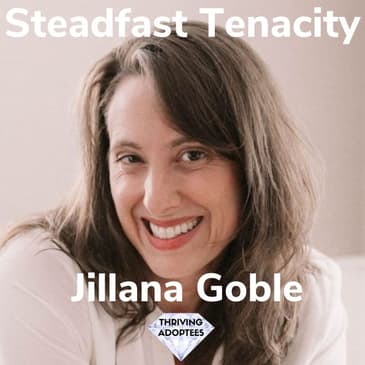
We are told that when we're going through tough stuff, to keep going. But what does that take? More than resilience? Listen in as Jillana talks steadfast tenacity, growth and humility. Powerful!
Here's more about today's guest from her website:
I’m Jillana.
Five remarkable kids who have stretched and shaped me all call me Mom. Together, my husband and I have redrawn the picture of traditional family, grafting children from hard places – and their families – into our circle. Some stay for a season, and others for a lifetime.
Parenting is sacred work, and I honor each and every family who is taking on this task of loving and caring for children from hard places. Nobody slips through the cracks here, and it is my deepest desire to encourage, inspire, and walk with you through it all.
https://www.facebook.com/jillanagoble/
https://www.instagram.com/jillanagoble/
https://www.facebook.com/everychildoregon/
https://www.instagram.com/everychildoregon
Guests and the host are not (unless mentioned) licensed pscyho-therapists and speak from their own opinion only. Seek qualified advice if you need help.
Want to learn more about thriving for you, your kids, your families or your colleagues? Pick a time to talk here
[00:00:02] Hello everybody, welcome to another episode of the Thriving Adoptees podcast. Today I'm delighted to be joined by Jillana, Jillana Goble. Looking forward to our conversation today, Jillana. The first Jillana we've had on the show, you must be. It's an exceptional name, right? I'm honoured, thanks Simon.
[00:00:20] You're welcome. So Jillana's website talks, it says that you're an advocate, you're a speaker and you're an author and you're a mum of five through adoption, through biological birth, through fostering, five kids. So how do you, and you also run this Every Child Oregon. So how on earth do you find time to do all that, Jillana?
[00:00:48] Oh my gosh. Well, I feel like it's ebbed and flowed over the years. I'm turning 50 this year and I think my capacity of what all the plates I can kind of hold spinning is definitely waning as I get older, but you know, things change. So I really love my role at this organization that I helped to found.
[00:01:09] Um, and yeah, my kids are all between the ages of 15 and 28 now. Um, and I have two biological daughters and then I have three boys who have all entered my life first through foster care, two of whom we have formally adopted.
[00:01:29] And the oldest, I refer to Simon as the son of my heart. He's the one that's 28. He was actually our very first foster placement in 2002 when he was a little boy in first grade.
[00:01:45] And it's a story that we can dive into a little bit more if you're curious, but essentially we raised him for a year, transitioned him to a pre-adoptive home that fell through and then had no contact with him for 12 years until we reconnected when he was a 19 year old man, which was, um, nine years ago.
[00:02:03] And we have been in deep connection since then. So there's, there's no legal relationship there, but he calls me mom. He calls my husband, Luke dad. He's the son of our heart. We are in, um, really close relationship. He has three kids. They all refer to us as Nana and Papa. And so those that's, that's an, that's an overview of my five kids.
[00:02:24] So, um, yeah, thank you for reminding me of that. Cause I've perhaps simplified it slightly in the, in the, in the preamble there. Um, but it's been a while since we spoke cause your kids have been keeping you very busy. Uh, yeah. April. Um, so I was going to just going to do something slightly different, um, listeners, uh, in terms of how we structured today's conversation. Um, I thought I'd, I'd read a little bit from Jillana's, uh, website and there's links to her website in the,
[00:02:54] show notes. We always put links. I always put links to the show notes in the, sorry, links to the website in the, in the show notes. And, but before saying that I'm, I'm 60 next year. Right. So yeah. Big milestones for both of us coming up. Big milestones. Yeah. Yeah. Um, so on the, on the website, it says, um, it's easy to feel overburdened by life's demands, looking out into the world.
[00:03:23] And as well as under the roof of our home may cause us to questions, how did we get here and how will we get through? Um, so this overburdening is something that we, that we all feel, I reckon, um, to, to, to, to various degrees and to, to various, various degrees and various degrees in terms of the, the, the weight of that overburden.
[00:03:50] And, and, and, and the frequency, you know, is that, that light, cause life's coming at us. Um, what does that overburdening, um, mean for, for you, Jelana? And what, and what, and what, and I guess what's, what, what lightens the load for you? Hmm. That's a really good question. Well, I think we don't have to look too far, um, to just know that there's a lot of, uh, swirling.
[00:04:20] Injustices and, and things that are, that really should not be. And yet here they are, and we're living in the midst of them. And then I think when you take kind of just the, the hum of the world, and then you add in opening up your front door and your heart to children that have experienced also things that should never be yet still are, and are engaging the after effects of, um, abuse and neglect.
[00:04:47] There's just, uh, uh, there's just always something that needs to be attended to. Um, and so I feel like, um, in some ways, you know, and I don't think that that's necessarily, uh, pertains to just foster or adopt a family, Simon.
[00:05:08] I think most people that are just engaging life would feel that way. I think people that, um, our parents, no matter how our children come to us would just feel like sometimes they're playing a perpetual game of whack-a-mole where you get one, you get one settled and stabled. And then another head pops up of some other thing to have to engage. But I do feel like, um, you know, in my, my personal life and my professional life are pretty interwoven.
[00:05:33] You know, when you, when you work, uh, your day job in a space that you also are living personally, uh, you have the opportunity to engage with a lot of people and there can be, uh, both, uh, a lovely side and kind of a shadow side to that, where you realize, wow, there is so much overwhelm that abounds.
[00:05:55] And also take some comfort in the fact that there's a lot of common denominators for families in this moment, especially families that have had, you know, abuse and neglect baked into their children's stories, um, that are, uh, just, just part of it. And so you asked about how I engage with that. I feel like a lot of it I'm learning, I've learned and I'm continually learning.
[00:06:24] It's kind of one of those lessons that I have to circle around to and circle around again, that really I cannot hitch the wellbeing of my own wagon to those of any of my children, um, that I want to celebrate every time they're doing well. But I also can't, uh, feel like I'm just that they're in the driver's seat of how I'm doing personally.
[00:06:47] And so, you know, you asked about how I engage and I just feel like I try to, um, just do things that I think a lot of people are doing to try to stay afloat. Honestly, I journal, I try to be intentional about getting time with some friends, getting time with my husbands that we just are not logistical business partners, but actually connecting about things and matters that don't just have to do with our children.
[00:07:12] Um, I really feel like humor, um, amongst those who kind of get it, you know, like you, it might seem like it's maybe a little bit of a dark shade of humor for those that are kind of outside the circle. But, you know, there, when, when you have relatability to somebody else, you can just kind of dive in. And so a lot of my, um, personal circle are those that have also done foster care and adoption.
[00:07:34] And so, um, you know, I, I think sometimes there there's, there's certainly moments for tears, but I think there's a lot of moments where if you, uh, you can just try to do your best to, to be as lighthearted as possible. And obviously there's a lot of things that aren't lighthearted, that are very serious that we have to engage from time to time.
[00:07:55] Um, but that's kind of how, that's kind of my strategy for, for coping is to just, uh, recognize that I'm not doing anybody any favors if I'm drowning and trying to like uphold others that I'm trying to come alongside. Yeah. Yeah. I want to take it back a little bit.
[00:08:15] You talked about unhitching the wagon of well, uh, of wellbeing from, so what that landed, as you were saying that the thing that happened to me is something that I heard. And I don't think this was a foster adopted mom. I think it, it, it was a biological mother and it was outside of the context of, of foster adoption.
[00:08:40] But what she said was, I'm as happy as my least happy kid. And I thought, well, that's a big, that's a big weight on your weight on your shoulders. Yeah. And, and, and she will, she wasn't parenting kids with trauma. Right. So if you're parenting kids with trauma and she's so that there's going to be more weight on those kids' shoulders.
[00:09:08] There's going to be more weight on your kid's shoulders, like that, that disconnect that unhatching the wagon between your wellbeing and your kid's wellbeing seems something that's, I don't know, is it almost impossible. I don't know from the outside me and my wife, I'm going to kid. Right. So.
[00:09:38] Yeah. I think, you know, for part of the mix is I have some neurodivergent kids. I have some kids that were exposed to in utero drug abuse and alcohol abuse. I have some kids that have struggled with mental health concerns. I just, I feel like in some ways, if I said my level of wellbeing is going to be dependent on your level of wellbeing.
[00:10:03] I feel like I'd be one of those floppy kind of use parking lot scarecrow dolls, you know, blowing in the wind. And so I'm not saying that how my kids aren't, are doing doesn't indelibly affect me. Of course it does.
[00:10:17] We have, but I'm not saying that how my kids are. somebody that's always in crisis. And so I don't want to just relegate myself from going from one
[00:10:40] crisis to the next crisis to the next crisis. I want to be able to model some steadfast tenacity and grit that like life doesn't need to be kind of all lined up with all arrows pointing in my preferred direction in order for me to feel some peace and some happiness. This is very imperfect. I don't do it perfectly, but I do feel like that has been one of the prime parenting
[00:11:08] lessons as I've gotten older is to realize. And I think that the flip side of that, Simon, is that I'm able or I'm hoping to be able to experience joy that isn't totally dependent on all the stars aligning of all my kids doing well, you know, that there is something inside of me and in the community that I'm trying to cultivate that is able to kind of stay afloat. My faith is a part of that, but certainly my getting together with my friends, getting together with my husband,
[00:11:38] being with people who get it, taking walks, drinking my water, going to bed on time, reading nourishing books that I like, like those are all little pieces that aren't like earth shattering, but things that help me to feel like I can still be, I want to strive to still be steady even when
[00:12:01] even when my, my kids are struggling or even when, you know, because I shared so many of my personal friends are in this world. I'm always with somebody that, you know, has something to celebrate and something that we wish were going differently. Yeah. And that's a, that's a repetitive learning, right? It so is, it so is. And what that looked like was different in my mid thirties to my,
[00:12:27] even my mid forties to now turning 50. I just, I feel like there is, um, I don't know. There's just a little bit more of, of a calmness. I hope, um, that as, as, you know, I, I heard a friend say the other day, small kids, small problems, bigger kids, bigger problems. And I'm finding that to be, be true, you know, as you kind of bear witness to just maybe some choices that your kids make that you're like, Hmm, that's not what I would choose for you,
[00:12:55] but you're going to need to, to, to, to do this. Obviously, if there's something that's going to like completely derail my kid's life, I'll step in, but I've had to learn that. Um, one of the most challenging things is to learn as my kids become young adults to ask more open-ended questions, because I oftentimes feel Simon, like I have a pretty good plan for your life. If you could just follow it, things would go well. And we would, we, we both wouldn't be in this,
[00:13:21] this place of, uh, you know, suffering or what have you. So yeah, those are some of the, just my, my learnings, but you're right. They're like a circle around circle around learning. It's not like a one time, Oh, I've got it. And I just, Yeah. We, we, we don't, we don't think much about learning with that depth somehow. Is it just me? I know that it's, uh, I, I was talking about
[00:13:51] this from my own perspective on a webinar I did last month and the, the metaphor that I came up for it were, was, uh, some, some pennies just keep dropping. Right. So it, it, it, it, it, it's, uh, infinite, it's an infinite drop, right? The, the, the, the penny never gets to the bottom of the
[00:14:18] water and, and, and, and lands on the lands on the earth. That's on this well. It's a, it's an infinite, it's an infinite drop, right? It's just, it, it, it keeps dropping at a more and more profound, profound level. Yeah. Um, you, you, you, your book, one of your books is called
[00:14:48] A Love Stretched Life. Yes. So does that tie in with this theme that we're exploring here in terms of your learnings? Absolutely. I mean, A Love Stretched Life, um, I have to tell you, you know, I love the cover of this book. The publisher did such a great job. It's basically
[00:15:15] like a rubber band art of like nails doing the outline of the heart and then strings that are attached. But when they first showed me the cover, it was all of these like pieces of yarn that had been snapped and were kind of like sitting, sitting in little pieces. And I just felt like, no, no, no, that's a love snapped life. And that's not what I'm going for. Actually, we're going for the stretching before the snapping. Um, and so, yes, that's, that's the idea is that I have been
[00:15:43] stretched by many different roles I've had in my life. Um, you know, as a, as a wife, as a daughter, as an employer, as an employee, as a community member, as a volunteer, but undoubtedly the role that has stretched me the most is my role as mom. And, um, so A Love Stretched Life really explores
[00:16:08] how my worldview has changed, um, by, uh, by embracing, you know, my kids that have come into my life and their stories and oftentimes their birth families. And, um, yeah, I mean, my life is better, better and richer in a lot of ways, but then there are a lot of times where this love stretch life,
[00:16:37] you know, in the midst of it, nobody in their right mind would look at kind of what maybe I've, I've engaged and like raise their hand and say like, sign me up for that. Sounds like a great time. Right. So like, I'm very thankful for, for the lessons that I've learned because it's a life that is mine. And yet, um, you know, this love stretch life has taken me on, on many detours, but I also feel like it's given me a more textured view of the world. Um, specifically when I think
[00:17:07] about engaging with my kids, um, birth families. Yeah. So when you talked about your, your worldview chain, your worldview has changed and continues to change, I would imagine. Um, what, one of the things that, uh, another adoptive mum said to me a while ago was we, we have to change first.
[00:17:36] Hmm. Yeah. We, we have to change, change first. And so I, I guess that, that, that paradigm shift, that will, that, that worldview change, that, that insight, that's what drive, that's, that's, what's driving how you, the, the change in how you engage with your kids. Yeah. Can you, can you talk us a little bit more about that? I'd say, so the, uh, a link, a link there between the,
[00:18:07] the, uh, the, the change in worldview and the change in how you parent, because a lot of time people are talking about changing behavior. Yeah. They're not talking about changing worldview, right? Right. Yeah. Right. Which we, we, we, we need to go upstream of our own behavior. Yeah. No, I, I'd love to talk about that. I think, you know, specifically in regards to,
[00:18:34] let's say my 18 year old's birth family, um, just I'll stick a pin in this and just give a little tiny bit of context. I met my, um, now son's beautiful first mom at court, um, when he was six months old and ended up kind of seeing this disheveled woman who was standing and whispering with her attorney. And I just said, hi, are you Jennifer? I have permission to use her name.
[00:18:59] She said, yes. I said, okay, I'm Jelana. I wanted to let you know that, you know, I'm fostering your son. I brought you this photograph. She took it. She started crying and to make a very long, 17 and a half year story short, um, that started our relationship that has included countless ups and downs, um, you know, years of kind of working together and then me having to put boundaries in place and her falling into addiction and then recovery and relationship. We ended up adopting
[00:19:29] her child. She ended up having a full biological brother. We ended up fostering that child and ultimately returning him to her where she is parenting him today. That's like the, that's the fast and furious version of the last 17 and a half years. But this relationship with Jennifer, when I talk about a worldview changing kind of on the bigger level, I think that previously to meeting
[00:19:54] Jennifer, getting to see her humanity, because all I was told is she's a meth addict. Well, that is true. And there's also many other things that are also true about her. Um, I I've recognized over the years, Simon, that while it's appropriate for me to know the struggle that initially led for her child to be child welfare involved, I have to recognize that, that it's not a two way street. Like we all,
[00:20:20] every single person has ways we miss the mark. And of course, not all of us fall to the level of needing child welfare involvement, but nobody's saying to Jennifer, yeah, Jennifer, your child has been placed with Jelana who can tend to be a chronic people pleaser and tend to like emotionally eat when she gets stressed. Right. Like, like, of course, those are not on the same level, but like we all have our things. Right. And so I think that there's this tendency to say, okay, in the child welfare system,
[00:20:45] like we're removing this child from you parentheses, bad parent, although everyone would know better than to say that, but they're placing them with you parentheses, good parent. And so I've really tried to emphasize in my own life and with my own community that we really need to be using the adjectives safe and healthy because without being really intentional with our words, like Jennifer is working on getting safe and healthy enough to care for herself. Therefore she can be safe and healthy
[00:21:13] enough to parent her children without being really intentional with our language. I feel like the paradigm does kind of shift into like good parent, bad parent, and that's not a helpful paradigm. I've also learned that it is really hard to demonize somebody that you are in close proximity with. And so I think it's such a gift that I've gotten to know her over the years and we have gone through,
[00:21:37] we speak together now to, to caseworkers and share on, on different stages about our story. She has 10 years clean. I mean, it's, it's a, it's like a miracle of a story and I'm so appreciative for the front row seat that I've gotten in seeing her change her life and the grit and tenacity that's required for her to just wake up every day and continue to choose to be clean and sober. But I think that while I wouldn't have been proud of it,
[00:22:06] Simon, when I started fostering in my mid twenties, my inner monologue before meeting a parent would have been like, well, it's not that hard, you know? And of course I wouldn't have said this, but I'm just exposing, like, I would have been like, you just need to stop choosing drugs over your kids, get it together, find some community and like, choose to be clean and sober. Now I am so, and while Jennifer would say like, actually there is some truth to that. I feel
[00:22:35] like I have walked that back to say, so I have needed to find so much humility for things that I have never personally experienced. And I feel like that's been part of the gift in getting to engage with her for 17 and a half of the last 18 years. It's been a gift in engaging with some of my other children's family and to recognize,
[00:23:04] I really have to take a huge step back. I have to recognize that the starting line in life is different marks for all of us and be really, really humble about all that I don't know and that I haven't experienced. And if I think something is simple, there's probably an indication that it's not. And so that's kind of the larger worldview that I think being in proximity to people whose
[00:23:34] burdens are more than they can bear. I think a lot of times for us, we, that's true for so many people, but so many people can have the facade of feeling like it's not true, you know, but for people that are in their active addiction or have their children that are child welfare involved. One of the things that I just deeply admire about Jennifer is her raw honesty and just kind of losing the facade. It really draws people to her. And so we've, I don't want to make this sound like it's some Disney
[00:24:03] version though of, you know, connecting. When I look at the color wheel, you know, where it's like red, it's like rage and betrayal. Like we have experienced every color and so many emotions over the last 17 and a half years. So I don't want to like pretty up the story too much to make it sound like, it's just been like, we decided to become friends. There's been a lot there, but all of that
[00:24:26] has changed my worldview. And I think made me, I hope a gentler person that's like, well, we don't know. I can't assume to know what she's thinking, but I'm going to try to root for her. Even if that means sometimes we're, we're cheering people on from afar, because it's not always the safest to be in relationships. So I've kind of learned that balance. Now that's kind of the worldview what, uh, kind of underneath the roof of my own home. I totally agree with that other parent that
[00:24:54] you talked to that says there's so much that I can't change. I have a, I have a child, Simon, um, who is really deeply affected moment by moment by his in utero, um, experience. And, um, I need to talk with him. Like I'm a happy preschool teacher pretty much all the time,
[00:25:18] even when I'm not to just help him to stay regulated, um, because of the way that he can pretty easily tip into pretty intense dysregulation. Um, is that something I love? It's not, do I wish I could be like, uh, you know, like all I do I'm human. Sometimes do I do that anyway, when I know it will set my sum off? I do not intentionally, but I feel like you just can't
[00:25:47] go 10 out of 10 all the time. But that's something that I've had to change because I recognize that the way that I talk and engage and, and interact with him is going to have a direct impact on how he's able to receive what I'm saying in a day to day, you know, moment by moment basis. So those are kind of the worldview and meaning to change underneath the roof of my own home. Yeah.
[00:26:13] Of the, it sounds like, um, the, uh, Jennifer, you said the, um, that, that, that's been a big area for you to have these paradigm shifts, right. For a change in, in, in, in your, in your worldview. Are there other, uh, other, other instances, are there other parts that seem, uh, parts of the
[00:26:38] journey that have been especially fruitful in terms of paradigm shifts for you? I remember, and an especially hard part of the journey with Jennifer, where we were caring for, we had just adopted one of her children. We were caring in foster care for her
[00:27:03] next child. She was in her active addiction. The agency was saying, you're probably going to adopt, you know, this one as well. I just was trying to hold on to hope for her, but I was felt like it was getting harder and harder to grasp onto. And I was driving down the road and I passed this old church with this kiosk with kind of the letters askew. And it said, Simon kind of faded wobbly
[00:27:31] letters. As long as there's breath, there's hope. And I just remember staring warily out the window and being like, Oh, is this just like a cutesy sticker that people put on their water bottles? Or is this something that I truly believe? Like, does this apply to a woman who grew up in the foster care system and had 63 homes and is now four for four with having her children, child welfare
[00:27:59] involved? Like as long as there's breath, there's hope. And I had to say, even though I wasn't feeling joyful at that moment, I was like, I do want to still hang onto this because then I believe if I, if it's not true, then it just means that we're all kind of on this conveyor belt to the inevitable of like, well, it's going to happen again. And those of us that have been in this world know that is true. There are hard stories. There are parents who never quote, get it together in the
[00:28:28] ways that we might hope. And yet, as long as there's breath, there's hope. And in this particular case, like she was able to have her son returned to her. And, um, you know, a lot of people might say like, gosh, he would have been better off staying with you. And I am so thrilled that she was able to parent him because I really think he saved her life. And she went on to become, you know, have 10 years,
[00:28:58] 10 years clean. There's a lot that could be said about that, but I do feel like, um, it's been a, it's, it's been a hard gift for me to walk alongside somebody that I've come to deeply care about and to witness with my own eyes sitting on the sidelines, how much picking yourself up and stumble, stepping and falling and picking yourself up is like part of
[00:29:26] the recovery journey. It's so rarely, I mean, I celebrate every time it's a clear, straight shooting star line for people. Some people have that story that's worth celebrating, but for me, for most people that have, you know, especially been dabbling in addiction since before they were preteens, that is not the story. And I think one of the things that I have learned along the way, Simon, is that kind of similar to what we talked about at the beginning of this episode is that I
[00:29:53] cannot let my caring for somebody else's life outpace their own. So I have learned the hard way with Jennifer that if she's, if she's taken it at a walk jog, I want to walk jog alongside her, but she can't be, she can't be walking and I can't be sprinting on her behalf. Like I want to keep pace with her so that she knows I'm in it. I'm encouraging, but I'm not overly compensating for her. I'm not
[00:30:22] enabling in any way. I'm just cheering her on within her own agency. And there are times where it's appropriate to help a little bit more. And then there are times to step back, but that is a lesson that I have learned with my oldest son of my heart as he's stumble stepped through life is yeah, just, just that, that I think the wisdom of keeping pace with people and not doing it for them.
[00:30:49] Yeah. I was, I was thinking about, you know, you, you use the word learning again, um, then, and what, what's gotten in the way of your learning?
[00:31:03] Hmm. What's gotten in the way of my learning is wanting to impress other people with the notion of like, I've got this under control or for people to know, um, that like, I do, you know,
[00:31:30] the, the concept of discipline, for example, can be a challenging one when you have kids that have this combination of like mental health and your substance exposure, like it's really not discipline because that kind of presupposes that somebody is able to take a situation and outside of, you know, the current moment, apply the logic, you know? So, so we've had to really like take out
[00:32:00] all the tools and our traditional tool belt of how we parent with like actions and consequences and, you know, stern glances and the tone of our voice communicating. I'm so disappointed, whatever it is. But, um, I think sometimes I want other people to know like, no, no, like I've, I've got this. Um, and for, for me to almost communicate to them, like I recognize how this sounds and how it seems.
[00:32:29] And so there were times, I think several, you know, a decade ago where I'd be tempted to be like, to do things that just flat out don't work for my kids and the name of kind of appeasing other people that like, I've got this under control or I'm trying to, I feel like I'm not really articulating this very well, Simon, but I think that that has been, uh, um, something that I've had to really wrestle with because I want people to think that I'm a good mom. People have very strong ideas about
[00:32:56] what a good parent means, especially when a child is visibly acting under control. How do you get that child under control? There are a society has big ideas about that. And when those ideas don't match up with what your kids ultimately need or won't ultimately work, where you're just really punishing yourself as a parent, if you're like, if you don't come in the house, you lose screen time for a week or like whatever it is, you know, like that kind of stuff might work for, for kids that have not had,
[00:33:24] uh, the, the life that my kids have had before they came to me, but that's not the case. And so that has been something that I've had to wrestle with. Uh, that's where I've kind of tripped up and gotten it in my own way. I think oftentimes, um, for foster and adaptive parents, uh, we just repeat what we know most people do for better or for worse, or, or they try to stay away from what
[00:33:49] they were told and, uh, or, or modeled. And, um, there's kind of a war I think within parents of like realizing who your kids are and how you're going to need to adjust and how other people might see you differently as a result of that adjustment. Yeah. Well, what I'm getting is a contrast between use the word humility, um, five minutes ago, and then you, or five, 10 minutes ago. And you talk,
[00:34:15] and you talked about impressing others and that they seem to be kind of opposite ends of the spectrum totally. I think so. So I just have had to kind of get out of my own way and to recognize that, um, you know, if you care a lot about image and the, the, the parents that, you know, then maybe that's going to be a challenge. That's going to be a challenge. No matter how your kids come
[00:34:42] to you, it's going to be a challenge, uh, especially if you have kids that for a myriad of reasons, act ways that, uh, that, um, society wouldn't be like, wow, what a perfectly behaved child. Right. So, um, yeah, I've had a, my, my son, uh, that struggles a lot with dysregulation
[00:35:06] has been dysregulated in almost any venue out in public standing in lines for things. And I've just had to get used to, um, you know, people staring and, and kind of having that invisible thought bubble of like, get your kid under control. And for me to realize, gosh, this might look like I'm being a permissive parent right now. I am absolutely not. And also I am trying to be trying to clamp it
[00:35:33] down and shut it down is actually going to prolong this, you know, so they're just things that are challenging. Um, thankfully we're knock on wood in a, in a space where just with a little extra maturity, he's, he's really coming along and I'm really proud of the ways that he's coming along. Um, but I think a lot of, a lot of parents can experience kind of the whiplash of like 10 steps forward, 12 steps back. And we've certainly experienced that. So for me as a parent, my job,
[00:36:01] Simon is to not believe that I've turned the corner with my son, that that is now those, those public dysregulations are a thing of the past. I need to be grateful that they are not a thing right now. And I can be hopeful that they won't enter the scene in the future. But I think where I've tripped up in the past is being so crushed by disappointment when things that have been issues in the past, um, pop back up again and feeling like I thought we were past this.
[00:36:30] And some of that is my own, my own disappointment. Yeah. Um, the, the, the word that, or the topic that came up for me as, as I was listening to them with, um, was expectations and there's that expectation gap. Uh, and people keep just saying, right, you know, that what, you know, I, I had to,
[00:36:56] I had to, uh, I had to reassess my expectations. I had to change my expectations. Uh, and, um, it, it seems a tricky space, right? That's well said. It's so tricky. It's so tricky. Um, I think you're absolutely right. It really does come down to it. And I think that the world of social media is not doing us any favors, you know,
[00:37:24] where parents can go and look at a square of a perfectly backlit, you know, room that might not even be somebody's real house. And, you know, they're, they're with their toddler child, just gazing into their eyes or they're handing the keys, you know, to their teenager, whatever it is. And I think that part of breaking down that, and if those are people's real stories and that's how it's going, then we celebrate that. But for so many people, I think they feel the sense that they are doing it
[00:37:53] wrong. And, um, it's, it's just based on, uh, people just need to be more real about the messiness amidst the everyday life. Yeah. I think one of the concerns that comes to me, and I'm not sure whether I have any right to, to, to have this, but I've started, so I've finished, right? I think one of my concerns is that,
[00:38:20] um, if we, will kids, if we aim low, will kids live up to that aiming low? Yeah. Right. You know, like how, yeah, that would be a concern. Yeah. Yeah, absolutely. And I have, I, I totally share that. I think that, um, you know,
[00:38:44] what that looks like, I think is continuing to, you know, continuing to kind of shoot for the moon, land in the stars, so to speak, but to not be upset about the times that we're not hitting the moon. Um, I think, Oh, we are playing the long game and I don't, I always have in the back of my mind, like, how are, how am I preparing these kids for the real world as much as possible? How am I,
[00:39:12] how am I keeping them within their comfort and stretching them just a little bit more and a little bit more and a little bit more and a little bit more. And that is how, you know, our son who is 15, but about developmentally half his chronological age. That's how he is now, you know, learning to make his breakfast and learning to take his laundry tub downstairs and start the washing machine. I mean, these are things that with a neurotypical kid might be a five minute
[00:39:41] lesson on a Saturday. This has taken us like six months to get to the point where like we're doing this. Um, and he can, he can do these things, you know, he just completed an internship. At a bike shop. And it took a, we took a very long road of like how to talk and engage with people. So I think that challenge for me is to like recognize where my child is at, but to also want to like steer them to where they're going, but recognizing that we're on the long path here,
[00:40:11] which also means that some means that sometimes when I feel discouraged, I need to, to look in the rear view mirror and remember like where we've come from, um, to, to be able to celebrate like where we are now, even though it is behind, um, you know, his peers and what neurotypical 15 year olds can do. So I totally agree with that wrestling. I've wrestled that myself. I think a lot of foster and adoptive
[00:40:36] parents wrestle with the gap between what a child's developmental and chronological age is, and that those don't match up for a plethora of reasons. Oftentimes, sometimes they do, sometimes they don't, but, um, how do we continue to just keep moving forward with just inching, you know, changing the mark of like what success is and inching forward in a way that they can do, but it's just
[00:41:01] going to take a little longer. So, I mean, you've talked about, you've talked about modeling earlier on and I'm just, I was thinking about the book, right? Um, love stretch life, like stretching yourself and stretching your kids. Is that, is that too simple? I don't think it's too simple. I think that, yeah, I mean, really it is about, um, I hope my kids have been stretched and, and grow and,
[00:41:29] in a lot of ways I know. Um, yeah, I know for some certain kids in my home, there's a lot that has transpired under the roof that I would like never willingly like raise my hand and shoes. And yet I just have to believe that that has shaped them. That's made them a very compassionate person. I don't want to Pollyanna it and be like, Oh, isn't it wonderful? I mean, it's come at a high cost, but I think the beauty of what some of my kids have experienced in my home that are more neurotypical
[00:41:58] is that they see folks and they have a much more compassionate lens to not have an, a judgy inner monologue that I might've had when I was their age to kind of be a little bit more of the vibe of like, what's wrong with you? Of course they would never say that. I would have never said that, but just in inner thought bubble to just have a more compassionate lens of like, what's happened to you? There's clearly more going on than meets the eye here. Um, so yeah.
[00:42:26] Yeah. Why are you looking to stretch to what, what, what, what, what's, what's on your mind in terms of your own stretching? Oh, that's such a good question. You know, I feel like what I'm stretching to has been pretty consistent, which is, I just want to love well, and I want to show my kids
[00:42:54] unconditional regard and I want to delight in who they are. And I hope to, um, be undistracted with my presence, with those around me. Like, that's what I'm, that's what I'm stretching for. And I feel like in different seasons, there are different obstacles that kind of can get thrown in the way. But I think at the end of the day, what I'm stretching for is one of those things that seems so simple, but like easier
[00:43:21] said than done, you know, um, just wanting to feel like people are seen when they are with me and that I genuinely care for them. Yeah. Other particular topics that you're studying, you know, you talked about, you mentioned books, um, uh, earlier on, and I'm, I got the sense that that was kind of like, uh,
[00:43:49] um, maybe enjoying a good book as a part of your self-care, that sort of stuff. Um, it, it, it, other particular topics that you're looking at, books that you're looking at or, or learnings that you're focusing on with, uh, with a view to the stretching part rather than the kind of self-care bit. Yeah, that's, that's such a great question. I love that. Um, you know,
[00:44:15] I'm very, very interested in, um, I'm very interested in books about like brain body connection. I think the book, the body keeps the score is so brilliant. I could read that and glean new things from it all the time. I, um, so I'm very interested in those books. I also feel like I've, uh,
[00:44:39] read quite a bit about kind of ambiguous grief, which, uh, which I, is a new term for me, which I've learned it to be, um, kind of grief that you can't go and buy a Hallmark card for, but there's a lot of things that fall into categories that are challenging, um, that are grief stricken. But, you know, I've also had to push myself, Simon, cause I can tend to be a little bit more on the serious side, but I don't always need to be reading about things to like better
[00:45:05] understand my kids or those around me or bring it like that. It's okay to just pick up a novel. And so in some ways for me and my personality, the stretching has been just saying I can pick up a fiction book, um, and just read that. And so I, uh, I, I read quite a bit at night. I've come to the conclusion and it's not a very popular one, but for me watching TV at night is not a good wind down
[00:45:31] for me. I'm kind of a sensitive soul. I don't like, uh, watching anything that has to do with crime or medical dramas. So like that pretty much takes out, takes out a lot of the shows. Um, so I just, I read for about an hour before bed and that is just part of like my wind down. And, um, sometimes they're memoirs, but oftentimes increasingly they are, um, just novels and I'm
[00:45:58] enjoying that. And I feel like that's just part of trying to keep myself afloat and be well-rounded and immerse myself in stories, true stories and otherwise that aren't just the ones that I'm living right in front of me. And that's been good for me. Yeah. Yeah. Um, I'm coming up on time here. Is there anything that you, you'd like to share that I've not asked you about?
[00:46:26] Um, gosh, Simon, I so badly want to say yes and say something really profound to end this podcast. I'm going to flank. Um, the, the, the one that popped in, the thing that popped into my head is, you know, you talked about ambiguous grief, uh, that, um, and, uh, you know, brain stuff,
[00:46:53] brain body connection and Bessel van der Kolk and that stuff. Uh, how do you, how do you try and explain that? Or do you try and explain that to, to kid, to your kids? Well, I mean, I think in the most basic of, of, of terms, I think as our kids have gotten older, you know, what we're able to share and the way we're able to share it has gotten a little bit more
[00:47:20] sophisticated as they've gotten older. But I think that a lot of it comes down to modeling, right? Like I can't be an angry, disgruntled mom and try to like, try to model for my kids, what it looks like to, to have a peaceful presence. And nobody does this perfectly myself included. Absolutely. But I think that I've just recognized kind of, as we talked about previously,
[00:47:45] how much of it is dependent on me taking care of myself and modeling for myself, um, what it looks like to stay calm. And that has been, that has just been one of those circle around circle around again, lessons. Um, I don't tend to naturally be somebody that's just like, Oh, whatever. Like, that's not my personality. I can be a little bit more high strung than that. So it's,
[00:48:13] it's definitely something that I have to work at to, to model. Um, yeah, it's a fascinating, fascinating area for me because before I came into the adoption space, uh, I, I spent six, seven years doing, um, in three words, children's happiness coaching.
[00:48:41] What did that mean? Well, I was going into, into elementary schools, we call primary schools here, um, working with eight to 11 year old kids about helping them, about empowering them to understand what's going on for them, where their happiness comes from, where it doesn't come from.
[00:49:08] And yeah, I, I, I, we, we haven't talked about behavior change, uh, trying to get your kids to, to change their behavior today at all. However, that is a big thing within this, within all parenting space. Right. And, uh, and my own take on that is, well,
[00:49:37] wouldn't it be better to empower them to change their own behavior? Right. Rather than trying to, and so, yeah, that's a, it's a fascination. Um, that's, that was what was behind my question in terms of, you know, do you, how do you, uh, to what I said, do you help, uh, do you share this stuff with, uh, with, with, with kids? I mean, so that's, that's a different, that's a different question for a different time. Yes. We could probably talk about a lot of things for a long time.
[00:50:07] Indeed. Thanks a lot, Jelana. And, uh, thank you to listeners. We'll speak to you again very soon. Okay. Bye-bye. Sounds good. Bye-bye. Bye-bye.