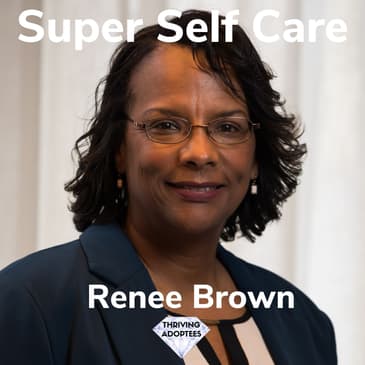
Are you hurting right now? Could you use some Super Self Care? Listen in as Renee shares insights aplenty into how we can make life just that little - or a BIG - bit easier.
Renee received her bachelor’s degree from the University of Texas at Austin and her master’s degree in Clinical Child Psychology from Virginia Tech. She started her career as a case manager for the intellectual and developmental disabilities population at the local Community Services Board (CSB). While working, she obtained her Licensed Professional Counselor (LPC) and Certified Substance Abuse Counselor (CSAC) certifications and was promoted to her first supervisory position in 2000. While in this position, Renee discovered her passion for program development and leadership. She continued to work at the CSB managing programs that supported individuals with mental health needs and/or developmental disabilities until she came to DePaul in January of 2017. Renee was already familiar with DePaul’s mission of hope and belonging as she was previously a foster parent for the organization. For almost six years, Renee has been the Vice President of Child and Family Services overseeing the Foster Care, Independent Living, Adoption, and Community-Based programs. During her time at DePaul, her restructuring of the CFS Leadership Team allowed for the expansion of the Independent Living program and the reimagining of pre-service training for prospective foster parents. Renee’s collaborative style was instrumental in increased cross-divisional and cross-program successes.
Renee values community partnerships and is a member of the Roanoke City and Roanoke County Community Policy and Management Teams (CPMT). Renee is also on the Family Focused Treatment Association Board, a national organization that provides support to agencies in the child welfare system, as well as the Project Discovery Board, a program that provides support to first generation college-bound students across Virginia.
https://www.linkedin.com/in/renee-brown-lpc-csac-20b93bba/
https://www.instagram.com/depaulcommunityresources/
https://www.facebook.com/DePaulCommunityResources
Guests and the host are not (unless mentioned) licensed pscyho-therapists and speak from their own opinion only. Seek qualified advice if you need help.
Want to learn more about thriving for you, your kids, your families or your colleagues? Pick a time to talk here
[00:00:02] - [Speaker 0]
Hello, everybody. Welcome to another episode of the Thriving Adoptees podcast. Today, I'm delighted to be joined by Renee, Renee Brown from DePaul Community Resources in Virginia. Looking forward to our conversation today, Renee.
[00:00:16] - [Speaker 1]
Yes, me too.
[00:00:18] - [Speaker 0]
Yeah, so Renee leads the in Virginia. And before that you were in charge of the adoption programme and some other parts of DePaul programming. And kind of before that, Renee was also a foster parent through DePaul. So there's the personal experience as well as the professional experience. And the other thing is that your younger brother is adopted too.
[00:00:50] - [Speaker 0]
So an interesting mix of different perspectives that we're looking to dive into today to explore your wisdom. I've always been modest about the word wisdom. Learnings is far more palatable, isn't it? Yeah, learnings.
[00:01:11] - [Speaker 1]
Yes, that's great. Yes, what I've learned.
[00:01:13] - [Speaker 0]
Yes, I've learned. Wisdom, man. That would be bragging to say that. Yeah, I think we all feel like that. So the big question to start with Renee, what does thriving mean to you?
[00:01:30] - [Speaker 0]
What does thriving mean to you?
[00:01:31] - [Speaker 1]
Yeah, so I've given that some thought and you know for me it's not the absence of hardships. I was actually thinking that, when I thought about it, going through difficult times I think actually builds your thriving muscle, like teaches you what you are capable of. And so when I think about thriving, I definitely don't think about a life that doesn't have challenges or hardships. I think it's learning the ability to get through those, to manage those challenging moments where we really grow. But when I think about thriving, I also think about connections.
[00:02:15] - [Speaker 1]
You know, feeling like there are people that you are connected to, where you belong, where you have a support group. I think you also need opportunity. So sometimes there are barriers in place where either people need to feel where they have the ability to overcome those barriers or they have the supports or policies or people in place who can help them remove barriers for their ability to do well. And then last but certainly not least, think people need to feel value, like internally feel value about themselves, that they deserve to thrive, that they can thrive, that they have it within themselves to do that. So, I think if you have, if you are connected to people who care about you, you have opportunities to chase your dreams or to go after what you want, and you feel like you deserve those things, I really think those are, when I think about thriving, are the things I really think about.
[00:03:17] - [Speaker 1]
And as a leader, I think it's really important for leaders to have some balance. So, for me, I work hard. My leadership team works really hard. And we need to be all in for our passions and all of that. But the other thing we need to have is balancing self care and taking care of ourselves.
[00:03:37] - [Speaker 1]
Because you cannot help your staff or the people you serve. You cannot do your best job if you are chronically exhausted. So it is important to also pour into yourself, just like you pour into those you serve with rest, with time off, with doing fun things that are outside of work, spending time with people that you care about. I think those are all really important to thriving. Yeah.
[00:04:07] - [Speaker 1]
Yeah.
[00:04:08] - [Speaker 0]
I love breadth. It makes my job so much easier when people have a broad expanse, expansive answer to that question. And it is broad, right? That is the truth. The bit jumped out for me was the removal of barriers.
[00:04:30] - [Speaker 0]
Because when I think about barriers, I think about kind of going round them or overcoming them. I don't tend to think of removing barriers. Yeah. Were you talking about removing barriers for other people? Was that the context?
[00:04:51] - [Speaker 1]
Yeah, like advocacy, Sometimes there is legislation, sometimes there are laws or policies in place that are unnecessary barriers for someone to thrive. I'll give you an example. So there's barrier crimes in The United States, right, which prevents certain people from being able to adopt or take care of family members if they have a barrier crime. Some of them, are really not relevant. For instance, we had a young man who had a substance abuse crime when he was very young.
[00:05:22] - [Speaker 1]
He is older now, he went to jail, he came out, he got off parole, he is clean, he is married, he is raising two children of his own, but he could not adopt his niece and nephew. And I'm like, okay, but he can, we're allowing him to raise his own children, but this law wouldn't allow him. So what we did is we needed to change the law where there's a process where you can ask for an exception to a barrier crime that's just a Virginia crime and not a federal crime. That's one way where we remove a barrier, right, for this family to be able to thrive and stay together. We just need to remove that barrier because you can't get or you can't just you can't get around it, right?
[00:05:58] - [Speaker 1]
We needed to remove that very restricted law and make sure there's a way for this family to move forward. Yeah.
[00:06:08] - [Speaker 0]
It's just because as I think about barriers to thriving, and I think about organisations like your own, I would normally associate them with the more kind of the emotional or mental health barriers, right? The actual law, the law that's preventing this kinship adoption from taking place and these kids finding permanency with their aunt and uncle, right? That was the relationship, yeah. So that's an interesting angle. Do you guys do much of that?
[00:06:48] - [Speaker 0]
Is that the kind of obviously in legal bit, is that a big part of what you do?
[00:06:53] - [Speaker 1]
It is certainly a big part, and we do it with a lot of other organisations and agencies. So we're part of you know, associations that bring organizations like ours together because obviously multiple voices have more power. We also though do very small things, you know, barriers, for instance, if a person doesn't have the appropriate wheelchair, right, to be able to self, know, move himself into his own van, right? That was a very small thing. His, the ramp and the wheelchair just didn't, he had to be pushed and he couldn't do that independently.
[00:07:23] - [Speaker 1]
So we got, you know, we got a better ramp, we got a better wheelchair and now this small piece of independence that this man can have, he can self propel himself into the van so when they go on trips or whatever. So, sometimes it's really small things like that, where Medicaid or there might not be a funding source for it. So if we can come up with money, we can remove a barrier. Or it's big global things, right, that impact communities and stay the books for a long time.
[00:07:50] - [Speaker 0]
Yeah. So, what do you see as the obstacles, the barriers to thriving?
[00:08:00] - [Speaker 1]
Yeah, I think many times it is having a safe place to heal. I think we don't always see adoption as also a loss. And I think that is a conception, an idea that we need to make sure that people understand that although this child has now hopefully found permanency with this family, they have lost, right, an entire portion of their identity. And we need to recognize that, and we need to honor that in giving them a safe place to heal and not expect them to, I don't know, just be grateful, right, that they have this amazing family now and they're removed from what could have been a potentially not great situation. But you know, that's not the full picture, right?
[00:08:47] - [Speaker 1]
The full picture is they lost some of their culture, their identity, maybe their school, their grandparents, or whoever. So, I think one barrier to thriving is the society's perception on how the adoptee should feel about being adopted. So I think we need to embrace their full story and encourage them to embrace their full story.
[00:09:14] - [Speaker 0]
Yeah, so clear. We've had that emergence of, we've been trauma blind within the adoption space until Nancy Ferrier came along with that book in 1993. And that started to raise awareness of the loss in relinquishment. And then we've become kind of more and more trauma aware over those last, what that is. Mean, it's only thirty three years, right?
[00:09:52] - [Speaker 0]
That trauma has been a thing. I know you grew up in a military family. So trauma wasn't a thing really, societally until post Vietnam, was it? Post Vietnam, the American government put a lot of money into exploring what was happening to these people that had served the country in Vietnam and started digging into what was going on. So trauma wasn't a thing kind of societally until the 70s, and then within the adoption space not until starting in '93.
[00:10:29] - [Speaker 0]
So your focus in terms of, we've talked about adoptees thriving, and that societal expectation of how they should feel as being a barrier. How do you see the barriers to adoptive families thriving if we kind of broaden who we're talking about beyond just the adoptee?
[00:11:00] - [Speaker 1]
Yeah, I think sometimes we feel like the end of their story or the end of their support is at the day of the adoption, right? So we have the big ceremony, they're in court, everybody comes, we have a celebration. And sometimes I think people feel like from that point forward, know, they're just now they're a family, and they're just they're like every other family, and they're not like every other family. And I think we need to acknowledge that. We have At DePaul, we have a post adoption program that's really extensive because we understand that there's going to be moments along the way where the adoption part of their story will become more salient.
[00:11:39] - [Speaker 1]
There may be times where it's a non issue for long periods of time, and that's fine. But it may not be. And of course, it depends on, obviously, if there's some obvious, you know, showings of them being adopted. For instance, like we don't match, right? A black family adopts a white child or a white family adopts a black child.
[00:11:56] - [Speaker 1]
And then so when every time they go on to public, it's kind of obvious that their family is a little bit different than everybody else. That makes it hard, I think, for the adoptive part of their story to kind of go into the background and not be a key focus. So, I think what we need to remember for our families is they're to need support all along the way. But we have found, especially when the children who have been adopted reach teenagehood and they're working on developing their own identity, that's a really crucial point where we sometimes see behaviors increase, an increased need for counseling. It just can be really difficult for everybody involved as the child is and if they don't have a lot of information about their biological family, that might be when they're really interested in seeking that.
[00:12:47] - [Speaker 1]
So, then does the adoptive family how do respond to that? Are they open to that or do they see that as sort of a front to what they've done? I've been your mom for fourteen years, and now you're really interested in your biological family. And I've been here for So, preparing them for that is really important and normalizing that is really important so the families are ready for it and they can be open again to their child's full story because part of it doesn't include them. And that's okay.
[00:13:22] - [Speaker 1]
Need to embrace the whole family. So, I think that's really what our families thrive in, is preparing them for the bumps along the way, and then also giving them community. We have an annual adoption camp every summer where we bring in all the adoptive families that are working with DePaul. We're talking about like over 100, 150 people come, and they're all different families. Some of them bring their biological kids and their foster kids and their adoptive kids and some of the families match and some of them don't.
[00:13:53] - [Speaker 1]
Adoption on that day, the adoption piece actually goes to the back of the room, right? Because everybody's touched by it. It's a non issue. It's just fun and connecting. And if a child calls somebody mom that doesn't look like them, nobody's like, that's your mom?
[00:14:10] - [Speaker 1]
It's just a non issue. So I think also providing them with community of other people who are experiencing the same thing and they get it right. Because nobody gets it like somebody who's experienced it.
[00:14:21] - [Speaker 0]
Yeah. For sure. Yeah. One of the things as you're talking about post opption, I think about as part, it's being part of human nature that we deal with the matter in hand, the tricky stuff that we're going and that could be in any part of our life, so that could be our job, our health or whatever, as well as what's going on for our kids. But you talked about adoption being a non issue and then often becoming an issue in teen years, and I've heard that expressed by many people.
[00:15:08] - [Speaker 0]
Have you looked at anything in terms of prevention stuff, just prior to teens? Because what I think is that an adopted parent, you mentioned this to an adopted parent when the kid's 10, 11, whatever, then you can say, well, we don't need to do the kind of prevention stuff, because we've got enough going on in our lives. And I think it's a human thing that we deal the situations that we've got at hand rather than anticipating what might happen in the future. And I'm wondering what you have to say about, does that make sense? You're nodding.
[00:15:57] - [Speaker 1]
Yeah, yeah, I think it does. And obviously every child and every family is an individual, right? So we don't wanna categorize them all the same. But I do think you're right about the preparing people. This is what might happen.
[00:16:11] - [Speaker 1]
We try to make sure there's open dialogue the whole way, right? So, we have something that's called a LifeBook, and we create those, you know, where it has all of their history and just different things, especially if there are things from their biological family that they can keep and follow along, pictures. So, if we can normalize the discussion of adoption the whole way, then hopefully the child will be coming to the parents or a trusted adult or their counselor or whoever's in their life when these things are starting to bubble up. But yeah, I do agree, normalizing conversation, saying it's okay to talk about what's going on. And also, think when we have these groups of adoptive families together, the teens and the preteens, they all get together and talk.
[00:17:03] - [Speaker 1]
And that's really strong when the teenagers can tell the preteens themselves, right, from them, like say, you know, this is what I'm experiencing, you might experience it too, or when the preteens talk to the teenagers and they're like, yep, that's normal to feel. I felt that way too when I was your age. So there are some, we don't have like a prescribed, like, you know, at 10 we're going to tell them this, but I do think normalizing those conversations all along is incredibly important.
[00:17:32] - [Speaker 0]
Yeah. Because there's a gap, right? The gap between the adoption whenever the adoption happens, whether it's infant adoption or an adoption at two, three, four, and then this teen part. One of the things that I know Doctor Parents have talked to me about is that question of, especially in the teen years, right? Is this a teen issue or is this an adoption issue?
[00:18:08] - [Speaker 0]
And my kind of take on that is, don't worry about the source, Because it can become a rabbit hole. Trying to identify the source of the challenge rather than just getting on with it and addressing the challenge head on, trying to figure out Yeah, the
[00:18:34] - [Speaker 1]
think it can be layered. Most teens are going go through some sort of identity something, thinking about who they are, who they want to be, what kind of person they want to be. You could layer that on if they're having gender identity or who they're going to love. You can layer those, but then you can also layer that with, and I don't know who my grandparents are, or and I don't know if I look like my mom or my dad. So then you sort of, I think it's just layers and sometimes adoptive teens will have more layers.
[00:19:03] - [Speaker 1]
And you're right, it doesn't matter which layer is what, just knowing though that if you have an adopted child, there might be an extra layer or two there to figure out.
[00:19:13] - [Speaker 0]
Yeah. So the identity piece clearly is, you talked about identity, you've talked about feelings. What other, I guess feelings of separation, if you're working so strong on that community, putting this community programming together, that's about trying to address the feeling of separation. What other challenges do you see in space during these teen years?
[00:19:51] - [Speaker 1]
Yeah, I really think the identity is the biggest piece. Trying to think of like, what would be some of the other purpose I think a lot of it is regular teen stuff. One thing we have found I will mention this recently in looking at some statewide data, there is an increase in adoptions dissolving in teenhood in Virginia, and that is alarming. There has been an increase in parental, well, not even parental, in relinquishing custody across the board for teens, so not just in adoptive families. What happens in a lot of families is the teens are really difficult, and then maybe they go to live with somebody else, like a grandparent, aunt, uncle, or somebody, and then that person is the person who relinquishes custody after trying to help out the parent.
[00:20:55] - [Speaker 1]
So, it's not always directly from the parents. Sometimes, parents have a step in between where they try to have another trusted family member or adult take custody of the child. So, that's a trend that's alarming, and I think it has a lot to do with increase in substance use, social media. There's a lot of there's families who are making decisions that are incredibly difficult. So, they may say, I no longer feel like I can keep the other children in my home safe with this child in my home, whether they're bringing in strangers, you know, through social media, because unfortunately some of some of our teenagers do that.
[00:21:36] - [Speaker 1]
They connect with a stranger and then give them their home address, and now you have strangers showing up at your house in the middle of the night. Or whether their behaviors are getting really aggressive or, you know, abusive towards their family members or even their siblings. That's alarming. That's not happened. I mean, it's not obviously the norm, but that is a trend that we have seen recently.
[00:21:56] - [Speaker 1]
And it's it's something that we're really struggling with across the board. Once the families get to where they no longer want their parental rights terminated, we are so far behind in the game. We have missed so many opportunities to intervene or our interventions have not been successful. It's hard to turn the ship around at that point. So, really need to be looking at what interventions or where are we missing the boat and where can we do better to prevent those and really educating our judges and our guard needle items and all of those people that are now in play to see how we can do better.
[00:22:41] - [Speaker 0]
You talked a little bit back about parental responses to adoptees wanting to search for biological family and adoptive parents taking that tough, right? Taking that tough. How much do you think that this thriving through the teen years is about the capacity of parents, their ability to ride their emotional roller coaster, right? How do you see that?
[00:23:23] - [Speaker 1]
Yeah, 100%. I think that's, but it's hard, right? And sometimes it's really hard. So, we need to make sure we're giving them the supports that they need. They have access to the supports, they have knowledge of the supports that are available to them.
[00:23:35] - [Speaker 1]
So, yes, the parents, you know, when we place children and they're young, you know, we don't know what their teenagehood is going look like. We don't know, you know, challenging that will be. So there's no predictor there, right? They could, you know, my brother, we adopted, he was placed with us at six weeks old, right? But he still had some struggles when he was a teenager.
[00:23:59] - [Speaker 1]
So I don't think there's even like a, you know, if you place him really young, then you're gonna skip all of this, right? It's just not the truth. So I think, right, as much as we can, we need to make sure that our families are aware of the resources and have access to the resources, because yeah, it could get really tough.
[00:24:18] - [Speaker 0]
Yeah. And I mean, you're talking about self care earlier on. Was thinking about how you're, well, first off, me say I talked to quite a few adoption agencies, right? And many of them don't do a lot in post adoption. For this reason, I think that often issues don't arrive straight away.
[00:24:46] - [Speaker 0]
So I was like your brother, I five weeks old, when I came to live with my own dad. Your brother was six weeks when he he came to live with you and you were seven, think, did you say? So he had a big sister. And so adoption agencies, traditional adoption agencies don't do a lot in post adoption because the issues don't rise. I aware of any I wasn't conscious of any adoption trauma, or let's say I wasn't aware of how trauma influenced my anger or insecurity or anything until I hit So 40, this stuff is like the iceberg, right?
[00:25:39] - [Speaker 0]
It's the part of the iceberg that we can't see. So what was the question I was gonna ask you? Yeah, so you're talking about, I'm saying good on you for doing the post adoption sport. That was basically what I was getting around to. How that impact your staff?
[00:26:02] - [Speaker 0]
Because you talked about self care. When we think about self care, some people talk about it, about bubble bath, which seems a little bit right. Your view of self care was somewhat more profound than bubble bath. People talk about hydration and sleep and doing fun things outside and vacation time off as well. When these families that you're supporting are going through tough stuff, how does that impact your staff?
[00:26:40] - [Speaker 1]
Yeah, it's tough. I mean, have staff that work in foster care as well. So they are experiencing children who are being removed from very difficult situations. And no matter how difficult the situation are being removed from, it's traumatic. So we are there from day one when children are placed with strangers.
[00:26:58] - [Speaker 1]
We have staff doing a number of things that difficult on a daily basis. Self care is really important, and it's something that the executive executive team and the leadership at DePaul has embraced. We do a number of things. One of the things we do is we invite staff to spend thirty minutes of every week on the clock doing some sort of self care. Watch a thirty minute sitcom, go for a walk, clean out your refrigerator, whatever.
[00:27:23] - [Speaker 1]
One thing that was really popular was people cleaning out their cars. Okay, whatever. So whatever that thirty minutes means to you, let's do that. The other thing we do is we do a summer self care initiative. So every summer we do something.
[00:27:35] - [Speaker 1]
Well, the last two summers we have. This summer, we offered staff either some additional money, some additional PTO, or two sessions with a professional coach. So, they could choose what thing would be most helpful for them. You know, when the economy is tough, sometimes the best thing we can do is just give them some extra cash and relieve a little bit of stress. Other people, it's the PTO.
[00:27:57] - [Speaker 1]
They want the time off. Maybe they used a bunch of it because they had a sick child or a situation and their time off is low. And so, them some more is most important. And others are in a position where they want to figure something out professionally or personally, and having a couple sessions with a professional coach to make a plan is most important for them. But we talk about self care all the time at DePaul.
[00:28:21] - [Speaker 1]
It's so very important. We encourage people to use their time off. We encourage people to use their sick time for mental health days. If you need a mental health day, use a sick day because sick doesn't have to mean medical. It can just mean you're not feeling well in some sort of way, and you need to use some time off.
[00:28:37] - [Speaker 1]
So use it however makes sense to you.
[00:28:43] - [Speaker 0]
When I mentioned earlier on, I'm talking about adopted parents and dealing with the tough stuff that their kids are going through during these teen years. I use the word capacity, right? So I think about adopted parents' ability, their capacity to not take their kids trauma personally, right? Sure. So, and their capacity to handle what's going on within household.
[00:29:19] - [Speaker 0]
What sort of languaging do you use around that? Does capacity kind of that kind of ring true to you? How do you see that? How do you see the wording? Sorry, I'm not sure.
[00:29:39] - [Speaker 0]
Do you know what I'm getting at? I'm saying, do
[00:29:41] - [Speaker 1]
you think this
[00:29:42] - [Speaker 0]
capacity work is a good word? Have you got another word in terms of their ability to cope, their ability to rise with the punches? What do you call that sort of ability?
[00:29:51] - [Speaker 1]
Yeah, I don't know that we have like a set word that we always use. I think capacity certainly makes sense to me. When you think about parents and they're managing these teens and, you know, sometimes what we found is, especially parents who have, like, they've parented children and their biological children are grown or older, they are surprised when they have to parent differently. They're like, but this works perfectly fine for my children. And sometimes it's like, we're not questioning your parenting skills, but this child needs something different because of their trauma history, because of X, Y and Z.
[00:30:39] - [Speaker 1]
And so we're going to ask you to change up your parenting style with this child and the way you're approaching them, seeing behaviors as communication, Not necessarily as just defiance that we have to Right? Know what I'm saying? So sometimes it's like, yeah, but what are they trying to communicate to you? We talk a lot about the need beneath the behavior. What is the need?
[00:31:06] - [Speaker 1]
And sometimes it's like, oh, they didn't have to think in those ways necessarily to be successful parents with their biological children, and we're stretching them, right? We're stretching how they think about things and they have to conceptualize things a little bit differently, and sometimes that can be a challenge.
[00:31:29] - [Speaker 0]
I'm thinking Yeah. Back to that, the reason I was asking about the capacity word is because I was about your staff and their capacity handle what's going on for the families that you're supporting. And I can see how that would link for me back into the coaching. So you said that one of the things that you offer is this coaching, right? So coaching is going to be, they might have an issue, that's why they pick the coaching option.
[00:32:05] - [Speaker 0]
Because being able to have some external input questions from a coach that will grow their capacity to to deal with the issue at hand differently, And at least they will get there. Often coaching is about helping people to see things differently, questions and things like that, rather than telling, they're not gonna tell you what to do. I had a business coach for years and she wouldn't tell me what to do. She would just, and it takes a certain amount of patience to do that because people would just say, just tell me what to do. I would say to her, So just tell me what to yeah, the coaching would be one strategy for growing your people's capacity.
[00:33:03] - [Speaker 0]
And I just wanna take it right back to the start, Renee, because you were talking about, you think of thriving as dealing with hardship. And I'm wondering what you've learned about increasing your capacity. What have been the learning moments when things have changed for you when you've had a perspective shift? What allows you, what grows your capacity and any particular moments around that?
[00:33:45] - [Speaker 1]
So as you were talking about capacity, it brought back to me the saying like, can't pour from an empty cup. And that's that whole capacity, like you have to pour into yourself and have others pouring into yourself and to you for you to be able to have the capacity to pour into others. And so, I think that goes nicely with what you were saying. So, I've done several I surround myself with really smart, great people. Like, I have an amazing executive team.
[00:34:14] - [Speaker 1]
And when you are when you have a team that is really skilled and thoughtful and different and diverse, I think that's that's huge in setting yourself up to being able to thrive because you don't can't No one person can carry this themselves, right? So, one thing you have to realize is when the problems are really big, you need a team. And the problems in child welfare, the challenges, they're big and they're heavy. And so, you have to approach it from a team's perspective and surround yourself with really talented people. I think, you know, one of the things that helps me is being a military brat change, I learned that change is just change.
[00:35:01] - [Speaker 1]
So, I think that's really adaptive for me. Change doesn't necessarily scare me. I'm not resistant to change. I mean, I don't like change for the sake of change, but if it's purposeful change, I'm good with it. So, when COVID hit and we had to quickly make some big decisions and change to working from home and get people, you know, it was like, okay, we can do that.
[00:35:23] - [Speaker 1]
We can adapt. We can make this happen. Everything is figureoutable. So, let's figure this out and let's figure out how we're going to continue to serve the people we're going to serve. They still need us.
[00:35:35] - [Speaker 1]
We're just going have to do it a different way. So just, I think having sort of a mind that's like, my dad was an engineer. So I have sort of that engineer, like there's multiple ways to solve a problem. Let's just figure out which way works best for us. Think is key to my ability to continue to thrive, because I'm always open to new ideas.
[00:35:57] - [Speaker 1]
And I'm also okay with ideas that don't work, right? It's okay. Know, every idea doesn't have to be successful. Let's fail fast if we can, but let's try some different things and let's not be scared, so scared of failure that we're not willing to be creative or think outside the box for sure. Yeah.
[00:36:20] - [Speaker 0]
Thing something popped into my head around secondary trauma. And I was thinking about the secondary trauma, impact of the kids trauma on the adopted parents. And then I was thinking also about the impact of that trauma, like tertiary trauma for your staff and that kind of clearing out and the triggering. What did somebody say? I heard talking to somebody the other day.
[00:36:58] - [Speaker 0]
He talks about, yeah, the wounded healer or the wounded helper. Some people go into welfare because they had a tough time themselves. And they're still kind of processing their own stuff. What have you learned around that? I mean, that's a big enough area to explore maybe, I don't know.
[00:37:21] - [Speaker 0]
Does that ring true to you, what I'm talking about?
[00:37:24] - [Speaker 1]
Oh, yes. So certainly there is the trauma of experience, like hearing things and seeing things. My staff get really attached to the children and young adults that we serve, and sometimes they experience tragedy. We've had a couple losses of life in the last few months that were really, really difficult on staff. And so, in those moments, right, first of all, we want to make sure staff are okay and we give them a lot of grace and give them time to take time off, time to be together for those that have knew the child or the young adult.
[00:38:01] - [Speaker 1]
We also use our mental health services that we provide in the community. If we need to do something for our own staff, we will bring them in and just say, look, let's just have, let's just talk about, have a debrief is what we call it, of the situation and give everybody an opportunity to express those things. Then we make sure the supervisors check on them on a regular basis and see if they need anything else. We have access to employee assisted benefits, so connect them with counselors and mental health counselors and supports that they need. But we need to make sure we're monitoring how each other's doing and checking in.
[00:38:36] - [Speaker 1]
And it's hard in a hybrid situation sometimes, right? If we have people working from home, from the office, we don't see each other as much. The water cooler talk doesn't happen as much. So, we have to be especially mindful of when people are changing or when people are looking different or feeling different or acting different and making sure we're checking in on them and saying, are you okay? The other thing we have to do is model.
[00:38:58] - [Speaker 1]
The leadership has to say, like, I will let people know I'm taking a break. I'm taking a vacation. You know, I'm taking a break. Because if we don't model that, then the staff won't think that it's okay to do the same. So, I make sure that, you know, people know, yeah, I'm going go on vacation.
[00:39:12] - [Speaker 1]
I'm going to do this. I'm going to take the day off. I'm going to hang out with my grandson. I'm just not coming in today. So, people know that taking care of yourself is really important.
[00:39:21] - [Speaker 1]
We need to model that and monitor for that. We do have people in our field that go into our field because they have experienced really difficult things. And that can be tricky, right? Because we have to watch that. If something is triggering them too much, then we need to be willing to step in and say, we're going to make a change here because I think this situation is just too difficult for you right now.
[00:39:43] - [Speaker 1]
And that's okay. We're just going to shift this.
[00:39:46] - [Speaker 0]
When I get near this topic of self awareness, I think of something that I heard from Bessel van der Kolk last year, think it was. Have you heard of this guy, Bessel van der Kolk?
[00:40:02] - [Speaker 1]
I have not.
[00:40:06] - [Speaker 0]
He's in The States now I think, but he was originally Dutch, he's probably 70s or 80s. And he wrote this book called, think it's about, they've been out about ten or eleven years called The Body Keeps the Score. So it's about, essentially it's about somatic trauma. That's what it's about in two words. And so he's been in this field of trauma for a long time, He's in his 70s or 80s.
[00:40:39] - [Speaker 0]
And only recently has he become aware of the secondary trauma he's been taking on in this space. And it only happened because he did some psychedelic assisted, some drug assisted therapy. And that brought it up from the subconscious. I just think it's amazing in terms of self awareness. You mentioned community quite a lot, it's been a thread all the way through and as you're saying about being aware of what's going on for your staff.
[00:41:22] - [Speaker 0]
Because I said this on an interview, did I say an interview the other day, just in a conversation, it's hard to see the picture when we're in the frame. The self awareness, the self awareness pieces, it's quite big. I think that is also the same in terms of a couple, right, or within a family. And helping people see stuff that they can't help themselves. And as soon as I think of that being a good idea, right, I think of when we have a conversation with friends or with family about anger.
[00:42:12] - [Speaker 0]
Something's gone on. They've seen I'm angry, I fall for this as well. So I've seen their anger, we've seen their anger. So he points out the anger, I'm not angry, I'm not angry. It's this kind of defensive reaction.
[00:42:32] - [Speaker 0]
But it is hard to see the picture when we're in the frame. That's why we need others to point it out to us in a gentle way that gets through.
[00:42:51] - [Speaker 1]
Oh, yeah, for sure. Yeah, you have to have people that you trust and that you've made it safe for them to come to you and say, Renee, the other day in the meeting you seemed off, is something going on? For sure.
[00:43:08] - [Speaker 0]
You see a really, just an interesting question. It's no one that I've never really thought about before, it sounds like an interesting question to ask. Do you see any, because you talked about self care, we're talking here about self awareness. Do you see those two things together? Do they overlap or how do they relate to one another?
[00:43:28] - [Speaker 1]
I think because self care makes space for self awareness. You are just on the wheel, going, going, going, going, and you never pause, will never take inventory of how you are doing. But if you take self care and if your 30 is just walking outside quietly, that is the space where the thoughts of something else or just recognizing how you're feeling in that moment, listening to your body for a second, that's when you allow space for the self awareness to come in of how you're actually doing. Because you have to pause. Because if you never pause, you will never know.
[00:44:08] - [Speaker 1]
Right?
[00:44:09] - [Speaker 0]
Yeah. So I've been a bit snooty about bubble baths, but taking your view on the connection between the two, maybe I should be a little less critical of self awareness because maybe the bubble bath is the time to think and for the self awareness to kind of Yes, space. Yeah. Maybe the bookbath is the space. The space.
[00:44:40] - [Speaker 0]
Space for self awareness to come in here.
[00:44:43] - [Speaker 1]
Yeah. Almost certainly could be for someone.
[00:44:45] - [Speaker 0]
Yeah. One final question, which is just a little, probably a 90 degree jump or something. Started off by saying that you were a foster parent back in the day for DePaul. How does what you did then inform how you are now, your perspective?
[00:45:14] - [Speaker 1]
Yeah, I think it obviously gave me insight on what it's like to be a foster parent, what it's like to complete the paperwork, what it's like to go through the process. You know, and things have changed. And so, it helps me think about like how things were then, how things are now, right? And where are the improvements that we made or where are some of the pivots? Like, if we could do over, if we could have a do over, what would make that experience more efficient or better?
[00:45:41] - [Speaker 1]
What was really good about that? What should we keep? So, it does give me some insight. It also, I think, helps when I talk to foster parents or I talk to staff and say, I've been a foster parent. I've also done the case management piece, the case management that you're doing.
[00:45:57] - [Speaker 1]
I've walked in their shoes, not to the extent that some of them have, but at least a little bit. And so I think it gives me a little bit of face value in what I'm saying in my perspective. I'm not just coming from the outside and saying, here I am, walking in and tell you how to do things. Lived experience is important, and I think we try to include that in any of our decisions. So, if we're making a change, we're like, okay, who's living this?
[00:46:30] - [Speaker 1]
We're redesigning some of our foster care work right now. We're going have focus groups with foster parents, because why would we redesign our foster care work without talking to the foster parents? So, it just reminds us, and it reminds me of the importance of the voices of those that we are serving, to include those when we're making decisions or making changes as we evaluate things.
[00:46:58] - [Speaker 0]
Is there anything that you'd like to share that I've not asked you about Renee?
[00:47:04] - [Speaker 1]
I can't think of anything. This has been delightful. I love talking about all of these things. You've actually triggered a few like thoughts of mine. So, I think after this, I'll think about some of the things that we discussed and I'm definitely going to look at, you know, body keeps the score.
[00:47:21] - [Speaker 0]
Yeah, yeah, it's a very interesting one that the body keeps the score. One of the challenges is that, to put it really boldly, people and will sometimes take a potshot at this, but I'm putting it really, really boldly. Talk therapy can't heal pre verbal trauma. Oh, wow. How can something that you have no words for pre verbal trauma, how come something that happened to you before you had words?
[00:48:07] - [Speaker 0]
How can you talk about that in talk therapy? Now, I say something, people have an, well it helps me, but that kind of, that whole somatic piece for me is fundamental. We don't know what we don't know.
[00:48:32] - [Speaker 1]
That's why play therapy is so important. Play therapist, we do that. The EMDR stuff, which might be more in line with what you're thinking about.
[00:48:41] - [Speaker 0]
It is, yeah. Somatic and EMDR, that's the right ballpark. Yeah, for sure.
[00:48:49] - [Speaker 1]
Yeah, so we offer that. We offer the talk, we offer the play there, We offer the whole gamut. Because in thinking about things, one size fits all is not the way people heal. So I think having a broad array of offerings, I think, is obviously a more effective approach to impacting individuals.
[00:49:11] - [Speaker 0]
I did some somatic experience for about eighteen months, just did it once a month. And seem to be lighter. I had more capacity to use the word that I worked out, that I used before. But I can't explain it, right? Because it's The somatic, you guy says right, another guy says, the issue is in the tissue.
[00:49:34] - [Speaker 0]
So, yeah,
[00:49:37] - [Speaker 1]
I mean, it makes sense, right? We're talking about brains forming right during those times, bodies forming. I mean, it makes sense that we're all you can't just like take one piece of a person and pull it out. Right? We're all All of the parts of us are interconnected, our brains, our hearts, our feelings, physicality, all of that stuff is interconnected.
[00:49:56] - [Speaker 0]
So somatic experiencing, on somatic stuff can be, I mean, you talked about taking a walk, right? So taking a walk, dancing, any form of exercise, anything that lets us release stuff that's in the body. It doesn't have to be somatic experiencing. And great you've treated some thoughts with me. I'm not gonna diss bubble bath anymore.
[00:50:31] - [Speaker 1]
Thank you. All right, well there we go.
[00:50:33] - [Speaker 0]
There we go, big win.
[00:50:35] - [Speaker 1]
Maybe next time we'll talk you'll be like, I took one and it was So
[00:50:41] - [Speaker 0]
I'll touch this talk about. Thanks Renee, thanks listeners,
[00:50:45] - [Speaker 1]
good to
[00:50:45] - [Speaker 0]
speak to you again very soon. Take care, bye bye.