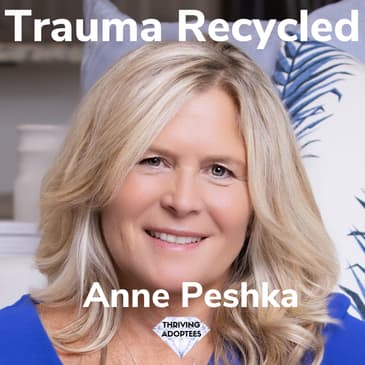
What if we could recycle our trauma? Make it into something profoundly useful? Something to drive our thriving? Something to fuel our growth? We can! Listen in as adoptee and birth mother Anne inspires us all...
Here's a bit about Anne from her website:
"I know what it feels like to carry things that should have broken you. Adoption. Abuse. Addiction. Years of making choices that almost erased me completely.
I also know what it feels like to get back up. Every single time.
I raised my kids as a single mom while working two and three jobs for decades. There was no safety net. No one coming to save me. Just me, deciding over and over again that this was not where my story ended.
I have reinvented myself more times than I can count. Not because it was easy or because I had it figured out. Because staying stuck was never an option I was willing to choose.
That is what true grit actually looks like. Not one dramatic comeback. Decades of showing up, doing the work, falling down, and getting back up before anyone was watching."
https://www.instagram.com/annepeshka/
https://www.facebook.com/annepeshkaauthor/
https://www.linkedin.com/in/annepeshka/
Guests and the host are not (unless mentioned) licensed pscyho-therapists and speak from their own opinion only. Seek qualified advice if you need help.
Want to learn more about thriving for you, your kids, your families or your colleagues? Pick a time to talk here
[00:00:02] Hello everybody, welcome to another episode of the Thriving Adoptees podcast. Today I'm delighted to be joined by Anne Peshka. Looking forward to our conversation today, Anne. It's going to be a blast. Yeah, looking forward to it. Yes, thank you so much for having me Simon. I'm looking forward to this conversation. You're so welcome. You're so welcome. So listeners, Anne is an adoptee. That's not all of you, right? This is just a part of us.
[00:00:27] And the book's called Trauma Recycled. And I just thought, that's a pretty cool title. So what led you to that title? What is Recycling Trauma? Yeah, exactly. It is such a great question. It's actually such a really cool concept too.
[00:00:49] It took me decades to realize that I did actually take all my trauma as a child and recycled it into my power and my greatest gifts without even knowing it was happening. And it's quite interesting, which is why I named my book Trauma Recycled. Because it, oftentimes, I think that when we experience a traumatic event, it stays with us.
[00:01:15] And it sometimes can define us, which is what I let happen to me for a very long time. And once I realized the gifts that I had from it, such as resilience, empathy, being able to feel how someone else's, you know, sadness or loneliness or dejection feels like it, it really just opened up doors for me. Just the greatest gifts that I would not have.
[00:01:41] I'm convinced I would not have these gifts had I been raised in a healthy family. You know? So is it, is it led to gold? Is it the alchemist's tale? Amazing. It's been, it has been such an amazing life. I mean, if you, you know, a lot of folks that read my book, they get through the first couple of chapters and they start to feel bad for me. They start to feel pity, which is not the purpose of my book at all.
[00:02:10] It's simply a story. It's an event that happened in an event that stopped, right? It's what I did with it that matters the most. So, yeah, it really has been magic because I chose for it to be. Yeah. Have you, have you read the, the alchemist? I love the alchemist. One of my favorite books.
[00:02:31] So I, I've heard of it and I don't know whether I actually read it or not a long time ago, but funnily enough, I, I listened to it this morning on the, you know, walk, walking the, the, the dog this morning. I, I, that came up. Yeah. So I was listening to a podcast and somebody mentioned alchemy and I thought, oh, dad. So anyway, I'm, I'm, I'm listening to it at the moment.
[00:02:58] I, I, I bought, I bought it this morning for six pounds, six pounds 29. Um, so that's why it's on my mind. Uh, but yeah. Lead, lead, lead to gold. Uh, I've, I've, I've, have you heard of this? Oh, absolutely. Yeah. You know, um, so the, the, the lead is, is the trauma. The gold is what's the gold? What's the gold?
[00:03:25] For me? Yeah. Oh, the gifts that I'm able to share with others, such as empathy, such as resilience, you know, being able to come from where I did and be the person I wish I had.
[00:03:44] So I wish I had had somebody that said to me, Hey, you're not alone or, Hey, it's going to be okay. Or, Hey, you can still do these things. You can still have an amazing life despite what has happened. You know, I wish I had had somebody like that. So now I'm able to be that person. And that's such a gift. So did the idea of calling it trauma upcycled come to you?
[00:04:13] It, you know, it's so funny because, uh, when I was working with a literary company at the time that I was putting my book together and she flat out was like, I hate the name. I hate the name. It reminds me of like yogurt, uh, yogurt cups and egg cartons. She said, and I'm like, you didn't live my life.
[00:04:33] You didn't live my magic. You didn't live my trauma. You didn't live what I have done. So it's not going to make sense to her, you know? And, um, she wanted me to change it dreadfully. And I just flat out was like, no, because this is what I did. I recycled my trauma. So I took the very worst things that ever happened to me and I turned it into my gifts. That's a recycle.
[00:04:58] Yeah. You think that's recycling? I do. Yeah. I, to me, it sounds, um, I don't mean, I'm just playing for this conversation, right? I'm not saying change the name of your book. Yeah. Yeah, no, no, no. But, um, but I'm saying, uh, yeah, it sounds more like upcycling to me somehow.
[00:05:21] Yeah. I guess it's like, you know, when you throw away, um, plastic or paper and then it's recycled into something purposeful. That was the concept for me. Yeah, yeah, yeah. Yeah.
[00:05:34] It makes more, it's more straightforward. Um, yeah. Anyway, let's not, um, I'm just doing this for conversation. I'm not doing, I do. I'm pretty good at, uh, unsolicited suggestions, right? So, but I'm trying to do a little bit less of that. Love it. It's okay.
[00:05:57] Okay. So, um, I want to take you back to something you said, you said that you, something like you let the trauma define you. The let word was the one that stuck with me. I don't, what, what, do you remember what you said? Let, let the trauma. Yeah, I did. I did let it define me for many years. But, but let, like you weren't doing on purpose on, right? None of us are doing this stuff on purpose.
[00:06:23] I didn't realize there was an option. You know, I just kind of felt like I was dealt this hand and it's always going to be this hand. You know, it's kind of like when people use the term victim or survivor, it's always going to be a part of you because you're attaching a label. And that's what I did for so long. I let it define me by, um, excusing bad behaviors.
[00:06:50] Oh, but this is what happened to me. So that's why I drank. Oh, this is what happened to me. That's why I'm never going to have a good relationship. You know, things like that. I let it just say, Hey, and you're never going to be enough. And I let that lead me for a long time.
[00:07:07] Until I finally realized, and I have, I mean, I am, I have spent a lot of time in therapy, reading books and all different types of modalities. When it finally, probably in my forties is when it started to go, wow, wait a second here. You know what? You have a lot more to offer than what you've allowed yourself to settle for.
[00:07:33] And then in my fifties is when it really full throttle. That just COVID was the greatest blessing for me because that was the realization. That was when it really hit me. Okay. Um, can I take you back a bit? Right. Absolutely. So, cause you've talked about, um, in your forties and then in your fifties, but so did you, do you remember when, what did you say? Uh, I didn't know it was an option. Is that what you said? Yeah. Yeah.
[00:08:02] So was, do you remember a moment seeing the option or glimpsing the option or? You know, I remember, I, you know, I just remember sitting there after reading hundreds of books. Right. And I remember sitting there going, this is my choice. If I decide to live the way that I'm living, I certainly can. But if I decide I want something bigger and greater, I can do that too.
[00:08:32] And that's when I started, you know, really working on my education. I started several different businesses. I went into financial services. I've, you know, got a couple of securities license. I, you know, I didn't stay in that industry, but what I was doing was proving to myself, you can do anything that you put your mind to. And that was a realization that I had never had before. I had never felt that way about myself before. That was big.
[00:08:59] But that, but that grew, that grew over decades. Sure did. But the, the, the turning point was sitting in, in your living room one day and the, the, my choice option came to you. Do you remember that moment?
[00:09:21] I do. I do. I do. I was a single mom. I had struggled, you know, working two, two to three jobs their entire life, never home, always working. And, you know, I started, I started looking at other people. I was a limo driver. That's what I did for 30 years. So I've got all these, you know, very well to do people in the back of my car.
[00:09:42] All these very successful people that I felt such a detachment from, I just felt like their lives could never be mine. I could never be the one in the back of the car. And I felt like that for so very long until one day when I, you know, was really realizing, I was really grasping that the choice was within me.
[00:10:00] It wasn't exterior and it wasn't a label that was attached to me permanently affixed that said you will never amount to anything because of the life that you've lived or the upbringing that you had. I realized it wasn't permanent. That was something I put on. I put that on me. So then I slowly. Was it you or was it trauma? It was, you know, it was a combination of both, but I let it stay there. Not realizing.
[00:10:29] I'm fascinated by this, this kind of let and choice and option and things like that, because I, you, it wasn't, you were, it wasn't a conscious choice. It was something subconscious was choosing for you. That's kind of my view. It completely was. No, you're correct. You're correct.
[00:10:51] You're correct. But by not working on my sense of self. So I didn't know how to work on me directly. Like I didn't know how to understand what I valued. I didn't know what that meant. What was important to me. What were, what were the belief systems that I had in my root? Not, not the belief systems taught to me, my rooted belief systems.
[00:11:17] I didn't know how to define that. And once I began digging into that and understanding myself a little bit more, that's when I realized I am a complete person underneath this label that I've worn, which was victim survivor. Those horrifying labels that held me back.
[00:11:42] I love this. I love this area. Touch on it. It's a somewhat recurring theme. I interviewed somebody yesterday around this kind of topic and we, we focused quite deeply on it. But let's just stay with the beliefs. Sure.
[00:12:10] We, well, my take on the kind of like the adoptee and the adoption space. We don't talk about beliefs a lot. Right. Would you, I mean, do you, do you, I know. 100%. Why? You know what? I think that's, that's such a great conversation. I would love to be on a panel and have that conversation. I can speak for myself.
[00:12:39] No, sorry. I interrupted you. I was going to say, that's what we're going to do, man. I love this. I love this because I think that, you know, collectively having five or six of us, it's going to be such a really interesting conversation. It really will be, you know, for me, I didn't believe I was worthy of anything other than existence in somebody else's ideal of who I was.
[00:13:08] You know, it was like I was placed into this family, which for whatever intent and purpose it happened. I now believe I was meant to be there, but, you know, for many, many, many years, I would struggle with if there's really a God, why would he do this? You know, I struggled with that for a very long time. But I think that not being able to, to have a belief in myself was so stricken with not belonging.
[00:13:37] So what did it matter? You know, very interesting. That's such an interesting question. The thing that came to mind as you were talking then was the difference between this happened to me and this happened for me. I don't know why I heard that, but that's, I love those little nuggets.
[00:14:03] Because, well, I love those little nuggets because I get lost. I drown in detail. I just, like, I can't tell you books, right? You know, I've read the, what's it, his sentences are just so long. And the words are just so, the words, it's just so, it's just too long.
[00:14:32] I lose track of the sentence halfway through. So when somebody says something to, you know, says something like, this happened, this happened, didn't happen to us, this happened for us. Okay, I can get that. I can, it's six, seven, eight words, whatever it is. I want to go back. I want to go back. And I agree, it would be a fascinating panel question. And I want to ask, kind of ask you again.
[00:15:02] Yeah. For just your take. Why do you think we don't talk about beliefs in adoption? Why is it trauma all the way? Why don't we talk about beliefs? You know, I think for me, like, always having that undercurrent feeling of you don't belong. You have to do what you're told to do. You have to be where you're told to be.
[00:15:31] Like, that being, piece to it, was almost literal. Like, there is no being inside here because you are being someone else's daughter. You are being in a family that you didn't choose or weren't naturally a part of. So I think the being part of me was just completely disconnected from Jump Street.
[00:15:56] I don't remember ever having a feeling as a child that my person mattered. That me as Anne, as a child, really, truly mattered. So I think just being grown up that way, that always landing wherever I landed, when somebody said to me, you know, like bad relationships, for example. I had a number of bad relationships. Never abusive, but just bad mixes.
[00:16:26] And I would just always feel like, well, this is where I'm supposed to be. It's where I ended up. It was the guy that came along that wanted to be with me. So here I am. So there was no being for me. It was just there. And it was not happy. And I would stay. So there's no self to have beliefs. Is that kind of what it's called? Correct. Correct.
[00:16:55] Correct. There's no being. Correct. That's exactly what it felt like. There's no being. There's no self. There's nothing here. There's nothing to have. No purpose. Right. Yeah. That's right. Yeah, it is. It is pretty deep.
[00:17:24] And it's and it's very difficult to crawl out of without support. Yeah. Without somebody else understanding, you know, and that's why, once again, it brings me back to I want to be the person I wish I had had. Yeah. My own answer to the question, why do we what? Why do we not mention beliefs is because we're so focused on the trauma. Mm hmm.
[00:17:54] So I, I love, I love an alternative answer to that. And I'll maybe I'll keep doing it. Maybe, maybe, maybe I'll do that again when I next interview someone. If we get near down that belief, I'll ask them that. I'll ask them that question. Yeah.
[00:18:18] Because the more, like the more, I guess the more questions we hear, sorry, the more answers to that question that we hear, the more likely that it's going to resonate. So your idea of a six panels on that, you know, everybody's got a completely different answer. Yeah. You know, there might be as, you know, people talk about there's as many views on adoption
[00:18:44] as there are adoptees, you know, like, so the more potential, the more creative we can be, the more, the more answers that we hear to that question, the more likely one of them is going to resonate. Exactly. Exactly. With, with us. Right.
[00:19:06] And maybe because my, my, my experience was so different to yours. Maybe that's why I have a different answer to that. A hundred percent. A hundred percent. A hundred percent. Yep. What's the next question?
[00:19:36] I don't know. What would you like to know? I'm, I'm, I'm just, I'm looking, I'm on your website. I'm on your website looking at some of the blurb. You've just come back from trip to, to, to Scotland. Yeah. And I, so I've been to Scotland, my wife's Scottish.
[00:20:04] I've been to Edinburgh where you were staying and been a few times. It's like, you loved it. I love it. I'd say it's my favorite city. I'm not like you. I'm not a city guy, but, but I, I like, I like Edinburgh. Something that I saw in a rugby stadium. I don't know whether it's Edinburgh or might have been Dublin. Cause that's one of the reasons that we go to Edinburgh to go and see, to watch the, to watch the rugby.
[00:20:31] And, and it was, it's a, it's a quote from Eleanor Roosevelt about the people in the stadium. The ones that get back up. I know it's not ringing anybody. But something that you say on the website kind of reminded me of that.
[00:20:57] I raised my kids as a single mom whilst working two and three jobs for decades. There was no safety net. No one coming to save me. Just me deciding over and over again, that this was not where my story ended. And then you talk about grit. And that's the bit that really reminds me of the, the Roosevelt quote. This is what true grit actually looks like. Not one dramatic comeback.
[00:21:23] Decades of showing up, doing the work, falling down and getting back up before anyone was watching. So the Roosevelt quote is, is, is about the people in the stadium. Yeah. That, that, that, that, that get, that get back up. Right. Yeah. So what's resilience? Resilience. Yeah. Yeah. That was one of my gifts. You know, I mean, I, once again, had I been raised in a, you know, more, I don't know what kind of word he would use.
[00:21:53] I hate the word normal. You know, it's like the best book on the planet. The myth of normal. It's a myth. There is no normal. But anyways, if I was raised in a healthy family, right. With opportunities and gifts given to me, such as opportunities, I would be vastly different. There's no way I would have the resilience that I've got. There's no way. It's a gift. That true grit was a gift and it still is. I've still got it. It didn't go away.
[00:22:22] So what's your, what's your focus now? My focus now, what I love the absolute most is helping women specifically who are age 50 and over, who have worn the labels their whole life, such as mother, wife, daughter. You know, a lot of people are carers. There's so many people that have not been them.
[00:22:47] They are, they may not have had a traumatic beginning like I did, but they still, they wake up, you know, the children are gone. Maybe they're divorced. Maybe they're widowed. Whatever the situation is. One day they wake up and they're like, who the hell am I? And what just happened? You know, and a lot of people feel like it's too late. There's so many massive numbers of women that are in their 60s that are like, well, I'm all done. And that's so not true.
[00:23:17] You know, there's so much wisdom. There's so much wisdom that you reach after 50. It's called wisdom. It's not, you can't even touch a 30 year old with wisdom. I've noticed that people have a strange relationship with wisdom. If I say to somebody, you know, I guess it's going to come on the show, right? So I'm going to, I'm going to explore your wisdom with you. And there's always a slight, not always, but there's often a slight kind of wisdom.
[00:23:42] Like I, and I see that and I say, yeah, we're all so modest about wisdom. They're afraid. They're afraid. People, people are afraid to show up, you know, when I, I mean, my social media is filled with me living. And I do that intentionally. And I do realize that there's a percentage of people that are going to look at my social media and feel like I'm a bragger. They feel like, cause I do travel a lot and I do.
[00:24:11] If the wind blows a certain way and I feel like I want to get on a plane and I want to put my finger on a map and go to a destination I've never been to, I will do absolutely that because I'm living and I want to show other people that you can make a choice and live to, or you can stay where you are and not do it. That's called a choice. Right.
[00:24:39] So I think it's important to, to show up and to be somebody that's going to be able to reach that person that's sitting right now on the couch, feeling like I'm not worth moving forward. I'm just going to work this job till I die. I'm going to punch a time clock till I die. And that beautiful life is for other people, not for me. Those are my people. Cause that's where I was.
[00:25:07] What about you and your own growth? You've talked when we spoke last time, a lot of time, you mentioned a few occasions about nature, right? You clearly know. But what, what, what, what's your, so you're, what, what that's, so if we think about your external focus being about travel and, and about spending time in nature, what's your internal focus? I love that.
[00:25:36] Such a great question too, because this is something that never ends. I never stopped working on me and I have done, I wish that I could have videotaped a 20 year old me 30, 40, and, and actually visibly seen the growth just in my conversations. But that never ends.
[00:26:23] I love to learn about people. I love to learn anything to do with the direction that our young people are going in, in addition to our, our adults and our seniors, what direction they're going in. Vast loneliness across the planet in all ages. And that fascinates me that we are allowing this to happen to us.
[00:26:47] And it just such a, it's such a instant gratification, fast paced world that we are losing ourselves. Yeah. So I'm very careful with that. Yeah. So you've, you've, we've talked about beliefs quite a lot and you've mentioned the healing word. Um, how do you see those? How do you see the relationship between, um, healing and beliefs?
[00:27:13] Um, healing for me wasn't possible until I believed I could. It wasn't possible. So those were two completely separate entities. And until I believed I was worth it. And that was really hard. Once I believed I was worth trying to improve myself, that's when the healing began. Healing was never going to begin until I believed that. And, and that is, that was not just alcohol and drugs.
[00:27:41] That was like in my own self-hatred that I believe that I am worth it as a mother was when I began down that road. Yeah. Um, did that, you must've seen the option first. The belief must've come later, did it? No.
[00:28:01] Um, I really, you know, it was after I placed my son for adoption is when that happened is that I literally, I was the mother of a three-year-old child and I got pregnant and I knew I wasn't going to be able to, to handle obviously taking care of another one when I couldn't even take care of myself. Nevermind my son that I already had. So it was during that process of choosing adoption for him that I, I looked at my, my toddler who looked at me like I was a super mom.
[00:28:29] He thought I was like, I could fly in the air. I was like amazing to him. And that's when I was like, you know what? I think maybe, maybe I am worth it. He believes I am. So that was what started my journey. If I had not placed that child for adoption, I likely would be dead. I don't know that I would have ever seen the path to improving myself and to stop doing drugs and drinking.
[00:28:54] Can you put, can you put those in a, into a timeline? Because it seems like you, so you had that moment, you'd, you'd, you'd read all the books you were sitting and you kind of saw an option. You saw a choice that you'd not seen before.
[00:29:18] Where's, where's the timeline between placing your son and, and that, and that option becoming possible to you? So I had my, yeah, sorry. Yeah, no, it's okay. I had my first child at 19 and then I had my second child, the one that I placed for adoption at 22. This is before any type of therapy. I had not done any work on myself. What I was doing is putting myself in a, in a grave.
[00:29:47] So it was at the age of 22 that I, I placed him at the age of 26 is when I found my first really good therapist. Now I had zero money. I was homeless. I was living in a shelter and welfare hotel. So I wasn't in any position to go, you know, paying for psychiatric help at all. So by the time I was able to get myself in position to begin seeing a therapist was about three years after that.
[00:30:15] And that is when she introduced me to self-help books, which blew my mind. And that began my journey of serious work on myself, but it would take, I mean, at 26 years old, 27 years old, when I started that, I mean, it would take. A while. It took me a long time to get to that place. It wasn't going to get me out of it overnight. It was a journey, you know, of building myself up. Yeah.
[00:30:48] Because you talk about reinventing yourself a lot in there. Yep. Can you share a bit more about that? Completely. Yeah. I mean, I reinvented myself just then. Right. So now I'm like, I started as this one person. I literally changed into a different person. And then in my thirties, changed into a different person again. I started to once again, educate myself, started businesses. I became a certified wedding planner, started a business doing that.
[00:31:16] I was limo driver was essentially my own business. I worked for a company, but I was in charge of what I did and building up my client base so that I would have repeat customers. So I just started to reinvent myself as an entrepreneur, never believing that I would be able to determine my own income. And that was really important to me because I hadn't had control over much.
[00:31:45] You know, as a child, there's zero control. And then you just then you reach this plate, this plate, this place where you realize you do have control and you can make choices. So I was slowly reinventing myself through all of these different phases. And then, you know, I got married when I was in my mid forties, another reinvention. Now I'm a wife for the first time. My kids are grown and on their own.
[00:32:12] And, you know, then I reach a place during COVID is when this happened where I wasn't, it wasn't a happy marriage. It wasn't traumatic. It wasn't abusive, but it wasn't healthy for me. Certainly wasn't healthy for him either. But I just realized I'm sitting in the same spot I was when I was a child. I'm completely powerless over my life right now. And I'm letting this relationship dictate who and can be.
[00:32:38] You can't rise like this because you're expected to be this. So I just went, boop, done, filed for divorce. I started a brand new business in real estate. I had zero experience in real estate. And I moved to a place in Florida that I didn't have anybody. I had zero people, friends. And I started this business. That was a complete reinvention, very successfully.
[00:33:04] And then five years later, after I had, you know, bought a house and furnished it on my own, my very first house by myself, which was such an amazing feeling. And then I just decided, you know what? I'm on a treadmill of owning things. I'm on a treadmill to hell. All I'm doing is working so I can buy more things. And this is stupid. This isn't living. Boom. Sold it all. I sold and donated everything I had. If it didn't fit in my car, it didn't come. And right now I'm renting a place that's furnished.
[00:33:34] And I've got my boxes of my stuff. I've got my real estate computer and my, you know, filing system that I need. And I still run my business, whether I'm traveling or I come back in person when folks need me in person. About 25% of what I do is in person. 75% is in a computer. That gave me the ability to reinvent all over again. And now I literally do.
[00:34:01] I come into town when I need to take care of people in person. The rest of the time, I'm gone. And it's beautiful. I never would have believed I could do that. Never. Never would have believed I was worthy of that. Never mind could do that. Yeah. We've talked a lot of stuff here.
[00:34:24] I'm just wondering if, as we kind of bring it into a close, is there something that I've not asked you about that you'd like to share? No, I mean, I think that one thing a lot of people will ask me is, how do you start? Like, I'll get phone calls after, you know, I'll do a podcast and I'll talk about some of my book. And I'll get phone calls or messages from people that are like, I don't know where to start.
[00:34:54] And that is such a great question, you know, and I really believe the answer is to just believe. Just believe you're enough. That's the start, right? You get to that point. And then there's just all different types of modalities that you can choose from. For me, journaling is vitally important. I need to write it out. And so I would love to share that, you know, if anybody were wondering, how do I start to reinvent myself?
[00:35:25] Journaling and believing that you can really have everything that you want. It just opens up those doors, you know. Perhaps the, have you heard of Byron Katie? Oh, yes. Love her. Yes.
[00:35:50] But her, she popped in, her idea, this process that she has called the work popped into my head. Yes. In terms of doing the work on the belief. What? That something, like whatever it is that the belief is. Such a great reference. I'm glad you brought her up because that would be helpful for people. Yeah. And the other thing is on beliefs.
[00:36:22] I heard this a while ago. And maybe you can explain it because I've tried to explain it a couple of times. And I can't. And I know it's true. Right? So, so the question is, is it a belief? Or is it something I believe? Is it a question?
[00:36:51] Or is it something I believe? Mm-hmm. Mm-hmm. Mm-hmm. I like that. I like that because I think that, like, I can once again reflect on myself. A belief could be something that was taught or shown me. Something I believe could be very different. And that is, that is such a great definition because I, I literally did that. I believed one thing. I believed I didn't belong.
[00:37:21] Right? I didn't belong. And now I believe I belong wherever I am. Yeah. But most people would say, I felt I didn't belong. Wouldn't they? They wouldn't say, I believe it. We believe that. That was my belief system. It wasn't even just a feeling. I really, truly believed I didn't belong anywhere.
[00:37:44] And there's days, I still have days where I'll be in a situation and I'm like, I don't belong here. And what that does, that's my little radar for Ann that goes, you know what? This either doesn't align with your values, with your sense of self, or the direction that you want to be in. So whether it's a group of people, whether it's a movie that I'm watching. I mean, there could be a number of different situations where I'll feel that.
[00:38:12] And I have to remind myself, you belong wherever you are. Surely it's easier to change your feeling than it is to change your, sorry, do the word out. It's easier to change your belief than it is to change your feeling, right? I think they're both hard. I think they're both very hard. Because if I, you know, I didn't, it took me a long time to believe that I belonged anywhere. It wasn't easy at all. Yeah. Or believing that I'm not enough.
[00:38:42] That was also a belief system I had because it was taught me. I was taught you are not enough. So there's no way I could have changed that by, you know, just saying to myself, oh, yes, you are. You're enough. Oh, no, that wasn't going to happen. That would take decades of work to believe that I was enough. And it would take a three-year-old little baby looking up at me when I felt like the lowest of the low, like in the gutter.
[00:39:10] His belief in me was enough to start me down that road. So sometimes bouncing off of someone else's belief, I call those angels. I've had so many beautiful angels in my life. And I weave my book with that because me on my own would not have been enough to get me to where I am.
[00:39:36] I needed these people that would say to me, hey, Ann, I think you'd be really good at this. And I believed them because I didn't believe it. I believed them and I would go down that road. Fortunately, they were all good roads. But, you know, it was I mean, it took those beautiful people that cared enough. And that, you know, and I think that when we don't realize the power that we have to really change the trajectory of someone's life.
[00:40:04] And when we see somebody and we think in our head something positive about them, that needs to come out of our face. We need to make that come out loud because we don't realize the difference it could make. And sometimes it's very small, you know, sometimes somebody that could feel so incredibly desperate on the inside when somebody says to them, wow, Simon, you look great today. You look really healthy. That could be such a big deal.
[00:40:32] You know, those are angels. Those are angels. Thanks, Ann. Thank you. Thank you. You're amazing, Simon. Thank you. Thank you, listeners. We'll speak to you very soon. Bye-bye.