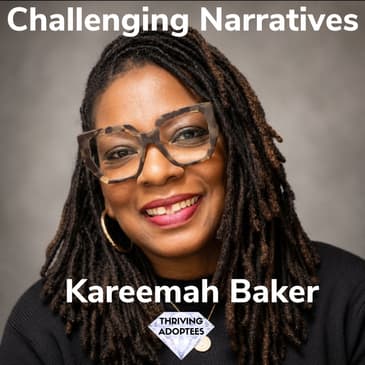
So many of us are challenging other people's narratives, but what if we challenge our own? This invariably leads to the insights that power our growth, fuel our relationships and succeed. Listen in as Kareemah shares her biggest insights to catalyse insight in yours.
Kareemah Harris-Baker’s story is one of resilience. As an adoptee who lost both her adoptive parents by the age of nine, Kareemah’s early life was shaped by profound transitions—and an unwavering sense of purpose instilled by her late parents. Kareemah works at New Jersey’s Department of Children and Families as Assistant Director of the Office of Adoption Operations.
https://www.linkedin.com/in/kareemah-h-baker-lsw-mpa-830079a2/
https://www.facebook.com/Ladyk583/
Guests and the host are not (unless mentioned) licensed pscyho-therapists and speak from their own opinion only. Seek qualified advice if you need help.
Want to learn more about thriving for you, your kids, your families or your colleagues? Pick a time to talk here
[00:00:02] Hello everybody, welcome to another episode of the Thriving Adoptees Podcast. Today I'm delighted to be joined by Kareemah Baker. Really looking forward to our conversation Kareemah. We had such a great chat last time we spoke and I know from what we've done now it's kind of a real meeting of hearts here and I find that really touching so it's going to be a great chat. Thank you for having me Simon.
[00:00:29] So Kareemah's got a, is it kind of a dream job for you? She's an adoptee and you're an adoption professional overseeing adoption and other parts of child welfare and New Jersey's department for children and families. Is it a dream job I guess?
[00:00:50] It is, it is for me. It's absolutely full circle for me as someone who's experienced adoption through the actual agency that I'm working with and now to oversee the work is yeah certainly a full circle moment for me. It's been therapeutic in a way where I'm able to kind of reconcile what my personal experience was with my
[00:01:20] the professional experience and different policies and different policies and things so it's been an amazing ride my career has been an amazing ride certainly. Yeah. Amazing. So what does, what does thriving mean to you Kareemah? That's a full question. That's a full question.
[00:01:42] Yeah. And thinking about the word itself, I think thriving is doing and being well, even beyond surviving, right? Not just simply existing or maintaining status quo, but you know, being exceptional, succeeding, being full, whether that's, you know, physically,
[00:02:07] physically, personally, spiritually, being whole. I think to thrive means you do well in excess. Yeah. Yeah. Yeah. Yeah. Wow. Chris, before we, before I hit record, you said that your, your purpose is to help people be well.
[00:02:29] Yeah. Yeah. Yeah. Yeah, it is. When I think of purpose. So for me, my own mantra, my constitution is to help children and families be well, regardless of my title or my role or where I stand in any organization or professionally.
[00:02:55] That that's what I'm, that that's what I'm, I believe that I'm on this earth to do. So regardless of where I am, I believe that I can do that well. And I'm committed to that. That's the passion behind the work, right? Yeah. Yeah. When did you realize that? Yeah. It took a while. It took a while. I want to say maybe in my thirties or so. Yeah.
[00:03:25] Yeah. Once I became a little more settled and comfortable in who I was, more comfortable in blocking out the noise and opinions of other people.
[00:03:34] Once I stopped repeating the narrative that I believe to be true behind my upbringing or my adoption story, because I feel like trauma sometimes can stop you from thinking in the fullness of who you are.
[00:03:56] So I think once I did my own work to become better, to become more confident in myself, that's when I realized this is, this is my purpose and this is what I do well and I can do it well, regardless of where I am. Yeah. No matter what. Yeah. No matter what. Yeah.
[00:04:16] So you've talked about fullness and you've also talked about wholeness. Are they kind of one in the same for you? Are they different? What do those words mean for you?
[00:04:30] Wholeness for me simply means complete or desire to be because no one's perfect, right? We're always healing. We're always learning. We're always growing. But there's a contentment that I believe comes with being whole.
[00:04:48] There's a confidence that comes with being whole. Despite what's going on around you, there's a certainty or a confidence in how you exist in the world when you're whole. And that takes work, right?
[00:05:09] So I mean, spiritually, emotionally, physically, all of those things contribute to a person feeling whole in their existence. And you don't just get there. That comes over time and having different life experiences, possibly different, you know, relationships and things, engagement with people and others. You can't, it's difficult, in my opinion, to become whole.
[00:05:39] Without being in relationship with other people, right? Because then that's kind of like an isolated being and you don't really know how to show up in different situations. So I think wholeness requires a level of interaction with other people. Yeah. Yeah. To become confident in who you are. Yeah.
[00:06:03] I was telling Karima, listeners, that before, before I record that I was at an adoption conference last week. And somebody, somebody talked about resilience being a group thing. Mm. Mm.
[00:06:28] So resilience isn't, resilience is when we're in, it's something that we share rather than it being an isolated experience. Hmm. Hmm. Hmm. I can see both. Um, resilience in being a group, um, situation or group idea, right?
[00:06:56] Because to be resilient, my, my definition of resilience is being able, um, to get what, what you need, regardless of the situation, right? So even if you don't get it in a traditional sense, you have the skills or tools to, um, connect with someone or something that provides you what you need. And that requires interaction with someone else, right? That's not isolated.
[00:07:19] But I think there are certain people or individuals who may have the, um, the skill of resilience itself. And I think resilience to the point we made earlier comes with, um, engagement with other people and experiences. I don't think you can become resilient on your own. It requires interaction with someone else or something else. Yeah.
[00:07:47] I was listening to a book this morning and I, uh, and something came to mind. It's a quote from a trauma expert guy called Peter Levine. Have you come across that guy, Peter Levine? No. So he's a bit like Bessel van der Kolk. Right? So he's, he's into this kind of somatic, somatic work of, of him.
[00:08:10] And it, it, one of the quotes that I've seen from Peter Levine, I've read a couple of his books, uh, trauma is a fact of life, but, but it's not a life sentence. It's not a life sentence. And I was thinking about, uh, what is it that freezes from the life sentence sentence?
[00:08:30] And I was thinking, and I was thinking along the kind of the prison, the prison metaphor, like, uh, and thinking of solitary confinement and how damaging that is for people. Mm-hmm . Like the, the solitary, the solitary confinement, uh, it, it, it may not be in, it may not be in jail, right? But it may be solid, solitary confinement.
[00:08:58] You, you, you, you're, you're in your bedroom, you're shut away from the world. Mm-hmm . Mm-hmm . And it's solitary and, and, and we, we can spiral down. Compared to what you're talking about as being in, in relation. Yeah. With, with others. Yeah. We weren't created to be alone, right? We weren't, we are created to engage one another, to have relationship, to learn from one another, right? That's what creates the experiences.
[00:09:26] Um, so yeah, nothing happens in isolation. Um, to your point of trauma, I think trauma can prevent a person from drive, thriving, excuse me, because, um, there are these narratives, right? That folks may consistently tell themselves that limits how we're able to think, right? Or how we believe certain experiences happen.
[00:09:52] And, um, so I think, um, having the mindset to learn always, to be open, to learn from other people in their experiences. Um, that's wisdom, right? Preventing you from having, you know, additional, um, or, or, or poor experiences when you learn from the experiences from others. That's wisdom. Um, and then, um, a spirit of gratitude, being grateful because, um, there's always a worse situation.
[00:10:20] Someone always has, all of us have stories, but someone's story is, can be, um, worse off than yours. I think leaving space to learn from other people. And also to, um, to be grateful because there's always something we can tap into, to, to express gratitude for. Yeah.
[00:10:45] One of the, you were talking about narratives and you were talking about it from our own internal narrative perspective, or an internal narrative, uh, which I think was struck me as interesting. Cause often within the adoptee community, we talk about other people's narratives rather than, rather than our own.
[00:11:10] And we have a desire to change that narrative, not least for our trauma to be recognized because it, it hasn't been recognized for very long. I mean, in, in, in, in, in terms of Nancy Berry putting a name to it and the Primal Wound back in, and publishing the book back in 1993. So that, that's only what? 34 years.
[00:11:40] Yeah. Fairly recent. Fairly recent for the extra, the, the external narrative started to recognize the stuff for us. But you were talking about internal narrative. So how do you, how, how do you see that internal versus external narrative for, for, for adoptees? What does that mean to you?
[00:12:07] Yeah, I think, um, well, historically we know, right. That the, the perspective that has been shared in child welfare systems, um, other systems, uh, et cetera, have been from the perspective of those who maybe, um, create the policies and guides to, to move the work forward.
[00:12:39] And, um, we've seen an increase in hearing perspectives from those with lived experience being the children directly impacted. Right.
[00:12:52] Because I know for me, historically, the story has always been, you know, you, you were adopted, you had a great family, be grateful, which I am, you know, I'm certainly grateful, but, um, everything isn't rainbows and butterflies in the experience itself from someone who's gone through it. So I think tapping into, and as an adoptee, I think as a, as a child, I can only share my experience.
[00:13:20] Um, it wasn't always encouraged to speak about how you feel or asked, you know, well, Karima, how do you feel about this situation happening? What do you think should happen? So I think as I've gotten older and developed and become more comfortable in having a voice, um, I tap into my experience and how I'm feeling a lot and it's, it's, and I don't allow it to be muffled at this point in my life.
[00:13:49] So, you know, my experience, I think every experience is valid, but I've, um, learned to amplify my own experience as well. And, you know, to put truth to power in what I believe to have occurred. And that's powerful because I'm the one existing, you know, you, as an individual, you're, you are responsible for how you show up in your own personal life and how you have different experiences.
[00:14:18] So in consideration of other experiences, but I amplify my own as well. Yeah. Yeah. Whenever we get near the gratitude topic and it's, we often revisit this on the, on, on the podcast. I see this distinction between kind of our internal spontaneous gratitude, right.
[00:14:43] that, that, that, that comes from within rather than this, uh, confidence that, sorry, than this gratitude that's kind of forced on us or suggested from other people. And they, they seem to be, to be two completely different things.
[00:15:02] And what, one of my concerns is that as adoptees, we can become, uh, we can, we can be less grateful about other stuff because in a way we've become allergic to gratitude. Because there's been so much, you should be grateful for this. So that we become allergic to, to gratitude in, in other areas of our, of our lives.
[00:15:30] How do you see, how do you see that, Karima? Yeah, I think, but I think that speaks to how trauma can negatively impact the way in which we thrive, right. Or choose to be grateful. Um, I think when we think of gratitude in terms of if, if we remove our situation of adoption, right.
[00:15:57] From the, so when we think of the fact that we have breath in our bodies, we're alive, we're somewhat healthy. Um, we have food, right. To eat where we have shelter. We have relationship with other people. Those things, um, are certainly things to be grateful for. And I think leaving room for gratitude always opens the door for more, right. Energy.
[00:16:26] I mean, when we're, when we practice gratitude, we make space to receive whatever God has in store for us moving forward. Yeah. So I think, um, when we speak of, um, trauma, right.
[00:16:46] And the trauma of being forced to be grateful for our family or being forced to be adopted by someone that narrative then can then consume us and prevent us from thinking of all of the other things that there are to be grateful for. Yeah. Yeah. So are you saying really then that trauma is choosing for us? Yes. Yes.
[00:17:10] We're allowing the trauma to choose for us or to create the narrative around our existence or ability to thrive versus not. Yeah. Mm-hmm. Do you, do you remember seeing that? Do you remember when you saw that for the first time? Hmm. Well, thriving as a choice. Thriving as a choice or, or, or, or the fact that trauma is choosing? Yeah. Or both? Yeah.
[00:17:39] Probably, um, I can, a profound point in my life was when I had my daughter actually and fear and hesitation prior to ever having the experience of motherhood. I can speak to that. Like, I really didn't, um, I had an amazing adoptive mom. I only had her for a short time because she passed while I was young.
[00:18:00] Um, but I had this like, oh, the, the, the fee, I would ruminate on how I would fail at motherhood because I didn't have, um, a solid example for a long period of time. Um, what I thought motherhood should be. And it was a real fear of mine. And then when I had my daughter, I realized that it all came from, um, what was rooted in, you know, my beginning story and the fact that I hadn't had the example.
[00:18:30] And it, it crutched me in a way thinking that I wouldn't be successful in mothering, um, my daughter. So through work, I realized that, and I realized that me telling myself that for many years, um, created this non-existing story of, I don't have the ability to be a good mom because I didn't have the example.
[00:18:57] Um, yeah, but I had my daughter and it's amazing to, I couldn't imagine my life without my daughter now. And to, to parent her with such intention, despite not having, you know, what I thought would have been a great foundation. So, so your daughter changed your, changed that internal narrative. Absolutely. Absolutely. Yeah.
[00:19:25] And I think they, I think as adoptees, we have different experiences that change our narrative and how we believe, um, we exist for some is it's motherhood for some, it's marriage for others, it's partnership. You know, it, it can vary depending on, but I think different, um, experiences certainly change the narrative that we tell ourselves. Yeah.
[00:19:53] So what, what's striking me is there's that, that, that, that, the internal narrative that we're, we're broken or that we're, there's, there's something wrong with us. And then seeing through that, seeing through that narrative, like you did that, um, or the experience helped you see through that narrative. You didn't, this wasn't like an affirmation thing, right? Right.
[00:20:19] I'm guessing you didn't, you didn't, you didn't write on your, um, mirror in the, you know, with lipstick. I must see through this narrative, right? Right. The narrative was changed for you. Yeah. Maybe, I don't know. Would, did, did God, did, did God have a hand in that change in the narrative for you? God has a hand in everything. God has a hand in everything. Yeah.
[00:20:43] So what, um, how much do you think that that internal narrative was shaped by the external narrative? Hmm. How do I think the internal narrative was shaped by the external narrative? That's an interesting question, Simon.
[00:21:10] Um, because I think both, both played a role. Yeah. Right. Just, um, externally in, in believing that I needed the example in order to be well and not trusting that I had the tools to make it happen. Ah, wow. Yeah. But internally trusting myself to make it happen. I've got goosebumps all over, Karina. Yeah. Wow. That is incredible.
[00:21:38] So I'm going to just, just, just say that back to you in a different way. Mm-hmm. So the shift in your narrative was realizing, happened when you realized that despite the fact you didn't have the external role model, that you could be a great mom despite that.
[00:22:07] It's kind of what it's about. Yeah. Yeah. Yeah. And there were other examples. So even when we speak of resiliency and tapping into the resources that you need, despite not having them in the traditional sense, they were wonderful. I had amazing women around me who served as role models. I had amazing mentors who poured into me. So everything I've ever needed, I've always had. Right?
[00:22:35] And we go back to that discussion of God having a hand in everything. Like everything I've always needed, he's provided. Yeah. So I had to trust that moving forward. Even in mothering that what we needed, he'd provide. Yeah. And you were also talking about a more fundamental gratitude.
[00:22:58] So perhaps upstream, more fundamental, more essential, you know, the fact that we're alive. Mm-hmm. What, as you said that, that we're breathing. Mm-hmm.
[00:23:22] When you were talking about that, a little memory popped into my head of one of my mentors, a guy called Richard Wilkins. He says, well, if I wake up in the morning and, you know, he put his, you can see me pushing my elbows out, right? So I'm pushing my elbows. I'm like I'm dancing, like I'm pretending I'm being a chicken, right? Yeah.
[00:23:51] So he gets up in the morning and he stretches his elbows out. And he said, and if I don't touch wood, as in I don't touch the wood of the coffin, he knows it's a good day. That's right.
[00:24:03] It's a more fundamental and more essential gratitude that's perhaps easier to access, not accessed as much, but more upstream, more basic, more intrinsic, more closer to who we really are. And a bigger goal, as in it's an easier goal to start. Mm-hmm. Mm-hmm.
[00:24:34] Yeah. And basic and seemingly basic to us because we have the capability, but not basic to someone else who does it, right? So. Beautifully put. Yeah. Beautifully put. Beautifully put. Beautifully put. So there was a little story that led me to ask you that question about the internal stroke external narrative.
[00:24:59] And it was from a few years ago, I was down in South Carolina doing some work down there.
[00:25:09] And somebody mentioned the word broken in front of a group of people which had some teenage kids that had been adopted and then their adoptions had fallen through. Mm-hmm. You know, it disrupted. It hadn't. So. So.
[00:25:36] But the chap's a great, a great friend of mine and I, and I love him. And so I was kind of stunned when he referred to these adopted kids within their earshot as broken. Mm-hmm.
[00:26:25] And so. Internal narrative. Yeah. Yeah. And that's huge. You know, I think of my, I think of my own stuff and being bullied. This was nothing to do with adoption, but this, this was actually on a scout camp outside. I was 11, the kid, the older guy in charge in the 10th, 14.
[00:26:56] And whenever I messed up and I messed up quite a lot, cause I'm not the most, I was new to scouts and I'm not the most practical guy. Whenever I messed up, he said, he made me kneel on the, on the grass and say, I am a worthless piece of lots of profanity around. And I had to repeat that. And so his, his external narrative became my internal narrative. Yeah. Yeah.
[00:27:26] Later on, I realized that he was just doing, I presume what his dad or his uncle or somebody else had done to him. But these, he said, I'm not the most. But these beliefs that we have about ourselves, the internal narrative, it can be profoundly weakening. Right? Yeah, absolutely. Words matter. Right? As simple as a phrase, it is.
[00:27:55] Words matter. Words matter. Language matters. Language matters. And the term broken is one of the easier words to, to be internalized. I believe when I think of broken, I think the alternative to that is healed or healing, right? Broken versus healing. When the reality is we all are healing as we navigate life, right? Because it's a journey.
[00:28:19] But to hear someone say that you are broken, specifically a child who's adopted, you then internalize, oh, I did something to cause this. I'm broken, but I did something to cause this. And you carry that narrative throughout life, thinking that you're the source of why something may have happened. And then internalizing, as a result, I'm broken. So language absolutely matters.
[00:28:48] How we convey things to other people matters. Yeah. Yeah. And you mentioned, you know, when I was asking you how you define thriving, one of the words that you used was whole. And broken and whole. I mean, they're the opposites, right? Yeah. Yeah.
[00:29:18] Yeah. I'm pondering on broken as, it's interesting because when we hear broken, we may think of an isolated incident or one situation that may have led to someone believing that they were broken. But then when I think wholeness, right?
[00:29:49] And a collective of things being done to navigate, whether it's therapeutic work, journaling, relationship, different things that can happen to make someone feel whole. Yeah. But I think it's personal. Yeah. It's personal. Yeah. Profoundly personal. Mm-hmm. Mm-hmm.
[00:30:18] So did having your daughter help you see your wholeness? A piece of it. I think that was one page in the chapter. I think there were many of experiences, right? When I think of having my daughter, when I think of being married, the constitution of married and creating my own family. When I think of, you know, my professional journey.
[00:30:48] When I think of other relationships, all of those things contribute to the wholeness of my being. It's not one thing or another. Yeah. How does your religion, your Christianity speak or inform your wholeness? Mm-hmm. I would say my faith.
[00:31:17] I like to be more on faith than religion because I feel a person can religiously do anything, right? That's habit. But faith is by belief and knowing that God, the creator, is in control of all things. So that has grounded me, whether positive experiences, even in challenges that, you know, he's the author and the finisher. He's all knowing.
[00:31:48] So that keeps me grounded, knowing that he's going to carry out the purpose he had for my life. Yeah. Beyond anything that I could do. So just to go back to our earlier discussion about purpose, like that was given to me by God. So he's going to make sure that that's carried out. Yeah. Mm-hmm. Do you remember when you saw that? I want to say that was when I was a young child, probably.
[00:32:18] I can tell you profoundly when I had a discussion, I had a conversation with God right after my ninth birthday and right after my adopted mom had passed away. And I remember the discussion like it was yesterday. I told God, I said, God, if you provide everything that I need as we navigate life now without my mother being here, you would always be like the source. I would always give you the credit for everything.
[00:32:45] And then from that point on, different things started happening spiritually that I knew couldn't be other than, you know, God orchestrating it for me and for my life. So I've always felt like I've had favor since I was a little girl. I've always felt like there's been an anointing on my life that he's been navigating ever since. Yeah.
[00:33:14] I've heard this a couple of times recently. And it was that this, this, this, this event, right? This, this bad event, right? This didn't happen. This didn't happen to me. This happened for me. Yes. So is that what you're talking about here? Absolutely. I think there's everything to learn through the journey.
[00:33:38] I think you were speaking earlier about, um, right, having to go through it, the journey and learning through the journey. So there's a beginning, there's an end, but there's the process in between where, in my opinion, most of the learning happens and the journey can feel uncomfortable. It can hurt. It's uncertain, right? All of those things. But you have to know that the end is coming. The light is coming and learn all that you can as you pass through.
[00:34:08] Yeah. Yeah. I'm the biggest thing. I think the biggest thing that you're saying is that it's the seeing of that. It's the seeing of, of that. Um, the, the transition from this happened to me, this happened for me. Why on earth is this happening to me? Is, is a kind of expression of frustration. Yeah.
[00:34:37] That's the question. That's the question. But this happening for me is the learning. Is the learning. Yeah. Yeah. And you saw that at nine on the back of obviously these horrific, the horrific event of the loss of your adopted mom. Yeah. Yeah. Yeah.
[00:34:58] And I've been able to share that experience with other young people who have lost parents, who may not have seen the light or saw that, you know, you can get through this. You can still become a productive individual in society, despite having this type of experience. Even as someone being an adoptee. Right. And navigating. Yeah.
[00:35:24] Um, and you're not caring things that you, you still can, can grow and do well in life, despite having these circumstances. Yeah. And how does that land for them? And how does that land for them? Presumably it lands differently for different people, but can you shed some light on that? Yeah, it's certainly received.
[00:35:42] Um, I can't say that I've seen the outcome of all of those experiences that I've been able to share, but it's often been, um, received. Well, yeah. And for me that when I think of, um, it's interesting, I think of mentorship and I've been blessed to have longstanding relationships with people who served as mentors for me.
[00:36:11] But for me, mentorship is, um, placing a seed or a word at any point with someone that can encourage them to get to the next phase. Yeah. Like even in passing. Right. So some, some relationships for me have been, and these people probably don't even know they served as mentors because they were in passing, but they gave me a good word that kind of watered my flower and kept me going. You know what I mean? So. Mm-hmm. And you're continuing on.
[00:36:40] I'm, I'm, I'm smiling because, uh, I was thinking of the, the metaphor of sowing seeds before, about two seconds before you said seed. Well, yeah. Yeah. Yeah. And we don't see the, we don't see the, um, as you, you're so right.
[00:36:59] We, we don't see the, um, the, the, the flowering of each of the seeds that we, so, um, we don't know the impact we've, we've had. Mm-hmm. Mm-hmm. And something, uh, as simple as this podcast, right?
[00:37:26] So I, I started off thinking we're doing the podcast for the, the, I was doing the podcast for the listeners. Then I realized that, uh, I was actually doing it for the guests as well as the listeners. Mm-hmm. Uh, and then a couple of months ago, I, I realized because somebody told me they, uh, and it was an adoptive mom who had shared the, her, her interview with her daughter.
[00:37:53] Uh, who is in her thirties. Mm-hmm. And, uh, uh, uh, because I'm like, bless you. Thank you. Yeah. The, uh, something had really landed for her daughter, for her daughter. And I realized, oh, we, we're not just doing, not just doing this for the listeners. We're not just doing it for the guests. We're doing it for the guests' families as well. Mm-hmm.
[00:38:20] But I would never have known that if, if that, if that guest hadn't, you know. Yeah. I'd pass the message on to me, my daughter. Mm-hmm. So people never know. You never know. Yeah. And that's an example of thriving, Simon, right?
[00:38:44] Your, your podcast itself, it started, you started with one intention, but it's grown now to impact beyond, um, what you foresaw it impacting. That's an example of, of thriving for me. Yeah. Mm-hmm. And it, it goes back to that choice thing.
[00:39:07] So the same mentor that said, you know, if I don't, if I can't feel the coughing when I wake up, I'm out, it's a good day. He, he also talked about the choice and what, what we focus on gets bigger. So the whole idea of the podcast focusing on thriving is to focus on what we want to get bigger. Mm-hmm.
[00:39:34] We want, we want the more, we want more thriving. Yeah. More healing. Mm-hmm. Mm-hmm. You, you've described healing as a, a journey. What have been clearly your, the birth of your daughter?
[00:39:54] Well, going back a while, clearly that, that moment on, um, on your ninth birthday, that was a big significant moment. Mm-hmm. Mm-hmm. You had your daughter in your thirties, were you 34 or something? Do I remember? Yeah, I was 30, 35. Yeah. Mm-hmm. Yeah.
[00:40:14] Um, what, what other, what other significant points have there been on, on their, on your healing journey and what was going on for, for you? What, what, what were your realizations on those, in those moments? Yeah. Mm-hmm. Mm-hmm.
[00:40:37] There were so many points on my, my healing journey that, um, contributed to, to my change in, in my frame and how I see different experiences. Um, I would say another one is, um, even currently, um, navigating a health situation, right? And this is physically, spiritually, all of those things.
[00:41:06] I think, um, at this point, realizing the need to rest and take a step back. We were talking about that a little earlier, how I know that, um, a survival mechanism for me, um, has been ambition, right? So for some, we, we think of ambition as a positive quality.
[00:41:35] If someone's ambitious, they're go get it, they got grit, they're going to keep going, all of those things. Um, but for me to come to the point where I realize that, um, my ambition has helped me to survive and helped me to, um, escape, if you will. Um, now having to sit in, um, stillness, right?
[00:42:02] For the purpose of my physical body healing, um, has been profound for me. Um, one, because I function well in going. I am a problem solver. I find solutions. Um, this is what I do. So now having to be still and to, um, stillness is hard. Stillness is hard.
[00:42:31] And I'm realizing that busy doesn't necessarily mean productive. And that most learning, real learning happens in stillness because you have the opportunity to hear. You can reflect. You can ask questions. You can, um, consider, reconsider all of those things in stillness. You can't hear when you're constantly on go.
[00:43:00] So this has been profound for me and something that I've never done with, um, such intention in my life. In my 43 years of being, I've never intentionally sat still. It would be, you know, take two days here, three days here, maybe a week of vacation. But even in that, I was going or doing something else. This is the first time probably. I want to say in my life where I've been still, um, to hear and reflect.
[00:43:31] And to know how I need to show up differently. Once, once I recover. Yeah. So the physical healing is driving the emotional healing, is it? Yeah, the emotional and the spiritual healing. Yeah. Yeah. Yeah.
[00:43:57] What, um, when you talk about spiritual healing, what, what does, what does your faith tell you about? Uh, wholeness. Hmm. Interesting. Well, well, God is whole, right? That my faith certainly tells me that. And that through his son, right?
[00:44:27] Through my, my faith in his son, um, that I am whole. Yeah. Through my, my faith makes me whole. Yeah. Um. Does your faith make you whole or does your faith help you see your wholeness? Is there a difference? I'm a splitting hairs. I don't know. How do you see it? That's an interesting question. And I think two things can be true depending on, you know, who you're, you're speaking to. For me, my faith makes me whole.
[00:44:57] Yeah. Mm-hmm. I'm, I'm, I'm just thinking about prayer and, and, and, and peace and stillness and seeing our wholeness. Mm-hmm.
[00:45:17] And I'm also thinking, like, I was telling Karima before we hit record listeners that I went, the adoption conference that I went to last week happened to be at, at this, at Leeds University, which, and those Leeds University buildings were actually a school beforehand. And it was a school that I went to, and it, and it included a chapel, right? This, this campus included a chapel.
[00:45:46] Um, and the, the chapel's now been converted into something else. It was a school that I went to last week. It was a school that I went to last week. But I, I thought about me going to chapel as a kid. I, I didn't, I, I didn't find a lot of peace or stillness there. I wasn't a believer.
[00:46:08] And yet, as you were talking about sitting in stillness because of, because of the, the health stuff, I thought, well, maybe that's, maybe that's it. Maybe the, the, the, the peace helps us see our wholeness. Mm-hmm. Mm-hmm.
[00:46:40] Yeah. Yeah. Yeah. Because in stillness, you have the opportunity to, um, reflect without noise. Without. Without noise. Yeah. Without noise. Without an outside perspective. Without those other narratives. Without our, maybe the external, the external narrative is switched off. Mm-hmm.
[00:47:10] And maybe the internal narrative is dialed down a little bit. Maybe it's a bit quieter. Mm-hmm. The voice in our head. Mm-hmm. Perhaps it's, it's, it's slightly less, fewer decibels than it was before. Yeah. Yeah. Yeah. Yeah. Yeah.
[00:47:34] I think one, one word we hear, um, in our faith, um, I don't know why I just, I'm thinking of the word shalom. Shalom. And shalom meaning peace, stillness, wholeness, all of the things that you just mentioned. Um, but all of that comes in, um, stillness and, and being able to be, um, retrospective, reflective. Yeah. Yeah.
[00:48:04] You, you, you, you really can't do it in the, the, the chaos of everyday experiences. You have to retreat in order to do that. Yeah. Mm-hmm. That's why we go on retreats. Mm-hmm. Yeah. Yeah. Yeah. But even if it's, um, informally with your. Yeah. With yourself. Yeah. Yeah. It's going within. Mm-hmm. It's going within. Yeah.
[00:48:40] It's resting in peace. That's it. Mm-hmm. But, but we're not talking about rest in peace and. No, not in death, but in life. Right. In life. Yeah. Yeah. But when we think of thriving, I think finding a place for that stillness and that rest is, it's, it's important. Yeah. It's important. Thriving.
[00:49:07] When you hear thrive, you may think, um, rigor and go and go, go, go. Yeah. No, but there's also a stillness in thriving. Yeah. Mm-hmm. And we, we could be full in full flow. So, but in, uh, but with quiet, right. Mm-hmm. Without a lot of our mind, you know, like when we're. Mm-hmm. In the zone. Mm-hmm.
[00:49:36] In the zone where our. Maybe go, go, go, but not a lot going on in our, in our head. Yeah. Yeah. Yeah. Is there something that I've not asked you about that you'd like to mention, Karima?
[00:50:05] No, not necessarily that you haven't asked me. Um, no, my desire is for everyone to thrive, for everyone to find a space where, um, they feel whole, um, that they can show up. Yeah. Yeah. In their full being. Yeah. And honor the, the stillness that comes.
[00:50:36] Honor, um, every experience, every emotion, um, and honor that life is a journey, right? We don't have a handbook teaching us how to get it done. And we have some tools that equip us to navigate a little more easily, but. To be gracious with ourselves.
[00:51:04] And that we all have the opportunity to thrive despite our circumstances. That feels a great place to bring it in. Thanks, Karima. Thank you, Simon. Thank you, listeners. We will speak to you today. Can we see you? Take care. Bye. Bye.