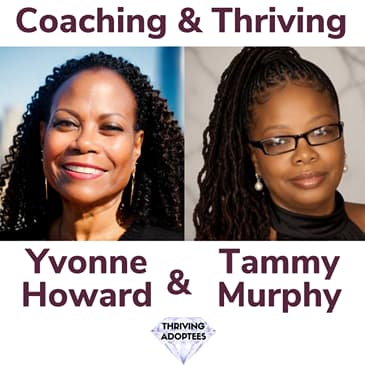
Using what we've learned to help others is one of the most powerful things we can do in life. It brings profound meaning to the tough stuff we've been through. It's alchemy. Lead that's weighed us down becomes gold that shines. Listen in as adoptees and coaches Yvonne and Tammy share some of their learnings.
Yvonne Howard is the owner and principal coach at Unmasked Coaching, with 25+ years' experience as a former licensed counselor, educator, and consultant.
As a biracial adoptee from a closed adoption, she understands the search for belonging. She works with adult members of the adoption triad, specializing in mental fitness and authenticity.
Yvonne pairs compassion with radical honesty and genuine curiosity, believing everyone already holds their own answers.
Wife, mother of two adults and two dogs, she loves knitting and exploring new places, people, and flavors.
Her practice is grounded in her 3 Gs: Grace, Gratitude, and Goodness.
Here are a few words from Tammy Murphy: "I am an adoption attuned certified professional. When I start my coaching business I will be coaching adult adopted women. My niche is Surviving the Daughter Wound. The name of my coaching service will be Life! Despite Adoption."
Links:
Guests and the host are not (unless mentioned) licensed pscyho-therapists and speak from their own opinion only. Seek qualified advice if you need help.
Want to learn more about thriving for you, your kids, your families or your colleagues? Pick a time to talk here
[00:00:02] Hello everybody, welcome to another episode of Thriving Adoptees podcast. Today I have not one guest but two guests for you so I'm delighted to be talking today to Yvonne Howard and Tammy Murphy, fellow adoptees and coaches as well. So welcome to the show. I'm looking forward to this chat, this three-way conversation this afternoon really. Well, morning your time rather, afternoon my time. So welcome to the show. Thank you. Thanks for having us.
[00:00:32] Yeah, you're welcome. You're very welcome. So I guess most people be pretty familiar with the idea of therapy for adoptees, for adoptive parents, perhaps less familiar with the idea of coaching. So I'd love to ask you, you know, kind of one at a time, how you see the difference between coaching and therapy in the future.
[00:01:02] In terms of process or benefits or any way, any way you want to answer that, that, that question. And if we start with you, Tammy, and then we'll move on to Yvonne, if that's okay. I would say what I've learned is as far as like the coach difference between coaching and counseling is coaching is to like motivate and mentor and encourage. So you're healed from it or have learned to cope with it.
[00:01:30] So you focus more on what they like to do and to motivate them to live life despite being adopted. So tap into like what they like to do or just motivate them and encourage them to live life and do what they want to do. Yeah. Then like staying stuck in survival mode to try and learn to get out of that and motivate and encourage yourself because you're still living despite being adopted. Yeah.
[00:01:56] Because I've learned just like what happened to you, it happened to you, but it doesn't have to define who you are or stop life. Yeah. That's what you need to find. I had to like find life despite being adopted instead of staying down and just stuck in my hurt. So that kind of, that's kind of what I learned from becoming a coach. Yeah. And the difference between the two. So definitely kind of like a future focus perhaps, Tammy?
[00:02:26] I think I want to do the daughter wound, focus on that. So like the mother wound. But then we as daughters of two women have to, you know, I'm learning that, that I was hurt by the woman that gave me up for adoption. Then I feel like the woman that raised me, they adopted me for the wrong reason, to replace the child or to have a child. So we had our problems. I think it's, she just couldn't really connect with me, bond with me emotionally or I with her because she had lied to me.
[00:02:55] You know, just the whole life of her not being my mother, I think caused me to break down and not see her as a mother as I got older. Yeah. So I want to focus on that, the daughter wound, where there's more of a focus on us as adopted daughters and our hurt and stuff. Because we were hurt and then like torn between two women, how to feel towards this and how to feel towards that one. Then maybe lose our identity as a daughter. We're two women's daughters, really.
[00:03:24] So how would, with that, with that mother wound that you talk about here, how would a coaching approach be different to a therapy approach with that, that particular part of that particular topic? Do you see a difference, Tammy? Yeah, I've learned like as a coach, I couldn't like focus on the daughter wound exactly, but help her recognize it and then live beyond that. And she understands her.
[00:03:52] Tell her like to try and get her to understand the basics of it, that she has a daughter wound. And then, you know, go from there. And then maybe get counseling on it and then maybe get coached on to live life despite it. But I can't, you know, focus on that exactly, but I can help her, I guess, learn to cope with it with breathing and learn when she's triggered by it, what to do with that. So the coach her to just stay motivated and encouraged for when those triggers do come up. Yeah.
[00:04:22] Yeah. What about you, Yvonne? How do you see the difference between coaching and counseling or therapy? Well, as a former licensed therapist, I have to admit I was really pretty ignorant and I didn't think there would be much of a difference.
[00:04:42] And then as I learned how to be a better coach and effective coach, I realized there's a huge difference in that as a therapist, I or counselor, I would meet with people. They would have a lot of unresolved issues from their past typically.
[00:05:06] And while questions were, I believe anyhow, questions are the forefront of learning about each other. And so questioning is very important in the therapeutic process as well. I found that coaching is even more important because while counseling or therapy is oftentimes not directed by the patient or the client,
[00:05:31] you get guidance from the therapist, especially depending on the severity of your presenting issues. A coach, you have resolved those issues or you're working at the same time with a therapist and you're coming with more present and future focused things you want to work out, objectives. And coaching has a different perspective, which is actually why I left the therapy world in a weird way,
[00:05:57] because I realized one time when I got myself really quiet that my personal belief system is that we're all born with the answers. And that as we get older, we get distracted by other people's influences, family, friends, communities, school, et cetera. And we start that starts chipping away or distracting us from what our truth saw.
[00:06:20] And that so for a coaching client, it's getting them to a place where they have they feel safe in that silence, first of all, because it can be uncomfortable and they can get in touch with their own answers through perhaps my guiding questions. I'm a partner. I'm not there to teach. I'm there to encourage. I'm there to ask questions that are going to help my clients become more aware of their own answers.
[00:06:50] Their own authenticity. Yeah. So. The future focus seems to be. Big for both of you, both the description, I'm saying it that way. Right. And there's a, there's an empowerment part to the, both of you seem to be talking about as well.
[00:07:19] And this I'm, I'm, I'm, I'm fascinated by this. The therapist doesn't help you to answers because just, just to be clear about my experience as a, as a recipient, right. As a, as a, you know, a client or patient, whichever word, word you want to use in which context. Coachee. Do you call them coachees? Clients. Clients.
[00:07:49] Yeah. I've had, you know, I've had a lot of coaching and a lot of business coaching. And I've been on a lot of kind of coachee type online programs as well. Like hundreds, thousands of hours, right. Whereas therapy, I've had maybe, maybe 20 hours in total,
[00:08:18] maybe 30 hours in, in kind of total, including some somatic experiencing. Right. Um, so my experience with, with therapy is, uh, is, is, is pretty small compared to, um, where, where do you see the, the, the, the difference in terms of the, the places that where people are, whether they're,
[00:08:48] Tommy talks about a coach and a therapist alongside each other. Um, where, where do you see the, where do you see the place for, for, for coaching or therapy on, on somebody's, let's call it their, their healing curve. And if we could start with you, Tommy, just, sorry, I'm not sure. Am I being clear with my question, Tommy? I think I got it. I think like, as far as like tap into like what they want to do,
[00:09:17] how they feel about things and then go from there. As though they're healed or coping with their adoption wound or the hurt, just like what they like to do out, you know, their hobbies and interests, their jobs to motivate and encourage them to stay there, focused on that. And maybe learn how to deal with it when they get down or get triggered, maybe to find a way back to being motivated, encouraged to work and just stay, maybe try and stay happy.
[00:09:47] So coach them how to do that. When we're going to trigger it, when they find themselves going down, have them tap into ways to stay, you know, breathing and different techniques like that. And so. Yeah. I guess, um, I'm, I'm, I'm struggling to, to see that, that difference, but clearly as you've done both, Yvonne, it, perhaps it's more, it's, it's more, you've got more clarity, uh, on this. Can you, uh,
[00:10:17] can you take a run at this? I'm not quite sure what answer to what question to ask. Sure. Um, as someone who has hundreds of hours in, um, both therapy and, and coaching on both sides of the desk, um, I, I'd say that, you know, I'll just, I'll just share my own. I can, I'll just speak for myself. I had, you know, as a lot of adoptees do struggle with a number of mental health issues,
[00:10:47] depression, anxiety, um, relationship issues, and ADHD without the hyperactivity. And, um, no one. And, and, and I just found that counselors as a counselor, they have, depending on their orientation. Um, and I, and I'm very much a cognitive behavioral type of person. Um, so you'd go, I, they would, we would discuss how I got there, spend so many sessions about how I got there.
[00:11:17] And with a coach, we're not going to spend several sessions on how I got there. You're here. That's where you are. Now, where would you like to go? And how would you like to take that with you? Or would you not? How, how will you integrate it? Or will you disintegrate it from your life? Does that help? Yeah. It's totally clear. Thank, thank you for that. Yeah. It's really the, the detail on the, the, the run, the, what the first sessions are about. Right.
[00:11:46] So there's, there's, there's no, there's, there's no looking back. There's only looking, well, minimal looking back, shall we say. Exactly. Minimal looking back. Wherever you are, there you go. So you can't completely divorce yourself from the past as much as we'd like to. But we're not, we're not, if something comes up and I would have realized that it was something from a past issue, then that's not, I'm not the person to help you. Yeah. Okay.
[00:12:18] So in a way, the fact that you, that you, that you started as a therapist and then made to move to being a coach kind of reflects that journey because as a therapist, you were looking back and then you've done, and then you've done enough looking back. Yeah. And you just want to, you kind of look forward, right? Yeah. I never thought I would like that, Simon, but thank you. You know, we're all learning to, we're all learning together. A, my, my favorite teacher,
[00:12:48] and he hates being called a teacher. He's not a coach. He's not a therapist. When, if somebody asked him a question, he'll just, he'll say, remember, I'm not a therapist. So, perhaps more of a speaker and a, a speaker and a, and a, and a writer. He says, are we not friends? Are we not friends here? Yeah. Am I, am I not in, in one part of our conversation,
[00:13:17] am I not asking for your, your thoughts, your in, in input? And then at another part of the conversation, are you not asking for, for mine? we are, we're, we're friends here. There's no hierarchy. There's no, there's no client, there's no client relationship. Well, there's no, there's, there's nobody, there's no hierarchy, right? That's the perfect description. There's no hierarchy. I,
[00:13:46] I always like to consider myself a partner to my client, a thought partner. I'm never going to tell them what to do. They're going to tell themselves what to do. Yes. And I'm going to guide them. I mean, if I see a Mack truck about to hit us, I'm going to pull them out of the way, of course. Um, and if I think that, you know, it's escalating to a place of harm, totally referring and calling nine one, which is our emergency. Yeah. you know, however,
[00:14:16] typically it's like, you consider they have the steering wheel, they're driving, and I'm just sitting in the passenger seat. And a lot of times because I'm in a passenger seat, I have a different perspective than the driver. So I might be able to show, Oh, look, here comes a path. They can decide what they want to do. Yeah. So, um, what say you to that, Tammy? How does, how, what, what would you,
[00:14:46] what can you add to, uh, Yvonne's, uh, thoughts there? What, what's, what seems true to you there? I would say basically kind of the same, see where they're at, and then just like guide or motivate and encourage them. And because it's their life, their choice, I'm like the coach to motivate you and keep going. Then to, um, stay stuck in the past. So I would agree to it. Like you're there to help or guide.
[00:15:14] You see them getting off track or diverting back to the past. Yeah. I'm not that I'm above them or better than them, like them basically, you know, but we're just talking. I'm your friend who's motivating and encouraging you. Yeah. Yeah. Um, one of the things that I found a little bit, a bit frustrating with, with coaching sometimes was what Yvonne said about not, you know, um,
[00:15:41] the time it takes to get to the answer. Right. So quest questions, the coach is going to ask questions, future kind of future pacing questions, and, and not be like a, a mentor or advisor is going to tell somebody what to do. Right. You're, you're not going to do that as a, as a, as a coach. So, um, it can be challenging. It can be challenging. Yeah. Um, yeah.
[00:16:12] And so what, what, what, um, yeah, what have you learned around, what have you learned around that and, uh, helping clients and potential clients see that and, and, and, and have that patience, you know, it's the ownership piece though. You know, I think that when you, um, you're able to,
[00:16:41] you're able to help the client see that this is their map. This is what they've chosen. This is what they want to achieve. And it will mean so much more if they come up with it themselves. You have that ownership piece. You are, you feel emboldened. You, this is came from within you. No one is telling you or leading you to do something. It's all on you. Now that's a lot of responsibility.
[00:17:11] And that's a lot of times where you might have a difficult conversation because again, they produce the map that they wanted to go on, or they, they, they, um, set the objective and maybe we're, we're devising the map together, but they're always in charge. I'm not the expert. They're the expert because it's their life. Yeah. And so, uh, tell me, what would you, what have you learned about encouragement along this journey? You know,
[00:17:40] if I'm just talking about a map, we're into a kind of a map and a, and a, and a, and a direction, that sort of metaphor here. What, what have you, what have you learned about, um, encouragement along, along the way? What does that look like and sound like and feel like for you? I think it would be like to stay present to what's going on and also look towards a future to what you want to do. And to be better, where it's like you had said earlier,
[00:18:09] where to empower them to stay in the present, but yet see a future instead of like mine, see going back to the past. So always looking forward the best that you can, you know, just by educating yourself or recognizing your patterns, why you do what you do. And then, or learn to cope with them or try and change them. So to help them like, see themselves and stuff, but they find, discover themselves. And then you, you know,
[00:18:37] help them find a good discovery. Cause there's a good in all of us. I think of what we want to do, but just like with adoption, that could be taken away from you. Cause we lose our identity where we still are who we are. We're nice. We're kind. You know, so help them focus on that instead of their adoptive. So I would say like just being present while looking towards the future. But empowering them. So that, that is, yeah. Presence along,
[00:19:07] presence along the, presence along the journey and future, future, future focus rather than drifting back into the, in, in, yeah. And also say it's also present focus. Yeah. You know? Yeah. Not just future. I, I say, you know, you, your questions are often about where the person is at that moment so that they can help figure out what it is they want to achieve,
[00:19:37] where they want to go. Yeah. Yeah. So if we move it on a little bit, um, I was going to say ladies, you don't mind being called ladies. Do you find that patronizing or something? I think you're okay with that, right? Yeah. Yes. I appreciate you asking though, because there are some people that might not. So yeah, that's great. Yeah. Cool. Um, I find that better than ma'am. I get called ma'am a lot and I don't like that. Okay. Um, yeah,
[00:20:06] I would never ma'am anybody. I, um, yeah. I think that Texas then everybody gets ma'am down here. Yeah. I, I got, I've not been to Texas, but I got served. I got served in, um, in South Carolina. So, okay. You got close. Yep. That was close and a little bit weird for, for a guy who still thinks he's fairly youthful at 59. Right. Yeah. Um, so, um,
[00:20:34] you guys have done this coach training with, uh, with, with, with gift. And that's how, um, that's what brought us together. Uh, you know, a lot of times when, I think when we go on trainings, especially when we're thinking about, you know, training to, to, to support others, we're kind of surprised about how much we learn about ourselves. Right. Um, some smiles going up there from, uh, from, from, from Yvonne. Uh,
[00:21:04] maybe if we start with you, uh, this time on, on that question, then Yvonne, what, what are some of the things that you've learned about yourself through this coach training that you've been with, with, uh, with gift. Oh, wow. Um, you know, in a way it saved me. Um, the whole coaching journey has saved me, but in particular, how I even fell into, um,
[00:21:33] looking into how to get more involved as a coach, as an adoptee, atoned coach, um, and really recognizing what it's a service. Um, the, the, the, the APA, the American society or American psychological association, where they, yay or nay, and also psychiatrists, yay or nay, what goes in the, the DSM, whatever number it is now, um,
[00:22:01] by not paying attention to the issues that adoptees may have. Um, and going back to initially, when I gave you the, the menu of everything I've struggled with over my life, what made that even much more difficult is that none of them were adoption competent. They had no, no, no connection. And granted, this was, you know, a couple of decades ago. So things have changed vastly in that time, but they had no record record, uh,
[00:22:30] no realization of a lot of the issues that adoptees struggle with that make it really different. And the primal wound again, was something that really hit home with me with the program. Um, which is, it's kind of this ambiguous, ambiguous loss that adoptees have, especially if they don't know, um, their birth, their birth family. And, um, just, it just kind of filled in this,
[00:22:59] this hole that I had with information and education. I'm someone that if I can name it, then at least I can start to understand it. And before I just felt like I was just this, this cell floating in the world, you know, and, and most of the time I, I did okay, but a lot of times I didn't. And if I had just been able to be with others or someone that could name it,
[00:23:28] then I wouldn't just feel I was just as weirdo as I often have. And now to the point to where I embrace being different, um, because I was always on the outside. Um, but just, just, I just had no idea of the core issues, which is what I got from gift. Things that are just, everybody seems to know, except I was the last one. I feel to know about it. And I was living it. Um, you know,
[00:23:53] I tried writing before I became a coach and nothing really could heal that wound.
[00:24:27] Um, diagnostic, diagnostic, statistic manual. Yeah. Or, um, psychological disorders. Yeah. And so the, the, this manual has been produced over the, uh, and, and republished, uh, over the years. Like, I don't know how many years, but what people tell me is that it gets, it keeps on getting thicker every time. Yes. And I, I saw a documentary on this on television and apparently,
[00:24:57] uh, the pharmacology, the, the pharma, the big pharma is involved in this. And what, but this is an allegation that I heard on this thing, but like the, the, the, the pharmaceutical companies pay university. Universities to discover new diagnoses so that they can make drugs for them.
[00:25:25] And that's why the DSM manual keeps on getting bigger, but. Don't forget insurance now. Okay. Okay. Yeah. I mean, because they also, the insurance people then also need a diagnosis or, you know, a code from that manual that gets them covered. I mean, it's, it's so it's just, um, horribly enmeshed the medical system. Yeah. So our system's completely different in, in, in the States.
[00:25:53] So when you say in the UK, um, so despite this DSM getting bigger, there hasn't been, um, an, uh, an adoption centric part of it. There isn't an adoptee because as you say, this, so, uh, uh, so what's, what's jumping out at me from this Yvonne is you've done all this training,
[00:26:23] but you, you've, the, the training that you've been in has been, has, has had nothing to do with adoption. It hasn't been adoption specific. It, it, when you were doing the, the counselor training, whereas, whereas what you've got with gift is, adoption centric content. So it's not, you know, when I think of, when I think of coaching, I think of,
[00:26:50] I don't think of content like that, like, you know, like just a, um, I, I don't think of content, like looking at the primal wound as a, you know, as a coach. However, clearly it needs to be, it needs to be there. And because that's what it's given you, that, that's what set, set you free. So it's filled the,
[00:27:17] it's filled the gaps in your education, the conventional psychological counseling education hasn't given you. And isn't that, pardon me, ladies, freaking nuts. It's, um, it's ironic at, by the, at least. That's a nice, more polite way. That's what a lady would say rather.
[00:27:46] It's it. Um, and yet the adoption world space still has so much work to do. Um, and I just, I'm so grateful because I looked for a program. At first I was going to be a different type of coach and I just kept getting pulled in or something would come up. And I looked for a program that would be, that would give me a certification in that specialty. Um, and there wasn't one when I looked initially.
[00:28:14] And then six months later I looked and blah, there it was. And, you know, I have had many roles in my life besides just being a therapist. I've, I've been mother, you know, wife, fur babies, all of it. And the role that has never, or the, the, the entity that, that has really had the most influence over me is being adopted. Regardless of what I'm doing, it's with me all the time.
[00:28:43] And I didn't really recognize the weight that I'd been carrying with it. Um, because I had a fairly decent upbringing. My parents made mistakes. Sure. They're human, but they did a lovely job with what they had to work with, you know, in terms of awareness and me. And so, um, I'm grateful for that, but the program also helped me let go of some of the anger that I was feeling too towards them. Um,
[00:29:13] because they just didn't know. And so now that I know it's for, it's now to me to live better and to pass it forward. Yeah. Beautiful. Fantastic. Um, Tammy, go ahead. Top that. Yeah. Yeah. Um, sorry, that was a bit, that was some, maybe some British trans, uh, humor that word translate. Um, so, uh, sorry,
[00:29:42] did I talk over the top of you there, Tommy? No, no, not really. I hear. I, I'm, I'm, I'm glad that I didn't. Uh, I, I like to be a nice guy, right? A nice, a nice host. Um, what, what, what if, what did you learn through the, uh, through the gift coach training? I think I learned too, that it is more adoptee centric than you can build your family that way,
[00:30:11] which I think is what the people that adopted me thought would do. Cause she would have a miscarriage. And then I learned that I had a bias towards birth mother since I was given up. And I, I was lied to about why she did it. And then I learned that while I was me, me, me was adopted. That's why I was thinking about that earlier. I got siblings where I know of a sister and we've talked years ago, but she could have been affected by it to think why you gave a child up. I don't know. It's why I didn't realize that a whole,
[00:30:39] a lot of other people are involved, especially if you have birth siblings that they could have been affected by and held some kind of anger towards the mother for giving the child up. And so then the parents, where I learned, I think like from a male perspective, let's say he's the reason that there can't be a biological child. He could feel some type of way. And do you blame him for it? Or let's say an argument comes up. How do you not bring that up? So I didn't realize how much to go into people.
[00:31:08] Should you get an adopted child when you can't have a child, can't have your own children or adopt when so much could go into it with you and how you feel at the end of it, the married couple, one could want to, one could not want to, then there's an innocent child. That's brought into maybe that. And neither one could really connect the bond because they really didn't want to adopt. Cause there'll be that genetic loss, but a man may do it because the mother wants to do it. But I think in my case,
[00:31:36] the father wanted to adopt and make a family than the mother did. It's kind of helped me understand. Maybe that's why we wasn't as close or not. I was closer to the father. And then she would be negative and say, he loves me more than her. So then that would make me not want to love him. So it's a lot that goes into it. If you probably really should have stayed child free, I think. So I've learned that. Yeah. So the, the, the,
[00:32:06] the through line is about understanding and the, the, and the, the, the kind of a amazing thing for, for me on the outside of this, just trying to you two ladies about it is how, personal and profound, the learnings with you, you, you both got completely different, different insights, different,
[00:32:35] different learnings. Yeah. From, from, from going, because you were on the same cohort, right? So you're going through the same courses, but getting, getting something, get, getting completely different learnings. it's, it's, it's, it's a gift, right? It's called gift coaching, right? Yeah. It's a gift. And, you know, Yvonne, you were talking earlier on about authenticity and, you know, who we, who we, who we truly are.
[00:33:05] Can you, can you talk a little bit more about that? Given what we've been talking about in the last couple of minutes. Sure. I mean, that, that's the other aspect of my coaching business is authenticity and, um, mental fitness, because they also have helped and, and they tie in so well with adoption as well. And so, um,
[00:33:32] I find that mental fitness is probably my foundation for my coaching and for my life. And in that I, um, went through a different program and it just helped me again, put, put names to things and ways that I might be sabotaging, um, myself. And that's something else that a lot of times adoptees do a lot of self sabotaging. And by identifying my thought process,
[00:34:01] then I could through different types of, uh, meditative or, um, just different ways of distracting my mind. I could calm myself down because one of the things I struggled with was emotional, uh, dysregulation. And so that mental fitness part is something that helps put everybody on the same kind of same page, so to speak. And then identifying your core values, not your parents,
[00:34:31] not your birth families, your husband, spouse, or whatever your, what matters most. And then looking at how you're living your life and how well did the core values you've identified, how well do they align with your life, with your career, your relationships, relationships, and then whether it disconnects, trying to, um, peel that back to see what, what's going on there. How come you're there? Yeah. Yeah. Um, we, we, we,
[00:35:01] we talk a lot, people, I did an interview earlier on today and we, we kind of explored this idea of getting in our own way. Right. Um, which I have a bit of a challenge with, cause I can, I can, sometimes I can take a metaphor too far. Right. But I, I truly believe this. Like we, we can't, we use this, we use this thing. We use these words like getting in our own way,
[00:35:31] but we can't actually do that physically. It's, it's, it's something clumsy. I think I get it. Um, yeah, I'm pretty clumsy. I'm pretty clumsy too. Uh, uh, and, um, yeah, spatial awareness. I, I terrible. and hand eye coordination, parking, driving. Maybe it's an adoptee thing. Maybe, maybe add that to the list. Okay. That's,
[00:36:01] no, let's not know. Um, uh, yeah. I, I sometimes think, um, I see, I see a post, I'm waiting, I'm waiting for that day when I see a post on Facebook saying, uh, I, I, I jumped out of the bed this morning. I stubbed my big toe against the, uh, against the bed head. And it's because I'm adopted. I think, you know, sometimes we can, the psychology, the psychologists call it, attribution error.
[00:36:31] Do they not? Yes. Attribution. They do. Yes. They call it attribution error. Um, yeah. Oh, there's one for you. Oh, I like that. Yeah. Where, where, where there's one for you. Um, what have you learned about attribution error? I have no answer. I usually have an answer to my own questions. Right. But this one, I have no answer whatsoever. I'm not going to come in and say, ah, funny. You should say that funny. I might be, sorry. Zip.
[00:37:02] Attribution error. What have you learned about attribution error? Oh, let's, let's define it first in case people haven't heard it. What it, what it's about. I've never heard of it. I'll tell you. I learned today. Yes. What it is. I mean, I kind of have an idea. I think what it means, but I've never heard of that put together. There are the terms. Have you got, have you got a, a, um, a definition of what it is? If I just don't have to come to mind.
[00:37:32] I do, but I want to find the actual, well, it's, it's more like a self-serving bias. That makes sense. You know, you, you kind of attribute, um, I'm, I am clumsy because my, my parents adopted me and they were overprotective. So I wasn't really allowed to do that.
[00:38:00] And then meeting someone else who also is clumsy and then finding out that they happen to be adopted. So now all adopted people must be, must have that same, um, challenge. It's kind of like painting, um, with a broad brush. And then sometimes that can be, I have a positive impact because then you kind of create a tribe. Right. And we like to feel that we're a part of a tribe. Yeah. Does that make sense? Yeah. Yeah. Um,
[00:38:31] I, the best that I can come up with to, in this context, uh, is blaming what is human on adoption. That's better. Um, so, but I, I'm, I'm using blame's a big word, right? So I'm, I'm not being particularly, uh,
[00:39:00] considered here. I'm, I'm not being neutral, you know, but, uh, attribution error. I think it, it, it's in a more general context, it's, it, it's, it's seeing a, getting cause and effect wrong, perhaps. That's, sometimes that line is very blurry. For example, you know, is it that I have a teenager who is just going through normal teenager things,
[00:39:29] or is it because they're adopted? I looked it up. Sorry. It says, in psychology, attribution refers to how people, how people explain why things happen, especially their own behavior and other people's behavior. Yeah. Yeah. It says that modern shift would be where people stop using simple explanations and just different things. It says something else, but then I looked it up first from a psychology standpoint.
[00:39:59] Yeah. Yeah. I, I, I, I think it goes back to ambiguity. Maybe I can't remember. Because we're ambiguous, because the loss is ambiguous. We, we struggle to see, to, to, well, to attribute correctly.
[00:40:29] And how did we, how did we get there? Yeah. Yeah. Um, so one of my little things here that I see is we, because the loss is ambiguous, we, we make a mountain out of a molehill or a molehill out of a mountain because we have no side. We have no idea.
[00:40:57] No conscious idea of the size of the thing, the loss. Yeah. And so there are no boundaries. So it can be as expansive as it likes. Yeah. Which is dangerous. And that's where getting some healthy coping skills and coaching also helps so that you can really kind of peel it back to say,
[00:41:26] is it, you know, it's called catastrophizing, right? Is it really that it is horrible, you know, hot as, as, you know, hell type weather, and it's going to be like that forever. Or is it that today's a really hot day. However, I live in Dallas, Texas. It's the end of July. It should be hot. Right. And then blaming it because I'm adopted, you know,
[00:41:54] adding that into the mix and I'm making, making light of it. But I, I think it's also about, um, not, not, it's like a chicken little moment. You know, the sky is falling, the sky is falling type thing. And it's really not. But if you walk around feeling like that, how horrible, you know, it's, and it's, it doesn't have to be so heavy. Indeed. Does anything come to, to,
[00:42:24] to mind for you, Tammy, on this ambiguity question or topic? I think like, I never really saw it as a loss before until I got older. So I'm kind of getting there. Maybe just kind of, I guess, deal with it or accept you did lose your birth family and how that would have affected you. I haven't really tapped in that yet. I'm just now getting there that I wasn't raised with biological family. So there was a loss. And so, cause it was just that,
[00:42:54] what can I do? I'm adopted. You know, I just do have real family and I wasn't with them how that would be a loss for me to feel alone, but not alone. But while I may be different than my birth adopted parents, so I have to deal with that part of it for myself to understand it more. Yeah. Yeah. What, as you were talking there, Tammy, I was thinking of like a curve, right?
[00:43:22] So we talk about a learning curve. We use that phrase quite a lot, don't we? I think of like a, I think of like a healing curve as well. And maybe there's also a clarity curve.
[00:43:41] Maybe there's a clarity curve where the ambiguity is resolved, it's clarified. You know, I, so as kids, adoptees are thinking, having all these, what's, yeah, everybody's got a different amount of questions, right? Every adoptee's got a different amount of questions.
[00:44:09] I was on the, at the no questions end of the, of the, of the continuum. But the, there's not only the, the, the number of questions, it's the kind of the emotional charge that's with the questions, right? So you can say, but what I mean by that is, why was, why was I, why was I adopted?
[00:44:39] Or you can say, why was I adopted? You know, it's got the, there's, there's, there's, there's not only the question, there's the amount of emotional charge that's, that's with the question and how painful that, that, that question is. And, and maybe that's, that's the kind of the, the start of the ambiguity to clarity curve, right? So the questions only come later, right? You've, if you're, if you're adopted as a, as a infant,
[00:45:09] or you're adopted at five weeks old, you collected at five weeks old, like I was, right? You, you don't have any questions. You don't have any questions because you haven't got any thoughts. Yeah. We're, we're in the jargon. What's it called? Precognition. Is it? Is that what people call it? Yeah. Yeah. So what, what do you, what do you make of this idea of ambiguity curve? I don't know.
[00:45:38] It's challenging because it hits people. So, so uniquely, you know, I mean, I was adopted shy of three months when I was a three month old. And again, since I always knew I was adopted, it wasn't so much of why was I adopted? Although sometimes it was, it was, but yet the question remained, you know, and if you think,
[00:46:06] if you're talking about the emotion behind the, the expression, well, where's that emotion coming from really? Right. Is it because they have such a mistrust now? They, they have less self-worth because of what, I mean, so what's the emotion about? And you really getting into that because the words, if you just typed out those words, why am I adopted? It's okay. Well, you were adopted because ABCDE. Okay.
[00:46:37] Moving on. But that emotion, what is that about? Yeah. And that helps to clarify the ambiguity. Yeah. So tell me, do you want to take a run at that? What is, what is that emotion about? Hmm. I think it just may be sad. Sadness and hurt and anger where, why you were giving up and not kept, I guess, and just why, you know, in my case,
[00:47:06] it wasn't really a lovely home. So I think until 17, I kind of really struggled with, or used to cry all the time about why. So I think it just would be like, then I was told what was true. I was sad as a girl. I found out at nine. Wow. And maybe understood it by the time I was 12, because I was asking questions to the adopted mother, did you have me back in? Did you get a cesarean? And how long were you in labor? And then they were older people. So they got married in 1955,
[00:47:36] but didn't have me, adopted me until 1968. So that didn't make sense. I think it was just for me, just like a sadness of why I had to go live some, or why she gave me up and kept others. And then they were, but they were loving to me. And I guess the best they could be would say, there was domestic violence amongst them. So it's like, why was I there or placed there in a non-loving home to when I want to be loved or supposed to be loved? You know, if they took me in as their child,
[00:48:07] I think it was just you with your emotions of not knowing or understanding of why, because you may be lied to, which is then going to make it worse. So you have to kind of figure it out on your own, at least your own conclusions. And so maybe meet your birth mother, which I did as an adult. And so she kind of told me different than what I heard. So I heard I was abandoned and just left at the hospital. And when I met her in 98, she said that she left with a man, but it was my father. She didn't abandon me.
[00:48:36] She just placed me for adoption. Wow. Yeah. Sadness was the one that really landed for me. Out of that, sadness and anger. So for me, the, you know, when I, when the, when, when the, when I became conscious of the trauma, it was, it was anger. It was anger there.
[00:49:06] And then reading about my birth, reading about my birth mother, it was sadness for her. And I, I think of, I think of coming out of the fog. As, you know, I think of that, that's,
[00:49:33] that's when the ambiguous loss becomes unambiguous, right? To, to an extent it becomes, we, we become aware of it. The, the, the, the subconscious trauma becomes conscious. It's how, kind of how I see it. Yvonne's nodding. You can't, you can't hear that on there. You can't hear that. Yes, I'm, I'm, you're nodding. no, I'm, I'm, I'm pulling you like that. So, and I'm,
[00:50:04] so the, so the, the metaphor that comes to me or the, the development of the metaphor, right? Is we come out of the fog. I think of the fog as the time when we are unconscious of our, of our trauma or perhaps unconscious of the, the source of our trauma. You could say probably both. We, we come out of the fog. The fog lifts to reveal the storm.
[00:50:35] Trauma's like a storm. I think of, you know, Tammy mentioned sadness. I think of sadness and, and grief, like the, the rain, the tears, right? Tammy, you talked about crying all the time. I, I, I think of the thunder as the, anger, anger. Tommy mentioned that anger, anger. It felt like for me. And then the, so thunder, thunder as anger.
[00:51:05] And I think of the kind of the, the scary bit, the scariest bit is sometimes the, the, the lightning. lightning. So I think of the lightning strikes, the bolts of lightning as fear. Or if I'm feeling in a, if I'm feeling in a very doomy space, terror, I kind of upgrade, upgrade from fear to fear, to terror. And,
[00:51:33] and then that, that come, we become conscious of that. damage after the storm to like, I guess the fog is lifted. Cause I think I went through that to, after the adopted mother died in 2008. And my adopted father died in 95. So I guess I felt okay to now think about me and being adopted and reflect the anger, sadness and hurt. So I can see that,
[00:52:02] like what the fog means. Now you can see clearly of how you, but I don't know if that would come after you maybe birth both adoptive parents. And then, cause now you can like think about, I mean, you will, but it's like you may feel more freedom or okay to think about it and why and how you felt when you had to keep it for so long. That's how I was at the beginning. Cause I'd heard about the fog, but I didn't really. Yeah. Until I knew what it was.
[00:52:29] And I think the program really helped me get out of the fog as well. The gift program. Because I had no idea what I didn't know. Right. You don't know what you don't know. And. And then getting my original birth certificate where my birth mother's name was on it. And that confirmed the questions I had about her ethnicity. And she was Asian,
[00:52:59] Cambodian and. Being able to find out some things about her life or her, her family life, really. It opened up another level of awareness for me. Um, and then learning that I had experienced trauma because I hadn't really classified my experiences of being adopted, um, as trauma. But then as I learned, it then helped me realize, okay, I, I,
[00:53:27] I went through something very traumatic. I'm not crazy. I'm not, um, you know, just this horrible person. That's off kilter. I have to process what's happened to me and no one ever has let me know that that's what I needed to do. And I think that's the case with a lot of adoptees, not all, but for those that are struggling, they just need a guide to help educate that will not educate, help share. Yeah. Yeah.
[00:53:56] So we're coming up on time here, ladies. Tammy, um, have you got anything that you'd like to share? And then we'll go on to, and anything that I've not asked you about that you, you'd love to share with the listeners. I think like as far as my coaching service, I haven't started it yet. I'm still building it, but it's called life exclamation point. Despite adoptions.
[00:54:21] I want to help adopt these once I come out of it more than I have to come out survival mode and just existing, but living. So again, finding life and happiness, despite adopting a focus on the daughter wounds. Yeah. Yeah. That's it. And thank you for having me on. You're welcome, Tommy. You're welcome. Yvonne, is there anything that you'd like to share? Um, don't give up.
[00:54:50] There are more resources out there. Just, um, take a breath and reach out. And, uh, you're not in it alone. Yeah. Thank you. And thank you for this great opportunity. Yeah. You're very welcome. You're very welcome. Thank you. Listeners. We'll speak to you again very soon. Okay. Bye. Bye.