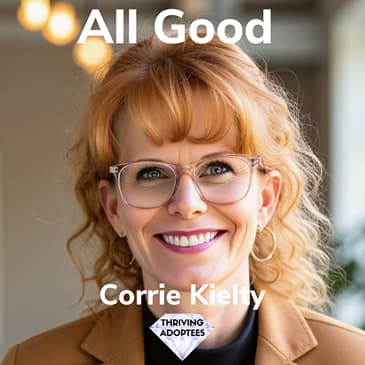
Being all good with the past has a strange way of empowering us to change more in the future. Listen as Corrie shares learning about acceptance, without fear and more.
https://www.linkedin.com/in/corrie-kielty-bb533357/
https://www.facebook.com/NebraskaCASA/
https://www.instagram.com/nebraska.casa/
https://www.linkedin.com/company/nebraska-casa-association/home/
Guests and the host are not (unless mentioned) licensed pscyho-therapists and speak from their own opinion only. Seek qualified advice if you need help.
Want to learn more about thriving for you, your kids, your families or your colleagues? Pick a time to talk here
[00:00:02] Hello everybody, welcome to another episode of the Thriving Adoptees podcast. Today I'm delighted to be joined by Corrie, Corrie Kielty. Looking forward to our conversation today Corrie, an absolute star. We haven't spoken since July, but she's been a very busy lady. So thank you for making time for us today Corrie. You're a star. Thank you. You're welcome. So as I was saying to Corrie before I hit record, we're having a bit of a Casa run at the moment.
[00:00:30] So, court-appointed special advocates. These are volunteers who are the constant advocate for kids in care and whilst their world may be changing all the time, multiple placements, different judges, there's one solid concrete person in their life that never changes, which is the Casa volunteer.
[00:01:01] So they're a CASA volunteer. And then the CASA, the organisations recruit and train those volunteers. And Corrie runs Nebraska CASA and she is also a mum to three boys, one of whom joined their family by adoption. Did I get that kind of okay, Corrie? Absolutely correct. Absolutely correct.
[00:01:27] Yeah. And the key thing about the volunteers, another key thing that I forgot yesterday, so I'm going to say it again, is that the Casa volunteers are not paid. They are volunteers.
[00:01:40] And that means the world to the kids in care and the teens in care that you are advocating for because they know that their advocate is doing it from the goodness of their heart, not for a paycheck. And that makes the bond, the starting of the bonds, extra special. Yeah.
[00:02:06] Yeah, you're correct. Yeah. I think a lot of people are surprised at how young a child understands this person is here because they want to be here, not because they're being paid to be here. Yeah. Yeah. So the biggie, the big question that we like to start with, Corrie, thriving, what does that mean to you?
[00:02:32] Thriving means growing, learning and feeling safe and cared for so that you can do those things without fear so that you're not stuck in patterns of unhealthy behavior. Yeah. Yeah.
[00:02:57] So you've got so much going on, right, as a mom, as a leader of a Casa. How do you find time for learning? Oh, honestly, I think that so I've worked for nonprofits with a couple of times that I left for a few years to work in public policy for over 30 years.
[00:03:23] And I always say that working for nonprofits, you know, you may not make very much money and you may not have the best benefits.
[00:03:31] But honestly, we are blessed with the ability to attend trainings and seminars and work with others who we just get to grow and we just get to learn so many things about how to be a great person and how to be a great whatever you do.
[00:03:55] Right. For me, it's supervising our local programs. And so, you know, being able to learn what's best to include all of our staff so that all of their voices are heard and then make sure that they're learning how to do that with our volunteers at the same time.
[00:04:14] Yeah. So what's yeah, I sometimes skip on just to the next question, don't I? Without feeling that. Right. So this is this is kind of built in the learning opportunities are kind of built into what you're doing. I think that's kind of what you say. I think so. Yeah. Yeah. Yeah. Yeah. I mean, first for us, some some of the learning is required for CASA.
[00:04:41] We have standards from our national association and some things are required that we, you know, not exact trainings, but that we have specific training. So are we inclusive in our training so that all of the children that we serve feel like we are empathetic to their circumstances and where they come from and who they are? And then, you know, you get funders that require certain things.
[00:05:09] We have government funding that requires us to do certain training. So it's just, you know, it's a matter of those things. And then utilizing the funding that comes to you for trainings so that you make it something that is rewarding to the people as well as the work that they then do.
[00:05:33] Yeah. Yeah. So what's fresh for you at the moment then in terms of what you're what you're learning? So something we just did, our director in our largest program applied to be a part of a leadership program that's actually funded partly by national funding, but also partly by an organization called Adopt U.S. Kids.
[00:06:00] And they're a nonprofit and they promote the adoption of children in foster care. So this leadership program selects people from all over the country and then they do a research project. And we went to Washington, D.C. last month and got to see all of their research projects presented.
[00:06:25] And it was amazing because these people who are already experts in their field chose something, you know, and said, hey, this is something that we. And so like, for instance, one of them was father's involvement in in the system. One of them was ensuring that siblings are not placed in different placements, that they stay together in their placements when they enter the child welfare system.
[00:06:53] And so they have fresh perspectives and also experience in the system to be able to look at, you know, new ways to do things that have been a challenge probably for a long time. And so it was just I just love listening to all of those research presentations and the new and of course, then bringing them back to Nebraska.
[00:07:13] Yeah. Yeah. And how how does that learning how do you how does what you kind of take on from a professional perspective? How does that translate to you as a as a I can't say mom because I'm British, but mom, mom, you know what I'm saying? You can say mom. And what do so, you know, I have five grandkids.
[00:07:39] So what's what's the typical we have lots of different names for grandma and for my family, we're grandma. So I'm grandma Corey, but there's lots of right. So what's the typical thing over there across the pond? Oh, grandma or grandma. Yeah. OK. Yeah, I had I had I had a I had a gram and a pop. And I had a grandma and I and I never met her.
[00:08:09] Her I never met my her husband because he died before. Yes. Came along. Right. So, yeah, a grand and a pop. Grand and a pop. And a grandma. That's what I had. Your grandma. I'm grandma. Yep. Yep. And that's what I called all my. And because I was my parents were so young when they had me, I had all of my grandparents were alive.
[00:08:36] And then I had four great grandmothers and one great, great grandmother when I was born. Wow. So there was a lot of them. Yeah. I was spoiled. Yeah. Yeah. So how does the learning then translate to being a great mom and a great grandma? I think it translated into being a good person. Right.
[00:08:59] And I think that being a good person and always trying to incorporate what you've learned into what you do daily. You know, it makes you a better mom, makes you a better grant, makes you a better person. And isn't it odd that the hardest thing is when we learn skills.
[00:09:19] So like we learn a great communication skill, but it's the people that are closest to us that we sometimes have the hardest time being able to, you know, be the nicest to and utilize. And I suppose that's the emotion involved, the love that you have and the passion for who, you know, those people are in your life. But yeah, trying to put those things into incorporated into your daily life, I think is what does it. Yeah.
[00:09:51] I've been, well, I was going to say, can you have a word with my wife about niceness? She can be a little bit critical. But I had a realization over the weekend that she is far less critical than other of my friends' wives. They get a lot more stick than I do.
[00:10:17] But because they get so much more stick, I think they're just used to it. So it's like water off a duck's back. But because mine isn't quite as persistent and consistent and always present, and I'm a little bit sensitive, it tends to land a little bit more for me. Yeah. Yeah.
[00:10:44] So it doesn't help to know that it's more difficult for some of your mates. In some ways. In some ways. I do think that, you know, our closest relationships are the ones where there is the trickiest stuff. I think. Is that kind of what you were alluding to? Is that what you said in slightly different words? Yes. Yes.
[00:11:11] Because you care so much, you know, that sometimes the new things, new skills you may have learned kind of go out the window because the emotions take over instead of the logical thinking. Yeah. Yeah. You know, you talk about being a great person and you talk about skills.
[00:11:33] The great person bit sounds more essential to me. things coming to mind.
[00:11:51] A podcast that I used to listen to, they were interviewing the captain of the South African rugby team who had taken the team to victory. And the sports psychologist, who's one of the co-hosts on the podcast said to this, this, this guy.
[00:12:17] Could you describe your, could you describe your leadership strategy or something like that? Right. And, and, and this guy just, he didn't miss a beat. He just said, it's just who I am. So he was going to character rather than strategies. Mm-hmm.
[00:12:41] And the, the, the, the, the strategy question was kind of too superficial, too passing. It just, it, it, it, it wasn't a deep enough question for this guy. Mm-hmm. The sports psychologist didn't take the, didn't see it, right? Yeah. Didn't ask him a deeper question. He, he, he just went on to ask him another, to, to me, what seemed to be a, a kind of a banal question.
[00:13:10] Do you know, do you know what I'm getting at here? I know what you're saying, yes. You know. Yeah. I think it, it, it, so for me, you know, we can look at skills or we can look at where we're coming from, how, how we're being in the moment, who we essentially are. And, and that's, that's, that's going to be far more powerful, a driver of how we relate to one another than skills.
[00:13:39] Yeah, I agree with, I think that is more powerful of a driver, but I also think that no matter who we are, we've learned unhealthy habits, unhealthy ways of doing things. And that the ability to learn, oh, I do that because I feel this way or because I learned this pattern and I can change that and be different.
[00:14:05] I mean, I think that that's essential to, again, agreeing with you that our, our, you know, ethics and morality is, is the main driver. But, but I think we all have that and I think some of us, and especially, you know, the children that we work with and the youth that we work with may have learned so many unhealthy coping skills.
[00:14:28] And then they grow up and they have terrible outcomes and they are doing what, they're maybe committing crimes or, but all of that is learned behavior. That doesn't mean that they don't have just as much morality as I do. It's just a matter of the fact that they've never felt the, the comfort and the safety in life.
[00:14:55] And they've never had those opportunities to learn, oh, well, this is an unhealthy behavior that I learned because ABCD happened or because my parents did it or whatever reason. And I've just repeated it because I've gotten whatever reinforcement from it over all my lifetime so far. And I need to learn something. Unfortunately, incarceration doesn't teach people those new, right?
[00:15:21] And so I think, I think for me, it's really important to remember that I believe we're all good in, you know, and it's just a matter of what's happened to us in life that has changed the way that we behave and that we do things. Yeah. Yeah. So what, what helps you change?
[00:15:48] You know, isn't it interesting that there's so many things I think that when I was young, I just couldn't see. Like, like, I, I just forged ahead. And maybe that was because I had three little kids that I was raising and I was just so focused on supporting them and doing what I needed to for them while feeding, you know, having a job to feed them and, and, and, and house them.
[00:16:16] Um, but I think the older that I get, the more I can, things are just like, Oh, why didn't I never realize that before? Why didn't I ever see that before? You know, I think a great example of that is, um, I grew up and I think we talked about this before. I grew up in a very small rural community in Nebraska and it was very, uh, white. Um, and we all sort of saw things in the same way. We all spoke the same language.
[00:16:46] No one had any accents or anything, right? We were all just so the same. And so it took years and years after I moved into a more multicultural community to be able to understand the differences and why diversity is such a great thing and how you can benefit from people's differences.
[00:17:10] And the, the fact that we see things differently when we're raised differently and have different cultures and have different languages. And, and I think, I feel like there was just over and over again, awakenings to, Oh, that's why this is this, you know, and that's why this is this way.
[00:17:29] And I think when we have the ability and the time to sit back and say, I can really observe this instead of just every day doing my thing over and over again. And, you know, checking my, my to do list, um, tasks off my list that, um, that helps to, to be able to learn. Yeah. Space for reflection. Yes. Perfect way to phrase that. Yeah.
[00:17:59] And where do you, how do you find time for, for that within the, within the routine, within the busy life? I think you have to make time. Right. You have to make time for that. Yeah. And sometimes that that's a matter of, you know, one of my staff saying, Hey, I'm in this program. I need a mentor. Will you be my mentor? So I, I of course say yes. And then I get to go to this thing in Washington DC and see all that, you know, sometimes it's just a matter of,
[00:18:26] I'm actually doing what I should do for my job, but it, it, it gave me that space. Right. Yeah. And we, and, and we provide those spaces for our staff. So when, for instance, I'm right now organizing a meeting, we, we meet with the local program directors once a month on zoom, but we try to twice a year have an in-person meeting. And, and, um, so I'm organizing January.
[00:18:54] So that will be a part of that agenda for that day. Is that time, you know, and it's really, we're doing it for them, but it will give me that time as well. Yeah. And you, you obviously the trip to, to the, to, to DC was about, uh, fresh perspectives and, um, but fresh perspectives from different people.
[00:19:18] So they were sharing, they were on a research program, but then they were sharing their findings. So it, it, it trickles outwards. Yes. Yeah. And, you know, we had time to spend with each other where I could talk to people who work in different areas of child welfare across the country and hear about their, you know, what they do as well as their lives and who they are.
[00:19:45] And also I had a four hour space where, you know, I wasn't at home, so I didn't have anything to worry about and I didn't have my dogs to walk. So I actually went for a walk all by myself. So, you know, and in DC, you have the ability, I went to some of the places that I love there, including the, the FDR monuments, which he was one of my favorite presidents.
[00:20:12] And, and they have all these phrases that he, uh, put, you know, he's the one that, that, um, put medic, Medicare in place so that older people in the United States would have health insurance like you have for every person. Um, and I, I believe very much in that. And so he was one of my favorite presidents. So that, you know, that gives you some time to, yeah.
[00:20:40] Was he the Bruce of all that said, don't wish life was easier, wish you were better or something like that? Was that one of his? You heard that? Not that I know of, I don't know who that was. It could be though him. Yeah. He had a lot of those quotes. He was our, that's another thing that I think about every time I, he, he, he had had a, I think polio when he was a child. And so he's in a wheelchair.
[00:21:08] And so they always made sure that they didn't show his, you know, because even today, I mean, back then definitely, but even today people think that that means that you're a weaker human or whatever. Right. So they had, they kind of hit the fact that he was in a wheelchair. Yeah. Yeah. So what, what gets in the way of our thriving, Corrie? Or your thriving? Ooh, that's a good question.
[00:21:39] Probably I get in the way. It's a, it's a, it's a common thing that people say, but is it true? Have you ever, have you ever tried to, have you ever tried to get in your own way? I can be a bit pedantic, Corrie, right? And a bit logical, a bit left brain.
[00:22:03] If you, you, have you ever got in your way physically? Right. You're walking down the street and you get in your own way. There's only one of you. Yeah. I don't think physically. No. No, no, no, no. But definitely in my own head. And definitely, I think being, I, I believe I, I live a privileged life.
[00:22:33] You know, there are a lot of people, including all of the children that we work with in child welfare who have no choices. And I have so many choices. And so I think those, that that's what I was thinking when I, when you asked me what gets in the way. And I said, me, is it's those choices that I get to make for myself. Yeah.
[00:22:57] I, whenever I hear the word privilege, well, recently I've been hearing more the term white, white privilege. Yeah. So multicultural. I've, I've always, somehow, I, for me, that's kind of, there's a, there's a criticism built into that. Yeah.
[00:23:25] I don't think, I think that we put our own criticism in that, right? I, I think some people see it as a criticism. I don't, I don't think that my privilege takes anything away from all of my hard work or how intelligent I am or any of those things. But I think I need to recognize that I do have more privilege than a lot of other people. And so I need to use that to make the world a better place. Yeah.
[00:23:54] I had the, I had a funny, well, I had an insight about privilege about three or four weeks ago when a lady, a volunteer that works at the community swimming pool that I go to. She, she, she said that I, she knows what I do. She's, she's retired.
[00:24:22] A very kind of socially minded person. And she said something, something to her, well, Simon, you're, you're very, you're very privileged. And it, there was no criticism in it whatsoever. And I thought, oh, wow. Privilege isn't, the word privilege, it doesn't have criticism baked into it.
[00:24:51] And, and you've just, you've just said, well, from, from your perspective, no, there's, there's no, there's no criticism built into the word privilege. And you also said, we build it in. And so you've helped me see that I built it in. Just to me. Yeah, I think, and I think that there are a lot of people that get defensive when they hear it.
[00:25:21] And then they communicate that, that, you know, I think, I think it's become, as the word gets used a lot more and, you know, that that's been something that's happened is that people say, oh, you say I'm privileged as an excuse for you not to work hard or not to whatever. And, and I think, I think that's kind of gets, starts to get baked into our psyche as well.
[00:25:45] And certainly for me as well, you know, I mean, I would never want someone to take away all of my accomplishments and say, oh, you only did these things because you were privileged because you were right. That's probably has something to do with my accomplishments, but I certainly worked very hard, you know. Yeah.
[00:26:10] I've spent a bit of time thinking about what gets, what is getting in our way when we say I got in my own way. I'm getting in my own way. I've, my little conclusion on this is it's a belief. A belief has got in our way. Okay.
[00:26:31] So congealed thought, like a belief that we can't like, so what a belief about, about money or a belief about impact. Right. So for, for me, the impact thing would be one, right. The belief is that. That we should have more listeners to this podcast.
[00:27:01] You know. Yeah. That, that, that, that, but, but then I, uh, an adoptee who I, uh, I've interviewed a couple of times and a friend of mine, I haven't spoken to this for a while actually. Um, he, he, he, he said something to me like, um, Simon, I was talking about download numbers.
[00:27:25] He said, I think you're getting quality mixed up with quantity. And what did he mean by that? He, he, he meant that it's, it's, uh, the, the, the quality of the, the quality of the conversations. It is more, it's more important than the quantity of downloads. Yeah. Yeah. Yeah.
[00:27:51] Um, and then I, and I keep on seeing that in slightly different ways. Right. So I, you know, so who are we doing there? Who are we doing the interview for? Right. We're doing it for the, for ourselves, for you, for me, we haven't been, you know, hopefully you're learning some stuff. I'm learning some stuff. I'm aware, and I'm interviewing you about what you've learned.
[00:28:15] So to, to benefit the, benefit the listeners, but, um, we're, and we're also benefiting the, the, the, the, the listeners family. So I had a, a lovely email from a, a guest that was on sometimes last year. She said, oh, my, um, my, my daughter, uh, my adult daughter.
[00:28:39] So daughters in the thirties said that she'd listened to, she'd listened to the interview with her, her mum, her adopted mum. Uh-huh. And, uh, she, she just said, uh, she, the, the daughter said, I wanted to say thank you for sticking with me when I was a troublesome teen. Something like that, you know? Along those lines. Yeah. And I thought, oh, well, that, that's another ripple.
[00:29:07] That's, that's, that's something that's really, that's something really important. And that's way more important than the, than the numbers of the, of the, of the, of the down. So the belief gets in the way that, so the belief gets in the way of, of me enjoying the, the quality of this thing. Cause you're thinking, well, I need more. Cause you're worried about, yeah. Yeah. Yeah. That makes sense.
[00:29:32] It reminds me of, you know, there's so much talk about visioning and all of how, how you vision things to, to become true. But I think to me, that has a lot to do with how you see yourself. And for instance, if you think I can't do something, you won't even try, right?
[00:29:58] If you think this is where my limitations are, then you're not gonna, but if you don't think you have those limitations, then you'll go for it. Yeah. And do it probably. And yeah. So a self-limiting belief is, is the, is the one that gets in, gets in, in our way of our potential. Yes. Yeah.
[00:30:28] And one of the things that's becoming clear to me that within this, within the adoption space, within the foster care space, within the broadest or child welfare space, we don't hear a lot these days about self-limiting beliefs. We don't hear a lot about mindset. It, it tends to be more about trauma. Yeah.
[00:30:58] Yeah. Trauma. I was working at a women's, uh, substance abuse and mental health treatment center. We had several facilities and women could bring their children to a couple of our long-term programs, small children. And that's when trauma really started becoming prevalent for at least services in Nebraska.
[00:31:19] And, uh, it was interesting to me that a lot of diagnosis that are, you know, on the list of diagnosis that then people prescribe, uh, medications for often, um, were really trauma, right? They were really trauma reflecting in behaviors.
[00:31:47] Um, and they were going back to what we're talking, you know, they were self-limiting because it's how people had learned unhealthy coping skills to deal with trauma. And then that was a behavior that then got diagnosed as a mental illness and often drugs were given for it.
[00:32:06] And so I think that I really like the, the fact that trauma has become something that we're looking more closely at, but also we can't blame trauma for everything. Right. We can't say, I think I've heard, especially people that are younger, you know, say, Oh, well, that's, that's traumatizing.
[00:32:34] I can't, well, a lot of things can be traumatizing and are traumatizing, but that doesn't mean they're so traumatizing that you can't look at them, deal with them and make a conscious decision about how to, right? Sometimes I think maybe we've taken trauma to the point that we're blaming it for everything.
[00:32:56] And I preface this with where I started with trauma, because I think it's so important that we are looking at it and that we are dealing with it. And that for so many people with, with PTSD, and we all have different, um, ways that we deal with trauma. I know that. Um, but we have to look at it very closely to make sure that we're not using it as an excuse for ourselves.
[00:33:25] And I hope that that isn't what's happening in the child welfare system either, because children deserve to get the best services and to get, you know, every possible chance to make their lives better. And we can't just say, Oh, they're traumatized. So, yeah. So what are we going to do? I mean, there are so many things that we can do to deal with trauma.
[00:33:52] And it's one of the things that I talked to our CASA volunteers about, because for them, sometimes it's hard that they don't see, you know, a quick change in a child's life, especially if they're dealing with a teenager and they're, you know, being a mentor as well as advocating for them in the, in the system. And they're like, but nothing's changed. You know, I've been with this young person for two years and nothing's changed. And they're still,
[00:34:17] and the truth is a, we know that the things that you've said and done with them are going to be with them for the rest of their lives. And you don't know when that difference, you know, will become very visible, but be the closeness and love and caring that we feel from another human being heals trauma every day, such simple things heal trauma every day. And that's one of the most important
[00:34:47] reasons that I do this work. So how do you see the relation? Sorry, I got off on a whole tangent. I'm sorry. No, no, at all. This is exactly what we're after. So how do you see the relationship between trauma and thriving? Oh, I think that trauma can really halt thriving. And I think that there's
[00:35:15] so many ways that we can make sure or try to make sure that it doesn't, it doesn't become that barrier to thriving, right? Like I said, human connection is one of those most important things. Knowledge, healing in the family, you know, we, we work really hard to make sure that families that have children
[00:35:43] that are put into the system. I mean, it too often, it's because of just poverty, you know, because they were unhoused, and they were living out of their car. And so their kids were removed. Well, then let's find them a place to let's help them out. Let's give them a hand up. So that they, you know, because we're traumatizing those children by removing them from their parents lives, you know, the only parents
[00:36:08] they've ever known or parents. And all it has to do with this poverty. And maybe there's other, maybe there's substance use, maybe there's other things worked. So we need to make sure that those services that those families need, get to them in a timely way. So that trauma doesn't prevent that child from in that family from thriving for too long. Yeah, you know,
[00:36:35] Do you? So I mean, you've referred to the, Oh, sorry, what's the old the, the, the, for the age, you talked, you referred to the Medicaid, Medicaid, Medicaid, Medicare is for older people in the United States. Yes. And everyone qualifies for it at age 65. And then we have Medicaid, which is for lower income people in the
[00:37:03] United States, which has a lot of qualifications you have to meet to get it. Yeah. I'm interested because you obviously, you know about our universal healthcare, free healthcare in the UK. Mm hmm. What I, it's one of the few occasions when I've seen an American
[00:37:33] criticise, criticise Brit and it was, it was European culture, actually, it was two guys on a, on a new show in the States. And they were, they were basically saying that the Europeans, Europeans, the, the, the, the, the European welfare system is too generous. And, and it's, it's,
[00:37:57] it's, it's laughable because they've got those two people at the idea, you know, if it's got to be, it's up to be me, had all that kind of self empowerment stuff. Yeah. And I wonder how that America, how widespread that kind of
[00:38:23] It's very widespread in my opinion. Yes. I think it really, really is widespread. I think it, it invades every part of our culture from movies where there's always the hero, right? Just the hero Um, everything and, and the, the absolute untruth that people who are lower income are taking advantage
[00:38:53] of our systems and, and bleeding us dry. Um, whereas if you look at the facts, it is large corporations and the very wealthy who are taking advantage of their corporate welfare and getting huge breaks
[00:39:14] so that they aren't paying taxes. And that's a lot of money versus, and, and it's, if you look at a person who is trying to get benefits in the United States, often it's a single mom, right? And we want them to work. And then we put all of these qualifications on them for getting Medicaid and
[00:39:40] getting assistance with paying their childcare, which costs so much money, um, and housing and all of the things that they need, maybe just a little bit of help with until they can pay those things themselves. Um, I mean, taking a day off to get all of, you know, to get all of your paperwork in so that you can get health insurance, health insurance for your children. Um, it's, it's very backwards in
[00:40:10] my opinion, how we do it in the States and, and I am someone who has never relied on it. So, um, often they say, Oh yeah, well everybody, well, I, I never have, and it's wrong, but I, because I see what families deal with and the amount of people who are, I don't even know if this is a word you guys use, but we, we say built bilking the system. Um, so taking advantage of the system and, you know,
[00:40:37] they just want to sit around and eat and smoke cigarettes and not work the typical image of, of a, of a welfare mom. Um, there's so few of there's so, so, so few of those people. It, it's a very sad thing, I think in our culture. Milking, we would call it milk. Maybe that's where, maybe bilking is a version of me. I don't know.
[00:41:06] I don't know where that term came from. So you've talked about, you know, healing of, of trauma in, in, in family. What, what's healing for you? What does, what does healing mean? Mm. You have really good questions. You must do this a lot. Um, yeah. And I spend a lot of time thinking about it, you know?
[00:41:35] Yeah. It's so broad. It's so many things. Um, okay. The terms that come to mind when I think of
[00:41:45] healing are love and safety and comfort. Yeah. Yeah. Yeah. I, I, I think of, I, I think of feeling,
[00:42:12] I think of whole, you know, feeling, feeling, seeing our wholeness and feeling whole. Yes. And, and, and what concerns me around this is, you know, reading the primal wound. You heard of this book? You heard of this book? I've heard of this book, but I haven't read it. Yeah. Don't bother. Don't read it.
[00:42:38] Oh, okay. Um, it's, uh, it's an, it's a, a, a mum's. It's, so like, like you, you've got, you've got two, two biological kids and you've got one on, um, son through adoption. This lady, Nancy Berry had, she had two kids, but she had two daughters, one adopted and one biological. And she was trying to understand the difference.
[00:43:05] This was in the eighties. I think she was trying to understand the difference between the, the, the, the two daughters. Um, so one assumes that the, the, the adopted daughter was playing out because that's what, what the book is. So the book is her theory. It's not a description of her family, but it's her family situation was the stimulus for her research. And she was a, an MD, a general medical practitioner who became a psychologist,
[00:43:34] I think. And, um, she just, she, she, she, she named this, uh, this thing called the, um, the primal wound and, uh, as trauma that is, uh, impacts adopted kids. And so reading,
[00:43:56] reading, reading the book about 12 years ago, I felt this, this kind of, this explains a lot of how I feel. And so there was a relief at a diagnosis. Uh, and then there was a concern
[00:44:18] that I was stuck with it. Yeah. And then there was a, a very profound realize realization that I'm not stuck with it because who I truly am is fundamentally unwound. My, my essence is,
[00:44:40] is unwoundable. Uh, so, so when I think of healing, I think of whole, right? So fundamentally unwoundable, another way of saying that is that I'm whole, that I'm, that I'm whole, that I'm intact, that I'm complete. I'm good to go. I'm not damaged. I'm not broken and da, da, da, and all those things. Right. So, uh, there is, uh, there, there is very big
[00:45:10] danger in diagnosis because people, people live up to their diagnosis. I can't do that because of these diagnosis, I can't do that. And, and that DSM book, the, the, the, the manual, it keeps on getting bigger. Mm-hmm. And you talked about big business. I saw a documentary about this and America, cause we don't have the DSM in Britain. I don't even know if we have an
[00:45:39] equivalent. Anyway, the, what, what the big pharma boys, largely boys and men that do, they, they, uh, they, they pay universities, colleges to, to, to discover new problems. Mm-hmm. Uh, and then solve them with, with drugs. And, and, and there are, and there are certain
[00:46:08] psychologists in the, in the US whose only job is to prescribe drugs. They can't do anything else. That's, that's all they do. So we have this huge economy all based around the monetization of finding new, new, new, new diagnosis, new, um, new, new forms of illness. Mm-hmm.
[00:46:33] And, and, and it's research and colleges want to do research. So you start to question the whole thing, but back to the, the essence of it, you know, I, I, when I think of healing, I think of seeing our wholeness, feeling whole and living our lives from that wholeness. That's, that's how I
[00:46:53] see it. Yeah. I like that, but nobody, no, nobody's, you know, so my counter to, to the primal wound is primordial wholeness, right? Mm-hmm. Yeah. But nobody's talking about this apart from me. Yeah. Yeah. I, like I said, I haven't read the book, but I mean, so we've
[00:47:22] all, we've all, we've all like, we've gone back to trauma. We've all experienced traumas, right? I, I would never look at my adopted son as having some sort of primal wound that makes him that much different from, you know what I mean? He, yes, he's different. Both of my children I gave birth to are different. They're all three different because they're
[00:47:47] their own people and they all have experienced all their different experiences in life. And did he, you know, experience trauma when he was in the womb or when he was taken and given to me by his birth mom at two months old? Yes. But maybe my oldest son also experienced trauma
[00:48:12] because I was so worried as a teenage pregnant, you know, young woman about how I was gonna, you know, what am I going to do? Am I putting this baby up for adoption? Am I, can I afford this? How am I going to do this? Um, you know, it's a whole different circumstance, but they all have their own. And, you know, maybe that's, that's the, the main difference between some people
[00:48:39] who feel like, cause I'm sure you've heard of people who adopt children and then don't want them anymore and, uh, relinquish their rights to them. And I always thought what, you know, how can that, maybe that's why, because they're looking at my children are my children and they've all had their own experiences and they're different because they're different people. Not because one
[00:49:03] one is adopted and one, I was a teenage mom and one I was married and you know, so that's, yeah, I haven't read it. Like I said, but I just would never hope that we look at things that way. And that probably is what leads us down the road to finding a drug to cure everything. And I'm sure you've talked with people who've been in the child welfare system as much as I have, who,
[00:49:32] who just drugs were just thrown at them. I mean, just, you have to take this, you have to, they just get diagnosed with one thing after another. And, and as adults, they will tell you these horrible experiences about all of these drugs that they had to take. They didn't have any choice and they didn't even know what their diagnosis were. And honestly, they were just kids. They just needed, you know, they needed services. Yes. And counseling and all of those things, but they just
[00:49:59] needed to be cared for and listened to. And, uh, yeah, that's again, goes back to why I do what I do. Yeah. Wow. We're coming up on time. That just flew by. Yeah, it did. Absolutely flew by. Like our first conversation. It's only thing else that you'd like to add, but I didn't ask you about, Corrie.
[00:50:25] No, I just want to thank you for doing this. I, I want to thank you for, for putting these experiences and opinions and, and all of the things that are so important out in the world, because I feel like often children in the circumstances that we work with are, are forgotten. And, um, so thank you. Thank you. And thank you for being part of it. Um, yeah.
[00:50:53] Yeah. Thank you listeners. We'll speak to you very soon. Take care. Bye-bye.