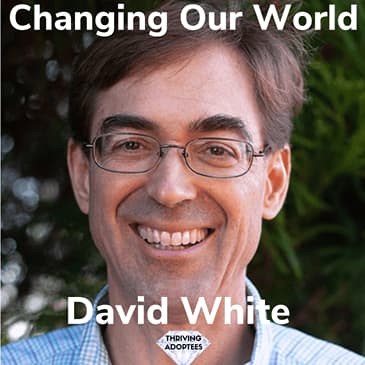
Epiphanies change our world. But how do they happen? Listen in as founder and adoptive dad David shares what's changed his world. Profound and empowering.
David holds an MBA in Corporate Finance and an MSW in Child Welfare. After spending 12 years working in corporate finance, he decided to pivot his career into serving individuals who are severely marginalized. He worked at two child-focused non-profit organizations prior to founding Fostering Great Ideas in 2011.
David was an Adjunct Professor with Clemson University’s MBA in Entrepreneurship program for ten years. He taught Community Impact Entrepreneurship: bringing entrepreneurial spirit to difficult world problems.
David enjoys hiking, gardening, cycling, and spending time with his family.
https://www.linkedin.com/in/davidwhiteinnovative/
https://www.facebook.com/fgi4kids
https://www.instagram.com/fgi4kids/
Guests and the host are not (unless mentioned) licensed pscyho-therapists and speak from their own opinion only. Seek qualified advice if you need help.
Want to learn more about thriving for you, your kids, your families or your colleagues? Pick a time to talk here
[00:00:02] Hello everybody, welcome to another episode of the Thriving Adoptees podcast. Today I'm delighted to be joined by David, David White. I'm looking forward to our conversation today. A busy amount, so we're going to dive straight in. David leads fostering great ideas, which we will get onto in a minute.
[00:00:23] But I'd like to start with the big question really, David, about Thriving and what Thriving means to you as a human being, as a leader of a non-profit. However, you know, as wide as you can go, David. As wide as you like.
[00:00:45] David White Well, it used to be winning or becoming great and being seen as great. But really, as I get older, I'm in my 50s, it really is about the connections that are meaningful. The people who will be with me even after I create great things.
[00:01:06] The people who actually just care about me as a human. That's what I consider thriving. If you have those relationships, you're thriving in life. That's my opinion. Yeah. So, obviously it was a change in how you defined. What led to that change, David?
[00:01:27] David White Probably other people who are much more relational driven than I was. And I was more just driving, you know, trying to drive a business, trying to drive my ego. And I still do that a lot. But it's really, there's a good number of people out there who really simply want to be in connection. And they show it and they're very kind to others. And so a kinder world.
[00:01:50] David White I've always had it in me that value, but it was never my primary value. It was, I'm starting to be kind, but I was, I was not somebody who really cared about all people. So people who do care about all people are the, are the, are the wonders out there. They've made the rest of us realize the importance of, of care and kindness. David White Yeah. David White And I believe I've become more loyal to people as a result, more oriented towards their interests as a result. And that is made me a better human.
[00:02:20] David White Yeah. So do you, do you remember, was this change gradual? Was it, was it, was it, did it happen in a few instances? What, what led, what led to this change? What was the surroundings to it?
[00:02:35] David White Things, Simon, definitely marriage. So I married a good number of years. We're both like, wow. And so as a result, it's, it's, it's that loyalty to one another. Obviously, that can't always be the case for people. But for us, the kindness one towards another and realizing this is it.
[00:02:56] David White That allowed me to realize that people need each other and period. And it's not just about succeeding, succeeding, succeeding. It's a lot more about connecting, connecting, connecting and staying thus connected.
[00:03:12] David White I also found it through the business, the charity nonprofit I run. And the people who give back so generously, these are obviously the donors, but they're also the volunteers and the staff. David White And the kindness, the generosity from others is really the first time I began to think about the word grace. I've often heard the word grace.
[00:03:40] David White I know that it's a, often a religious word. And I found it in individuals who simply give of themselves. I have that in me too. But these were very focused. They're coming in, they're donating a very small amount, but a meaningful amount. And it's hard on them because it means a lot because they don't make a lot of money.
[00:04:03] David White Those people let me stop. And let me understand that they are the best. And to drive ourselves more towards them is the key.
[00:04:18] David White I find myself, I hope this isn't like putting a spotlight on, but I'm trying to get to that transition point because you set up the nonprofit. You were the founder of it, if I remember rightly. Is that right, David? David White That's great. David White That's great. David White So this grace, this kindness and connecting,
[00:04:43] David White That's amazing. That the, that must, the nonprofit, I'm guessing, was a result of a shift that happened within you. And I'm trying to get to the moment when things started to change. I'm just being nosy, I think. it's a logical statement on your part but actually that's not when it happens so okay so
[00:05:09] I knew i would run something big because i have an ego and i knew i could build something big and i think a great entrepreneur or any entrepreneur needs to know that they will succeed they believe they will succeed they don't think in terms of failure i'm not going to fail and i'm simply not i've built other things and i'm not going to fail i said that that's a that's where i drove from i also drove from dignity framing so if you look at any movement civil
[00:05:36] rights movement is the most prominent it's always based on dignity um seeing another human being i've always been very capable at that uh when i used to hang out and um i did a soup kitchen shower house when i was a teenager one summer and instead of simply serving homeless guys i ate with homeless guys so it's just very much um i am with i see now you and i delight um and we can laugh together
[00:06:05] you're in a very difficult situation i'm not but we are having a meal together and that's both of our intent so i've always had that dignity uh building a movement uh from the aspect of everyone is seeing obviously the child in foster care became the ultimate movement for me that i built fostering
[00:06:28] great ideas the betterment of the child's experience while they live in foster care but even being that driver that entrepreneur it does not mean that i actually had that level of care for other people i simply had the idea that a big movement based on people being seen is really important and i can do it
[00:06:53] that's an entrepreneurial answer but if being honest with myself i didn't fully realize i don't have to drive everything i don't have to always be the one others can too and that's less important than the human connection at every state and those who do show us race who are kind they're the best humans and that's
[00:07:22] now who i strive to be right as we all should strive so i've still got the entrepreneurial bent i've still got the founder bent i still um love to create and it's very much a part of me and but a lot of that is ego and um creative spirit the individual can get lost in that founders are well known for just
[00:07:45] running like a steamroller and everybody's like you totally didn't notice me um the staff could be for example or um you know individuals just being being almost irritated with because your goal is to drive and to grow uh whatever you've created um the subtle point is really to say others are equal
[00:08:10] and and the grace they share for this mission you created is is is something that really needs to stand forward stand talk it's beautiful so you know just like anyone else um i i i i learn as i get older um I remain a driver um but i certainly um now fully understand i think um the beauty of of of
[00:08:38] people yeah and their giving did did you know that uh steve jobs of Apple was an adoptee that's what i understand yes yeah and he was uh clearly he was a a a driver and uh yeah and but good and bad out of that yeah it's a double-edged every driver is difficult double-edged double-edged sword right right
[00:09:06] yeah um it's interesting for me because you know i think people have different definitions of the word thriving or else we wouldn't have 700 odd episodes of the of the podcast it would have been a little bit boring by now um uh and uh people have different definitions of uh of ego too so what does ego mean
[00:09:34] to you um ego means to me i really like myself and i really like how i operate and that's a little excessive so i was born on april fool's day as a left-handed kid and so i knew i was unique um uh an april fool for sure and everyone remembers my birthday and left-handed well that's pretty fun too so at every point of my life i realized i needed to create this because it defines
[00:10:04] me so like a branding uh subconsciously uh unique stuff so i've i've only created or i often create unique things that help others to communicate connect with one another disparate groups i created a talk show where disparate conversation you know people with different posing views get together and we have a spirited conversation i created that i created a newscast i created an alliance of non-profits
[00:10:30] um to where we're all on different planes of our industries but how then what is our core needs what is our core understanding of each other within all that um it's all driven by my ego that says i i can do this and i can do it well uh i don't think it's a bad thing i think it's actually a very good
[00:10:52] thing for a child in foster care uh their ego can be um destroyed or at the very least minimized if you live in foster care for a number of years from what i hear from people who have i have not it is um a place where you are uh you're often forgotten even though you're the most important
[00:11:15] person there you're the reason for the system um you can feel i'm quite isolated uh anyone who feels quite isolated does not know that they can be um uh whoever or they can express however they want and that to me is probably the saddest thing my children will often say my wife as well that in a movie where someone is able to express themselves they get out of their out of their box and they are able to
[00:11:44] live who they are i cry at those points that's that's my my expression my being able to be what i called to my parents when i was 12 years old i was at a camp uh simon and i wrote them a letter and i signed it your pick of the litter now my brother and sister did not appreciate that i called myself the pick of the litter but i did and i said i gotta see myself with an ego and it's and it's
[00:12:12] it's run me the whole my whole life it can be a little much but at the same time it is a founder's story and at the same time wouldn't it be lovely if every child who lives in foster care knew that they were loved that they were the pick of the litter and knew that they were seen they had a birthday that was special and knew that they were unique for me it was being left-handed i mean that is the goal
[00:12:41] uh and so if i can create an organization where that child is seen valued heard then i've created what i wanted for me i had it for me but they all deserve it nonetheless definitively yeah so in ego and thriving is that you are um you are valued and you can you can express and experience and people
[00:13:05] appreciate how you do that that's what thriving ultimately is and for those who are kind and provide grace they are the ones who will allow you to thrive they are the ones who will give you the play box they're the ones who will give you the resources the tools so you will be who you're frankly
[00:13:26] meant to be who you were able to be that's how it all comes together yeah so is it like a transition from winning separately to winning together hey great question yeah it probably is right so uh uh in a way do i care about other people definitively i care about them as a group sort of a sociology
[00:13:54] you know the dignity of a whole community the individualization the caring of the individual means that i believe that it is not just me and my drive it is all of us um together that is the learning process that i've had to take on not dissimilar to other people too but very much of a founder is learning uh and then seeing it as the entire community um all working on a singular mission that you
[00:14:23] as a driver have uh and then embracing it and and and thriving as a communal uh setting that's that's the ultimate yeah so so what gets in the way of that thriving david probably me right you know you can always say that um you know if you build an organization a non-profit right uh it's not easy so um well donor dollars
[00:14:51] are difficult because the individuals who are receiving the service are not paying into the service so you may go in a whole new market scale scale scale but your donors are are going to be behind uh it's going to take them a while they may only be interested in that particular community that particular program you have to you're not getting your widget does not get paid for so it's an exhausting process to run a non-profit because your donors are behind your vision they love your vision
[00:15:19] they accept your vision they actually embrace you in your vision uh and some will stay with you uh fast but if you're an entrepreneur if you're a founder that's working it's really fast and so they're really critical but you have to make the same story to every new community and that's a hard thing to do so you can be running a really tight show and nobody even knows it in the world of non-profits
[00:15:47] um so that makes it difficult but in terms of your question how to keep that community together that is a part of it the donors are definitely a part of that build the volunteers they're definitely a part of that build are they ready to experience um more intentional care to get in relationship in my example with children who are in foster care become a mentor become one of their a tutor to go into that
[00:16:11] foster home you have to constantly build individuals to realize that this movement that you've developed that you envision is a movement to jump onto and once they do i firmly believe the organization all drives towards division as a founder as a visionary type that movement of everyone pivoting towards
[00:16:40] the vision and then saying i'm running with you i'm running i'm running we're all a community we're all a communal expression a a stable approach to serving these children that's required of me if i can't do that and at times i stumble on that then we just go into little pockets we have silos and we have donations that are truncated only a year long you know like some grants foundations are out like that sort of silly
[00:17:09] in my opinion we have uh volunteers who um um um you know maybe like uh well how long do i really need to stay in in this relationship well the vision is you're staying as long as the child needs you so if the visionary can be strong and i mean just consistently pushing the organization's approach we're
[00:17:37] building something big it's a movement versus a organization then i really have seen and i i love how the staff how the volunteers have the donors all are like yeah we're all on the same team we're all running together and then we're all running at the same pace as the visionary uh that is difficult um organizational dynamics come into play silos can come into play hard feelings can come into play
[00:18:04] founders who don't listen well like myself can come into play um but to resolve all that it's really the vision is being pushed and there's an organizational design to where everyone knows quite clearly what their role is yeah that's the combo to me um you you said uh a couple of minutes
[00:18:27] ago you talked about being uh exhausted uh what i i wrote it down but i can't remember the the exact context what you you use the word exhausted and do you remember what what that was about um i don't remember exactly but i will say that it is exhausting to run a non-profit so uh you know
[00:18:50] you know i don't have venture funding you know trying to acquire us uh uh our private equity i i would love that right so you know a lot of um it's often stated that there's a ton of wealth out there in the world and there is there's a lot of poverty there's also a lot of wealth and that wealth it needs to be
[00:19:10] it needs to be um excited it needs to see vision a lot of people myself included um as a philanthropist as a donor within an organization or two i may not feel that excitement i'm just donating it's it's almost a task it's an appropriate task but it's almost a task what is exhausting is that um it takes time
[00:19:39] to build out this excitement now what's wonderful is that once people get it they stay and they drive as long as you have strong roles for them they applaud but the reality is for children in foster care across the united states where i am there's 350 000 children in foster care it's just
[00:20:05] i don't get overwhelmed easily but it is exhausting knowing that i just knew one of our programs called sibling siblings half of sibs are separated when they're in foster care they're separate foster placements no harm i was a foster parent five siblings we only take one it happens all the time sibling our program that brings them together for wonderful sibling visits
[00:20:31] it's it's only in one state of the united states that's tragic and there aren't a lot of programs that do what we do because there's no funding streams for that that 350 000 children half of them are separated from their brothers and sisters are just in a random assortment of policy social services
[00:20:54] policy you need to see your siblings but actual process of that you see your sibling when you see your parent but what happens if your parent does not show up you need to see your siblings to see your siblings to re-bond you in a healthy way from all the difficult times you've had together it's sibling
[00:21:15] it frustrates me that it takes so long for innovation to work its way through a legacy even though a pretty an improving system called child welfare yeah so um when it's exhausting and i thought well
[00:21:41] raising kids is exhausting as well right and right and you you mentioned that you were a foster parent and i had forgotten that or i never knew that i can't but um so what have you learned about
[00:22:06] uh simon simon simon simon no problem uh so uh you know the uk and in in the us may be varied in this but in the united states only about i believe this is accurate only about a quarter of all caregivers foster parents licensed foster parents i will take somebody else's children into my home
[00:22:33] only about a quarter of those individuals stay on for two or more years my wife and i for example we stayed on for about two years then we were that was enough now that's tragic for the child the children still have to stay in foster care they don't get the choice to say that is enough but i had that choice and so we made that choice and that is not uncommon only about a quarter stay
[00:22:59] past two years now there's some some logical reasons for that and there's adoptions that happen right i've adopted now i'm out from being a caregiver uh there's licensed kinship or relatives who i'm going to only serve the niece who just came into foster care i'm going to take her and the nephew and once they're out half of the children do go back to their parent once they're out i'm done so those
[00:23:25] are very logical points but the greater problem is that it is quite difficult um most difficult to be the child most difficult to be the child's parent but very difficult to be the foster parent we actually have a training that um has almost hit uh the uk it's definitely in four other countries uh that we designed at fostering great ideas called life in limbo it's experiential learning
[00:23:53] by taking on the role of the child their parent or their caregiver you feel the stress the uncertainty the difficulty of being the child most of all the parent and then the caregiver and then you have more and more compassion for each of those parties it's called life in limbo it's a big play uh around the nation and in various countries and we really need to understand that if we see the parent if we see
[00:24:20] the caregiver um once we can support them so it's not um wow this is so much then the child will do much better because they will feel uh stable right yeah um i did you go on to you said that you fostered for two years did you go on to adopt or did yeah or did that happen now that did not happen we are an
[00:24:46] adoptive family we we went uh the old-fashioned way bio our birth and then we adoption and then uh we fostered uh uh so uh it was a fun little trio of kids with my wife and i right and uh all different places coming in right for the child we fostered we did not adopt um she came from within child welfare um from the states um and um we decided not to uh which in and of itself is a difficult question
[00:25:15] because you know single people single adults can can foster and i think it's great married adults do as well of course and within that there may be different points of view so my wife and i struggled when we lay that out perfectly fine in the fostering process and adoption was not on our plate as a result
[00:25:38] for um the child we had in our foster that child wanted her parents yeah well i can't blame her for that yeah she was adopted because her parents did not come forward in a way that the state deemed sufficient sufficient to receive your child back half the children go back half do not go back to their parents and so she was adopted with one of her siblings which is a good story even though it's quite
[00:26:06] difficult um with one of her siblings to another home and adopted from yeah um so how does uh how does um being being a parent impact the non-profit and the non-profit profit impact how you parent yeah so i
[00:26:31] think being a parent impacts a non-profit more than the other way around i definitely thought about some of the great ideas while fostering great ideas uh we change foster care we improve foster care by innovation and a lot of community engagement within the child's journey through foster care uh definitely having been a foster dad i um thought of innovation within what was this girl experiencing when she came to us
[00:26:58] and what did she experience when she left us when she came to us highly frozen traumatized why am i here even as a third three-year-old by the time she was five she was crying as we left her as we let her go to another family but in that crying she learned how to have a connection where she had no connection
[00:27:23] at the beginning so we learned from her the importance of although we knew it we learned from her the importance of every child in foster care does feel alone at some point very much and i would say and feel shamed uh you know why am i here why am i not with my parent this is a moment in time and i have to move
[00:27:48] again i mean that's that's ridiculous will we want that for any child no so these children feel that and that certainly helps me to respond in a better way but uh on a humorous and good note and i i give a shout out to all my dad's listening to this uh um you you guys may not be any different than me i i i am a problem
[00:28:12] solver for sure moms you're on the table too for this but i hear dads don't listen very well i'm not one i'm i'm i'm i'm in that group and so dads do good dad jokes but they also sometimes um at least a certain cohort i need to improve our listening skills so my two daughters are who told me dad you gotta listen better and so from that they
[00:28:38] both told me i've gotten better as i've aged and that they got in the teenage years and like and their issues are critical to them and therefore they are critical to me and ultimately they are important to me because they're my children and once i started to learn that i do believe that i do better as a non-profit lead uh because as an entrepreneur as a founder i drive so fast that i don't naturally listen
[00:29:04] um when i drive because i'm really interested in the agenda uh but my children have told me in a very kind way um listen it's not all about agenda driving that's a very great statement and i honor that yeah this uh i want to go back to the the life in limbo yep um project do you call it a project did you
[00:29:32] call it a project uh great idea project sounds great project in the us we call it project but we'll call it project for you okay um what it what it seemed to me to be about is uh uh sit you know standing in their shoes yeah as as a way to have you know to see the world differently
[00:30:01] as a way to have a shift in in your perspective is that really very much so yeah i i would consider it i mean it's our most it's our hardest thing to operate uh you know we have we have relational programs you you're a mentor for a teenager so when they age out if they age out of foster care they have somebody those those are our mentor relationships last for years for a subset a very strong subset and the
[00:30:30] teens who are now young adults say i've got my person and that's beautiful right um you know we have our tutor relationships where you know if you're in foster care you actually have your own private tutor i mean this is a volunteer but it's often a retired educator a sunday school teacher but just someone with an ability to problem solve and is encouraging and as a third grader in foster care you're doing well
[00:30:55] the ability of doing well as a child academically is a game changer right so there are these relational programs that are by themselves great ideas and they operate well yet one great idea or project project is life in limbo which is really the hardest to get interest from for people it goes to the general population and may go to social service people they go to
[00:31:23] HASA court appointed special advocates and may go to faith communities but to get people to want to get into a role play Simon is really tough role play no way so we start limbo with simply saying we welcome our community to come together
[00:31:45] to learn together i didn't say anything about foster care i said to learn together what do we know we know that there's children in our community and we can name the number who live in a system called foster care we all care for these children we may not know them we may not foster them
[00:32:15] but they deserve our response life in limbo if you join in for this hour hour and a half two hour experience immersion experience you will see what their needs are clearly because you will have to mere statement stepped in their shoes that is a hard win when life is busy when stepping in
[00:32:43] somebody's shoes sounds extremely vulnerable as it is but when people do it when people say i'm willing to play in your training in your unique immersive training on foster care they are robustly happy
[00:33:06] that they did it it's tough but it helps them to see in new ways and now they can respond with i care and i know now i can get involved let's go to the next step yeah so it's the toughest one of all of ours but you know the uniqueness of it or the interesting part is that it's in four countries now
[00:33:32] um and people who are leaders in these areas in these communities are giving the same vision i gave just now and saying our community can see we are not scared of seeing the child and when we do see the child we then know that the child deserves our very best life in limbo offers this opportunity for the scene
[00:33:58] yeah so the the thing that i'm seeing is a theme of insights yeah well said so you you had an insight um your your daughter's helped you see see the world differently by challenging you nicely about listening more right you the the um life in limbo
[00:34:28] program is a an immersive experience that leads to a change in people's perspectives yes yeah so i i know again an insight so how like to me insights are a big deal insights are a big deal um are they a big deal to you what is it that you think drives
[00:34:57] improvement change better outcomes what's the drivers for you yeah that's great um i don't think i've ever used the word insights but that is it isn't it simon so um um i do have the ability even though i don't listen well necessarily because i'm driving an agenda i do have the ability to um i think that
[00:35:19] is probably my my um my golden goose or my unicorn or my my the thing that makes me able to do what i've done not only in this but in creating other things is uh is is to as my wife used to say i used to before the phone social media and all that crap i used to say uh she used to say you just stare at walls a lot
[00:35:44] so uh i i don't try to get to us i simply want to absorb and and there's great people who absorb who they absorb and they learn about the history and culture and they remember it all i don't remember hardly any of it i just absorb i gain insights because i don't want to make a judgment before i really understand now that can be very freezing you know you don't you don't ever make a
[00:36:11] judgment i'm not that that at all for some reason i have a great calculation i appreciate that about myself to where i can see gained insight i created a talk show where it was all about insights gain insights and then see the point of this is the point this is the point of entry this is the point of change and then drive it because
[00:36:34] i'm an entrepreneur so i do believe it's firmly it's it's um it's my ability to sit back and now nowadays with so much political play of you know anger from one party another and all this um junk that hits us and we have these positions i'm the opposite of that and i believe most people are and i really can see I may may or may not help us here but i will say i had two i've had two really
[00:37:02] good um uh statements about me that that have cemented me uh um and everything else is is good but it doesn't doesn't change my life the two have really been um one guy said hey david you remind me of a of a white guy who's a freedom writer during the civil rights movement he was a black pastor he is a black pastor that was a real honor for me to hear that that said that i see that i have insights and
[00:37:29] i'm not making these bias points all over the place uh which is so common uh if i don't know another party another group and then the other one which ties to foster care is someone said about three or four or five years of me developing fostering great ideas he said uh not thinking i must have even though i would have never lived in foster care he said this nonchalantly so um how long did you live
[00:37:55] in foster care at that point i knew that this organization i was developing was going to win it was going to be a game changer in child welfare because the insights that i fortunately can do allowed me to build and then everyone can see a vision that is not uh biased anti this group pro
[00:38:21] this group simply sees a child in their need points so that i think probably is my defining trait as an entrepreneur and the reason i can create yeah i want to take you back to the parenting and i don't really know the right question to ask but other than the background to the background to the question is we've talked quite a lot about the organization
[00:38:50] stuff um and i i really want to mine your wisdom in in in in in that from the parenting space for dads or mums yes so uh is that enough for you to share stuff that i don't know how to i don't know the right question to ask yeah well you know in terms of being a mom or a dad or a mom over here in the
[00:39:20] states and a dad y'all y'all don't call them duds or dads or dudes uh you call them dads and we call them dads you just do mums you do mums i like mum that's nice i mean i think it's so difficult to be a child when you don't know if you're heard right so that's number one and it's on the mums and dad to know that your child or if you're a foster parent the child in your care wants most of all to
[00:39:49] be heard i mean that's what my children taught me right i think that's what we have to be aware of otherwise we can become a very controlling figure we can become someone where it's almost like the child is just a product of the marriage or whatever uh i've for those people who have that mindset um wake up you know i've never had that mindset so it's never been terrible it's just been
[00:40:15] how to become the parent that your child deserves and first and foremost um and they want to be heard that's it i mean the whole organization i run is they want to be heard every child wants to be heard that's it i think um you know the beauty of the parent-child relationship
[00:40:37] is what i find uh simon is children want to please their parent um and that can be healthy or unhealthy you know if it's a parent who responds well that's perfect and then they develop confidence through wanting to please their parent their parent smiles back at them there's a connection that builds who they are for a child in foster care uh that uh is connection is truncated by the removal process and then
[00:41:05] they are trying to play almost i would say a game where they're trying to be heard by this trying to be heard by that the social worker the caregiver of the time trying to get back with their parent often so it becomes a very difficult um game where they're they they're the one in charge of that where it really should be the parent who simply says i see you and i'm i delight in seeing you
[00:41:30] and the child reflecting back that the light and then the child builds from there so from a parent standpoint a mom or a dad um it's on all of us to be the primary in this conversation to be the person who says uh my child deserves to be heard if you do it as a team with your spouse all the better
[00:41:53] uh you know if your spouse is on one side uh the child just needs to listen and that's it um then you have a then you have a tough haul uh but certainly as we started our conversation today simon we talked about care and kindness as a spouse we can always help our our spouse or our partner to be kind uh i think that's that's the that's the most beauty that spouses can provide for each other
[00:42:19] um my wife and i remark that certainly communication is the key to our marriage but the crime key is really to be kind to one another to care to reflect back on one another not just to say you're cool but to say i'm truly interested in you so it goes back to everyone wants to be heard correct yeah um
[00:42:42] that's the best form of parenting that is and and um we all need to hear it i certainly have and um we all did yeah the being heard you you took you you took my understanding of that to a different level
[00:43:04] there um so what i and you you talked about campaigners you know within civil rights right um um what what what can what the middle-aged uh adoptees who are campaigners right so middle-aged adoptees in
[00:43:23] my generation of adoptees right yeah those the ones that are campaigning the the feeling that they have not been heard is it's got to be one of the top three drivers of their campaign yeah a generation ago or two generations
[00:43:52] ago those adoptees didn't feel heard and they they didn't they didn't feel heard uh they didn't feel heard about their trauma right so the what what what this means in really specific terms is this you know one of the
[00:44:17] biggest things that cheeses adoptees of to put it blunt you know to put it in a in a in a kind of like a palatable way right it's it's a lot bigger than cheesing off right that they're they're angry about yeah they're angry about being expected to be grateful
[00:44:42] yeah i've heard this too right that's a that's a that's a theme out there that just blows my mind um that we put that on adoptees as a i mean not we all of us but that that is a theme that adoptees have to some adoptees have to come back so silly you know right i mean a family is a family every family who's an adoptive family is we're an adoptive family versus that child's adopted and we're not
[00:45:12] we're an adoptive family uh it is it has to be us it has to be framed in a way that it is reality which is us the adoptee i would just i'm not an adoptee but adoptees uh know that they're coming in this in a way that um they may be uniquely different uh in very noticeable ways whether it's the color of their
[00:45:35] skin uh ethnicity uh or just their story uh and to honor that that person that adoptee sees things in a way that you didn't have a clue about as an adoptive parent for example is really important for not only the well definitely for the adoptee that they know that they are heard
[00:46:00] um but also for the adoptive parent if you want to be um a capable parent which is um a very good idea yeah it's so much more rich i mean uh you know grace kindness all around a rich family unit is is just brilliant uh it's it's it's really lovely and uh it requires all parties especially the parents
[00:46:27] the parents the onus is on the parents i i say at every point uh to to understand and to to honor the value yeah the other parties in the family but so my parents never expected gratitude from me it worked exactly the opposite way around they were grateful for me
[00:46:51] yeah they didn't expect me to be grateful for them that i agree and so it's not every adoptive sorry it's not every adoptee's experience this this um expectation of gratitude it's not it's not everyone but i i think it probably was more prevalent
[00:47:18] in in uh less emotionally intelligent times right yeah that's fair um so one of the big and i i think one of the things that they they want to be heard about is is their trauma so what and so there are some
[00:47:43] kind of uh uh structural structural cultural challenges here so the uh that their parents were trauma blind they were really struggling and the chair their parents didn't because they were trauma blind didn't see the reason for their struggling and and until the world became true that you know the the
[00:48:12] um until the world became trauma aware in in you know adoption trauma wasn't a thing in um the 19th century that's what i understand it wasn't the trauma wasn't a thing in the 19th century in terms of like um the napoleonic wars right no nobody was coming back from the napoleonic war saying i've got ptsd
[00:48:36] right right that didn't happen so but it's it was the same it's been the same in adoption right so trauma didn't become a thing until the 70s in the general and and it became you know it's a ptsd thing because it was off the back of vietnam that's when trauma became a thing right so trauma didn't become a thing in in um adoption land until nancy verrier published this book in 1993 called the
[00:49:06] primal wound so what was happening was the the parents were trauma blind because society was trauma blind or adoption trauma blind so those are the that's the reason for the the the the blindness that's fair you know for me um i i i definitely think about trauma but for me it's interesting simon
[00:49:34] i think about loss more often than trauma a lot more often and shame at some level but loss is is is my way of understanding um the world of um children in difficult uh situations coming into trying to wanting stability as we all do want stability and so from in the foster care arena for example the law says that
[00:50:02] no one's generally died i may go back to my mom i may not so there's no closure to that loss and so i'm in this constant state of longing uh in the world of adoption and obviously it just depending on where a child started uh uh but there's always i would suggest i don't know from an adoptee standpoint i mean across the world but um you know loss has got to be in there right for everybody is is really truly there
[00:50:31] for the child in foster care because you actually see your parent at family visits and then you're like i think i'm going back to my mom now but you're not so it's very easy to understand in foster care but in adoption world it really will depend on what you hear from those who are adopted into a family is there still a loss uh from their prior family it'll be individualized i would assume
[00:50:55] that's a lot of people who are not so it's very important but i don't know that yeah um would you like my take on that yeah sure yeah um so i i think of trauma like a storm trauma is like a storm so the the
[00:51:14] the grief is the tears of the storm and and and therefore grief and loss would be kind of um similar it's similar in the same sort of ballpark right so um and then the other elements of trauma i
[00:51:37] would see is anger which is like the thunder of the storm and then um the lightning strikes which would be like the fear the fear of abandonment fear of rejection the insecurity yeah so that that's how i would kind of that's great deconstruct it and uh and the good news right and the good news is that we're the sky
[00:52:04] yeah yeah yeah good and the sky isn't damaged by the storm well said nice very nice thank you um anyway so that's my my take on it so uh yeah trauma is a generic term i i i totally agree that if we if we if
[00:52:28] if we pull out the the the emotions it makes the the emotions that go that are part of trauma um it makes it a far more um impactful kind of uh understanding i guess so um coming up on time is there anything
[00:52:55] that i've not asked you about that you'd like to share david i think it's been a great discussion i appreciate all good yeah yeah me too me too uh and we hope that you have enjoyed it too listeners and i guess you would have turned off by now if you hadn't um so thank you david and thank you listeners and we'll speak to you again very soon bye