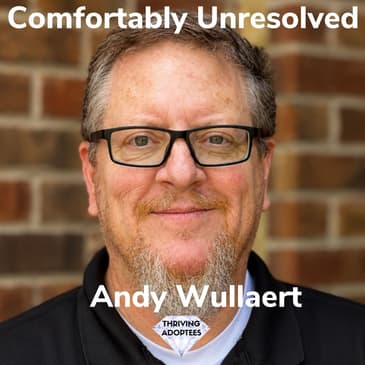
Is something that you've not resolved making you uncomfortable? Making you suffer? Our suffering lies in the gap between what we have - like resolution - and what we don't have. Listen in as adoptee Andy explores being ok with matters unresolved and much more.
Here's a bit about Andy
"I'm an adoptee who spent more than five decades wrestling with questions about identity, belonging, and what adoption ultimately means over the course of a lifetime. Like many adoptees, I believed that if I could somehow reconnect with my biological family, I'd finally understand who I was. Ironically, they found me.
For years, I imagined that reunion would answer the biggest questions of my life. It didn't. What I found instead was something far more nuanced. They were kind people. Good people. I'm genuinely grateful to know them, and I believe they're good to their core. But they weren't my people, and they didn't hold the answers I thought they would.
Ironically, the most meaningful part of the reunion wasn't discovering who they were. It was realizing they were never responsible for defining who I was in the first place. My mother was a psychotherapist who encouraged me throughout my life to examine each stage of that journey honestly and put language to what I was experiencing. That became one of the motivating forces behind writing my memoir, Blood = Water: The Search for Identity Beyond Biology.
I think many adoptees quietly wrestle with questions about biology, identity, expectations, forgiveness, and agency, but we don't always give ourselves permission to say those thoughts out loud.
Find out about Andy's book here https://a.co/d/085HEgsk
Guests and the host are not (unless mentioned) licensed pscyho-therapists and speak from their own opinion only. Seek qualified advice if you need help.
Want to learn more about thriving for you, your kids, your families or your colleagues? Pick a time to talk here
[00:00:02] Hello everybody, welcome to another episode of Thriving Adoptees podcast. Today I'm delighted to be joined by Andy Wullaert. Looking forward to our conversation today Andy, we had a blast last time, just like four weeks ago and looking forward to diving in today. So listeners, Andy's a fellow adoptee and we're about the same vintage, we're the same generation.
[00:00:23] You're 57 if I remember my notes right, I'm just 59, just a couple of years ahead of you, you spring chicken, right? So welcome to the show, looking forward to our chat today Andy. Thank you Simon, I'm happy to be here. I love what you do, I love the podcast and yeah I'd love to share my story
[00:00:48] maybe give a voice to some folks who haven't seen it a certain way yet. Yeah, so as we've been a little bit around the houses, this is where we were going to kick off for the podcast but we came back to my first instinct was a phrase that Andy came up with when I spoke to him a couple of weeks back.
[00:01:09] And the phrase, the two words that you mentioned were comfortably unresolved. And that seems like a bit of a contradiction in terms and it seems like, well I can't be comfortable, society would say I can't be comfortable until I'm resolved, right?
[00:01:36] So that's why it jumped out at me there, is it a dichotomy there? You know, a contradiction in terms? There's something going on there but what does it mean? I'm just mentioning two words but what do those two words mean to you?
[00:01:53] Yeah, so it's a point that I got that I reached emotionally two big times in my life, you know, with regards to my adoption story. As a young man, a younger man in my early twenties, you know, we, I had been down the journey of discovering I was adopted and wrestled with, where does my identity start?
[00:02:22] And so, at that, at a young 20 year old Andy, I, I finally got to a point where I kind of sorted out and segmented out that part of my emotional journey of the adoption and said, hey, you're going to decide how you build your identity from here. The past, you're not going to get those answers.
[00:02:46] And once I started looking forward and my eyes opened to that I'm, I'm building my own identity, I think there was a certain level of freedom or agency that gave me at that point. And, um, I really, really was okay with it for, I could say, maybe the first time and then it just stuck with me.
[00:03:11] A few years later, uh, when my biological sister called, of course, I was not so comfortably unresolved for a little bit while I went down the path of meeting my biological family. After going to meet them, which I'm sure we'll talk about a little bit here. Uh, I found that we weren't cut while we were cut from the same cloth. My experiences with my biological family didn't build my identity.
[00:03:39] I, I had built my own identity and the situation I was in had built my identity that I became quite comfortable with. So at two points, I became comfortably resolved early twenties and the late twenties after meeting them. Yeah. Yeah. It, it's, um, it, it, is it, is it a continuum on one length?
[00:04:05] Cause I, I've spoken to, I've spoken to adoptees who said like, you know, because I had, I felt I had no identity. I had the freedom to create my own. And then at the other end, so it's an old, it's an old, it's a freedom. It's a, it's a tonic to our freedom. It's a driver of our, our, our, our freedom and all about that agency. And at the other end of the spectrum, it's, it's confusion.
[00:04:35] So is it, does it look like a spectrum to you? Confusion and agency. Does it look like, do they, do they look like tick, tick boxes? What are making any sense? Yeah, I think that, I think that's a great point. And I think, um, what I like to do is think of it as where I put my focus. So when I'm, when I'm feeling confused, uh, one of the main things that, that, that help,
[00:05:02] that has me overwhelmed with is a lack of power of who I am, what I'm, why I'm here. Um, what created this situation, whatever, whatever is building up to that confusion. For me, empowerment comes when I can act and when I can choose and move in a direction.
[00:05:22] So I think that being comfortably unresolved is a lot of moving your focus to where you need your focus to be. So in the terms of my adoption story, becoming the man, becoming the husband, I want to be the father. I want to be making choices is something that I'm empowered to do. And I'm able to start with, uh, I know you focus on freedom. I call it agency.
[00:05:49] I think it's all different terms of the same thing that I can start at this point and move forward and create the rest of my life. And I know that sounds like, you know, cereal box wisdom sometimes, but it is really empowering to say, Hey, the, these choices and the movement towards what you're focusing on is really important.
[00:06:11] So when, when I say comfortably unresolved, or when I say, um, comfortable with my own identity, I'm really focusing on the agency of choosing where I move. And I hope not to be too abstract. No, no, um, when you say comfortable and identity, you know, I think of, I think of comfortable as a feeling, right.
[00:06:36] And, and, and identity as a, as a, as a, as a thing, as a, as, as an object, as a, as an object. And the, you know, the, the, the metaphor that pops into my head is a, is a, is a tree, you know, there's a, there's an adopted podcast called pull by the root, right. Pulled by the root, you know, root rootless, right.
[00:07:06] Yes. Not ruthless, rootless, right. And feeling, you know, um, feeling comfortable about identity. That seems to me to be like feeling, feeling rooted. It's more of a feeling thing than a, it's a feeling thing. It's a, it's a knowing thing. It's not a thinking thing. It's not a concept. It's more of a experience.
[00:07:35] It is, is that kind of what you mean? Like, cause we've got the unresolved because you have, you can have the, you can have the, uh, the, to, to, to, to, to extend the, the tree metaphor, right. Um, you, you can have a load of questions going on in your head, but being still rooted to the ground.
[00:07:53] The, the top of the tree can be blowing around in there, in the wind or the, or the gales, but if the roots are strong, then what the, the, the, the, the trees not bother really. It's just going with the flow. Yeah, no. And I, I, I understand your metaphor. I think that us adoptees might not be rooted in the ground. We may be hydroponic trees. Okay.
[00:08:19] I mean, it, it, we could still have the same sturdy trunk. We could still have the same branch structure. Um, I, I, I think for me, the non connectedness or, you know, there's a, there's a point and I'm not saying that I didn't yearn for connection.
[00:08:43] When we, when we, when I found out I was adopted at eight or nine years old, um, the, the feeling of absolute rejection, you know, the one connection in your life that should be there, uh, as a parent. Um, it just isn't there. And the questions were intense. Uh, why was I given up? And, you know, I'm sure everybody's been through a similar experience. You know, I grew up in a loving home.
[00:09:10] Um, and the experience was my mother trying to desperately tell me how much I was wanted. And I applaud her for that. If there's one fault that she ever had is that she mom too hard. And so when it finally sunk in and I finally went to her with the tails, uh, or with a, with the questions of what is this actually? And it finally sunk in. I felt deceived. I felt, I felt alone.
[00:09:36] And I think your whole audience will probably know a lot of those feelings. Um, the question she was trying to answer or make sure that I was hearing was how much she loved me. But I was wondering how could the connected one, the biological one not. And that, you know, I don't think that anyone did or didn't. It's not a black or white world.
[00:10:01] So through my younger years, the focus was on, well, I'm missing this connection. I'm missing this connection. And using the, the, the tree analogy, I think once I was able to say, I'm not going to have that connection. We have, we have a freedom that other trees don't in as much as, uh, we're ambulatory. We can get up and we can move.
[00:10:30] Uh, the, the hydroponic trees, but we're may not be connected to one area, but we can start, we can put our roots wherever we want and start at that point. And I think once I viewed that as a freedom, once I took the agency of, uh, grabbing the ball and running the play I wanted. Uh, I think, I think my life really changed.
[00:10:59] So I like your tree analogy, but I think, I think we're super trees that don't need to be connected. Okay. Thank you for, uh, for extending the metaphor. I, I find that there's great, um, it's a great way to roll with it. Right. It's a great way to, to roll, to roll with the conversation is, you know, we've got this, we've got this metaphor. This commonly used metaphor, um, and, uh, only by tweaking it slightly.
[00:11:28] Can we, uh, can we, I just want to take you back to kind of a little point of detail. Um, uh, Andy, uh, because I, I can't remember you said, you said about, um, well, first I'll just ask you a straightforward question. Do you, how old were you when your mum first told you that you were adopted? I think she, she had said my whole life. We love you.
[00:11:54] We adopted you and kind of put those things together at the coaching of the adoption agency. I finally realized I was adopted, uh, in elementary school, eight or nine years old. Right. My sister had gone in spoken with her friends and said, yeah, my parents aren't my real parents and all these things. And when they came up and questioned me about it, they said, yeah, your parents aren't your real parents. I said, of course they are. And he said, no, you're not. And it finally sunk in what adopted means.
[00:12:23] That's when I went home. So eight or nine years old, I went home and my mother understood that I was finally getting it. And she took me to the library, explained how she couldn't have kids and how, you know, how desperately they wanted kids and how, how much they wanted, uh, me specifically. And my sister specifically.
[00:12:48] Um, but like I said, she was answering the question the best she could, but she was answering the wrong question and there's no way she could have answered the question of why I was given up at that point. Yeah. So it was the meaning of, it was the meaning of the word, not the word itself. Yes. Yeah. Yeah. Okay. Um, yeah. Freedom. Uh, so you.
[00:13:21] What does, what does I, what, what does identity mean to you then? Um, yeah. What other than I'm a tree, right? I'm a hot, I'm a, I'm a, I'm a, I'm a literary tree. An interesting, an interesting part in my growth towards developing my own identity. Uh, I was a troubled teen gotten a lot of trouble.
[00:13:45] My parents, uh, had finally sent me to, I guess it finally had enough. They sent me to, uh, one of those boarding schools in the eighties that was structured like a, um, an outward bound school. And at that point I was kind of just made a decision. I'm going to go with the flow and I'm going to see if I can affect my own, my own future here, because you've got nothing else to do there other than to go through the program.
[00:14:15] And you can either give yourself to it and see what it can offer you, or you can resist against it. And I, I had a youth, uh, taking the easy path of resisting against everything. Because if you reject the world first, then the world can't reject you back. I think sometimes we have a tendency to get into the, into that, that state of mind. So I went to the school and I was looking for an easy elective and there was a drama teacher.
[00:14:41] And he recognized my struggle with identity. And one of the things we were studying was Hamlet for that semester. And he cast me as Hamlet and we went through the, uh, uh, the, the big monologue, the to be or not to be monologue. And he had me really dissect. Uh, I, of course I'm not gonna remember each line right now, but the to be or not to be monologue where it's Hamlet at the point.
[00:15:11] At that point is wrestling with thoughts of his existence, his identity, um, and basically whether to kill himself or not. And, but if you take that on an emotional metaphor, um, he really coached me into, Hey, you know, do you want to be to be or not to be is kind of a pivotal point where you're going to be at right now.
[00:15:30] And we, we explored that together and it was, it was pretty empowering to, to have this abstract, uh, message that touched on a lot of areas and kind of put everything into a choice, uh, at that point. So, um, it highlights all the difficult things that can come your way. You know, the slings and arrows of outrageous fortune to sleep for chance to dream all the things.
[00:16:00] Um, but I really felt like things were my choice at that point. And I think agency for an adoptee is big because the choices that got us where we are, we're not our own. Our fate was shaped in a different form than everyone else's.
[00:16:20] And it feels like we had this, these decisions made all around us that academically, like you say, in your head were for our own good. I, I totally get it. They were made from love and everything, but there's this disconnection of perception. Once you feel it, once you, once you feel the emotions that anyways, I'm going on, but the to be part was great. The point of the podcast is to go on.
[00:16:51] Um, I, I, I, I, another, uh, another metaphor, another Shakespeare thing's coming to, to, to, to mind for, for, for me. Um, and it, it's kind of tied in, it's, it's, it's tied into my favorite teacher at the moment, but it's not a drama teacher. It's, it's a guy that's teaching me right now.
[00:17:19] Like, you know, an author, a speaker, a trainer, um, workshop leader guy, um, called, called Rupert Spirot. He, um, a Brit guy. He, he, he talks about, um, identity using the metaphor of, and, uh, and the Shakespeare play, um, of King Lear.
[00:17:40] So he, he, he talks about, uh, John Smith, who is an actor, uh, uh, living a peaceful life at home. Um, and he, he goes to the, he goes to the theater each night and, uh, dons, uh, King, King Lear's clothes and actions and, and, and, and pretend, and, you know, and, and pretends to be. He dresses up like King Lear.
[00:18:07] And, uh, and he's, he's got all these, he's got all these troubles on him. He's got the war with the French. He's got the arguments with, uh, his, uh, he's got the arguments with his, uh, with his family, with his daughters. Um, and then, uh, at the, uh, after, uh, after the, the evening's performance, he goes back into the dressing room and a friend comes in to, to speak to him and says, um, uh, you know, how are you doing? That was great.
[00:18:37] And, and, and the, that, that, that was great. How are you doing? And, and, and, uh, so he, he's forgotten that he's John Smith. Right. He's forgotten that he's John Smith. John Smith is peace, happy, content, all is well, well, the word.
[00:19:01] But he's, uh, so, uh, Rupert, Rupert's Barry saying, we're, we're John Smith. We just think we're King Lear. Interesting. Yeah. I think I, I like that because it covers our perception once again is so powerful that you can walk away from a situation for method acting, so to speak. Yeah.
[00:19:30] Uh, maybe we're all method actors. Yeah. We, we, we, we're pretending to be somebody who, who we, we aren't. Um, I heard a, you talked about perception. I heard a great phrase yesterday on a podcast, I think, uh, that I was listening to. I think I might've mentioned it on a recording interview I did last night. Uh, and it was, um, perceptual humility. Perceptual humility.
[00:19:55] Basically, it's holding, um, being a little bit more cautious about how we see the world. Realizing that we've got, we've, we've got, uh, uh, glasses on, right? We've got, and especially, you know, like we've got trauma glasses on. So, you, you talked about, uh, rejecting the world, uh, rejecting the world before it rejects me.
[00:20:24] And, uh, I'm getting goosebumps, uh, with it, Annie. Because I, I was thinking about a girl that I went out with 1989, 89, maybe 90. Uh, and we, we had a, we had a bit of a, an argument and I wasn't in the best place. I'd been away for the, been away on business for the weekend. I hadn't slept well.
[00:20:50] I'd had late nights and we had this, we had this argument, uh, and when she, when she rang. So I went off and I can't remember exactly how we kind of left it, but when she rang, um, work the next day. So the argument was a Sunday night ring. She rang, worked the next day about quarter past five.
[00:21:17] And, uh, my dad answered the phone because everybody else had gone. It was just me and my dad were left at work. Um, my dad said, oh, it's, uh, it's, uh, it's, it's Lucy on the phone for you. And, um, I wouldn't take the call. I wouldn't take the call. So I was thinking, what if I had taken the call? Right. Yeah. I, I, I could have gone for, uh, was she, was she ringing to kind of make up?
[00:21:47] Right. Was she ringing to make up? Was she ringing to confirm it? It was, you don't even ring to confirm it's over. Do you ring to, you ring to make up? So in that moment, in that moment, not wanting to speak to her, I was considered that that was it. And we kind of got to back, got to back together again in a couple of, um, uh, you know, a couple of months later, but it was always off there.
[00:22:07] Uh, and, um, but when she fast forward five years, maybe when she found out that I was getting married to Lynn, a friend of mine told her and she cried. Oh, she cried.
[00:22:24] So like rejecting others before we, before they can, before they can reject us or, you know, I, I, I call it, um, the, yeah. Yeah. What is it? The, uh, the expectation of rejection. So we'll get our rejection in first, right?
[00:22:49] I, I, and, and I think that's, I would understand if that was a commonality amongst adoptees. It's part of my, part of my growth or part of my processing through this was adoption began with my perception of adoption is my life began with this life-changing decision made for me. So I desperately look for these ways to control it.
[00:23:14] And I, I espouse agency is this great thing of building our own, building our own path, building our own creation.
[00:23:23] And that's a plus to it, but I think that plus also comes from this fierce protection of wanting to control a situation because it, it, it so intensely felt like I was out of control of these things that I thought were basic staples in life. These things should be this way. So I controlled my boundaries. I controlled my relationships and with relationships I couldn't control.
[00:23:53] Just, uh, just like you and your dating in the, in the phone call in 1989, the, your way of controlling as I see it was not taking the call. So now instead of going through what could have been a painful conversation, you controlled it and made it your choice.
[00:24:10] And I think for me, at least I, I, I look at my teenage years and I look at some of the ways I dealt with relationships and, you know, rejecting others before they reject me first, you know, maybe, maybe I'll control whatever situation I'm in, you know, whether it's, uh, being a performer or being a joker. Um, right now it's being a writer, um, right. I, it's, but I'm controlling the narrative in every way I can. And I, it's agency, but it's also a little bit of control.
[00:24:40] Um, I, I, I think once I realized that my story really belongs to me at this point, um, there's a way to do it without rejecting the world. Uh, and I, and I think that's an important switch that I figured out at one point, but it's hard not to fall back into that. When you get a relationship that has struggles, when you get all these things, you just want this control.
[00:25:09] And, uh, you know, I'm married and I have kids now and marriages don't work with control. Marriages work with other things other than control. So that's been a huge growth for me. Um, so, and being a dad, you have to tell me who's going to control their kids. It's just not going to happen. So you have to get okay with these things. Yeah. Uh, you know what?
[00:25:34] I, um, as you've been talking, as we've been talking about identity, right? I, I was, I'm thinking about, uh, uh, you know, adoptive parents saying, and courses for adoptive parents talking about, um, helping kids resolve their identity, you know, and, you know, they, good luck with that. Right. Yeah.
[00:26:02] If you think you can, if, if, if you think you can control it, if you think you can control your, your kids, you're, you're off. Right. But if you can help, if you think that you can resolve it for them, they're going to have to, we're going to have to resolve it on our own. It's, it's our own. Maybe they give us some prompts or some, some, some, some questions. I don't know. But the resolution of, of, of identity.
[00:26:32] Yeah. Start circling back to the comfortably unresolved, unresolved, um, an identity and all that. First off, unresolved doesn't mean broken, you know, healing and going through all these, like as a parent, I want my kids to be okay. And I think the adoptive parents want to give some philosophical outline that, that, that, that has the adoptee just feel better and feel comfortable.
[00:27:01] And as a parent, I want to see my kids comfortable. I don't want to see them wrestling with that, but I think we need to be okay with the fact that healing is not a permanent finish line, you know, and that's what I mean by comfortably unresolved. We need to let them continue to process. Um, as parents through there.
[00:27:21] And I think, I think is something that I, I, I highlighted a little bit in my book was when, when you, as a child, when I would meet other parents, when I finally understood what adoption meant, it, it, it was, it wasn't like I was a broken kid crying in the corner every day. You know, it hurt.
[00:27:44] And there were some times where I probably could have, but it was just this slow burn, this elephant in the room that no one else could see. And, uh, you know, that you would go into these conversations where the other kids or somebody would say, oh my gosh, you look so much like your dad. You and your brother could be twins and all these things, these physical connected things that had you. Just not connected to the other.
[00:28:12] So you'd get this slow burn, you'd get this slow burn, these reminders that are going to come up for the rest of your life that, you know what? I'm not connected. And as a parent, I'm not going to be able to wave a magic wand. And my mom wasn't able to wave a magic wand. And when I say my mom, I mean my adopted mom. She wasn't able to wave a magic wand to say, fix his pain. She wanted to.
[00:28:36] And the misnomer, I think that the big, I'm at a loss for words. The big perception there is that love is going to fix everything right off the bat. If I tell my son, I love him enough. He's going to know. He's going to know when it's going to fix everything. It's not. And I think kids need to talk through things. I think young adults need to talk through things. It's going to come up here and there where the disconnectedness is going to hurt.
[00:29:06] So that's kind of what I mean with comfortably unresolved. Peace doesn't require perfect closure. Peace requires a perception of I'm okay with it. I think comfortably unresolved can be an honest, healthy destination to try to get to. And it's basically just accept the reality of the situation and find power in the agency or the freedom that it gives you.
[00:29:35] I don't mean to sound preachy, but it was so moving for me that it was absolutely life changing. What was? Figuring out that my agency or my choices and the freedom that come with it and circling back to the comfortably unresolved. I was a new spawn point for you, for the video gamers out there.
[00:30:02] I was the point at which everything started here. I could say, this is the man I want to be by these choices I'm making. And different layers of that came in through my whole life. But the whole title of my book, the whole kind of adventure I went on wasn't to say I didn't have pain from the disconnection. It was to say, I have pain from the disconnectedness and I'm okay with the pain. And I figured out how to process the pain.
[00:30:32] But I've got this other thing that came with it, which I call agency. I know you term it as freedom a lot. That is overwhelmingly cool. It's the greatest thing ever because now where other people have these are, you know, the common biologically connected folks.
[00:30:54] They may have this ceremony or this legacy that they feel they need to do because, you know, my father was a mason. I have to be a mason or whatever. Why I chose masonry, I don't know. Can I take you back a bit, Andy? Yes, of course.
[00:31:16] I think what kind of one of the things that you said was being okay with the pain. Being okay with the pain, right? Yes, sir.
[00:31:38] Being my longest standing mentor says, if we're okay with not being okay, we're always okay. Yes. And that, I think, is pivotal as far as carrying what we carry with us and then still just being able to take the next breath. I mean, you can love your life and still grieve parts of it. Absolutely do that.
[00:32:12] John Smith doesn't care about King Lear's pain. There you go. That's an excellent, excellent analogy right there. And there is, but King Lear is an act that John Smith plays. It's not who he is. There is no King Lear. King Lear is a work of fiction.
[00:32:41] Right. It's a work of fiction by Shakespeare. And it's a role that John Smith plays. And John Smith isn't bothered by the feelings that he has as John Smith. Unless he starts to believe that he's John Smith.
[00:33:09] So, yeah, there is a, sorry, unless he feels that he is King Lear. So, there's a, you talked about method acting, right? So, there was a soap here in the UK in the 80s. It's still going, actually. And one of the main characters, he ran, so a lot of British soaps are often based in pubs. Right. That's the, because that's where everybody comes together. Right. And now wine bars, right, and food, you know, and restaurants and stuff.
[00:33:38] They, they, they, they, they, they, they move in the times. But, you know, back, back in the day, there were no wine bars in the 70s. Right. So, this actor played, the, the, the actor was called, I think it was called Mike Smith. He, he played the publican. He played the landlord of the pub.
[00:34:03] And the character, the character in, in the screen, written by the screenwriter, right? The, the, the character in the soap became manic, manic depressive, became a manic depressive. Okay. And the actor started suffering from that himself. Wow.
[00:34:31] The character had manic depression and the actor took it on. He got, he lost himself so much in his role that he took on his character's mental disease. So, that's super interesting. And, and I'm, and I'm trying to put myself in the place of that actor to, to kind of feel like, so I'm going through.
[00:35:02] Wow. So, he went through all the emotions and acting. And so, he, he put himself through the ups and downs of being a manic depressive. And developed habits along with that probably. And, yeah, I, the method acting can be a dangerous thing, I guess. It is. Geez. Um, wow. That's really interesting.
[00:35:23] But I think, you know, I think that, that, that once again, circles around, uh, the concept of agency of how much we have control over how we see things and how we continue on. I mean, if we develop the wrong habits, if we put our focus in the wrong place, you know, maybe we can fall back a little bit into, into clinical depression or whatnot.
[00:35:48] Um, and I'm not saying, you know, we, we, we have complete power about what's around us, but we do have complete power about how we see it and how we act with it.
[00:35:57] And I think, I think that's the central point of my, of my story is, um, that if, if, if I had stayed there in the unhealthy habits that I was in, uh, I, I don't think that I would have been able to lead a happy life.
[00:36:19] But once I turned my disconnectedness to where I needed it to be, um, basically choices moving forward and whatnot, uh, instead of method acting, maybe I would just became a different type of actor. Um, but that's interesting.
[00:36:35] And it's funny how acting comes up so much when we're on the topic of how, how we handle this, this pain of adoption, because I'm not scared to call it pain. I'll talk to anyone about it and let them know, Hey, I felt rejected. I felt sad, but it's not so common out there that you can just discuss it with anyone. And then I find that other folks get stuck in it sometimes.
[00:37:04] I think acting allows us to move through it. I mean, I'm just talking, I'm going in all sorts of directions here, but that's the, that's the point, mate. Um, I, um, you know, I've been looking at your guitars on the wall behind you, right? Um, and, uh, so, but like one's a flying, did they call it a flying V or something? Is that what it's called? Right. I don't know where I picked that up, but you've also got like a, a strange one next to the flying V.
[00:37:32] Uh, sorry, listeners, obviously you can't see this, but right. So, but they're electric guitars, right? Um, so perhaps not the right metaphor for, uh, perhaps the, the, the, the, an incorrect metaphor for a rock guy. But, you know, I was thinking about Gloria Gaynor, but she's clearly disco rather than rock. And, you know, I am what I am. I am my own special creation. Right.
[00:37:59] And I don't know the rest, but yeah, I was, I will survive. I will survive. I am no special creation. And I will survive. Yeah. And, um, for some reason, uh, I don't know whether this is, uh, this is in the UK, the US, both or what? That, that's, um, that's quite, uh, uh, an iconic song amongst the, the gay community. Oh, okay. Yeah.
[00:38:28] Um, I am what I am because obviously they're, they're in the minority. Yeah. And, and I will survive. So it's, it's empowerment for them. So, you know, I, I think what is, what, what, what they're saying is she's mirroring how they, how they feel, um, when society wants them to be straight. Right. Right.
[00:38:53] And they don't, they don't see themselves as straight. They, they don't identify as straight. Whatever the word is. Right. I'm not knocking. Right. But, but, but it's about freedom to, to be okay in a minority. And, you know, people say, well, there's loads of adoptees, but we're still tiny minority. Whatever we are, half a percent, 1%, 2%. Well, you know, like it's a, it's a tiny minority.
[00:39:17] And a lot of people get, uh, a lot of people get cheesed off about that we're, we're not, um, allowed for. Right. And people talk about that in, in, in schools. I think, well, schools, they're, they're systemic, you know, they're a system, they're a bureaucracy. They're met that they're, they're designed for the masses. They're not designed for the minorities. And, you know, and we, but we want them to fit our minority.
[00:39:47] Well, yeah. Good luck with that. Good luck with that. You know, it's part of the 1% trying to change something that's set up for the 99%. And the bureaucracies are set up for the masses and they're set up not to change. So getting frustrated with the fact that they don't bow to our needs. I mean, yeah, you, you, you, you're barking up a completely wrong tree. You're in, you're in the wrong bloody forest, right? You know, you're, you're at the lake.
[00:40:15] You're not even close to, close to be barking up the wrong tree. You're in a desert. There aren't any trees. Yeah. I think you hit the nail on the head there. I think, I think you really, you really nailed it there because again, you can change the way you view it. You can change your interaction with it as much as you want. You're empowered to do that. But swimming upstream or changing the other 99%, that's a journey that's going to be pretty hard.
[00:40:43] When there's simple choices that come with, Hey, handle your own part of it. And I think, you know, not to sound like, you know, tough love guy or whatever, but I really think figuring out how to navigate something you cannot change is something that I had to do to get comfortable with it. Again, comfortably unresolved, right? It empowered me to control my own choices.
[00:41:13] And I think the 1%, whatever the minority is in that situation, we can do that. We can, we can talk to each other. We can even talk to folks that don't even have to be adoptees or, you know, for, for, for folks that aren't straight or, you know, LGBTQ, whatever the minority is, you can find your support groups to just be you.
[00:41:42] And I don't think, I think the first switch that you need to kind of flip over is that it's not the world's responsibility. It's my responsibility to get comfortable with it. And once I was able to do that, it was, it was absolutely life changing. I know I'm kind of trying to say the same thing, but it was so incredibly empowering. I like your 1% to 99% analogy as well.
[00:42:13] I'm getting identity here as perhaps more about how we are than who we are. What I mean by that is whole, right? Whole, whole with a W at the start of it, right? So, identity is a many layered thing.
[00:42:44] I'm on a, I'm on a bit of a roll with musical references here. And I'm thinking from the 60s, I guess it's American. I don't know who it is. But there was a song called Love is a Many Splendid Thing, right? Uh-huh. Love is a Many Splendid Thing. And I'm thinking identity is a many layered thing. Absolutely. The many layered thing. And the book, the book's called The Search for Identity Beyond Biology.
[00:43:14] But when we think of identity, you think, well, the first thing that comes to mind is an identity card. For the population, right? And it's got your name on it, right? I remember having that, I remember having the, getting the piece of paper with my birth mother's name on it. And it also had the name that she'd given me.
[00:43:41] And I remember a few years, a few months later hearing something and an insight popping into my head, which was the truth never changes. But, you know, before I was Simon Jonathan Benham, I was David Anthony Flower. If identity, if truth never changes, I'm not my name.
[00:44:10] My name is just a label. I've had two labels given to me, one given to me by my bio mum and one given to my adopted parents. But that's not who I am. Absolutely. I absolutely agree with that. And that's why, that's why the whole title of the book, Blood Equals Water, plays on the old adage that blood is thicker than water. Is it really?
[00:44:39] I think, I think identity comes from exactly who we are right now. I, we can decide who we become by our choices, by the way we communicate, by the way we interact with others. If I think somebody is seeing me as too direct or one way or another, I can, I can lean into being kind. I can lean into connecting. I can lean into these other things.
[00:45:09] I can control the identity. Yeah. And you can do it for yourself too. If you want to change the world that you see, change the way you see the world. Yeah. Big, big stuff. Let me take you back before we dive into that big one, right? Because I said how we are rather than who we are. And all the things that you just shared were about how you are in the world.
[00:45:40] Yes, sir. You know, how, you know, you talked about it earlier, right? So how you are as a, how you are as a parent, how you are as a husband. So, you know, perhaps identity beyond, uh, identity beyond, uh, identity beyond, uh, beyond biology, uh, identity beyond name, identity beyond name as well.
[00:46:06] And identity, uh, identity as how we are in the world. Not who we are. That's surely kind of more important, really. How we are in the world. I, I, I think it's more important. I think is how we are indicates or focuses on your actions today and where you're going. I think how you are shapes, who you become.
[00:46:34] Um, I, I, looking back for me was always looking on things that where I felt disconnected, you know, looking back, looking back to whether it's heritage or whatnot. I didn't have that. So my empowerment came looking forward. And I think it helped me. Like you say, it's not who you are. It's how you are.
[00:47:03] Um, who I was, was, you know, Andrew Woolert with a, with a, with Scottish blood and a Belgian name. And it's, uh, all the, I didn't even know it was Scottish blood until later on, but, uh, who I was, was completely under my control. So yeah, that became my identity. I, I, I became the choices I was making in that way.
[00:47:33] I found my identity beyond biology. Yeah. You were talking about changing the way that we see the world or something like that. Can, can you go back to that? Do you remember what it was? Yeah. Uh, something that I don't know where I heard it or whether me and my mother came up with it.
[00:47:56] Uh, but if you, as a young man, I was again in my whole rejection spiral. Um, and you tend to find the negative in everything and angry at this and angry at that. Young men have this spiral that they fall in. Sometimes I can speak from personal experience. And, uh, a couple of things we would use and she was a psychotherapist. So it was always fun to talk to her about what was going on.
[00:48:26] But one of the things we really stuck on is what you focus on expands. I'm focusing on how much this situation just flat out sucks. That's all I'm going to see is how much everything around me sucks because my focus is on the suckiness of whatever. And, um, if I learned finally that if I wanted to change the world that I see, I need to change the way I see the world.
[00:48:55] Basically, instead of focusing on, on the bad part, I could focus on where I wanted to go and Hey, maybe even move in that direction. But if I move where my focus is, that's what I'm going to see. And that's what I'm going to focus on. And I found that to be incredibly empowering.
[00:49:14] And again, coming back to agency, which is one of the themes, uh, I think adoption healing, um, it definitely was for me, but to change the lens that, that you're viewing things in is extremely powerful.
[00:49:32] And I think, you know, you and I spoke the last time and we, we talked about, uh, how sometimes groups of adoptees, I think a term you used was, uh, trauma validation where, yeah, I can understand another adoptee's trauma to a degree.
[00:49:51] I can understand the feelings of disconnectedness, the longing for, for explanation and the downright pining for, for things. I can understand my own too. I also want to move away from that because if I stay there, uh, that's, that's, that's all my focus is going to be on, but I like moving along, resolving it. If it comes up and it hurts, I'll talk through it.
[00:50:21] I'll feel the hurt, but I want to move on afterwards. I want to get onto, uh, how I am not who I am. Yeah. But I think, I think that's an important step. Um, once you realize the pain's there, let's move, let's move through it. Let's move past it. So they changed the way I see the world. Yeah.
[00:50:43] Um, another taking on that, that, uh, I've heard that quote. Or something like that quote. And I can't remember where it's from either. And I can remember an Einstein quote along the, along the same lines, but perhaps, uh, you know, a next step on from it, perhaps. I don't know. Uh, or step back. Who goes?
[00:51:09] It's a, it, it goes something like this. It's the biggest question that we can ask ourselves is, is the world for us or against us? Interesting. So what do you think it is? Do you think the world's for you or against you? Well, it depends what sort of frame of mind I'm in. Yeah.
[00:51:38] I get, I don't, I don't know that it could be either, but that's, uh, I know there are days where it feels like it's against me. Yeah. Yeah. That's it. That's it. It varies. Right. Um, uh, our view of the world, our view of the world changes.
[00:52:01] It does, it does change, but if we, I think it's more to do with what we know deep down. So our opinion might change, but our wisdom doesn't. Do you see what I mean? Yes, sir. So do we know, do we think deep down, do we think deep down that the world is for us or against us?
[00:52:29] And another way, uh, another way of looking at the same question slightly differently, um, is this didn't, this happened for me. It didn't happen to me. This happened for me. It didn't happen to me. Well, that is a, that is a strong pivot.
[00:52:56] That is, that's profound. I really liked that. That is a strong pivot. Wow. But I, it, it's on the same path of, you know, I'm going to take this and I'm going to reshape it and make it my own. That's a very, very cool pivot. You know, I get lost. I get lost in the detail. Yeah.
[00:53:25] Of this conversation. So if I can, if somebody can put it to me on, you know, what you, you, uh, on what would you call them bumper stickers or something? Yeah. Yeah. Yeah. If you, if you can put it on a bumper sticker, I, I, I, I sometimes I get really frustrated with waffle around this, um, around this space. I, I get frustrated with my own waffle. Yeah. Right.
[00:53:54] I want to, I want to kind of really make it really crisp. How, how, how, how, how succinctly can I say this? Yeah. And as I was saying it, I was stuttering over there. How, did you mean like how succinctly can I say this? No, I, I, how, how, you know, how, how, how succinct is the, is, is, is the truth.
[00:54:19] And I get very frustrated with people that can't, you know, cut to the chase. I, I, I find myself arguing and no, I preempt this, right? I, I preempt this with, with, with chat GPT because that's a bit waffly. Right. Right. So I ask you a question. I'll just say in one sentence, please. Yeah. Yes. Thank you.
[00:54:46] Because don't like, if it depends, tell me it depends. Right. It's, it's black, it's black or it's white or it's gray. Right. Like just tell me, or just say, I don't know. Like talking, you know, when I'm talking to a person, just, just tell me you don't know. And like, it's okay. Right. When, when can you finish this job for me? Um, well, just tell me.
[00:55:14] Well, and I, I often used to do this with a supplier when I was working in the publishing business. I say, say to people, this, this, I'd say, when can you do this for? And then to say, when do you want it? Oh, Jesus. And then we're going to go around the circle. Right. So I say, okay, can you, can you do this for next Monday? I, I, I don't know. Waffle, waffle, waffle. Well, I tell you what, go away and come back and just give me an answer. Right.
[00:55:39] And then I'd say, look, I'm, I'm not asking you for that day to put you under pressure. I just want to know. I, I just, I just want to know. And then, then we, when we've got a, we've got an agreement then. And then if you, if, but that, you know, if that date changes for you, let, let me know.
[00:56:04] Don't let me, don't, let's get to the day when I'm expecting this delivery and me ringing you up and you say, oh, it's not going to be till next week. It goes back to your control thing. Yeah. It goes back to your control thing. I'm waffling a little bit, but yeah, it happened for us, not to us. And, and, and it's that, that is the world is for us.
[00:56:34] That it's, it's the, it's an extension of that, the Einstein idea of, or the question is the most, the most, the most important question we can see ourselves is, is the word for us or against us. And it, it might feel someday that the world is against us, but how, how do we, what do we know in our hearts? And, and he's, and he's frozen now.
[00:57:04] So we might just kind of bring it in because we've been going. Oh, hey Andy. I just lost you for a minute there, buddy. Yeah. We'll, we'll bring it in listeners. I think we're getting a little bit. Yeah. Are we back? We're, we're back. And we're going to say, we're going to say goodbye to the, to the listeners because it's getting a bit glitchy.
[00:57:34] Thank you listeners. We'll speak to you again very soon. Take care. Bye bye.