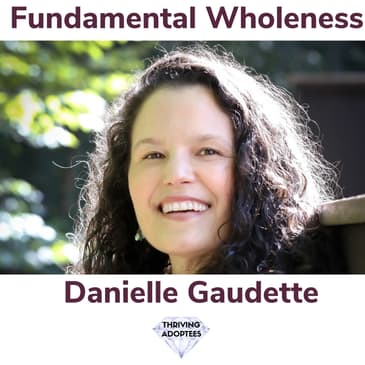
What would feeling fundamentally whole do for you? Knowing that trauma hadn't damaged the essence of You? That You are intact underneath your trauma, despite your trauma? Listen in as adoptee and Emotional Healing and Integration Guide Danielle asks me some great questions and I do my best to answer them.
Here's a bit about Danielle from her website:
"I suppose my own healing journey began the moment I was born. Relinquished by my birth mother, I was adopted by two amazing humans. However, heartache set in as I watched the mother who cared for me everyday struggle profoundly with a mental illness brought on by her own childhood trauma. From the age of six years old, I did everything I could to help her, care for her, and make her happy.
The pain of watching my mother suffer, as well as a deeper pain I didn’t understand until much later – the pain of my own relinquishment trauma – trained me to be a highly sensitive, empathic little person. I developed a healing heart, full of compassion and love for the suffering of humanity and the earth, yet unable to shine that same light on myself. Instead, I tortured myself with deep insecurities, debilitating anxieties and incessant fears, all in an attempt to grasp for some kind of control in an unsafe world. For more information about my story, please check out my memoir, Healing Tree.
I experienced self-love for the first time in my life when I was twenty-two years old. It was in the year 2000 when I met and fell in love with the principles of Brain Education and the ancient Korean mindfulness practices of Body & Brain, discovering the profound power of energy healing. From that moment, I whole-heartedly threw myself into my emotional healing and spiritual growth journey, eventually leading me to share the tools that changed my life with others."
Her free 2-part video experience and guided meditation: Healing Your Relationship With Yourself
Her website www.daniellegaudette.com
YouTube Channel: Healing Tree with Danielle
Guests and the host are not (unless mentioned) licensed pscyho-therapists and speak from their own opinion only. Seek qualified advice if you need help.
Want to learn more about thriving for you, your kids, your families or your colleagues? Pick a time to talk here
[00:00:02] Hello everybody, welcome to another episode of the Thriving Adoptees podcast. Today I'm invited to be joined by Danielle, Danielle Gaudette. Like you must be like the third, fourth time something, fourth time maybe, Danielle? Yeah, I think so. I think it's the fourth, yeah. Yeah. So, listeners, if you haven't heard of Danielle before, she's an adoptee and she is also an emotional healing and integration guide.
[00:00:27] And when I thought of who I'd love to interview me about, well, you could just have a chat, right? Probably just have a chat about what Fundamental Wholeness is all about. I thought, Danielle's got to be one of those people, right? So, she's got a great book. Shout out the name of your book, Danielle?
[00:00:52] Oh, it's called The Healing Tree, an adopted story about hurting, healing and letting the light shine through. So, and it's remarkable in the sense that the first book is really about, the first half is about the story. And then the second half is more about a healing, like taking listens through a healing journey. How would you describe that?
[00:01:16] Yeah, it's tools. Yeah, each chapter in the second part is like tools that I use to help me on my own emotional healing journey. And I'm kind of sharing the principles, some stories, my own experiences, and I give a little, like, if they want to try it at the end. Yeah. So, it's much more than a memoir. It's, yeah, it's inspirational stuff.
[00:01:46] So, we're going to talk about Fundamental Wholeness. Yes, I'm excited. Yeah. Ask me a question. Kick off or? Well, first, I just want to ask you about this because you mentioned this phrase to me. You were talking about non-religious spirituality and you said, I'm calling this what you are focused on, Fundamental Wholeness. I want to hear what that is.
[00:02:14] So, Fundamental Wholeness is essentially my philosophy, right? It's my perspective. It's my way. It's my paradigm, right? So, it's how I see it.
[00:02:34] So, Nancy Verrier describes us as primarily wounded. That's her perspective. That's her paradigm. That's her view of adoptees.
[00:02:46] My view of adoptees is that we are fundamentally whole. And what I mean by that is that underneath our trauma, there is a part of us that our essence is whole. It's intact. It's not being damaged. Trauma has hidden who we are.
[00:03:14] It hasn't harmed who we are. So, it's spiritual because it talks about identity.
[00:03:31] Our psychology, psychology is not identity. Spirituality is, spirit is identity. Right. You're talking about who, our essence.
[00:03:49] Our essence, yeah. So, essence, essence, spirit, consciousness, awareness, chi, God. These are all synonyms for who we truly are. So, our essence. Mm-hmm. Our essence. Mm-hmm.
[00:04:12] So, I'm saying I'm distinguishing between our psychology and our essence. I'm saying we are not our psychology. Mm-hmm. We are not our trauma. We are essence. Mm-hmm. Mm-hmm. Mm-hmm. Hidden by trauma. Sometimes. Sometimes not. Mm-hmm. Mm-hmm. So, it's a veil. It's like a veil. Mm-hmm. Right.
[00:04:41] It's like a cloud veils the sky. Right. Like a storm, storm veils the sky, right? So, trauma is like a storm is a metaphor for trauma. We've got grief. Mm-hmm. The rain of grief. Mm-hmm. We've got the thunder of anger. Mm-hmm.
[00:05:05] And we've got the lightning forks of fear and insecurity. Mm-hmm. The storm hides the sky. It doesn't harm the sky. Right. The sky isn't afraid of the storm. Right. Right.
[00:05:29] And as we deepen, as we see our fundamental wholeness deeper and deeper and deeper, we're less scared when we're triggered. We're triggered less. Yeah. And we're less, we're triggered less. And the triggerings, the triggerings are quieter, right? The explosion from the trigger. Mm-hmm. Mm-hmm.
[00:05:54] Is, is, is quieter because the, because the sky knows that the storm can't do any damage. This too shall pass. The trauma, the, the, the storm will, will go. And, and when the storm's gone, we are, we're untouched. Mm-hmm. But we're visible. Mm-hmm. Mm-hmm. Yeah. I couldn't agree with you more.
[00:06:22] A hundred percent on the same page with you about that. I'm curious. Well, first I'm curious. So this is fundamental wholeness is what you are calling our, I'm just going to use the word essence. It's the paradigm, as you said. Is there a pathway that you present to it for people to, to feel that, to meet with their fundamental wholeness? Yeah.
[00:06:59] Yeah. The perception. Yeah. It's a seeing thing, not a doing thing. Okay. Yeah. We don't, we don't have to, unless we're really straining to see something cause the light's dark or we haven't got our glasses on. Right. We're both going to get our glasses on. Unless we're straining, seeing is, doesn't require any effort. Right. It's, it's, this, this is a, a seeing thing, not a doing thing.
[00:07:29] Okay. Yeah. I understand. So when you share about that, the pathway, the pathway is seeing, the pathway is seeing, the pathway is seeing, the pathway is perhaps taking off our trauma lenses. That could be. Yeah. Yeah. And so the, but let's go, just let's say that, let's go play with the metaphor for, for, for the pathway because people want to understand the root to it. Right. Okay.
[00:07:58] So I would say the, the pathway has two distinct points on it. Mm-hmm. So let's call those junctions. Right. Okay. Well, let's call them mile markers. Right. Let's call them mile markers. Right. Okay.
[00:08:23] So mile marker one, we see our fundamental wholeness. Okay. Mm-hmm. Mile marker two would be, we feel our fundamental wholeness. Mm-hmm. So the seeing is done by our eyes and an, an idea in our head. Mm-hmm.
[00:08:50] The feeling of our fundamental wholeness, wholeness happens in, happens in our heart. Yeah. Right. Where we feel it. Mm-hmm. And then the rest of, the rest of the path, and it's an infinite path, or you, yeah, it's an infinite path. You could say it's a path until we, until we die. Is aligning, is, is, is, is, is one of alignment.
[00:09:15] And what I mean by alignment is our thoughts, our feelings, our actions align to our fundamental wholeness. So milestone one, seeing that we're whole. Mm-hmm.
[00:09:42] And then the rest of the, the rest of the path aligning to that. Yeah. Yeah. I love that. So, but I'm curious. So, okay. You meet with a lot of adopted persons, right? Mm-hmm. Through your podcast. And are you sharing about this with them? And how's the response? This is my question. So, um, I'm normally interviewing them. Yeah.
[00:10:10] So you don't necessarily always do. No, I don't. I, I, I, I put some of my, I might put my, some of my psychology, sorry, my psychology, some of my perspective in, my, my, my thoughts. But I'm interviewing them. Yeah. So that, that's why we're having this conversation today, the other way around. Yeah. Which is, allows, because I, I'm being interviewed, which means that I can ramble on.
[00:10:41] Well, you know, I, I can talk about stuff. You can ask me questions about that. And, um, and one of the reasons for, for, for doing that is because I want to get better at expressing fundamental wholeness. Mm-hmm. So that more people can see that fundamental wholeness. Yeah.
[00:11:06] So I need to get, I need to get savvier with my metaphors, with my story, with my clarity. I need to get savvier. I need to get cleverer. I need to get tighter. I need to get more precise. Mm-hmm. So the, I can, I can do that on a keyboard. I can do that writing in a book, but I actually prefer to do it in a live conversation. I, I, I, I love dialogue.
[00:11:36] Yeah. I don't, I don't love monologue. Yeah. Yeah. And I don't, I don't, I don't particularly, I, I, I, I'd far rather talk than write. Mm-hmm. Mm-hmm. Right. We've talked about that before. I've heard you say that. Yeah. Yeah. Well, I'm good. I'm glad you are sharing. For me, the way you're explaining it is very clear, but that could be because I've been on
[00:12:01] an extremely long journey with my fundamental wholeness, with it, towards it, in, in these mile markers, especially, I would say, a deep desire and moving towards feeling, feeling to alignment is kind of an ongoing process for me.
[00:12:26] But I'm curious, I feel like, what would you say to someone who, I guess, gets blocked, right? First, maybe the first mile marker, they can't see it. Or, I think I want to talk about both of these things. The second mile marker, because I feel like that's also where I struggled for a long time,
[00:12:48] where I could feel it, but it was like, it was like, quick side note, there's a scene in The Matrix, the movie The Matrix, I think it's episode three, I love that series, where they're going to the Machine City, Trinity's driving, she's flying the ship, Neo's next to her, he's blinded by now. Sorry, spoiler for anyone who hasn't seen it.
[00:13:13] But she breaks through, for one moment, the machines have scorched the sky. So she breaks through that for one moment, and she sees the real, true sun, not the Matrix sun, but the real, honest sun. And it's like, oh, it's like an enlightenment moment for her. So back to this point, for me, the feeling part was a little bit like that, and then back
[00:13:40] into the storm, back into the scorched sky. So for people, and then we're talking here about adoptees, that's the theme really, who can't see, A, see it, and then B, can't feel it, so have a hard time even moving to the third mile marker. What do you say? What is your advice? What is your suggestion?
[00:14:05] So my suggestion is to research different teachers, to find different teachers. Yeah. So what I'm talking about here is sometimes it's psycho-spiritual, right?
[00:14:28] So one way of looking at this, there are different psycho-spiritual modalities, books, and teachers. So one guy who talks about this stuff is a guy called Richard Schwartz. He's the founder of something called Internal Family Systems, and that is a psycho-spiritual framework.
[00:14:57] What is psycho-spiritual? Could you define that quickly for me? So it's psychological and spiritual. It's a combination of the two. I see. Okay. So, and you could also have like psycho-spiritual-physical, right? So physical would be the somatic stuff, right? When we're looking at the body, and I know that's a big part of your... Yes. That's been a big in your journey, right?
[00:15:23] So I'm talking here really, I think, about the glimpse, the head stuff of this, right? Yes. So seeing it and seeing it, having it as a thought in your head. Yes. Rather than a body stuff, right? So Internal Family Systems, Richard Schwartz is psycho-spiritual.
[00:15:50] So what he's doing, what I call and other people call consciousness, what you call essence, he calls the uppercase S self. Yes, I've heard that. He calls the uppercase S self. And he characterizes the uppercase S self, which is very cool. And he has seven or eight Cs, and I can never remember them all.
[00:16:17] But the first one, the most significant two, I would say, are calm. Calm. When I think about trauma, I think of anger. Anger would be a big part of my trauma. My trauma, what's the word? My trauma experience, I would say anger. It would be a strong one.
[00:16:46] So calm, opposite. You know, calm and anger, kind of opposites. And connectedness, connection, which is very significant for us. So what that means in an adoptee perspective, right?
[00:17:05] And also within an adoptive parent context as well, I would say, is like adoptees feel a relief in connection, connecting with other adoptees. So they feel connected. Okay, they're connected. Some of that, it's a shared experience.
[00:17:33] So that's the great part of it. And we make new connections. We make new friends, right? So if I never started this podcast, then you and I would never have met, right? And there's that. So great to make new connections. But there's also, it depends who we're hanging around with, right? And where they are on their healing journey, should we say.
[00:18:01] So we can trauma dump. We can trauma bond. And trauma bonding keeps us stuck to our trauma. Yeah. Which is thinking that we're the storm. Right. Not the sky. So there's an adoptee on social media. This person is also an adopted parent.
[00:18:27] And I saw a quote from her on LinkedIn. I am trauma. I am trauma. So she is identified with trauma. Yeah. And so that's not even stuck. That's just one. Two things can be stuck together. But she's saying, I am trauma. There's a singularity there.
[00:18:58] There's no separation between who she is and trauma. She's saying, trauma defines me. Trauma confines me. Trauma identifies me. Trauma, you know. Right. So, right. So that's one of the. So one of the things that can keep us from seeing our wholeness. Is the people that we're listening to. Yeah, I see. I see.
[00:19:29] Yeah. Simon's talking shit. I see. Yeah. They could say that. Right. Yeah. I've been. I've been called toxically positive. Right. Okay. So let's talk about that. Toxic positivity. What, what do you, well, how do you define that? How is what you're talking about? So toxic positivity. Well, I'm, I'm, I'm just focused on our fundamental wholeness and our trauma.
[00:19:59] And some people find that toxically positive. Because they would, they would be, they, they think that I'm denying the trauma. Perhaps. I don't know. I have to ask what's going on. I can't, I can kind of try and guess what's going on, on, on for them. And I'm guessing that they think I'm denying the trauma. Well, I'm, I'm not denying the trauma for one, from one minute.
[00:20:26] I'm just denying the fact that we are our trauma. Right. I'm saying we are fundamentally whole underneath our trauma. So I'm not, I'm, if, if, if I, if I was going to be toxically positive, I wouldn't mention the word trauma at all, would I? I would just say, well, we're fundamentally whole. End of. That's it. Goodbye. Hope you see it soon. Right. Right. Thank you. Adios. I'm off. No. Right.
[00:20:54] I'm, I'm just saying, I'm not denying our trauma. I'm just denying that our trauma is who we are. Right. So I'm just under, if I'm understanding, you can tell me if I'm understanding correctly that like your, I don't know, wish, maybe sense of purpose. I don't know if you feel like mission in it is to like, let adoptees know that they are fundamentally whole and they are not their trauma. That's like your desire.
[00:21:24] Is that right? That's what I'm pointing towards. That's, that's my, the podcast is about thriving. Yes. Right. Podcast has been going for five and a half years. Right. Thriving and fundamental wholeness. Yeah. Yeah. And then you're. Interchanging. Interchange. Interchangeable. Intertwined. It's not trauma denying. It's just not trauma identifying. Right.
[00:21:51] I heard you say like, you're not denying that there is a trauma. You're just saying you're not that trauma. Correct. Yeah. Yeah. We are whole. We are. We are. Yeah. We are unwounded. We are because we, because our essence is unwoundable. Yes. Yes. I.
[00:22:20] I'm totally with you on that. And. The toxic positivity thing is interesting to me because. Well, I don't know what it is. I don't really know what it is, but I think the word that comes to my mind is like bypassing. This is another common word, which I actually, I don't like it myself. I am in the camp of. I am not. I have a wound. I am not that wound.
[00:22:49] Never could be that wound. The fundamental wholeness that I am is perfection itself as for all human beings. But yes, the way I came into the world created some injury and there's like an effect that I feel as I live life. So I try not to bypass and be toxically positive. Just like, just, you know, smile and just choose happiness.
[00:23:16] And this is a little bit bypassing, I guess, toxic positivity. But what you're talking about is something different. Like you're just trying to sort out like the, the true essence of who we are from our confused, confused identity that is confused because of how much like pain we have experienced.
[00:23:43] So my own experience with the primal wound was a relief at a diagnosis. And on the back of the relief of the diagnosis, there was a feeling that I'm stuck with this. Yes. It puts you in a box for sure. It puts us in a box.
[00:24:04] And then the next thing that happened was a realization that, that I am unwounded because we are unwoundable. Yeah. And that was about 12 years ago. So I don't think I could express it quite as clearly as that. Yes. Yes. Yes. But I've been grasping, working that way, working. I'm still working.
[00:24:33] I still had a lot to learn. Yeah. On my, on the clarity of my communication. Yeah. That's why we're here. Yeah. Today. Yeah. And it's not just only, you know, adoptees, like all people are in some form of box or another.
[00:24:52] There's different identities that people get attached to and they lose that attachment to another identity that is usually, it has some pain in it. Like it's comforting to attach to that identity for some reason.
[00:25:13] But the unfortunate part is then, like you said, that becomes a box or a veil or a block or a barrier to reconnect with that. Well, Akkad Tully would call it the pain body. Yeah. Yeah. So pain body and trauma for me are kind of almost the same thing. Just different words for the same thing.
[00:25:39] One of the, one of the other, like the somatic guys, Peter Levine, he says that trauma is a fact of life, but it's not a life sentence. Trauma is a fact of life, but it's not a life sentence.
[00:25:54] And so my question to, my question off the back of that is, well, what's the key that unlocks the jailhouse door to end the life sentence? Yeah. And for me, that is insight. It's insights. Yeah.
[00:26:22] And I don't find a lot of people being really clear and really brief and really succinct in that. So if you ask somebody, what does healing mean to, what does healing mean to, to, to, to you? Then we, we, you know, like me too, right? I would just start, you know, before I got to where I am, I would say, well, I would just yabber on. Right.
[00:26:52] But I would say, so, well, healing is a process. The step one is, is seeing that we're whole. Step two is, is, is feeling whole. And the rest of the journey is aligning our thoughts, feelings, and actions to that felt sense of wholeness. Right.
[00:27:12] So what, what stops us having insights, I believe is the, the, the waffle that there is in this space, the, the lack of clarity and succinctness. That, that to me is not very good pointing. I'm trying to point to things. I'm trying to point. I'm, I'm, I'm, I'm, I'm using sentences as pointers.
[00:27:43] I'm trying to be very brief, trying to be very clear, very concise. So we talked about IFS as, as, as, you know, if people want to see their fundamental wholeness, one way you can do that is looking at, um, Richard, Richard, Richard Schwartz and his IFS. Um, that's one, uh, uh, teacher.
[00:28:03] Um, and my own favorite teacher is a guy, a Brit guy called Rupert Spira, who, uh, who I, I think is superb in, in the precision of his pointing, his clarity, his way of sharing his paradigm. Um, with, with, with other people.
[00:28:33] So that's, but yeah, so those, those, those are two, two people, but if you Google, if you don't like Rupert Spira, then Google non-duality teachers or put non-duality teacher into, into your podcast search. And it will bring up a whole load of different, different people and find, find a teacher that resonates with you.
[00:29:00] That, that you, you like their metaphors, their stories, their precision, their, their, um, their inclusion of psychology or, or, or whatever that is. Find, find, find a, find a teacher that resonates with you, that, that helps you and, and experiment till you see what those teachers are trying to point to.
[00:29:31] Yeah. Yeah. Yeah. That's good advice. I think it's all about awakening the, they have to kind of awaken the sense of it. They have to feel, feeling it is like, is sensing it. So back to just kind of loop around and close the toxic positivity story.
[00:29:48] I just want to say, I think it gets super tricky when people haven't sensed what you're talking about, whether that's even an intellectual sense or a feeling sense or a deep knowing sense. And they haven't sensed it. Then the whole story, like a response to like, Oh, that's toxically positive.
[00:30:12] You know, they're going to respond to your fundamental wholeness with the, with their trauma. Okay. So, yeah, I agree. And I, I, I also think that everybody has experienced a split second of calm in their life. Okay.
[00:30:40] At some point, we're not angry all the time. We're not insecure all the time. We're not scared all the time. There are moments. There are moments.
[00:30:55] So it might be when a, a painting takes our breath away, or it might be a moment when a mountain takes our breath away, or it might be in a moment when we snuggle our child, or it might be a moment when we pat our dog. Like we've all had an experience of calm at some point.
[00:31:26] Well, that's, that's the taste of our fundamental wholeness. Right. And I use the word taste very intentionally because taste is visceral. Mm hmm. Mm hmm. It's not intellectual. Right. It's an experience, right?
[00:31:50] So we've, we've, we've got theories and we've got experiences or we've got theories and we've got felt understandings. Mm hmm. Experience. We've all, we've all had a moment of calm in our life. And that's the taste of our fundamental wholeness. Mm hmm. And it's usually, it's, it's often at the end of seeking. Right.
[00:32:18] So I've just interviewed somebody else for the, I interviewed somebody else for the podcast just before we came on in that run late. Right. He was talking about, he was talking about the end of seeking. So I read the primal wound and I felt relief at the diagnosis. That's how I expressed it to him. And he said that, that relief wasn't caused by the book.
[00:32:47] That relief was the end of your seeking. Mm hmm. I see. So the end of, the end of seeking. Mm hmm. Seeking for some kind of answer. Oh, anything. Right. So, um, my own stuff, my, my own life. Right.
[00:33:08] I, I, I thought, I thought that I spent 10 years shit scared about business. Thinking that if I had a good year in business, I would be happy. Mm hmm. Mm hmm. And I was briefly when it eventually happened. Mm hmm. But then the feeling of relief stopped.
[00:33:36] The relief was short-lived. Right. And then the worrying came back in. The worrying about the future of the business. Mm hmm. Came back in. But there was a relief. But that, so sometimes with, you know, you've got a, you've got, you've told me a little bit about your reunion story. It's been great. It's been great.
[00:34:05] And there's, but there's been ups and ups and downs. So a lot of us, a lot of us, a lot of us, think that, that, believe that the, the, the reunion is going to be the, the, the happy ending. Right. And we're going to be happy ever after. Right. But that's not the truth. But we're, we're, we're looking, we're looking for happiness in another person. Right. We're looking external.
[00:34:35] Right. When we know that feelings are an inside job. But we're conditioned by society, by our parents, by, you know, like we're conditioned to think that the, the, the world determines our happiness. Right. So we've got these phrases. I don't know if you have it. Do you have miserable weather in the States? We have miserable weather here in the UK. Uh huh. Uh huh. We have miserable weather here in the UK. Uh huh. So the idea is that weather causes misery.
[00:35:05] Mm hmm. Have you ever been happy in the rain? I have. Yeah. Have you ever been sad in the rain? Probably as well. So there's not a causal relationship between the weather. That's right. That's right. And our feelings. Right. But, but we forget that all the time. Right. Yeah. We forget that all the time. Anyway. Yeah. Yeah. What you're talking about is the inner journey, which so many people have a hard time taking.
[00:35:31] And especially when they're stuck on this, but this thing, this because like a blame. Right. Because of this thing, I cannot feel peaceful. Or so anyway, that's, that's like, I feel like another whole conversation. That's a lot of the work that I do. But I just want to say, I want to make sure to recognize what I liked, what you said when
[00:35:56] you said, I feel like, I feel like you're just simply inviting people to lean into those little moments. I have a friend who calls them glimmers in life where you felt that calm or that joy or that, that heart, like seeing a baby or just, you know, looking at the trees or the river. Right. And then leaning into that, like you felt that.
[00:36:26] So, you know that. So that, that's getting closer to your fundamental wholeness. It's the moments when our thoughts drop away. Right.
[00:37:04] Yeah. And then the pain comes in, then the, the, the, the, the anger comes back, right? Or the frustration comes back. And, you know, so, so it, it ends, it ends the glimpse. But we have tasted, that's, you know, like we have, we have all tasted moments of calm. Yeah. And that is the proof that we're not fundamentally broken because if we are fundamentally broken,
[00:37:34] fundamentally wounded, we would feel trauma all the time. 24 seven. And yet we, we don't because we're, we're the, the sky in which our trauma storm comes and goes. Yeah. Yeah. Yeah.
[00:37:58] It's, it's good to give the people those reminders because sometimes people just can't even catch it. Like fundamental wholeness. Like what can, what is that? So it's great that you're giving people those examples and then they have something to relate to that gives hope and like, okay, that's the direction. Yeah. Yeah. Yeah. Feels like a good place to bring it in, Danielle.
[00:38:27] Sounds good. It was great to hear more about it. Thank you so much for sharing with me. Thank you. Yeah. Thank you. And I, I, I want to, uh, Garrett, the guy that I interviewed, uh, just before we got on, he said, don't, don't believe me. Right. Look, look in your own experience. Look, look to your own experience.
[00:38:54] And, uh, I thought that that was such great advice. Right. Uh, and I think I probably should have mentioned that earlier at the top of the show. So it's just look for your experience. But I think that what I would encourage people to hang, hang on to or question to ask themselves. Right. Have I ever had a moment's peace? Yeah. Yeah. Yeah.
[00:39:22] Uh, because in all likelihood they have, right? And to, to link that in my favorite, uh, my favorite teacher, Rupert Spire says, uh, peace, peace and happiness are the nature of our being. Yes. Mm-hmm. Mm-hmm. Yeah. Thanks, Danielle.
[00:39:53] Thank you, Simon. Good luck with everything. Yeah. Take care. Bye-bye.