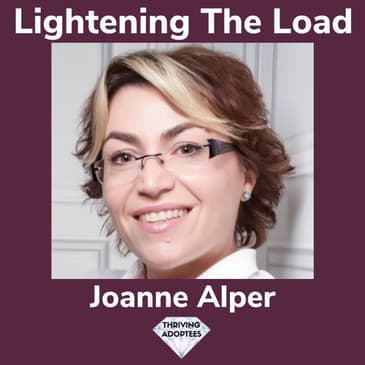
How would a lighter load help you? Your kids? Listen in as adoption professional Joanne talks self care, helping kids carry less baggage and much more...
Here's a bit about Joanne from her organisation's website
"I have over 30 years' social work experience in both local authority and the independent sector, covering child protection, children's care and Adoption and Fostering. I have worked as team manager, service manager and service director and was instrumental in establishing Adoptionplus in 2002 first as an Adoption Support Agency and then in 2006 as a Voluntary Adoption Agency.
I am a qualified social worker and play therapist and have had 9 books published, including the Billy Says series of 6 books; All About Mummies and Daddies; Assessing Adoptive and Foster Parents: Improving Analysis and Understanding of Parenting Capacity; and Supporting Birth Parents of Children who have been Adopted.
I have sat as a Trustee on the CVAA Board, a special adviser on the NICE committee for Quality Standards in Attachment and been invited to give evidence at a number of All Party Parliamentary Committees.
Over the years it has been incredibly rewarding to play a leading role in developing Adoptionplus and to work with our talented team dedicated to improving the quality of life for so many children and families."
Find out more at:
https://www.linkedin.com/in/joanne-alper-13267a42/
https://www.adoptionplus.co.uk/
https://www.linkedin.com/company/adoptionplus
https://www.facebook.com/Adoptionplus
Guests and the host are not (unless mentioned) licensed pscyho-therapists and speak from their own opinion only. Seek qualified advice if you need help.
Want to learn more about thriving for you, your kids, your families or your colleagues? Pick a time to talk here
[00:00:02] Hello everybody, welcome to another episode of the Thriving Adoptees Podcast. Today I'm delighted to be joined by Joanne Alper. Looking forward to this, Joanne. Do you know how long this conversation has been in the offing? A long while. Do you want to take a guess? Five years? The earliest email I can find is 2021. Goodness.
[00:00:28] So, this lady Joanne is mega busy. So we've finally made it happen. It's the first proper conversation we've bumped into, conferences and stuff like that, but this is probably the first proper conversation. So, listeners, Joanne started as a social worker and then was instrumental setting up what you call a therapeutic adoption agency, right? Yeah.
[00:00:55] Called Adoption Plus. And part of your background is also as being a CEO, an exact director, what do you call yourself? At the moment I'm CEO of Adoption Plus. Yeah. But you've also trained as a play therapist, right? I have, yeah. If I can remember my LinkedIn stuff, right? Oh wow. Yeah. So, thriving. What does thriving mean to you personally, right?
[00:01:25] You as a mum, I know you've got a couple of kids, two daughters you mentioned. I have got two daughters. I'm one of those following in your footsteps into a social worker. Yeah. So, as a mum, as a human being, as a leader within a therapeutic adoption agency, what does thriving mean to you? Yeah. Well, it's a really, really interesting question. So, I mean, you don't often get time to sit and think about stuff like this. So, I think it's useful.
[00:01:55] And I guess I just wanted to say as well, my background before setting up Adoption Plus was working in child protection. So, I've been used to spending a lot of hours in the week working in quite stressful, upsetting context really with trauma. So, I was thinking about thriving within that context as well. But for me, I've had to really focus on how to take care of myself and be able to bring the best of myself every day.
[00:02:23] And I think for me, thriving is about being as positive as I can and seeing the positives in things wherever possible. Because there is so much pressure not to look at the positives, to always look at the problems. So, I'm definitely, I would say, very much focused on what might help, what might make a difference.
[00:02:49] And that, I think, helps me by trying to find solutions to solve problems. Yeah. I think also for me, recognizing and creating as many moments of joy as possible. I don't believe that everyone's happy all the time. I don't think it's realistic to think that we can all be happy all the time. But we definitely can have moments of joy and pleasure and connection. And I just, whenever those happen, I try and create as many as possible.
[00:03:17] And I call them trying to, being the creator of magical moments. I like to try and create those. And then when they're, you know, I just try and notice those when I'm in those. It might be laughing with friends or sharing a bit with family or sitting in the garden or whatever it is. It's not anything huge. It's usually the day to day activities.
[00:03:39] So I think for me, those are the things that I think about when I'm thinking about how do I, how do I stay in a space where I can thrive and be my best self. And then I guess the last thing, which is probably really obvious, but is about self care.
[00:03:57] And when things are particularly stressful and when I feel like I have the least amount of time because of work demands and other demands on me, I feel it's even more important to focus on self care. Which for me is maybe going for a walk in the forest or by the beach or going swimming or making my sourdough, whatever it is, just taking those moments away just to keep myself being okay.
[00:04:26] So I guess, I don't know if that kind of answers your question, but that's kind of what I was thinking really. Yeah, there's no right answer. Yeah. And it is personal. Yeah. It's a good job there is no right answer. And it's a good job that it is personal because otherwise I wouldn't have done 680 episodes, right? People, it just, it wouldn't have the longevity because I'd just run out of stuff to talk about, you know, if it was the same for everyone.
[00:04:55] Take him, gonna take you back a little bit. A lot of social workers cut their teeth in this child protection space. That's what seems to happen in the UK. A lot of people talk to me about that. I don't know whether that's actually the same in the rest of the world as well. You know, we've got listeners from the States, Canada, some in Australia, India.
[00:05:21] I don't know whether that's the, but yeah, it seems to be a kind of a baptism of fire, right? It's tough. You, I'm guessing you learn a lot about, some people might call it compartmentalization or something like that.
[00:05:43] You must learn a lot in those, experiencing those environments that are new to you, tougher than you've seen before. Am I kind of on the right line in terms of the picture that I'm painting? I mean, I, when I, when I went into child protection, it was, it was a newish team and it was just social workers working with the police.
[00:06:12] And we literally just did the child protection investigation up until the first child protection meeting. So it was basically all days about uncovering child abuse and really horrific situations. I was quite young in my early twenties when I did it, I did it for over five years. And I, so I had to find a way, I guess, to, well, at that point, almost, it felt like either survive or leave. I mean, I could, you know, you have to find a way.
[00:06:44] And you talk about compartmentalizing, but I remember one of my managers at the time, because it's so upsetting taking off doing your first interview with the police. I won't go into details, but some of the, some of the things were really, really, really upsetting. And, um, I had to find a way to deal with that pain. And, and I, and my manager's time was saying, well, you need to get a thick skin. Um, and I remember thinking, I don't know where you get that is from.
[00:07:11] Uh, Argos, uh, Argos, Amazon, all good entrepreneurs. Well, I definitely don't have a thick skin. Um, and I, and I thought, well, if I haven't got thick skin, can I do this work? Um, and then I realized, actually, I don't know if I want a thick skin. Because who wants to be, have such a thick skin that you're not feeling and that you've got no compassion or empathy. Yeah. I sort of thought I actually want an oiled skin. I want to be able to feel things, but I don't want it to hurt me.
[00:07:39] I don't want it to kind of get inside and cause me additional pain. But I still want to be able to have compassion and empathy. Um, and I think for me, what I did in that situation, which was like incredibly helpful is I got my own, um, reflective space outside of work to be able to process some of the stuff I was hearing. And I focused on self care a lot. How can I look after myself? So it's those two things. It was the kind of emotional wellbeing and the physical wellbeing.
[00:08:09] And I think the other thing was, um, some, one of the big overwhelming bits of it. And I think in a way is a lot of things nowadays is, is the problem seems so huge. The criminal justice system didn't seem fair for children. Didn't seem, it was, wasn't easy to get cases to go through court because of children's ages and vulnerability. And, and, and I, it was just worrying that you felt like you couldn't do what you really wanted to do in terms of protecting children.
[00:08:37] Um, and it just felt so huge. And I, I basically came to the conclusion that the only way I could manage is it manage it was thinking, what can I do today? How can I make a difference today? Because if I start thinking about all of the children who needed, you know, who needed support, it was just too overwhelming.
[00:08:56] And I think that's the way that's been probably in terms of my career, that's probably been one of the most helpful ways I've thought about it is thinking not in the macro in terms of it, cause it's just too overwhelming. It's how can I make a difference to this young person or to this parent or to whoever it is I'm dealing with today? How can I make a difference today? What can I do?
[00:09:19] Um, and that I think really helps maintain empathy, maintain compassion and maintain hope, which you kind of need to also keep hold of in when you're working in this area. Yeah. So what gets in you the way of your thriving then? What gets in the way of me thriving?
[00:09:40] Uh, overwhelm, I think, when it feels like there are so many problems in so many different areas, it's difficult to know which way to kind of turn first. Um, maybe unrealistic expectations of myself.
[00:10:02] Um, um, maybe if I've stopped taking care of myself, because ironically, like I said, the busier I get, I then things like my morning swimming, my go, because I think, oh, I need to go into work. But actually I need to make sure I protect that morning swim because I know that the brain I'm going to be bringing into work is going to be a much better brain to solve some of the problems than if I just let work eat into every hour of my day.
[00:10:31] So yeah, I'd say those things really. Yeah. I, I had a distinction between from a, a mentor, a mentor of mine, a guy, American guy, um, but a bit of an Anglophile. So, you know, uh, not, uh, cause sometimes I think as Brits, we see the States and they think that it seems like a different world, right?
[00:10:58] And different sort of people in this, this, this guy's lived in the UK. So he, he, he, he knows that he knows that kind of thing that sometimes if it impacts us as Brits. So that's too American, right? You know, that's, that's America, but that's not, that's the UK. I don't know why I started talking about that anyway, but he, he made a, I heard him, I heard him make a really great distinction between overwhelm and overload.
[00:11:27] Right? So overload is trying to do too much. You've got too much on your plate. So that's a kind of like a, a functional thing. Um, and I'm, I'm, I'm thinking, you know, like, so yeah, I'm thinking of what would the example be? Right? So I used to be in publishing and I know that I can, I can proofread 2000 words in proofread edit, in fairly light edit in 20 minutes.
[00:11:56] But if you asked me to do it in five minutes, I couldn't, I couldn't do it. If you give me 20 of them and say, right, do them in an hour, that, that would be actually an impossibility for me to do it. So that's overload. Um, uh, overwhelm is, uh, is for me is when you're like, you, you look, well, I got it last week actually, cause I was, I was on zooms all day.
[00:12:25] And then I, I looked at my inbox and I just thought, how am I going to get through this inbox? I can't get through this. And, and, but I don't need to get through that inbox. It's just, it's the, it's the, the overwhelm is the feeling. Whereas an overload is kind of more of a fact base thing. Um, uh, a work kind of a workload thing.
[00:12:47] So that you talked about better brain, that, that distinction was quite cool for me to, to see the difference between those two. And it's, it's, it's, it's always stuck with me. I must've had that like five, six years ago, something like that.
[00:13:01] And yeah, I'll tell you as well, just thinking about what you're saying, another kind of description that I like is mindful as in full of stuff or mindful is in terms of your kind of thinking and reflecting on what the situation is. And I like that as well, because, um, you don't want to be, you don't want to have a head that's just too full, but you do want to have a head that's thinking in the moment and aware of what you can do and what you can't do. Yeah.
[00:13:31] So that's another nice one as well. So Joanne shared, listeners, before we hit the record, um, that she's dyslexic, right? So I, but I'm thinking mindful with one L or mindful with two Ls. Yeah. Two Ls. Yeah, exactly. Full, funny. And, uh, I like to go, I like to, to go against or to carry on the metaphors, right? So mindful.
[00:14:00] Well, yeah. Okay. But when I'm, you know, you talked about walking in the forest, right? That's mind empty. Well, well, it can be, it can be, but you can also be in the moment and actually being, you know, here, seeing the light coming through the trees. Yeah. Smelling the forest.
[00:14:25] So you're, you're kind of in that moment, noticing and experiencing without necessarily worrying about things that you have to worry about. Yeah. That's exactly what I'm getting at. Yeah. Right. I'm, I'm saying your heads or I'm saying my, so I don't, we don't have any forest near us, but I, I sometimes go to walking in a, in a, in a little wood. Um, or I walk around the fields. I could do most mornings. Yeah.
[00:14:54] Right around here, uh, trying to stray in the shade as I was discussing, you know, before, uh, when it, when it's hot. Yorkshire people aren't really used to, uh, heat. Um, so my, my mind is full of nature. It's not full of thought. Yeah, absolutely. So mind empty, what I mean is it, it, it, nature's filling it up. Yeah. If, if there's anything there, it's yeah. And, and swimming, right. Okay.
[00:15:24] But you, you kind of just, you, you take it, I'm taking in the senses. I'm, I'm feeling, I'm feeling my, my hands through the water and my, my legs kicking or are they kicking or am I taking it steady or am I pulling through? So it's somewhat, it's far more kind of somatic-y place to be, right? Yeah. Feeling, feeling, feeling the body. I think, I think so. It's Latin for body, for, or maybe it's Greek, one of those two.
[00:15:53] Um, so, so yeah, that, that, uh, that, that distinction between not a lot on our mind and not our mind being open to the, our brain being open to the, to the space, right? So I've got a screensaver on, you know, there's a screen behind my, my, behind my, um, Google Chrome window on my computer. There's a forest space. I didn't, I didn't select that. Right.
[00:16:22] That's just, that's just the way it is. But, um, I want to go back to the oil skin and thick skin, because I think that's a genius, a genius metaphor. If we're in this space of wanting to help people, then we don't want to be a, we don't want to be thick skinned. Right. So nowadays everything, if you try and get anything sorted on, on, um, uh, you know, online, it, it, it, it's robots now, isn't it? Right.
[00:16:53] But before it was robots, it was, it, it was call center workers. And if you ever try to get through to a, like a computer company call center to try and explain what's going on, those people seem to be robots. Right. We, we, I, I, I'm losing it. I'm, I'm totally overwhelmed with the fact that I can't get Microsoft Word to do whatever it was or, or my internet browser.
[00:17:20] Right. And, and those, but those, but those, uh, that, those people that I'm, that I'm, that I, in those days are picking up the, picking up the phone, lack all empathy, seem like robots. Um, and, uh, say helpful things like, have you turned, have you turned it off and turn it back on again? And that, that there is a, it's an empathy desert, isn't it?
[00:17:48] It's an empathy desert. Whereas, you know, you can't get too, you can't get too, you know, you can't get further away than one end of the spectrum of being a social worker and the other end of being a IT support desk person who has seemed to, they seem to have ice water running through their, through their veins. Right. So who wants to be like that? Who wants to be, who wants to be thick skinned?
[00:18:19] I don't, I mean, I guess in some situations it may be helpful in terms of survival. Um, but in the, in the field I work, it's definitely not something that, that I would want to aspire to. And it doesn't fit my personality anyway. Um, so it would have to, it would change me and I don't want that. I want to still be myself.
[00:18:42] Yeah. Yeah. And so oil skin, uh, it sees, feels, feels great. And, uh, as you were explaining it, I was thinking of a, uh, another metaphor or an equivalent metaphor, cause I'm a metaphor lover. Um, uh, Teflon, right? Yeah. Nothing, nothing sticks. Nothing, nothing sticks. We can be in the space.
[00:19:12] We can be in the space for our, our clients. We can hold, hold space for them, but their stuff doesn't stick. To be fair though, to be, to be fair, I think sometimes, I don't know if Teflon for me would be quite, that might be just a little bit too far. Too far.
[00:19:34] Some things do. I mean, there are people I remember, children I work with, um, people I've worked with over the years that I just hold a special place for. And, um, yeah, so, I mean, I'm not carrying their pain, but I'm definitely carrying their story still. Um, and yeah, I would not want that either. I'm happy to hold those stories, but without necessarily. Yeah.
[00:20:01] Absorbing the pain and carrying it cause it's, yeah, not mine. Um, and it's not going to help anyone if I'm carrying other people's pain. Yeah. Yeah. So where's the hope then? You talked at the start, um, talked at the start about, uh, pressure to look at the negative. Yeah. Um, so let's explain a little bit more on that. If you can expand that a little bit more.
[00:20:31] Yeah, there's just, I'm just talking work now. So there's so often, I mean, you, you're in the adoption world in the UK at the moment, you know, all the challenges that we're facing. There are many, many problems and running a small charity like ours. Um, there are many hurdles we have to navigate.
[00:20:50] Um, and sometimes you can get just so, because there are so many coming at the same time, there's a lot to be focusing on all these kinds of hurdles, challenges, problems. So overload, overload. There's a lot, there's a lot. And so it's how do you stay hopeful in those kinds of situations and realistic. It's not some kind of, um, fantasy world of hope, but actually realistic. And I think it's about focusing on what you can do.
[00:21:19] I think for me, it's about having making space to step back and reflect, not just by myself, but with other people who I respect and think together and share ideas and reflect together. Because I think, um, you can often find solutions and find ideas and actually think about things differently from a different perspective when you kind of step away from it and you're talking to someone else and thinking it's thinking together with someone else.
[00:21:46] Um, and those moments are really incredibly helpful, I think in enabling you to stay off me to stay hopeful because we find solutions in those. Um, and then I think other connections with people where you feel that, you know, what you're doing, although it's hard, um, that you are still making a difference and you're making a positive difference to people's lives. And that helps me stay hopeful as well. Yeah.
[00:22:14] Um, so yeah, it's noticing the small things. It's noticing where I am making a difference and it's, um, making sure I protect, I guess, that, that kind of thinking and reflective space with other people. Yeah. Have you got, uh, you talked about kind of macro and micro, you kind of alluded to that as a distinction, whatever, 20 minutes or so ago.
[00:22:40] Um, do you see, uh, do you have, um, micro examples of hope that have been particularly, uh, impactful in your, in your life? You know, you've explained hope as a macro thing, but are there certain, certain memories that stick with you or certain things that you see at the moment now that, right. You know, that, that's a, that's a beacon of hope. Okay. There is one.
[00:23:09] It really stands out. I often get emotional when I talk about it. So just, I just wanted to give you that warning. Hopefully I'll be all right at the moment. Cause, um, so basically I said, when I was in my early twenties, I worked in child protection and, um, I was involved in supporting a young girl, um, who had been really horribly abused within her family.
[00:23:37] And, um, shortly after her, her mama died. And so she had to come into care as a result of what happened. It was literally, my heart went out to her just having to deal with the loss of her mom and all the trauma that she had to go through. Um, and I, at the time I worked in a team, like I said, it was with the police. We just worked up until the first child protection meeting.
[00:24:05] So it may have been three or four months. Um, and I wanted to do everything I could for this young girl in the short space of time, but I work within a system that's limited in what you can do. Um, but I took her to her mom's grave. She never had, she hadn't had an opportunity to say goodbye to her mom. Um, I supported her in whatever way I could within the limited resources we had. Um, now that would have been 30 years ago.
[00:24:34] Um, and I often, well, I say often, I, I thought of her over the years, definitely. I wondered how she was doing. Um, I had, I, if I could, I would have wanted to stay involved in supporting her for longer, but again, the local authority system, that wasn't how it worked. Um, and then probably about 25 years after I'd worked with her. So she would have been in her thirties. She contacted me.
[00:25:01] She found me on the internet and she emailed me. And I remember just like being completely so emotional when I got this email. Um, and what she said to me is that she was a mom now and she had her own kids and she had wanted to reach out and basically thank me. Um, and it wasn't anything I actually physically did. She said that she remembers.
[00:25:28] It was the fact that she felt I cared about her. And that feeling I would never, I don't imagine I would have said, oh, I really care about you. But because I did care about her, every conversation I would have had, she obviously felt it. And I guess I didn't realize until I got that email that just caring about the people we work with and caring about the people we support, they feel it. And they, they hold onto that.
[00:25:58] And she said that during the difficult times in her life, she often would remember how much I cared about her. And that if I cared, maybe there was something okay about her because someone's cared about her. And she used that as something, I guess, to hold onto for herself, something positive.
[00:26:16] And, and I look back on that now and I think I often felt when I used to think about her, it was with the feeling of, I felt so helpless really in terms of how limited and what I could do to be supported to her at that time. But she saw it very differently. She saw, she recognized the system wasn't ideal, but she saw another human being who genuinely wanted to help and cared about her.
[00:26:40] And that in itself was something that I think all of us all the time when we work in this area often feel hopeless because we're working in a system that's not ideal. But actually when you realize what's important, that human connection and genuinely caring for someone else and then feeling it. That mustn't be undervalued. Yeah. She felt it. She absolutely felt it. She emailed me again a few months later as well.
[00:27:09] We kind of stayed, stayed in touch on the email and yeah. And she, she absolutely felt it. And that's why she'd reached out. And I've, yeah, that was very, very powerful for me. Me getting that email from her and realizing just how important it was. Again, going back to the oiled skin again and not having a thick skin, just being able to have compassion for her pain and her situation. Yeah. Yeah.
[00:27:37] And her feeling that I genuinely, I genuinely had that. Yeah. How helpful that was for her. Yeah. So perhaps that's where, you know, like my, my Teflon device, right? My Teflon, Teflon metaphor. Yeah. Went too, too far. And that's where the oil skin maybe goes too far. The thick skin definitely goes, is barking up the wrong, yeah.
[00:28:07] Wrong tree, right? That's what the IT call desk never gave me. Yeah. I never felt that they cared. That they were in left brain, analytical, how do we solve this problem mode? And I find, I use AI.
[00:28:36] You know, you were talking about having, sharing different perspectives with clients. I mean, I have lots of conversations to share different perspectives with people that I talk with, but I don't, I'm a one man band. So I don't have different, the different perspectives. So sometimes I, I, I use AI quite a lot to, to kick ideas around.
[00:29:01] And what it gives me, it never gives me a feeling of care. It, it, it, it's, it's a reflection of what the IT support desk used to give me. It, it, it, it's, it's robotic. Yeah. AI is robotic and those call center people used to be robotic.
[00:29:29] And a lot of them, because I know a little bit about how that industry works. That's a lot of them, the, like social workers are put into this child protection. So they, they put the new, the newbies, they put them on, these, they put them on the call centers. So they're new, they've got no experience. So that, that's why it, so, so not only are they being robotic, but they often can't help because they don't really know that much.
[00:29:59] And, and these are companies that are supposed to care about us. So, um, anyway, I'm, I'm, I'm waffling on a bit. Um, did, did you sense a turnaround in, in that young lady's life? How do, how do you mean? Did you, well, she, you, you, uh, you'd been, uh, supporting her presumably when she was like, I don't know, eight, 10, five single figures, was she? How, how old is she? How, how old was she? Yeah, so she was, she was very young. Yeah.
[00:30:29] She was very young. I'm also aware as I'm talking to you about this, I want to be as sensitive as possible. Of course. Yeah. Yeah, sure. Information I'm sharing. And I think, I think for me, the reason I kind of highlighted that was just when you asked me about hope, um, I don't know if she realizes that when she sent me that email, how much hope she gave me.
[00:30:52] Um, so I'd given her hope in my, um, and she'd actually given it to me 25 years later when she talked about how, how that had been helpful to her. And so that, that was a magical moment for you to use what it was. It absolutely was. It was a really important moment.
[00:31:10] Um, I guess it's something in the intervening 25 years that I've obviously felt is very important not to, to lose the capacity for empathy and compassion. Um, but having her feedback to me about exactly how it felt and how that had made a difference to her life, um, was incredibly powerful for me. Yeah.
[00:31:37] So I've got, uh, I've got a similar, a story that starts the same way, but I, I, I know the ending and I can share the ending because I know that the lady has written a book about it. Right. So my longest standing mentor, right. So a lady that has, uh, been there for me to support me.
[00:32:03] Um, yeah, probably you more of a counselor than. Than a, a mentor to, but she's in a slightly different space to that. She was abused by her dad. Um, and she wanted out of this was in Scotland in the seventies, uh, Glasgow to be exact.
[00:32:31] She wanted out, but the, the, the courts didn't remove her. Yeah. Uh, and she was functioning in the world. Um, with, despite this, this, uh, this abuse as a kid, uh, and then had a, it nearly died in a car crash.
[00:32:55] Uh, and, and, and that was a pivotal moment, uh, for her to appreciate life and become to, to, to function better in the world and to turn, uh, well, yeah. Some people use this phrase, turning the shit that we've been through into manure that we can use to help other people grow. Right.
[00:33:21] So we're, we're, we're, we're, we're, we're, we're, we're, we're, we're, we're sharing our learnings in, in, in, in sport of humanity too. And that gives me hope. So I'm, I'm, I'm, I'm struggling with some stuff early, early forties. I'm struggling with some, uh, adoption stuff. I'm struggling with some business stuff.
[00:33:51] Uh, and that, that brings me hope in terms of if, if, if she's done that, then if she can turn it around from that, if, if people are capable of turning it around, then this is, this is hope personified. And this isn't rah, rah thinking.
[00:34:15] This is somebody that's been through the, been through the worst stuff you can imagine and yet come out of the other end. And, and that shifts our perspective. You know, you were talking earlier on about perspective shifts that, that shifted my, my, my perspective for sure. Yeah.
[00:34:40] How do you see, how does what, that, that experience that you've been through and the, the, the baptism of fire that was shower protection, this particular young lady in, in, in particular, how does that inform your work today? Really? Cause, uh, most, most adoptions, I don't know.
[00:35:05] Are all the adoptions that you guys do, are they pretty much all removals is, is that? Yeah. Well, in terms of how it informs the work, um, it, it's really the reason why I chose to get into this work. Because when you're, when you spend your, your, your job, if you like, is uncovering trauma and abuse.
[00:35:33] Um, the fact that I'm now in a situation where I can focus on healing and supporting families, um, is like just incredibly important to me. Um, it feels like, uh, I'm positively able to try and do something to, to help and support young people and the families caring for them. Um, we're not, at the moment, we're not actually, uh, making adoptions.
[00:36:01] Um, when the numbers, uh, the placement order numbers dropped in the UK, we decided at that point to focus more on therapeutic support. So we've been really more focusing in the last couple of years on, on the sort of therapeutic support side. Yeah. So how does, um, thank you for that clarification. I hadn't, I hadn't, uh, been, um, wise to that, right. I hadn't got wise to that.
[00:36:28] So how, how does, I can see the pivot. I can, I can see the pivot very profoundly and it makes absolute, it makes absolute sense to the shift from uncovering the abuse to, uh, to working on the healing side. Yeah. Uh, what, how do you see the relationship? Well, first off, um, what, what does healing mean to you?
[00:36:57] Um, healing means to me in the, in the area that we're talking about in terms of relational trauma. Um, healing means to me somebody being able to understand and, um, to some extent make sense of what's happened to them in their past.
[00:37:17] Um, it means not carrying the weight of other people's actions and not feeling responsible for other people's actions and not carrying the shame associated with other people's actions.
[00:37:36] It means being, understanding what healthy relationships look like and being able to move in that direction to, to have more healthy relationships. Um, it means understanding, um, how to manage your stress better as best as possible in a way that's as helpful as possible.
[00:38:04] Um, those are probably the main things I would say. So you use the word understanding quite a lot there. Yeah. It should, as I wrote down, scribbled down the bullet points, pretty much everyone started to work by understanding. Um, you, the second one you got into more of a feeling thing. And when you talked about shame and I'm wondering if you can, I thought it's quite interesting, right? Cause when we think, and everybody's got a different definition of thriving, right?
[00:38:31] Hence the podcast has longevity, right? Everybody's got a different definition of healing again. Hence the, the, the pod. So for a, for a year or so, I shifted the, I shifted the question to, to healing. And then I went back to, to, to, to, to, to thriving because I thought I'd done enough in, in that space.
[00:38:52] So, um, you know, when I think of healing, I'm probably, yeah, uh, I, for me, it's about seeing our wholeness and feeling whole and living, uh, life from wholeness. So it's got, uh, it's got a, it's got a, a thinking bit, a believing bit, right?
[00:39:19] It's got a head, head thing, seeing, it's got, it's got, it's got, it's got a feeling, it's got a feeling part to it and it's got a living part to it too. So, um, in terms of the, you talked about the feeling part and, and feeling and, and, and shame. So clearly shame's a, a feeling bit.
[00:39:47] Um, where, where, where do you see that? Can you expand a little bit more on that, what that means to you? I think, um, obviously we work with lots of young people who have been adopted and, and come from backgrounds where there's been, um, trauma and abuse within the family.
[00:40:11] Um, and it's really common for a lot of young people to think it's their fault that, that there was something wrong with them. Um, and it's so important that a lot of the work we do is helping and people make sense of that, that the, the actions and decisions of others aren't their responsibility.
[00:40:36] Um, because if you're carrying the shame from someone else's actions, that's, that's just gonna, it's not your shame to carry. It's not your weight to carry, it's theirs. If they've made a mistake, if someone else has made a mistake, it's their mistake. It's not yours.
[00:40:53] And, um, so yeah, it was really about that, really about, I guess, going back to that, that skin thing again, it's like young people allowing, um, or, or, or I guess adopted adults who've been in that situation, taking that in as, as theirs, but actually when it's not theirs.
[00:41:12] And it just causes pain, um, and it's not their weight to carry, um, and just trying to help them kind of unpick that and make sense of that and work out, you know, what, what, what as a baby, are you responsible for? And as an adult in that situation.
[00:41:31] So, um, yeah, that's kind of what I meant really, that I think if people are carrying the weight of other people's actions and, um, behaviors, um, those things can get in the way of healing and thriving. Yeah. So how do you see the relationship between trauma and thriving?
[00:41:56] I think, um, I think there's, um, an element of, you know, I saw a little something on YouTube last week, which I thought was absolutely brilliant. It was a psychologist talking about patterns and the brain being, uh, drawn to patterns that are familiar.
[00:42:22] So if you've, um, if you've had your early experiences as a child were in a family, which was unhealthy and, um, dysfunctional in some ways or abusive, um, there is, um, there is the risk that those are the kind of relationships and situations that, that you might be drawn to as you move into your adult life.
[00:42:48] So I think that kind of repeated kind of way of responding because it feels familiar. It feels, ironically, it feels safe because it's what you're, you know, it's what you've been raised in. Um, uh, so I think that understanding that and understanding that, um, it's about that awareness.
[00:43:09] Um, I think the other thing is, um, in relation to, um, not valuing yourself as well, not that, I guess the wholeness that you were talking about before. Um, I think that can get in the way trauma can get in the way of that because again, it's about carrying that weight of, of assuming that you're not good enough. And that, well, there's something wrong with you and that, um, which is completely wrong.
[00:43:40] But you, but as humans in those situations, it's completely understandable that that might be the first place people go. So, so working and supporting people to, um, and children that we're working with to kind of understand that, I think, um, is really, really important. Um, I think also trauma, like you were talking about the body as well, the trauma, trauma impacts our bodies. You know, you know, that vessel, uh, vessel, uh, vessel, uh, vessel, uh, the body holds the score.
[00:44:09] Um, and I think it can impact on our health, um, early trauma experiences. And so finding ways to physically, um, I guess, discharge that stress, um, can be really very helpful and important. Um, I think trauma impacts can, it can impact on relationships.
[00:44:34] Like I was saying, you can just, uh, be creating relationships where, uh, they repeat patterns in your, in your past. I think, um, yeah, it can get in the way of being able to concentrate and focus, um, because this is particularly, I think, as well with the young people we work with. It can really, um, lead young people to feel kind of very super alert all the time.
[00:45:03] Um, so, so then if you're feeling super, super alert, it's then can be quite difficult to, uh, relax or think. Um, so, um, yeah. And I think that whole regulating stress is a real big one as well. Um, so I think it can really get in the way of being able to do, to do that.
[00:45:26] I think all of those things though, separately are very, um, are manageable in terms of there are ways to address those. As long as, as long as you're on your first, I guess, your first action is not to avoid everything. Cause it's about where things are difficult and where you are having difficulties.
[00:45:49] I think for some people with a trauma history, they might want to just avoid going there to certain things that are difficult, but that just means you're going to stay in the same place. So being able to, you know, you said before I use the word understanding a lot. I think actually self-understanding is probably one of the keys. Um, uh, it's not, this is not about a destination. This is about a journey. This is some days are easier than others. Some weeks are easier.
[00:46:18] It's, you know, two step forwards, maybe one step back, but it's, it's a constant journey and of self-discovery and of curiosity and of openness and willing to look into the areas that personally, maybe you struggle with a little bit and how you can get support with those areas.
[00:46:36] What's the biggest or some of the biggest areas where adoptive parents struggle raising their kids to thrive?
[00:46:52] I think probably the impact of relational trauma, because if young people have been hurt and threatened in situations where potentially it's their birth parents. Um, and those are the people we're wired as human beings to go to for safety and protection. It's very understandable that any new parental relationship might feel threatening and scary.
[00:47:21] Um, so, so you've got that reluctance for some young people to get close to their new, to their adoptive parents. You've also got the relational patterns I was talking about earlier, uh, um, that, that young people might be feeling more comfortable in that space of crisis and anger and rage. Um, it, difficulty with regulation, um, young people's ability to regulate their feelings when they're stressed and upset.
[00:47:51] Their ability, their difficulties with, with sometimes with being able to concentrate, they don't feel safe in school. So there are, yeah, because I guess for a lot of adoptive parents, if they're just wanting to give love and care, and that's scary for young people who've had those experiences. It is a, it's a, it's a, it's a difficult situation and people do need support. Yeah. Um, yeah. What, what about this?
[00:48:20] You know, you mentioned that self-understanding is, uh, uh, really important here. What about, so when you were talking, you know, you've, you've given some kind of like the, what, when I, you've given some, you answer that question from the perspective of what's going on for the kids. Uh, and, and, and, and teens, and sorry, some people take, use that word, say people think that kids is a pejorative word, right? I, I, I don't know. Um, I don't, so I'm getting hypersensitive on that.
[00:48:49] Um, what, what, what about the, what, what about the, from an internal perspective, what is it that is the, what, what is it where the area where adoptive parents struggle in internally rather than with the kids struggles?
[00:49:14] I think probably, as with most human beings, we've all, you know, whether you're an adoptive parent or a parent, you've, as soon as you become a parent, um, it, it raises things for you internally about your own childhood, how you were parented, experiences you had yourself. So you've got all of that.
[00:49:35] So I think it's very different for each adoptive parent because it will obviously depend on their own personal experience, um, why they've chosen to adopt. That, that could be a factor as well. Um, then, you know, so I think there are a lot of different factors that impact on people differently.
[00:49:57] Um, but I think, I think probably one of the biggest ones will be maybe wanting to see change in their adoptive children quicker than the young people are actually able to make those changes. Um, so like, uh, you mentioned expectations earlier on. Is that maybe, maybe the expectations in terms of timescales and in terms of how behaviors will change.
[00:50:21] Um, and sometimes depending on what young people have been through, um, if there's neurodevelopmental difficulty as well, it's going to all impact on whether young people can change some of those behaviors. And even if they can, the sort of timescale it's going to take, it might be, you don't see things till, you know, early adulthood in terms of, uh, and even then we're all growing, developing, changing throughout our lives. So, um, I'd say probably that would be the main one about expectations potentially.
[00:50:51] And, and to what sense is it, is it about their coping, that their, their, um, their ability to cope with what the kids are throwing at them and sometimes literally throwing at them? Yeah, absolutely. I mean, I, I personally think that support for adoptive parents is one of the most important things we should be doing because we can offer therapeutic services to young people and parents together.
[00:51:19] And I think, uh, some of those obviously very, very, um, beneficial and helpful. We've spoken about, you know, helping young people make sense of the past and what's happened. Um, but throughout the journey, the emotional wellbeing of the parents is going to be absolutely crucial. So whatever we can do to support parents to stay healthy themselves and thrive is going to be crucial.
[00:51:45] Um, so yeah, we are very supportive of all services and different things help different people. Some people find peer group support really helpful. Other people might find therapeutic support helpful. Um, but, and different things help at different times in people's lives.
[00:52:01] Um, and I think having support services available for parents whenever they need them without having to jump through loads of hoops and tell the story again and again and, and also feel blamed or criticized for when they're just trying their best. Um, those things, I think it's about how we, how we can have a more compassionate, supportive approach to the whole family.
[00:52:25] And I, and I feel that as well for birth parents who've had their children removed and placed for adoption, that kind of compassionate, supportive approach is just as important. Yeah. Well, we've got a lot of ground. I'm conscious of, of time here. Um, is there something that you, anything you'd like to share that I've not touched on, John? No, I don't think so. I think we've had a very thorough conversation this morning, Simon. Yeah. Yeah. Yeah. Yeah. Thank you. Yeah.
[00:52:54] Thank you for inviting me. You're welcome. You're welcome. Um, thank you listeners. And, um, thank you, John. I'll speak to you again very soon. Take care. Bye-bye.