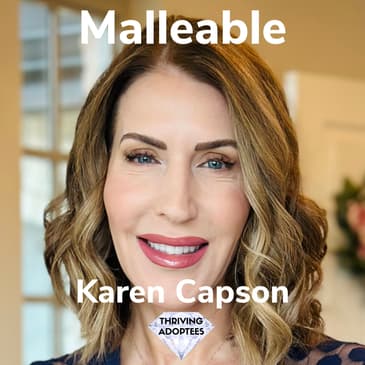
Are you waiting for someone else to change? We might be waiting for that forever. Because we have to change first. Listen in as adoptive mom and adoption professional Karen shares her insights into change, humility and grace.
Here's a link to Karen and her daughter Madi's book This I Know For Sure
More about Karen here:
https://www.instagram.com/karen_capson/
https://legacyadoptiontexas.com/
https://dfwchild.com/karen-capson/
Guests and the host are not (unless mentioned) licensed pscyho-therapists and speak from their own opinion only. Seek qualified advice if you need help.
Want to learn more about thriving for you, your kids, your families or your colleagues? Pick a time to talk here
[00:00:02] Hello everybody, welcome to another episode of the Thriving Adoptees podcast. Today I'm delighted to be joined by Karen, Karen Capson. Looking forward to our conversation. Let's pretend that we haven't spent the last five minutes just catching up, right? That's right. That's right. So listen, Karen works for Legacy Adoption Services and also she is an adoptive mum. So we're going to be diving into that rich experience, right?
[00:00:30] The personal and the professional and the nuggets that you've learned along that way. The wisdom. I say wisdom to people and people get very modest about wisdom, right? I definitely think it's wisdom and I think wisdom comes from looking backwards on your experience and then looking through a different lens than you have when you started something. So I think wisdom is the perfect word.
[00:00:58] Okay, right. Go Karen as I believe an American would say, right? Maybe it's just British people that are modest about their wisdom. We have our stiff upper lip, we have a tea at four o'clock and we also have, yeah, modesty. Learnings is okay, but wisdom would be taking just a step too far. It would be a little bit, yeah. Yeah. Arrogant?
[00:01:27] But you like it. You like it. So that's, that's it, right? Who cares? Yeah. Well, I feel like wisdom is meant to be shared. So if you say wisdom, then it's something that is, you've learned and maybe through hardships, you now can lend to someone else who's going through an experience in order for them to be able to find confidence and to be able to go through their life experience.
[00:01:51] Okay. So I'm going to, at some point, I'm going to get a clip of that audio clip there, what you just said, because that sums up exactly what the podcast is about. That's nice.
[00:02:05] That's nice.
[00:02:35] You have always been so good at honoring the various sides of the adoption triad. And so we're not, we're not in this life alone. And I think there's so much to be learned and gained from sitting and hearing people's stories and finding connection. So yeah.
[00:02:57] Yeah. And I'm going to be doing a project of that nature, like fairly in the next coming months, like where we bring together the different parts of the triad and learn from one another, share our wisdom. And do that in a different setting to a podcast. But it'll still be on Zoom, but it'll just be more people.
[00:03:28] So I'm trying to figure, I'm trying to figure out the logistics of that at the moment. So yeah, wisdom then. So you talked about looking, looking back, having a different lens. Yeah. What are the biggest bits, what have been the biggest wisdom, pieces of wisdom that have landed for you over?
[00:03:58] Well, for me, it's... Because Maddie's at college now, so... She is, she's 20 now. So this is 20 years of, well, 20 plus, because if you count leading up and all the prayer and infertility and things that led up to us being her parents, you know, it's been probably 28 years in the making to be at this point in time.
[00:04:24] Okay. So 28 years of wisdom in 55 minutes. There you go. 51 minutes, actually. Yeah, but go on. Sorry. No, it's definitely a topic I think that certainly I can never get bored of because it is something that the roots run very, very deep in my heart when it comes to this.
[00:04:49] And so I think in the beginning, dealing with infertility myself and feeling like for me, I had tried so many different medical ways of becoming pregnant. I was a school teacher. And so I think there were parts of myself that I felt like I knew that I would be a great mom.
[00:05:10] I knew that I was in a great relationship with my spouse and that we were in a place to become parents, that it was all very self-serving, perhaps, because you'd see, I'd see all of my friends getting pregnant. And it just felt like the timing, in my opinion, was the right timing and all of that.
[00:05:32] And then when it didn't happen in the way that I think I had envisioned it from even as a child of becoming a mom and how it was just going to be this beautiful, simple experience. And that as soon as I was ready to start a family, it would happen so quickly. And it didn't. You know, we sought outside help through doctors and all.
[00:05:52] And, you know, there were oftentimes met with disappointment or failed pregnancies and all that I remember one time I was driving down the road and coming back from a doctor's appointment. And I am a Christian and I was screaming out in my car to God, feeling like I had all the proper things in alignment in order to become a mom. And why was this so difficult?
[00:06:17] And so it was kind of in that moment that I finally threw my hands up and said, I recognize I can't do this the way that I want to do this. And when I finally, I think, released control of it, things just fell into place for people to come into my life, opportunities to come into my life that pointed in the direction of adoption.
[00:06:41] And so I look back and I think how much I'm so grateful that I went through all those trials and tribulations and tears and all because I really felt like in that moment, I was significant enough in my life that God wanted me to have a better relationship with him, that he put me through all of that in order to stop looking to medical science.
[00:07:10] And start trusting in him that he was still going to give me the most perfect created child specifically for my husband and myself. If I just put my trust in him. And even though I didn't birth our daughter, Maddie, I know for a fact that she was specifically created for my husband and I to be the ones to raise her. And so I feel very honored by that in looking back, feeling like, wow.
[00:07:37] Like it, I've said before that sometimes you don't really know what sweet tastes like until you've tasted the sour. And so I think having those valuable lessons in life and tasting those sour moments enable you to appreciate when the sweet ones come about. Yeah. Yeah. The life of contrast. Yes. There's no negative without a positive. No positive without a negative.
[00:08:07] I heard a really interesting idea from another adoptive mum a couple of weeks ago. I can't remember the lady's name. That's my 59 year old brain going again. Yeah. She, she talked about her daughter choosing her. Yes.
[00:08:35] I'm wondering if that we had had a conversation similar to that. And I don't know if I had shared that with you. I have a great relationship with our daughter's birth mother. In fact, this past weekend as kind of a send off before Maddie went back to college, we got together with her birth mom, her full sibling. She has a older sister who is a biological sister, about two years older.
[00:09:00] And then she has a half brother who is younger than her by a couple of years. And so it was my husband and myself and her birth mother and her two siblings. And we were sitting around this table at a restaurant. And I had this moment where we've done this before. We've gotten together many times over the years.
[00:09:23] But I had this moment where, like I'm probably going to get teary eyed now, where I just got a little choked up because I realized that all that we had planned to do in order for Madison to feel secure in who she was. And to put that word thrive back into the mix here.
[00:09:47] Thrive as an individual and feel like she could feel very grounded in her story and who she was. And I looked around and just seeing the vibrance within her and engaging with her sister and similar mannerisms.
[00:10:01] And in looking on, I remember always saying my goal is to raise Maddie in a way that someday when she's older, I can sit around a dining room table and present her basically back to her birth parents or her birth mom. And be able to show what a lovely woman she is and how grateful I was to be given the opportunity to be the one to raise her.
[00:10:29] And for us to not have any awkwardness when we're sitting around this table and just enjoy each other's presence. And that's exactly what we were doing. And I just looked over at her birth mom named Stacy and just said, we did it. Like we've navigated 20 years of so many conversations separately, together. And so it just was a beautiful thing. It really was. It was just such a lovely full circle moment. Even me working for an adoption agency.
[00:11:00] It's like being brought around to this place. I never would have anticipated it. Yeah. It feels purposeful. It feels by design. It feels like this is the trajectory it was always meant to be. And what a lovely thing to be sitting in that place to feel when there were moments that I felt like I wasn't seen or God didn't see me.
[00:11:21] And I was just a speck in this universe to feel like, no, he saw me all along and has been with me through this roller coaster ride and said, but here's the place that I had always intended to take you. So I just needed you to strap in and go for the ride along with me. And trust me. Yeah. So what did you learn on the downs of the roller coaster? So much. It's a really good question.
[00:11:49] Where to begin on that one? What did you learn about thriving on the downhill parts of the roller coaster? If you want me to be a bit more specific. Oh, you know what? I think it's interesting because I think thriving, maybe the definition in my mind back then would have had a different meaning. And maybe back then it would have been like the life checklist of, like I said, husband, check.
[00:12:18] Good job, check. Financial security, check. You know, beautiful home, check. Those sorts of things. That maybe would have been my definition before life experiences. Now I think thriving is really falling into realizing what your purpose and plan is, what God's purpose and plan is for you.
[00:12:44] And then finding a rhythm where you are giving back to others and it not being self-seeking. And it being one where you say, here are the gifts and talents that have been placed within me. Or here are the life experiences and the jobs that I've had in the past.
[00:13:04] And how can I utilize all those things to kind of give him glory and to, again, bless others and help others navigate their difficult path and road that they're on with compassion, understanding. And I think that's why now working for an adoption agency, I'm seeing things from a bird's eye view.
[00:13:30] You know, coming back fresh from Germany and being up at that eagle's nest that was up there. Right. That's where Hitler used to live, listeners, if you don't know what the eagle's nest is. Well, I mean, let me tell you, it was such a beautiful moment. I climbed to the top. In fact, if my husband hadn't been so afraid of heights, I think I would have just kept going into the whole and straight into Switzerland. I mean, it was just stunning to be up there and see the fog.
[00:13:58] And once it cleared and you could just see totally out amongst the valleys and the lake and all of that, it was just stunning. And it really felt like an analogy for life that I had climbed all of these different mountains and I looked out and it just felt peaceful. It felt quiet. It felt calmness.
[00:14:19] And so that's where now I feel like I am in my life where this opportunity came about after me being funny, an empty nester. Never. Does that play into this? And having my daughter go off to college and saying, OK, I can get any old job. I can have lunch dates with friends. I can, you know, we play Mahjong here. I can play Mahjong and all. But what does that do for all that I've learned?
[00:14:47] And it just wasn't sitting right after about six months of kind of sitting around the house. And I thought, no, I need to do something bigger. And a call came in about an opportunity to work at an adoption agency and it felt like a calling. And going and working for them, I now see things from a whole different perspective. That bird's eye view, that before I saw things very flat and only from my perspective.
[00:15:12] But now on the daily, I'm calling our daughter's birth mom and I'm saying, wow, today this is what happened. And I am so grateful that you made the brave choice that you did and chose for me to be our daughter's mom, to be able to raise her.
[00:15:32] Because now I know what bravery you showed because I'm seeing cases and women who we work with each and every day who are confused in their unplanned pregnancies and don't know what direction to go. And now I see things from a different perspective. So I'm grateful for the perspective that her birth mom allowed me to stay in my little happy bubble, you know, after my years of infertility to be able to go, ah, this is it. This is my moment.
[00:16:02] I'm now a mom. But now I get to see things from the difficult perspective of what the grief and loss feels like for an expectant parent and how she navigated her emotions through the years. So these deeper conversations I'm having with her, a lot is being revealed that I think maybe she wanted to not necessarily protect me from, but maybe I was just not as open to asking.
[00:16:29] And now knowing I just honor and respect her all the more. Yeah. Have you heard about adoptees, this word that adoptees we use about coming out of the fog? Have you heard that phrase? Actually, no, but enlighten me. Okay.
[00:16:50] So coming out of the fog is used to describe, it's used in different ways, but the way that I say it, I think, is about, it's when we realize that our grief becomes obvious to us. So for me, it was that the teddy bear moment, right?
[00:17:15] So when I found out the teddy bear was from my birth mother and that brought up the short-lived anger towards her, right? Well, not anger towards her. Yeah, it was anger. It was anger towards her. It was short-lived. So I was 40, and the words that came out of my mouth was, she didn't love me enough to keep me.
[00:17:43] And the lady that I was talking to at the time put me right, right? She said, I'm a mum, Simon, and I don't think it would have been like that. Right. So I saw that those words, the words that came out of my mouth were true.
[00:18:07] But that's the coming out of the fog moment is when the grief or the loss, the trauma, when we become conscious. Right. When we become conscious of what was previously subconscious. And your perception is reality. And so sometimes it takes an outside source maybe to rephrase it in a way that you see things in a different way.
[00:18:37] But 100%, I think not everybody's adoptions, none of the adoption stories look the same. And it's so unique. I think there were periods where even our daughter, maybe she wasn't as open to meeting up with her birth mom. But I realized, maybe with the gratitude I had in my heart, that I knew that I needed to keep up this relationship with her birth mom for future Maddie,
[00:19:07] in case future Maddie had more questions to ask. And so there were times that Maddie wasn't comfortable going and meeting up with her birth mom. But I knew, hey, let me just go and have coffee with her and let me sit because she's such a facet of who my daughter is. I want to get to know her. It's not always, it's not that it was always just about Maddie. This is a tapestry. Right.
[00:19:33] This is my daughter's family tree. And I see it almost as if, if you thought of a tree trunk, but you've got two twisted branches that go up in order to create this full tree, that I always wanted to make sure that I could honor that side. So for me, I tried to always keep that relationship up with her birth mom, recognizing in this instance, there was nothing unsafe about it.
[00:20:02] There was nothing that made me overly cautious, I think, as an adoptive mom that would make me think this is not a relationship that I think would be good for Maddie. And this, this clearly is a huge difference. Right. So I was adopted, my mom and dad adopted me 39 years before you adopted Maddie. Right.
[00:20:28] So in that 39 years, there was a lot of change. And in those days, it was a closed adoption. Yep. And how many questions does that take out of the equation? How many questions does that mean?
[00:20:56] How many questions don't come up in an open adoption that come up in a closed adoption? Right. It's chalk and cheese, right? Oh, I can imagine not having the answers. You know, there was a time when Maddie was in high school and, and she has a lot of adopted friends at school, but some international adoption.
[00:21:21] So they will never know or meet probably their, their birth parents or know any specifics to it. So what a blessing it has been that she's just a phone call away. In fact, her, her birth mom had four children. Her fourth child that was born actually was placed for adoption to another family who now lives in the area. So at one time we have gotten together, all the siblings together and the other adopted mom and, and so forth.
[00:21:50] But there, there came a time in high school when they were having very deep conversations. And she goes, she went to a Christian high school. And so in class, they actually spoke about abortion. And I remember her coming home and she just looks so much heavier than she normally had been. And she said, mom, had Stacy ever told you, did she ever consider abortion with me? And I said, you know what, Maddie, I know what she's told me.
[00:22:19] And I can easily tell you what she has shared with me. But this is what all of these years of me having conversations with her have, have led up to that you're old enough. I want you to gather your questions. Let's call her up and let's just ask her. I want, I want it to come from her ear and or her from her mouth. And so Maddie went to another room and I went to my bedroom and I picked up the phone and I called her birth mom.
[00:22:48] And I said, Hey, Hey girl, what are you doing? And she said, not, not much. What are you doing? And I said, well, some heavy questions are about to hit here in the household. Are you, are, is this a good time? Can you handle a call in about five minutes? Buckle up, Maddie's got some, some questions for you. And so we sent her up to her room. Maddie got a notepad and she grabbed a pillow and a blanket. And we all gathered in my husband, myself and Maddie. And we piled into our big king size bed and we put it on speaker.
[00:23:17] And she just started asking her birth mom questions. But there were things that I would have thought with so much certainty that Maddie already knew the answer to. And it's as if she needed to hear it straight from her birth mom. So questions like, do you feel uncomfortable if I call my mom, mom, what do I call you? And I'm thinking at this point, we navigated 18 years of this. You call her Stacy. I'm mom. Like, why is that even a question?
[00:23:47] Is what I was thinking in my mind. And of course, her birth mom said, you call me whatever you want, but your mom is your mom. I chose your mom. And then she paused and she said, Maddie, I have the most incredible thing to share with you. I don't think I ever told you this. She said, when I was reviewing profile books through, we went through an adoption attorney at the time.
[00:24:11] She said, they gave me nine different potential families to look through in order to determine who I might pick in order to raise my child. And she said, of course, I was confused. There's so many options. I'm looking through all these books. And she said, but let me tell you, I got to your book and or your parents book.
[00:24:33] And when I flipped through and I started reading about them, she said, all of a sudden, this feeling that felt supernatural came over my whole body. You started doing the cartwheels in my stomach and all of that. And she said, and in that moment, I knew that this was the couple that I needed to choose to raise my family.
[00:24:55] And as many times, Maddie, as you have heard, your adoptive parents chose you. She said, this is what I need you to remember. You chose them. Because when I was looking through that book and you started giving me all the signs that, hey, these are going to be my future parents. Choose them.
[00:25:18] She said, so then here's Stacey, you know, saying to Madison, listen, next time that, you know, you're being punished or you feel really frustrated with them. You just remember, you chose them. Kind of thing. But there was something about that night that after that call and hearing her birth mother say the words, I love you.
[00:25:40] That our daughter went to bed as if she had taken off a backpack that carried a lifetime of bricks on the back of it. And she woke up and she was lighter and she was happier. And maybe that's her moment that she came out of the fog, Simon. Because it was almost as if the weight of the what ifs and what would it have looked like if I had been raised by my birth mom?
[00:26:09] And why did she make the choices that she made? There's something about hearing it, I think, through the mouth and the voice of her biological mom, almost granting her permission to say, hey, go have a happy life. It's okay. Can I take you back a bit? Can I take you back a bit? So this is kind of my take on the metaphor and the fog and the clarity. Right. Okay.
[00:26:38] So this is my impression. Right. My impression is that when she came home with those questions and she was and a heavy heart. Right. That moment in class is the moment that she'd come out of the fog. Right. And she'd come out of the fog and she'd seen the storm of trauma.
[00:27:07] She'd felt that storm. Right. Yeah. And then when she got on the phone, rather than saying I'm staying, rather than saying I'm staying outside. Right. She thought, right, no, I'm going out. I'm going to go out in the storm and I'm going to get to the bottom of this weather. Right. So she had this conversation.
[00:27:37] And then the storm lifted. And we came out and she came out of the storm. Right. And then into the sunshine. Right. So that would be my take on what. I like that take on it. That's beautiful, Simon. I like that. Because that shows the bravery. I think that so much of even the decision that expectant parents make to choose life for their child.
[00:28:04] And as hard as it is to choose someone else to raise their child because they may not be in a place in order to gift that child all that they wish that they could to make a choice to place their child for adoption. I see it as such a brave and selfless act. Not that it's not free of guilt, grief, loss.
[00:28:32] And I think it comes in waves for them. But I do think that having a child in utero, I do think that that adopted children pick up all of that when they're being created and you have a birth mom who's dealing with their own life traumas and uncertainties and things going on in their life. I think that there's a piece and a fragment of that. I think that does sit in the soul of an adopted child.
[00:29:01] That they need resolve. And it may take 40 years to find that resolve. You know, no matter how loved they can be or the opportunities that are provided through an adoptive parent, I think there's probably just something within an adopted child that no one can fully understand unless they've been in that place. I try to. I think my daughter's so eloquent in explaining it.
[00:29:31] There was one time where she had said, and this hit me hard because she was an older age, you know, in our maybe middle school. And she said, you know, I don't know how I love you. And I remember just feeling crushed. Like, how does my daughter not know that I love her? Every day I've been so intentional to tell her how much I love her and share with her, like her story. But she says, no.
[00:29:59] She says, I don't know how I love you. How do I know that I don't love you just like a friend or somebody that I just, you know, spend time with that I'm interested in? She said, if I don't have my birth parents in front of me and I don't know that biological, natural, what it's like to love, how do I know?
[00:30:23] Because out of comparison, how do I know that I love you the same way that I would if you were my biological mom? And so when she explained it like that, I guess I thought about it. And I said, you know, maybe it's the same as you're not my biological daughter. But I know that the well of love that I have for you runs so deep that I can't imagine loving a biological daughter any more than I do loving you.
[00:30:52] But I did share with her that there was a moment at the hospital when she was born. And I had fear because I thought there's a big sense of responsibility being an adoptive parent because I feel like a whole lot of things have to fall into an alignment for us to have this child in our life. And I didn't want to let her birth parents down or not do as good of a job. So I think I put a lot of pressure on myself.
[00:31:20] But my fear was I knew I would grow to love her. But would I have as deep of a love for her if I didn't carry her in my in my uterus? And so I here's here's the moment that it really changed for me, Simon, when she was born and we had a whole hospital plan in place.
[00:31:45] And my husband was to be there and cut the cord and and then the baby would be handed to her birth mom. And then symbolically, she would hand our daughter over to me to hold. And so we had this whole plan in place. But as we know, that plans never really go as we expected. And so her birth mom wasn't progressing very quickly with the birth. So I sent my husband home to go take a shower. And her birth mom was very sweet to let me be there in the hospital room.
[00:32:14] And very quickly she progressed and had this baby and my husband wasn't there. And so the cutting the cord then went to me. But there's something about when I looked at our daughter, the moment she was born, it's as if a chamber of my heart opened. And I can't explain it except anything as if it was supernatural, that it was God,
[00:32:40] God's presence there, that a seed had been planted so much deep in my heart that in the moment that I looked at her, I recognized her. Like she felt familiar to me. And I looked at her and went, yeah, that is that is my daughter. I know her. And I, she, she didn't have my genes. I didn't carry her for nine months. She was a stranger who in that moment I looked at her, but it's as if I had always known, yeah,
[00:33:09] that was the child I was always meant to have as my child. And of course, in my opinion, she's far more miraculous, beautiful and better than she ever would have been had she birthed from me. And far prettier, by the way, she looks like her birth mom. So she's a, she's, she's a gorgeous young lady who does not have my big nose or my husband's unibrow. So she, so, but, but, but those are the things that I, I've realized I can't know her perspective.
[00:33:39] I can only know my own. But I appreciate when adoptees like yourself are vulnerable and transparent to try to paint a picture that we may never truly know what it feels like to be in your shoes and to walk your path.
[00:34:03] But I can definitely empathize and say how incredibly strong I think adopted children are because there's a whole lot more emotion to navigate from a very young age that I think any natural born child who's raised by their biological parents will never know.
[00:34:32] So there's a strength that I think that adoptees carry. That is just bravery and just the ability that, that I think that they can overcome so much and transform this world. How does that land for you?
[00:34:58] Like, how does Maddie's and adoptees tricky time, tricky times, tricky stuff, how, how does that impact you? Hmm. It's had its moments. I'm not asking, I'm not asking about Maddie's story. I'm asking for your kind of your perspective, just to be clear. Yeah. Do you see what you said?
[00:35:28] I want to honor Maddie's stories, Maddie's story. Yeah. You know what I mean? I'm asking for your, your, your take. Yeah. Your take. Yeah. That's what I'm after. Yeah. Well, I, I understand. And I, I think I've never felt like I wasn't her mom.
[00:35:53] I think I've never needed the biological connection to know that there was, um, a plan in place for, in a design for me as a mom to be the one to bring out the traits, the characteristics, the strengths that were placed within our biological.
[00:36:20] Um, that I felt like I was the one who was chosen and it's a beautiful relate to me. It's so much more beautiful than if she had been my biological child, because I feel like, even though there are times that I feel like, gosh, she thinks so differently than me. Like we just, there are things that are so similar, but then there are also parts that it has refined me.
[00:36:50] Um, and so I, I feel like, whereas I think a lot of times people who maybe don't walk adoption and don't understand it sometimes say, oh, wow, what a blessing it is that she has you as parents.
[00:37:07] And I, I see it as what a blessing it is that I have a daughter who's made me introspectively look within myself, deal with my own upbringing, um, challenge some of my personal beliefs and has refined me, um, almost like sandpaper.
[00:37:25] Like she has been the holy sandpaper on me to help me be a better version of myself because some of our connections don't flow as easily and required a little bit more conversation and work. I don't know if that answers your question. I hope so. Kind of. Um, I'm not sure if my question was that well, uh, stated. Um, but you do remind me of another, another way around and perhaps is a better way of staying, stating it.
[00:37:55] So you talked about, um, Maddie was lighter after that conversation. She'd had the tough day at school. You'd got on the phone. She'd asked, she'd heard that she'd heard, had her answers from her birth mother. And that lightened the, that lightened the load, the, the, the, the storm passed. Right.
[00:38:19] Um, and you'd said she woke up in the following morning and, and it was like the, the, the rucksack on her back had been emptied. Something like that. The back, back. Yeah. A, another adoptive mom who I interviewed a few years ago and who also works in an adoption agency,
[00:38:42] Holly Ann Patrick, um, said to me that raising, uh, raising kids is about us as adoptive parents. Um, unpacking our own emotional baggage. Yeah. Yep. For me. Yes.
[00:39:09] And I, my parents grew up in an era. My, my dad turns 91 today. So not to my sweet birthday. Yes. His name's Rudd. Happy birthday to Rudd. Rudd. You know, they grew up. Has he got red hair? No. No, he's no hair now. R-U-D. It's short for Rudolph. Oh, oh, Rudd. Right. Yeah. Okay. Not red. Okay. Sorry. R-U-D. Yeah. Rudd.
[00:39:33] Um, you know, they kind of grew up in an era where it's, you have your 2.3, whatever the number was. Children, it was the thing to do kind of. Um, and listen, they, they did an incredible job with my sister and myself, but there are parts of myself that, um, I think, you know, there are things from growing up that you say, you know, those were really delightful things that I choose to repeat when I become a parent.
[00:40:00] And then sometimes there are things that you look at and you go, you know what, for me, um, I think I would have preferred to have this way of, of parenting or, um, this type of communication would have served me a little bit better. Um, but I think the things that I learned that were my takeaways that made me say, when I become a mom, um, I want to be a little bit more intentional with the communication aspect. I think that really benefited the openness of the conversation.
[00:40:30] We've always, from day one, Maddie has always known that she's adopted. We've always tried to tell her that always, and I shouldn't even say tried, we've always told her the truth, whether it was uncomfortable for us, uncomfortable for her, those conversations always happened. Um, and it, it, it definitely helped me unpack so much of my childhood to try to provide her
[00:40:57] and see her in the stage that she was at. I never wanted her to feel that she needed to be a little Karen or a copycat of me being that I come from a special education background. The goal was always, let me see her for how she learns, um, how she navigates the world, the questions she asks and make sure that I am the malleable one to show up in a way that
[00:41:24] meets her where she's at at each and every stage of her life to feel seen, to feel like knowledge, to feel that she can have openness with us about even the most difficult of, um, topics. And so I think having those early conversations with her really lended to, uh, bigger conversations, whether it's about boys, whether it's about, you know, other hard hitting topics.
[00:41:53] She always knew that we were going to be that safe space to always come back to, to get the truth. Um, and that has helped me so much. I think give permission to grieve some of the areas in which I had hoped maybe my upbringing was a little bit different.
[00:42:21] Um, but I recognize that again, I had to have that in order to be the parent I am now. Um, so I wouldn't change a thing about it, but it did have, I did have to wrestle, I think a little bit with, um, my upbringing. Um, if that helps at all. And, and that's what also preempted, I think, um, when Maddie was seven, we, we wrote a book
[00:42:48] together and it was a book, um, that was meant to open up conversation about adoption so that parents could feel more free to be able to have some of those more difficult conversations earlier on to help them navigate, um, sharing the truths about their birth mom and, or about their birth family and how they got the name that they got and to help them feel a little
[00:43:15] bit more grounded and secure, um, in their relationship, um, with their adoptive parents, but then also finding peace within as to the, what started their story in the first place. Which, which starts with the, the bravery of expected parents who made a choice. Yeah. So, yeah. Did you get the book? Was the book published? Is it still printed? Yes.
[00:43:45] Yes. It's that it's actually, um, I think you can get it through Amazon. Yes, you can get it through Amazon, but through Barnes & Noble and other, um, yeah. Okay. Well, I, I, I'll put a, I'll find it on Amazon and I'll, I'll put a link in the show notes. Sure. Lovely. Thank you. Yeah. Yeah. Yeah. The goal, the goal was always to, to create a way to have those open conversations. Cause so many of the adoptive, uh, books that we saw out there when Maddie was younger
[00:44:14] were animal based where, where the, the grizzly bear adopts the panda bear and things like that. And we really wanted to put for us, because my faith is important, but God at the epicenter of the creation of family. And, um, and so it, I, my hope was that it would, um, just put, put some faith in there and how, um, you know, God, God creates the right family in order for hopefully a child
[00:44:43] to grow up and feel loved and secure and all that. That, that, um, that malleability word that, uh, that you used, I think that's, um, a real genius. Because it's about you flexing, not the child flexing. Well, you being malleable. Yeah. It's about you, you changing, right? So we have, we, we have to change. Yeah. We, but we have to change first. Right. We, we, we do.
[00:45:13] And that, that can be very difficult. Um, you know, I, I think, I think especially because I know that she always has thrived with structure and routine and knowing things in advance. And even when she was little, I'd tell her what, what kind of errands we were running for the day so that she could anticipate, um, what was around the corner. Um, I've also learned that as she's grown up and her needs have changed so much of me
[00:45:42] having to say, just because something has worked in the past, doesn't mean that it's not worth a look again to say, how can I do it better? And how can I show up for you? And having those specific asks of her. In fact, I recently just asked her this week, I said, you know, there are areas where I think I have strengths. There are other areas where I feel like I may not be showing up for you with the full extent that you need.
[00:46:13] Do you mind sharing with me? Tell me where I can do better. Tell me what it is that you need in this season of your life that I can be a better support system to you and can help you feel like you have got, um, a little bit more of a safety net underneath you to, to, to go out and do what you need to do. But where can I show up in a better way where I have been lacking? Um, and she's always quite endearing and so sweet to me where, where a lot of times she'll say,
[00:46:42] listen, mom, I know that the decisions that you made back then, you made them as best as you could with the information you had at the time, which is always very true. But there's, again, sometimes that hindsight can be a little bit of a beast because I look back and go, man, that was not one of my best parenting moments. I probably could have done a better job with that. Um, but I think asking for forgiveness and to acknowledge that, Hey, like that didn't bring out the best of me. Um, I, I, I'm sorry.
[00:47:11] I didn't handle that as well as I could have. Um, I think owning my own, uh, shortcomings also gives her permission to maybe be a little softer on herself where she wants to be. She, she's very hard on herself. And so I think by being a model to say like, isn't that what life's about? It's tripping up and making mistakes, but then pulling up our bootstraps and getting right
[00:47:36] back up and having a learning lesson that we can walk away with so that we do it, do it better the next time. And grace. Grace. And forgiveness. And forgiveness. Yeah. That feels like a good place to bring it in, Karen. This has been lovely. I'm so appreciative to you. Thanks. Thanks for being open to listen. And allow us to share. Thank you. Thank you for being open and thank you listeners for speaking to you. I'm very soon. Take care. Bye-bye. Bye-bye.