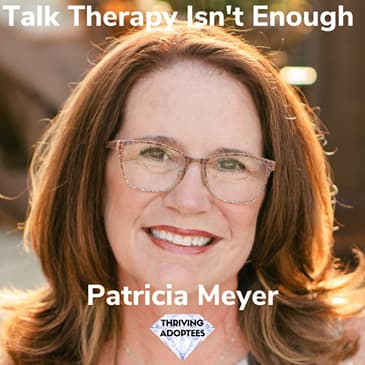
How can talk therapy heal preverbal trauma that we have no words for? It can't. So what do we do instead. Listen in as we dive deep into healing with adoptee Patricia.
Patricia Knight Meyer is an author, speaker, and adoption reform advocate. Her story begins along a Texas hospital curb, where by her parent’s account she was handed over as an infant in a 1970 attorney-brokered black-market adoption. The attorney, they alleged, extorted them with the threat of taking back the baby. They doled out $30K, they said, before walking away with their paperless child.
Patricia’s road to true identity began at 39, when she set out to unravel her mystery. Starting with no original records, no known birth name, and no confirmed date or place of birth, Patricia used public record databases to track down the alleged black-market attorney and uncover a biological adopted cousin also placed by the same man, also handed over without papers.
Patricia reunited with both of her birth parents in 2010 and 2011, and her reunion video with her birth father has been viewed more than 290,000 times on YouTube. She received her true and accurate birth certificate at 47 years old. Patricia tells this story in her debut memoir, WONDERLAND: Memoir of a Black-Market Adoption (Unsolicited Press, November 3, 2026).
The book arrives as an IndieReader Award Winner in True Crime, a CIPA EVVY Gold winner in Memoir, an Eric Hoffer Finalist, a Next Generation Indie Book Award Finalist, a Storytrade Prodigy Award Finalist, an Indies Today Memoir Finalist, and a NYC Big Book Award Distinguished Favorite in Memoir 2026. Patricia also narrates the audiobook, released through her imprint YAYDNA Press.
She serves on the board of the National Association of Adoptees and Parents (NAAP), where she hosts the monthly NAAP Happy Hour. She is connected to Concerned United Birthparents, Adoption Knowledge Affiliates, Support Texas Adoptee Rights, Saving Our Sisters, and other advocacy organizations.
Her blog, My Adopted Life, reaches a booming community of adoptees, birth parents, and advocates. She keynotes adoption conferences and leads memoir writing workshops. Patricia has appeared on Al Jazeera’s The Stream and HuffPost Live. Her essays have been published in Ms. Magazine, Severance Magazine, Magpie Zine, Narrative Arc, and Kinsmen Quarterly.
Patricia left high school before graduating, earned her GED, and worked her way through community college. She was admitted to the journalism program at the University of Texas at Austin, where she graduated as a single mother. She went on to a twenty-year career in author publicity and digital marketing.
She is also the founder of YAYDNA Genetic Greeting Cards, cards made for the complicated joy and emotions of DNA discovery and reunion, available on Amazon.
WONDERLAND memoir page: https://myadoptedlife.com/wonderland-the-memoir/
Book website: https://www.wonderlandthememoir.com
Audiobook on Spotify: https://open.spotify.com/show/7EZEbVZQAAFVyeaDvcnG2i
Free livestream, Nov 6, Down the Rabbit Hole: The Fight for Texas Adoptee Rights Then and Now. A scene from WONDERLAND unfolds live on stage, then a panel on the fight to open Texas adoptees' birth certificates: https://bit.ly/TXADOPTEERIGHTS
My Adopted Life: https://www.myadoptedlife.com
Instagram: https://www.instagram.com/patriciaknightmeyer
Instagram (book): https://www.instagram.com/wonderlandthememoir
Facebook: https://www.facebook.com/Wonderlandthememoir
TikTok: https://www.tiktok.com/@myadoptedlife
YouTube: https://www.youtube.com/@myadoptedlife
LinkedIn: https://www.linkedin.com/in/patricia-ann-meyer
Bluesky: https://bsky.app/profile/myadoptedlife.bsky.social
Guests and the host are not (unless mentioned) licensed pscyho-therapists and speak from their own opinion only. Seek qualified advice if you need help.
Want to learn more about thriving for you, your kids, your families or your colleagues? Pick a time to talk here
[00:00:02] Hello everybody, welcome to another episode of the Thriving Adoptees Podcast. Today I'm delighted to be joined by Corrie Kielty. Looking forward to our conversation. It's been ages, hasn't it, Patricia?
[00:00:13] Since we last week. And you've been so busy on this mega book program, writing it, getting all the website done and doing some fancy work with the AI to get the site pristine.
[00:00:33] So, ladies and gentlemen, Patricia is an adoptee. And her book is coming out in November. We're recording this on the 20th of October. But the book comes out in November this year, 2026. And there's links at the bottom for all that sort of stuff.
[00:00:54] So, what we decided to do or what I suggested and Patricia graciously accepted is, I'm just going to read something from one of her blog posts. And then we're going to start the conversation from there. So, welcome to the show, Patricia. Looking forward to diving into this. Thank you, Simon. I'm so happy to be here. Thanks for having me on.
[00:01:16] You're very welcome. So, the piece on this blog post starts, After three years in therapy, trying to untangle my self-defeating habits and my complete inability to end my codependent dead-end romance, my therapist finally recommended EMDR.
[00:01:43] The therapist said, so when you're dealing with a primal wound, taught therapy can only get you so far. So, I thought that was a great place to jump off. And what was the year? Do you remember the year that the therapist finally said this to you? Is that like five years ago, six years ago? Well, when did you say it was about five years ago? Five years ago.
[00:02:10] And I want to add that it wasn't like I only had three years of therapy. I'd been in therapy for 15 years of my life, if not 20. I mean, I'd been seeing the therapist since I was in my, since I was in my early 30s. But no one had ever suggested EMDR. And it took me, I was 10 years into therapy with my therapist before I even thought to tell him that I had been adopted.
[00:02:37] And so, you know, once he found that out, and I only did that after I walked in and said, oh, hey, by the way, I found my birth mother. And he was like, you're adopted. So that cracked open, you know, a huge, huge can of worms. And I thought that having gone through a lot of coming out of the adoption fog and finding the community and beginning to understand what, what adoption trauma does to a person.
[00:03:04] And I sort of thought I had a handle on it. But at the same time, I knew that I had been in this relationship with this person that honestly, within the first six months, I knew this wasn't the right person for me. And then I spent about four years on this poor lady, three years, I guess, on this poor lady's couch telling her that I knew he wasn't the right person for me. But I didn't know. I just couldn't bring myself to break up with him.
[00:03:32] And I think a lot of it was tied to this, this still this deep seated feeling of not wanting to be the abandoner in any relationship. But also what she helped me learn after trying all kinds of different things was that ultimately, a lot of my struggles were, were on a much deeper, more primal level. And she recommended EMDR. Yeah. Yeah. Yeah.
[00:04:02] And as we, we talk about this quite a lot on the show, as I mentioned before hit record, right? And the reason I keep banging on about it is because so many, so few people know that. And the logic is so compelling and obvious. It's like, you know, Doe from Homer Simpson, right? Pre-verbal therapy, sorry, taught therapy can't touch the sides of pre-verbal trauma.
[00:04:32] I mean, it's just a contradiction. It's just a contradiction. It's just a contradiction in terms. It makes no, it makes no sense whatsoever. And yet so many adoptees have spent so much money with so many therapists because nobody said that or that they haven't heard that. And, and it's a really huge thing.
[00:04:54] And it's, you know, how many years or decades have been wasted because we, we didn't know the right modality, therapeutic modality. Yeah. And it's, it's funny because oftentimes a therapist, they've, they've heard about this when it comes to soldiers returning from war. Um, they'd immediately go to EMDR therapy.
[00:05:18] They, they make that connection very quickly, but I don't think that therapists understand that, that, that primal wound trauma, that separation from mother at birth, that wiring of our central nervous system in utero, because of increased amount of adrenaline in, in your mother's bloodstream due to the stress she's under, uh, that all of that has programmed us for life. And that this, this, um, this, uh, wound runs within our vagus nerve.
[00:05:46] It's, it's something that is literally chemically wired and physically wired into, it's how we were shaped while we were in utero because of what was about to happen to us. And then it was magnified after that when it did happen to us. And you, you just carry it in your, I just got chill, but I was talking about it.
[00:06:09] You carry it in your body and I'm not sure that it ever a hundred percent goes away, but I do think EMDR. And for me, my therapist included internal family systems as well and combined it with EMDR. And that really, really unlocked things for me because I had a lot of early, early childhood, like two, three, four, five, six year old memories with a very abusive adoptive mother.
[00:06:42] And so when I started this family parts work with the EMDR therapist, one of the things she had me do while we were doing EMDR is go back into these moments of, um, really just. Like one moment in the kitchen with my mother, when she was standing there with a knife, she was cutting some vegetables or something.
[00:07:05] She got mad at me and she swung around and had the knife in her hand and I jumped and she very quickly turned and said, do you really think I could stab you with this? And the way she said it, I was like, thought in my head, well, yeah, cause I don't, I can't predict what you're ever going to do. So why not? You know? Um, but I remembered that I used to not be able to tell that story without breaking down in tears and I certainly couldn't write about it.
[00:07:33] And it was through this EMDR parts work where the adult me came forward and stood in front of this little child in this moment and basically told the child, um, you are safe. I am with you now. No one can ever hurt you again, because what we learn about trauma in our brains is that our brains don't understand time.
[00:07:56] And so the part of the brain that uses that's holding onto this memory that, that, that veterans of war have it happen to them as well. Your brain cannot register that this happened in the past because it's still stuck in immediate, the immediate part of your brain that, that is recording it like it's real time. And what EMDR does is it allows those memories that get stuck due to trauma, due to being very scared or terrified.
[00:08:23] And it moves it into the other part of your brain, which I think is on the left side that, that stores it like long-term memory. You remember it as something that happened to you, but you're not living in that moment again. And on the one hand, having those kinds of memories live in your immediate memory makes for really good writing. Um, you know, there were some things I couldn't write, but there were other things that were stuck there like that, that I could, I could be in it like it would happen yesterday.
[00:08:50] And then my, my EMDR therapist told me, if you want to write about any of this stuff, or at least remember the details of it, you need to write it down now. Because after we process this, you're not going to remember it in the level of detail that you remember it now. And that's part of the beauty of EMDR. It takes all of that out of your immediate, out of immediate memory. And truly, I just almost want to say it's like it puts a soft screen on the past.
[00:09:21] And I don't have the, I'm not a therapist or a doctor or a brain scientist. So obviously I don't have the words to explain what the proper mechanisms of all this that are happening are. But as a person who experienced it, it definitely felt like it, it moved from something very immediate in my body to something that was just a memory. Yeah. The word that was popping into my head was hypervigilance. Cause that's it. Yes. Yes, absolutely. Hypervigilance.
[00:09:50] And this going back, tying this back to the relationship that I was in, what I figured out also was that this, this particular guy was a bit of a narcissist. Well, a lot of a narcissist. And he, he was very much like my mother. He were, he was critical, like my adoptive mother. He could be very shaming, like my adoptive mother. So he was constantly bringing that little girl in me was constantly being triggered.
[00:10:20] And that little girl in me was still wanting that approval, still wanting that validation. And he was in my psyche representing this, this mother figure, which was part of why I was so bound to trying to work out this relationship with him. And, and then I somehow had tied it in therapy to this fear of abandoning him.
[00:10:44] But one of the amazing things that this therapist helped me understand is that out of my fear of abandoning him, I was abandoning myself. And that, and that, and that that self was not just the adult self, because it's easy to abandon your adult self. But when you imagine your adult self, abandoning your child self, then it makes it a lot easier to have healthy boundaries and realize, oh, the, the person I need to be worried about here in this situation is me.
[00:11:14] I'm the one that's, my little child self is terrified of abandonment. And yet I am tending to his needs and worried about his abandonment when I really need to be worried about my own, especially my child self's. And that is what totally broke open or, you know, allowed me to step out of that relationship. And honestly have really, really healthy boundaries in all relationships since then. Well, there haven't been any serious relationships since then.
[00:11:43] But even that is a, is a good telltale sign because I used to move from, I was like the serial monogamist who never had a short relationship. Or, you know, if I went on a date with you three times, we were about to be in a three-year relationship. That's just how it was. And so that pattern also broke. And I can't tell enough adoptees how, especially ones who say, I'm fine, you know, I'm adopted, but I don't have any issues.
[00:12:12] But are you in therapist? Are you in therapy talking about relationship problems? Are you in therapy because you're struggling in your relationship with your children or with coworkers? Or you feel like you're not good enough? Like, so many adoptees and their therapists don't understand that at the root of a lot of common, you know, issues that people go to therapy for is adoption when adoption is part of a person's story. Yeah.
[00:12:43] And when we, and I think about trauma, I cannot, I see it as a layer cake, right? So there's the generational trauma. So for example, my, my birth father was in and out of care himself, right?
[00:12:58] So that, that, that, that stress gets passed on, you know, African-Americans slave the, the, you know, they're carrying the, the genes from, from, from the stress that they went through from, from slavery. Right.
[00:13:22] Jewish people that, you know, have, have all this, the, the Holocaust and, and the, the attacks on those over the years, right? That it all, it all comes down to it. So you've got, you've got some generational trauma. Yeah. They've proven that those, that your genetic code is changed by that trauma and that then your child inherits that, that change in the genetic code in your, in your own body. Yeah.
[00:13:50] So that means that whatever trauma is my, my father, his father, his great grandfather centuries back, all of that trauma changed each of them a little bit. And it all lives within me in my genetic code now and how I moved through the world. So we've got that generational trauma.
[00:14:09] Then we've got the in utero trauma that you were talking about, the adrenaline and the cortisol that's running through a birth mother's, birth mother's veins. And we're like pickled in cortisol, right? As, as, as adoptees. Yeah. Wow. That's a great, and that's a great metaphor. Yeah. Well, yeah, that's kind of, I, yeah, it is, I don't know why I heard that, but it, it, it's spot on, isn't it?
[00:14:37] And then, then you've got any trauma that goes on post birth and then trauma that within the birth family and then trauma that goes on with the adoptive family. So, you know, I was thinking about your, your, your, your, your adoptive mother and this, you know, this chaos that was going on with inside her. And it's like the, the layers kind of build up, don't they?
[00:15:02] And, you know, I think a lot of people who've read my book have struggled to understand how I could carry both, like what, how she treated me and still love her so very, very much. And I think for some reason, I don't know why, but I always, and maybe it was because she was very transparent about the trauma that she experienced in her life as a child.
[00:15:27] But I always understood that hurt people hurt people. And I understood that she had been hurt. I understood that her father was an alcoholic and he had physically beat her and her mother. You know, I felt lucky that she only yelled at me. And, you know, that's, you can say that that was a little, you know, not necessarily a healthy way for a child or, you know, a good way for a child to have to think about their parents, obviously.
[00:15:55] But I never demonized her because I always saw her as a victim. And I think that my goal in life was to not become a victim of whatever I was, you know, being subjected to. I wasn't going to pass it down and that I wanted to heal that generational trauma. I think I knew as a teenager, I wanted to heal that generational trauma. I was also named after her sister who died in a car accident when she was 18. They were only a year and a half apart.
[00:16:22] And so, you know, her father committed suicide when I was 10. That would be my grandfather. She married a man who became so severely obese that I knew that they didn't have a sex life. Like as a child, I was constantly analyzing my mother. I'm surprised I didn't wind up becoming a therapist. And actually, I did want to become a therapist at some, you know, early on in my 20s before I went into journalism. But I think that it is.
[00:16:54] There's oftentimes, you know, and then, of course, you want to add to all of her trauma, the trauma of infertility. And I think that she did not ever mourn. And her very cruel father once said, her name was Jackie, and he used to call her Jack. And he said, Jack, you can't even get knocked up right. You know, like what a horrible thing for a dad to say to his daughter about not being able to get pregnant. Right. Yeah.
[00:17:20] And so a lot of adoptive parents, mothers, especially back in our generation of adoption, none of them had mourned their infertility. None of them understood that that was a wound that they were carrying and that many of them expected the child that they were bringing into their home to heal that wound.
[00:17:44] And I think it's a weird place to be because when I entered reunion, I realized that my birth mother carried all these wounds, too, and that she also wanted me to heal them, help her heal them. And at some point, an adoptee is like, who is going to show up and help me heal mine? And yet I think that we go through the world thinking we can only count on ourselves. It's this hypervigilance you're talking about, this feeling of who's really going to be there for me.
[00:18:13] And so I have still to this day, even though I know it's not necessarily the healthiest mind space to be in, I'm pretty much always saying I hope for the best from people who make me promises. But in the end, I only plan for me. I know that Patricia has to take care of herself. And I don't fully trust that there's any one particular person on the planet that will be there for me other than myself.
[00:18:42] Even though I know my daughter loves me, I know my best friend loves me. When my birth father was alive, he was probably the closest that I ever came to feeling that way about. Like, somebody's got my back 100%. But I think even that feeling is all, again, part of the wound, the adoption wound. Yeah. Yeah. So we've got this layer cake, right? And different people have different thicknesses of layer.
[00:19:12] Some adoptees are missing each one or more of the layers. So I'm thinking about that, you know, the complexity that transracial adoption brings in, right? So you're black or brown or yellow and you're living in a white zone, right? And people don't, you have no, what do they call it? You have no kind of mirroring. You have nobody around you.
[00:19:41] So you feel even more different, right? So that feels like, that manifests as another layer of the cake of the trauma. And yet, and yet, parts work, IFS tells us that we're the cake stand, right? We're not the cake.
[00:20:06] You know, IFS talks about this uppercase S self. Right. Yeah. I don't know, is it seven or eight Cs? Have you dug into that? Have you dug into that? I don't know about the Cs. I mean, I know about the different, the, the, the different, the protector, the manager, the, you know, the different roles that, that these versions of yourself play and show up
[00:20:36] to play at different whenever, depending on whatever kind of situation that you're in. Yeah. Okay. Yeah. I really would love to study it more. And it's been a while since I did any work around it. So I'm a little rusty when it comes to all the different, but I highly recommend anybody who's interested in it to, there's a great book on it to, to study about it because it's, it's a really great way to manage the different parts of yourself. Yeah.
[00:21:05] Are you talking about the No Bad Parts book? Yes. That one. Yep. That's it. So the, the, the No Bad Parts. So it's a psycho-spiritual framework. Right. So it's got two parts to it. It's psychological and it's spiritual. It's not religious spiritual, but it's talking about our spirit. And Richard Dick Schwartz talks about it. The, the, he calls it the uppercase S self. Okay.
[00:21:34] The uppercase S self. And the characteristics of that uppercase S self are the seven or eight Cs. I can never remember which, right. But the, the ones that really stand out for me is the, the, the, the calm one. Right. So on one hand, we've been talking about hypervigilance as part of our trauma, part of our psychology. Right.
[00:22:02] And then on the other hand, we've got this C of, of calm. Right. And so they're, they're opposites clearly from hypervigilant to calm. It's, it's, it's, it's, it's opposites or two ends of one, different ends of a spectrum. And the other one is connected, right. Feeling connected. That's right. Connected to ourself. Connected to others.
[00:22:29] And, and, and clearly that is exactly the opposite end of the primal wound kind of separation thing and, and abandonment. So, so for me, the, the genius of IFS is this uppercase S self that is on the, so the trauma is in the psychology. It's not in the uppercase S self.
[00:22:53] So it, it, it, it's, it's huge. It's huge for, for me. And I think Dick, Dick Schwartz is, has realized that he hasn't really done the, the spiritual part of the psycho-spiritual framework justice.
[00:23:16] And the, the, the, the parts work like the protector parts and those other different parts that you're talking, talking about are key. Yeah. On, on, on their healing. And in terms of healing on one level, we'll be healing forever psychologically, but at a different level, at a deeper level, spiritually, we are, we are whole. We're intact. We're complete. We're good to go, you know? Right.
[00:23:44] And that's where all the hope is. And, and, but, but he doesn't talk about that a lot. Well, now he, now he is. And it's great to, to see that doing. Does that make sense? It's almost like, yeah, if you imagine, you're talking about the cake stand or the layers, it, I imagine it more almost like a, a really dirty painting or something that, you know, if you restore it, there's all these layers of dirt.
[00:24:08] There's these layers of, you know, that, that need to be removed, that lighten the load, but also once you pull them all back, the picture becomes incredibly clear and beautiful. Um, and so it's a matter of innately at the very, at your core, you're never, you know, there is, there is still a self that is, I guess, this, I, I mean, some people argue that you can be broken to your core. Right.
[00:24:36] Um, but I think that when you imagine that there is this part of you that is pure and whole and as beautiful as the day you were born, right? It's all the stuff that happens to you after the day that you're born, you know, we, that's what we love about a brand new baby is they don't, they don't have any of that. Right. They're just little pristine, angelic human beings that have no, some people would call it sin, have no flaws, have no ego, have no ulterior motives.
[00:25:02] They are just being in themselves, you know, and if we can get back to that state, it's what the world does to you all those years later that you have to pull away, peel off, you know, to get back down to that. That core self. Yeah. Yeah. But the, the uppercase S self is untouched. That's its genius. That's his genius. It's pointing to that untouched. Right.
[00:25:28] So why, why it's really powerful for me is because I didn't really, I didn't, I didn't think that I was primarily wounded until I read the primal wound. Right. And, and then I, then there was some relief at seeing this explains everything. This makes a little sense. Yeah. And then there was doom. Oh, I'm stuck with it.
[00:25:54] And then I had this realization kind of out of the blue. That's where realizations come from, you know, like out of the blue, like an aha moment, an epiphany. Right. Right. Mm hmm. I'm, I'm unwounded because we are unwoundable. And the, the, the, the, the, the, the, the, the, the, the, the unwoundable bit is the uppercase W we or the uppercase S self that Richard Schwartz talks about.
[00:26:21] So I had that profound realization like 11 years ago that I'm, I'm, I am, I am unwounded because we, we are all unwoundable. And then reading the IFS book like four years ago, something like that, Dick Schwartz, No Bad Parts, it's called listeners.
[00:26:51] Mm hmm. The, uh, Michelle, um, Michelle Irene, a fellow adoptee, again, our generation of adoptees.
[00:27:21] That podcast is the, is, is a phrase that she said, right? The episode of that podcast is a phrase that she said, the soul is whole. She was the one with the angel wings, right? Yeah. Yeah. Yeah. Yeah. I listened to that one. The soul is whole. The soul is, the soul is unwoundable. Um, and, you know, the, the brokenness, right?
[00:27:47] Lots of, some religious people say that we're all broken, right? We're all broken, adopted or not. We're all broken, right? Um, so there's, there's some really, really profound stuff here that is just kind of bandied about with these words, broken, wounded, you know, and, and we, we really have to kind of get our heads around them and investigate, you know?
[00:28:15] So my latest kind of go at doing this is what if trauma is a veil, not a cup? That's beautiful. Because that's what Dick Schwartz says. Mm-hmm. Yeah. We're not our psychology, right? Right. Yeah. Yeah. Our soul is whole. Yeah.
[00:28:42] Well, that's, it's a beautiful thought and I do encourage everybody to read, to read that book because it is a very, very good book. We, you know, the bigger question I keep being left with is what can we do as a community to try to help the adoptees? We, we, it feels like we, at least every year we lose a handful of adoptees to self-harm and, you know, the, the big, the other S word.
[00:29:10] Um, and it's something that most of society doesn't realize that adoptees, what is it that we're twice as likely to end our own lives? Um, you know, obviously there are some people who do feel that there's no, you know, that they are broken to the core and how do we, how do we help them?
[00:29:34] You know, what, what can we do and how can we let society know that, um, you know, people think that they're saving adopt, they're saving lives by, you know, forced births to prevent abortions. Um, but many of these forced births and that wind up into becoming adoptees, you wind up with adoptees with addiction problems and issues with suicidality. It's, uh, it's just, it's passed down, you know, it's just not happening this year.
[00:30:03] It might happen in another 20 years. You know, it's, uh, there's a lot of education that needs to be done, Simon, and I'm glad you're creating a platform for us to have these conversations. So, yeah. And the answer, what do we do? Right. I think there's, there's, there's two answers, right? I mean, if we say, right, within the adoptee space and within the adoption space, there's one thing that needs to be done.
[00:30:33] And, and outside of that space, there's the education that needs to be done and, and the system change and all that sort of stuff as well. Right. So my, my focus is purely and purely and, and I, I don't go into that system change stuff, uh, you know, um, that advocacy stuff. I've done some, I've done some support works. I've done some panels to, to, to bring advocates into the space and, and give them, you know,
[00:31:00] help them share what they've learned about advocacy. So I've, I've done that. My, my focus is purely within the kind of within the adoption is within the adoption space. And the, the, the, the one top thing that I think that needs to be done is, is the education within the adoption space of the need for somatic and EMDR therapy.
[00:31:28] That, that's why I keep the conversation off intentionally in that space because we need to, if, if, if shrinks, if, if adoptees are going to shrinks and, and, and not getting the right modalities, not, not, not looking at this EMDR, not seeing the, the, the hope that is within IFS framework, then that, then that's how they're going to, how they're going to
[00:31:56] get, um, they're going to, the situation is going to deteriorate or not going to get better. And that's what's going to lead to, uh, to self-harm and suicidation, suicide ideation and ideation and suicide itself. Right. So we, we have to talk about, we have to get this message out there within the adoption space that pre-verbal trauma cannot be healed by talk therapy.
[00:32:26] Now I, I, I often say it as blunt, as blunt as that, and people pulled me up on it, but you know, like I, I think it's, it's gotta be clear. It's gotta be black and black and black and white. I think, I think some talk therapy can help, but I think to really get at the root of it, you do need EMDR. Um, and you need an awareness within, I mean, you can tackle it from two different directions, right? We can try to get adoptees that are coming out of the fog to understand that this is the way to heal, right? This is the way to heal.
[00:32:56] Um, but also there's the opportunity to educate the practitioners and the therapists and finding, and this is part of the adoptees like myself who've written books, uh, trying to invite them to our book readings, to our events, offering to come in to their organizations and hospitals and other places where they work and, uh, like associations of therapists and give talks and
[00:33:23] explain to them what, what kind of treatment we need and how we struggled in therapy for the times that we did. I think there's a lot of opportunity around work for that. Um, and I do think that, uh, I feel like there's probably a lot of adoptees in the world, myself included, who have thought about suicide and are ashamed to talk about it.
[00:33:51] And I think that when people are ashamed to talk about it, or they, they, they're afraid to mention it because they're worried that now their, their family or their children or their spouses are going to be worried for them. You keep it inside. And then, because you don't want to worry other people and you know, well, I'm probably never going to do that. It just happened across my mind a couple of times. Right. Um, but if we, if we stay silent about it, then the problem, it just gets to live and, and not, it doesn't get the voices that need to be heard around it.
[00:34:21] I, um, even though I knew all about adoption trauma in the space of a very short period of time, I found my birth mother. Then I found my birth father. My daughter had, had flown the coop because she was now in college. While I found my birth father, my husband had an affair. I found out the, about the affair. I got a divorce and in that process of the divorce, I just was at, I thought I was at
[00:34:50] my very bottom and that abandonment that, that him cheating and, and all of that in the line really brought me to my lowest place. And I had lucky for me, my best friend is a, is a psychologist and a therapist. And she gave, she came to my house. She gave me all these letters, one to open every single day with a message of love and hope in it. And I was like, this is great. This is wonderful, whatever. But she also left me this giant bar of lemon soap.
[00:35:19] It was a yellow bar. It smelled like lemons, big, big bar of soap. And I put that bar of soap in my shower and had a conversation with it. And I said, literally standing in my shower, sobbing one day, I said, I will not kill myself until this bar of soap is completely gone. Because I had this idea that if I could just, I knew how long it took a gigantic bar of soap and how many baths I was going to have to have for that to go away.
[00:35:48] That by then I was going to be in a different place. By then things will have sorted themselves out. By then things were going to be better. But I made a deal with a bar of soap. And I was a grown woman, you know, already writing an adoption blog who never mentioned it to anybody. And, you know, really until just now. And that's the kind of things that adoptees deal with when we go through things that everybody
[00:36:17] else in the world experiences. The death of a family member, a divorce. I really want to talk more in the work that I do about adoptees dealing with divorce. Because if you get online and you Google adoption and divorce, you find nothing but articles about what it does to a child who is adopted when their adoptive parents divorce. But there is a lot of trauma that gets re-triggered through divorce.
[00:36:47] And I bet there's a ton of therapists working with couples in divorce who haven't even thought about asking if either one of them are adopted, either one of those people are adopted. You just got me on a soapbox. I could go on and on. Yeah. More talk. Yeah. Soapbox and lemon soap. Yeah. They kind of go together. I want to kind of take you back to the start, really, in terms of this.
[00:37:17] You know, you talked about, in this blog post that you read, you talked about coming out of the fog multiple times. And I wondered if you could share a little bit about that. It's not a once and done thing. It's surfacing of stuff again and again, right? Yes. It's very, very layered.
[00:37:42] And I have a feeling it's probably always going to be there on some level. I think being able to name it and understand what it is is a big part of learning to live with it. It's like, you know, they say that grief for someone who passes away, it never gets easier. You just learn to live with it a little better. And I mean, there's definitely the early stages of being in the fog where you truly think adoption has not impacted you. And that is the first phase of coming out of the fog.
[00:38:11] But then I think there's just, for me, these waves of grief. Like, I know I still have extremely deep-seated, suppressed waves of grief. Because I had been, this was probably my fourth adoption conference. It was just not this year, but last year at Concerned United Birth Parents. I was at their conference. And I had this really deep, meaningful conversation with these first mothers one evening over dinner.
[00:38:38] And I didn't realize how much that conversation had been affecting me. And when I got up to my hotel room, I threw myself on the bed. And I sobbed and cried the largest tears I've ever had coming out of my eyes, you know, that I can recall in the last decade. It just poured out of me. This, like, sobbing. Like, this deep, deep, it came from some truly primal place within.
[00:39:07] And I was crying over the lost relationship. The fact that I'm not in communication with my birth mother anymore. And that, you know, we lost that connection. And realizing how much of it was lost, you know, the day I was taken away from her. And how, like, it didn't matter whether we were in a reunion or not in a reunion.
[00:39:33] That I was never going to have, I couldn't, I had to grieve the mother that I never got. Because my adoptive mother could not be that mother. And finding my birth mother certainly didn't bring the mother that I lost back either. Right? I'll never be the child who was raised by the person who gave birth to her. Right? That's a, that's never going to happen. You have to grieve that. And that's what I was grieving that night.
[00:40:00] I didn't know I needed to grieve that until suddenly it just showed up. And so I do still move through the world thinking, well, what do I still have to grieve? Worming its way around and they're ready to come out at any moment. Who knows? I'm sure there's a lot to grieve. You know, I have a very, very close relationship with my birth father's wife. And I call her nanny. And she truly is the closest thing to the mother that I always wanted.
[00:40:29] And she has become a real mother to me. And she's up there, you know, she's approaching her mid-80s. And I'm very well aware that our days are numbered together. I get teared up just thinking about it. And I have a feeling that when I lose her, I'm going to cry again. I'm going to cry again. That I'm going to, like, have a whole other wave of maternal grief come. Because I think that I have, I've been so blessed to have this relationship with her.
[00:40:57] But I'm sure that I'm going to be mourning her much more than the average person mourns their stepmother's passing. If that makes any sense. Yeah. Better out than in, though, right? Absolutely. Yeah. Absolutely. Yeah, I've certainly learned that. That's for sure. Yeah. Well, it's been a little bit of a heavy talk, but I've enjoyed it, Simon.
[00:41:26] What about the wholeness stuff? What about the wholeness stuff, right? What about the intact wholeness that we are? Yeah. What if trauma is a veil, not a cut? Yeah. What if that's not just a nice word? Right. What if that's the truth? Yes.
[00:41:51] I think that, I think if anything, we've convinced people they need to do EMDR. Yeah. Or somatic stuff and IFS, right? You know, like, we've got to do what works for us. Yeah. We've got to do what works for us. And we've got to be more discerning in the questions that we ask our therapist in terms of what they're doing.
[00:42:19] I remember seeing a therapist like 11 years ago when I asked her about her process. I asked her about other people that she'd helped and she gaslit me. She made it like it was my fault. I was wrong for asking her questions about her stuff. Well, you know, we have to be, we have to, we have to become very discerning buyers of services.
[00:42:48] Right. Like, you know, like we, we've got to ask the questions. That's a nice big red flag for you right there. Like, no, thank you. Move on. We get to, we get to interview our therapist. We certainly do. You know. Well, we do. Coming armed with information. Yeah. And we do. And, and that feels like a good place to bring it in. And because not only because I know that you, you've got a hard stop now as well. So thanks. Thanks, Patricia. It's been a great, a great call. Can I talk about that event?
[00:43:18] Can I, can I talk about that event real fast? Oh, sorry. Of course. Yeah, of course. Sorry, Patricia. Sorry. No worries. I just don't want people to miss out on it. November the 6th, part of the book launch for my book, Wonderland, Memoir of a Black Market Adoption that comes out on November 3rd. On the 6th, we're live streaming the book launch event from the Bob Bullock Texas State History Museum. A chapter from the book is going to come alive on stage.
[00:43:44] And then that's going to be followed by a panel on adult Texas adoptee rights. Texas is one of the states that does not allow adoptees rights to their birth records. And we're headed into a new legislative session. And we're going to talk about what we can do to change that in the coming year. And I hope everyone will join us. Simon will have a link in the show notes to how to sign up and get free tickets and watch from anywhere in the U.S. Thanks, Patricia.
[00:44:14] And thanks, listeners. We'll speak to you again, OK? Take care. Bye-bye.