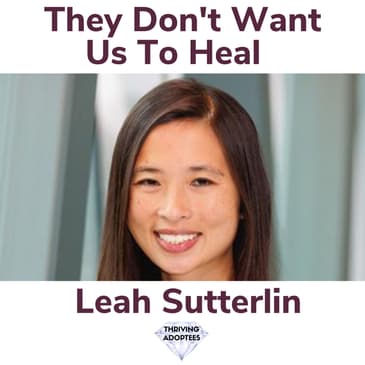
They Don't Want Us To Heal...Leah's words stopped me dead in my tracks when we first spoke. Surely everybody wants the best for us all? Listen and make your own mind up...
Leah Sutterlin serves as the Adoption Communication Manager for National Council For Adoption. Leah comes from a business and technology background and is passionate about writing and data-driven storytelling. She also brings lived experience as an adoptee from China and previous work experience with organizations like the Christian Alliance for Orphans and Help One Child in the foster care and adoption space.
Leah earned a B.S. in economics from the Wharton School, University of Pennsylvania. She and her husband, Spencer, reside in the SF Bay Area in California and love traveling and experiencing new cultures.
https://www.linkedin.com/in/davidson125/
https://www.facebook.com/AdoptionCouncil/
https://www.instagram.com/adoptioncouncil/
https://www.linkedin.com/company/national-council-for-adoption/
Guests and the host are not (unless mentioned) licensed pscyho-therapists and speak from their own opinion only. Seek qualified advice if you need help.
Want to learn more about thriving for you, your kids, your families or your colleagues? Pick a time to talk here
[00:00:02] Hello everybody, welcome to another episode of Thriving Adoptees podcast. Today I'm delighted to be joined by Leah, Leah Sutterlin. Looking forward to this conversation, Leah. You posed a really interesting question when we spoke a couple of weeks back. So, looking forward to diving in. Leah Sutterlin, Ph.D.: Excited to be here.
[00:00:21] Yeah. So, so listeners, Leah is an adoptee herself. She was adopted from China and it was under the One Child Policy regime at that time. And she also works within the adoption space. So she's the adoption communication manager for the National Council for Adoption. So she's got that professional hat as well as that lived experience.
[00:00:49] Leah Sutterlin, Ph.D.: And you worked at CAFO as well. Christian Alliance for Orphans before that. Yeah, I'm actually still, I'm still working there, but more on the data tech, data tech space. Ah, okay. Right. Still doing that. So juggling a few roles. So what you said to me a few weeks back, Leah, really stopped me in my tracks, right?
[00:01:13] Um, uh, this, this, this idea that they, they don't want us to heal, right? People don't want the doesn't want us to heal. And I, and I just thought that is a huge, that's a huge topic. Um, and, uh, one that runs so counter to what I'm about.
[00:01:38] I, I, I, I just thought I've got to dive in. I've got to dive in and explore that because I'm going to learn something new and, and hopefully the listeners will learn, um, along, um, along with us. Right. So, uh, was, was there, when, when, when did you become aware of this, this, this, this, this notion that they don't want us to heal? And who's the they really?
[00:02:07] Right. Yeah. I would say it's definitely not everyone. I think there are people that do support adoptees healing and overcoming in life, but I think there is what we've seen as a growing anti-adoption movement where there's more criticism.
[00:02:22] And I think a lot of people, um, some people are using different research, um, on trauma to back this up. Um, but others are more live people with lived experience. So other adoptees or people with similar experiences of trauma who have been so hurt by the process that they just don't understand.
[00:02:44] And I think how anyone could overcome that degree of trauma. And some of them, unfortunately were traumatized even post adoption, or there's been other traumatic things in their life. So, um,
[00:02:57] I think in some ways it's like there, when some people feel like by us being able to move on or heal in different ways that we're negating the difficult parts of adoption or not being true to those feelings, um, which I would argue is not necessarily the case. I think both can exist, but some people feel like we're not being real about what happens in adoption and the pain that it causes.
[00:03:25] Um, so almost a denial then. Yeah. So I think some people would accuse us probably of being in denial because we've been able to move to maybe a more integrated identity or being able to move towards hope and gratitude. And I think it depends. I think there is a process where people maybe go straight to those and they don't have to process all of the intermediate stages of grief.
[00:03:54] And I think, you know, as a child, I probably didn't have that full understanding of how all of that fits together. So I would say now I feel like I've lived through all of those different stages of, of grief and loss, and I've been able to come up the other side of being more reflective and grateful and being able to balance things a little bit better than I was as a child.
[00:04:17] But I would say like, I would say like, this could be accurate had someone just said, I'm thankful for being adopted without having done all of that work to delve into it. So I think that they may not realize all of the different steps that each person goes through to get to a point of healing. And in some cases, that doesn't look like ignoring the pain that happens. It just means applying different positive or hope filled frameworks on top of that.
[00:04:44] Once you've been able to see that once you've been able to see that there is a future that's out there, if you're able to embrace more of a growth mindset. Yeah. Yeah. Wow. There's so much there. The first one, the first idea that came to me was kind of one of almost jealousy.
[00:05:05] Like why would, why would anybody not want to heal or to, to trash people who have done, done the work? Like, like what's behind this? What's the, what, what, what's the, what's their motive or what, what's their, what's their motive?
[00:05:31] What's their driver? What's their, their thought process behind this? Yeah. I think that if they, if more people stay angry, sometimes people feel like they have a stronger cause towards whatever they're trying to do, like get, sometimes it could be well-intentioned like to get more support for adoptees. So if we feel like adoptees stay broken longer, maybe we can put in more effort towards helping, helping adoptees.
[00:06:01] And that, that I think has well-intentioned parts of it, but maybe it's expressed in a place of trying to keep people in a, in a negative space. I think also some people are actually against adoption altogether. And so they also feel like if people speak out more about their pain, then the media and others will take more notice. And maybe they also don't want to feel alone in what they're going through too. So if they have more adoptees feeling the same way, then it creates a greater sense of community.
[00:06:31] But I would argue that there's communities can form around all kinds of different shared experiences. And so I've also seen, I've seen both sides. I've seen communities of adoptees that kind of have that shared mentality of, of where we've been a victim of a process versus others, which are like adoptions, which are adoption is part of my story. I'm trying to share to help other people like more of a positive framing.
[00:06:58] But it's kind of like different friend or association circles. Like you, you, you tend to, people tend to, to group together. That kind of forms, I think a very strong mentality of how a shared mentality in some ways of how to think about your situation. It can be the same situation. It's just, you can apply the same real circumstances that are lived through, through two different lenses and come up with a completely different narrative, just depending on the language that you use and how you frame it.
[00:07:26] And maybe your worldview and other things kind of shape that self narrative. But I would say the same, very same circumstances of my life have at different points in my life been thought through by myself in very different lenses. So I think you can, it's a lot about framing in many ways. Yeah. Have you been attacked personally in this space? I have not.
[00:07:56] I mean, I think working for adoption organization, I see that they face a lot of criticism, but I also am friends with adoptees who have faced a lot more public criticism. And some people say that they're nervous about sharing their story because they're like nervous that people will be, be attacking it because it's not the same as their own. And I just don't understand why among adoptees,
[00:08:21] we can't just be supportive of a wider range of experiences and just be able to listen with compassion to those. But it is strange when people are sharing from lived experience that someone is saying that you can't have that experience because my experience was different because there's such a wide range of different types of adoption in different circumstances. At the National Council for Adoption, we've done some research on trends that show overwhelmingly that adoptees are able to achieve satisfaction in different parts of life.
[00:08:50] That doesn't mean everyone is, but just the overall trends in the field. So I think there's those like trend data that we can try to elevate to show different positive outcomes. But also, I think there is a value of the individual lived stories of people. I just think that we need to be able to hear experiences that don't necessarily resonate with our own. And I say that in both ways. Like, I also want to hear from people who have been negatively impacted by adoption,
[00:09:17] because I think that that's a horrible thing that they had to go through. And I think that they should be heard and they should be supported. And if there's ways adoption can be improved for those individuals, that would be great. But I don't like when people are tearing each other down because they want people to feel the way that they do. Yeah. Yeah. Yeah. We hang around.
[00:09:44] We tend to hang around with people that have the same worldview as us, as human beings. That's what we do. Right. That's a human being thing. That's not an adoptee thing. Right. So me and my wife haven't got any kids and we spend more time with people that don't have kids than we do with people that do have kids. Yeah.
[00:10:12] So it's just logistics, lifestyle, the kind of the whole thing. I'm also thinking about business stuff. So people tell us, you know, because I've had a lot of business coaching, worked a lot on business improvement back in the day.
[00:10:39] And people were always telling me, you know, you should be hanging around with people who are ahead of you in terms of their business success. You don't want to be hanging around with people that are behind you because you're not going to learn from them. You're going to learn from people who are ahead of you on the curve.
[00:10:57] And so I've kind of taken, I've taken that approach to healing is to, is to, is to find people who are further along that, that, that curve. Right.
[00:11:19] And, and, and, and, and better at communicating it and more clearly, you know, I'm, I'm struggling with my words right now. I'm just running a little bit slow. So, yeah.
[00:11:35] The, the big thing for me in terms of don't want to, don't, don't want to is it's a, it comes back to a little story that a little vignette story that I heard from a really, a really important mentor in, in, in, in my life in terms of my own healing journey, if you like. And so the, so the story goes like this, right?
[00:12:03] So Leah and I aren't 6,000 miles away with you in San Francisco and me in, in Yorkshire. Right. We, we, we're together in Leah's backyard and, uh, we, we, we're having this conversation about healing and, and, and thriving and this sort of thing going, going on.
[00:12:27] And there, uh, underneath the, underneath the dirt in the, underneath the, underneath the dirt in the garden, underneath the, the, the, the, the soil in the garden, there are some, uh, there's some daffodil bulbs. Right. You and I are, you, you and I are, are, are fully grown daffodils that we're, we're basking in, in the sunshine and we're saying life, life, life is good. Right.
[00:12:56] Right. But there's a, uh, there's a daffodil bulb underneath the, the dirt that hasn't sprouted yet. It hasn't broken through the dirt and, and felt the sunshine. So when you and I are saying, is, is, isn't this sun beautiful? The, the underground daffodil saying, what on earth are you talking about here? Um, the world's dark, it's cold.
[00:13:24] And so what, what the vignette is about is about seeing, is, is about a perspective. It's, it's to express how our different, how different our perspectives are depending on where, where we are above the, above the dirt or below the dirt.
[00:13:48] So for me, it's, it's, it's, it's, uh, it's an ability to see rather than a desire to see or, or, or want it. It's, it's just our perspective. Um, what do you make of that? Yeah. Yeah. I would say that some people haven't experienced, um, healing.
[00:14:13] I think there's also probably a current of people that feel like that they're stronger for not seeing that, getting to that point because maybe it strengthens their, the arguments that they're trying to, to fight for in life. You know, that, that, you know, cause a lot of, of advocacy in some fields comes from a lot of bent up frustration about a system. And so a lot of people maybe feel like staying there is, um, a stronger case for making the changes that they want to see. But I would say that it is a worldview.
[00:14:42] And I think what you were saying before about people being on different stages of that journey, I think that is true. And I think when I was trying to learn about adoption and how to think through my story as an adult, I did look through, for examples of people, uh, who had been through similar, even maybe greater trauma in different fields. Um, and what, how they had overcome that. Because I think for me, and that's also why I think that you can, it's really helpful to hear from other adoptees.
[00:15:11] It's also helpful to hear a wide range of other challenges and life adversities and just how people have overcome those. Because adoption is not going to be the only challenge you go through in life. Maybe not even the biggest challenge in all of what happens during your life. And it's important for people to understand what can lead to thriving and healing from adversity, just in general. And I think having studied people who have overcome adversity, I see a few different patterns.
[00:15:38] And some of those are the self-work that they've been able to do on themselves and processing their emotions. Um, their ability to like hold different things in tension and balance, joy and pain and love and all of these complex emotions in a coherent way. Um, I think other trends are people that have been able to get help from others. So a community, loved ones, they've been maybe a counselor if they need that. Like they've been able to find support around them on their journey.
[00:16:06] And for other people, it's been able to find a creative channel or a faith community or some, some other form of outlet that is able to provide another way for them to share their story and get help in processing it. So those are such as some of the trends that I've seen. But I do think that people could benefit from just looking at who is out there that has been able to overcome and just what are the patterns in those people's lives.
[00:16:36] Because it is possible to build a toolkit for young people who have been through different forms of trauma or early childhood adversity to, to build resilience and thrive and be able to, to have a framework for overcoming challenges past and present that come their way. And I think that we, we need people to understand why that's so important.
[00:17:01] Because if you can't, if you can't understand adoption and, and be able to heal from that, I just worry that you won't, people won't be able to heal from other things that life gives them either. Yeah. So they're going to be more fragile. Right.
[00:17:21] Or they're going to be able to, they're going to stay and like, let that depression and other things be consuming of, of their time and talent in a way that that's, that's tragic in some way versus being able to, I like, I see so many adoptees that are in this professional field. Because I think people want to, because I think people want to, and they want to, when they've been able to heal themselves, they want to help other people.
[00:17:47] They want to support the next, like vulnerable children and be there and be mentors and share what they've learned. So I do think that once people get to a point of, of healing themselves, there is this overwhelming sense of, we do want to help others too. Um, but yeah, I think it just more people need to reach that, that point of being able to, um, heal and also to, to want to give back.
[00:18:17] Um, have you heard this phrase trauma bonding? I may have, but I have been a bit of appreciate a definition again. Yeah. Um, I thought it was people coming together and sticking, sticking together and kind of like a, a negative spiral. And group think, um, that, that, that's kind of what, what it, what it mean, me, means to, uh, what it means to, to, to me, or that's what I thought it meant.
[00:18:47] But it's, it's actually, it's actually to do with, um, um, no different definitions, the different definitions to it. But that, that, that to me seems to be what, what's, what's going on.
[00:19:05] Um, we have, we have, we have group think either, uh, with a, either a positive slant, a thriving and healing slant on it, or we have group think as in trauma bonding, which means we all, we all get, we all get into a pit together. And then somebody kick, kicks away the, uh, the, the, the ladder, right?
[00:19:33] So nobody can get out, nobody can get out of, out of the hole. And for, for some of us who have felt that our trauma has been denied, uh, denied us, it's been denied because our, perhaps our parents haven't been aware of it. So they've, they've, they've criticized us, or they've said that, uh, they've invalidated our feelings.
[00:20:01] Um, they haven't supported us, as in, in our pain, they haven't supported the pain. They, they've denied the trauma. Then, so we've got this, this pressure that's built up and then we find a space where we can share our trauma and it's not invalidated.
[00:20:23] And we, we, it, it just becomes this, it just becomes this, uh, self-fulfilling group think trauma bonding, which it feels great in the, uh, it feels great in the, in the first flushes of it because we're, we're getting that validation that we haven't had for our lives.
[00:20:47] But the, the, the, the validation, so the validation makes us feel good, but that validation keeps us, keeps us stuck in, in, in, in the longterm. And, uh, if anybody comes into that, cause this has happened to me, right? Um, I, I came into that, I came into one of these, uh, one of these groups. It was, it was, I can't remember what the title of the Facebook group was, but the, it was some, to me,
[00:21:16] it seemed to be a group of people that had been from the title that had been through the, the tough stuff, learned some stuff, come out the other side and wanted to help others. But that wasn't the case whatsoever. They, they were all still in, in the midst of their, in the midst of their trauma bonding. And I was, uh, I, I was called toxically positive. Right.
[00:21:46] Um, and I thought, oh, I've, I've upset, I've, I've upset somebody unintentionally. Right. So I, I deleted my comments and kind of got out of the group. Uh, and as I, uh, just on the way out of the group, there was this post that said, ha, he hasn't even got the courage to stand his own convictions and kind of argue his case. And I just thought, no, I, I can't, I can't be here.
[00:22:16] I can't be here. And, and you're, you're so far wrong. I, I, this is, I'm not leaving because of, uh, uh, uh, of being, of, uh, being unsure about my convictions. I'm, I'm leaving because I don't, I don't feel at home here. And, and I've, I've upset you.
[00:22:43] I don't want to, I've deleted the comments because I don't want anybody else to be, to be upset. Yeah. Yeah. Um, yeah, that's a lot that you've shared. And I, I, I think that there is a, a place for people to share trauma, but I do worry about groups that never move beyond that. Like they never have a stage two.
[00:23:06] It's just that this is your, this is your new stage for life in some ways, it seems, which, um, which I think misses a larger opportunity. I will also say that I worry about young people who are impressionable and haven't formed that self-narrative who get drawn to one of these groups, but don't have the toolkit to think of any alternative.
[00:23:28] So when people are processing for the first time that things that have happened to them in life, we really need people to be surrounded by trusted people that they can trust with good values and who have the right mindset to overcome adversity. But a lot of times young people are getting impressions from the internet and group forums and all of these spaces.
[00:23:53] And so if you hear, this is how you should feel about what happened in your adoption and you, you're, you're trying to grasp onto something and you feel like there's some parts of it that you do resonate with. You may fall into that, letting them help feed you what you ultimately end up believing, as opposed to going through the work of taking all of the different views that are out there, synthesizing, taking hold of what really resonates with yourself and building that narrative.
[00:24:22] But that narrative construction can be, unfortunately influenced by the loudest voices in the room or the people that lure you in with some language or marketing. So I, I think that every adoptee's journey is personal, but we need to provide different and wide range of frameworks and alternatives for people so that they don't just see that they have to go down the one path, but that there are different, different outcomes.
[00:24:49] Um, and that ultimately, yeah, healing is beneficial because not only because it doesn't mean that you're dismissing or you're forgetting what happened in maybe being abandoned or, um, in my case, because of the one child policy, those things are, are tragic and grow up in orphanage.
[00:25:10] It doesn't mean that doesn't mean you're forgetting that, but it just means that you see a different, a new life that's possible for you, uh, with a rich family and career and just relationships that are healthy and secure. Um, that's possible for you if you're able to get beyond and, and just, and have that being part of your story, but not the full story. Yeah. So what's helped you along the, the healing journey, Leah? Yeah.
[00:25:39] I think I'm, I'm a writer, so I think writing, being able to process in that way. Um, I think faith has also played a role in just providing, um, a hope and being able to see adoption through a wider lens. What was that, sorry, Leah? Faith, being part of a faith community.
[00:26:02] Um, and I do think talking to other adoptees and hearing their stories, um, hearing stories of adversity and people who have gone through maybe identity challenges, but have found a way to now, um, yeah, be whole and be present in the reality that they're in right now. Um, and not always live in the past. I think those are also inspiring. Um, and I think along your comment of toxic positivity, I think there's a balance.
[00:26:32] I think there's like nuance. And I think there's people out there, um, who are able to handle that, that well, that nuance and navigate so that they're not alienating people who are still in that space of pain. And, and I would say that even as an adoptee who has done a lot of work of healing, there are times when that I still feel pain or loss or grief. So it doesn't mean that those don't exist.
[00:26:53] Um, so I think that I, I've been inspired by people who are able to handle the both, the both and, um, of their story in a way that is comprehensive.
[00:27:07] And it's, I, I feel like it's integrated into who they are, where they see the good and the bad, and they're able to choose the good in their story, but not forget or neglect the ways that, that, um, that there have been difficult parts of that too. Um, so I've been, yeah, I've been inspired by hearing from other adoptees and getting support from that community.
[00:27:32] That wasn't something, those weren't necessarily people I had access to as a child, but now I see that there are more communities out there. It's just sometimes hard to find the right ones to tap into, as you mentioned. Yeah. Yeah. Has there been a change in the way that you feel about your feelings? Yeah, I would say, I mean, I, I think I've gone through a lot of different feelings. So, um, and it hasn't all been positive about adoption.
[00:27:58] And I, during adolescence, there were times when I was really angry about with my birth family and just even my adoptive family for feeling misunderstood. Um, so I think all of those are normal. And I wouldn't say that when someone is going through hopefully a temporary stage of, of really being in, in grief and, and maybe feeling down about that, I wouldn't say that you necessarily have to coax them to move right away to a point of healing.
[00:28:24] Like, I think it's, it's okay to sit with that and to acknowledge, because for me, that process of it really hitting me, what had happened in the first nine months, first year of my life didn't happen until adolescence. So up until that point, I just hadn't thought about it. And I think there is a can't where people just don't think about it ever. And I don't think that's like bearing that, that isn't necessarily, isn't healthy at all either. So I do think people need to process it.
[00:28:49] I think people need to be okay with sitting through difficult parts of people's journey while they're in that phase. But I think for me, my feelings have evolved because I've also been able to see, I've been grateful for who my adoptive parents are, even if they're not perfect and no one is. I've been able to focus more on the present and not some imaginary other situation. Like, I never had the opportunity to know my birth family. So I don't know what they would have been like.
[00:29:18] But sometimes it's easy to picture a perfect other scenario that with your biological family that would have fixed all the problems that you encountered in life. But the reality is that might not have happened, probably wouldn't have happened. And you can't compare the reality that you're in with those alternative scenarios. So I think as I've been able to process and be appreciative for what I have in the present, which isn't all perfect, but it's just been me being content with the circumstances in front of me and saying that this is the life I have, not any other possible life.
[00:29:48] And I'm okay with making the most of that life. And part of that is getting to a point where I feel healthy and whole as a person. Maybe not every day, but just overall that I have that more positive framework for approaching every day.
[00:30:06] So that's kind of been my own journey of being able to process really hard emotions, but also see how in the midst of it, there's been a lot of purpose behind it. And I see many things in my life that couldn't have happened had other life challenges not happened before that. And I see that those were ultimately used for the good.
[00:30:30] So even in the case of adoption, I probably wouldn't be in this field of adoption had I not been through that. I probably wouldn't have mentored other adopted children had I not been adopted myself. We probably wouldn't be having this conversation. So in many ways, a lot of maybe the lessons or growth that an individual has through adversity leads them to potentially being in a better place.
[00:30:54] In other ways of being more able to help other people more able to understand people who have been through difficult circumstances and relate to them. And I think we can focus sometimes more on what people have gained from a situation as opposed to all that you have lost from it. Yeah. You mentioned growth a couple of times and you talked about the growth. You talked about growth mindset a little while ago.
[00:31:23] Can you share a little bit about that, Leah, in case people aren't familiar with it? Yeah. So I think a growth mindset is just believing that humans are able to change and grow and things are not necessarily static. And a lot of the trauma narrative focuses on the trauma that happens and the rewiring of brain chemistry that happens during that early childhood deprivation or loss.
[00:31:51] And I think that that is true, that there are things that happen when there is neglect and abuse. I don't deny that that does alter how a child's able to process attachment. But I also know that the brain is there's a lot of neuroplasticity. Like there's a lot of ability to learn new patterns of thinking and for the brain to be rewired in certain ways through coaching and through other forms of love.
[00:32:17] And it's a healthy attachment being surrounding that individual later in life. So I think that my overarching view is that people can, with the right tools and resources, be able to overcome a lot. And that even though there still are some things that trauma may have long term and even lifelong repercussions, there's a lot of ways the brain is malleable as well, especially when things happen at an early age.
[00:32:47] Your brain isn't fully developed at that point. So I think people can hold on to that hope that people can overcome. And yeah, I think that's ultimately what I'm trying to get at with the growth mindset. Yeah. One of the things that strikes me is that even when I was struggling,
[00:33:17] there were moments of peace, right? So if this is a really, really simplistic view here, Liam. If adoption had messed me up, I would have always been messed up. And yet I haven't always been messed up. I've had moments of being messed up and other moments while I haven't.
[00:33:47] So to me, it seems that there is another factor at play. And that factor is my mood, my thoughts, my mindset in any given moment. And that strikes me.
[00:34:18] So what do you make of that? Am I making sense? I'm saying like, so if you, if you, like, if you can, we use the analogy of the broken thing, right? Right. So a broken glass, a broken leg is going to heal, right? But a broken glass isn't going to heal unless we put it together and get some glue on it. Right.
[00:34:44] So you can, we can go, the metaphor that we choose to fit our mindset. Sorry, we choose the metaphors to believe, to kind of sum up what we think is true.
[00:35:04] But what do you think of this notion that I'm pointing forward of the being an intermediary, you know, another factor at play? And that factor is thought. What do you make of that? Yeah, no, I agree with that.
[00:35:23] I think that we will universally see the data point to if adoption or the circumstances that happen before making adoption necessary led to adoptees not thriving universally. I think we would only see that outcome, but we see a wide range, which means there's so many factors at play. Part of that being mindset, mood, personality, support system, like all these other things.
[00:35:52] And it's hard to disentangle it all because I know if we had like a playbook of what would absolutely work for everyone, then we would all be OK. But there is some nuance to it, too. So I think what we can do is highlight what are some of those factors that lead to greater thriving and healing in adoptees and maybe even research that.
[00:36:15] But also know that it's not going to be exactly the same for every person because there's so many biological and environmental factors that you mentioned that are different. Like some people might be more susceptible to mental health conditions, even without adoption being part of that. That's just how their brain is wired. And so they may have more difficulty in certain areas. Other people have experienced other forms of of.
[00:36:46] Abuse or loss, even post adoption, they've been through different life traumas. And so that that has a compounding effect, you know, on how they see adoption because they've been through such a difficult life in general. And so there's such a wide range of different differences that each the approach that's going to lead each person to heal is slightly individualized and tailored to that person.
[00:37:12] But there are some overarching trends that I think we both see that can help through that process. Yeah. I'm just talking about me and the fact that my mood goes up and down. Right. Yeah. Yeah. And everybody's mood goes up and down.
[00:37:37] And this does a there's a Scottish adoptee, theosopher guy called Sidney Banks. He's no longer with us, but he he he he got some interesting books.
[00:37:57] It's Sidney with a Y, I think Sidney Banks, all sorts of different books and videos out there about how he saw thought as the. They. The the defining factor in any moment. Right. So. Yes, everybody's. Yes, everybody's. Circumstances are different.
[00:38:24] If we just purely look at our own circumstances and and our own. And how they change, how our feelings, how our feelings change from from moment to from from moment to moment. Then to me, it points to. You know, we're feeling our current thinking.
[00:38:52] We're not we're not we're not feeling I'm not feeling my relinquishment. Fifty nine years ago. Right. And I'm not I'm not feeling my adoption. We call it adoption trauma, but actually it's more to do with the relinquishment. Surely. You know, and or it's it's more. But let me let you say that there's two it's two factors. There's two factors at play.
[00:39:19] It's it's the it's the the the the trauma, the relinquishment and then the the degree to which our. The the level of emotional intelligence of our of our adoptive parents. And. And the two things. Yeah, I think thoughts do play a large role in that. And I know that there are many thoughts that go through my head on many topics every day.
[00:39:46] So in a way, each person is their own filter for deciding which thoughts get more priority, which thoughts do people focus on and ruminate on and hold on to. And so I think people need to be careful of the thoughts that they let in, but also how they're they're processing it, because. As I said before, you can take the same circumstances that happened and. You can.
[00:40:13] Well, on a given day, you may feel many different ways about that, so you have to, first of all, make sure that how you're feeling at one point is doesn't necessarily have to be how you're feeling about something forever. Like things your thoughts can evolve and change. But I think also how you see the same event can be looked at through different lenses or you can you can think maybe like 100 different thoughts about one single event.
[00:40:38] So it's more around each person's ability to process them and and people have different lenses for choosing what thoughts do they actually choose as like core viewpoints or which thoughts do they evangelize to other people and share with other people.
[00:40:56] So I do think that there's work in each person in working on their personal thought life and evaluating the health of that process to to get to a better point of feeling. Yeah. Isn't it isn't it isn't healing a change in how we feel and isn't that driven by our thoughts? Yeah, I mean, I think there's a wide range of factors. I think thoughts being one of them, I think.
[00:41:27] And you can use those thoughts. I mean, thoughts are a large part. And those can be influenced by maybe data that you read, like stories of people, people speaking into your life. Like there's many different ways that thoughts get into our brain. And so, yes, I agree that we can change our thinking, but it also depends on where are we consuming information from? Like what is leading into the thoughts in the way that we're feeling and what are the influences in our life?
[00:41:55] So I think all of those are tied together to how we can process things. Yeah. The idea that we can change how we feel in any moment, I think once we're in a feeling, we're in it. But it's got a half-life. The feeling's got a half-life. And I don't think that I don't think we can kind of like I must, you know, I must change this thought.
[00:42:26] I don't think that's kind of quite how it works. I think insights change our thoughts for us, right? Yeah. I mean, I think there's processes that people can do to work on changing negative thought patterns and other things.
[00:42:47] But, yeah, I think that it's important, I guess, in the adoption side of things to be able to focus more on what are the underlying beliefs and thoughts. Because feelings will ebb and flow so much that we can't use feelings to dictate how to think about something. Because, you know, maybe I didn't eat breakfast and I'm like really upset. Like that doesn't necessarily mean that I need to feel negatively about all my relationships in life just because I'm angry in this one moment.
[00:43:12] So I think that actually what's important for each person is to focus on what are some of the core thoughts and beliefs that can help me when I'm experiencing different emotions to pull me back to like a focus center. As opposed to getting, just following my mood at any time. Because I think that, yeah, it's very, it can change as you said it. Feelings last only a certain amount of time.
[00:43:38] But if we were only our feelings, we would not be able to sustain any relationship because we would be all every which way. But because we're able to come back to like, oh, I love this person or, you know, some core anchoring truths. Then I think that those are able to override our feelings in some healthy and important ways. Yeah. You talked about gratitude. You mentioned it a couple of times in the first bit.
[00:44:04] And I want to take you back to that because it's a very loaded term within adoption, within adoptees. And one of the thoughts that I had or a question for you, I guess, is do adoptees become kind of allergic to gratitude?
[00:44:34] So they've been told that they should feel grateful. They don't feel grateful. And this can, it's a suspicion of mine, right? That it makes us allergic to gratitude in other areas of our life, right? Yeah, I mean, I think gratitude is so important.
[00:45:01] And so I think it's just an important practice to develop just in general for overall life health and the betterment of relationships around you. Like grateful people are so pleasant to be around. Not, I don't think adoptees, I think there was, you know, an overall cultural movement around not feeling grateful for adoptees, not feeling grateful.
[00:45:24] And I agree, there's some things that adoptees don't necessarily need to feel grateful for all the time in excess of what other people feel. So, for example, adoptees don't choose necessarily their adoptive parents or their circumstances. So just feeling grateful for your adoption, that it happened and that you were, you had adoptive parents.
[00:45:48] Well, I would say like, do other people with biological parents feel grateful for just being born into that family? And I think the answer is sometimes yes, sometimes no. But I will say that I do think it's discouraged us from having gratitude in the long run, too. And I think that there is a gratitude that comes from being able to see the good that comes from different relationships.
[00:46:12] For example, I'm not always grateful just for the fact that I was adopted, although I am because I see in different ways it helped my life in so many ways. But I'm also grateful for who my adoptive parents are and how they raised me and all the hard work that they did throughout that process. So I wouldn't say that I am toxically grateful. I think that I am just appropriately grateful for what people have done.
[00:46:38] And my gratitude is actually more so for the work that happens day in and day out in those relationships, as opposed to just the act of being adopted. So in some sense, I think that people's gratitude can change and should actually focus more on what's happening and what's happening, what has happened throughout and over a long period of time than gratitude just for a single event that was outside of their control.
[00:47:07] But that's part of normal human development. And I think getting to a healthy point, we're able to just be grateful for the good that's happened in all circumstances and the people that contributed to that process, the people who invested in you, the relationships that you have. And I would be so sad if people feel like they just can't be grateful for anything in life because they've had a negative experience in one facet.
[00:47:31] And so sometimes I think when we say don't be grateful, then we just prohibit people from saying that they're grateful at all, which, yeah, there's just so much more that people can be grateful for, even if it's not that one thing. And so I hope that people are able to see the bigger picture and how gratitude helps. Yeah. We're coming up on time here, Leah.
[00:47:59] Is there anything that I've not asked you about that you think's big in terms of what we've discussed or anything else that you'd like to share? No, I think this was very helpful. I will say that a lot of times people confuse what you said, the relinquishment with the adoption in these conversations. And a lot of times, not in every story, but in mine, that the trauma happened before the adoption.
[00:48:26] So those are often tied together as being adoption trauma, when really it's the events that happened that made adoption necessary that were the traumatic part in the separation aspect. So I think that that's an important distinction, how we talk about this. But I also think that there's just so much benefit in people finding resources and communities that encourage courage, flourishing and healing.
[00:48:56] Just because I think they'll see the ripple effects across so many domains of life from embracing that mentality. And that doesn't mean you can't advocate for change. That doesn't mean you can't change things that are broken. It just means that you're approaching it from a more healthy, processed way. So I would just encourage people to try to do that work of seeing what's out there. Yeah. Fantastic, Leah. Thank you very much.
[00:49:25] And we'll speak to you again very soon. Take care. Bye-bye.