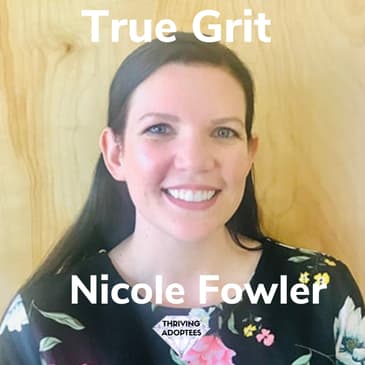
Adoption can be a wild ride that takes true grit. Listen in as adoptive mom and adoption professional Nicole shares some of her most powerful learnings on self compassion, grit and more...
https://www.linkedin.com/in/nicole-fowler-3517b594/
https://www.facebook.com/AdoptionsFromTheHeart
https://www.instagram.com/adoptionsfromtheheart
Guests and the host are not (unless mentioned) licensed pscyho-therapists and speak from their own opinion only. Seek qualified advice if you need help.
Want to learn more about thriving for you, your kids, your families or your colleagues? Pick a time to talk here
[00:00:02] Hello everybody, welcome to another episode of the Thriving Adoptees podcast. Today I'm delighted to be joined by Nicole, Nicole Fowler from Adoptions from the Heart. Looking forward to our conversation today, Nicole. Let's pretend that we've not been talking for the last 20 minutes right? Yes.
[00:00:20] So yeah, Claire Nicole is an adoption professional. She's also a mum through adoption. She has a daughter in her 20s that she adopts from foster care. And if I remember rightly, it's a single mum? Yes. Yeah, you and you. Okay. Sometimes I can't read my own notes, right? And it's coming up two months since we spoke last.
[00:00:44] So, the biggie, right? Thriving. What does thriving mean to you personally as a mum, as a professional, as a human being, as a sister, daughter? You know, what does it mean to you? As wide as you like Nicole? Okay, thank you. Thriving means to me, I...
[00:01:16] In a bigger picture, I definitely want to enjoy and cherish my family, my friends, my community, my relationships. And that's not always so easy to live through in the day-to-day with emotions and circumstances that come up.
[00:01:37] So, I think building my community has really been helpful to that for me and having compassion for others. And then through that, others having compassion for me and seeing each other through this wild journey of being a daughter, a friend, a sister, a mother. I have to have that community around me too.
[00:02:03] To support one another? What does the community give you?
[00:02:10] The community gives me empathy and advice and courage and enjoyment and fun and being seen, especially if you have a couple really close people to you who you share the good, the bad, and the ugly with, without... And can be vulnerable with, without feeling judged.
[00:02:39] And there usually is just a couple to a handful of people like that. That helps me be the best mom I can be in any moment. Professional I can be. Yeah. I've heard a lot about from other adoptive moms or moms, right? We call them moms, you call them moms.
[00:03:08] Moms and dads about being judged by others. And I think... I was talking to somebody who, a Brit who lives in the States about this last week.
[00:03:30] And so my kind of my theory was that are Americans more judgmental than Brits? And she said, yeah. You know, it was a loaded question. I knew my opinion. But luckily her, or luckily I don't know about her opinion did.
[00:03:53] And so this kind of need, the need to judge or to point out or... It just seems really nasty to me. Mm-hmm. And a lot of it is done behind the keyboard with social media now. I think that's made people a lot more comfortable. But where does that come from?
[00:04:21] Is it from a rigid standard from your parents from growing up that... I always think that judgment comes from insecurity. That's been my thought on that. And I think that there's room for growth for everyone, but that deep judgment of other people, especially not understanding... I'm never going to understand another circumstances 100%. All of us are living very unique circumstances and unique lives.
[00:04:51] So I don't know. That rigid thought of exactly what a person should be is definitely strong. Yeah. It's a long story. I won't tell the whole story, but I did some work in an elementary school. We call it a primary school a few years ago.
[00:05:17] And they didn't tell me what they wanted until I asked. And the head teacher said, we just want the kids to be nicer to each other, comma, especially the girls. And she was talking about eight-year-olds. And this was probably 10 years ago.
[00:05:46] So, yeah, I'm sure there's a lot more eight-year-olds with phones these days than there was 10 years ago. So it wasn't a social media kind of thing. It was the most important, most longstanding mentor in my life who judges me not one bit, says, girls cry and men fight and boys fight.
[00:06:18] And so there's a, you know, like, so for me, nicer to each other in the playground. I went to an old boys school where we fought in the playground, whereas girls don't fight and play and do something else. You know, I'm going back to the 1970s here on that whole, right? You talked about compassion earlier on.
[00:06:43] And so how does this idea of perhaps truth, right, that the judgments come from insecurity, how does compassion impact this for you?
[00:06:58] For me, having compassion for others and having compassion for myself really helps me navigate through any challenges. And I think it's just like a lot of things. To have something, you need to give something.
[00:07:26] So if I want compassion, I need to find ways to find compassion for other people as well. But that's not always easy in the day to day and the moments and the normal and also recognizing the negative, quote, negative emotions of, you know, anger and pain, fear. And that's all a part of the bigger picture and not shoving that down.
[00:07:51] So I think having compassion is also having compassion for those and identifying, again, quote, negative emotions. So what's compassion for yourself? How do you, what does that mean for you?
[00:08:13] I think being able to take the time to pause, recognize different feelings, recognize that I'm not going to be a perfect mother, a perfect sister, a perfect friend. I don't expect that of others either.
[00:08:30] And I think taking the time to really stop and not, I think sometimes when we're on autopilot, we can just keep moving through everything. And I think compassion takes meditation.
[00:08:48] I think compassion takes a well-deserved and needed break sometimes to just be with myself, to have that self-compassion. So it's pause and grace. Yes, yes. Yeah, yeah.
[00:09:07] What was coming up for me as you talked about grow passion for ourselves, it's like, it was this, have you come across this, some people call it parts work. It's a therapy modality called IFS, internal family systems. You come across that? Yes, you had mentioned it last time and I put one of the books on my reading list, but I have not gotten it from the library yet. Yeah.
[00:09:34] Does it, because when we say compassion for ourselves, what we're talking about is a, and really a, or what, yeah, we're talking about part relationships between different parts of us. Because, you know, we can't, it takes two to tango, it takes two to judge. Yes. Yeah. So, but there's only one of us, right?
[00:10:04] Yeah. So how, how does it happen? You know, but parts work is about kind of would, would, would be investigating that. So there's a, there's a, there's a judgment, there's a judge apart and there's a, a forgiving part. And, and the, the, and then we would be, so the, the Dick Schwartz is the IFS guy, right?
[00:10:29] And he's, he's, his book or one of his books is called No Bad Parts because we can, we can have an inner critic and then we can criticize ourselves for having an inner critic. Right. Yeah. Yes. Right. Right. So you talked about suppressing stuff, right? So we can have, the inner critic can come up. The inner critic is, is the one that's saying we should know better and we should be better. You should have learned this lesson by now, Simon.
[00:10:58] I'm not talking about you, Nicole, right? So my inner critic says, right, you should have learned this lesson. I had one at, I had one at the swimming pool. I was talking to a guy that I, a guy that sits swimming pool quite, quite often. And I said, you know, like I, I made some mistakes in, in, at school at high school. Right.
[00:11:24] And then I made pretty much the same mistake again at college. Right. So we can really go to town with the inner critic, but the inner critic is going to, the, the, the, the, the, the, the, the, the, the, the, the, the, critic is criticizing another part of us. It's like a board meeting. Yes, yes.
[00:11:50] Like a board meeting and there's the different parts of us that are arguing with one another. They've got a different view. So compassion, so the book's called No Bad Parts. The Dick Schwartz book is called No Bad Parts, right? So what it's saying is we're not going to try and eject the inner critic
[00:12:19] from the boardroom. We're going to have compassion for the inner critic, the inner judge, because we know, like as you said, that judgment is coming from, the judge is coming from insecurity. I had a great phrase this morning listening to a podcast, perceptual humility.
[00:12:48] Okay. Perceptual humility. Writing that down. I thought that was great because it's essentially being up, being up for the way, being up for seeing that the way that we see the world is maybe a little bit off. Mm-hmm.
[00:13:18] Mm-hmm. So we may be seeing through dodgy eyewear. Mm-hmm. And what do you do with that? Sorry? What do you do with that? What do you do with that? Well, it's kind of, it's a noticing thing. Uh-huh, uh-huh. It's a noticing thing.
[00:13:42] So if I make it a bit more personal now, me viewing the world through trauma glasses. Mm-hmm. So I can look back now. I can look back. And this happens quite a lot. I look back at certain things from 20 years ago. Uh, and I think I wasn't seeing that right.
[00:14:10] So I bumped into, I used to knock around with a certain group of people. And then, unfortunately, one of those, that changed, right? And then I, one of the guys went off traveling. And I tried to stay in touch with a couple of the people. And it didn't work out.
[00:14:33] And I thought, I didn't, yeah. I bumped into one of those people a few years later. And I thought she'd kind of dumped me as a friend. Mm-hmm. I didn't know that kind of, but she was gushing about how great it was to see me. And I was like, well, you dumped me.
[00:15:01] Like, I don't know, I can't understand what's going on, right? I can't understand what, I don't understand what you're saying now. I don't know why you're so gushing now because you basically, you dumped me. So, but looking back on that now, I can see that was, that was my insecurity glasses were on. When she, you know, I was, I was off. I was off.
[00:15:27] My perception was incorrect. And I've got another one. Walked past, walked past an old girlfriend in the street with a new boyfriend and a mum. And she blanked me, right? She didn't, she didn't acknowledge me.
[00:15:54] I was on the way back from the pub and being a bit lippy and, you know, had a few bids. And I said, don't say hello then, Fiona. Two minutes later, I turned around. And as I turned around, this fist landed in my face. And, and I went down on the deck and the guy was starting to kick me while I was on the, on the, on the ground, right? And a friend of mine that was with me who knew him kind of pulled him off or got him to stop.
[00:16:25] And that, that was when I was 90. So I'm 59 now. So that was 40 years ago, four years ago. And he, it only dawned on me a couple of years ago that she wasn't, she wasn't rejecting me. She wasn't ignoring me on purpose. She must have known what a boyfriend was like. She knew her boyfriend had this jealous streak. And that if she said hello to me, it was going to cause some ruptures.
[00:16:54] So perceptual humility is seeing that how we see things might be a little bit off. Mm-hmm. And it becomes a whole new world. That, that, that little part of your world becomes completely new. Yes.
[00:17:17] Can I ask if there was ever a time where, or what the, the moment was that, um, you started learning more about, about that perception. And, and when that changed and, and when that changed and kind of surrendering to maybe therapy or any sort of help with changing that. Well, first off, I'm interviewing you. So that's. It's the natural counselor in me. I know.
[00:17:48] And, and I said that jokingly when you were taking a sip from a straw, right. Of a drink. So that went probably. Yeah. Say, say the question again. Was there a time it was in your teens or twenties or thirties when you, when you kind of wanted to grow in, in learning more about your perception and your history and. Yeah.
[00:18:16] Um, I, I would say it was, it was, um, I would say it was in, in business. I got a business coach. Okay. And one of the things that the, so this business coach just asked me questions, right. It's really infuriating. A mentor tells you what to do or an advisor tells you what to do. Uh huh.
[00:18:45] A true coach never tells you what to do. Uh huh. Okay. That's a simple, massive implication, right. But what, one of the things that she did tell us to do was to do this. You know, when I say never to do, she, she never told me what to do about a particular situation. Right. So if I said, should I ring this guy? I shouldn't ring this guy. She would say, I'm not going to answer that question.
[00:19:10] But what she did do is, is she got us down this and going down this, um, we did these, what's called a disc profile. So a disc profile is like a, you're nodding your head. You know what? Yes. Talking about. Yeah. So for those who don't listen, um, it's a kind of a personality at work profile and, and it reveals some stuff. You answer some questions and on a computer and it gives you some stuff and it, and it's amazingly insightful.
[00:19:42] Um, and it, another one of my mentors, his favorite phrases was, it's hard to see the picture when we're in the frame. It's hard to see the picture when we're in the frame. Now, when we talked last time, you, you were talking about, you know, the importance of the stuff that being, being a mom, uh, you know, that you've learned a lot about yourself. Right.
[00:20:05] So it's, but it's hard to see the picture when we're in the frame, but something like a, a disc profiling questionnaire or an emotional intelligence questionnaire, um, that reveals stuff about ourselves based on the answers that we give it. The, the, the, the, the computer software brings up some stuff. So, and then you, then I.
[00:20:33] I see the error of some of my ways. And, and when you see better, you do better. And when you do better, you do better. So that, do that. Yeah. It's like holding our beliefs less tightly. Mm-hmm.
[00:21:00] So what, what, what would you, big question, right? Um, and my turn now. What, what, um, what have you learned about, what, what are some of the big things that you've learned about yourself through motherhood? That is a big question.
[00:21:30] Um, things I've learned about myself through motherhood. I don't really know. I, I've, I, it's been a day by day. My son is three. He just turned three. So that's been a lot of the first year was kind of survival.
[00:21:58] Um, so it was kind of a juxtaposition of, of two separate generations. And navigating that, um, has been a joy, lots of blessings, but lots of challenges as well.
[00:22:18] Um, so really, I think what I've learned most about myself is, is having those relationships with my family and friends and community. That's, that's, that's what's valuable to me. And that's, that's what I want my life to be. Yeah. So the community helps you, uh, overcome the, the, the challenges. Definitely. And I, I, I've always wanted to be a part of my community. I volunteer as much as possible.
[00:22:48] I, I, and I want to instill that in my children as well. Um, that to, to want community is to be community and to be involved and be active. Yeah. Yeah. Yeah. And, and, and your inner resilience in these challenging challenges? Cause I presume there's some learnings around that. Um, definitely.
[00:23:15] Um, I think the inner learnings have been just filtering out the logistical things. What, what do I want? How do I want to parent? How do I want to discipline? How do I want to, um, set boundaries and also navigating all of the, the feelings and emotions
[00:23:41] surrounding that and being able to pause and take care of my mind, body and spirit. Um, because that's how I'm going to best be a parent. Yeah. Yeah. Yeah. And so what does that look like for you? Um, going to the doctor for the first time in three years, going to the dentist for the first time in three years.
[00:24:03] Um, going back to yoga for the first time in two years, um, and, and building in that time and space for me to cancel plans as well. And space for me to say, oh, I was in a moment of thinking, oh, I want to do this and want to do that. And I want to plan this and plan that. Um, and being able to say, no, I just need to, I just need to sit with myself or take my son to the museum today.
[00:24:31] That's what we're, that's, what's going to be the best use of my time, um, and our time. So the, the logistics have in the past got in the way of your thriving. Juggling. Definitely. Yeah. So are there other things that have got in the way of your thriving or get in the way of your thriving, you think?
[00:25:07] I think definitely like the, the inner critic that we were talking about before, for sure. For sure. You know, there's a, it's actually, it's a, there is a place in the brain where it lives. Oh.
[00:25:34] Um, what, what's your, what's your take on the inner critic? Do you try and talk it out of stuff? Do you, do you put, shove your fingers in your ears and go blah, blah, blah. I'm not listening. What, you know, what, what's your, what's your go-to strategy with the inner critic? Definitely. I will. I am a, um, I'm a freezer in times of stress.
[00:25:59] I freeze and, uh, kind of dissociate and kind of just get through things. And I've definitely learned more about that in the past several years of, okay, we got to face it. Just, just like you said, it's a, you got to go through it. So, um, how are we going to do that without freezing for as long as we froze last time? We're not going to fix everything overnight, but how do we, how do we get through that?
[00:26:28] And then that means allowing the inner critic to talk and being able to, to figure that out without just shutting it off. Oh, you're not there. You're, you're, you know, there is no inner critic. That's shutting it off, allowing all of the parts of us to, to work together. Uh, so kind of compassion for the inner critic then? Absolutely. Absolutely. Yeah.
[00:26:58] You, you, you unlocked something for me with that earlier on about the judgment coming from insecurity. So if the inner kid, if the inner critic is coming from insecurity, um, the, the, the other one that I hear a lot is, um, and everybody just kind of accepts it as, as truth is, you know, getting in our own way. I'm getting in my own way.
[00:27:31] Well, we, we can't actually do that physically. Do you know what I mean? Like try and walk down, try and walk down. Um, we call it a pavement. You call it a sidewalk train. Sorry, listeners. If you heard me say this recently, I can't remember the last time I said, but you can't actually get in your own way. Not, it's physically impossible, right? It's physically impossible to get in our own way, but we say it all the time. Like it's yeah. So that comes out of the perceptual humility, right?
[00:27:57] So we're just putting some ideas under the, under the microscope here and saying, you know, can we actually get in our own way? Well, if we can't get in our own way, because it's a physical, uh, uh, uh, possibility, what is getting in, in the way? Mm-hmm. Mm-hmm. Uh, sorry. I should have asked that question. If we can't actually get in the way, Nicole, what is actually getting in the way? What do you have a take on that?
[00:28:24] Um, oh, probably go down a million, um, like psychological things. I do think mind, body and spirit comes back to a lot of things for me. I try and explore those three things. So, um, things from the past traumas from the past, um, how we handle them.
[00:28:50] And you say, um, I get in my own way here in the States. A lot of people accuse other people of that. They just get in their own way. They just get in their own way. So I think of it in a, in, um, yeah. We do it both ways. We do it. Yeah. We do it both ways. We, we, we say I'm getting in my own way and we say to other people are getting in their own way. Yeah. We, we project it onto others and we talk about it ourselves.
[00:29:18] Uh, and it's, but it seems, it seems as a criticism, isn't it? Absolutely. Whether it, whether it's, um, somebody else getting in their way or us getting in, in, in our way, uh, I was talking to a chap about this the other week and I think it was after we'd finished the pod, the recording.
[00:29:36] Um, and he got to, he got to a point and he said, uh, this is Jamal, uh, a guy interviewed last week. He talked about decision or indecision, right? So what gets in, what gets in his way, if it's not him? Uh, and he said, oh, it, it, it, it's a decision.
[00:30:06] You know, I get to a fork in the road and I don't know which fork to, to, to take. So indecision or decisions or indecision, decisions gets in, gets in his way, which I thought was brilliant because I'd never seen that before. I thought that was great.
[00:30:31] Uh, I, I kind of, I decided that the only thing that gets in our way, right? Was beliefs, like belief that we can't do something. So if you ask me a question, if you ask me a question about DIY, you're doing anything, painting or decorating or anything around the house, I am not your guy, right? And I have decided I am not going to do that, right? I've decided I'm not going to do that because I'm crap at it. So I'm not going to do it.
[00:31:01] I'm going to pay somebody else. I'm going to avoid it or I'm going to live with the wonky shelf, right? I'm not going to, um, so I've kind of decided on that. So I think, so for me, beliefs get, get in, uh, get in our way. I agree. I think that past trauma gets, gets in our way too. I'm a freezer as well. Sometimes on occasion, I'm a, I'm a freezer. Um, so we've got decisions, trauma, um, beliefs.
[00:31:31] What, what else gets in our way if it's not ourselves? Any thoughts? I think probably fear and just unknowing. Um, if, if decisions get in the way, are you spiraling out over what decision could go wrong or right are all of the things that could go wrong or right with any decision and maybe
[00:32:00] just like kind of a lack of, um, radical acceptance of what life is. And, um, also having, I guess, beliefs, as you said, knowing what your beliefs are. Yeah. I, I, as we were pausing and you were thinking the answer, the one that came to me was one of the same ones that came to you was fear.
[00:32:27] Uh, mine had a, mine had a little bit more detail on it and it was fear of failure. Mm-hmm. Mm-hmm. Fear of failure. So I'm not gonna, I'm, I'm gonna freeze. I'm gonna freeze because I'm not gonna act. If I don't act, I can't do anything wrong. Uh-huh. And clearly that is not an option when you're raising kids, right? You can't, you can't, um, say, you can't just opt out. Yeah. A business people can do this.
[00:32:56] I, I, I, I remember an Irish guy I dealt with, uh, and he, you know, he was, uh, I w we were on a deadline. They were putting, it was a client. He was putting us under a deadline. All his staff, all his team, his boss was putting on a deadline. We're gonna deal with him. And he, he wouldn't make a decision on something. Uh, and I'm thinking, oh, I'm thinking really nasty thoughts, right?
[00:33:20] Like, I'm, I'm, I'm really, I'm really criticizing him because he wouldn't make a decision. Like, just, and it was, it was as if, well, what it felt like to me is it was, it was a decision that was below him. You know, it was a kind of like an ivory tower. Uh, ivory tower. I come from a big organization. I'm now working for the small organization in the big organization.
[00:33:49] I could avoid the decisions. Uh-huh. I didn't get dragged into the details. You know, I'm, I'm, I'm a, I'm a big picture guy, you know? Well, if the big picture is my, I mean, it didn't say this to her at all, right? But the big picture is if you don't make a decision on this, you're not going to get your delivery on time. So, I'm sorry I didn't say this, but, um, but yeah.
[00:34:15] So fear of, uh, like, so you've got a, you can't do that. You can't abdicate a decision when you're raising a three-year-old or a, trying to support a, a, a daughter in her twenties. You can't abdicate. You've just kind of got to go with your gut, your best guess at it. Yes, absolutely. Best guess and, and the most courageous decision you can make in that moment.
[00:34:42] And, um, yeah, and, and, and doing your best, but also understanding nobody's at a high level of, the highest level of functioning at all times, but doing your best to role model for you. I think that's one of the most important parts of parenting and, and working and friendships and anything is modeling. Modeling. Tell us more. Tell us more.
[00:35:10] Maybe some details or some insights you've had around this or particular moments that you're comfortable to. Yeah. I would say like professionally, you know, there, of course, if you're working for a business, there's expectations of work, um, and management and things like that. But I've learned a lot through, um, supervising and management and, and I have so much
[00:35:40] to learn, but role modeling is really important to me in that. I, um, and, and for, as a parent, um, as well, I believe in grit. I believe in hard work. I believe in compassion and community. And I got to put my money where my mouth is and actually live that through my life. Yeah.
[00:36:05] Uh, the, the, as you were saying that the, the idea that came to my head is something that, uh, uh, a mum told me a while ago that kids do what we do, not what we say. Mm-hmm. So we better be modeling because otherwise that they, they, they, they, they've got,
[00:36:32] uh, they've got a, a truth radar. They've got a truth sensor. Yes, they do. They've got a true sensor in, in, uh, um, where is it? It's in the solar plexus, I think, is it? Have you heard about this? Yeah. We've all got, we've got a truth radar in, in, in our solar plexus and there's, and we've, you know, we get that feeling in the, in the pit of our stomach. That's it. Yeah. Yeah. Um, what, what have you heard about that stuff and what, how does that apply to you?
[00:37:03] Um, well, the solar plexus, I was just working on that and yoga and it's definitely the gut feeling it's right in there. And, um, uh, the, the stomach and the heart are at the center of our bodies. So, um, definitely a lot of that, but, uh, I had a mirror shown at me through both my son and daughter and through just, uh, copying my mannerisms. And I'm like, oh my goodness.
[00:37:32] Um, but then that's, that becomes bigger picture that becomes pointing out, well, you said this and now, you know, but this is what you did mom. So this doesn't, you know, align and, and being able to sit there and role model, you know what, you're right. Let me, let me take some time to think about that. Can we, can we pick this back up and talk another time? Yeah. Yeah. Talking about time, we're coming up on time here.
[00:38:00] It's the only thing that you'd like to, I mean, fascinating. I've, I've loved the conversation. I've loved it as well. I appreciate it and, um, yeah, we're all learning together and just getting through this life. Uh, and I, I appreciate, um, the insight and the, uh, recommendations too. Like I said, the ISF I have on my to read list and I definitely want to learn more. Yeah.
[00:38:28] Is there anything that you'd like to share before we drink Brighton or reading? Are you, you're good? No, I think, I think this was a great conversation. I really appreciate it. Yeah. Thanks, Nicole. And thanks listeners. We'll speak to you again very soon. Okay. Bye-bye.