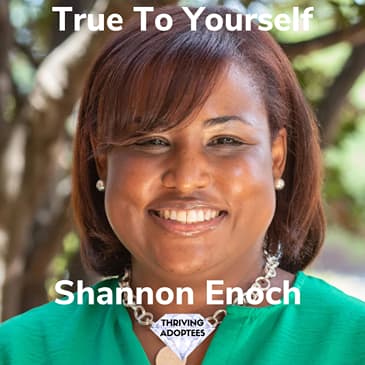
What does being true to you mean to you? Listen in as adoption professional Shannon shares her insights on stopping pleasing others, authenticity and more.
Find out more about Shannon and the organisation she works for here:
https://www.linkedin.com/in/shannon-enoch-ma-lcmhc-a6bb93123/
https://www.linkedin.com/company/chs-nc
https://www.facebook.com/CHSNorthCarolina
https://www.instagram.com/chs_nc
Guests and the host are not (unless mentioned) licensed pscyho-therapists and speak from their own opinion only. Seek qualified advice if you need help.
Want to learn more about thriving for you, your kids, your families or your colleagues? Pick a time to talk here
[00:00:02] Hello everybody, welcome to another episode of the Thriving Adoptees podcast. Today I'm delighted to be joined by Shannon, Shannon Enoch from North Carolina and I'm sorry listeners that you're listening to this, you're not seeing Shannon's beam, right? This smile that she's got is electrifying and very captivating. So I'm sorry that you can't see it.
[00:00:29] So what you're going to have to do is you're going to have to look at the show notes and then hopefully the picture of Shannon on there will be as illuminating as it is now. So Shannon, you started off as a therapist, right? But now you run, you kind of over foster and adoptions in the Children's Home Society in North Carolina. So I'm really looking forward to our conversation with a great chat last time.
[00:00:58] I am too Simon Benn, thank you for having me. You're very welcome. You're very welcome. So, yeah, Enoch's normally a Christian name in the UK rather than a surname. Same in the States, right? It has a biblical derivative in the States, but yeah. It's my last name by marriage. All right. Okay. So what were you before you were an Enoch? I was a Johnson.
[00:01:25] Johnson. Okay. Well, Enoch's got a bit, Enoch's a bit more unusual, isn't it? Definitely more unusual. Yeah. Yeah. Which describes me. Yeah, indeed. Indeed. Yeah, for sure. So the big question that Shannon, thriving, what does thriving mean to you? I think for me, thriving is living your best life and being your best self authentic to whoever that is for you.
[00:01:52] Not just, you know, getting by and doing what everyone feels like you should do or making decisions or living your life for other people, but really doing what is best for you and living your authentic life, I think is thriving for me. Yeah. So it's very much an action thing, right? It's a doing thing for you. Yes. Yeah. So it's about what you do rather than how you feel. I don't know. You know, so that's interesting. I think it can be both. Right.
[00:02:20] Because I think authenticity. Right. I think a lot of times we do, but we feel differently. So I think the two are connected. Yeah. Okay. So authenticity then. What, what is, what's that about for you? What, what does that mean? Yeah. I think, you know, what I've learned in my many years, I think both professionally and personally is that we often do things to please others. And we, we change ourselves.
[00:02:48] Or we dim our light or we show up differently to make sure that everyone else is okay. But as I approach 50, I think that what I have learned, and I tried to apply this to my work and to my, to myself personally, is that it doesn't like, I'm going to be respectful of others, but at the end of the day, I have to be okay. And I have to be right with Shannon and in right relationship. So I have to say yes to the things that give me light.
[00:03:11] And I also have to say no to the things that don't and that others, I can explain and offer, you know, that I'm sorry, I can't help you with that, but that's okay. Yeah. And I think also professionally, it's the same thing. I think a lot of the families and people I've worked with, they do a lot of people pleasing and things to appease others, you know? Yeah. Yeah.
[00:03:28] I think one of the challenges with adoptees is we, we take on, we, yeah, we, we think that a lot of what we do is adoption related, when often it's human related. Yeah. Yeah, I would agree. People, people, people pleasing.
[00:03:50] Oh, well, you know, when anybody says to me as an adoptee, I think, yeah, I know kind of, this is, this may be leading down a track. I guess the alarm bell goes off, right? When I say the word as an adoptee, I think, is this person going to share what is, what is kind of human? Or is this, is it going to be adoption, adoptee specific?
[00:04:19] Is it going to be, yeah, is it going to be, is it going to be tricky? And, and how, how do we disentangle, right? How do, how we, how do we disentangle what is adoptee specific and what is human specific, right? It's, it's, it's, it's. Absolutely. And it's a bit of a rabbit. It can be done a bit of a rabbit hole. Yeah.
[00:04:49] No, I agree. I mean, even in, when I was doing full-time therapy, what, most of it at CHS has been post-adoption therapy. But, um, even helping, you know, in the family therapy realm of it, helping parents kind of understand what's going on with the youth in which they've adopted. Um, a lot of times they would, you know, kind of be projecting it towards because they were adopted because of the trauma. When a lot of it was normal adolescent, Simon Benn, it was because they were human and they're 13. Yeah. Yeah. Or 16.
[00:05:17] And developmentally, this is appropriate and what they should be doing. Yeah. I mean, there are some complexities, right? With the adoption lens. But to your point, a lot of it is just humanity and developmental processes and where we are in life. Yeah. But we know more about what's going on within ourselves, don't we? Yeah. Absolutely. So, and we know a lot less about what's going on with, with, within others. Um, yeah.
[00:05:46] And what, uh, this is a, uh, uh, perhaps a strange question to ask, but I've started so I'll finish, right? Um, why does it matter knowing whether this is an adoption issue or it's a human issue? Does, well, why does it matter? Does it matter? You know, I think it depends on the person who's looking for the answer.
[00:06:09] Um, I think, you know, there is some power in knowing where this is coming from for me and what's bringing this up for me. But I think, to your point in the adoption arena, we often do want to, to like put things in nice little neat little buckets, right? Instead of like, let's just talk about what's going on. We can talk about the impact specifically if that's helpful for you. Um, but I do think sometimes for adoptees and for adoptive families and birth parents, even like we do have a way of wanting to label things. Yeah.
[00:06:41] Um, I often think about the, the, um, the, the, the, the, the loss or, or the, uh, you know, the confusion or the loss, you know, like when my birth mother wasn't there anymore. And that's, that feels like, um, a feeling thing. It, it, it feels like a, a feeling thing. Yeah.
[00:07:08] Whereas this, this idea that we're not, I'm not good enough or we're not good enough as adoptees because we were given away. I, I, um, that seems to be a belief thing. And so on one hand, you've got, we've, you've, you've got something that's, we've got something that's very visceral. Right. That I can't remember. I've got a few years on you.
[00:07:37] I'm, I'm 59 and even at your, I think, did you say 46 last time? We, we spoke. You're very down. 48. Sorry, 48. A couple of years out. Um, so even at 48, I didn't remember losing my birth mother or how that felt like when I was four weeks old. Right.
[00:08:03] So it was, one's very visceral, that loss that I can't remember, but it must've been visceral at the time. Whereas then on another hand, you've got this idea that, or I had this idea briefly that she, she didn't love me enough to keep me, which is a, is a feeling. It is a, that's a thought thing.
[00:08:33] It's not, it's not a feeling thing. Yeah. Yeah. I think it can be both though. I think it can be a thought. I think there can be feelings too, to your, your point, you were four weeks old. So at the time you didn't have the words, there may have been an emotion of, cause you in utero, like the smells, the sound. I mean, there's lots of scientific proof around that, the voices that you can hear in utero. And then for that to be missing from your environment, but at four weeks old, you don't have words to express what you're feeling. But I do believe, and there's science that proves it too, that all that can be stored in our bodies.
[00:09:03] I think too, one of the things in the adoption arena that we don't give precedence to is kind of what the grief and loss. Adoption is formed out of loss. That's just the reality. Not to say that it can't be for the best intentions, not to say you can't have a good experience, but adoption, no matter how it enters, whether it's through a foster care termination or whether it's through a relinquishment and a plan of a birth parent to place a child, it's, it's grounded in loss. But a society, it can be a happy thing and it can be a great thing.
[00:09:32] We tend to lean heavy towards the celebration and the happiness and we don't embrace the grief and loss that it's rooted in and give place to that and voice to that. Even if you think about birth parents, we often say, well, you made this decision, it's time for you to move on with your life. That's a huge loss. Yes, it was the decision I made for good reasons, but it's a huge loss for the adoptee, the loss of a parent. And maybe you don't have the story of why it happened. And that's a loss. I think if we could acknowledge that more, you'd have more precedence to that. Maybe the unspoken feelings that you don't even know what they're about.
[00:10:00] But until we can do that, I don't know that we make a lot of progress there. I think we just kind of skirt over that piece that is grounded in loss. Yeah. Did you were last time when we spoke, did you mention this word or this phrase was disenfranchised grief? Yeah. Yeah. So is that what you're explaining? Yeah, absolutely.
[00:10:23] You know, that it's expected that it's not something we're going to talk about or that it's really rooted in anything like it's not something we can dwell on or talk about because, you know, adoption can be a blessing and it can be a happy thing. But again, there's the loss piece of it can be and in both, I guess is where I'm coming with that. And that's where the disenfranchised piece comes in. Yeah. So putting, well, what's the next question? I think I could.
[00:10:53] Because, you know, what do we do with, when we think of grief or enfranchised grief, you know, like I can think of the first time I lost somebody clear to me, to me and my adopted family was my grandfather's family. My grandfather, my dad's, my adopted dad's dad, my dad's dad, when I was about seven or eight or something like that.
[00:11:24] And that's grief that we can kind of remember. I can remember the moment. I can remember how I felt. I can remember crying. And then that gradually, that heals. Yeah. What about disenfranchised grief?
[00:11:47] Are they, what have you learned about the different ways that that heals? Yeah. I think the first thing is acknowledging that it exists, right? I think we don't give space for, for adoptees. Again, anyone in the constellation, adoptees, adoptive parents, birth parents, to really have space to say, and to give, not only to give space to feel it, but also to name it.
[00:12:14] That it's grief that you're feeling. And to make that okay. And to validate it and a normalcy of that. And let's talk about it. I think that's where the healing comes. And it's going to be different for each person. And everybody's not going to be in therapy for it for three years either. And talk about it. Some people just need to label. I mean, think about there are other, even outside of the adoption, or there are other things in your life that you can probably think about if that was really hard, but I don't know why it was hard. But just having space to kind of sit in it and figure out what's going on and then to name it. And it's okay to feel the way that you feel.
[00:12:42] And I don't think that in our adoption community that we really call out disenfranchised grief or grief at all, all very well. And like, let's just sit with it and it's okay. And how would you like to move forward with this? Yeah. There's a tension here between how the adoptee may be feeling or any child may be feeling and how the parents feeling, right?
[00:13:09] So I often hear parents say, and my mum has said this to me, right? We just want you to be happy. We just want them to be happy. That's all I want for my child. I just want my child to be happy. Right? And I'm thinking that there's this tension here because the parents want us to be happy. But if you've got this disenfranchised grief going on as a kid, right?
[00:13:40] And it's dragging you down. Yeah. Then there's a tension between what the parent wants and what the kids feel is, right? Yeah. And again, I think that's why it's so important for the education piece of it, for parents and for kids. Because, and there is, there's an allegiance.
[00:14:00] And, you know, not all, but the majority of the adoptees I would say that I've worked with had great adoptive experiences and are, you know, very thankful that their birth parents made the decisions that they made and they had great lives. But a lot of them talk about kind of this pool of curiosity or wondering that, like, what is my story and how did this all start? And, and or like, you know, you hear a lot about adoptees who wonder, is there anyone that looks like me? Or if they ever reconnect having someone, not that I wish I would have had a different life, but it's just that connection point and that wondering.
[00:14:30] And I think for adoptive parents, it comes out of a good place, right? Like to your point, they want their kids to be happy. They want them to be healthy and settled. And if we're honest, there's probably a little bit of fear there too, right? If we talk about this, what does this mean? Because I see you as my child. But again, I think it can be and both, right? You have two families. How blessed are you? Yeah.
[00:14:51] I think the challenge without the education piece that you're talking about is that the parent who wants their kids to be happy can be in danger of invalidating their unhappiness. Right? Yeah. Yeah. And that means that you don't feel understood. Yeah. Yeah, I agree.
[00:15:16] And I think, you know, I think about, so I've been doing this work now for 22 years altogether in the adoption specific arena, longer for therapy. But I think about when I first started and where we are today, I think we're more open and having conversations earlier as people are coming to adoption agencies and foster care agencies and they're doing placement assessments and talking about the process.
[00:15:38] And I think about that, you know, I think about the reasons why birth parents may make a plan of adoption. And, you know, it used to, everything used to happen in secrecy. I have some of my mentors at our agency talk about there used to be a time where they would separate like everybody had to come at different times. So no one saw what they were, each other were driving in the license plates and they were in separate rooms. And, you know, nobody needs to intermingle and see each other ever.
[00:16:06] Like even the foster parent and the adoptive parent, it was kind of this cloak of secrecy, which secrecy kind of, you know, kind of those some big question marks and fear. Right? Yeah. Yeah, for sure. This human, this human need to be understood is so big. I mean, that, I'm thinking back to how we started off, you know, I think so.
[00:16:36] The need to people please, oh, that's an adoptee thing. The need to be understood, oh, that's an adoptee thing. No, like the need to be understood and understood rather than invalidated. Yeah.
[00:16:54] You know, I can think of one moment where there was a kind of a little bit of a clash between the way that I felt and what my mum said. And it was just one occasion, right? So it kind of sticks in, it sticks in my mind.
[00:17:18] So, yeah, I, I, I'd been, I'd been knocked over by a very slow moving car, like doing about five miles an hour. But I didn't see it. And, and I went, I went, I was 10 and I was not, not knocked down. And there was no big, I had a bit of a bruise, but nothing really bad. But, you know, when I said to my mum that I'd told her mum what had happened and she said, oh, you, you silly thing or something like that. And I thought, well, I didn't do it on purpose. Do you know what I mean?
[00:17:47] Um, but that kind of sticks out as the one time where my mum kind of challenged my thinking or challenged my behaviour or, uh, or, or how I was feeling. And I, and I found that quite, I found that quite tricky in the moment, which is probably why it sticks with me like 42 odd years, 42 years, years later. But, um, this, what, what have you learned about that need to be understood?
[00:18:18] Yeah, I think that transcends again, even, I think it's just human morality, right? I think we all are striving to be understood in whatever environment we are. We are, again, I do think it's more convoluted probably for, um, people who have been adopted because there's different layers. And again, I think the biggest piece, a lot of people don't know their story, right? They don't know why they were placed. They don't know a lot of information about their birth parents.
[00:18:42] Um, you know, as adoption has gotten a little bit more open or identified in various states, uh, internationally and in the United States, I think some of that is evolving. But yeah, just, I need to know who I am. I need to sort. And then too, for, for individuals who have been adopted, whether it was through the foster care journey and then termination or relinquishment, there's a lot of what I've especially, I work with specializing a lot of young kids. I started my career working with older kids and then transcended to the little ones.
[00:19:08] And what I've learned, um, is that a lot of the young ones have lots of feelings and emotions that they can't really explain and put words with because all this stuff happened pre-verbalization. Right? So it's kind of like, I don't know what this is about. It's in my body, but being able to tell that story to your point, to be understood and to be seen. And for me to understand myself can be so healing. Yeah. There's a challenge here, right? About that authenticity thing. Right?
[00:19:37] So what, what thriving means to, to, to, to you Shannon Enoch, right? That authenticity. And then this, this lack of clarity around identity, uh, that, uh, that some adoptees feel. Um, how, how do we, how do we minimize that? How do we tackle that? How do we heal that?
[00:20:06] What do we do with that? Yeah. Again, and I know it keeps saying the same thing. I think it's around openness and communication. I think for years we didn't talk about these things, right? Like you were, you were adopted. We did that. We'll have a, you know, celebration day on your, whatever you're on gotcha day or adoption day, whatever. Every family calls it something different and then we move on, right? This is our family now. But again, let's have conversation. How are you? And that may change.
[00:20:30] You know, you may have different thoughts and feelings at seven than you do at 14 or 21. Or I hear a lot of adoptees talk about too, that as normal things happen in their life, like they get married, they have their own children, that some of these things that they thought that they were done with or had processed and put away, like come back up. Right. Right. But it's just about making space for conversation and normalizing. There's nothing wrong with you to feel this way. Let's, let's just talk about it. Yeah.
[00:20:58] I, I, I, the, the, the nothing wrong with you piece. Um, is, is, is huge. Right. And I think feeling stuff we, we'd rather not feel makes us think that there's something wrong with us. We're, we're, we live in a world that is kind of emotophobic. Yeah.
[00:21:28] And, and, um, I wonder what you've learned perhaps from, from, from parents, from adoptive parents around this normalizing of tricky feelings. Yeah. Yeah.
[00:21:49] What I've learned most from families and what I've seen be most successful, I would also say in family units, it's just a level of like discussion, even when things are not said, uh, you know, Simon, it looks like you're a little down today. You know, what is that about? I want you to know, you can always come and talk to me and mom, because it could be something about your adoption. It could be that Billy was really bad at school today or bullied you or just said something that was mean. It may be nothing. So you don't want to overly focus either on the adoption lens. Right.
[00:22:14] Because that may not be, it may just be normal childhood development or something that happened, but just openness and that, you know, we're not going to judge you or preach to you, whatever you're feeling and that we're, we're adults and we're going to handle our feelings. So you don't need to take care of us and worry about us because I think there's also this for a lot of, especially, well, and I think adult adoptees too. It's not just younger. I was going to say younger, but that's not it either. You don't want to disappoint and you want your parents, your adoptive parents to know that you love them and you appreciate them.
[00:22:43] And I think about my birth parents sometimes, but they worry sometimes that, you know, that may be disappointing or hurtful to their parents. I've heard from, we have our lifelong post adoption program here at CHS where in the state of North Carolina, if a adoptee wants to get, you know, you can get background information, but also the law now allows for if an adoptee or an adoptive parent or I'm sorry, a birth parent want to connect with each other. And I think that's a lot of adoptees.
[00:23:09] And I think that's a lot of adoptees, and I think that's a lot of adoptees, and I think that's a lot of adoptees who wait until their adoptive parents have passed away because they were, they didn't want to disappoint or hurt their feelings and their desire to know more about their birth family. Yeah. Which is interesting and fascinating to me. Yeah. Well, it's the, it's the fear of hurting. Hurting. Yeah, absolutely. And that's one, you know, that's, that's what I did.
[00:23:35] Well, I didn't wait till they, I didn't wait till my, my parents had died, but I kept it very quiet. I didn't tell them much about what I was going on until I kind of come out the other side of it.
[00:23:48] Um, what, one of the things that I find fascinating is around, uh, modeling, modeling, uh, sorry, parents modeling things for their kids like this. Yeah.
[00:24:10] Like this, okay with bad feelings and being vulnerable enough to say, look, I sometimes feel bad too. Yeah. Because otherwise if, if we, if we think our parents never, ever feel, feel, feel bad them themselves, we think it's, it's bad for us to feel bad. Right. They, they, they don't normalize feeling bad.
[00:24:39] And, and I think that, that, that adds to this kind of emotophobia in the broad, in the wider world, in the wider world. Um, so what have you learned around modeling and vulnerability for any adoptive parents that may be listening to this? Um, I, I think it's very important. I think that just having the trick, it's a feel like they can come to you, um, and talk to you about anything.
[00:25:09] And that's not just something that a kid just wakes up in the morning and is like, oh, I think I can go talk to mom and dad about anything. But it's something that you say verbally and that you, and, and not only do you say it, but you also show it right. Right. That sometimes, you know, kids and, or, or, you know, close relations desk can tell us stuff that's really hard to hear in the moment, but you got to control some of it.
[00:25:30] Because the reality is, if you say you can come to me for anything and I come to you with the first hard thing and your face is utter disgust or shock or like anger, the likelihood of me coming again is pretty soon. Yeah. So, you know, a creating a open environment saying that, but also having your own support system. What do you do with that? Because as a parent, that's hard sometimes, right? And it's big and I may need to go back and process somebody with that. I think also, to your point of them modeling that they have feelings and also like having emotion language.
[00:26:00] Most kids, what I've learned along the years is they know sad and mad. All the other ones aren't always known to every family dynamic, right? So I think, you know, giving language to that. I think also, you know, verbalizing, you can have two things at the same time. As it turns out, you can be sad and happy at the same time. That's okay. I call it double dip feelings when I was doing therapy and talking about that and modeling it and giving examples as a parent when you felt that so that the child feels safe and that you are a safe space to come and talk about that.
[00:26:28] I think also as parents, we assume that we have to have all the answers to all the things. Often we do not, especially about the birth family story. But saying that, that, you know, I don't I don't know what to do with this or I don't have the answer, but thank you for telling me and we're going to figure it out together. Yeah. I'm thinking also about that modeling thing when it comes to uncertainty or not knowing. Right.
[00:26:57] So we have to admit that sometimes we don't know either. Yeah. And that sometimes that causes challenges for us rather than making that not knowing thing bad.
[00:27:17] You know, like, and when I think about this, it's a bit of a jump really, but you don't, when they, when a news, when an interviewer is talking to a politician, the interviewer is trying to put pressure on the politician to admit that they don't know. Yeah.
[00:27:42] So, because not knowing if you're a politician and you're supposed to be in China and you don't know, then, you know, they, so they, they, they, they're trying to, not knowing, not knowing is kind of as bad as bad feelings. Right. That's the society that we, that, that we, that we, that we work in. Yeah.
[00:28:05] Let, let me broaden it out in terms of adoptive parents that may be, may be listening to this Shannon. You've, you've said, time and time again, the communication, the, the openness, the acceptance, the okayness with how our kids are feeling.
[00:28:32] What, what do you see as the other kind of drivers of our kids thriving? Yeah. I think some of it goes back to identity. I think that life is complex, but how our kids identify and see themselves and being open with that. And knowing, you know, it may not be representative of who we are as a family or individuals, but that, that's okay. And that we can seek to understand each other.
[00:29:03] And I think in the adoption arena, we have to also remember that genetically, the reality is we don't have the same DNA and there may be some genetic creatives for lots of, you know, like, you know, I don't know. Ideas are wanting to pursue something or, you know, it's very interesting to me when people reconnect and like they have similarities and music interests like, or that they, it's, and I don't know that there's a DNA marker for some of this stuff, Simon.
[00:29:27] I mean, I'm not trying to be super deep, but it is interesting when you look at generations of things, but just seeking to understand and not judge, I think would be a good predecessor for that, for the openness level of that. I don't know if that answers your question. Yeah. Yeah. It's the curiosity thing, isn't it? Yeah. It's, it, it, it, rather than judging is getting curious, you know, if I remember rightly, when I looked at your LinkedIn, you'd done the TBRI.
[00:29:57] Yes. Is that right? Yeah. And I think they talk a lot about curiosity, being curious about our kids' behavior, feelings, thoughts, rather than running. Yeah. Yeah. Yeah. Yeah. Staying open and curious and, you know, what is that about? Or, you know, let's learn more about that. Or I would like to learn more about that. Can you tell me more? Because, I mean, think about it.
[00:30:25] Even as an adult, if someone comes to you and tells you, Simon, this is wrong, you shouldn't feel this way, you shouldn't think that, that's the end of the conversation. Let's be real. Yeah. I have no desire to talk to you any further. Yeah. For sure. The, when, because I've spoken to quite a few people who have done the TBRI training and everybody talks about how fantastic it is and how enlightening it is.
[00:30:51] And a lot of people have said to me that they went to TBRI training thinking that what they were going to learn about was the kids, but, but what they actually learned about. Was themselves. Was about themselves. Yeah. Yeah. I think, you know, that was a facet within just my therapy practices general when families would come to me and generally speaking, I mean, people came to therapy, to be very honest, there was a problem or an issue, generally a behavior that was annoying or troublesome to the family.
[00:31:21] And I used to always say, I can't fix kids. And I don't fix kids. What I can help is join with your family to talk about how you guys can communicate better. And for you to understand, as it turns out, you can't make your children do anything. What you can change is how you see behavior and emotions and how you respond. Because we, as at the end of the day, we can only control ourselves. And I think that's some of the facets of TBRI is taking a look into who we are and why am I having this, this reaction? Why do I feel like, why is this so troublesome?
[00:31:50] Or why do I feel like this isn't that? What is that about me instead of always just looking at the other person and how we fix it? Does that make sense? It does. It does. And it echoes a theme that keeps on coming back on the podcast, which is raising adoptive parents. Sorry, raising adopted kids isn't about fixing them. It's about our growth.
[00:32:18] When I say our, I mean, adopted parents growth. And so, and I would go a step further than that. I would say, well, it's not about fixing us because we're not broken, right? Right. We aren't broken. We just have tricky feelings that drive tricky behaviors. Right. So that's it. But we're not, we're not broken. So you don't need to fix us because we're not broken. You just need to understand this.
[00:32:48] And you also, you need to understand yourself a little bit better. But clearly that team, you know, doing the TBRI training, it's a big, a big undertaking and not one that most adopted parents would, would have the, the time or the resources to do.
[00:33:05] So what have you, what have you learned or what do you advise to adoptive parents in terms of understanding themselves better and facilitating their own growth? If it's not about fixing them, fixing the kids. It's about their growth.
[00:33:31] What, what pointers have you got in terms of for adoptive parents listening in terms of their own growth? Yeah, I think, you know, a, I think finding a, a community of support, whether that be therapy or I think finding a good support group of adoptive parents. I think a lot of times adoptive parents are looking for support and they may be asking their family of origin who have no concept of adoption necessarily other than their experience.
[00:33:58] And some of the information, although, you know, our families are family and we love them or our friends are, or our friends, sometimes it's not extremely helpful because they're not grounded in our reality of what we're experiencing. So I think, you know, engaging in a support group and those are everywhere, you just have to look for them. But people who are experiencing the things that you're experiencing so that you can have shared community and you feel seen and heard, right?
[00:34:20] I think being connected to a good therapist, but not just, I think there's a difference in a therapist and an adoption competent therapist. You know, Case out of Maryland does a lot of the, the TAC training and training people to be adoption competent. And I've heard from many adoptive families over the years that they've been through therapy many times for themselves and for their children, and it has not been extremely helpful. But I think finding a therapist that is adoption competent and is also a good fit for you.
[00:34:47] I think the other piece is just normalizing that it's okay to not be okay and normalizing that it's okay to ask for help. I think adoptive parents are some of the most amazing beings that I've ever interacted with. There's so many strengths there and they do so well in taking care of not only their children, but others. I've generally found them to be givers and helpers. They don't always do such a great job of taking care of themselves, Simon, or asking people for help. So I think, you know, just reaching out and saying that I'm struggling here.
[00:35:16] I need to talk about this and that to know that that's okay and that you're not alone. Yeah. Well, one of the things that we, you know, we talked, you've talked to, we talked about earlier on about pre verbal, pre verbal, pre verbal trauma of, for adoptees placed relinquished, removed.
[00:35:37] One of the things that, again, we come back to on this podcast again and again, is that talk, talk therapy isn't great, to put it mildly for pre verbal trauma. Mm hmm. And so, you know, we have to look at other things, you know, like other modalities, EMDR and somatic kind of approaches.
[00:36:05] Can you talk a little bit more about that, Shannon? Yeah. Yeah. I think for young kids and kids who experienced, even older ones who experienced trauma or placements prior to pre verbal. Yeah, you're asking. I have a funny, I remember sitting in a room in a living room with the family doing family therapy and it was a six year old and they kept saying just tell us what you're feeling. Tell us what you think. Why did you do that? And he kept saying, I don't know. I don't know. And like this went on and I was like, I think we need to get present with what he's saying.
[00:36:34] I believe him. He really does not know. And it's kind of like, has anyone ever asked you something that you truly didn't know the answer to near to the point you just want to bang your head on the wall? Like that's what we're doing to him at this moment. He truly does not know. Let's, let's see more broadly. But yes, I think, you know, sometimes you're not going to, especially. The story is not being able to told, I think sometimes pre verbally, if you have the story, you can fill in the gaps of what happened to me. Right. And giving some, some, you know, framework to that, but sometimes it's not going to be still going to be unknown.
[00:37:03] I think for little kids when that happens, there's the child parent psychotherapy or form of play therapy that you can play out what you're feeling right. For older, I think, you know, EMDR, even, you know, some of the relaxation kind of techniques and whatnot to cope with the feelings and the body sensations, because you need to figure out how to cope and move beyond. Right. Because we don't have the words to fill in all the things. I think. I think. Therapy doesn't have to be a one.
[00:37:34] And stop shop or one modality. I think playing, educating yourself and playing around to what fits right for you. I always say I'm a collective in my piece. I am training a lot of different modalities and EVPs. But the reality is that none of my families and children that I've served have the books and the training that I have. So we have to together decide what is the right pathway for you? Yeah. So it's a personalization of approach. Yeah. Yeah. Yeah.
[00:38:00] Well, we, people talk about the EMDR. You know, I think about somatic stuff as well. And, you know, I think about kids and energy and playing football or little league baseball or soccer or, you know, swimming, running track.
[00:38:23] What, what, what other things help with the somatic stuff? Again, I think there isn't a one stop shop for that either. I think it depends on the child and TBR talks about this a lot too. Sometimes it may be, it may not even be a, it may be a sensory issue, right? The child is overstimulated in some way.
[00:38:45] And we need to figure that out through, you know, some PT or OT of what we can do to help that child to kind of, you know, be able to have a balance, right? And not feel dysregulated in their body to have a sense of regulation. For other kids, it may be that I have this excessive energy and I don't know what to do with it. And, you know, maybe we look at a recreational activity or some type of team sport or something to help with that. For other kids, it may be an artistic endeavor.
[00:39:13] I think it's really, it's going back to what we talked about before, Simon. It's being curious and going back to that, whether it's an adult, an adoptive parent or a child and seeing like, what's going on now? Let's talk about that and figuring out what is the right avenue for you, because it's going to be different for everyone. So the curiosity is, is almost like problem solving and following breadcrumbs to get to trial and error, right?
[00:39:44] Experimentation. Yeah. And I think too, you know, I'm big on too, joining with people. I don't want to ever tell you what Shannon thinks that Simon should be doing. Like it, that should be itself like, I can join with you and be your guide to that. But I think some of the best stuff that I've seen happen in family dynamics and individual counseling is when you come to that reality on your own of this clicks, this works for me. Right. And that you are not being told to, but you're exploring for yourself and figuring it out. Yeah.
[00:40:15] So kind of more alongside coaching kind of approach. Is that what you? Yes. Yes. And then I would also say to adoptive parents, especially in the, in the arena of children, trauma happened pre-verbal or placement happened pre-verbal. So I do think there's also, I've learned over the years, having a good doctor, a developmental pediatrician or a doctor too. There are some physical things that could be going on too.
[00:40:40] And TBR talks about that too, that may be happening, that may have nothing to do with trauma or the adoption process itself. There could be other things. And I think oftentimes we don't, we don't do a thorough assessment of all the things, right? We just want to assign labels too. Yeah. Yeah. Labels are tricky, right? Yeah.
[00:41:05] And, and as it turns out labels, honestly, I mean, I guess for billing purposes for therapy and medications, like you need them sometimes, labels don't fix anything. Labels don't make problems or issues or feelings any smaller. And don't labels get in the way of authenticity as well, right? Yeah. Yeah. Yeah. And you're not, I mean, one of the things that stick out in my head is a 13 year old I saw years ago, we were talking and he'd been through a lot of therapists, bless his heart.
[00:41:32] And he said, Ms. Shannon, just read my chart. Don't you know what it had, I am ADHD and ODD. And like a light bulb went off in my head. And I was like, honey, that's not who you are. You are an a close name, but like, let's unpack that. That's, I don't know who told you, but that is not who you are. That is a diagnosis that someone has given you. And yes, you may take medication, but that is not who you are. But I think that's the tricky part and the harmful part possibly of diagnosis and labels.
[00:42:01] You know, that individuals come to see themselves as that thing. Yeah. And I've seen that at a, I've seen that from an adult adoptee who is also an adopted mother. I've seen a post from that, from her on LinkedIn that said, I am trauma.
[00:42:31] Hmm. I am trauma. So. But that's. But that's. I just think about, I'm just holding that. Imagine like life from the lens of that individual, that that's the way they see themselves and feel like others see them. Like that has to be heavy. Yeah. Yeah. It does. And that identification piece. Yeah.
[00:42:58] Is heavy and it's very sticky, you know, it's not, it's not going away. Isn't that? Is it? It's going to, it's going to take a big, it's going to take a big insight to break away from that. Yeah. Yeah. I think that's a lot of exploration, someone joining with you. I mean, you can do it yourself, but joining with you to help you unpack that. I just think we're all so much more than the circumstances that have made us.
[00:43:28] I mean, yeah, I am African American. I am a woman. I am a clinician. I am a North Carolinian, but that's Shannon is multifaceted. I'm not one thing. You know, you may have been adopted, but that's not all that you are. There's much more to you. I think, you know, we just need to look deeper and while labels can be helpful. They're not all inclusive. No. Are you a person of faith, Shannon? I am. Are you a Christ? Yes.
[00:43:56] Because didn't, didn't, did, was it, this is, was this the burning bush telling Moses, I am that I am? Have you heard that? Uh huh. Yeah. Yeah. I, I, and, um, I was listening to some, uh, a podcast, this, well, not, yeah, it was an audio book actually, but, uh, about that subject.
[00:44:21] And the, the, the guy, uh, Rupert Spire, uh, my, my kind of, my favorite teacher, uh, he, he said, you know, Moses, the, the, the burning bush, you know, that I am that I am. Uh, and he said, Popeye said it too. I didn't think about that. He's right. Yeah. I am, I am, I am that I am and that's all that I am. Yeah. Yeah. Yeah. So the I am is.
[00:44:51] Yeah. The I am is who we, who we are. All the rest is labels. Yeah. Yeah. Yeah, absolutely. Yeah. Again, I, I really think it just goes back to conversation and dialogue and accepting of the people where they are and who they are. And you may not be all the way there. You may not have it all figured out. And that's okay. I think it's the and part. And, and don't we find it hard to accept trauma?
[00:45:21] Yeah. Aren't we, aren't we running away from it? Aren't we trying to suppress it? Are we trying to deny it? Aren't we trying to pretend it didn't happen? Aren't we like all of those things that we, we, we're trying to do. Oh, absolutely. And when acceptance, like, so how do we live with trauma? We live with trauma. Yeah. Yeah. Yeah.
[00:45:50] We don't, um, I'm thinking of a really cheesy song from the eighties. Is that went something I can't fight this feeling anymore. Right? Okay. Yeah. I, I just, I think it's foreigner. I don't know. I've heard the song. I'm not sure who sings it yet. Yeah. Okay. Um, do you know why foreign is called foreigner? No, I do not. Cause the lead singer was a Brit and the rest of the band were American. Interesting. Yeah. Yeah. Okay. Interesting. A useful poetry.
[00:46:18] And, and, um, I'm going to find out later on that the, the, the, they didn't sing the song. Right. But anyway, it might've been Chicago. Right. Or Peter Satira. Right. Um, I can't fight this feeling anymore. Right. Well, I can't fight this trauma anymore. Yeah. Yeah. Well, who said you had to fight it?
[00:46:45] Well, and I think trauma too, you know, one of the other things I've learned is that I think, and I think it comes out of a good place. I don't think it's out of like a, you know, be done with this. But I've found over the years, a lot of adopted families struggle sometimes with, yes, that bad thing happened to you. And you've now been in our home and part of our family for the last 10 years. You should be over that. But trauma is a tricky thing. You can think that you've unpacked it. You talked about it, you dealt with it and you can sneak back up. It's like grief. Um, I mean, you know, I can remember, uh, my grandmother passed away when it's been,
[00:47:14] it's gotta be 15 years ago now. And this happened last year. I was driving, I drive a lot for work cause I cover the whole state of North Carolina and I was driving and I think a song came on the radio. And then before I knew it, I started thinking about her and I was bawling in the car and it was kind of like, after I kind of like I had the cry, I was like, where'd that come from? I mean, she passed away years ago, but she just like, you're never done with it. It's, it's, it's sneaky. It sneaks up sometimes. Yeah. Even though you've processed it and you've dealt with it, you know, grief and trauma,
[00:47:43] I think are just sneaky. Right. And you never know. Sometimes they just show up. So being able to identify that. I'm guessing you don't fight the feeling anymore. No, no, I let myself feel what I, I mean, I'm not going to say I'm always great at it. Um, but no, I don't fight the feeling. I let myself feel the way that I feel and I'm unapologetic for it. And I create space when I need it. I mean, another, you know, personally, my father passed away at the end of January.
[00:48:11] Um, and then he had been sick for the last two years. It wasn't, we knew that death was likely he was in hospice care, but I will say, even though it was an expected death, it was harder than I ever thought that it was going to be. Um, and I can remember telling my husband, we still have these conversations that sometimes I just need space. Like, I don't want to talk. It's not anything personal against you, but I just need to sit with my feelings and I'm okay. If you want to call anybody, but I need to sit with this. Where, where do we get this idea that we have to fight our feelings?
[00:48:42] I think to your point, um, earlier in the podcast, I think we've been, you know, in our society that we have to be okay and that we should always be happy. Um, and happiness is like equaling success. Um, and that, but the reality is life is hard. Sometimes life is sad. Life is big sometimes, and we're going to have a multitude of feelings. And it's okay. But I think we all want to be sure that everyone sees us as being okay. And we will.
[00:49:10] I think we also have a desire to make sure others are okay and taking care of others. Well, most of us do. Um, but yeah, I think we just need to normalize like to your point, not fighting the feeling living where you are and, and that's okay. And if you need to live there for a couple of days until you feel better, that's fine. Okay. Yeah. Um, when we get near this topic, I often think about when somebody is angry and somebody
[00:49:39] else says, Oh, you seem to be angry about this. Then the person that is angry gets even angrier whilst saying that they're not angry. Yeah. Yeah. Yeah. I think that can be, be true. Um, but I think it's in that case, it's the, I think what there's also a pressure that we need to explain ourselves to others and that we need to, I need to tell you why I'm sad.
[00:50:09] Like my example of my dad, I don't want to talk about it. It's not that I'm pushing down or hiding anything, but I'm still figuring all this out. It's pretty new journey for me. I never like when I need to talk, I'll let you know, but I don't need anything right now. And I think we feel like sometimes we owe people an explanation for that. And that can elevate whatever current, like if you're angry, make you angrier because it's, it's this old that something may be wrong with me or that I have to explain or validate to you why I feel angry. Yeah. There's something wrong with me.
[00:50:37] There's something the wrong feeling wrong makes me wrong. Yeah. Feeling bad stuff makes me bad. Yeah. Yeah. Yeah. And I, you know, and I see that a lot too, with adoptive parents that I've worked through the years too, that not having the answers makes me, you know, not a great parent or I'm not doing this right because my child is acting in this way or they're feeling in this way, but we're not responsible for others behaviors or needs.
[00:51:04] We can join with them and help them, but like we're all doing the best we can, Simon. Yeah. Life is hard. Parenting is hard. Yeah. We're coming up on time. Shannon, is there anything that you'd like to share that I've not asked you about in terms of this thriving thing? No, I just think, you know, people, especially, you know, adoptive parents and adoptees really kind of doing a self assessment of where they are and what they may need.
[00:51:33] And, and, you know, I hope this has brought some encouragement that you're okay with no matter what you feel or who you are, what you present with or what you're going through and to reach out. And I think sometimes we get stuck when we try to figure it all out ourselves in a silo. Like there's a community internationally here in the United States, reach out to your community and figure out where your fit is. And if you can't, I'm sure there's lots of resources. I know there's resources on our website. I'm sure you have some on the podcast. There's things, people and experts out there who can help in different bodies, but don't, don't do this alone.
[00:52:03] I don't think you can do this alone. No. No. Thank you, Sharon. It's been an absolute pleasure. Thank you, Simon. Thank you, listeners. We'll speak to you again very soon. Take care. Bye-bye.