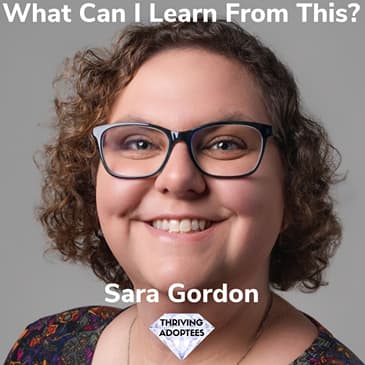
What if life's trials and tribulations happen FOR us not to us? What if the tough stuff happens for us to learn? Life feels easier from that perspective. What can I learn from this is a question we can ask to take us back to a more empowered place. Listen is adoptive mother Sara shares insights on perspective, support and much more.
Find out more about Sara and the organisation she works for here:
https://www.linkedin.com/in/sara-gordon-7514374a/
https://www.instagram.com/mycasaep/
Guests and the host are not (unless mentioned) licensed pscyho-therapists and speak from their own opinion only. Seek qualified advice if you need help.
Want to learn more about thriving for you, your kids, your families or your colleagues? Pick a time to talk here
[00:00:02] Hello everybody, welcome to another episode of Thriving Adoptees podcast. Today I'm delighted to be joined by Sara, Patricia Meyer. Looking forward to our conversation, Sara. Last chat we had was so great and so yeah, been really looking forward to catching up with you today. I'm excited to catch up with you today too, Simon. Thank you for having me. Yeah, a wonderful smile. Sorry listeners, you're listening right? You can't see Sara's smile. But yeah, it warms my heart.
[00:00:31] So Sara is in West Virginia, the Eastern Panhandle. Last time I got confused with my panhandles. I thought only Texas has a panhandle, but West Virginia, you have a panhandle too. And it is the Eastern Panhandle to be exact, right? That's correct. You got it right. Yeah, I was a little bit embarrassed last time. That's why I'm making a big deal of it, listeners.
[00:00:56] More important than geography, Sara has two kids through adoption, that's right, if I remember rightly from last time, yeah? That's correct.
[00:01:05] So, and she works in West Virginia with CASA, right? She's the court-appointed special advocates. And as I said last time we had a CASA on the show, something from CASA, it's, we seem to have been a bit of a run of them. So a great organisation doing great work across the counties and states of the USA.
[00:01:32] So the big question that we like to start with, Sara, the thriving question, what does thriving mean to you? Oh, thriving means to me that you are able to be productive in your everyday life and have the skill sets to be able to go out and do things independently in whatever facet that might be.
[00:01:59] To me, thriving means that you know how to handle obstacles when they come your way and you have a support system behind you that you can rely on to help you navigate obstacles when times are a little bit difficult.
[00:02:16] Yeah, yeah. So you're clearly making the distinction, but you've got the internal stuff going on and you've got the external stuff going on too in terms of the external support that we can call on.
[00:02:34] I was at a conference last week in an adoption conference here in the UK and it, the support thing that you mentioned just then, it rang a bell for me because one of the challenges I think that seems to be quite,
[00:02:56] I don't think as human beings we can delay asking for support or we can ask help. It isn't just, it's a human thing, right? It's not just a parent thing, it's not just a social entrepreneur thing, it's not just a casa thing, it's not just a mum thing, just a dad thing.
[00:03:16] But it's not just an adoptive parent thing either. It kind of seems to be part of our, part of our humanity that we're a little bit slow for asking for support and help. I mean, that's kind of how I see it. I mean, what?
[00:03:35] Yeah, I would agree. You know, one of the big things that we focus on here at CASA is anytime we bring somebody in to train them, we talk a lot about how you're, our kids are only one caring adult away from breaking the cycle or, you know, having a positive influence and believing in themselves. But I think it goes bigger than that, Simon. I really think if we look at it and we go, we're all only one caring person away.
[00:04:05] You know, it doesn't matter what point in your life that person steps in. It could be in adolescence. It could be in your college years. It could be when you're 87. It only takes one person to show interest in you and to show that they care about you to make that difference for you to see that within yourself. And so I think you're right. I think a lot of times we get held up with, oh, I can do it by myself. I don't need anybody.
[00:04:32] But if you have been a part of this world, the biggest phrase, catchphrase they always say is, it takes a village, right? But sometimes it just takes one person and that's OK. So I think if we can let go of that thought process of I can handle it all on my own. Nobody's gotten where they are today without some sort of help, you know?
[00:04:54] Yeah. Why do you think we are slow to ask for help? Is it as simple as is it is it pride? I mean, what else? That's a really great question. I do think a lot of it is pride. I do think that we sometimes get stuck in just the daily monotony or the routine of like, you know, as a kid, go ask your mom or go ask your dad.
[00:05:22] So it's always kind of being pushed off on somebody else. And so we're instantly learning, oh, well, I need to do it for myself. Or everything you've been taught is to be able for you to be able to stand on your own two feet and handle the world by yourself. But that's not how the world works, or at least not in my in my eyes. We are supposed to be a village and help build each other up. So I think a lot of times it's just inherited in us as we and ingrained in us as we've grown up from a young age.
[00:05:52] Yeah. Yeah. I'm wondering about the cultures, the differences here, because on one hand, I'm thinking about the assuming there is no one British culture, no one American culture. Right. But this is the kind of that I'm talking clearly in big, broad generalities, generalities.
[00:06:19] American and self-starter seems to be a bigger kind of a bigger thing. And yet when it comes to the the adoptive parent view of perspective, it clearly there's no just one entity. You know, it does seem to be something that's that holds us back.
[00:06:45] Both both Brits and both Brits and Americans are a little bit slow on that. Is it when you're talking about the the routine and that and the I guess the routine and. The. The amount of things that people have on our plates, maybe it's just not seeing it as an option.
[00:07:08] We're so focused on the on the next thing, a broad, a bigger picture view or time to call somebody to do that. Maybe that's gets in the way, the practicalities of it, maybe. Yeah. And I think this sense of, you know, I'm supposed to give wholeheartedly to everybody else, but you can't you can't survive out of an empty bucket. And at some point you have to remember that you're worthy of that, too.
[00:07:37] You're worthy of that support. And it's not selfish or self-centered to put yourself at the forefront and go, hey, I need a little bit of help. I want to be able to get out of survival mode and I want to be able to thrive. And I think it's a it's a whole mindset change that needs to happen. Yeah. And we. Sorry, fixated on the kids rather than realizing it starts with us.
[00:08:06] I think I think maybe that's a good thought process, you know, and I think in the adoptive world, too. Sometimes we I know, at least for myself, sometimes I'm afraid to ask for help because sometimes I feel like people don't understand, you know, like sometimes adoption, unfortunately, is looked at as a nontraditional family. But to me, the way that my family was made is very beautiful and it's something to be celebrated and not something to be afraid of.
[00:08:35] And so sometimes I think as adoptive parents, we go nobody's going to understand because they haven't been here. But most people who are parents understand what it's like to raise a child and can help in those areas, too. Most parents understand what it's like to struggle and balance lots of things on your plate. So there's a lot of commonalities there. And I think it's just a lot of mental barriers that we a lot of get stuck in the way.
[00:09:01] Yeah. Do parents conflate adoption challenges, should we say, with what are human challenges? I think so. I think that's a really good way to say that. I do. I do think that we allow the term to get in the way. And just instead of just looking at it, all humans go through challenges.
[00:09:30] Yeah. I see that in adoptees. So if somebody says to me, if an adoptee says to me, as an adoptee, da, da, da, da, da, da, I kind of, I see, I see perhaps something that is,
[00:09:59] yeah, something that is human. Well, I see, do they call it attribution error? I'm not sure. That sounds right. There's an attribution error. I think it's a science, something, a phrase that's used in science. I put it more simply, pinning the tail on the wrong donkey.
[00:10:29] I like that. So we're pinning the tail on the adoption donkey when we should be pinning the tail on the human donkey. Well, there isn't a donkey. Yes. That's just ridiculous. You know what I'm getting there. Right. Well, in the world, I feel like makes us put labels on everything. And so as I have watched my kids grow and navigated the world of adoption,
[00:10:55] I find myself many times having to explain their story when I don't feel like it's my place because people don't understand. And especially like when it's centered around education, you know, if your kid has an IEP and they, the school just doesn't get it. And so I feel like I have to backfill all of this information and I don't want to do that.
[00:11:21] But because people aren't willing to see the bigger picture or they just see the kid on the paper, then we have to throw around labels or certain school projects where they want you to showcase a family tree. Well, you know, my kids and everybody has their own opinions on how they want their children to know about adoption and things like that. But in our house, we believe that our kids should know right from the beginning. And some of my kids are through foster care.
[00:11:50] One of my kids is through Safe Haven. And so their journeys are very different. And I think it should be something that's celebrated. But when you have tasks like that, that's a family tree project, it makes it very difficult for a kid to look and go, well, how do I describe who I am? So kind of these labels create some kind of like identity crisis for the kid, which instead of us just looking past it, I'm not saying to like get rid of it in general.
[00:12:20] I think it needs to be there, but to not be so heavy handed with the labels. Yeah. Well, so my own. Yeah. My own relationship with labels is I think labels can kind of define that they can. Well, they have defined me in the past. Let's let's just put it that way. Right. And the primal wound label.
[00:12:47] I didn't believe I was primarily wounded until I read the primal wound. Right. So there was a relief. There was a relief. Oh, this explains everything. And then on the back of that, there was a layer of doom settled in. And I thought, well, I'm stuck with this. And then the next thing was that I realized, no, I'm not.
[00:13:16] But if I hadn't had that realization at the end of the sequence, I would have been stuck with it. So my concern about labels or metaphors or naming things. Yeah. Thingification. Yeah. Yeah. This is a man called Michael Neal.
[00:13:45] I think he introduced me to that. Thingification makes things more solid. But we think then if we think they're more solid, they become harder to change. Right. Everybody talks about mindset. Right. Well, what about mind fluid? Right. Yeah. That's really powerful.
[00:14:12] And I think with our labels, we end up getting ourselves stuck into boxes. We're just we're just stuck there. And you don't know how to get out because you don't know anything different than what you've been told. And so I think, again, that comes back to part of being able to thrive is being able to explore and and figure out things on your own. When we're labeling, I think we're keeping everybody in survival mode because this is what I've always been told that I am or how I should be or I'm always going to be in that sets people up for failure, just in my opinion.
[00:14:42] But if we can get ourselves outside of the box and we can thrive because we're allowed to explore and come up with conclusions on our own. Yeah. Yeah. That must be what thinking out of the box is, is our own conclusions. Other people are putting us in a box and then we're having a different conclusion that
[00:15:07] takes us out of out of the box that they tried to put us in. Yeah. Is that right? Yeah. Yeah. And I think you're right. You know, like you said, kind of for yourself, like it gave you kind of a sense of, oh, like of relief or it gave you answers and clarity. And I don't think that we always give our kids that opportunity because right from the
[00:15:32] moment they come in or are adopted, that's the label that's put on them right away. Yeah. Yeah. See, I didn't used to say I'm an adoptee. I said I was adopted. I'm adopted. No, I wouldn't say I was adopted. So, and I wouldn't say this in everyday, everyday conversation. So when it would come up, right?
[00:15:59] So if I'm in hospital for wisdom teeth out when I'm 18, right? Any medical issues, any medical history, I don't know. I'm adopted. So I would say I'm adopted in the setting, but I wouldn't say I'm an adoptee. You know, I'm adopted. That's an adjective, is it? And I'm an adoptee. That's an identity. There's a difference between the two things.
[00:16:28] But within the adoption space, if I go to an adoption conference, I'm an adoptee. But I've only been using that term for five years or so since starting the podcast. It's just a shorthand. Yeah. Yeah. And you're choosing how to use it yourself, right? Like you get to decide when you want to use it and how you need to use it. Like understand going to the hospital and think you're right.
[00:16:56] You don't know all of your medical history. The same with my kids. And so those are pertinent. That is a pertinent time for information to be shared. But the last thing I think anybody wants is for that to just be like a billboard sign over their head. Yeah. You know. Yeah. Because it's your story. You're the one who gets to share what you want to share. Yeah. Yeah. And we try to stay.
[00:17:23] We try to honor that on the podcast, right? I don't want to pry into your kids' stories. I'm more interested in what you've learned in terms of what helps you thrive. So what helps you thrive, Sarah? Oh, man. I think there's so many things.
[00:17:45] I think when we started out down this journey, like just having a supportive group of people around us, that has really helped. And I will say a lot of that was found not just by our family members, but our church family as well. That was really, really helpful. Immersing myself in just text and understanding people's different viewpoints.
[00:18:11] We quickly learned through this process that our norm was not the norm is what we would get told quite often. And I think when you hear something like that, you want to go, oh, well, this is disheartening. But I think we just chose to look at it. Okay. It's a new norm. Let's just kind of figure it out. And I think a lot of it comes back to your mindset. If you're positive, positivity breeds positivity, in my opinion, and negativity breeds negativity.
[00:18:36] And so if you're willing to just go and try to have a positive mindset, not saying that things aren't going to bump you down along the way, it's easier for you to get back up. And I think a lot of it is for myself. I thrive because I choose to always try to find the positive, even in a negative situation. There's something that I can be thankful for. There's something that I've had the opportunity to learn.
[00:19:02] There is an area of growth or it brings the opportunity for me to reflect and go, how can I change this for the next time I have a conversation or for the next time I'm faced with something like this? So as much as it was support from our community, I think a lot of it internally has been based upon having a positive disposition. Yeah. What do you think?
[00:19:31] Well, let me explain a little bit of my take on this so it's not leaving you out on a limb here. I see quite a lot of adoptee stuff right on Facebook. And most people and most adoptees who go on Facebook aren't going on Facebook to share the fact that they're having a good time, right?
[00:19:57] There's so much darkness and anger. And that makes me feel... It makes me see that I kind of got lucky with my parents because a lot of the stuff is... A lot of the anger is projected onto adopted parents. That must be like... Did you stay away from that?
[00:20:27] Because it must be tough. It must be tough to see that. It's tough for me, so it must be tough for you. I don't know. Maybe not. It is tough sometimes when you read things like that. And I think I just try to tell myself, like, everybody's journey is different. Everybody's story is different. And I feel like their voices are valid. I mean, that's their experience.
[00:20:57] And you nor I can take that away from them, right? We could both have experienced the same thing. Ate at the same... I'm going to use a restaurant. You and I ate at the same restaurant. And we could have both walked away with a different truth, right? I could have really loved it. And you could have really hated it. But neither of those are wrong. They're both valid. And I think that's the beautiful thing about being humans, is finding that respect to honor each other's stories,
[00:21:26] even if it's not something that we feel is a truth to us. But it is the truth to somebody else. Yeah. It's powerful. Do you remember when that kind of idea first struck you? Or have you known it so long, and it's just like the wallpaper, right? I would say when we fostered our first time,
[00:21:54] it was, you know, when you step into it, we were very young, early in our marriage, and just kind of took a leap of faith. And you're met with both sides, right? And so I think at that moment, we had to choose, or I'm speaking for myself because my husband's not here, but I had to choose which path am I going to take? You know, I can't live their journey, you know, and they can't live my journey. Because the one thing that we both have in common,
[00:22:22] I think, is that we both understand that there's a sense of loss that comes with all of this. And that is something that we can connect on, you know, and understanding that. And understanding that when you're an adoptive parent, you, at least my perspective is, I'm never going to truly replace the birth parents ever. And that's not my job. My job is to just love and care for,
[00:22:49] and there's always going to be a connection to that family. And I think part of it in thriving in an adoptive world, and again, everybody has different viewpoints. Again, this is just how I view it, is being respectful of how you honor and how you talk about those families. I think that for myself, thriving, especially as a mom who couldn't have kids of my own, I look at it as one of the most selfless things
[00:23:18] that somebody could have ever done. Again, two truths. Other people could look at that and go, that's the most selfish thing you could have ever done. But it's all about perspective. And for me, my family wouldn't be here today if somebody wouldn't have made a selfless, in my eyes, a selfless decision. Yeah. I agree with you. It's all about perspective. And our perspectives change, don't they?
[00:23:47] That moment or that learning that you had about not replacing a birth mother, that must have been pretty big. Yeah, it is. I think it is huge. At least in my mind, it is huge to me.
[00:24:13] You know, because, again, they did something that I think it really is just so selfless. Like, they gave somebody the opportunity and a chance at life. And I understand that not everybody views it that way. But from a mom's heart to another mom's heart, I am so grateful. I really am. You know? And the way that we view it, or I view it for myself,
[00:24:40] is, like, those kids grew in her heart and her belly. But they grew in my heart, you know? I never got to carry them. But I get the joy of raising them. And I hope that any chance I have, if I ever run into any of the moms, is that they're proud of the kid that, like, I did them justice. I did what they would have wanted their kid to be like. You know? And that they are thriving. So it is a really big moment.
[00:25:08] And I think sometimes it's kind of heavy weight, right? Like, you're carrying this somebody else's responsibility in your own hands. And that's a beautiful blessing to me. Yeah. Yeah. I'm seeing that if somebody was trying to replace a birth mom, well, you know, like, would they be doing that on purpose? Would they be doing that?
[00:25:38] You know, would they even know that they were doing that? Do you know? Would it be kind of, like, unconscious to them? But it would be a, you know, a thinking or, I don't know what. It's going to be impossible. Right. Right. Because connection starts in the womb, right? We know that. There's already, that's scientific proof. There's already a connection to the biological mom inside the womb.
[00:26:07] So there's always going to be that. That's nothing that nobody could erase, nor why would anybody want to erase that? Again, everybody has different viewpoints. I don't know. I guess it's always going to be there. So why not honor it in a way that... Well, yeah. And you're setting yourself up for failure if you think that that's what you're going to try to do. Because you're...
[00:26:36] What's the word? You're trying to fight biology. Right. That's not going to win. Yeah. And I think that that comes back to the stories that we see that are so negative is that I think sometimes maybe those are the instances that this conversation that we're having is what occurred. You know, maybe it is that replacement mindset that comes into play when it shouldn't. It shouldn't. No.
[00:27:04] Well, it shouldn't, but only because the person hasn't seen that. Right. There's something very powerful there. Last... And the way that you were talking about birth mums, Sarah,
[00:27:29] and, you know, kind of like focusing on the child and focus on the birth mum and honoring the birth mum and all... What... What came to mind was, you know, I've been having a few conversations about secondary trauma recently. Right? Okay. And... What... What came to me about that was... So I... So we're recording this on a Monday, you know, like a Monday's help of six...
[00:27:59] In the evening here, right? We're... But it's a... It's a Monday... It's a Monday evening. I remember... I don't know. I remember... Perhaps about six months ago, maybe longer than that. But on a... On a Monday, about this time, I remember... I was going on Facebook to have a look at something. But I... I felt... I felt the weight of... Of the... Of a lot of adoptees trauma.
[00:28:29] It felt... It kind of fell on my shoulders. I felt it on my shoulders. I felt it... I felt it viscerally. Viscerally, right? And I thought, you know, I need to spend less time on Facebook looking at this stuff. Because it's landing on me. And somebody talking to me about secondary trauma, having a few conversations about that. I was thinking...
[00:28:55] What came to me was if I put those two experiences together. If I'm... If I'm one... If I'm worrying about my own secondary trauma, I'm not thinking about making a difference in the world. I'm being... I'm being... I'm being... For want of a better word. A bit selfish. Okay. And... And... And I don't know what the answer...
[00:29:25] I don't know what the question is to ask you on the back of that. Does it make sense, I guess? To what extent does that make sense? I think so. I think... Again, like... When we surround ourselves with that, then we kind of... Like... When you're... When those things you see, it comes back to... Oh, that's something you can connect with. Right? And so... If I connect with this and this is a label that's been used for me, then I must be this. Or I must... Or maybe there's a sense of guilt sometimes. I don't feel that way.
[00:29:54] Am I supposed to feel that way? You know? I think the same is said on our side. Like... Oh, am I supposed to feel guilty about... About being mom or whatever. I think it's just about... What you surround yourself with. So if you read the positive posts and you go... Yeah, I agree with that. Or you read the negative posts and you go... You know what? I can understand where they're coming from. And that's their truth. But it doesn't have to be my truth. Right? But it doesn't mean that it's not valid. Yeah.
[00:30:25] Yeah. And I think that's how we thrive in this world together. Is coming back and understanding... Each other's stories and each other's point of view. And honestly, just in the world in general. And understanding that you're not right. And I'm not wrong. And I'm not right. And you're not wrong. Like we both can be... We both can be right. Because it's our story. And we get to choose how we want to tell it. And how we want to thrive in it. Yeah.
[00:30:55] You mentioned earlier on the church family. I'm wondering whether these sorts of deeper... Deeper sentiments, should I say. Right. Perspectives. Whether that's... Whether it... Is that something that comes more from your church family? Or... I don't know.
[00:31:24] Like the positivity part of it? Well, let me put it this way. Right. I spoke to somebody... Yeah. I was interviewing an adoptee earlier on. A Christian. She talked about the difference between... You know, like she knew God when she was a kid. But she didn't have a relationship with Jesus. And then that kind of came later. But after we'd stopped the recording,
[00:31:54] I said... I said, I find religious people nicer. That's funny. But it's true, right? And so I guess that's been... That landed... Well, if... This was a... I feel that. I feel that over Zoom. I feel that over Zoom.
[00:32:24] I did some work in South Carolina a couple of years ago. I spent some time over there. I spent a week over there. Spent more time with Christians. More time with religious people. And it felt like... It just really felt that way. And also, I guess you mixed in with a bit of... People might say southern hospitality, right? You know, down in South Carolina. So a mixture of all these things. But I'm... I guess my question is really...
[00:32:55] Is this... To what extent does your faith support your thriving? That's... Yeah. That wasn't the question that I was going to ask. But that sounds like a good question to ask, right? I think... I think they kind of go hand in hand. I really do. And, you know, throughout this entire journey, because it's been... Well, this would be nine years of being part of the system in some way.
[00:33:22] My faith has been tested on so many levels. And I was able to see that if I allowed myself to wallow in it, then that's where I'm going to stay. And that doesn't help anybody else that I'm supposed to be caring for. It doesn't help myself. It doesn't help the world around me. But if I choose to have a positive outlook and go, what am I supposed to learn for this? Or, you know, been here before. God is going to get me through again.
[00:33:51] I think it does go hand in hand. And I think just having that support in general. I grew up in a very small church. And I still go to the same church. And we were the only ones who had ever done anything like this in our church. So this was completely new. And, you know, they just surrounded us with so much love. And any kid that has come into our home that has been willing to go to church,
[00:34:21] they have surrounded them with so much love. And to me, that's beautiful, you know? And you see that it makes a difference when you've got a little one singing a hymn in the background. Like, how can that not bring you joy? And you hope that maybe part of whatever their journey is and however long they're meant to be with us, part of that joy and that peace will go along with them. And maybe that's where the seed gets planted and the positivity comes in for them.
[00:34:51] You know, I'm not saying that they have to go out and be faith-based, but I'm saying maybe they can find peace and positivity. And if that's the life lesson that they learned, man, peace and positivity is going to take them far. Indeed. Indeed. And what should I learn from this is a question we can all do with asking ourselves whether we're faith-based or not.
[00:35:21] Absolutely. It is about a learning experience and lifelong learning. I don't know if I said that recently, but that used to just seem like, yeah, lifelong learning. Can I ever be done with this? But no, it doesn't work like that. Yeah, we're all lifelong learners. You know, that was taught to me in my master's program and I thought, you're right. Like, if we choose to stop learning, what's the point, right?
[00:35:50] Like, that's part of the inquisitivity of being human is that we should always be asking questions and looking, how can we grow from this? How can we make the world a better place from this? How can we impact those around us from this? And again, coming back to the topic of this, how can we help others and ourselves thrive? Yeah. So if, is lifelong learning,
[00:36:22] lifelong learnings, is that about the perspective shifts that we have in the moment? I think so, because those to me are your light bulb moments, right? Like, you know, it goes off and you're like, aha, that's what this means. Or yes, this explains how I've been feeling or man, that gave me the answers that I've been looking for. Yeah. You know, and it doesn't, in lifelong learning doesn't mean that it's always going to have a positive outcome because sometimes those light bulbs
[00:36:51] then give us more questions than answers in some cases, but it allows us that opportunity to go, oh, that explains a lot. Yeah. So what are some of your biggest light bulb moments, Sarah? Oh, I think that's a really great question. I think for myself, it's learning
[00:37:20] just as an adoptive mom that every kid needs something different and I think that any parent can relate to that. How you help one kiddo is going to be completely different than how you help somebody else. That's a human thing, not an adoption thing, right? Right. That's what Sarah's saying, listeners. Sorry to make it a little bit blunt. Yeah. Yes. Yes. Human thing. Absolutely. You know, all of us.
[00:37:49] For myself, knowing that it's okay to communicate, you know, openly and freely about my journey because, again, it comes back to, I feel like if I didn't talk about it, how would I know what doors it opens up and what kind of community can be there and how can I better serve those around me? And I think that's the other big thing for me too, the light bulb moment is
[00:38:18] so much of this world, especially from the lens of working in CASA, everything I feel like a lot of times is reactive instead of proactive. And I think that there's so much we can do ahead of time to help families in different positions and just like humans in general, you know, I really believe in a holistic approach. We can't, if somebody's needs aren't being met in a certain area, then how are we
[00:38:47] supposed to expect them to thrive? And then looking at that as yourself and going, but don't I deserve the same thing? And understanding that that's not selfish I think was a really big learning moment for me because I am somebody who constantly wants to be able to do it on my own and be independent and, you know, learning to ask for help for yourself and learning that that's okay. Yeah.
[00:39:18] Back to where we were at the start, wasn't it? Yeah. Full circle. And the barriers to that. So what did we have? We had pride. I think you mentioned we're thinking that they won't get us. They won't get us. They won't understand how we feel and they haven't been through it so they won't, they haven't walked in our shoes so they won't know what to do.
[00:39:48] What else did we have in terms of the barriers? Oh, the routine. The routine stuck in our routines. Time and the practicalities. I haven't got time to do that. I haven't got time to take a step back from that to think it. I haven't got time to ask for help and it's down on me. I had
[00:40:18] at this conference that was at last week there was an adoptive dad talking about the fact he felt well, yeah, that agency had no peer-to-peer support group. They just didn't have it and he didn't know there were he didn't even know there were such things, right? So, I guess that's another thing, lack of knowledge about who to think
[00:40:48] and the bit that really got me was he said basically he thought he'd spent a lot of time with the social worker before adopting his child at four, I think it was, four or five and he felt he was letting the social worker down
[00:41:17] by being truthful being honest about what was going on for him and I was like wow that is I would have never seen that coming so one of the realisations that the agency had come to is the fact that they
[00:41:47] needed to start talking about the post-adoption support earlier in it rather than offering it as an add-on stop people taking it stop people taking them up on their offer but the fact that he felt he was letting the social worker down by admitting this woman's
[00:42:17] trained me to do this stuff and now I'm not coping very well so I can't go back to her because I'm letting her down my kids difficulties are letting the social worker down it was like I couldn't believe that you heard anything like that before yeah I've heard of that and I've experienced that for myself because you do go
[00:42:47] through all of these trainings and you feel like okay well now I really know what feelings are going to come up or how things are going to go I can remember with our first placement through care we've never ever been ones to force our kids to call us mom and dad our kids can call us whatever they want
[00:43:17] but this particular group called me that word and one would think that you would be joyous I sat on my bed and sobbed because I just thought no that's not for me that's not the word that I'm supposed to be defined with and then I was afraid to tell our workers about this kind of stuff but come to find out that's very common and it's called baby blues I think is what she referred to it as you go through that even biological moms go through
[00:43:48] phases like that because your body just doesn't know what to do or how to process the information and it's overwhelmed and deals with connecting and things like that and I think it well I don't think they do talk about it a lot because I I've
[00:44:17] done 700 interviews and I've never heard anything like that I mean obviously I've interviewed adopters and birth parents as well but as you were talking about your own experience I was the thing that popped into my head is so until whatever 15 years ago I had a small business like 4 or 5 6 employees
[00:44:47] over the years it went up and down but one of the guys called me boss one day and I really didn't like it I was trying to it didn't fit with who I wanted to be you know I who I don't know what seeing bosses on TV aren't usually good guys right you know somebody calls it boss you know
[00:45:17] there's a there's a deference and a difference it didn't it didn't kind of it didn't fit fit me are there any other things that come to mind that are less talked about I think sometimes understanding that you might be parenting a kid at two different points
[00:45:46] so like maybe educationally they're at grade level but emotionally they're somewhere else and understanding that you you're parenting both ages at once sometimes gets overlooked a lot and I just recently for the first time about two months ago joined my first support group for adoptive moms ironically I was there to give a presentation for what I do for work and I was like you know what
[00:46:16] I think I can benefit from this and so when I was sitting there that was like a huge topic that they were talking about and I just I can remember going huh so it's not just me like this is common and it's okay you know there's nothing wrong with that I think that gets overlooked a lot and I think just not knowing resources like you said that there are things out there for people to like the support group or even a lot
[00:46:46] of times you can still go back to your agency even after the adoption has been finalized and they'll still be so it's always like a catch 22 right yeah did you
[00:47:16] talk about being proactive I was just looking through my notes there yeah you did yeah I wrote down reactive versus proactive so something from the agency side that I heard last week at this conference is the agencies thought that and it wasn't taken up then clearly there hadn't been a need so they
[00:47:46] had to change and to be actually proactive and so instead of saying we're here if you need us to call in to call and check in with I always said check up right but they're not checking up no that's it to check in you know to do a check in and to set it up set all this out at the outset right so it's not an add-on
[00:48:16] it's just expected yeah and I think people are less likely to check in because they don't want to feel like a burden but nobody has said that they're being a burden again it's a label it's a thought that we put on ourselves so you're right so then we become proactive and go five o'clock on Tuesday here's your training on post adoption and you need to be there and you're going to get your certificate or whatever but coming back to that realization that a lot of this is
[00:48:46] just things that we're putting on ourselves and just if we would just ask and just kind of go you know what I'm sure somebody else has called and asked this I'm going to call and ask this and if not maybe it's something that they can send out to everybody else and say hey we had a good question come in yeah no stupid questions right right no stupid questions in the age of AI we don't need to we can just ask stupid questions away you know like so I
[00:49:16] will say what am I missing here am I missing anything here you know like I will I will ask chat GPT that what am I missing here am I missing what you know like you can it's safe to be stupid in those spaces you know but yeah I you gotta have a certain oh
[00:49:46] yeah I read this book maybe questions are the answer questions are the answer so and you know once you've formulated the question or you tweaked the question I had a learning about this last week at the adoption conference actually because of the way I asked the question I didn't get an answer that kind of
[00:50:22] the correct question so formulating questions Sarah we're kind of coming up on time here well there you are right is there anything that I've not asked you that you would like to share or anything that pops into your head that I've not prompted you on I would I don't think so I think this has been a really great
[00:50:51] conversation I've enjoyed being able to you know it's allowed me to reflect as we're talking to and to just realize that I really am like if I could tell younger me this is where I would be now I'm really proud of where I'm at and I genuinely do believe that I am thriving and so that I
[00:51:23] how it makes them feel that they at least can come out with that thought process of you know I'm thriving too and be proud of where they