"Other people's opinions of us are none of our business." Winston Churchill. I love that quote. For me it's about doing what feels authentic to me. Being me. Doing me. I could never have imagined that the starting point for our conversation - stigma - was going to empower my advocacy. Make me bolder. Listen in and see where this episode takes you.
About Becky's last interview...
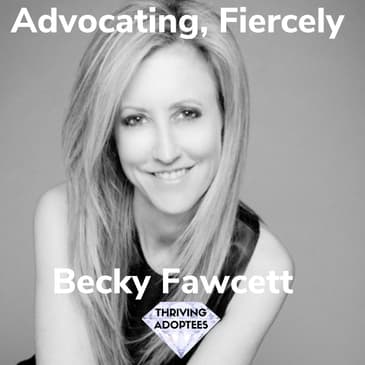
Following failed and miscarriages Becky and her husband Kip adopted 2 girls who are now thriving teenagers. Listen in as Becky shares what she's learned - and continues to learn - for insights on how you can navigate your own journey as an adoptive parent. There are tonnes of insights into handling the tests our kids bring us, building relationships with birth parents and much, much more. Practical, relatable and insightful
Here's a link to it https://thriving-adoptees.simplecast.com/episodes/handling-tough-stuff-with-adoptive-mom-becky-fawcett
HelpUsAdopt.org, founded in 2007, is a national 501(c)(3) adoption grant program. HelpUsAdopt.org was founded by Becky and Kipp Fawcett as a response to their own personal adoption experience - they have 2 daughters - in an effort to make adoption more feasible for all families.
The organization is the only one of its kind in the United States that embodies all of the following criteria:
- awards large, life-changing and problem-solving grants up to $15,000
- supports all types of families (married couples, single parents and LGBT families)
- supports all types of adoptions (domestic, international, foster care)
- supports all types of religions, and does not require a statement of faith
- does not charge applicants to apply
Find out more at:
https://www.instagram.com/becky.fawcett/?hl=en
https://www.facebook.com/helpusadopt.org
https://www.instagram.com/helpusadopt/
Guests and the host are not (unless mentioned) licensed pscyho-therapists and speak from their own opinion only. Seek qualified advice if you need help.
Want to learn more about thriving for you, your kids, your families or your colleagues? Pick a time to talk here
[00:00:01] Hello everybody, welcome to another episode of the Thriving Adoptees podcast. Today I'm delighted to be joined by Becky, Becky Fawcett. Welcome back. December, no February 2022, the 10th of February to be exact. Becky, your episode, last episode was released? That's a long break. Maybe too much of a break, right? Like we should have, but we've been busy. I've been busy. You've been busy?
[00:00:27] Yeah, we've been busy. And as I said before we hit record, it's great to see you without your sunglasses, right? Because see Becky on social all the time, Facebook especially, and she's got these great eyes, but they're always hidden by these, what should we call them? Statement sunglasses. They're like, you know, big round Hollywood old lady sunglasses. And it's funny. So I do wear them.
[00:00:55] First of all, I have very fair skin and blue, sometimes green eyes. And if you have that color combination, number one, your eyes are more sensitive to light. I never knew that until a dermatologist told me that. Cause I was like, I need to wear sunglasses on a hazy day and people make fun of me. She goes, that's totally normal based on your skin color and eye color. So there's that. Most of the time when I'm out walking my dogs, I have no makeup on, Simon. There's the big thing.
[00:01:25] Like, but no one knows that. Cause I got these big things hiding me from the world. So, um, and sometimes I don't look at the camera if I'm recording without them. And I'm like, look, yeah. So they're my thing. I have a big collection. Some are expensive. Some are from target. Some are from Amazon. They're all mixed and matched and they're just part of who I am now. And it's sort of funny. Everybody has a comment.
[00:01:49] Cool. But they are the gateway to your soul. So it's lovely to see your eyes. Yeah. It's lovely to see you too. Lovely to be seen. Um, so, uh, I asked, uh, Becky to come back and she said, yeah, I want to do that. And, uh, let's, let's talk stigma.
[00:02:11] I think it was, if I can sum it up, um, was the email that came back from you. So why, why do you want to talk about stigma? So it's interesting. So just to quickly identify who I am for your listeners again, I am, um, a mom by adoption twice. My girls are both domestic open adoptions and they're now 19 and 15 years old.
[00:02:37] And, um, we still have successful open adoptions, um, minus the death of one birth parent. And that is a devastating blow for all of us. Um, it was unexpected and it even makes my chest tight to say it out loud here.
[00:02:58] Um, not what any of us want, but we have, we're still good with what's existing. Um, and we can talk about that later if we want to get into it. But, um, you know, I asked, I know the stigmas of adoption being a woman who was infertile, who couldn't have a child biologically. I know the stigmas that I faced about adopting, uh, what people say about me as an adoptive mother of shame and secrecy and all these things.
[00:03:28] And what people think about my children. I know it from the parent's side. I've experienced it as my kids have gotten older from their side. And that makes me mad. I'll be honest. Um, and my children and I talk about everything like the good, the bad, the ugly. And as teenagers go, they are the first people to tell me, mom, this ain't your lane.
[00:03:56] Get out of this lane. This is not your lane. And so, you know, over the years I've said to them, you know, I know how I feel about what people think and say about adoption. And that's just what we hear, right? That's not what's behind the closed curtain number three.
[00:04:15] And as they've gotten older, they're like, you know, I said to them once about six months ago, a year ago, what's the hardest thing about being adopted? Two open adoptions in New York City in a year. This is probably 2024. And, and they both looked at me and Jane said, being adopted, quite frankly, for me, and she's only talking about herself.
[00:04:44] Okay. So this is her is very easy because in our family, it's been easy. Okay. It's been quote normalized in our family, transparent, honest, good, the bad, the ugly, everything. She was the hardest part of being adopted is the way the world reacts to the word and the stigma that comes with it. And I nearly fell over because this is an 18 year old girl last year who's saying this to me.
[00:05:11] And I'm like, wow. Wow. And then I looked at my younger daughter who back then was 14. And I said, what about you? What's the hardest part about being adopted? And she goes, well, I love my story. And I love my open adoption. And I, her best friends, they became best friends before they both figured out that they were both adopted. So that's just a lovely thing that they have found for each other.
[00:05:39] And their first day of sixth grade, they're now in ninth grade and they share that. She goes, but I meet other kids who I realized they're adopted and I'm so excited to share. And she goes, and they don't want to talk about it. And it's not even that they just won't want to talk about it. They shut down and they're negative about it. And she said, that kills me. I'm so saddened by that. And so we've started talking about this.
[00:06:08] We've started talking about why, why, the why to all this. And that's why I wanted to be on here. I wanted to, I love being with you, but I wanted to talk about something that I don't think people talk about every day. And it's got to change, you know, I get it. I get what happened in the past.
[00:06:26] I get that so many people were wronged by shameful secret, closed adoptions, broken stories, lies, all of it. No transparency, no open. I get it. It's terrible. It's really terrible.
[00:06:43] But as I've met older adoptees in the last 20 years of my adoption journey as a mother and founder of helpusadopt.org, I've talked openly with and honestly with some older adoptees. And we've had constructive conversations about it all. And I have thanked them all. I've apologized for behavior that is nothing to do with me.
[00:07:11] I wasn't even alive when somebody said, on behalf of the world, let me apologize for how you were treated. Because I really do believe that. But because of your story, mountains were moved in progressive open adoption for future generations. And the world listened. The world listened. And the world is making efforts now, the adoption community, to teach future adoptive families what open adoption truly means.
[00:07:40] An ethical birth parent treatment really means. And how you don't want to adopt if it's not ethical. And all these things. So I think movements made in the right direction. Is there a lot of anti-adoption and not nice noise in the background still? Yeah. And I just wish we could come together to acknowledge their pain and be more constructive with that message.
[00:08:09] Yeah. Where do I start from that? Where do I go from that? I mean, it's a lot. It's a lot, Simon. It's a lot. I'm sorry. And it's a lot. And it's really simple too, right? So, yeah, the world's moved on. And it continues to move on.
[00:08:39] And, yeah, like people, I was thinking about this. So, like, is she going to ask me whether I'm pro-adoption or anti-adoption? When people ask me that? And they don't, to be honest. But when they do, I say, I'm not in either of those camps. I'm pro what's best for the kid. Yeah. So, if you want to put me in a category, right?
[00:09:07] Because you live in this world where everybody used to fit into a box. Well, you know, tough. You put me in the category. You put me in the category that you want to put me in. I'll just find my own way. And you don't mean me. You're talking you globally. Because I'm with you. I don't think this is a black and white issue. I just, I, you know. But the world wants. The world wants. No, there's no box. The world wants. The world wants a box.
[00:09:35] But we're here as an adoption community collectively is what I'd like to see us all work. And that's a dream. I know that. But collectively to say, why don't you learn about the adoption community? Because there's a lot of people like me who say, oh, my gosh, what happened in the past was terrible. It was terrible what happened in the past. I mean, I do a lot of reading. And I can barely stop. I force myself to read it because it's unpleasant.
[00:10:04] It's in my category. I want to know. I want to be able to tell my children that I work hard every day, not just as their mom, but in Help Us Adopt Land, in my voice online, to educate, to talk about the mistakes of the past. And these are human beings. It's like birth mothers, adoptees, adoptive parents. We're all humans, you know.
[00:10:30] And in any category across the planet, I don't care what you pick, you can never say all. I've learned that in my 55 years on this planet. Nothing is an all. It's some, not all. And so are there some adoptees who are anti-adoption? Of course. Do they have terrible stories? They sure did. Were they wronged? Yeah. Are they never going to know their pieces? Nope.
[00:10:59] Are they ever going to be whole? Maybe not. As a mom by adoption, kills me. I've gone to great lengths, so my kids have their stories and their details and relationships. But that advantage wasn't always, like, given to adoption. And that is heartbreaking. It's heartbreaking. We've seen what that does to people. And we have to acknowledge it. You cannot pretend that this bad decisions weren't made.
[00:11:30] And I'm with you. I think a lot of people now, that's it. The child comes first. Now, I also see it as a birth parent decision. I did two domestic adoptions, so I have a different perspective on that. And maybe that's just my experience, right? Like, my experience. But again, I don't know. I think there's so many details out there. And I just don't like it when it's painted one way or the other because it's not fair to the people who might fall in the middle.
[00:12:05] Yeah. And I think it's okay for you to say you don't have a box. But the world has never told you, Simon, that that's okay. Right? The world didn't need to tell me. Yeah. I figured it out on my own. Or maybe my parents led me that way. Maybe my education led me that way.
[00:12:29] But, you know, like the idea of being a sheep really terrifies me. So, something that I occasionally have run-ins with call centre people, right? And so I'm expressing something, a concern or a complaint or whatever.
[00:12:59] And I'm trying to stop doing this. But, you know, like I say to them, so, yeah, so last week I want to put my car in for a service. When can I get my car in for a service with a courtesy car? This was the 1st of May. And the guy said 30th of June, right? 30th of June.
[00:13:21] And I said, do you think that that really reflects Audi's brand values? Right. And I said to the guy, and he couldn't say anything. He just mumbled stuff. I said, now just as a human being, do you think that's good? Do you think you should have some more courtesy cars? Yeah. And he couldn't answer. He couldn't answer.
[00:13:47] He had to pay, he had to tow the company line. And I just thought, that's really sad. Do you know what I mean? He can't, I'm asking his opinion as a human being for a two-month delay. And he can't say, he is, maybe all calls are being recorded for training purposes. And he can't say that, right?
[00:14:13] Now, somewhere along the way, that scares the bejesus out of me, that somebody has to tow the company line to fit into a box. And everybody wants to fit in a box. Are you a liberal? Are you whatever? Are you a dove or an eagle? Are you blue or red? Well, just go and do that. Go and worry about your own boxes. I'll create a new box. Yeah. And, you know, so it's interesting when you say all that.
[00:14:43] So, you know, I, people have their stereotypes and stigmas of me when they look at me or hear that I raise money to help give adoption grants. I want to be very transparent about what I do here. There's no hiding anything with Becky Fawcett. I'm going to tell you that. And I've also talked to my children's birth parents about negative stuff. And they're appalled because they made the decision, placed their children with me.
[00:15:12] And again, there's a lot that goes into that. It's not so easy on them either. I always give them the respect and the space to talk about it. And I'm very proud and honored, number one, that they chose me. And number two, that we're one big family. And my children have half siblings and full siblings. And we're meeting and have relationships. And my youngest daughter has actually become very close with my oldest daughter's sister.
[00:15:40] I mean, these are great stories. This is modern adoption. And that's the thing. It's modern. It's a new modern way of thinking. And it doesn't scare me. Scares some other people. But, you know, when I talk to the people I talk to, I'm like, who got to decide that birth parents were terrible people generations ago?
[00:16:06] And who got to decide that adoptees were shameful and should be secretive and not told? And who got to decide that these two communities and adoptive parents, three communities, don't have stories worth celebrating? Who did that? Because it's time to change that, right? The church. And I meet. The church. The church. Yeah. Quite a lot of that. The world is largely being read by. It's been. And people have nothing to do with the adoption decided the rules.
[00:16:35] And that's ridiculous. So it's time to take back that power and use a modern day positive discussion to talk about the good, the bad, the ugly. I won't deny there's ugly. And I'm going to tell you this example. And then I'm handing it back to you. I mean, a lot of people in my work at Help Us Adopt who want to introduce me. They're like, oh, my God, I just found out my neighbor is an adoptee. And I wanted her to have coffee with you. And she said that woman doesn't.
[00:17:03] The neighbor said that woman probably doesn't want to have coffee with me because I'm not very happy about my adoption. No, she might be 70 or 80. And so the answer and my friend will come back to me and be like, I'm so sorry. I don't think she's. And I go, well, I'd like you to relay a message back to her. That's OK. I would like to think I understand why you're not happy.
[00:17:30] And I'd love to have coffee if you're willing to tell me your story. And I've had older adoptees. Some will still say not talking to you. Fine. I get it. Others will give me the grace for that coffee. And they will tell me that I am the first person who ever asked to hear their story. And I don't understand that. I don't understand that. I don't understand that. For me, it's just a natural. It's a.
[00:18:02] I hear you're in pain. I want to know why. I can't fix it. But I want to acknowledge your pain. Right. I want to sit with you there. I want to say. Anything I can just to say you're seen. Right. You're seen. I hear it. And I've had the most amazing conversations with men and women over the years who are adopted and some birth parents who really didn't get a good shake in this world.
[00:18:31] And I'm grateful to be let in. I'm grateful to have been able to hear the story. Is it going to go any further than that? Probably not. They don't want it to. It's OK. But adoptees don't ask to be adopted. And I've always said that about my children, too. Grown up decisions were made for them before they even came into this world that they didn't get a vote in. It's a fact. It's a fact.
[00:19:02] Well, most people, most people want to put their opinion on other people. Most people don't want to hear. Or they don't. You know, it's funny. And no one likes when I say this. So I'm going to preface this with that. Ready? No one likes this. I come from a family of five siblings. I'm the oldest. Technically, my next brother is a full biological sibling.
[00:19:33] Technically, my three youngest siblings are half siblings. We don't like that terminology in my family because we don't always get along. But for the most part, get along. We grew up together. We are brothers and sisters, period. We are siblings. I am nothing like any of them. Nothing. When I go out with my brothers, people think we're married because we did. It's very.
[00:19:59] And I hear similar stories in the adoption world. And I understand I'm treading on thin ice here. But I'm nothing like them. And it's sort of funny when we're all together and everybody's like, oh, there's Becky. You know. And so when I had my kids or adopted my children, we had to go through counseling that said, now you need to be prepared that you are adopting children outside of your biological line and they might not be anything like you.
[00:20:29] And I was like, I'm living that truth. Not as an adoptee. Let's be clear. But I'm not like my dad was so intellectual and he could hear a song on a radio and then go sit down at a piano and play it by ear instantly. I'm like, I am. Oh, my God. I'm nothing like that. I had piano lessons and I was all thumbs, you know. So, again, with my kids, I just want them to be who they are.
[00:20:59] It doesn't have to be like me. And they're not like me. But they are like me. Does that make sense? Like, we have certain things that we are like, but you're not like me. And I just encourage them to be who they are. And I think that's one of the beauties of open adoption is that I've shared their story since the beginning. I've shared the why as soon as they were old enough so that it was understandable.
[00:21:25] And when they both met their birth parents for the first time and spent time alone, they came back. And I said, so what did you talk about? And they're like, you're not going to like it. I'm like, what could I not like? And they're like, well, we asked the why. I go, I think that's totally fair. What'd they say? And they said, everything you said. And I said, I told you. I would never.
[00:21:54] If I ever tell you a piece that we find out is untrue, it's because I didn't know. Or I was told that. And I tell them that. I said, there's no rule book. Well, it may be three years ago since we had that conversation. But I remember you saying that now. There's no rule book. And sometimes when they ask me certain things, I'm like, I don't know. But guess what I can do? I can text in modern day adoption. I can text. Jane had surgery.
[00:22:23] This is so this isn't about shame and stigma. Maybe it is breaking the stigma, right? She was 16. So three years ago, she had surgery. She didn't have it was a day surgery. But we were in Mount Sinai Hospital in New York City. And anesthesiologist comes in to ask her questions and goes, hi, mom. Has Jane ever had anesthesia before? And I'm like, well, Jane's right there. And she's 16. So she can answer. Jane goes, no.
[00:22:52] And she said, any family history. And I said, Jane looks at me. And I said, Jane is adopted. So my family history medically does not manage hers. And the anesthesiologist said, we know how to accommodate for that. And I go, well, wait a minute. I don't think you have to accommodate for that. And I pulled out my phone. And I started to text her birth mother. And the anesthesiologist goes, what are you doing? And I go, oh, hold on. I'm texting her birth mother. Hold on.
[00:23:22] I'm going to forget. She's around. I'll have an answer. And so I'm like, text. Any problems with anesthesia? 30 seconds later. Nope. All good on this end. Wish Jane good luck. And I go, we're all good. And the anesthesiologist goes. She sat down in the chair. And she said, I don't think I understand what just happened here. And I said, welcome to the land of open, positive adoption. She said, I cannot believe what you just did.
[00:23:52] I said, it's pretty cool. It's pretty cool. You know? And again, I can't apologize enough for mistakes of past generations. But the world has listened a little bit and tried to right the wrongs. And we can't go back and fix it. I can't be held responsible for people who did things that are not me. Um, but I, I do always want people to know your people. Listen, I'm listening.
[00:24:23] I hear it. I want it to be better. And if you still want to tell me your story, I'll listen. Maybe we can make something positive out of it. Share your story with the world. I don't know. There's ways, but it doesn't always have to be perfect. Look, Brooke doesn't love adoption because her birth mother died. She's not happy, but that has nothing to do about adoption, right? Like that was a different issue, but it's under her adoption umbrella. It's her birth mother.
[00:24:54] She's angry. I don't blame her. Birth mother was pretty great. And guess what? Her birth mother was adopted too. Look at that story. I wish she was still alive for so many reasons, but I wish we could have shared that full circle with the world. Um, and I wish she could see Brooke. I think she'd be so proud. But I did track down her mother.
[00:25:20] So now Brooke's maternal grandmother is part of our story and she has gotten to meet Brooke, her grandchild. And, but I made the effort to do that. You know, I really did. I found her because I wanted a piece for Brooke. I wanted her to have that. And I wanted the grandmother to have us. So these are things to try to break the stigmas, to try to share the world, a new perspective.
[00:25:50] Never taking away anybody's pain. Never. We can't. I can't change that. But isn't stigma projection? Hmm? Isn't stigma projection? Yeah. It's someone else's opinion that grows into a larger group of people's opinion. I mean, there are people out there who have told me because I didn't carry a child in my
[00:26:18] body because I didn't give birth to a child out of my body. I didn't breastfeed my children. I like to remind people that even if I'd been pregnant, breastfeeding was not for me. So that would have been a stigma in today's world, whatever. People tell me, don't worry. We still think you're a woman. I'm like, was there ever any doubt? Like, holy, what the hell? I've had people say, don't worry.
[00:26:46] We still think you're a real mom, even though you adopted your children. I'm like, define real. Holy, holy moly. You know, I've had people say when they meet my girls, how are they so beautiful? And I'm like, because they are. And they're like, but they're adopted. I'm like, oh my God, what? What on earth? I've had people, Jane is fair.
[00:27:15] Jane looks like she came out of my body. And Brooke actually does too, because she looks like my husband. So it is very funny that way. But Jane really looks like me. Fair skin, blue eyed, strawberry blonde hair, not blonde. And people, when she was younger, would say to me, did you have to pay extra for the blonde hair and the blue eyes? I'm like, oh my God. Who is telling you these stories? No. She was mad.
[00:27:42] The birth mother chose me to parent while she was pregnant. We didn't know what this child was going to look like. Like, this isn't, that's a terrible thing to say. But I don't know. Somehow this person thought that that was okay to say. Well, I mean, you said who told them that? Well, just because somebody told them that doesn't mean they need to repeat it.
[00:28:04] I mean, like, I do, you're putting your finger on something that I think is a little bit of a difference between, in our cultures, in our cultures, people in the state seem to be a little bit more forthright than they are in the UK. As a whole. As a massive, as a massive thing. It's very judgmental.
[00:28:33] The way, maybe that's a great perspective because you're not in the United States. At least in the United States, people are very judgmental about adoption. And I remember this. It's not just adoption. It's not just adoption. You're right. But today we're talking about it. They're very judgmental. It's a cultural thing. I think. Yeah. You're a bit more forthright. Like, you could, the difference between judgmental and forthright.
[00:28:57] You know, it's like the difference between, you know, a lot of bosses get accused of bullying. They're being, some of them clearly are bullying. But some of them are just trying to get stuff done. You know. And so what one person's, you know, one person's being forthright is another person in judgmental. It's all, it's all in perception. It's all in perception.
[00:29:23] But like Winston Churchill said something like, other people's opinions of us is none of our business. Right? Like, and there's a ruder version than that. Right? You know what, Simon? I'm going to tell you this is because people will say, why do you care? And I'll tell you why I care.
[00:29:46] So when these other women out there will tell me, like, we don't think you're a real mom or you're not a woman because you didn't give birth and blah, blah, blah. Come at me. I don't really care. You can come at me because you're such, you're so misguided in that, especially with my last 20 years of my life. Like, if, okay, you're right, whatever. However, the reason I speak up is because I know that not everybody is like me.
[00:30:14] Not everybody likes to take the bull by the horn and walk uphill backwards with a backpack on of weights. That's what I always say I do every day. And so I stand up to right the wrongs and point it out for the people behind me who maybe go, oh, thank God she's going to talk about it because I will just start crying. Um, I did make someone cry when Jane was really young. We got invited to a party at a friend's house and she was young.
[00:30:43] So they said, just bring her because she was in the car, you know, the car seat bucket that you carry around. She would just eat and sleep. And that was the end of it. And we put her in a corner. Actually, everybody at the party carried her around because they were like, thought she was amazing. But when we walked into the party, some woman immediately, who I didn't know, another guest at the party came up to us and said, baby. I'm like, well, she's not that new, but she's new. And they look in and she looks at me.
[00:31:11] First of all, Jane was maybe three months old. I'm not sure babies even look like themselves at three months old. But again, I'd be wrong. Um, she looked at the baby, looked at me, looked at my husband, looked at the baby and goes, she doesn't look like either one of you at all. And I, she had just pushed me a little bit too far that day, Simon. And I said, well, that could be because she's adopted. But thanks for pointing it all out.
[00:31:41] It's exactly what every new mother wants to hear, that their baby doesn't look like that. The woman just paled, started crying and ran away. So at that point, Kip takes the baby and goes, you better apologize to your friend, the host. And I'm like, I always say I'm loud and outspoken and opinionated. Sometimes it gets me into trouble. And this one, I really was like, oh, shoot, shoot. I didn't handle that well.
[00:32:08] But she had just pushed me and I was over it. And I went and found my friend and I said, I'm so sorry. I don't even know who I just made cry, but I really overstepped my bounds. And if you want me to leave, I'll leave. I didn't mean to ruin your party. And she goes, are you kidding? I overheard the whole thing. She's lucky that's all you said to her. Go get a drink. I mean, it was so, and again, I did not mean to really do it.
[00:32:36] But again, who said, even if you give birth biologically, I've met women who have delivered their children biologically. The kid didn't get one ounce of their genes, one ounce. It happens. Sometimes the other, the husbands, the other partner, the gene pool is so strong, it overpowers the mothers. And I've watched my friends in those cases be a little saddened that they don't see themselves in the face.
[00:33:02] So I, you know, again, you just, you don't criticize all these things. Everybody's got their stuff, adoption or not, babies, whatever. And you're right. People in America, it cross lines like it's crazy with what they think it's okay to say to people, which does go back to my whole stigma of adoption world. Like the people who aren't happy with adoption.
[00:33:29] Why, why are you allowed to now lump me as a happy adoptive family in your camp and tell me I can't be who I am? What gives you the right? And that's my thing. Like people can be as miserable as they want to be, but that doesn't mean you can put your misery on someone else and tell them that you're not allowed to be happy. You're not allowed to think adoption's okay. You're not allowed. I don't get that. That'll never understand.
[00:33:57] Um, and like you, one last thing, then I'm going back to you. You know how you said if you had to be in a camp of pro adoption or anti, you're in the middle. I didn't say that. I didn't say that. What did you say? Sorry. I said that I'm, I'm pro what's best for the kid. Oh, what? Sorry. You're in your own box. Pro what's best for a kid. Sorry. I misspoke. When people say, do you want everybody to adopt?
[00:34:26] I say that's not my mission in life. I would love everybody to understand the magic of adoption. It's been, I think adoptees have magical stories. I think you do. I love your teddy bear story. I love what you're doing with this podcast, but adoption is not for everybody to build their family as a parent. And if it's right for you, I'd love to share how to do it ethically.
[00:34:52] What I believe about open adoption, but I'm never going to tell someone you have to adopt. That's not my role in life. This is how I built my family. Do I know a lot about it? Yeah. Do I think I'm an expert? Absolutely not. And I'm not here to tell anybody how to build their family. That's not the role. Can I share some cool stories? Yeah. Can I share some mistakes I made along the road?
[00:35:22] Sure. But I just think this black and white line in adoption is very difficult to be modern. It's not modern. I still think it's projection, right? It's people who have had a trickier time putting their stuff on the world.
[00:35:55] And there was a lot of bad stuff. I read a recent book. There is a lot of bad stuff. There's a lot of bad stuff. But I also think that a lot of it is to... I think adoption stuff gets very mixed up with parenting stuff. Yeah. Well, it does go a little hand in hand, unfortunately. But people... But people...
[00:36:21] I think it's one human being, right? It presents in one human being. But I do think that... It's like a multiplier fact. It's like a multiplier thing, right?
[00:36:42] So if you've had a tough time with the separation stuff, and then you get adopted by parents who are very emotionally intelligent. Should we put it that way? Or are very open and are very insecure and don't want to talk about it.
[00:37:05] Then, you know, those that want to deny your emotions, then that's going to... It's going to lead to a tougher life. But the two things multiply together. So I reckon I was pretty lucky. Yeah. You know, and I don't know. I mean, I... Well, I do know. And we can talk about this for hours.
[00:37:33] And, you know, I do know in kindergarten for my youngest daughter, the way New York City Public School works, she got fed into kindergarten at four years, ten months. A little too early. But that's how it works here. You don't have a choice. So she was behind schedule. When she went into kindergarten, and if she were here, I'm not embarrassing her. She didn't know. She didn't know the difference between a letter and a number.
[00:38:01] She was not cooked, as I say it. Her brain was not cooked. She was four years, ten months. And I remember having to meet with... The teacher got it right away and said, she's going to need to repeat kindergarten. There's just no way she's going to make it through the school year. And I'm going to help you. And he was a great ally. I'll never forget him. His name was Larry. And really put... Because Brooke now, stellar student. Like, he really... She needed to repeat kindergarten. And now she's great.
[00:38:31] But the social worker at the school had to be brought in to talk about getting her testing done. Fine. That's how it works here. There's a process. Fine. He said to me in the intake call to get some family history, which again, she's adopted. It's not a secret. It's right out there. Oh, I know now why she can't read. I go, oh, do you? It's because she's adopted.
[00:39:01] And I almost reached through the phone and punched this guy in the face. I said, are you out of your mind? Are you out of your mind? And it got worse. Like, at one point, I did report him to the city of New York because he was so ridiculous in his reporting of his language, of how he talked about adoption. He was so off base. And to the wrong mother... They would have listened to him. ...that might cripple my child for the rest of her world.
[00:39:30] I said, no, Brooke can't read because Brooke can't read. And she's not even five... Well, she's just five now. Like, are you kidding? She's here too. Like, Brooke can't read because Brooke can't read. She is adopted. But that's not the reason why she can't read.
[00:39:46] And again, you know, but this was a very high-positioned social worker in a very lovely elementary school in New York City where adoption's not a foreign word. And oh, my God, this guy, he did announce retirement at the end of that year. I might have had something to do with it. I'll take the win. He should not have been talking to parents of any sort if that's what he thought was the problem.
[00:40:15] And Brooke was just a late bloomer. Late bloomer. She struggled with reading for years. No testing. Gave any red flags as to anything. And she is now coming to her own in four... Like, she was a late bloomer. That's it. Now I can't keep books out of her hand. You know? It's like... And had I listened to that guy, had I not had the wherewithal to her mother to say, it's not because she's adopted.
[00:40:44] Because she can't read. It's a fact. It could have had a totally different turn on her entire life. The way he wanted to blame that. That's the problem. That's a scary thing to me. That that guy's talking to adoptive parents. And what if Brooke had heard that? Come on. We can do better by this community. And we can do better by these children. And I feel that all our efforts to do better
[00:41:12] is out of respect for those who it wasn't done better by. And is that the wrong thing to say? It might be someone's going to listen to your podcast and be like, that was the worst thing you ever said. But I really feel it. We're listening to mistakes that were made in the past. We can't fix them. But we can do better by this community moving forward. We can honor this community better. We can listen to this community. Not be yelled at by this community. But listen constructively to this community.
[00:41:41] And advocate for this community. All of us. You know. We can. And we will. I know. I wish, you know. Again, I always say I would love to do. And I would host it here in New York. You can fly in. I'd love to do a roundtable. All the triad. I'd like to have birth mothers who are happy with adoption plan. I'd like to have birth mothers who feel they weren't. I'd love to have birth fathers on both sides
[00:42:10] who are often the forgotten picture out of any of these conversations. I'd like to have adoptees of all sorts. And I would like to host a day of respectful but honest story sharing. Because I do think if we all didn't yell at each other. It doesn't have to be pretty. But we can't yell at each other. I think people would find more similarities in all of us. Including adoptive parents.
[00:42:38] Than people are taking the time to hear. And I don't think it has to be us against them. That's what I always hear out on the internet. It's us against you. We're the most important voice in this group. And that to me is a very scary thing. I don't think anybody's voice is the most important. I think everybody has an opinion to share. Right? It's respectful.
[00:43:03] That's a reaction to having, being, feeling small and having felt to be ignored. We're trying to. We puff our, puff our fish. I was talking to, who was I talking to about this? Yeah. And a fellow adoptee, Danielle, Danielle Godet. She was talking, she says like puffer fish.
[00:43:30] Make themselves, when they're feeling threatened, they puff up so that they look bigger. And that's, that's what's causing them. Well, and I think with most of the world, I get why people do that. Most of the world is not kind. Most of the world is not compassionate. But, you know, I think I, I am always the girl who thinks we can do better.
[00:43:59] And I like to think I do do better and I work to do better. And I'm always willing to say the unpopular thing to move this ship forward. Because quite frankly, these are my kids. This is my family. This is me. This is you. And I think I've, over the years, built a very large adoption network across the country. I think voices have been heard through my platforms that have never been heard before. Very proud of that.
[00:44:27] And listen, not every story we publish on our Voices of Adoption page on our website is positive. And people ask me that. They say, I want to do a profile, but it's not all roses and sunshine. I said, as long as it's not hate speech, we're good. I don't publish hate speech. But I understand. I want your story to be heard.
[00:44:56] If you can tell your negative story and your unhappiness in a constructive way, let's, let's share it with the world. Because it's important. Indeed. And I say that all the time. I say that to birth parents. I say that to adoptees. I will share your story online and put it out there. Doesn't have to be perfect. Doesn't even have to be good. You can be heard through the platforms I've created. And I'm very proud of that.
[00:45:25] I wish more adoptees and birth parents would take me up on that. But I don't think they trust me totally. And that's fair. But no hateful, mean speech will I publish. I don't. I think the world's got enough of that. Not on my platform. But I think these stories are important. So important. Keep doing it, Becky. I'll see you in New York. You did an adoptee voice. I think you did adoptee voices. A long time ago. I must have done it. Yeah. Yeah. I think you did.
[00:45:55] I'll have to go through and see. Because I think you told the teddy bear story. And if I'm wrong, then we've got to get you to do one. Because it's important. Really is important. We're all in this together. Some people then say, I don't want to be in it with you, Blondie. And I'm like, too bad. Right, Becky. Any final thoughts? Because I know you've got to go. I'm trying to watch some time for you.
[00:46:20] I mean, Simon, I just, I love you that you always want to talk about things that, listen, this is not a pretty conversation to some people. I understand that. It's not the safe conversation to a lot of people. But I do believe, I'm listening to my girls. They're driving the ship in our family. And they say, this is not okay. Therefore, I'm having the conversation. I always tell people, I work for them.
[00:46:51] Thanks, Becky. Thanks, listeners. And as always, check out the show notes for links to what Becky's doing. Take care. We'll speak to you again very soon. Take care. Bye-bye. Always a pleasure, Simon. Thank you for the work that you do to make this world a better place. You're welcome.