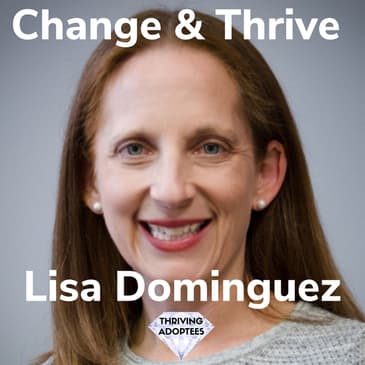
We humans have a funny relationship with change. What if change was for the better? A change in how we think, how we feel, how we see ourselves? Listen is adoption leader and therapist Lisa shares insights on growth, learning and change...
Here's a bit about Lisa from her organisation's website:
Lisa Dominguez stepped into the CEO role in 2024, yet has a longstanding history with Paths for Families, as she first joined the organization in 2006 as a contract social worker, completing home studies, post-placements, and clinical services.
Her 25+ career has been centered around serving children and families, almost half of which was spent working exclusively in the adoption, foster care, and kinship community. She is a seasoned supervisor and trainer, providing perspective on trauma-responsive techniques for both parents and professionals locally, nationally, and internationally.
In 2022, she re-joined the team to step into the role of Chief Program Officer, which laid the groundwork for her trajectory to CEO as our founder, Janice Goldwater, was strategically making succession plans.
Lisa has stepped confidently forward in upholding and building upon the legacy of what Janice Goldwater has built at Paths for Families.
Lisa received her B.A. in Psychology from the University of Maryland, and her Master’s in Social Work from New York University. Outside of work, Lisa loves to travel, is a huge fan of fitness, and loves to spend time in nature.
https://www.facebook.com/pathsforfamilies
https://www.instagram.com/pathsforfamilies
https://www.linkedin.com/in/lisa-dominguez-610126150/
Guests and the host are not (unless mentioned) licensed pscyho-therapists and speak from their own opinion only. Seek qualified advice if you need help.
Want to learn more about thriving for you, your kids, your families or your colleagues? Pick a time to talk here
[00:00:02] Hello everybody, welcome to another episode of the Thriving Adoptees podcast. Today I'm delighted to be joined by Lisa, Lisa Dominguez from Pass for Families. I'm really looking forward to our conversation today Lisa. We had a great conversation just last month right? I don't know whether the listeners know this but I always like to meet guests first and just to get to know each other and talk about the pod. I think it brings out the best in the interview.
[00:00:31] So the conversation starter right, the starting piece that we always kick off with is Thriving. What does Thriving mean to you Lisa? I thought a lot about that Simon after we talked and I think when you look at the actual definition, kind of the dictionary definition of Thriving, it often talks about growth and success and prosperity.
[00:00:57] It's interesting because at our organization, part of our vision is that all children and families have what they need to thrive. So it was really helpful for me to really think about what that really means.
[00:01:10] And I think Thriving for me is really not just surviving, but living and really having what you need to have the freedom to be your authentic self and to really find your joy and your passion. So those are the things that really come to mind for me when I think about Thriving. Yeah. Yeah.
[00:01:40] So a big focus on internal then, you know, think about, yeah, growth. I think internal, but I think the internal can't come without a lot of external support. Yeah. You know, when I think about the children and families that we work with, being able to thrive means you have a community that meets your basic, helps you meet your basic needs, that you have a sense of belonging.
[00:02:07] So I think, I think the external promotes the internal ability to thrive. I think they're very, very connected. Yeah. Yeah. And also how that, the manifestation of that, how what's happening is for on the inside shows on the outside.
[00:02:32] And I guess it's measured on the outside, outside in terms of our, what we achieve in the world, what we do in the world. Yeah. Yeah.
[00:02:50] And I think achievement, you know, is often thought of in terms of a title, a job title or a certain, you know, kind of financial position or, you know, and I think that's one part of achievement.
[00:03:07] But I think really focusing on like the other aspects of, of achievement in terms of feeling like you are able to accomplish the things that are important to you, that you are able to give time and care to the people that are important to you. So, so I think, I think achievement is, is really important.
[00:03:27] And I think it's really important to have kind of an expansive definition of what achievement is and what achievement looks like and feels like for each person is really, really different. And, and, and meaning, like doing, doing what makes sense to us, what, what brings meaning to our, our lives and how lucky we are.
[00:03:58] We, as in you and me, how lucky we are to be, to be doing something that has huge meaning for us. And, and it's a different, so it's a different sort of success, rather than the stereotypical financial success, you know, you mentioned the job titles, you know, I, I think about the people that I, people that I've interviewed, who have shifted.
[00:04:25] They have started off down a, you know, a career. So talking about money, like people, people that, that I've interviewed, one guy was a, a banker and then became the leader of a non, a nonprofit. So in the child welfare space.
[00:04:46] So, you know, it's that we, we realize that we realize that what we thought was going to make us happy. Didn't. And then we, we, we change, we change, change paths. And when you, when you, when you kind of Google or think of, look at, at thriving, it, it often is, is paired with flourishing, which I thought was really interesting.
[00:05:14] I kind of went down this little rabbit hole when I was, you know, thinking about like, what is thriving as like the, the definition? And then how do I think of it? And it also, a lot of the things that I was looking at around thriving as well, talked about growth. And I think that's such an important piece of thriving is that continued ability to grow and to change. And kind of having the luxury to be able to do that throughout your life.
[00:05:44] So that thriving is a real active process, not a static process. So I, I love that idea of thinking about how growth fits into all of that as well. And what, what sort of growth are you talking about there? What does it mean to you personally?
[00:06:02] I think for me is kind of always learning and always kind of discovering new things about yourself and about what brings you joy, because we change, right? I mean, the core of who we are is who we are, but that, that changes over time for so many different reasons.
[00:06:25] You know, I think about, you know, now that I'm in my fifties, you know, how, what thriving looks like and feels like to me versus when I was, you know, in my twenties or, you know, in my thirties raising young kids.
[00:06:39] And, and I think it's just really interesting to think about thriving as growth and the ability to continue to grow and change and adapt and to be able to pivot, to meet kind of your joy and your passion as, as you continue to grow and change.
[00:06:58] So if we bring the adoptee part into the, into the conversation, what, what comes to mind when you hear this word thriving adoptees and how does that, how does that alter, if it alters at all your impact? So your definition of thriving?
[00:07:22] I mean, I think for adoptees, there's a whole nother layer to it. I think an essential part of being able to thrive is knowing who you are and knowing your story. And I think, unfortunately for so many adoptees, that's a part that is missing for them. Um, and, you know, when we first started talking, I think I mentioned, you know, being able to thrive is kind of the freedom to be your authentic self.
[00:07:51] And, um, I think it's really hard for someone to be their authentic self if they don't know their story. And so I think for me, that's such a huge piece. And so much of the work that, that we do at Pass for Families is making sure that adoptees have access to information.
[00:08:13] Um, and, um, because I think that's such an important part of being able to thrive is having that, that sense of self and knowing who you are. And I think that's really hard to do, um, if you don't have information, if you don't know your story, and if you haven't had the support that you need to navigate loss.
[00:08:42] Um, you know, even, you know, even adoptees who have a loving and wonderful relationship with their adoptive families and even adoptees who have connection to birth family and information, adoption doesn't happen unless there's some sort of loss. Um, and so being able to have the support, um, for whatever that means for that person. And for some folks, it's very, very present for them. Um, and for others, it's not.
[00:09:11] And I think, um, it depends on, you know, the person, it depends on the circumstance, but I think really having the support to navigate all of those complexities in order to thrive. What have you learned about uncertainty?
[00:09:30] And because in, in, in, in, in, in the gaps with, with those gaps in knowledge, with those gaps, gaps in story, uh, clearly there are a lot less gaps in, in, in adoption as it is today. Right. Right.
[00:09:47] Come to adoption as it was for me in the 19, 1960s, you know, this whole movement from, uh, closed adoptions to open adoptions means there's less gaps in the story, but gaps inevitably still, uh, are there. Yeah. What have you learned about what helps, um, what helps us navigate uncertainty?
[00:10:15] Yeah, that's such a good question. You know, for so much of my career, I've been a therapist and uncertainty is an ambiguity is one of the hardest things for us as humans to, um, to sit with. We like certainty. Um, you know, I often say that, um, you know, sometimes having hard news is better than just not knowing.
[00:10:39] Cause if you, if you, if you have information, you can plan, you can process, you can, um, you can work through it. But when you don't know, it's really hard to heal from something that you don't fully understand or you don't fully know. So I think, I think filling in gaps as much as we can for adoptees in terms of if they want to search, encouraging them, you know, to be able to search supporting that.
[00:11:09] If adoptive parents have information that they haven't shared, you know, sharing that information. And then I think really getting support around the gaps, because I think when there are gaps, our minds make up a story, right? Like if we don't know why our birth mother chose to make an adoption plan, we make up a story and we often make up the worst possible story that we can make up.
[00:11:35] You know, my birth mother didn't love me or I cried too much when I was born or, you know, whatever the thing. And so I think, I think being able to fill in the gaps whenever we can is essential. And then I think really helping folks get support around the stories they've told themselves around the gaps that they do have. And, you know, kind of the meaning that we make of the information from, from, from, from the gaps.
[00:12:04] Because I think, I think our, our minds are so powerful in terms of the stories that we, we tell ourselves. And, you know, how do we find peace with, with the not knowing? And again, for myself, as someone who's not adopted, it's something that I can only understand, you know, to a certain point. Because I don't have the gap that so many, that adoptees face, that so many adoptees face.
[00:12:34] One of the things that fascinates me is how, how that, that loss or confusion. You know, I think, I think of my, I think of my, myself, what, what, what was I like on that first day that I was brought home or the first day that I, I lost my birth mother?
[00:13:04] I, well, I lost her twice, actually. So I was in short-term foster care and then she collected me from short-term foster care and took me to the agency. So that must have been really tough for her because she had to say goodbye twice. Like, so I, I think of that confusion, the, the, the, the baby confusion, right? Like, and, and it's not, even I've, I've used a word that's about thinking, haven't I?
[00:13:34] You know, it's about, uh, bewilderment would probably be a, a better kind of word. Word, I think it's, it's not, it's disorientating. Clearly at five weeks old, I'm not doing much thinking, right? I haven't got any, I haven't got any words. This is, this is pre-verbal, right? And I, you, you, you use the word meaning.
[00:13:59] And I, I, I, what fascinates me is how this emotion of loss becomes a, a, a, a belief or a, a meaning is, a meaning, a meaning is associated with this event.
[00:14:23] And then that can grow and fester, right? Yeah. That's exactly the word I was thinking of, fester. Yeah. How does that, how does that actually happen? How does, how does, how does something that is purely emotional become something that is more beliefy or more cognitive, more meaning? It's, it's, it's a word thing.
[00:14:52] It's, it's not just a pure emotional thing, right? Yeah. I mean, it's such a complicated thing. Um, so I, I mean, I have a couple of things that I can offer. So I can't tell you how many times, you know, in my career as a therapist, parents would say to me, well, they were so little, they don't remember.
[00:15:13] And I would really challenge and kind of push back because you might not remember Simon, that loss, the way that you remember what you had for breakfast this morning. But I, you know, there's research that, that shows, um, and there's been a lot of study around the fact that our bodies remember things, even if we don't have a memory in the same way.
[00:15:41] And I often would say to parents that actually, when things happen to us, when we're very young, when we don't have language, language is how we make sense and how we process what happens to us. So when things happen to us pre-verbally, we don't have the language to process what's going on. But our bodies, I would argue, remember that loss.
[00:16:07] So, um, you know, a child might not remember being hungry when they were in an orphanage, but as a six year old, they hoard food and their parents are like, why, why are they hoarding food? You know, we, they have all of the food that they need. Um, but there's something I believe very primally that, that the body remembers the feeling of being hungry.
[00:16:35] Um, and so I think, I think there is the emotional piece and then there's the meaning making that we make that, that the, the, the meaning that we make of what happens to us. So, you know, what, what does it mean to me that my, so to use your example, so you were in short-term foster care, then your birth mom collected you and then, you know, decided in the end that she needed to make an adoption plan for you.
[00:17:04] What meaning do you make of that? Right. One person might make the meaning of my birth mother didn't love me. I was a terrible child. Um, she didn't love me. She gave me away. Another person might be my birth mom loved me so much. She tried so hard to parent me and she knew that she couldn't.
[00:17:27] And so because of her immense love for me, she made an adoption plan when she realized she couldn't take care of me. So the same situation, but two different people can, can make it mean something completely different to them. Um, and so it's really powerful, the stories that we tell ourselves.
[00:17:49] And that's why those going back to those gaps and we don't know it's even harder, but even when you have information, we all then interpret it and look at it a different, in a different way. Um, and so that's to me, what's, what's so fascinating about us as humans, because two folks could have the exact same experience and make it mean something completely different.
[00:18:16] And what it means to them impacts then how they see themselves, how they see the world, all kinds of things. Yeah. Yeah. And of course it's not a, we don't choose the meaning that we make. Um, and, and, and, and your two examples were, were me, right?
[00:18:42] I, the first, the first, the first example was me for, for, for, for 10 seconds when I was 40, for 10 seconds when I was 40, I, I, I said, she didn't love me enough to keep me. I, I didn't say those words until that instant because I'd never thought that, thought that thought until that instant.
[00:19:12] And, and then the person that I was speaking to said that I'm a mum, Simon, and I don't think it would have been quite like that. So that thought, that, that thought didn't kind of, um, take hold and, and become a, a, a, a belief. And yet, um, because the body was keeping the score, right? The body had kept the score. There was some stuff going on for me.
[00:19:43] Absolutely. There was some stuff just turning on for me. So I, I, I got, I, I got, I got her, I got her at some level that she didn't reject me. So when I said she didn't love me enough to keep me, the lady I was talking to, Sarah, she said, I don't think it would have been quite like that Simon. I'm a mum and that's, that's not what it'd been like. I saw the truth in what she said.
[00:20:10] So the, the, the, the thought didn't take hold, it didn't grow to become a, a, a belief. I got at some level that she didn't reject me. Fast forward 10 years, I get my adoption file. The pieces of the jigsaw are completed. And, and I feel her love for me whilst reading one of the documents that's in the adoption file.
[00:20:40] So is, is, is, is therapy about learning about a change in the, a change in the way that we, about a change in our meaning, about a change in the way our, we, we feel. Is that, is that what your, your approach as a practitioner?
[00:21:06] Because you're not an executive director now, but is that what therapy is about? It can be. I think it's, it's a part of it. I mean, I think what you're saying, Simon, is how powerful our, our thinking is. So I think, you know, everyone's adoption story is different. And so for some, there's much deeper trauma, you know, that really needs to be healed depending on, you know, when they came into care, if they were adopted at birth.
[00:21:33] I mean, there's, you know, so many variables, but meaning making is such a part of, of therapy. And I think, like you were saying, like, if that thought had taken hold, or if that thought had been with you since the moment you understood that you were adopted. Your life probably would have looked and felt very, very different.
[00:21:58] And so I think in therapy, it's about understanding the power of our thoughts. And so if you say to yourself over and over again, my, my mom didn't love me. My mom rejected me. My mom abandoned me. And that's how you think that, you know, our, our, our thoughts drive our feelings, which drive our actions. Right. So if, if that's your thought, you're going to feel angry.
[00:22:28] You're going to feel betrayed. You're going to feel unloved. And if you feel all of those things, you may lash out at other people. It may be hard for you to be in an intimate relationship, all of those things. If you think about your adoption story of, you know, my mom loved me enough to make an adoption plan for me. She knew she couldn't take care of me.
[00:22:56] You may feel sad, but you might not feel that anger, that rejection, all of that. Again, not to say everyone's adoption story is that simplistic, right? There, there's, there's, there's some things where it's hard to make meaning of, you know, how could my mom have, you know, abused me? Or how could my father have, you know? I mean, I think, you know, I don't want to oversimplify things.
[00:23:20] But I think the power of how we think about our lives is, um, is, is essential. So even if the thought is, okay, maybe my mom really did abandon me, you know, in a different situation. Um, what's the meaning you make that about yourself, right?
[00:23:44] So then it would be about, okay, well, as a one day old baby, is there anything that you could have done to make your mom abandon you? So I think, I think there are lots of different roads to go down.
[00:23:55] But I think part of trauma work and part of, of therapy is, um, making meaning out of the narrative that you've created and sometimes needing to create another narrative that challenges the narrative that you've kind of been living with, um, for, for a long time. Yeah. So I think that that is a, can be a really, really important piece of the therapy work.
[00:24:24] So, um, I'm, I'm interested just because I know that most of you listeners, listeners, I'm speaking to you, right? I know that most of you, uh, are in the States. We know that 65% of the listeners are in to this podcast in the States. And we know, I know that 80% of the people that listen are, uh, are women between the ages of 40 and 60. How many of you are adoptees?
[00:24:49] How many of you are birth mothers, birth fathers, well, um, uh, adopted parents, therapists, adoption fresh? We don't know. But like what, what are, um, these, these beliefs that we've been talking about for, and this change in these beliefs that we're talking about adoptees. What, what do you see as in terms of, uh, adoptive parents?
[00:25:17] So one of the savviest adoptive moms that I ever interviewed is also an executive director for, um, adoption organization. I know you do more than adoption. She said, raising adoptive kids is about unpacking our own emotional baggage as adopted parents. Mm-hmm.
[00:25:45] And, and that, that struck me as very self-aware. You talked about knowing ourselves, right? Yeah. This, this lady had clearly done some work. But she had realized that although we, we, we've got to focus on the child, actually we, we got to do our own stuff ourselves. Yeah.
[00:26:11] What, what, um, what have been your learnings about that, um, that unpacking, that, um, belief shifts, um, amongst the adoptive parents, the, the emotional health and the mental well-being of adoptive parents? What, what have you learned about that?
[00:26:35] Yeah, I think that's such a, an important question because I think, you know, adoptive parents come to adoption for many reasons. Um, and some come to adoption because they have not been able to have children biologically. Um, and so that's, you know, for them a loss.
[00:26:56] Um, I think, I think the power of the narrative that the adoptive parents have about themselves and about their children's adopt, adoption story or their child adoption stories is, is really, really powerful.
[00:27:13] I think, I think, I think for adoptive parents really understanding that, um, and we talk a lot about this in our work of kind of this kind of saviorism of adoptive parenting that, you know, of, you know, I saved this child. I gave this child a better life. Um, and really the damage that that does in terms of how it kind of tends to vilify birth families.
[00:27:41] And it also kind of creates this narrative of you, you're so lucky, right? You're so lucky to be adopted. And yes, many, many adoptees feel fear, you know, love their adoptive parents deeply. Um, but to say someone's lucky to have not been able to be raised in their birth family is just not true.
[00:28:05] You know, ideally every child should be able to be with their parent and every parent should be able to raise their child. Um, and so we see this kind of push and pull on how that narrative can really interfere with how the child sees his or her adoption story.
[00:28:28] And also if, and when they decide to search, if they don't already have a, uh, an open relationship with their birth parent, it creates all of this sense of loyal, you know, disloyalty, you know, that, um, you know, when adoptive parents feel like, well, you know, why do they want to search? Like, aren't I enough? Right. And it becomes about the adoptive parent as opposed to what the child really needs.
[00:28:53] Um, and so I think, I don't know if I'm, I'm answering your question, Simon, I feel like I'm going off on a tangent, but, um, but I think, I think the meaning that the adoptive parent has about their child's story, um, is really, really impactful in terms of how the child views his or her own story as well.
[00:29:16] And I think I have found adoptive parents when they are really open to a connection or information about birth family, it actually enhances the relationship as opposed to threatens the relationship. I think adoptive parents, it's counterintuitive that your child would feel closer to you if they're able to have information or connection to their birth family. But that's what I have found time and time again.
[00:29:46] Um, and that the child doesn't love you any less, right? We all have the capacity to love many, many people in our lives. Um, but when they feel really threatened by that connection or that information, it really impacts their child's ability to come to some peace and understanding of their story.
[00:30:10] And it takes a lot of work, um, on the adoptive parents part, because it is hard. It's hard to not feel threatened, to feel like I'm not enough for this child. Um, but, you know, it's, you know, I often would say to parents, you know, when I was doing therapy, that it's not about a child rejecting you. It's about the child finding themselves. Yeah. And that, that, you know, we all deserve, you know, to know our stories and who we are.
[00:30:39] Um, and that it's not a, um, it's not a reflection of how much they love or don't love you that they want to search. That's a really clear distinction. Um, so they're not rejecting you. They're finding themselves. I like that. Um, I like that.
[00:30:58] And, and at the same time as, as liking it as a, a nice clear distinction, I know that it's one of those things that's kind of seems black and white, but it's probably grayer and, and, and, uh, more, far more nuanced than that. And it's one of those insights that we get that, that is a lot deeper than that.
[00:31:27] It's not, it's not just a yes or a no, a one or a zero. It's an insight that has depth. I'm just, I want to go back to the saviourism thing, because what, as you said, the saviourism thing, I was thinking about, um, clearly religious, right? It's a, it, it sounds like a religious kind of thing to say. And that, um, I interviewed many religious people, many Christians on, on the show.
[00:31:57] Uh, I wouldn't call myself, well, I'm not a practicing Christian, but I was kind of raised a Christian. I went to a Christian school, but it wasn't really, it wasn't really big for me. It was only very superficial, despite, you know, um, listening to a hymn, singing a hymn every morning, you know, and listening to something from the Bible. I was thinking about the degree to which we talked about self, you talked about self-knowledge.
[00:32:27] I talked about self-knowledge and self-awareness. And I'm wondering, do, because, uh, uh, adoptees, uh, sometimes we, we can't see our own stuff, right? We, as a mentor of mine says, it's hard to see the picture when we're in the frame. Um, I'm wondering how, if, if people have been very religious for a long period of their lives, um, adopt, adopted parents, I'm thinking,
[00:32:55] and they're coming to what, to what extent do they easily see that they're coming from a saviorism perspective? Do they, do they see that? Do they get that? Or is that really tricky? I don't, is it, is my, is my question clear, Lisa? It's clear. Yeah. And, and I, and I haven't seen, I mean, I think there are definitely some people who are called to adopt because of their faith.
[00:33:23] That, that, that's, you know, they're kind of called to adopt. Um, and there's that kind of saviorism in terms of like a religious piece of it. But I, I see it much more across the board for folks where it's not about religion. It's more about, um, you know, you're doing this, this amazing thing for this child by adopting them.
[00:33:48] Um, and, you know, um, it's kind of, um, you know, when people say, oh, you know, you're such a wonderful person to have, you know, given this child a better life. And, um. So saviorism is, is an ego thing. Yeah. It's not restricted to some. Not, yeah. I mean, I think there are, there are, there are some people who are called to adopt, you know, due to, you know, kind of religious beliefs.
[00:34:17] And, um, there is a sense of, you know, saving a child from, you know, all of these things. And I mean, it kind of goes back to thriving. Like you can be someone of, of, of, you know, you don't need to be someone who's financially wealthy to thrive. Right. And so there's this sense of, you know, I saved you from growing up poor or I saved you from whatever this is.
[00:34:45] So I think there's a religious piece, but I think there's also the saviors. And that ends up othering birth families in terms of, I needed to save you from your birth family. Um, and that kind of feeds into like, you're so lucky. Um, you know, which is, which also then feeds into, you're so lucky. You have everything that you, you have this beautiful life. Why would you want to search for your birth family?
[00:35:13] So that's that saviors and that kind of feeds into that, which leads to where we talk, you know, how we started our conversation with like gaps in information and not knowing and, you know, feeling disloyal if you want to search or, you know. And, um, so it's, it's, I think it's more complicated. I don't think it's just a religious thing.
[00:35:34] I think it's a mindset around not only a mindset, but I think also like misinformation about what adoption really is. Um, and I think it's, um, and I think it also is different.
[00:35:50] Like it depends on, you know, children who are adopted at birth and then the children who have been in foster care who are then, you know, adopted later in life or, um, you know, it doesn't happen as much in the United States as it used to, but international adoption. And there was a lot, you know, of kind of saviorism too, like, you know, we're saving you from this terrible country and bringing you to America, the land, you know, opportunity.
[00:36:17] And so I think there are lots of, lots of pieces that feed into it. Um, and, um, can create, again, for me, it's always like the child needs to be at the center of like all of it.
[00:36:32] And, you know, um, I think creates a lot of challenges for children and families to be able to thrive when there's this kind of like, you know, where there's so focused on the adoptive parent of, of doing this wonderful thing for this child, um, who needed them.
[00:36:55] Well, um, you, you, you mentioned, uh, the body remembering and obviously people, if you're in this space and you think of Bessel van der Kolk and the body keeps the score, um, an incredible, uh, incredible impact that books had. Bearing, bearing in mind, it's only like 11 years old since he came out, 5 million copies or whatever.
[00:37:16] Uh, and I, I recently heard, uh, Bessel van der Kolk, last year, I think it was actually, I heard Bessel van der Kolk saying that he's been doing some, uh, some, uh, drug assisted therapy, like doing some ayahuasca or some, you know, one of these, one of these, um, I don't, is there, there's a jargon word for it that I can't remember.
[00:37:45] The, um, is it called drug assisted therapy? Okay. No. Um, anyway, he's done some of that and it, it has, he's been in this field 50 odd years. He's 70, in his seventies or his eighties. He's been in trauma all life and doing this, doing this therapy for himself.
[00:38:08] He's become aware of the impact of secondary trauma on, on him and that he was previously unaware of. And when I hear that, I think, well, if, if he's not aware of his own, his secondary trauma and he's this great guy, then what help have we got? Right.
[00:38:33] How, how, how aware, um, it's hard for us all to see our beliefs that aren't true, our self-limiting beliefs. People talk about self-limiting beliefs all the time. Well, in a lot of spaces, not in the adoption space. So I, I find out and people don't tend to, it's kind of, it's trauma all the way. Right. Um, yeah.
[00:39:00] Rather than looking at beliefs, which is, I think is interesting in it, in itself. Um, what do you make of this secondary trauma thing and, and that's all done and what I just said? So, yeah, I mean, I'm not as familiar with his recent work around secondary trauma, so I can't speak to specifically what, you know, what he's experienced. I mean, when, when I hear about secondary trauma, it's often like vicarious trauma.
[00:39:29] So you haven't experienced the trauma yourself, but as a helper, you know, as we fit in a therapy room and hear kind of folks' trauma stories over and over and over again, um, it often can take a toll on the helpers. Right. Because, you know, we haven't experienced the trauma, but we're surrounded by trauma day in and day out. So I think there's. That's exactly what I'm pointing to. Yeah. Sorry. Yeah.
[00:39:58] So, so I think, um, I mean, I think, you know, your point is well taken that, you know, even someone like Bessel who, you know, this is his life's work for him to not recognize.
[00:40:10] When he's struggling or when he needs help or, you know, like the impact on him that, you know, how hard it is for kind of everyday folks to navigate and recognize that they're sitting or experiencing trauma when, you know, um, because I think, you know, even as professionals, we have all the skills and the tools and the knowledge.
[00:40:32] Um, and, um, there is a risk, you know, when you're hearing, you know, you know, really tough story after really tough story day in and day out that can take its toll on you as, as the helper, you know, even though, you know, you didn't experience the trauma yourself. Um, and so having that awareness, whether you're the person seeking help or the person giving help, um, of how something is impacting you.
[00:41:02] Um, I think that can be a really, it can be a really subtle thing that sometimes you don't know because it's, and I think especially for folks who have experienced the trauma directly. Like everyone's normal is their normal. Right. And I think sometimes until you go to therapy, you're like, Oh, I didn't realize that I didn't have to think about my trauma every day, or I didn't have to feel this way, or I could, you know, I, I think we don't know what we don't know.
[00:41:28] And whatever, whatever we're coping with and dealing with, it feels normal to us. And sometimes it's hard to, to know or believe that there's another way of, of thinking or another way of feeling. And to me, that's the gift of, you know, really good therapy is creating that new narrative, you know, processing what has happened to us.
[00:41:50] Um, you know, realizing that again, going back to thriving that, you know, that I can continue to grow and I can continue to evolve, you know, at 50, at 60, at 70, right. That, that, that never stops. And it, and it's a, it's hard to be human, right.
[00:42:07] And, and it takes a lot of work, um, and intention, I think around that growth and that thriving, especially when you've had really hard things happen to you in your life. Um, and really needing that, that really specialized help and support, um, so that you can, you can thrive, right.
[00:42:34] So that you can be your authentic self, that you can, um, make, make meaning of the things that have happened to you. So they aren't things that define you. They're things that have happened to you. Um, and kind of to be able to get out of your own way sometimes, which I think can be really, really hard. Yeah.
[00:42:56] I was going to ask you how you see the, the relationship between trauma and thriving, and you've kind of touched on that just, just then, but can I ask you again, mate, you might bring out some more of your wisdom.
[00:43:15] So I think, I think for me, you know, I think, you know, Bruce Perry and other folks in the field, and there's been, I think a really positive shift in terms of thinking about, um, what happened to you as opposed to what's wrong with you. Right.
[00:43:35] And really understanding, again, that's, that goes back to the power of language of thinking, even, even if we're, even if we're saying it to ourselves, right. It's a powerful thing. Instead of saying, what's wrong with me as to, if you ask a question, well, what happened to me? Like, what have I had to endure and how can I understand it?
[00:43:55] So I think being able to unpack and really understand, um, what has happened to you and to understand it as, um, something that has happened to you and something that you've had, that you had to endure and that you coped. You know, we all have ways of coping with, you know, terrible things that happen.
[00:44:19] And so how do we, how do we look at those coping mechanisms without judgment, learned new ways of coping that sometimes might be healthier for us. Um, but I think pivoting away from shame and blame, um, because I think those are things that really get in the way of thriving.
[00:44:39] And I think, you know, really, um, being able to understand your story, um, from a new lens. And I think that that's what really good trauma work is able to do.
[00:45:00] I mean, obviously it's learning more positive ways of coping and regulation and all of those things, but it's the meaning making of your story that I think can really be pivotal in terms of. Allowing you to thrive, allowing you to not be stuck in what happened to you. Um, because I think with trauma, we often, and again, it depends on the trauma.
[00:45:25] We were stuck, you know, if the trauma happened to us at three, sometimes we're stuck at age three. And how is a 50 year old, can you thrive when you're stuck at age three? So it's really attending to that three year old part of yourself so that the 50 year old part of yourself can, can thrive. And I think it's that three, you talked about getting in our own way. I think it's the three year old self that's getting in our way. I don't think it's the 50 year old, right?
[00:45:55] It's that, that's the kind of thing. Um, we, we talked to, when you mentioned, you've mentioned a few different trauma specialist guys. One, one of the things, one of the things I really, one of the guys that I like, I've done some somatic experiencing with, uh, with a woman who was trained with Peter Levine. Um, and he, for listeners, he's a bit like Bessel van der Kolk. He's kind of, but he's got, he's got his own take on it.
[00:46:19] Um, and he, he, he says, my favorite quote of his is, uh, trauma is a fact of life, but it's not a life sentence. And it's about hope. And you mentioned coping. I, I, many years, well, years ago, I only, I've been interviewing people five years for this podcast, but four or five years ago, I interviewed somebody and we're talking about healing. And that person was a therapist and didn't think that healing was possible.
[00:46:47] Uh, and the best that we could do was cope. And so it was about coping mechanisms. And I, to, to me, that, that, that is a far less hopeful way of looking at it than, than, than Peter Levine's idea that it's not a life. A lot of life, a lot of life, not a life sentence.
[00:47:14] And I think we need with, with, I think we need more hope in, in this space and, and, and, and, and, and, and more light and more. Like you say, um, let's not focus on, on, on the blame. And, and, and, and yet so many of us do, but it doesn't, doesn't do as good. It just, yeah. Yeah.
[00:47:41] And I think, I mean, I think to me, you know, I never want to minimize what happened to anyone and to, and to make it sound like healing is, you know, this easy process. Process because it's, it's not. And, you know, I think for me, you know, in the, in the years I was doing therapy, you know, there was, you know, as parents, we want to protect our children. Right. So much.
[00:48:10] So I would have parents say to me, you know, these terrible things happened in the past. Like, why do we need to revisit them? Like, it's just gonna, you know, make them more upset. And, you know, we would talk a lot. I would talk a lot with parents about healing isn't about erasing what happened, right? We cannot change things that have already happened. We can change how we feel about them. We can change how we think about them. We can change the meaning we give those things.
[00:48:39] And that's the work of healing to me. It's not about pretending it didn't happen or we can't, we can't undo the terrible thing or the terrible things or the hard things that have happened. But we can help kids and adults kind of process and make meaning so that, you know, like you said, it doesn't, it doesn't define who they are. It's something that has happened to them.
[00:49:04] And they need to find a way to understand it and to make meaning of it that doesn't, again, that shift from what's wrong with you to what's happened to you. Like, what has happened to you? And especially when things happen to us, you know, as children, you know, it's like you were the child, like you weren't responsible for your trauma. And it's, you know, it is really powerful.
[00:49:30] And I think as therapists, we need to have that hope for our kids and for our parents. And I remember one parent saying to me once, you knew my child would be better before I did. Right? Like, I believed that I could help that child heal. Could I take away the horrible thing that happened? Absolutely not.
[00:49:53] But, like, once they saw their child getting better, like, they recognized that, like, I had said to them, you know, the first time they walked in my office, like, this horrible thing happened. And I can help, you know? And I think, I think hope is a very powerful intervention.
[00:50:17] It's not a, it's not, you know, a strategy, but I think it's essential, essential to our work in a way that doesn't minimize the real hurt and harm that folks have experienced. Indeed. Let's finish on hope and let's finish there. Thank you very much, Lisa. And thank you to listeners. We'll speak to you again very soon. Take care. Bye-bye.