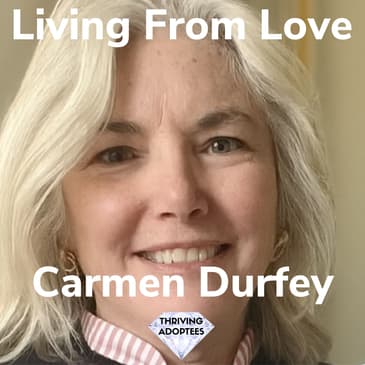
Where are you living from? So many of us spend so much of our living from fear, worry and anxiety. How does this change? Listen in as adoptee Carmen shares her insights into living differently. Living from love.
Here's a bit about Carmen from her website:
Carmen is happily married for 40+ years. She is the mother of four and grandmother of six. She loves all things outdoors and anything related to water. Her passions are her work as a paraprofessional, writing, her faith and her family. She will always find a way to laugh at herself and find the bright side
More at
https://www.instagram.com/spaghetti.memior
https://www.amazon.com/dp/B0G1LK9B9S
Guests and the host are not (unless mentioned) licensed pscyho-therapists and speak from their own opinion only. Seek qualified advice if you need help.
Want to learn more about thriving for you, your kids, your families or your colleagues? Pick a time to talk here
[00:00:02] Hello everybody, welcome to another episode of the Thriving Adoptees podcast. Today I'm delighted to be joined by Carmen, Carmen Durfey. Looking forward to our conversation today, Carmen. Me too. Yeah. And Carmen is up at a ridiculous time of the day to talk to me. So thank you for doing that. I appreciate that. What time is it with you? 4am? 4am. 4am. Yeah. Kind of nuts what we do, right?
[00:00:29] I'm better in the morning than I am at night, truthfully. Yeah. Me too. Me too. I've noticed that in the morning I'm at my clearest in terms of the amount of crap that's on my mind. It builds during the day. So earlier in the day I've got less on my mind. Yeah.
[00:00:55] Yeah. And I'm a lot more focused on, yeah, I'm just, I'm better. Yeah. So, Thriving Adoptees, what does that mean? Oh, ladies and gentlemen, listeners, Carmen is an adulte, right? So, Carmen, what does Thriving Adoptees mean to you?
[00:01:13] I would think, when I think of Thriving, I think of not, honestly, probably not living in fear is one of the first things that comes to mind and living with purpose and peace. Yeah.
[00:01:37] So, would they be the opposites then, living in fear and peace? Is peace the opposite of fear for you? I think so. I think so. Yeah. In my mind, it seems like a lot of the times when I've been very, very fearful about something is when I haven't been able to find purpose and growth because I'm so paralyzed with fear.
[00:02:10] Paralyzed by fear. Is it a seeing thing? Is it a shading thing? Is it, you know, when you say living in fear, living in peace, I go back to that, what I said about being clearer in the morning. So, clearer and peace seem to be the kind of same thing to me.
[00:02:40] I would agree. I'm more at peace. I'm more at peace at the start of the day than I am kind of at the end of the day. And it's kind of hard to discern, right? Sometimes.
[00:02:56] Right. I would agree because I feel like when, when I, when, when I'm basing my choices based on fear at any level where it's, I mean, like I didn't, one of the reasons I never wanted to look for my biological parents was, you know, fear of rejection, fear of what I would find in the closet.
[00:03:21] Fear of what I, what was the other thing I was thinking that a fear of just the unknown of, you know, what would be out there.
[00:03:40] And once, once I felt like I had a reason to do it, all of those, all of those fears became like clear as fears. And then it was like, oh, okay. I, this is, this isn't, the fear should not stop me, I guess. Yeah. Yeah.
[00:04:07] Yeah. Um, the, the, the, the thing that started me restarted the thing that restarted my search was an anger at the fear. Yeah. Yeah. Like you're not going to control me anymore.
[00:04:33] Exactly. Yeah, exactly. And it, it wasn't, it was, it was instantaneous. It was unsolicited. It was, um, it came out of nowhere. I would agree with that because I was, this is something I was never going to do. And I literally had the thought that it was what I was supposed to do.
[00:04:53] And it was like, but I have a million reasons not to. And one reason, I mean, but yeah, but it was like, oh no. Okay. I mean, But the clarity came first. The clarity, did the clarity come, the clarity come first and then the reasons why not to comes after the brain kicks in. Right. That was my argument in my head is for, you know, I mean, I literally had a clear thought that I would, you know, it's time, it's time.
[00:05:22] And then I had my rebuttal in my head of like, you know, how can it be time for something? I was never, I never had my timeline. Um, and then, you know, all of the, like, I don't want to be rejected again. I don't want to be, you know, I don't, I don't, I don't want to have to find someone who's not capable of taking care of themselves or just any number of, you know, scenarios that run through your head of what you could find.
[00:05:50] Yeah. You said rebuttal. And, uh, and I think of the yeah, but yeah, but so you, we, we come up with something, a new idea. Yeah. And then we have the yeah, but and people don't refer to buts mean buts with two T's.
[00:06:10] Um, it's used in the States, but you know, we don't use that word, you know, talking out of our butt or anything like that here in the UK. That's not a, that's not a, that's not a metaphor. That's not a word we use. But yeah, but you know, talking out of our butt, you know, and it's also, uh, in Britain, because of our strange thing about our manners.
[00:06:35] Uh, people you'll say something to somebody and they'll say yes, but, and they didn't mean to agree with you. Right. So yes. Says, I agree with you. And then, but says, I don't agree with you. I don't agree with you.
[00:06:59] Yeah. Yeah. People don't like to say no, no, no, because that's not polite. Right. Right. Yeah. I'm, I feel I'm taking this down a rabbit hole. So I shouldn't have done. Let me get back to this. So we have an idea. And then the butts come in. And then the fear grows from the, from the butts.
[00:07:28] Is that what you're saying? Mm-hmm. Yeah, I would, I would agree. And, um, yeah. And I mean, I, like an example, it's this a little more dramatic, but when my, um, I have one daughter, well, I have three sons and then a daughter.
[00:07:46] And when she was 16, she got like gravely, gravely ill and barely lived. I mean, she did. And I remember, I mean, I was just, I was absolutely consumed with fear that, you know, that she could still die. And cause she was very sick. I mean, every day it's a dude specialist. And, and, and I remember one day driving in the car with her and just being consumed with fear about all the what ifs.
[00:08:13] And, and I had the thought of like, you're missing this, she's here and you're missing this because you're so consumed with what could be. And, um, it just, and so, I mean, when you talk about like a growth, like growth or thriving, I was not thriving. I was every, every decision I made was based in fear.
[00:08:37] Yeah. So that was one of those things I had to learn to like, okay, I need to let this go and have faith in myself that, that if some, if she did die, it's still going to like, I, I still could function as a human being. And anyway. Yeah. Have you read the power of now? I can't tell you book. I don't know how to pronounce it.
[00:09:06] I don't know that I have. No. Okay. I'll put it on my list. But it's the power of now, right? Right now. Not the future. Right. Um, and, and that's what popped into my head as you were describing it. You said, so you've got these, you've got this negative voice in your head, uh, doom mongering.
[00:09:28] Right. Uh, fear focus consumed by fear. And then on the other side, you've got the power of now, but I've got her now. She, she's with me. Yeah. She, she, she's with me now. And therefore there's a, uh, what is it? I don't know. An argument between the two. You know, is it, is it a dance between the two? What, what, what is it? A fight between the two?
[00:09:56] Yeah. It's probably more, well, at the time, at the time in that situation, it was a full on fight, but now I hope I've learned to dance a little better. Yeah. And, and to, and to recognize those as, as fear-based. I mean, if when, I mean, and we make, we make fear-based decisions every, like every day. I mean, little things like, I mean, just little things of like, if I talk to that stranger, well, they're going to think I'm weird.
[00:10:25] Instead of just saying the dress is pretty or, yeah, I mean, we make, we make decisions all the time based in just little fears. And if we get away with that, it's basically, in my mind, it's basically going from fear-based to probably peace or love-based.
[00:10:44] Yeah. I'm delighted that you said that because what was going through my mind was the difference between coming from love and coming from fear. Mm-hmm. Mm-hmm. So we had, we hadn't got to love yet. We talked about peace and fear. Mm-hmm.
[00:11:07] And, and, and somehow, you know, coming from peace, that, that doesn't, that doesn't run, run for me, but coming from love, coming from love or we're coming from fear. Yeah. Yeah. Are we, is, is love propelling us? Yeah. Or is fear propelling us? Mm-hmm. Mm-hmm.
[00:11:30] And when I've gotten to the point where I actually stop and focus on what my decision is based in, I make better decisions. Yeah. We generally do better, don't we, when we come from love. Yeah. And I make braver decisions. Yeah. The, the other things that's coming for, for, coming up for me is, are we, what, what are we, are we, are we seeking or are we expressing?
[00:12:00] Are we, are we, are we looking for, are we looking for happiness in our reunion, for example? Mm-hmm. Or are we, are we expressing our love? Mm-hmm. Through our actions, through what we do in, in reunion. Right. Right.
[00:12:29] Are we seeking the other, you know, that whole, I'm thinking about the, the, the kind of Western narrative and Western culture, whether we're Brits or, um, Brits or Yanks, right? Mm-hmm. Mm-hmm. Um, we are, the, the, the, the, the culture is all about, think about the music, all the songs about love. Mm-hmm.
[00:12:56] It's about, you know, you, you fulfill me, you complete me. Mm-hmm. Mm-hmm. I, I, I, I'm yearning for completion through love. I'm, I want to find my soulmate. I, I want to, and, and if we take, if we take that kind of seeking and put that on to our, to our birth mother or our birth father or biological family,
[00:13:22] if, if we go seeking love, seeking completeness, seeking wholeness, seeking happiness, outside ourselves, within the biological family, we're, we're cooking up a recipe for disaster, right? Yes. And, and, and a lot of disappointment probably. Yeah. So, yeah. Yeah.
[00:13:49] Um, I was actually thinking, so, but I had the thought that I was supposed to search and then, um, I, I mean, they had unsealed Washington's birth records. And so I just, I just wrote the state and they sent me the original birth certificate and it showed up in the mail, you know, like three weeks later. And, and my daughter helped me, um, put her name into Google. And the first thing that popped up was, uh, her name and my birthday.
[00:14:15] So she had put in an adoption search search, like probably like, you know, I think it would have been like 10 years earlier. And the minute I saw, I saw that information. I see that I saw that she had been searching my, my mindset completely changed from what if, what could I find to like, I have, I have to find this woman and answer her questions. Like it went from fear-based to like, just love-based.
[00:14:42] I needed to, I needed to find her to say thank you and I'm great. And I didn't realize at the time how knowing her and knowing her, like her story, like just the gratitude. And like, it just expanded, it just expanded everything, expanded love, it expanded understanding, expanded all of it. But I wasn't going seeking for what she could give me.
[00:15:10] I was, I was like, I got, I've got it. I've got to, if this is something she wants, I have to do this for her. And she got me here. So, but that was, uh, that sounds like it was a complete, complete upending of your belief system though. It, it, it wasn't the fact, it wasn't the fact that, um, so my background is a little like I, I was adopted and then my adopted mother died. And then my dad remarried like, you know, three times after that.
[00:15:39] And, um, so my childhood was not stable and I always, and I'm, I've got a lot of faith and I believe in God. And I, as a kid, my whole question was like, first off, if we're supposed to have families, why did you take my mom? The second off, as I got a little older, it was like, well, if you're in control of this, why would you drop me in this situation? Why would you drop me in this family when you knew all of everything that was going to go on?
[00:16:08] Um, and learning, learning that I was a product of rape and the fact that I'm even alive completely changed. And when I learned everything that she went through, I mean, back then they did not treat these women well in the sixties. So, and, and to realize what she sacrificed, it complete, it just completely changed my perspective of, um,
[00:16:33] it's, it, I went from wondering kind of like, what was, well, if I believe that God is not trying to punish me, then he was trying to teach me something. And I'm like, well, I kind of don't know what I was supposed to learn. And when I meet her and I get her story, I realized, no, he was just giving me the best shot to the life I have now, which I absolutely love.
[00:17:00] So it just, it just completely changed my perspective of, of a why, why would this, why would I be given this to, I'm so thankful I was given my exact life. So what you found out changed your perspective. You didn't change the perspective. The perspective was changed for you by the insight, by the new piece of information. Yes. And it's one of those things that if I lived in fear and never gotten the answer,
[00:17:28] like never searched, gotten the answer for, I would not have had an expanded view of my life, you know? So. Yeah. Have I puzzled you? Yeah. Well, it's just so true, isn't it?
[00:17:55] It is just so, so true. And it, somebody was, somebody was, I was talking to an adoptive mum yesterday and she was talking about mindset. And she said, you know, like, I, I like your positive mindset, Simon.
[00:18:21] And, and, and I thought, well, yeah, I, I, I'm not making this mindset positive. Right. The, the, the realizations that I, I, I have had over my life, they have led, led me to a positive mindset. And I, I think about mindset.
[00:18:49] And I, when I think about mindset, I think about setting concrete. Right. Right. And if, if, if, if, if our minds are, are, are setting concrete, then we're not really open to, we're not really open to change. And what, what you're talking about is a complete shift in your perspective. Which is, it's more about mind fluidity, not about mindset.
[00:19:18] You know? Yeah. And, and, and I saw something yesterday about a, I think I used the word earlier on because, um, it, it, it, uh, it landed for me. And it, the, the, the word was something like, the, the phrase I saw yesterday was, um, an upending of my perspective. Mm-hmm.
[00:19:43] So it turns everything completely on its head. And I think about my, I think about my birth mother. And I think about this idea that I had for 10 seconds that she didn't love me enough to keep me. And then the, the, the lady I was talking to question that, um, question that belief.
[00:20:10] And I saw through, I saw that the thought wasn't, wasn't true. And the thought, so the thought didn't become a belief. And then 10 years later, I, I get this letter about the teddy bear and it, I, I feel her love for me. Mm-hmm.
[00:20:35] So at the age of 40, I've realized that she, intellectually that she didn't reject me. Mm-hmm. But then 10 years, 10 years later, I, I feel her love for me. Mm-hmm. And that's so much more profound. It's a whole body experience. Mm-hmm. It's, it's an, it, it's a, it's an epiphany rather than an insight.
[00:20:59] It's got depth and how, if I, if I'd stayed in that, if I'd stayed in that fear place, I wouldn't have done the searching. But, but I, I, I didn't make the fear go away. The, the, the fear, fear when of its own accord somehow. Yeah. Yeah.
[00:21:33] And what I was hearing from you was like, you're asking God, what do you need to, what do you want me to learn? Mm-hmm. And then this happens and you realize, oh, that's what you wanted me to learn. Mm-hmm. Gratitude. Gratitude.
[00:21:58] I mean, that's the biggest takeaway I came out with was that gratitude for my exact life. Like every bit of it. Like when, when I'm talking, when I'm talking to Joy and, and, you know, she's like, kid, they let me hold you. This story would have had a completely different outcome. And me thinking, I mean, I could have had, I could have had the family. I, that as a kid, I so desperately wanted. She wanted to marry and have four other kids. You know what I mean? I could have had that. But I wouldn't be me.
[00:22:27] And I wouldn't, it wouldn't have gotten me to my life that I have now. And so it was like just the profound gratitude that not only that she gave birth to me, but then that she didn't keep me. And she put me in this life that I thought had been a challenge for me. And it was, there were parts of it that were challenging, but life is challenging. It comes with blessings and it comes with challenges. Yeah. Gratitude seems too small a word for this, can't it?
[00:22:58] Yeah. Maybe. Maybe. I don't know. I don't know a bigger one. Sorry. I know. Yeah. What's a bigger word? Yeah. Awe? Maybe. Are you reading my mind? That's what I was going to say. Yeah. That's what I was going to say.
[00:23:20] I sometimes, anytime I need, anytime I need, get near this word gratitude. I think of the kind of forced gratitude that some adoptees talk about. And, and I see the, I see a huge contrast, huge contrast between our own instantaneous gratitude.
[00:23:49] And, and somebody else trying to force gratitude on us or suggest to us that we should be gratitude. And if, if some, if anybody suggests that we should feel differently to the way that we feel as human beings, we don't really like that, do we? No, no, we don't. Oh, well, I was actually just thinking, I feel like one of the reasons, you mean like forced gratitude of like, I should just be happy.
[00:24:16] Like, I should be happy that I have this home and that, is that what you're meaning? No, no, no. I'm, I mean, forced gratitude, forced gratitude from the outside. You, like, we, we can say, I should be grateful. But other people say to us, you should be grateful. Oh, yeah. You should be grateful. Yeah. When, when people tell us, you, you, you, you shouldn't be feeling this way. You should be feeling that way.
[00:24:46] I, I, I, I, as, even as I just say that, there's, there's a part of me on the back of my neck thinking, you know, how very dare you. Yeah. Like, well, just out of spite, I'm not going to. Just out of spite, I'm not going to. And I think that, um, I, I have a concern that, so I've never been told that I should be grateful. My mum and dad never tell me, you should be grateful.
[00:25:15] That, that, they, that's not sort of, that's not the sort of people that they are. But I know a lot of people, a lot of adoptees who've, who've been told that you should be grateful. And they don't feel grateful. And, and I, and my slight concern is here, and maybe it's bigger than the slight concern is that, that we, we become allergic to gratitude.
[00:25:41] Because at this fundamental level, somebody's told us that we should be grateful. And we don't feel grateful. So. Yeah. Yeah. Yeah. I mean, I, I was actually just thinking, and I think maybe one of the reasons why I, I never felt like as an adoptee, I never felt like I was any different. In my family is because my mother, I mean, she died when I was four, but I do have some memories.
[00:26:09] And one of them was always our story and her gratitude for us. I mean, I was never told I was supposed to be grateful. She told me how grateful she was that she had us. Yeah. Yeah. So. And funnily enough, my, my mom says that sort of stuff to me now. Yeah. Yeah. Whether she told me earlier and I just didn't hear it, I'm not.
[00:26:37] Oh, um, one, um, my dad less so because blokes don't talk about this squashy, lovey, feely stuff as, as much as, as, as women do. Uh, I remember I was in, I was doing some manual labor with my, with, with my dad. We were put, do you call them dumpsters? The big metal containers you put rubbish in?
[00:27:07] Yeah. Yeah. What do you call them? I just want to know the English word. Uh, skip, skip. Okay. Yeah. So we were loading a dumpster or a skip with some bricks, right? We were, he was doing some changes to the, to the house, to, to the garden, in the garden, in the yard, our wall, boundary wall.
[00:27:28] So, and I was just taking a break from that manual labor and looking back at the cars in the drive. And I said to my dad, do you, are you, are you, are you proud of what you've achieved in business that has allowed you to buy these two cars?
[00:27:55] And he said, no, no, no, no, no. But I'm proud of you and your sister. Mm. Mm. And that's what, and he didn't talk about that sort of stuff. Yeah. Yeah. Very often. So when he, when he did, it landed. Yeah. Yeah. It landed.
[00:28:23] And I think there's a, there's a warm feeling that comes with that, you know, which you expressed too. Mm. And I think about the, the, the spectrum of why adoptive parents adopt.
[00:28:45] And at one end of the spectrum, I hear about one adoptee said, well, I, growing up, I realized that they only adopted me. They only adopted a child to look good at church. Mm. Mm.
[00:29:11] And I think that, that, that, um, narcissism, narcissist, narcissist word is a bit overused at the moment. If you go on Facebook, everybody, everybody in the whole world, every, well, especially every bloke, right? Every guy in the world, every one of us is a, is a narcissist apparently. But it's, it's, it's, it's, who, who are we adopting? Who are they adopting for?
[00:29:40] Are they adopting, are they adopting for them or are they adopting for us? Uh-huh. Uh-huh. Well, it's probably, it's probably both. I mean, you know, I mean, I, I look at my parents' situation, my adopted parents' situation, and she was chronically ill. I mean, she, they had her first three babies died and then they had two more.
[00:30:07] And then the doctor was like, you shouldn't have, you know what I mean? You can't do this. And they wanted more kids. But, um, I mean, I mean, nowadays there's just no way they would have given them babies. I mean, she, she had type one diabetes that back then they didn't, you know, they just didn't treat well.
[00:30:27] And so, I mean, my, my dad adopted my brother and I probably knowing full well he would end up raising us without her at some point. So, or maybe he thought he was going to get a miracle. I don't know. But, yeah. But so I'm sure a lot of that was like, this is, this is what she wants. Okay. I give it to her. Yeah. Yeah. But.
[00:30:54] I want to take you back a bit to the, to the, what's the difference between, because you use that or word. Yeah. So how do you see the difference between gratitude and or? And or gratitude and or. Um, I, I feel there's just, I guess the word I'm thinking of there's, it feels to me like there's more reverence with awe. Yeah.
[00:31:24] There's just a bigger, it's just, it's just bigger and so much more intricate. Um, and when I think of like, um, after I found joy and I learned my whole background and her whole background, the, I, the awe of that I felt like I needed to have for every person and every person's story. Was immense. And it wasn't gratitude.
[00:31:51] It was like absolute awe for everything you've experienced and how intricate it is and how it's made you, you and just what a miracle we all are that we walk around and function. You know? Yeah. And what, how, how does all impact fear? Yeah.
[00:32:20] Well, I, if you, if, if I come from a place of awe with anyone I encounter, I'm no longer, uh, I'm no longer fearful of, um, your judgment or your, um, I just want to help.
[00:32:42] I, you know, I, I, I go from fear-based and like, you're not like me or, or you're going to think I'm weird or any other fear I could possibly have to that person in the grocery store behind me. Um, I, I, I am in awe of just you being here and being you.
[00:33:03] And I'm, I'm going to look out for you instead of, uh, instead of not paying attention, I guess. Yeah. But you, you had to have, did you, you found, you found the awe for yourself before you started sharing it with others? Presumably. Oh yeah. Yeah. Yeah. Yeah.
[00:33:29] You know, I, the, the, the thing that came to mind for me was that, uh, gratitude, sorry, awe, awe, uh, eats gratitude for breakfast. Yeah. Yeah. Yeah. You know, awe is in a different, it's a completely different ballpark. Yeah. Go ahead.
[00:33:57] It's a complete, it's a completely different magnitude. Yeah. Yeah. I remember. Yeah. I remember thinking like that, um, you know, I always, I was always grateful that this woman gave birth to me and placed me for adoption and allowed me to live.
[00:34:18] But it wasn't until I learned her story that the amount of awe I had for it wasn't, it wasn't, this is no longer gratitude. This is so far beyond gratitude, what she did for me. Yeah. Yeah. So it's, it's awe inspiring. Yeah. Yeah. Yeah. I want to read something that you, that you said to me, um, on the email.
[00:35:25] Okay. And then in that conversation, she informed me that I was a product of rape. Learning this information and my list, learning this information changed my entire perspective on life. I no longer felt overlooked by God. I felt he had a purpose in placing me where he'd placed me to get to in this life. I have now, it placed me to the life I have now. It was just a complete perspective shift.
[00:35:53] Just a complete perspective shift. So that's, that's taking you thriving to a different level, isn't it? Yes. Yes, it is. Yeah. And, and well, and that's it. So the, my, so my birth mom's name is joy, but so the title of the book was spaghetti, lemonade and finding joy, which is like a dual meeting with finding joy.
[00:36:23] But I would have told you I had joy. I would have told you, you know what I mean? And my life was good and my life, you know, before this. And it, it wasn't, it wasn't like, um, this nagging, like. Like, I mean, there, I didn't have this nagging hole about these questions about like why I got placed where I got placed.
[00:36:49] But finding her feeling like I needed to answer her questions. Like it, it, it gave me answers. I didn't even know I wanted or needed, you know, but I also, but I also think of like, even the timing. Like if, if I would have gotten the same information when I was 20, I wouldn't have had the same perspective. It would have, it would have been a completely different. It would have been all about, it would have been fear-based. What does this mean about me?
[00:37:18] How, how does that information about my father change me? Yeah. You know. Tell me about the book you mentioned. Oh, it's called, well, it's just a memoir. It's called Spaghetti, Lemonade and Finding Joy. So it took me forever to write. Yeah. Yeah. Cause I didn't know how I was doing. Yeah. It does tend to take us a long time to write the memoirs, right?
[00:37:48] Yeah. Yeah. So, and, and it started out different. I remember like the night after I met joy at the first phone call was there the next morning. I told my husband, I need a laptop. Cause I need to write, I need to write some stories for her to fill her in on the childhood that she missed. Um, and so it was just going to be all the funny things because I did, I did grow up with a lot of freedom and, um, I ran wild and it was great.
[00:38:16] But the more I, the more I wrote, the more I, the more I was like, nah, that's not the story I'm supposed to tell. This is the, I'm supposed to, I'm supposed to, I'm supposed to, I'm supposed to tell a story that shows how, um, just God has his hand in every, every single life, every single life. And I need to have offer every single life and every person I encounter.
[00:38:42] So if I, if I, if I approach everyone understanding, if he, if he did this for me, if he, if he, if he had this much interest in me, he has just, he has that much interest in you. And I need to be respectful of that. Yeah. But yeah. It's incredibly powerful stuff.
[00:39:12] Well, glad you think so. Yeah. Well, it's, it's unmistakably powerful. The power is unmistakable. So, but it's not me. So it's not. Yeah. It's, it's not personal, right? Yeah. So you, you, uh, it doesn't need to be, you don't need to be modest about it. Do you?
[00:39:41] If it's not you. Yeah. Yeah, that's true. Yeah. Yeah. If it's, if it's universal. Yeah, that's true. That's absolutely true. Yeah. Yeah. And I should be much bolder about it, actually, if it's universal. I don't know whether you should be. It seems pretty bold to me. Okay. I think, I think it's, it's pretty bold to me. But, um, what, what did you learn writing your book?
[00:40:12] I learned that writing a book is really, really hard. No. Um, what did I learn from it? Um. Had you had the joy, had you had the shift from gratitude to awe before you wrote the book? Oh, yeah. Oh, yeah.
[00:40:37] I mean, it was, it, it was, it literally like for probably six months after, like for six months out, I was just like, gonna, you know, I'm just like that. Oh, you know. So, and, um, so I had had that shift. Um, it was more, I guess, I guess it was more like, cause I wanted to tell her story too. And it was, it was really more just what I learning really how she got treated.
[00:41:06] I mean, her mom didn't believe her. Of course she, you know, she gets raped in college. She doesn't tell anyone because you don't back then. And then, then her, then she's pregnant. So her mom doesn't believe her and they ship her off. She has a baby. She comes home. And I am like, it is never, never discussed. I mean, can you imagine your 21 year old daughter and you never, she walks back through the door without her baby. And you don't even say like, how you doing? What can I do for you?
[00:41:35] It was, it was so really what I learned was just the really what her sacrifice was. Yeah. And what I, the other thing that was so, um, when I first found her was that I realized that she has feelings and memories attached to me that I don't have attached to her. And I can't, I can't hurt this woman again.
[00:42:00] Like there was a lot of responsibility that I, when I first made that phone call, I didn't realize the responsibility that was tied to it. You know? So. Yeah. Well, if, um, we talked earlier on about coming from fear or coming from love. What about coming from awe? Yeah.
[00:42:30] Once again, awe is just so, it's so much bigger. If I come from awe, then every, every day is a good day. Like even in, even in the really, really hard stuff. I think that's a lot of with fright thriving to it. Even in the really, really hard stuff. If you can find purpose. And I know there's things that like in the day you're like, what there, there can't be a purpose behind this. But there probably is. You just don't know about yet.
[00:42:58] Did, did you ever read the hiding place? No. It's, it's, it's actually quite remarkable. It's about these two little, um, I think they're Polish. Anyway, they hide Jews through world war two. Okay. And they get caught and they get put in a concentration camp. And, um, one of the sisters there's, there's the sisters and one of the sisters, they they're in this barracks that is completely full of fleas, completely full of fleas. And her sister prays every night. And her sister says, you know, in her prayers, thank you for the fleas.
[00:43:28] Like she's thanking God for everything. Thank you for the fleas. And her sister is like, absolutely not. I refuse to thank God for the fleas. Like, are you kidding me? Um, and years, years later, years later, um, she, she goes on speaking to us and she's, you know, she does, she speaks all over the world. And I think, I don't, I think she's passed on now, but anyway, she had an old guard from the prison come up and tell her, do you, and they have, they had more freedom in their barracks than anybody else. And do you know why they had more freedom?
[00:43:58] Because of the fleas. So she did learn years and years down the road that though, that this, this curse that her sister was praying, they thank you for really did turn out to be something. That had blessed them. So I think that that is a lot of it is just having, recognizing that even the hard stuff has a purpose. Yeah. So.
[00:44:26] What, what if people talk about, um, coming from love, coming from fear and some other people talk about us, us being love. It, it, it is, is, is God love? Are we love? Are we, are we God? Are we, are we, or what, what do you make of all that? I think God is love and awe. And we're trying to be, if we're, if, if we're really trying to seek him, then we're trying to be, but we don't get it right.
[00:44:55] All that, you know, we, we, we get it wrong a lot, but that, I feel like that's the goal. What's the goal? Is to live in that place of love. Yeah. I feel like it's the goal. And some days I do it well and some days I don't. Yeah. But it's not a trying thing that this all came to you. You didn't make it happen. It wasn't like, you know, it wasn't like an affirmation that you wrote, wrote in lipstick on your, uh, on your, on your bathroom mirror.
[00:45:24] I, I must be more all awesome today. That all came to you through a, an insight, a perspective shift. Yeah. You didn't make it happen. You, it, it, it found you. That's true. Then that's death. I would say that's 100% of God thing then. Yeah. That was a gift. Yeah. Yeah. And then it's my job to like project that.
[00:45:54] Project it. Yeah. And they, you know, the irony of this is, is joy helped you find joy. Exactly. Exactly. That's what I was like. Well, her name's a gimme for a book. Yeah. Like. Yeah. Spaghetti. Joy that I didn't even know I needed. Like joy.
[00:46:22] I didn't like, I mean, I would have told you I had joy, but I went from joy to awe. Yeah. It's, um, it's a different level of joy. Yeah. Yeah. And does that, does that come in as, as the fear evaporates? The joy is closer to the surface?
[00:46:52] I believe so. I, yeah, I believe so. Um, I mean, yeah, well, I think so in a lot of this is cause I mean, I don't even, even just the, the fear of like, let's say I'm going to write a book. Like, where does that come from? There's a million reasons not to. Yeah. Um, but you know what I mean? Yeah.
[00:47:16] So no, I think, I think it has, it has, it has pushed fear out of a lot of the way of, of, of things. Yeah. The, the all has. Yeah. Yeah. It kind of, yeah. It's, um, it, it's kind of, it's kind of like if, if, like, what do I, what do I have to be afraid of?
[00:47:46] Like what it's kind of like, if, if this guy has this much hand of a, has this much, um, involvement or interest or invest in my life, then. And so what if I fail? Just try it. Just, just, just try. What's the, what's the worst that's going to happen? You're going to learn something.
[00:48:16] Feels a good place to bring it in, Carmen. Thank you. And thank you. Thank you. Thank you. Um, Zoom is just, uh, playing around with it. So it's just changed the system and I can't figure where to, oh, there we are. So, sorry, listeners. I'll know better next time. Thanks, Carmen.
[00:48:46] No, that's good. Can I just tell you, like, thank you for what you do. Like, you really are a positive light. And it, and you, you're, you're a good, good soul. You're a good guy. So. And I'm still recording this, right? So I could just. Well, make sure you leave that part in. Thank you. Thank you for your lovely comments and thank you for sharing the light this morning.
[00:49:14] So, thank you. Thanks, listeners. We'll speak to you soon. Take care. Bye-bye.