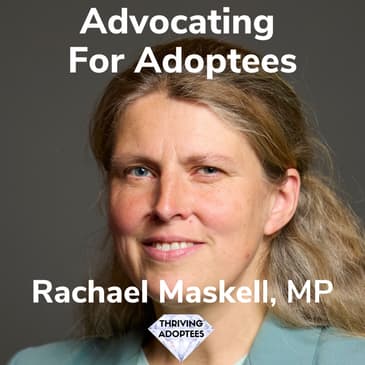
What can we learn about from someone who advocates for us from within the system? What life is really like for today's young adoptees? Listen in as Rachael Maskell, MP for York Central shares her insights and vital research.
The All-Party Parliamentary Group for Adoption and Permanence (APPGAP) was established in February 2019 and aims:
to amplify the voices and experiences of adoptees and those in other forms of permanence and their families,
to inform parliamentarians,
to promote the development and implementation of effective policy and practice.
The APPGAP is chaired by Rachael Maskell, MP for York Central. Charities Adoption UK and Home for Good provide the secretariat for the group.
The group has conducted three inquiries since its inception.
The latest of these, Adoptee Voices (13 – 25) (link) focuses on the experiences of young adoptees in their teenage years and through the transition to adulthood. It spotlights key issues for young adoptees across the themes of identity, mental health and wellbeing; and education.
More info at:
https://www.rachaelmaskell.com/
https://www.facebook.com/rachaelmaskell4york
https://www.instagram.com/rachael_maskell/
Guests and the host are not (unless mentioned) licensed pscyho-therapists and speak from their own opinion only. Seek qualified advice if you need help.
Want to learn more about thriving for you, your kids, your families or your colleagues? Pick a time to talk here
[00:00:02] Hello everybody, welcome to another episode of the Thriving Adoptees podcast. Today I'm delighted to be joined by Rachael, Rachael Maskell. Looking forward to our conversation today Rachael. I'm delighted to welcome you to the show. It's great to join you as well and I'm looking forward to our conversation. So this is going to be a little bit different listeners because Rachael Maskell's an MP here in there. She's MP for York which is about 12 miles away from where I live.
[00:00:29] And Rachel's been doing some great work over the last five, ten years is it? I mean you've been in this trying to fly the flag for adoptive families for that time right? Well that's right. I mean one of my very first surgeries family came to me and brought to me some of the challenges they were facing.
[00:00:53] And it's not long after government introduced the adoption support fund as it was at the time. And so there was some results there but it was a multi-agency challenge that they were facing with the local authority, the police and education. And it was really complicated so I sought to try and find resolution but also health services were a part of that.
[00:01:20] And I think there was a number of cases then that came to me in quick succession and there wasn't an all party parliamentary group which is a mechanism in Westminster we use for being the champion of the voice of people with the experiences whether adoptees or adopters.
[00:01:39] So I set up the all party parliamentary group with Adoption UK and also jointly we did that in order to bring forward a body in parliament which is there to be that voice,
[00:02:04] to be that campaigning place to champion the needs of both adoptees and adopters and yet really, really important. We also shared the Secretariat with Homes for Good and both organisations have been absolutely amazing I have to say in the all party parliamentary group.
[00:02:28] So yeah, we're a team and we do whatever we can in Westminster to try and advance the needs of families which experience adoption. Yeah. So if you're in the UK, right, and you're into this, the talks with us that Rachel was talking about, you need to check out the links in the show notes.
[00:02:49] And one of the key things in the show notes is a report into Adopti Voices that Rachel and Abcap commissioned. And I've been sharing that report across my channels as far as I can since it was released in January this year.
[00:03:13] And so if you're in the UK, then check this out and this is where you, this is kind of the place to be. This is the hub, right, for our advocacy for change, for our advocacy for supporting adoptive families.
[00:03:29] And if you're not in the UK, the findings of the report are nonetheless valid for you because having interviewed people from all over the world for the podcast, I can see that many of the issues that we have here in the UK are mirrored in the US, in Canada, in Australia.
[00:03:53] These, the emotional issues of adoptees are all kind of worldwide, adoptees and adoptive parents. And this desire to encourage more people with lived experience and adoptees to drive change within the system is a worldwide thing, worldwide thing too.
[00:04:19] So I'm wondering, can you share some of the most important findings from this Voices of Adoptees report that you released? Of course. I mean, the report itself, first of all, to say it was young people who were adoptees that spent time together.
[00:04:38] So they determined the terms of reference, they determined what they wanted to focus on and they had the conversations with others as well as through surveys. So it was a very raw take, I think it's fair to say, on what adoptees experience.
[00:04:57] And they looked at a number of areas, particularly looking at things like education, healthcare, their own kind of emotional navigation through their own experiences. And really brought to the fore some of the challenges they face, some of the incredible barriers which they have to overcome. Some of the ways that systems certainly are not working for them.
[00:05:27] I mean, for instance, when healthcare asked for people's medical history and family history, and of course they would not have that information to hand and access to birth parents' medical history. It's not easy to come by. So just ensuring that systems and organisations are aware of adoption and some of those barriers would massively help individuals.
[00:05:55] But I think really what I drew, and they were very powerful sessions that they ran, and very honest as well, is kind of bringing forward that complexity of emotions that young people are trying to navigate. And I know also from the adopter's perspective, they're also trying to navigate a complexity of parenting and different emotions.
[00:06:22] And I think sometimes it really reaches that point of harmony, but sometimes there are different expectations. Or when I pulled out even more, a belief that there were different expectations. So trying to live within the character that you think you should be or are expected to be. And that was complicated.
[00:06:42] And I think it was very powerful how the young people discussed that, you know, and how they had to suppress other emotions in order to pursue that. And sometimes that exhibited itself in positive ways and sometimes in negative ways. And that's a huge toll on a young person, not least if they're a teenager and going through all the things teenagers go through.
[00:07:08] And I think we, for some people, they don't experience trauma for no experiences, but other people significant trauma. And we've got to recognise the challenges of that. And as a result, keep looking back at the system to determine what could help people in the future. I mean, we know that adoptees, for instance, increasingly would have come from quite a challenging family home.
[00:07:37] That there's a high proportion of young people who would be neurodiverse, that a higher proportion than normal that would have fetal alcohol spectrum disorder. As a result of that, that presents challenges for any parent. And if you layer that with issues around detachment, trust, confidence, that can display itself in a number of ways.
[00:08:05] And I think we're learning so much on the all party parliamentary group about how do we ensure that we work really closely with people in the system. These young adoptees, I think, just are such powerful voices for their peers to ensure that the work that we do is really co-produced.
[00:08:27] So that young people are very much at the forefront of what we're doing, but also parents as well, so that they've got space to talk about some of the challenges, the backup they need from the education system, the health system, the police sometimes, the criminal justice system. And one of the things that it's really come down to is ensuring that there is on-demand adequacy in support.
[00:08:53] And I'm really glad that the government are looking at this. The Adoption and Special Guardianship Support Fund is now the mechanism through which people can access resource to be able to get therapeutic help. However, the resource has been cut in two. And now you can only have either an assessment or therapy. And there's no point in having an assessment if you're not going to have therapy to follow.
[00:09:21] So government have got to fund that adequately, as has been done before, but also ensure that one of its concerns is the high number of providers in the private sector. And I think we've got to pull that more into the stashery sector, whilst at the same time ensuring this prioritisation for people who are care experienced.
[00:09:46] And finally, on this side, I would say that I do welcome what the Labour government are doing, ensuring those key transition points, particularly between primary and secondary school. There is proper support for families at that juncture, because we know that that is one of the most difficult transitions that young people have to make. So some really positive work happening there.
[00:10:09] But it's been incredible pulling together, I think, of real lived experience and it kind of untainted by other voices. This, I have to say, in my 11 years in Parliament, this was the most powerful report that I have ever picked up and read. Wow. And I guess that fuels you to do more work and more advocacy.
[00:10:35] And it's strange for me when I think about advocacy coming from outside the system. But you're a Member of Parliament, you're in the Houses of Parliament advocating for change kind of within the system. So what fuels you in this area, Rachel? You've alluded to the, well, not alluded to, you mentioned that the support's really, really important to you.
[00:11:05] But what fuels you and what advice, guidance, insights would you share with other people that are listening that want to advocate for change more effectively? To kind of want to raise their level in terms of their advocacy, the impact of their advocacy?
[00:11:27] I think, again, it came out in the report and some of the findings there, which kind of fuels me. And if you allow me just to run through some of the key findings of the report, I mean, 92% said adoptees need specialist help to understand their past. So I think we have to understand that that's got to be available for all adoptees.
[00:11:56] One in three of adoptees said they do not feel confident, know identity or fully understand their own story. That's got to be addressed as well. And with proper therapeutic input, that can be addressed. And also half of adoptees, young adoptees said that they do not feel part of any community that truly understands them.
[00:12:21] And I think one of the powerful things I, when listening to the evidence as they were gathering that, is that they found a peer group who they understood each other's journeys. And I think that was so important for them because some of them hadn't had those conversations before. So I think being able to get that support was really important.
[00:12:48] And then some of our other findings went on to say that, you know, 83% of adoptees need more help in school than their peers, managing their feelings and emotions. 71% said that they need extra support to do well in education. They want to do well. They want to get on. And we heard from people that have done incredibly well as a result of the support they've had around them. And so education was really important to them. They want to learn.
[00:13:17] They want to continue training. But not all of them felt settled in an education environment. And we need to have a real think about what that means for our young people. So massively powerful in what they kind of said about their own journeys.
[00:13:40] And it wasn't so much the statistics as the stories that followed that really brought to the fore the challenges that young people are experiencing in different, different ways. So we've got to absorb that and recognise it and to be able to address it.
[00:14:02] And as I've kind of said, already layered with, I mean, 62% of people that were surveyed for the report experienced autism or other forms of neurodiversity. So they've got those layers. 51% of adoptees said they wanted mental health support. So we've got those kind of interactions as well.
[00:14:24] So I do think it kind of says they really do need peer support, professional support, family support. And that doesn't come cheap. And if we are going to prevent a family breakdown, if we are going to ensure that these adoption processes and then families really have the bonds and connection and support they need,
[00:14:53] then it's so, so important that that therapeutic support is there and whether or not that's increasing the budget for individuals or finding a better pathway into public services. I really do think that we have got to make that investment. So it's the right thing to do.
[00:15:16] But I think ultimately making these connections is really, really important for adoptees because it's like they came to life in each other's company, which is beautiful to see. But often you can feel quite isolated or lonely because your story is different.
[00:15:33] And being able to find those safe places to explore, discuss what you're going through with people that are also on that journey is just central to people's own experience. And that's, I can only echo that. That's part of the power of this podcast and there's loads of other adoption podcasts are available, right?
[00:16:01] So that is the power, the power of shared experience. What's coming out really loud and clear for me is that there are implications here. Sorry, it feels to me that people were able, young people, teenagers were able to be honest and open with you in a way that, and the people doing the research, that perhaps they're not, they don't feel safe to do with their, for their parents.
[00:16:30] So adopted parents listening should be looking at this, looking at this report for an insight into the things that perhaps their teen or their adoptee child, adopted child isn't saying or isn't saying yet. There's a, there's a, there's a powerful volume of information that we all need to be, that we need to be aware of, right? You know, I think, I think you're right.
[00:16:57] And, and of course, I would say the same goes for adopted parents as well. So I attend York's group where adopted parents will come together. And I think it's really an important space because they need to learn from one another and share those experiences and also provide advocacy for the things that they need.
[00:17:18] So, you know, I think it's on all sides that just having that safe, safe spaces is really, really crucial. And I think particularly you may be the only child in your, you know, in your community, there may be other children.
[00:17:35] And I think to be able to just get together and support each other, you know, it's, it's really, really central really to be able to almost normalize some of those experiences that you've had for yourself. And to say, actually, other people who have got that experience of adoption, they're the same. I'm not, I'm not a kind of out there as being different from them.
[00:18:05] So I do think it's really healthy to be able to do the peer support that's needed. And of course, age appropriate because younger children will experience something different to, to teenagers and young adults. Yeah. Is that an Adoption UK, the York group, the York Adopted Parents group? Is that your adoption? It's a local group which was set up with parents. Yeah.
[00:18:31] So, yeah, that's, and I think, you know, I know other areas and they are supported by One Adoption York show and, you know, they'll come along and engage because we want to get the system right. I think everyone in the system, whether it's City of York Council or others, really doing some incredible work in this space.
[00:18:52] I have to say, City of York Council went from requiring improvement to outstanding in all areas in children's social care in just a couple of years. And because of new leadership and it's been a phenomenal journey that they've been on there to ensure that children are front and centre of everything they do. Yeah. Interesting point.
[00:19:18] You know, as I said, you know, we're putting the kids, we're putting the kids, the children and the teens first, the adoptees first. For them to thrive, their parents need to be thriving. And for the parents to thrive, the people within the system that are supporting those parents, they need to be thriving too.
[00:19:43] So how do you see changes in that space in terms of the well-being and the empowerment of the professionals that support families? Well, I can only talk on a local basis, really. And kind of having worked very closely with the work that's going on in York.
[00:20:04] And I think, first of all, they adopted a new approach to children's social care to ensure that people with lived experience were at the heart of everything they did, which means co-chairing all the committees and support and interviewing social workers and really being at the centre. It's so child-focused or young person-focused.
[00:20:25] And beyond that, really reflecting back on what young people through the care system have asked for and then supporting people in that way. Of course, everyone's journey will be different. But I think what they first of all looked at is how do we prevent family breakdown in the first place? And are doing a lot of work in that space.
[00:20:51] And, you know, I'm very focused on the 1001 Critical Day Agenda so that we're really supporting parenting at the earliest possible point. Because that's how you can have the best impact is to keep the birth family together. But of course, that's not always possible. And I recognise that as well. It's so important that children are kept safe. And where interventions don't create that safe environment, then, of course, the welfare of a child needs to be put first.
[00:21:21] So from that to having a look at how, you know, there is good support for parents in the system. And I've been talking a lot with government ministers about this. And not least in the light of a lot of the work they're doing with special educational needs and the reform of the system there is saying, well, many of the young people who are adoptees will also have special educational needs. So we can't just put children in boxes.
[00:21:51] We've got to look at children holistically. And as a result of that, recognising the protected characteristic of care experience, I do believe is really important. Because it talks about a possible pathway of need and additional support. And I think if we then normalise under that, it doesn't stigmatise individuals.
[00:22:18] And I think we've got to move away from just labels, but ensure that we're creating that environment which is trauma informed. And during COVID, our group in Parliament, we met with an incredible school in North Lincolnshire, where the head was an adoptive parent. And he talked about how he had transformed his school into being trauma informed and really inclusive for children who had experienced adoption.
[00:22:47] And it was a primary school. So it just shows that actually, if there is proper training and support, it can be done and can be achieved. And it is better for all the children to have those kind of approaches. They're looking at attachment at an early age, looking at kind of the wide support needs and wellbeing needs.
[00:23:09] Because we know that ultimately, you know, we've got to think, and this is City of York Council's thinking, is we can't just look to how a child is now. We've got to think about what they're going to, how they're going to be when they're 20 and 30 as flourishing adults and what those pathways are.
[00:23:30] So putting in good foundations, but also supporting people and recognising for adoptees is not a moment of adoption. It's a life course. And we've got to ensure that that support is available for anyone when they need it.
[00:23:49] And so, you know, it's a lot of people, you know, young people or older people that are normally there, they need additional support because it brings up a whole different layers of challenge and trauma or confusion or all of those emotions.
[00:24:16] So we've got to see this as a lifelong journey. Yeah. So what message, what's the key message that you want the listeners to hear in terms of all the work that you're doing to improve outcomes for adopted people? Yeah.
[00:24:38] I mean, if I may, I know that, first of all, there is a piece of work that we're kind of focused on, and that's on the historic forced adoptions. And we know that their prevalence, obviously, in that post-war period into right through into the kind of 1970s, you know, there has got to be a public apology.
[00:25:05] And we are working on that because I think it's really important that there's acknowledgement the state was aware. And I do think it's really important that it's recognised with reparation. And other countries, in fact, other jurisdictions in the United Kingdom have been on that journey. And I'm urging our government to recognise that.
[00:25:27] Secondly, I do think I'd say to people who have got adoption experience is that they've got a voice. And there's many parliamentarians I was talking to MP who attended the launch of our Adoptee Voices report. And he said he just wanted to come along and understand more and had a real interest to do that. And therefore, I'm really encouraged to go and talk to your MP.
[00:25:58] Tell them about the experiences, what, you know, with the shortfalls and what you need support with. I think that's important. And then for public services must absolutely be heard at the heart of everything. And finally, for government, we need to see this as an investment in supporting, first of all, the families,
[00:26:22] but also the kind of wider emotional needs and ensure those services are in the right place at the right time. And to really understand that. But I think with all of this, we've really got to ensure that we are led by those people with different experiences of adoption. Because not only are their stories more real and more powerful, but also within the, it will contain the solutions. Yeah.
[00:26:51] And in terms of Adoptee Voices, this is just me chipping in here, listeners. One of the things that I'm very keen to do is to interview younger adoptees for the show. So we've had 650 odd interviews so far. I would probably less than 10 have been people, young people under the age of 30. It's often been my own generation of adoptees that have been interviewed.
[00:27:18] I have interviewed, met some younger adoptees, interviewed them both here in the UK and from the States. But we need more. We need more on the show because their experiences have changed. Adoption experiences and more open adoption leads. We need to capture that within what the learnings from those adoptees are in terms of what helps us thrive.
[00:27:48] And just a question that I haven't yet got to the bottom of, Rachel. I don't know whether you'll have an insight on this or not. But here in England, I think there's like two and a half thousand, three thousand adoptions last year. And those are the numbers that I can hear mentioned. Have you got an idea of how many of those are removals rather than voluntary placements?
[00:28:16] Have you got an insight into that? I think the vast majority of adoption cases in this day and age are a child that is being removed because they are a child in need. They are a child that needs to be kept safe.
[00:28:33] And ultimately, I think things will change on the numbers because we are putting in the best start family hubs to really put the scaffolding around families to try and support those families as much as we possibly can. If we get into the 1001 critical days, support families during pregnancy as well to be able to develop the parenting skills.
[00:28:58] I mean, I just find it incredible in our country is that it's one of the things least invested in is parenting skills. And it's the most important job anyone can do. So, you know, we've lost things like antenatal classes, parent craft, all the things that used to be there. But also some people do have dependencies and, you know, are in very difficult relationships and sometimes violent relationships.
[00:29:22] And we need to be able to support those families, but to keep your child safe. So it's only at those high thresholds is a child taken into care. But when they are taken into care, it's really important that the system works in the right way at the right pace to minimise the trauma on the young person.
[00:29:45] And also I recognise on the birth mother as well, and I've engaged with many mothers who have had their children taken from them and walked that process of trauma with them as well. But to really ensure that the adoption processes move forward at the right pace, that there aren't delays.
[00:30:10] And often there have been delays because the health system takes time to get appointments and things like that. We need to zip those up a little bit more so that people aren't in long queues because there's a child waiting for their new family. And it's really important that that isn't delayed unduly.
[00:30:30] So, you know, I really do urge all services to work together to prioritise these really important checks and balances that need to take place in the system. And just as we bring it in, Rachel, is there something that you'd like to share that I've not asked you about? I don't think so. I mean, it's been a really great discussion.
[00:30:53] And all I can say is that there's members of the House of Lords as well as the House of Commons who work on this together cross party. You know, there's no politics involved in that. You know, we have fully got the interests of adoptees and adopters. And importantly, look at the issue of permanence as well within our brief. And it's really important to all of us to get it right.
[00:31:22] We've all got different stories as to why this story has come to the fold. Some of the MPs in particular, it's just because the experiences they've had and the challenges from the families they've had. And that's why it's important to speak to those families and get your MPs to join the all party parliamentary group. But also, I have to say, I sit on many all party parliamentary groups, but we get really, really good engagement from the Department for Education.
[00:31:51] They want to be a part of our work. So, and they always attend the events we hold, the launches of reports, and it's a very healthy relationship. So, you know, I think get involved from that perspective. You know, and if you are kind of wrestling as an adoptee or an adopter, just to say that there is support out there.
[00:32:17] And MPs can sometimes help unlock that or certainly be by your side as you work together on it. So, you know, do speak out if you are wrestling in the system somewhere or want to be heard. And I just say to adoptees in particular, your voices really do matter and you must be heard in the system. And MPs can be a really helpful conduit in that. Yeah. Well, thank you very much for your time, Rachel. It's been great.
[00:32:47] And thank you listeners. It's been a slightly different episode, but variety is the spice of life, right? So I hope you've enjoyed it too. I guess if you're still listening to me talking, you have done. So thank you again, Rachel. And thank you listeners. We'll speak to you again very soon. Take care. Bye-bye.