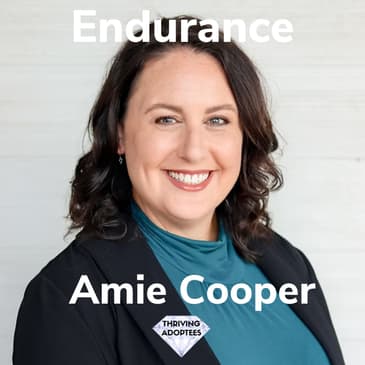
Are you going through tough stuff? In need of a break? Inspiration? Listen in adoptive mom, executive director and counsellor Amie shares insights on endurance, flourishing and more...
Amie Cooper is the Founder and Executive Director of Flourishing Families of South Carolina, a nonprofit organization dedicated to offering hope, healing, and holistic support to families impacted by childhood trauma. With both personal and professional experience in foster care, adoption, and kinship caregiving, Amie leads with profound empathy, authenticity, and insight as she walks alongside caregivers raising children from hard places.
Her passion for this work was born from her own family’s journey and a deeply personal understanding of how trauma, isolation, and unmet needs can affect both children and caregivers. In response to the overwhelming lack of support for families navigating these challenges, Amie founded Flourishing Families to be a source of education, encouragement, and enduring connection.
Under her leadership, the organization provides trauma-informed resources, caregiver coaching, support groups, and strategic community partnerships designed to equip, connect, and sustain families through every season. At the heart of her vision is the belief that no caregiver should walk this road alone—and that healing and wholeness are possible when families are surrounded by the right tools and relationships.
Amie is a TBRI® (Trust-Based Relational Intervention®) Practitioner, trained through the Karyn Purvis Institute of Child Development, and integrates these principles across all programming to promote safety, attachment, and regulation for children and caregivers alike. She is currently pursuing a master’s degree in Clinical Mental Health Counseling, expanding her capacity to bring both relational and clinical support to the families she serves.
A gifted speaker, trainer, and advocate, Amie is passionate about building trauma-responsive communities and creating spaces where caregivers feel seen, supported, and empowered. Through her leadership, Flourishing Families is not only helping families survive hard seasons—but thrive, heal, and truly flourish.
https://www.flourishingfamiliessc.org/
https://www.instagram.com/flourishingfamiliessc/
https://www.instagram.com/flourishingfamiliessc/
https://www.linkedin.com/in/cooperamie/
Guests and the host are not (unless mentioned) licensed pscyho-therapists and speak from their own opinion only. Seek qualified advice if you need help.
Want to learn more about thriving for you, your kids, your families or your colleagues? Pick a time to talk here
[00:00:02] Hello everybody, welcome to another episode of the Thriving Adoptees podcast. Today I'm delighted to be joined by Amy, Amy Cooper. Looking forward to our conversation today, Amy. Me as well. It's a pleasure to be here, Simon. It's a pleasure. Amy's going to be graduating next month with a, what's the qualification? Masters? Is it a Masters? Yes, Masters in Clinical Mental Health Counselling.
[00:00:29] Clinical Mental Health Counselling. Wow. And she leads, well you started it right? You started Flourishing Families in Columbia, South Carolina. So rather than asking about Thriving, we're going to have to ask about Flourishing.
[00:00:51] That's right. Right. So, how come you came up with that name? That's a great question. So, we originated as a faith-based organization and in South Carolina, the famous way you think of South Carolina is the Palmetto Tree.
[00:01:18] And so, our logo for Flourishing Families is the Palmetto Tree and it includes the roots. You can see the roots. You can see the palms at the top. And so, it really has to do with flourishing coming out of what being deeply rooted and having a solid, fertile soil that helps you survive when the hurricanes come. In South Carolina, we get the hurricane season.
[00:01:47] And so, the palm tree actually sways the way it does to withstand the winds, unlike other trees that snap when the winds come through and the storms come through. And so, flourishing families kind of came out of thinking about that visual of families able to withstand complex and difficult circumstances.
[00:02:12] And also, out of being rooted, there's a verse in the Bible that says, the righteous will flourish like the palm tree. So, flourishing like that, despite whatever circumstances come. So, it's really a combination of those two things and wanting to see families flourish in the way that palm trees do here in our state. Yeah. Yeah. Yeah. And I've got your website up, so, you know, I can see the visual.
[00:02:43] But I've been, I've told you, I've been to South Carolina and I didn't see any palm trees. So, I'm feeling kind of left out on them. But are the palm trees on the coast? On the coast. Okay, right. Yeah, I think you were in the upstate, weren't you? Yeah. So, I was in Greenwood, Greenwood, South Carolina, which is... Technically considered part of the upstate. In between the Midlands where I am and the upstate, you're not going to see a lot of palm trees. But the palm trees, you're definitely going to see all along the coast. Right. Yeah.
[00:03:12] Because there's some famous beach spots there, aren't there? Absolutely. Along that coast. And will you, I mean, we're recording this in July, listeners. So, will you be getting to the coast? Do you do vacation? Great question. I need to get there. We have family at the coast in the Myrtle Beach area. And so, we need to get to the beach. We've actually traveled back to the Midwest this summer. And so, I need to get to the beach before school starts, for sure.
[00:03:42] For sure. Yeah. So, what are the qualities that you associate with this palm tree? Flexibility. Absolutely. Yeah. And endurance. Okay. Be able to endure even a whole season of storms, not just one storm.
[00:04:12] And year after year. And remain rooted. And it's beautiful. So, let's break this down then. The flexibility. So, what does that mean? Pat, do you know, I looked at my notes. I couldn't find my notes from last time when you told me about the family, right? So, I'm thinking, how am I going to get away with this? So, I've given the game away now, haven't I?
[00:04:41] So, tell us a little bit about your family and perhaps give us a... Because there's some kinship in there as well, I think. Yes. Yeah? So, I remember that much, but... I've gone a bit red here. I don't know. But perhaps tell us a little bit about the family and then give us an example of what flexibility means to you.
[00:05:09] Because this is about your flexibility as their mom, right? Ooh! That's a tall order to say it's about my flexibility as their mom. I think for us... Tall order? Tall order. Palm trees are tall. They are. They are tall. Okay. That was totally unintentional. Unintentional. But anyway, go back to it. So, tell us a little bit about your family.
[00:05:38] Yeah, so for our family, we... My husband and I, as a young newlywed couple, very early twenties, at that time we lived in Indiana, in the Midwest of America and not here in South Carolina. We started out our parenting journey through foster care. Uh, we started the process of getting our foster license. And in that process, we actually had a kinship placement, a young infant, uh, come live with us.
[00:06:06] And then our next, um, placement was a teenage girl in foster care. And then we very quickly got two more kinship placements who were elementary age. And then right after that, uh, got pregnant. So we went from zero to five kids at rapid speed. Um, and we thought that our family was complete after we had, we adopted, um, four in Indiana.
[00:06:35] And then we had our, a biological child. Um, and we moved to South Carolina really, uh, for the weather to be quite honest and to be near the beach. And we thought coming to South Carolina is going to be really relaxing. And when we got here, we realized the need for foster care was even greater than where we had moved from and realized we had the capacity.
[00:07:01] And so we opened our home again and started fostering, um, and have since adopted four more children. So, um, the flexibility that it takes to parent nine children and the endurance, I guess, are very parallel to that palm tree in the storm scenario. We've, we've weathered a lot of storms as a family over the years.
[00:07:26] And it's been, um, there's been a lot of beauty and there's also been a lot of just clinging to our roots and refusing to be knocked down as a family. Yeah. So one word that I, that springs to mind and, um, is mindset, but that, that, yeah, you, you nodding along.
[00:07:55] Um, that you're, you're, you're, you're faith based organization. So would you, would you say mindset or would mindset be a bit too kind of psychological, if you like, rather than being, being spiritual? What? So we, we take a lot of the science, uh, along with the faith.
[00:08:18] And so even though we're rooted in our faith, uh, the practices that we use are established in the science and what we know helps families flourish. Um, and we serve all families regardless of their faith. And so I definitely think it's a mindset. Um, in fact, we talk about the, the.
[00:08:40] The method or the, the practices that we teach are rooted in trust-based relational intervention, TBRI. Yeah. And it really is a mindset shift. That's one of the main things that we're trying to accomplish when we support families and when we support professionals, anyone who's working with a child who's had significant trauma is to shift your mindset. And adjust your approach rather than focusing on, well, how do I fix this kid?
[00:09:10] Yeah. So how would you summarize that mindset shift? Oh, so the great Dr. Karen Purvis is the, uh, she's there. Yeah. And I think, um, there were a few key things that stood out to me when I first heard of TBRI that helped shift mindset for me.
[00:09:34] And it came directly from her was first of all, stop asking what's wrong and start asking what happened. And look at the behaviors that you're seeing with your child through the lens of their history. When you're parenting a child who didn't start out with you, their history matters.
[00:09:55] And a lot of times parents, we view our children's behavior as a reflection of us or as, uh, a rejection of us sometimes in our role. And that's really not a helpful mindset to have because this child is their own person. We have a role to play.
[00:10:21] And we're not the whole, we're not the beginning of their story and we won't be the end. The goal is to raise adults. And so that mindset shift of instead of making it about how I feel when my child behaves this way, or what it means about me as a parent, if my child is behaving a certain way, I shift it to what happened to my child and what do they need from me? Yeah. Yeah. Um, it strikes me. Um, have you read that?
[00:10:49] The there's a book by Bruce Perry and Oprah Winfrey, a lot of the along this subject. Yes. Yeah. That's nine hours of my life. I won't get back. Right. You, you, you've just summed it up in less than nine minutes. You probably signed up in two minutes. And listening to that book, it just says that over and over and over again. Like I kept on thinking, when are they going to get to the good bit of this book?
[00:11:19] Um, but no, it didn't, it didn't do it for me. And it really, you know, I didn't, the book didn't do it for me because I don't need to be told the same thing for nine hours. What, what you've just summed up in three, four, five, six sentences is, is what the book is. Right. It's just that stretched out for nine hours.
[00:11:43] Um, well, I love that book and I'm coming to it from a different perspective. And so I wonder as an adoptee, if you read that book differently than an adoptive parent, uh, reading that book, because that is when I recommend the what happened to you book by Dr. Bruce Perry and Oprah Winfrey and Dr. Perry, I think was influential, um, as a colleague of Dr. Purvis. So I imagine that's where she got that. Yeah. From his research.
[00:12:13] Yeah. Um, that's interesting. Uh, I didn't know which way around it was. Um, cause unfortunately Karen Purvis is no longer with us. She's, she died unfortunately, but I, I have interviewed, have you met David Cross? That was her. Yeah. Yes. He was a supervisor. I think initially, I don't know. Um, he was her professor when she was doing her doctorate. Yeah. And they together formed TBRI.
[00:12:41] So the way they talk about it is typically Dr. Purvis kind of was the embodiment of TBRI and Dr. Cross followed her around and figured out the science that was the method that she was using. And together they developed the way of being, which is TBRI. Yeah. Cause I've interviewed him a couple of times. A great guy. A great guy. Yeah. And he was in foster care and aged out, right? Did he age out? Or did somebody kind of, I can't remember now. Um, yeah.
[00:13:11] I'm thinking there's a kinship element to his story as well, but it's been a while since I heard his story. You're, you're bringing it back to me. Um, he's such a big thinker. Yes. He's such, he's such a big, uh, such a big, such a big, such a big brain. So wise. And a bit of a, it struck me as a bit of a polymath as well. Like, um, uh, like multi-skilled, like his brain's so big, you know, he can turn himself to lots of, uh, lots of different, uh, lots of different things.
[00:13:40] Um, so the, the, the, the mindset shift then is, is it we're, we've got to change first. They, they, they'll only change if we change, we have to change first. That's a big piece of it. So the first thing you learn when you, uh, go through TBRI training is mindfulness and examining your own history.
[00:14:08] Um, knowing that there's a, this is a relationship. And so I bring something here. So often we're focused on what the child's bringing because oftentimes when there's trauma, the behaviors get loud. You have to notice them. Um, but we, if we skip over noticing what's going on with me, when I interact with this child, what do I bring?
[00:14:31] What does my attachment history and my upbringing and the way I was parented, uh, have to do with the way that I'm parenting this child. If we skip that, we're just going to be applying techniques and we're going to miss the heart of the relationship was, which is the attachment between parent and child. And so that's what I love about TBRI is you can't just check a box. I did this parenting class.
[00:14:59] It's it's, oh, I'm going to adjust the way I approach this relationship with my child. Now we want to help the child learn skills. We want to help the child change behavior. But if we try to change behavior before establishing a truly trusting, safe relationship, we're not going to get anywhere.
[00:15:23] So that the, the, the, the flex, the flexibility, you're talking about a big mindset shift as being the kind of the, the, well, I was going to say roots, but we've used that word quite a lot already. So that's the starting piece of it.
[00:15:40] So I think is, is this about kind of one macro mindset shift and then lots of little micro mindset shift is, is, is, is this, is this kind of a big, a big turnaround to prepare you for smaller turnarounds and, and, and, and the individual. So yeah. Yeah. I would say TBRI is a mindset shift.
[00:16:10] Uh, it is an approach. It's also techniques and it's rooted in science. And so the mindset shift happens and there are practical things of what to do. They have to go together though. If we just do the, here's the practical piece and we, we skip the mindset shift and we skip the relational piece, then it's not TBRI. You have to have both. Uh, it's talked about as a balance of structure and nurture.
[00:16:38] Uh, and so if we have all the structure pieces of TBRI and we miss the nurture, you're not going to see the healing happen in that family and that child. Yeah. Yeah. And endurance was the other word. Oh, so what, what does that mean in this context?
[00:17:01] So many adoptive families, including myself as an adoptive mom come into the work of healing a child who's experienced trauma and think it's not going to take so long. They're going to come into this loving, caring, welcoming environment, and they are going to feel whole.
[00:17:34] Sometimes that happens. Often though, that's a really unrealistic expectation. And this is a long lifetime of healing together and relationship between parent and child and helping your child establish what it feels like to have safe healing relationships so that they can go on and have other relationships that are that way. And it's not a quick fix.
[00:18:03] It's not a, again, you can't just check the box. I did that. I did that TBRI thing. And now we're moving on. It's a long, um, staying power of your presence as a safe, secure base that we call it in attachment science, that the parent can be the safe, secure base, that the child can go out and explore the world.
[00:18:28] And then if they fall down and scrape their knee, they come back and get comfort and then, okay, you're ready. You can do it. And you send them back out. And of course the eventual goal of parenting is to send them out. And then they are able to do it without you. And so endurance and parenting in general, right? It's a long race. Um, I think a lot of adoptive parents though, we think with our rosy glasses, love is going to be enough initially. And then we learn, Oh no, I've got to, I've got to keep coming back.
[00:18:58] I've got to keep doing the work of repairing with my child and, um, measuring success can look a lot different than, than what you originally imagined. So you, you use the word healing. Um, what about our, our own healing?
[00:19:24] And by our, I mean, I'm lumping myself in with adoptive parents. What about, what about parental healing? Absolutely. And that's why the first piece is the mindfulness. If you can't lead a child to a place of healing, if you don't know the way yourself, Dr. Purvis said that.
[00:19:45] And so if you haven't done your own healing work in your own trauma, which many of us adoptive parents, we have our own childhood traumas and our own relational traumas. Uh, and we have not done the work. And then our child comes home and there's a really unrealistic expectation of what this healing relationship will feel like with my child.
[00:20:09] And if I'm expecting my child to meet my emotional needs, I'm setting us up for failure in this relationship. And so, yeah, we have to do a lot of work on our own healing. Um, and as a mental health professional in training, um, I just signed back up for, for my own counseling again, you know, there's been many cycles in my life where I've had to say, whoa, something's triggering me. And I need to work on that so that I can show up as a safe base for my child and all my relationships.
[00:20:39] Yeah. So you said, uh, uh, a way to healing, a way of healing or way of what does that way? What does that journey look like? What are the milestones along the journey or take that journey and just, uh, uh, describe it as. I should like, don't bother about me saying milestones just. No, that that's actually helpful.
[00:21:09] So within TBRI, we're talking about trauma informed parenting, and we're also talking about attachment focused parenting. And so I think about those markers of healing as related to looking at attachment security. And so there are a Jude Cassidy says there are four skills of secure attachment. We want to be able to give care in a relationship. We want to be able to receive care and a relationship.
[00:21:36] We need to be able to negotiate our needs within a relationship and then feel okay when we're autonomous self. So autonomy. So there's four skills. And so that's one way that I measure it, um, is can the parent and child given received care? Some children who've been harmed really struggle to receive care from a parent. You know, they fall down and scrape their knee. They don't want you to give them a bandaid. I'm tough.
[00:22:06] I can handle it myself. I don't need care. And so when that child starts coming for comfort and care, that's a good sign. That's a sign that we're moving closer to that secure attachment relationship. Um, when they can give care, when, you know, mom, isn't feeling well, and she's on the couch, you know, with a fever and a runny nose and they bring the box of tissues and here, mom, I brought you, um, your water bottle. That's giving care.
[00:22:31] That's appropriate in a parent child relationship, um, when they can negotiate their needs. So instead of the, no, I'm not doing it, they learn how to make compromises and, um, how to negotiate at an age appropriate level. You know, Hey mom, can I have 10 more minutes to finish my video game, please. Instead of melting down when they hear a no, that's a way of measuring it. And also are the parents able to negotiate with their child?
[00:22:57] Are they able to offer appropriate negotiations or are they just my way or the highway of parenting that? So that's another way we can measure that secure relationship. And then the autonomous self, I feel like I have self-efficacy. I can do it. Um, I, I believe in myself and my capacity and I don't feel anxious without the other person in the relationship right beside me. That's the autonomy piece.
[00:23:26] So we can measure it. Yeah. So what we're, we're, we're measuring it and, and what helps us increase it? Yeah. So within TBRI, there's the three core principles. There's the connecting principles, which are about establishing a sense of trust and felt safety.
[00:23:51] And so there are lots of things that parents can do to help a child feel safe. I might know my child is safe in my home. My child may not experience that sense of safety. And so, um, providing ways of engaging playfully play helps bring down fear. And so a lot of parents have to learn how to play, to play and enjoy their child, especially when your child's coming home at an older age. Right.
[00:24:21] When, when a baby comes home, you know, you're rocking and looking in their eyes and feeding and soothing. And there's no nose given to that child until they hit the toddler stage. And then that becomes one of their favorite words, right? Cause they're hearing it all the time. No, no, no. But when older children come home into their adoptive family, they get hit with the nose right away. These are the rules. These are the expectations. No, you can't do that.
[00:24:45] And so giving yeses, lots of yeses, finding ways to give yeses that help the child feel safe and feel delighted in. And that playfulness are some really, um, baseline ways that we coach parents, um, to create that sense of felt safety. Um, but they also need that balance of structure and nurture. And so felt safety also comes from predictability. I know what to expect. You're consistent. You show up. Meals are at the same time.
[00:25:11] Um, that helps provide a sense of safety as well and connection. Yeah. So changing tack a little bit, what, what gets in the way of families flourishing? Well, first of all, uh, unrealistic expectations, which I already mentioned, and I'm one of them, right?
[00:25:37] I came into this as a parent expecting that I wasn't going to need help. Like I was going to be enough for my child. And so when a parent experiences the feeling of I'm not enough, I I'm not enough for my child. There's shame that happens in the parent. And oftentimes our parenting tactics are shaming to our child. You should know better by now. I've already told you that, you know, um, why can't you do what I say? Those are all shaming messages.
[00:26:07] Um, and so oftentimes the parents feel shame and the children feel shame. And so I'd say that's one of the initial barriers we see is that shame is a disconnection in a relationship, right? Um, it's opposite of felt safety. If I feel ashamed, I don't feel safe to come to you and express my needs. Right. And if I, as a parent feel shamed, I don't feel safe to go ask for help. Uh, so a lot of times that's the barrier initially. Um, there's also a lot of systemic barriers.
[00:26:36] There's a lack of appropriate supports. And so many times when parents reach out for support, the advice or the help that they're given is contradictory to attachment science. It's contradictory to trauma informed care. And so, um, that can continue to make it difficult when a family reaches out for help early on. And then ultimately.
[00:27:06] You mean like contradictory messages? Yes. If you just punish and you're strict with the punishment and you follow through every time, if you ignore that behavior, if you send that child away, they will learn that that behavior is not okay. Well, for a child who's experienced an attachment disruption, who's lost their initial caregiver through adoption, even infant adoption. Many of the families we work with are through foster care and that child's had multiple caregivers come and go, come and go, come and go.
[00:27:36] When you send that child away to time out. That induces shame. Increases fear. When you tell that child, you know, I'm going to ignore your behavior. Well, they've already felt invisible. Overlooked. So we're looking at, um, parenting a child who doesn't have that foundation of felt safety and secure attachment. We don't want to apply traditional parenting strategies that could further harm that child's sense of self and identity and preciousness.
[00:28:05] Yeah. I guess I'm looking for the upstream of the upstream stuff, the upstream of the behaviors, the upstream of our own behaviors here, really. Uh, so, you know, looking, getting contradictory messages. Mm hmm. That's going on in, in, in, insiders. If you've got a systemic, if you've got challenges on the outside.
[00:28:36] Mm hmm. I guess I'm thinking more around what people might call self-awareness and, and kind of look, looking at. Yeah. You know, you mentioned mindfulness a couple of, a couple of times in, in the, in the old days, not so long ago, people used to talk a lot about emotional intelligence. Mm hmm.
[00:28:58] And, and that, that seems to me, I don't know, but it just, that, that, that does, that seems to have gone out of fashion a bit or people don't mention that anymore. I mean, that's my take on it. I mean, do you, would you, would you agree with that to what, is it? No, I, I definitely have heard of emotional intelligence. Um, I had a former supervisor. No, it's happening in fashion now. I mean, it's gone out of kind of fashion now. Yeah. I had a former supervisor that was big on emotional intelligence and he told me all the time, you're reminding me of him.
[00:29:27] His name is Rex Uberman. And he's since left, left this world as well. And he's precious, dear man to me. He's who brought me to South Carolina. And he would always tell me, Amy, you have really strong emotional intelligence and that's going to make you a good leader. And so you bringing that up is like sweet to me because it's reminding me of Rex. And I think there is a piece of that, that, um, we're not as aware of.
[00:29:54] And that climate, um, I do think emotional intelligence, I'm curious how that relates to TBRI. You have me thinking about it because I haven't considered the connection between the two, but a big piece of what we want children to learn how to do is to understand what's going on in their own body. And we want adults to understand that too. And so it's also knowing when I feel this way, this is what it means, or this is what I need. And so if we teach that to a child, we have to know it ourselves as well. Yeah.
[00:30:24] I think that would be, that would be the, that. That is exactly right. The, you know, part of, part of emotional intelligence. So I try, for example, I know that I can get, uh, my, the hairs on, the hairs on my arm, right. Will stand up. They're doing it now that I'm just talking about it. That's really weird. Right.
[00:30:53] So I know that that can be brilliant. That, that, that can be brilliant news. Hmm. It's the, something, something's resonating really deep in me. So I've got a truth here, right? So I've, I've got a truth. And, but it can also be tricky stuff as well. It's not always brilliant.
[00:31:23] Right. So, so when you're talking about what's going on in your body, you know, I'm, I'm thinking about, we, we say the word emotional intelligence, but I'm listening. I'm also thinking about it somatically. Right. So what's my body trying to tell me is what's going on internally for me at this moment?
[00:31:51] What kind of, what, what's going on? Right. So I, I used to think that the, the hair standing up was always bad, but it's not sometimes, sometimes it's like, I've onto something really, I'm onto something really big here. There's a real meeting of hearts, meeting of meeting more, more than meeting of hearts, a real oneness. Right.
[00:32:15] I'm, I'm, I'm coming into a sacred space of love with the other person that I'm talking to on a zoom call. Right. This is what happens. So it's, it's a real connection.
[00:32:30] Um, so what I'm talking about with the, you know, but so that's really intense and, and, and profound and deep and, and, and it's a gazillion miles away from strategy. Right. Or, or from tactics, tactics, you know, behavior, do this or do that. Right. I don't know whether to do this. Um, TBR tells me to do this. Somebody else tells me to, to do that.
[00:33:00] Just tell me what to do. Well, that, that's not autonomous, right? That, that's, that's looking, that's looking for, looking for tactics. That, that's not, that's not going within. That's, that, that's over-sciencing it really, you know? Yeah. It's saying that there's one right way. It's, it's not about flexibility. It's not about, which is big theme of bending with the thing.
[00:33:30] It's like, there's a right way to do it. And somebody's gonna, somebody else is gonna tell me how to do it. I need to find the right person to tell me to do this. It's like, that's, that's just abdicating responsibility, right? And, and thinking it's about what we do, but it's all about where we're coming from. Hmm. The word that is coming through my mind as you speak about this is attunement.
[00:33:57] And that's critical in attachment science. Attunement. Again, it's science, but it's the science of relationships that I'm talking about. Attunement is the ability to sense and know what's underneath the behavior. Right? So when you get those hairs up on your, on your arms and you feel like I'm super connected to this other person, it's attunement. You you're feeling what they're feeling.
[00:34:27] And that's what we need to know the right intervention, right? If there's behavior happening, if I'm not attuned to what's going on beneath what I see on the surface, like I can see your facial expressions. I can see, I can hear your tone of voice. Attunement is I sense in my nervous system, what your nervous system is experiencing. Um, and that's why you can't say here's the approach to that behavior because it, it matters. What's driving the behavior.
[00:34:55] If fear is driving the hitting that my child is doing, I'm going to respond differently than if what's driving the hitting is my child has a need for sensory input and they need to do some big, you know, muscle movement activities, some crash and bump. That's going to be different than my child feels afraid and they hit to protect themselves. Right? I'm going to address that behavior, even though it's the same behavior in two different ways, depending on what my child needs. Yeah.
[00:35:23] And I only know that if I'm attuned to my child relationally. Yes. And I, I think it's attunement. Uh, yeah, I think it's attunement to, to a truth within us, the truth of the truth of who we,
[00:35:44] um, have you come across, uh, power versus force by David Hawkins? He's, he's known with us as well. Um, he, so, you know, he, he was, uh, a, a Christian, um, a Christian, a philosopher, psychologist as well.
[00:36:12] I think, uh, and he created this scale of human consciousness and it's from naught to a thousand. And, and, and he did it through kinesiology as in, and kinesiology is his body response. Right.
[00:36:43] Now, it, I haven't mentioned it much recently. I don't think I did used to talk about it quite a lot on the podcast. It's an incredible, it's incredible scale. It's an incredible thing to look at. So the scale goes from zero to a thousand and zero is dead. And shame is 20. Yeah. Pride is 180.
[00:37:12] Below 200 is life detracting. And above 200 is life affirming. And you'd be pleased to hear that Jesus is a thousand. I love that. Unconditional love. Right. Unconditional love is 450. He also calibrates the wag of a dog's tail. And that comes in about the same.
[00:37:37] So now my, my body's really is going on over. Uh, my hairs are really sticking up. Um, because I, what we're attuning to here is where people say love's not enough. And I say, well, yeah, it's a pretty good place to start though.
[00:37:59] Um, you know, I, but we're attuning to love as in our, our, our, our, our oneness, like the, the oneness, the oneness that you have at church, you know, the, the oneness of everybody singing to him or everybody singing to Bon, Bon Jovi concert. Right. Or, you know, I've been to a Bon Jovi concert, but I've been to, I felt that alive in, um, killers concerts.
[00:38:29] I felt that alive. I felt that oneness. I felt it. I can, I can watch the, um, the Superbowl and I'm not really into American football and I can listen to them. Um, Beyonce singing the star spangled banner and I'm not American. Yeah. And it gets me like that. Yeah. It gets me that, that oneness.
[00:38:52] So we're, we're attuning to one another, but we're also tuning into something that's far deeper and far more, far more profound, far more spiritual rather than, than, um, than, than psychological. You know, when I, when people talk about, you know, I mentioned about self awareness, like what, what's, what do we mean? Which self do we mean? Right. Have you come across internal family systems?
[00:39:22] Yes. A little bit. Yeah. A little bit. So uppercase S self, right. Which is, you know, and I think, I think in a faith world, some people call this Christ consciousness. Hmm. Some other people call it consciousness. Some other people call it awareness. It's, it's different words for the same thing, but that's that self awareness.
[00:39:53] Most people is like, how do I, you know, am I reacting? Am I responding? Am I reacting? You know, and so in a parenting situation, you know, like, or, you know, am I responding to my, am I responding to my wife or am I, or am I reacting? Right. That, that kind of stuff. I'm talking about self awareness. But that's what most people think about self awareness. And yeah. And, but which self are we aware of here?
[00:40:18] We, you know, are we aware of, are we talking the little, the, the, the little self, the ego, or are we talking uppercase S self who we, who we, who we truly are? Um, anyway, that was a bit of a ramble. Does that make any sense? I don't know. Yeah. I'm thinking about integration as you say that, like wholly integrating all of ourselves and not, and you mentioned shame being very low on that scale.
[00:40:44] And I don't know if you've done much reading of Brene Brown, but she is the foremost shame researcher, right? Yeah. And talks about, you know, shame. And how really that's what keeps us out of being our full selves. That's what keeps us out of showing up as our full selves. And so I was thinking about that, like earlier when you asked, what's the barrier? And I said, shame, shame's the barrier. It keeps us out of being our full self.
[00:41:13] It keeps us out of experiencing the full selves of others that we do love and want to be in relationship with, because when we're in shame, we can't, we can't access our cortex. So the other thing I've been recently trained in is DTAP developmental trauma attachment program out of Chaddock in Quincy, Illinois. And we, they talk a lot about what part of your brain are you functioning out of in the moment?
[00:41:38] And if you're functioning out of shame, your prefrontal cortex, where you do all your reasoning and good decision making is not online. You know, you're, you're, you're in your emotion mind, you're in your survival brain. And so of course you can't connect with someone else when you're focused on a sense of shame in yourself.
[00:42:00] And I think that when we integrate all of ourselves, even the wounding that we've experienced and accept it for what it is. And I think you, and I talked about this in one of our earlier conversations and, and make purpose out of it, make meaning out of it, make hope out of it, find thriving or flourishing, fully embracing. What's happened to me is, is a part of my story and I don't have to be ashamed of it.
[00:42:30] And I don't have to be ashamed of who I am because of what's happened to me or what I failed at, or that behavior I did. I'm still precious. Then I can connect with another human and find that healing.
[00:42:43] So the thriving adoptees diamond, the thriving adoptees logo is a diamond as a direct opposite of garbage, garbage can, rubbish bin, as we'd say here.
[00:43:12] Precious, precious stone, diamond. Yeah. Identity. Yes. Self-worth. Yes. And, and, and the, and the, and the, the, the diamond metaphor goes so far, but then it, but then it, it doesn't, it doesn't go quite far enough. Right. Because a diamond's value is set by the market. It's a market value for the diamond based on the number of criteria.
[00:43:39] Whereas self-worth is set by us. Yeah. Unless trauma's choosing. Right. Right. Mm-hmm. Preciousness is one of the most important pieces of adoptive parenting. We have to hold the preciousness of our child. Yeah. No matter what.
[00:44:08] When, and there's in our early conversations of share with you, the, no matter what has really been no matter what, in my experience as an adoptive parent. Um, and there's been times it's been really hard to remember the preciousness of my child beneath the behavior that says, I hate you. I don't want you send me to another family.
[00:44:32] I'd rather be dead than with this, with you as my mom and me beneath that, seeing my precious child that I love and adore and know that that's not the core of who they are. Is that behavior that I'm seeing in that moment. And believing that that healing is still going to come regardless of what's happening in this moment. And that's that endurance and staying rooted.
[00:45:00] And like, I'm not going anywhere. I'll be right here when you're ready to connect again. Yeah. That feels the right place, place to bring it in, Amy. We did it. I'm glad you connected it back to endurance. Yeah. This was a really powerful conversation for me.
[00:45:28] I'm in a, I'm in a, a hurricane season right now with one of my children. And I think I needed this reminder as much as your listeners do. Yeah. Powerful for me too. Hopefully powerful to you listeners. Um, we'll speak to you again very soon. Take care. Bye-bye.