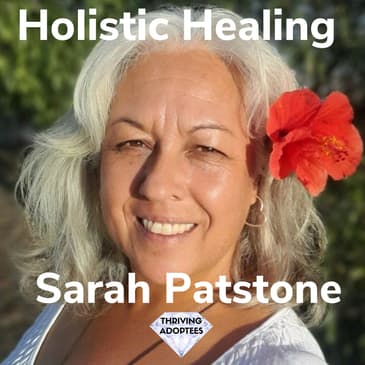
How's your healing? If you're looking for more healing then a broader, holistic, view may help you jump the barriers on your journey. Listen in as adoptee and holistic healer for adoptees Sarah goes wide (and deep) to speed you along.
Here's a bit about Sarah
"I am 53 yrs old adoptee, English/Indian and a mom to two teenage boys. As a fully qualified Bowen Therapist and Reiki Master my goal is to unify the mind, body and soul for healing and recovery. I work from my own space in Silves, Portugal and globally remotely. Life gave me the opportunity to take a new path which began when I received a course of Bowen treatments after the birth of my first son in 2007. This led me to retrain into the holistic health field, since then I have been dedicated to the wellness of others on all levels. Over the last few years I felt a pull to expand into learning about the synergy of the mind and body. After a profound personal transformation, I knew that I could guide others on their own healing journey, specifically adoptees. My heart-led goal is to guide, encourage, lead and support you in creating a solid foundation for yourself, your family, your life. A foundation that is real, meaningful and unshakable from where you can expand and transform."
Here's a link to Sarah's group
https://www.facebook.com/groups/574139124622133
Connect with Sarah here:
https://www.globalhearthealing.com/
https://www.facebook.com/bowentherapyalgarvemstr
https://www.linkedin.com/in/sarahpatstone/
Guests and the host are not (unless mentioned) licensed pscyho-therapists and speak from their own opinion only. Seek qualified advice if you need help.
Want to learn more about thriving for you, your kids, your families or your colleagues? Pick a time to talk here
[00:00:00] Hello, everybody. Welcome to another episode of the Thriving Adoptees podcast. Today, I'm
[00:00:07] delighted to be joined by Sarah, Sarah Patstone, delighted to have, we haven't had any Brits
[00:00:11] on the show for a while, right? So, you know, delighted to be talking to you today, Sarah.
[00:00:19] Thank you. That's wonderful. I'm not, and of course, I'm a Brit Brum who brought me
[00:00:22] too. So, I mean, seven hours. But the one did get away so did the big one got away. Yeah, it was like a shark. Yeah. And it was a little bit tricky because we'd had about five hours sleep
[00:02:43] personal level it means loving myself unconditionally.
[00:02:49] Get into that place where I have self-worth, self-value,
[00:02:53] I've gone through the self forgiveness,
[00:02:57] self appreciation, all of those things and found who I am.
[00:02:59] That's what healing means to me.
[00:03:02] Okay, so then the next big question from that then
[00:03:07] is who are you? point of view, my purpose now is to help raise awareness for people that have been loved and cared for and had no idea that their adoption and that detachment probably most likely did cause a wound. They could be very well adjusted. I think for mostly I was well adjusted. Probably
[00:04:22] menopause and midlife crisis made a big difference and made a big So for me personally, whatever the universe wanted me to be, and I'm trying to fulfil that. Yeah, so it sounds like you've found some meaning, have you? Definitely, definitely. We were told very often that we have a purpose. For many years,
[00:05:40] I was doing holistic therapies, massage things, and I was the treatments 10, 12 years ago, probably more actually if I look at the days. You know, it's taken that long to get to where I am now, but of course it was a journey, it was a path that I needed to heal before I could even discover any of this.
[00:08:05] structure. I'm in danger of pushing my structure on you. So
[00:08:06] how do you see it?
[00:08:12] You're absolutely right. I mean, holistic, it's holistic healing, which means the body, the mind, the soul, those
[00:08:16] things. And we never work on one thing without working on the
[00:08:19] other. And actually, as well, holistic really doesn't mean
[00:08:22] you're trying to treat a symptom, you go in for the root I can still, although I've gone through much healing, that word still is like... It's like a trigger word. Yeah, but I'm not triggered by it because I know now, but it's almost, it's still, there's a residual sensation to the word, I would say.
[00:09:40] Okay, so healing is, at another level, you do the job, you know, it's enough. So I just want to go back to that, those words. So use the word relinquishment and you bit softer. Yeah, from the birth mother point of view. And I used to maybe feel a little bit angry, you know, when I heard that word placed, placed for adoption, that kind of implies to me more care.
[00:14:44] The next question, my next question really is do any particular healing moments come to mind for you? Healing moments. Yeah I think the day I woke up
[00:14:54] and realized that there was the pain I had lived with inside that was always
[00:14:59] there, there was a pain inside that I couldn't reach lot of Esther Hicks too. Everything is always working out for me. It's all the positive mindset. I don't really go too much into fixing what happened, but fixing the way I feel about it. You can't fix what happened. Actually, you actually can't do. And we do think about it, but I always knew I was adopted and really never had any major issue with it. I never did really. It was okay, I absolutely love caring parents. I was very blessed that way.
[00:17:40] So the fact that I was adopted
[00:17:43] and wasn't with birth parents didn't bother me at all, So childhood trauma causes similar symptoms, regardless of what the actual trauma was caused by. Yeah. So how did you come, what was it that led you to come out of the fog four years ago, do you think?
[00:19:01] The realization that there was trauma there because I didn't know. thinking to myself and I've thought this a lot since, one of the things adoptees struggle with is self-worth and self-value. And if we even know that we have this trauma to heal, we don't value ourself enough to invest in ourself financially that we just can't do it. And I've spoken to many adoptees about this and I say, I realize that this is an issue.
[00:20:21] And I, with my work, running a pay-forward scheme.
[00:20:25] So when people get to like it was about improvement, it looked like it was about business improvement but it was really about self-awareness. That's not development but I thought it was going to take me or help me with my career.
[00:21:40] It was a confidence and clarity and I certainly got clarity.
[00:22:47] a spelling hospital without parents being sent off to relatives if mum or dad was ill or had to work away. So that would cause abandonment trauma. But when you generally look at these
[00:22:53] things it doesn't say adoption. No. And with late. Yeah. I was thinking that I was thinking about my own answer to that question. And what what popped into my head was that it's it's on its unconscious.
[00:24:24] Well, yes, we're unconscious of that.
[00:24:28] Yeah. were putting the foundations, sorry, were putting bricks, were building the House of Love. There's a song, I am a spy in the House of Love. Is that the madness? Welcome to the House of Love, yes. House of Fun. House of Fun, is it? Welcome to the House of Fun. Okay. Well, you wanted fun and love
[00:25:43] from this conversation.
[00:25:44] I know, something on there and I've worked with this ever since. And I wrote down the foundations of you. And that is I have a Facebook group that's called that and I call my website that because for me, that's it. Unless we have foundations, we have nothing to build on. Yeah. But you put foundations at the top of the pyramid when the foundation.
[00:27:04] No, no, that was just no, no, they're not.
[00:27:08] Oh, gosh, come on, you. I think one of the big challenges that we have these days is we're judging 20th century parenting or 20th century parents on 21st century child development. Yeah. Understanding or if that's too broad for you like if we're judging 1970s parenting
[00:29:27] now, there has to be a way to have some things, mechanisms in place to soothe more. In fact, I read not long ago as well that one of the things that soothes a baby when they're feeling ill or
[00:29:35] whatever, whether they're teething, hungry, or whatever, is their mother's voice because they
[00:29:40] used to hear in that in the womb. So just hearing their mother's voice would be soothing for them.
[00:30:44] There's loyalty, secrecy and all of those things. Do we even want to go into the safety section of this?
[00:30:50] Yeah.
[00:30:52] That goes way deeper.
[00:30:57] Yeah.
[00:31:02] So how did you navigate that fine line?
[00:31:05] Or how do you navigate that fine line? So it's not easy to be truthful. Sometimes there's a lot of deep emotions come up with that truth. Yeah. So we're back to that bit in terms of healing, the holistic bit in terms of mind,
[00:32:21] body and soul. ask a question and write, ask them how old they are and what message do they have or if there's anything they want you to know and write with your left hand or just go with it because something will come up. If you're open to it of course you have to be open to these things and it can be quite challenging and it can be quite emotional. Yeah.
[00:34:45] tend to not ever recall their child would or not go there.
[00:34:51] And that is detachment, detachment from the time
[00:34:54] that they were caused their trauma.
[00:34:59] And it prevents them from feeling the pain again, the reverberation and recalling the pain.
[00:35:02] But really we have to go there not for long.
[00:35:04] You don't have to spend the next 10 years spectrum of emotions and every single one will feel differently. Yeah. You. And just this real even even asking a child where do you feel it in your body? Is it in your stomach? Is it in your chest? Is it in your head? Can you give you some idea of what type of emotion it it on the internet and it's color coded too. I can't think what it's looking for there. I haven't... It's a three months at some point.
[00:37:41] Sorry.
[00:37:42] I haven't come across a color coded one.
[00:38:49] into that it ties into the human experience really well, because that's where it came from.
[00:39:00] And it ties into, it ties into adoptees emotions, and belief systems really well too, although it, because life does have its ups and downs and challenges. And you know, it's how we manage them that's better. Yeah, that makes it better. What, what I've been for a while. Yeah, you started off talking about self-worth and you've talked about self-work
[00:42:48] You're a good person, not saying I wasn't a good person, but you deserve the best and there's no reason why you shouldn't have it. And you're worthy of it.
[00:42:53] Yeah.
[00:42:54] In all areas of life, and when I say the best here, I'm not talking financially, I mean,
[00:43:00] often people think about when you say you deserve the best, I'm certainly not talking
[00:43:03] about the best pair of shoes and the best tells me I'm a worthless piece of shit is a liar. So it was an excavation job.
[00:44:21] It was understanding what I wasn't,
[00:44:25] rather than understanding what I was. how this relinquishment leads to low self-esteem. Because one is a fall or and we don't we you know that doesn't help anyone does it we just want to somebody to say oh bless you let's have a hug you know and um and and take that because it's almost saying that we can't feel and we can't show emotions and that isn't helpful either
[00:47:01] it's another another layer yeah
[00:48:06] there but why the hell do I want to do that? No but I mean it is a bit of a reminder now and again
[00:48:12] it will crop up and it's like yeah okay that's fine I'm hearing you. I know I know I've done the work I've earned my wigs and I'm proud of them because you know your stomach should be when you
[00:48:16] put the effort in. Yeah does the social media sometimes take you back there?
[00:49:25] I'm doing the second virtual meet up.
[00:49:27] So that would be interesting to see how that goes. But it's something I want to do every month
[00:49:30] just to get a group of adoptees together just to talk
[00:49:33] and have a topic and see if we can do some journaling
[00:49:36] and stuff to try and have some self-reflection.
[00:49:39] Yeah.
[00:49:40] You know, with a view to moving forward
[00:49:43] and putting small tools in place or a dirty spencer or someone, maybe we need to present that to them and see what they can work with. And the other question for me, perhaps the most straightforward one to ask you for an answer rather than just something to ponder is,
[00:51:01] what do you think, what are beliefs made of?
[00:52:15] So there are beliefs that are inherited. Inherited, learned. Learned. Yeah, it learns a better word in it than inherited. There are the beliefs that come from the world that we pick up or the sky? Yes and that's exactly that's it isn't it that's exactly what um you know. The cloud doesn't change the cloud doesn't change the sky. No it changes how you see it.
[00:55:02] It changes the view not the true. It changes the perspective. Yeah. Smoke screen. It's all a smoke screen. Smoke screen. That's a great metaphor. There's a great metaphor to work on. But you know, I mean some things that they have their advantages don't know. all the same place. Yeah, every metaphor runs out of steam, right? So yeah. Oh, I know what I will add, I'm going to make a lot of information. Oh, I am writing a book. Brilliant. No idea what it's
[00:56:23] going to be called other than, and I'm going to go with this, I'm going to put it there,