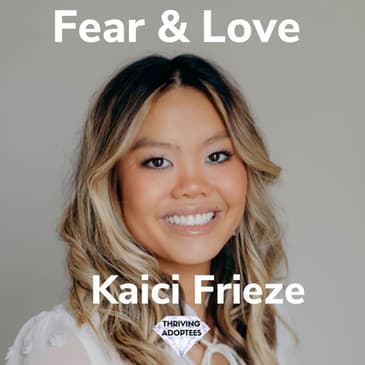
Are we coming from love or fear? Perhaps one of the most profound things we can notice in any moment. Or in any relationship. Loving on our child's birth parents leads to better outcomes for all. Listen in as adoptee and adoption professional Kaici shares how she's empowering adoptive parents with her own learnings growing up.
Find out more about Kaici here:
https://www.facebook.com/kaici.frieze/
https://hopeadoptionagency.org/
https://www.facebook.com/hopeadoptionagency
https://www.instagram.com/hopecenteradoptions
https://www.linkedin.com/company/hope-center-adoptions/
Guests and the host are not (unless mentioned) licensed pscyho-therapists and speak from their own opinion only. Seek qualified advice if you need help.
Want to learn more about thriving for you, your kids, your families or your colleagues? Pick a time to talk here
[00:00:02] Hello everybody, welcome to another episode of the Thriving Adoptees podcast. Today I'm delighted to be joined by Kaici, Kaici Frieze. Looking forward to our conversation today, Kaici? Yes. Yes, star, star. So Kaici is an adoptee and she also works down at the Hope Adoption Agency in Tennessee.
[00:00:26] So the big question that we love to start with here, Kaici, what does thriving mean to you? I think thriving just in general for everyone is different. Truly generally just in my work specifically, seeing families thriving or the children thriving.
[00:00:50] For us, it's just that they feel loved, that they feel complete and whole. So many of our families, this is their first child because they struggle with infertility. But a lot of these children also come from just broken homes. The parents are not together or the mother is unemployed, doesn't have housing and she's just financially and mentally struggling.
[00:01:15] And she makes this brave decision to place her child with a loving family who can provide the means that she can't. And so for thriving for us, it's just showcasing that there is completeness and wholeness in what you might see as brokenness, incompleteness. We don't see that. And just being able to do this job and walking alongside our families, I see so many of them thriving because it is a, it's just a missing puzzle piece for them,
[00:01:42] for both the child and for the family. I know you said you're not a believer, but in for us, you know, we just so strongly see just that every family and every path has just been so orchestrated beautifully by him. Just exactly what a birth mother needs, what an adoptive family needs and what the child needs.
[00:02:00] We could not have picked each family or each mother to have a relationship, that relationship more so than what has come from the past and what comes currently and what we see. So thriving is just being complete, being whole and seeing that happiness in all of them.
[00:02:20] Yeah. Yeah. The, the, the, the brokenness thing and the fixing, I, I saw some, I got an email today from, you know, like a, a, a promotional email, if you like. And I'm just looking at, I'm just looking at it. So here we are.
[00:02:41] And the title was, if we can't fix our kids, what can we do? And I, and I, I just looked at it and I thought, nah, that's, that, that's, that's wrong. Right.
[00:02:57] You know, the idea that, that, that, that, that kids are broken or even breakable. Right. It, it just, or that any of us, you know, I guess there's a different, I see a difference between kind of feeling broken and actually being broken. Right.
[00:03:19] Right. We, we, we all have bad days. We have bad weeks. We have bad, bad years sometimes. And, and, and we, we, we get a bit down, but the idea that we're actually broken and to, to think of our kids as broken, to talk about them as broken.
[00:03:43] It's really, really dangerous because it can become a, like, um, a self-fulfilling prophecy. Right. Right. We're, we're, we're kids. We're kids. And we, we, uh, well, I'm a 59 year old kid. Right. But we, as, as, as a kid, you know, as a kid, we kind of, we, we sometimes, we often believe what we say from the, what we hear from the, from the, from the, from the big people.
[00:04:08] Um, Casey, Casey's, uh, daughters in, in the background wanting to join the, uh, part, but she's a little bit young for it at the moment. It's your time. Um, but this, this brokenness, um, yeah, it, it feels, it feels really dangerous to me. Um, so I went, I went back to the, to the, the, the chap, um, who's, he's an adoptive, don't I write?
[00:04:30] Uh, and, um, he said, uh, personally, I've never, I never thought that my kids were broken. The fixing I referred to in this interview has more to do with behavior modification. Um, and I thought, well, yeah, fair enough. Fair enough, but don't, don't, don't title, don't title your, don't title your emails like that.
[00:04:56] Right. Brevity can be really dangerous in, in this sort of, uh, space. Um, what, what do you make of that, Casey? I think, I mean, I think you're exactly right. When you start thinking it and speaking it, it sometimes fulfills itself just because of the mindset you live in.
[00:05:19] Um, and they're choosing to speak out. Um, I definitely don't see that in our families or in our children or any of our cases because I don't believe it, but just hearing each of their stories, um, and seeing it from an outside perspective, I can definitely see how people view it that way. Um, because they don't fully just understand what adoption means and the beauty that can come from it.
[00:05:40] I think there's just such, I think we talked about this last time, such a negative, negative, um, I just lost the word stigma. Yes. A lot of just a very negative stigma around it. Um, and, and people see it as broken. People see it as well. This is an incomplete family who couldn't have children. And so they are broken. And then they're, you know, choosing to bring in a child who comes from a broken home.
[00:06:04] And from an outside perspective, it does seem that way, but I don't, we don't see it that way. Just us in this field. Um, I know I can speak for my coworkers and anyone in this field. Um, it, we don't see it that way because there's not, um, I don't personally believe that any of our children that come into adoption or any of our families that can't have children of their own are broken. Um, it's just a part of their story.
[00:06:30] And because of the beauty that comes from adoption, being complete, being whole, I mean, myself, I'm an adopted like you are, um, for so long. I felt like that mindset as a child, um, you feel it because. You know, there was a negative, there wasn't much talked about, but I think now as a grown adult, being able to work in it, being able to walk alongside these families, I'm so careful in, in how I talk to them about it or, and how the process needs to look, um, how they need to honor their birth mom or their birth family.
[00:06:59] Um, how they really need to honor their child. Um, they need to talk about it. They need to be open about it because I saw when I was reading and doing some, I was doing some more research. It just because you're not talking about it doesn't mean the child's not thinking about it. Um, and so if you don't talk about it, it allows the child to just have those thoughts and have those questions of, well, why was I not wanted? Why was I not this? Why was my mom, you know, why was I not good enough?
[00:07:24] And then all of those flood into them that they live out and that they start acting on maybe subconsciously, maybe not thinking about it. But if you're not talking about it openly and referencing and honoring, um, and praising their story and praising their mom, um, it allows those thoughts to come in. So I, I encourage our families to always be talking about it, to be thinking about how to talk about that with their child, what questions they might ask.
[00:07:51] Um, and being an adoptive, adopting myself, I think it allows my family to feel more comfortable when they ask me questions like, well, what, what should we talk about? How should we word it? Um, I've had a family say, you know, was this the correct language? And I was like, I, I don't personally see anything wrong with it. And the education I've done, like, I don't see that you, you know, listed them incorrectly or talked about it with your child incorrectly.
[00:08:12] Um, but yes, I do agree. Like if you don't talk about it or if you don't, um, allow those thoughts to, you know, be in the back burner, not even be there, um, with your child, then they can't come to thrive. So that broken mindset can really be, I wouldn't say fixed, but can be definitely, um, nurtured to be a healthier mindset.
[00:08:35] If you talk about it, if you're open about it, um, and respect that story and, and all of that, because I feel personally, we didn't really talk about my story, but, um, I mean, my family is white. So as a kid, you know, you can kind of see the difference, you know, you start asking those questions like, why do I not look like you? Things like that.
[00:08:52] Um, and so, um, I just think it's really healthy if a family talks about it with their child very openly, um, when they start asking questions, when they get to that age, because for me, I didn't, we didn't really necessarily talk about it or, um, the questions that I did have were kind of just like, oh, well, those are invalid. You know, what you're thinking, what you're, um, feeling, those are invalid because, you know, we adopted you. That means we love you.
[00:09:14] Well, yes, I'm not doubting that, you know, you love me, but there are questions I have, I, you know, want to ask or want to talk about, and they just were not talked about. So, um, I do definitely think it's a mindset that can be, can be talked about and adjusted, um, if you're open and having that conversation with your kids and with your families.
[00:09:34] Yeah. I was interviewing, uh, a guy called Jamal last week. He's, uh, he was fostered rather than adopted, but he said he was unofficially, unofficially adopted by a science teacher, which is another story companion. But anyway, um, you know, we talked about mindset, uh, and, uh, and the, you know, a lot of the conversation was about the word, you know, the, the fact that we don't hear the word mindset.
[00:10:01] We don't hear the word beliefs a lot in the, in the, uh, in the adoption space. Um, do you, do you see, do you see, do you see much talk about that of mindset? I mean, uh, is it, is it just, is it just me? Is it just me? Um, have you got, have you got a take on that Casey? What do you mean? Like with our families, with.
[00:10:31] Generally, you know, if, cause I spend a lot of time researching, researching adoption, uh, agencies, adoption related organizations, children's ministries, welfare, um, those sorts of things. And so, uh, sorts of websites, the organizations to, to find, get, you know, guests like I found you to, to come on the show, right? Yes. And it's very rarely that I see the word mindset on their websites. Mm-hmm.
[00:10:57] It, it, it, it, it, it's, um, it, it, it, it, sometimes, it, sometimes it's about trauma. Sometimes it's about the complexity, you know, the, the, the, the, the, the, the, the good, the good part, the good, the good parts and the, and the, and the bad parts of adoption. The, the, the, the pain and the, and the beauty, those sorts of things gets talked about quite a lot.
[00:11:23] Um, but when it comes to mindset, it, it doesn't, it, it doesn't really, we don't see that word used a lot. Um, and you know, what it says for, for your little bio on, on, um, on your agency's website, it says Christ-centered mindset. And that, that's even rarer, right? We, we, you know, to, to, to think of a Christ-centered mindset.
[00:11:51] So what, what does that mean to you? What, what does, what does Christ-centered mindset mean, Casey? I think for me, um, just like I said, being, being so personal on both ends, I, I can walk for the child and for the family seeking to adopt. For me, that mindset is where I see so commonly, you can say all the right things. Um, you can say, I'm going to honor their birth mother. I'm going to respect their story. I'm going to do all of this.
[00:12:20] You can say all of those things. Um, but your mindset is going to affect your actions. And I feel that sometimes it's a lot easier said than done. Um, and it, sometimes it breaks my heart because a family, you know, wants a child so badly that they're going to say, yes, we're going to do this. We're going to keep in contact. We're going to honor her. We're going to celebrate her.
[00:12:47] Um, and then, and when, you know, you're chosen, all of those emotions are flooding in. Um, you're, you're, you're adopting that child. You're, you're accepting them into your home as your own. Um, and a lot of times that's where the birth mother kind of just gets pushed to the back burner. Um, not for all of our families at all.
[00:13:09] Um, our families are wonderful, but I have seen in some cases, some with ours, some other agencies, it's so easy to be all about the child that you forget who blessed you with that child, who made that decision. So when I tell our families and when I walk alongside them and when they're choosing to be a waiting family, like, yes, I want you to say the right things. I want you, but I also want you to believe that.
[00:13:33] I want that to be a mindset that you're going to walk out and who better to resemble than Christ because he first adopted us. And so to walk that and to honor that and to exemplify what it means to be a Christ-sickered home and mindset, you're going to walk that out. Um, when we make profile books and when I tell a family to make a book that talks about them and their lives, I always, in all of our, all of our books, I want them all to be very uniquely different to their own family, to their own lives, because that's what a birth mother is going to see.
[00:14:02] But I make sure that every family and every booklet, um, in the front page, um, thanks her for her time, for her willingness, for her openness to even just consider adoption, um, consider them as a family. And then that last page, I, I make every family, um, have a promise page to her because I think it's so important that when you start writing and when you start typing, um, these words out and you start, you're going to start living them.
[00:14:31] Um, and to have that and to have that visual to say like, yes, I promise these things. I'm going to do these. This is how I'm going to go on. Are you this is going to how I'm going to honor your child and the story and the blessing that you blessed us with. Um, and so that's my mindset is that if you are going to say it and you're going to believe it, then it's a mindset that we're going to walk out. Um, and because we are a Christ-centered adoption agency, I want that to be your forefront focus too, is that you're exemplifying Christ to this child as well. And to this birth mom. Yeah.
[00:15:01] Yeah. So it's, it's, um, looking upstream from what they do to upstream of what they say to where they're, where they're coming from. So when you say Christ-centered mindset, you're, you're talking about, uh, a deep honoring of the, of the birth mother and the, and the child. Yes.
[00:15:25] Can I just, can I just, uh, take it to a slightly different, uh, angle in terms of kind of you rather than professional you. Yes. Yes. So, so what, when, when, when it says on your website that you've got a Christ-centered mindset and you've, you've talked about feeling, um, loved, complete and, and whole your, your, yourself.
[00:15:51] What, what, what's, what are the most important drivers or the most important parts of that for you? I will definitely say it's been a learning curve and something that I've really had to grow into, um, as an adult, because like I said, um, and in previous conversation, I really did struggle as a child.
[00:16:15] Um, with it, I struggled, it struggled with that mindset and just feeling incomplete, feeling distant, feeling, um, separated as a child. Um, yes, there was all the materialistic things. Yes. They provided a home. Yes. They provided, you know, food on the table and clothes on my back and, and those materialistic things. But as far as the mindset of knowing that I'm complete, knowing that I'm whole, knowing that there's nothing wrong with me, even though I'm different.
[00:16:43] Um, it really was something that I had to learn and appreciate as I got older. Um, and something that I realized as an adult, I could use that story to touch other lives and connect with other people. Because as a child growing up, I, like I said, the community, my family, they were all white. So I, of course I had all those questions. Like, why do I look so different? Why does no one else share this story? Like why, you know, all of that.
[00:17:08] Um, and just as I got older, you know, I had to come to the realization and seeing other Chinese adoptee stories. I was like, oh my goodness, I'm not alone. A lot of people share the same story, even though we're not two minutes from each other. We don't live in the same town. They're all over the world. We share the same story. And I, and I, as I got older, I was like, it's okay to be different. It's okay to have this unique story because in, even in your unique needs, you share some similarity with someone else and you can connect on that.
[00:17:38] Um, and so it's definitely been a learning curve because it was not easy for me as a kid. Um, I think I was very, just, there was just a lot of anger built up, a lot of, um, frustration, a lot of guilt, um, that I just carried as a child. But as an adult, I just realized like, I, there's no, there's no room for that in my life. I don't need to carry that. None of that is need to be on my shoulders or a weight that I need to carry because there's just beauty in my own story.
[00:18:06] Um, and in that, so it's definitely been, definitely been a learning curve. Are there certain moments that kind of stand out in terms of, uh, uh, important, well, moments? Yeah. Are there any moments on that learning curve that stand out sort of, uh, you use the word realize a couple of times, right? Particular moments when you, uh, there was a shift in your mindset, right? Uh, a change in your perspective.
[00:18:35] Does any particular moments stand out for you, Casey? This sounds bad, but it's not necessarily that it was like a, oh, well, whatever I give up. But I definitely think when I watched the movie Lion, I'm not sure if you've heard of it, but it's about an Indian boy. Yes. Who has visions and dreams. Yes.
[00:19:03] With the family in Australia and he goes back to India and all, and he, his story unfolds, all of that. I think once I had watched that, I realized for me, that was never going to be possible. Um, that I wasn't going to be able to go back to China and find my file or see the town and run into my birth mother and have that story.
[00:19:29] But it wasn't this grief, uh, or a loss of what could have been. It was just a realization that that's okay because I have watched his story, but I had also watched other adoptee stories who shared similar to me where they had unanswered questions. They had stories not fully developed about their adoption case that I realized it's okay to be in that, to not know.
[00:19:59] And so I just moved forward with in the work that I'm going to do or in the lives that I'm going to touch. If I share a story with someone, it's okay to not know. And that's okay. Um, it sounds like I had just given up, but I just came to a position that that's okay. I was not going to chase something that I was never going to get answers to because you're going to go crazy from that.
[00:20:24] If you don't get answers, if you continue to ask questions continually, not be fulfilled with the life that you're living and have these constant questions and constant what ifs, then you're never going to be satisfied in the moment. And I realized, I think that's a lot of where my anger and frustration came from because I was saying, well, why does someone else get to know their full story? Why do, you know, domestic children get to maybe one day find their parents and have that connection and have that happy ending?
[00:20:53] But I realized I'm happy in my life and I've been able to use my story for better and share my story and touch other people's lives without having those questions answered, without having their, their, their story lineup where I got to meet my birth family. Um, and so it's just, just that mindset, my mind shift, my mindset just shifted that it's okay to not know. Um, because I was enjoying the life that I was living and building and just the person being confident in who I was without those answers.
[00:21:22] Yeah. Um, the phrase is coming to mind. It's something I heard from a mentor of mine a few years ago. Uh, and this lady was really, uh, important was, uh, was, was Sammy, this mentor, because she's the reason I'm doing the podcast, right? She, she told me how to do it. So it's down to your, it's down to you, Sam. Um, she, the, the way she summed it up was, uh, our, our, our mess, our mess becomes our message. Our mess becomes our message.
[00:21:52] So something that we've, uh, struggled, struggled with the, in the past, we, we see as manure, right? So that we can help other people grow and we, we can, uh, we, it sounds like, you know, you're, you're sharing what would have been ideal for you with the, uh, with the adopted parents that you're supporting.
[00:22:21] So that they're more in informed and, uh, and hopefully that will be a, a smoother ride for their kid than it, than it was for you. Absolutely. Yes, absolutely. Because, because we have contact, because we know that side of their story.
[00:22:42] And I think the, the child deserves to know, they deserve to, to know where they came from, who their birth mother was, the story there, that there's not a narrative of negativity, that the birth mother didn't want them, that there's a narrative that they were unwanted, that they, uh, ruined their birth mother's lives.
[00:23:04] All of those are such a negative narrative, but because we know where the birth mother came from and because we had a personal relationship with her and walked this journey with her, there's so much selflessness, selflessness, bravery, and strength that she showcased. That that's what I want our adoptive families to share and to see, because she gave you a blessing. She blessed you guys with this child. That is how you should honor her.
[00:23:32] Um, we did not force her into this decision. We did not coerce her in any way. This was a selfless decision that she recognized. She could not, whether it was financially, whether it was mentally, whether it was whatever the case, but that she recognized she could not provide a good enough life that this child deserved. That, that's how I talk with our adoptive families is that's how I want you to honor them because she does deserve to be honored.
[00:23:58] Um, she made this decision so that this child could have the best opportunity at life, at education, at growth, at love. Then she could provide in the situation she was in the circumstances that she felt fell into. Um, and so that's how I want my art, my adoptive families to see her because I didn't get to have that opportunity. I don't, I don't get to have those questions, answers. I don't get to just know her or see, you know, in the past when you were a baby, this was her.
[00:24:25] And in the pictures, um, we do a lot of pictures of the birth mother's okay with that, but there's always documentation of just, it's just beautiful. Really just walking this journey. I get to see it. And so just from my personal experience, I try to, you know, not necessarily coach them or teach them because every story is different. But just from my experience, I will say like, you get to have these answers. You get to have these questions and then I should be able to answer them.
[00:24:50] Um, and if not, you have this relationship with this birth mom and, and should you choose that, should the child want that later in life, you have the means to access that, to have that relationship, whether it be from you guys or through the agency, contact us and we can get you in contact with her. But that's just, yes, you're totally right. Like I tried to advise them and just what they should or should not do. But of course, you know, every story is different and how it needs to unfold. Yeah.
[00:25:17] Okay. So what, what do you, uh, you've been answering this, you've been answering this question, I guess, for, for a lot of our conversation so far, but if you were to distill it down, what, what do you think helps adoptive families thrive?
[00:25:34] I definitely think it's getting plugged in, um, in part of our training, I definitely tell them get plugged in, whether it be an online group, whether it be through friends in a social setting, physically or online. I always tell them to get plugged in because the waiting season looks different for every family. It could be a couple of months. It could be a year with domestic adoption.
[00:26:04] We don't know what that looks like. There's not a time that we can give every family that's cookie cutter because it's different for every family. Um, and so I tell them to get plugged in because that waiting season allows those thoughts to creep in. Well, what are we not doing right? Why are we unwanted? What's wrong with our family profile? If you get plugged in and you are, you, you socialize with friends and family that are walking the same journey with you or already have walked that journey, they can ease your mind.
[00:26:34] They can answer those questions and provide just a sense of peace and calmness that otherwise you wouldn't know if you were walking the journey alone, um, in solitude. But I also tell them to educate yourself because adoption is not just a cookie cutter. Well, I take this child into my home and I love them as my own. There's so much more that goes into it. And so our education that we require of our families is just a lot of that. There's different aspects of it. We have them read books. We have them watch videos.
[00:27:03] We have them watch videos based on birth mother, you know, stories or adoptive children's stories because we want them to educate themselves on what it could or could not look like and prepare themselves for that. Um, and so it's just, um, I'm so sorry. It's just different for everybody. So, yeah.
[00:27:24] And what, what about, um, after, after the, after the, uh, after the adoption, presumably more, more of the same in terms of the, uh, the, the network that they're plugged into, whether that's online or in, or in person. Um, and, um, what, what else, what else do you, what do you, what else drives their thriving, uh, as a family?
[00:27:56] I would say you're saying like after the adoption is finalized and everything, I think just continuing to just love on the child, um, whether they have children or not. Um, I see it for both sides when they have children or when, um, this is their first child. I think just involving them in everything, um, not trying to separate the lives of you stand out, you're adopted, but combining that life.
[00:28:24] Um, you're one with us. We're doing everything as a family. You're our family. Um, and we want to honor that. We want to just love on you. You're part of our family. And I, and I love seeing that because that is a question I ask upfront. Hey, this child is, um, biracial or this child is Hispanic background. How is your family going to respond to that? How is your friends going to respond to that? And I love to see that it never changes their mindset.
[00:28:52] Um, they say, you know, we're going to love them just as is. Um, and I see that beautifully. Um, even after the adoption is finalized, um, that doesn't change their mindset. It has not affected their love in any way. That child is a beautiful blessing and a child and a gift to them and their family. And they just love them as is, um, even though they're not biologically there. So I definitely see that as a big stepping, stepping stone of how they're thriving. They're just loving that child.
[00:29:20] There's no, you could not tell me that is, that is not biologically their child because of how well they love them and how well they include them in all family activities, traveling, their friends, their family that love on this child, um, and love their friends that have adopted. So. Yeah. Yeah. So what gets in the way of adoptive families thriving?
[00:29:43] I would definitely say just, just not being able to fully, I guess, respect, um, the birth mom or the birth family or birth couple. Um, like I had said previously, sometimes it's so, it's so hard because there's sometimes just a sense of fear. Well, what if they come back?
[00:30:09] What if the birth mom or birth father come back to take this child, which legally there is, there's no way they can. Um, but it's a fear. I mean, we're human. Um, here's a child we've longed for. So, so deeply and so desperately. What if they do come back? What if, um, they try to take this child from me? Um, and then that fear really creeps in and, and kind of showcases in their action of the updates that I, that I asked for, for the birth mom or, or just through the holidays or
[00:30:39] mother's day, Christmas, things like that. Hey, you know, she has asked for photos. What updates would you like? And just the sense of fear kind of displays itself of, well, is she asking or are you asking? And I see that a lot of just, why don't you just have these updates for her when she is ready? Because sometimes it's just the journey of healing for a birth mom that it doesn't make it easy, um, for anybody because of that is that there is a grievance and a loss for her.
[00:31:06] Um, and so I just kind of see that, but some of the majority of our family, they're wonderful and it is not in every case of that fear steps in, but sometimes when it does, I can kind of see this, this block in the road of when that annual visit comes up, there's kind of some hesitation or when, um, there's updates, there's a little bit of a hesitation just because of that fear of what if the unknown, um, that I definitely see can get in the way of them thriving because of the unknown.
[00:31:34] But there is, there's absolutely no way, you know, that the birth family can come back, um, for that child. Um, and I just want them to walk that journey and just grace and humility and have that relationship of just openness to honor her when she asked for updates or that annual visit that's in the contract and things like that. And, and our families are wonderful. Um, it just is every so often, if I do see it, I will say that that probably is the reason
[00:32:01] that maybe sometimes there's a block in the road of just what, what doesn't cause them to thrive that relationship kind of have a hold in it. Yeah. Um, you, you mentioned, uh, a little while ago about, I think more at the start of the conversation, you mentioned, uh, honoring the birth mother and I, I, what I was getting,
[00:32:24] what, what I was thinking about was, uh, honoring the birth mother in front of the, in front of the child, because otherwise the child thinks that they're, um, fruit from a poison tree. Is that the, do you know what I mean? Yeah. Is that, I know, dream. Yeah. Um, so, you know, if we, we, we've got to more than respect, we've got to honor them because
[00:32:53] by honoring their birth mother, we're honoring them. What, I mean, what have you learned around that? Does that, is that, does that, I don't know where I heard that, but, um, it made incredible sense to me listening to that, you know? Um, I, I, I connected with a cousin on my birth mother's side a couple of months ago and I found
[00:33:22] out that she was his favorite, she was his favorite, uh, relative. My birth mother was his favorite relative. So her aunt, he, he was, she, she was his auntie, right? Um, and that she was, she, she'd been, she'd been happy. She'd, she'd managed to process her relinquishing trauma. You know, that she, she, it hadn't, it hadn't blotted her life.
[00:33:52] And that, that was something that I really didn't need. I, I didn't know that I needed to know. I didn't know that, that knowing that would benefit me and, uh, and yet it did. Right. So I'm, I think that's slightly different, but, um, what do you, what do you say about honoring birth mothers in front of the kids?
[00:34:21] What's your take on that? I think it's a beautiful way, uh, just to honor the story as a whole. Um, here are these two families coming together as one for the child, for the sake of the child. There have been a couple instances because I'm at the hospital when the birth mother's giving birth and the adoptive family's there, not all of the cases, but in some of them, I've been able to take pictures of the birth mother handing the adoptive mother, the child.
[00:34:51] And just to have that in a photo, there's really not words because here I am, I was walking a journey separate because we don't, we don't allow, you know, them to have open communication throughout this entire process, unless that is something they voice. Um, but just to protect both our family and our birth mothers, we, we are the mediator in communication.
[00:35:16] Um, but at the hospital, when they're coming together physically in one room and I've been able to capture that photo of a birth mother handing the child to the adoptive mother. It is one of the most beautiful things I can, can just be a part of to witness because how, how beautiful is that? Um, here is that decision coming to life for the sake of the child. This child is such a beautiful gift to everybody.
[00:35:44] Um, but to have that photo that you can later share with that child. I mean, there's not really any way you can get around of how just, how is, how is that not honoring her of here? She is so, so selfishly and brave, bravely entrusting me with you. And here I get to love you and raise you and love on you and provide for you and honor her with this photo.
[00:36:12] Like it's just, it's, it's actually incredible. Like I've, I've gotten, not all of our cases have been that way, but there have been a handful where I have a photo of that and I think it's just beautiful. I think it's a beautiful thing to see and witness. Yeah. Incredible. Incredible. Um, a lot of, uh, a lot of people have been talking to me recently about the, the, the
[00:36:40] the toughest stuff that, uh, that, um, raise its head later on. Right. So often during the, uh, often during the teen years, uh, as hormones are kicking in, it's, it's a really tricky, uh, tricky season. Um, what, what have you seen around that part of an adoptee's, uh, life?
[00:37:07] When the child grows older? Yeah. The, the, the, the, the, the, the teen years, do you, do you have much to do with that? Um, we don't necessarily because we're an infant placing agency, but there have been families that have come to us for either counseling or guidance about it just because of adoption as a whole.
[00:37:32] Um, I will say it definitely causes a little bit, bit, bit of static in the family, just because there's a lot of growth and, um, emotion. And like you said, hormones as you're getting older, as you're, as you're growing, um, in, in that and your comfortability as a young adult, um, who you are. Um, but we've definitely advised, you know, sitting down as a family, talking about it,
[00:37:59] talking about that concern, um, what questions journaling. Um, but it's not something that we're, I don't want to fully speak on just because we don't do it every day, but there have been some instances where a family will come and, and seek guidance from us about just how to handle that, what questions or what answers to provide, um, because of just adoption being a whole thing that is talked about that we can specialize in.
[00:38:26] But it's definitely, it's definitely difficult because, um, sometimes the adoptive family don't, doesn't have answers. Um, and sometimes we're not able to provide that either. Um, and so I think it leaves the child with just more questions. Um, but we definitely advise, you know, seeking professional counseling. If there's something that we can't help with or that we can't, you know, guide them towards in, in helping. Yeah.
[00:38:53] Well, one of the things that's coming to me is the, the kind of the, the need, uh, to, the need for kind of preventative work in this area, right? Anticipating, because we know that, uh, there's a, a likelihood we, I couldn't, we're not going to put it on a percentage on it, but we know there's a likelihood of this stuff happening. And, and therefore what we should be doing is we should be anticipating the challenge
[00:39:20] and perhaps do something, uh, uh, ahead of, ahead of time on that. Um, you know, as our, you know, we, we talked about mindset at the start, didn't we? And I think, you know, there's, there's, there's two things, there's, there's two things in terms of, well, there's more than two things. There's more than two things, but, you know, from, from our perspective and I say our, as,
[00:39:47] as, as, as a adoptees, Casey, there's, there's the, there's the, the kind of the, where's, there's the, there's the feeling of, there's the feeling of loss and, and confusion. Where's our birth mother gone, right? That's one thing. And then there's the questions that come off the back of that feeling.
[00:40:15] And those, those questions build over, build over time, but they might not be hit, you know, they, they might not be coming up for a seven year old, but they come up for more at 13 year olds. Do you know what I mean? There's, there's two parts to, there's two parts to this and that perhaps that, that mindset is, it is, is the second part.
[00:40:43] What do you, I don't, I'm making any sense here, Casey? Yes. Yeah. Yeah. Um, what do you, what do you, what do you make of that? Are you asking the difference in? Well, yeah, I just, there's two bits and there's two parts. There's the, there's the, there's the loss. And then there's the thoughts about the loss, the thoughts, you know, and, and, and that
[00:41:13] they can snowball, right? For the child or for, for, for the, for the child, they can start to snowball and, and, and, and, and child stroke teen, you know, the, where, what do people say? The, the loss. So I was a week old when I went into, into foster care, maybe, I'm not sure. Um, I was in, uh, I was in short term foster care.
[00:41:40] Then my birth mother came to collect me from there, took me to the, took me to the agency. You know, this is, you know, I've been fortunate, like, as you say, with the, there's no chance that you'll get your, uh, file from China, but I was domestic adoptee. So I got this, you know, um, so I, I, I had this picture that I built up from, from looking in the, looking in the folder.
[00:42:03] Um, but that, that kind of, that, that loss, that, that confusion about where, confusion or fear about where my birth mother has gone, right? That, that's one thing, but there's the, the, there's the, there's the cognition, there's a belief part that comes, that comes later. And that, that can, that can snowball, snowball, especially during teenage years.
[00:42:32] And perhaps we should be doing more in to, to, to prevent, prevent the snowballing, building the kids, um, building the kids emotional intelligence or whatever to, to reduce that snowball effect. I wish we could. Um, I think we try our best with the communication piece of it, but there's grievance and loss
[00:43:01] for both, both sides for the child as they grow older. Those questions are, where is my birth mother, all of those questions and there's not answers, but it also is for the birth mother as well. There's a, like I said, there's grievance and loss for her because here she is that her body physically went through caring, nurturing, nurturing, supporting this life, giving birth to this child. There is that connection there physically, mentally, emotionally, her body just did that for 10 months.
[00:43:31] Um, and to be able to walk away from that, it takes time. It takes healing. It takes a, it takes a process. Um, and, and sometimes for our birth mothers, that can be her mindset is I knew from the start of this child was this adopted family's child, but for some it's a struggle. It's, it's a, if I had better means, I, I would have raised this child and sometimes it's hard for her. And so she, or she has just a lot going on in life.
[00:44:01] Um, her circumstances are struggling. She doesn't have a job. She doesn't have housing. She doesn't have support. And so her mentality, um, is, is just that loss hits her a lot harder. Um, and so I have seen in some cases where the birth mother just, she, she starts where she wants those updates. She asks, she inquires to know that they're in a good form, that they're loved and we can provide that for her.
[00:44:27] And I think once she gets that, um, I think there's a level of ease that comes over her that she knowing that she made a good decision that this child is loved, that this child is supported, that then she then focuses on herself. And sometimes that falls into back into addiction or bad habits. Um, and, and I don't know if it comes from just a lot of emotion, a lot of loss that she's
[00:44:54] struggling with or the, the confidence, um, that she knows this child's well taken care of. And then now the rest of life and its emotions are flooding in. Um, and she, and to be able to cope with it, she falls back into those negative ways. And so we lose contact with her. And so I will say for some children, it might not be, they might not be able to have those answers with their birth mother because she falls off to communication. For some of them, we have continuous communication.
[00:45:24] They check in with me. I check in with them. They, they respond back. Um, and I love that. And I, and I'm grateful that they continue to maintain contact because I want to know how they're doing. I want to ensure that, um, they're thriving. Like you have asked, but what is thriving? And I hope, I hope that they're doing well. I hope that they have support after all of this, that they're, um, you know, they're looking into getting a job or that they're getting housing, that they're well supported by friends and family or their community, wherever they may be.
[00:45:52] Um, but for some, some of our birth moms, they, they lose that contact and it breaks my heart, but I just have to pray that they're doing well. Um, but at the end of the day, I'm very thankful that, um, they made the decision that they did. The child is loved, the child is cared for. Um, and if they do circle back around, they want to check in with me one day. I'd be so thankful for that. Um, but to differentiate, unfortunately, I don't think I can because it's a loss for the
[00:46:21] birth mother as well. And, and her healing journey also has to be respected. Um, and I think you just have to share that with the child that's asking, well, where's my birth mother? And you just have to be honest with them. I think I would tell my families, you just have to be honest that, you know, all the emotions that you're feeling, um, all the questions that you have, she too is, you know, she too walked that journey of emotion of loss of grievance of unknown uncertainty. Um, so you just have to be patient and respectful with her as well.
[00:46:53] Well, we're covered a lot of ground, Casey. We've got a lot of ground. Um, we kind of coming up on time. Is there anything that you'd like to, like to share that I've not asked you about? I don't think so. I think just, I think adoption is beautiful. I'm so thankful that I was able to come on this podcast. You were able to find me and we were able to share my story or my agency and what I do,
[00:47:23] um, and just how that's well connected and just into the adoption world. I think, um, as I grow, as I get older, as, you know, adoption is, um, continues to be a thing. I hope that the stigma around it breaks of that negativity that, you know, we take the child and the birth mother is just kicked to the curb. Um, in my line of work and in my coworkers and other agencies, I don't see that.
[00:47:48] Um, talking with other adoptees, younger ones, um, there's a lot more beauty in there. Um, I would say maybe, you know, for the older generation from different generations. Yeah. There's a whole different duration of negative stigma around adoption. Um, but I think it can be a beautiful thing and I don't think that adoption is a last resort. Um, that is something that we want our birth mothers to know when we go speak at clinics
[00:48:13] or when we go speak somewhere at a church that we want adoption to be an option. That is what we say every day. Adoption is an option. Um, it is not a last resort. The only two options are not to parent or to abort. We don't, we don't stand on those are the only two options. And that adoption is not a negative choice. It's not a, well, you can do those, you can do those two choices. So I guess we'll just default to adoption, um, and never have contact with this child again.
[00:48:42] Adoption can be our first choice and it can be a beautiful journey and relationship between the child, the adoptive family and the birth mother, as well as the agency, if you choose that. But we, we just want people and, and birth mothers, whoever is listening, that adoption is an option, is not a last resort. And it's a beautiful decision or choice or journey. Um, should you choose to walk it? Should you choose to learn more about it? Um, you can have that relationship. It is not a shut door. It is not a closed door.
[00:49:12] Um, it is not an unknown. Um, there's beauty in it. There's grace in it. There's just redemption in it. I think, um, there's redemption in that story as well. So that's definitely something that we, we try to push and project out there that it is an option. It can be a beautiful option. Cool. Thank you, Casey. And thank you. We'll speak to you again very soon. Take care. Bye-bye. Yes. Thank you too.