
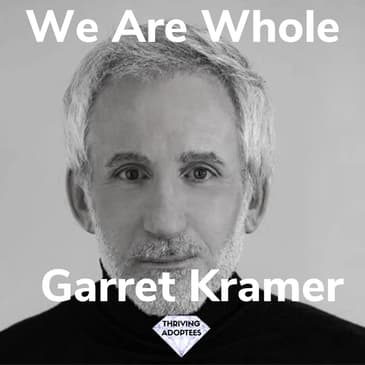
"You are whole. We are whole. Nothing can change what is true." Provocative? Perhaps. Challenging? Definitely. True? That's for you to decide. Listen in as coach and son of an adoptee Garret dives deep into a profound exploration of wholeness.
Garret Kramer is the founder of Inner Sports, a visionary who for nearly three decades, has been providing transformative consulting services to athletes, coaches, actors, doctors, and business leaders. His extensive career also includes conducting workshops, daylong symposiums, and retreats for teams, organizations, universities, and schools.
Having introduced the "Direct Path of Self-Exploration" to the high-performance community, Garret has played a pivotal role in redefining the way we approach excellence, passion, and maximizing potential. He also now shares with global audiences his unique perspective on the Consciousness-only model and its profound implications for creating a more harmonious world.
Garret resides in New Jersey, USA, with his family. His insights have appeared in The New York Times, The Wall Street Journal, Sports Illustrated, and Forbes, and he has appeared on major media platforms, including ESPN, FOX, NPR, WFAN, NBC, and The Golf Channel.
Garret is the author of three transformative books, True Self: Notes on the Essence of Being, Stillpower: Excellence with Ease in Sports and Life, and The Path of No Resistance: Why Overcoming is Simpler than You Think.
https://www.facebook.com/garret.kramer.1
Guests and the host are not (unless mentioned) licensed pscyho-therapists and speak from their own opinion only. Seek qualified advice if you need help.
Want to learn more about thriving for you, your kids, your families or your colleagues? Pick a time to talk here
[00:00:02] Hello everybody, welcome to another episode of Thriving Adoptees podcast. Today I'm delighted to be joined by Garret, Garret Kramer. He's a coach and a great thinker. I've listened to so many of your interviews on podcast, Garret. That's why you're here my friend. I love your message and your clarity. So I'm really looking forward to diving in today.
[00:00:29] Thanks, Garret. I'm happy to be here and talk about it. Thank you. So I asked Garret to come on the podcast because I love listening to him talking on podcasts. And also I've had his first couple of books for a long time. And I got his third book, It's Great.
[00:00:50] And so when I asked him on, he said, actually, funny you should say that about the adoption stuff, but my dad was adopted too. And I didn't know that. So, but you didn't know that either for a while, Garret? You found that out later.
[00:01:13] I found that out when I was, I could be off by a year or two, but I think when I was 21 years old. Yeah. My grandmother, my grandmother had been sick. Yes, I was 21 years old, my junior year in college.
[00:01:37] My grandmother had been sick. She lived in Florida. And during spring break, I was a hockey player in college. But after our season was over, rather than go hang out with my buddies over spring break, I thought it right to go see my grandmother in Florida.
[00:02:02] And she got plastered one night. And she was sick, but then she was better and she's drinking way too much wine. And she, we somehow got on the subject of my father. I'm sorry, this is, this doesn't have to be this long, but I'm just remembering it. And we got on the subject of my father. And how at times he could be temperamental.
[00:02:27] And she says to me, well, well, dear, he can't help it. It's his Italian temper. Now, I knew nothing about being Italian. Right. Yeah. Kramer is not an Italian name. Oh, no, his name was Kramer. So that doesn't make any sense whatsoever. But the minute she said it.
[00:02:52] I knew that she wasn't his biological mother. I knew it. I knew what she meant. And she was so drunk, I didn't really, wasn't sensible to get into it with her. Like, I just let it go. But I remember going back to the guest room.
[00:03:12] She, I was staying in this bungalow by the pool in this place, in this apartment complex where she lived. I remember it was no cell phones that I remember calling my, my brother and sister separately, both younger than me and saying, are you sitting down? I've got something to tell you. Right. And both of them are like, that makes sense. All three of us right away. We're like, that makes sense.
[00:03:37] So, yes. And, and this, this may sound even crazier, but my father died five and a half years ago. And we decided we were never going to bring this up to him unless he brought it up to us. We collectively decided, my siblings and I, that clearly this was a problem, a source of a lot of issues for him or clear we would have, he would have brought it up to us.
[00:04:04] And I, I led the charge in this. I thought it just didn't make any sense. We'd be making it about us and not him if we did that and we were fine. Um, and that was that, that was that, um, but it did explain his Italian temper.
[00:04:24] I guess, I don't know what that even means, but yes. So I, uh, uh, interestingly enough, I would say that my, my level of compassion for my father and understanding of my father was, went through the roof over the years as I reflected on this.
[00:04:42] Yeah. But, uh, and I, so he had a temper, but presumably he was an inspirational guy as well. Cause he was a coach. He was a, he was, he was a coach. One of the reasons that you, I think went into coaching, we kind of fathering, following your father's footsteps to a degree. My father was a dichotomy. He could be, um, he, he always had time for those less fortunate.
[00:05:11] He had no tolerance for those so-called fortunate. If that makes any sense. He didn't have, he had no tolerance for authority. And that's kind of me also. Um, so because he had, and, and children and even not just young children, but, uh, teenagers or even, young adults, he had a lot of time for, this is what made him a very good hockey coach. Yeah. Besides he was, uh, he, he was incredibly bright so he could get stay ahead of the competition.
[00:05:42] Um, but he had a side to him as a, as a, as a, that he, he would kind of push back on society a little bit and it would drive him crazy. And he would push back with anger and frustration, especially when his oldest son was acting in a way that he didn't agree with.
[00:06:05] So it became a real source as my grandmother was indicating. She didn't really know the bottom line, bottom, the truth of it, but she was indicating that we, there was some friction as I got older that started to develop between us. That, that was because he, he, he didn't agree with me and he didn't quite know how to let that be. Yeah. That was, that was, that was, that was hard. Yeah.
[00:06:31] Tell the, tell the story about, um, what your dad said when you said that you were going to become a coach. Do you remember that? I don't, well, I, I had already been a, uh, a sport coach. So I'd already been coaching at the high school level, the same sport that he coached. And I was very good at it. I was very, for the same reasons that he was good at it. I was good. I was probably even better because I was a player.
[00:06:59] I had, I had, I was also a player. All right. He wasn't a player. Okay. He wasn't a player. He wasn't a hockey player. He was a very good athlete, but he wasn't a hockey player. So I had been a player and I had played at the high level. So I kind of, those experiences are somewhat valuable, not essential, but valuable. Um, so then when I told him, I, I didn't really tell him I wanted to coach what I, what I told him was. I wanted to bring my understanding.
[00:07:29] This is how I would say I've said it back then, Simon, we're talking, um, almost 40 years ago now, maybe 38, 36 or seven years ago. So what I said to him was, I was, I was coaching. I was teaching and I was somewhat active in, uh, the construction business that my grandfather had.
[00:07:58] I was, and I was actually making a lot of money. I timed it very well in the construction, right in the eighties when wall street was booming, I was building houses for incredibly rich people. And I came up with a way to do that where I wouldn't have any risk. I did it for a fee, big fee. So you pay me $300,000 flat fee. I'll build your house at cost.
[00:08:28] And those fees kept escalating. So as a young man, I was making a lot of money. So then I thought it wasn't making you happy from what I've can recall. Well, it wasn't, it wasn't, um, true to me. The whole game wasn't, I was good at it cause I'm meticulous and I could kind of see, I have a good design sense. I guess my daughter does too. Um, and, and I was good at that. And I organized and I hustled and I worked hard and blah, blah, blah.
[00:08:58] I had grown up in that business because my grandfather put me to work in the, on the construction sites when I was 10 years old. So I knew that business inside and out, it was easy. All you got to do is hustle. But you're right. It didn't, it clearly wasn't going to be my life's calling. No chance. I just didn't find that it was allowing me to express or serve in a good way. It served myself, Garrett, very well. All right. Anyway.
[00:09:25] So I then told my father that I kind of stumbled into a different way to look at psychology and spirit. And I think I could teach this and really help people. And that's when he said, you are, you're cut off. I'm done with you. He, he, he had no, he had no tolerance for this. He thought I just had to suck it up and work hard at this job.
[00:09:54] You could become incredibly wealthy. No, this is a stupid thing to do. It wasn't totally crazy. I mean, it was kind of risky. But here I am. Here you are. Years later. Yeah. So I thought I'd start by asking you about something I heard you say.
[00:10:20] And it's subject to, you know, we're talking about thriving adoptees. It's, it's, it's, it's about how, how we thrive. It's how we thrive despite trauma or you may say, despite so-called trauma. You said something on an interview, something like trauma is a result of the belief that we are separate selves. Something like that.
[00:10:49] Sound about right. It's going right to the heart of it. Yeah. I don't know that I would start exactly there, but we'll, but we'll definitely get there. Okay. So it's going right to the heart of it. So we're not finding separate set. We would have to.
[00:11:08] So, so I would say trauma, let's say like this trauma is not. And by the way, let me just say this first. Sorry. Sorry. I'm not asking anyone, including you, who's listening to this to, that, to believe what I'm saying. I'm just proposing how I see it.
[00:11:34] If it makes sense to you then, or anyone then ask me, we can, we can explore it. If it, if it doesn't, then we should just toss it. I'm just, I'm not saying I'm right about this. I'm saying this is where I'm at after exploring this topic thoroughly. Okay. So trauma is, it's, it's conventionally believed that trauma is the result of what happens to us.
[00:12:03] Yeah. An event, a circumstance, how we're treated by somebody. So what happens to us? I disagree with that. I would say trauma is the result. I would say trauma is the result.
[00:12:25] Trauma will result to the degree that we've been conditioned to believe that what happens to us can damage us. So, so, so maybe a little shorter. Trauma is the result of the misconception. Trauma results from the misconception that we are damageable.
[00:12:54] Trauma is the result of the fact that we're dealing with that. Trauma is the result of the fact that we're dealing with that. So, so, so one will experience trauma to the extent that they believe that. Can, can I give you another one of you, can I give you one of your quotes that I think sums up what you're getting at in, in, in really, really simple, straightforward language. And this, this is from the back of Garrett's book. He's got some reflections on that.
[00:13:25] So the book's called True Self, notes on the essence of being. And the, the, the bullet point is you are whole. We are whole. Nothing can change what is true. Correct. That's right. And the, and trauma will result to the extent that that truth has been covered up.
[00:13:54] And, and, and, and, and all of us, it has been covered up to a certain degree. There is no one on this planet, even a newborn who to some degree hasn't been sullied with the belief
[00:14:19] that that's not true, that that's something can damage us or make us incomplete or not whole. Yeah. So those who are, who are reeling in so-called trauma, my, my heart goes out to them, but not because of what the events of their life,
[00:14:42] because they have, they don't understand that those events are not as powerful as they are. Yeah. That to me is unfortunate. And just as an analogy back to, to, to, to kids, newborns, whatever, but let's say a little boy or girl is a year and a half, like, like one of my grandsons is, and I'm just using him as an analogy.
[00:15:12] They're not perfect either, but just, so it's just an analogy. He ran into the corner of our stove so hard yesterday. I, I just, I hated it so much. And he went, his feet came out from under him and he let out a scream or whatever, cried.
[00:15:37] But I'm telling you within 30 seconds, he was exactly how he was prior and a big bump on his head. There was no trauma. He's not afraid of stoves. He's, he's, it was absolutely gone. Now, now again, metaphorically, why is that?
[00:16:00] Well, because he has not been trained yet to believe that stoves are more powerful than him or stoves can make him less complete or damage him. He hasn't, he doesn't have that belief. Yeah. So, so it's much like that. You and I, we've been around a while.
[00:16:20] Well, this is the, this conventional belief that the out so-called outside has power over us has been, we have been inundated with that belief. In my case for 64 years, it's almost impossible for me to not have bought into a certain extent. My work in my life is all about kind of unwinding that belief system, that conditioning. Yeah. Yeah.
[00:16:50] So can I, I, I, you know, want to relate it back to what you've shared about your, um, uh, shared about your, your, your, your father, um, and his, his, his origins and, and adoption and, and trauma. Right. Put the whole thing together. So you, your, your grandma, your, your dad's mom blamed his, uh, anxiety.
[00:17:19] His anger, his temperament, right? His anger, his temperament. She blamed it on his, she blamed it on his, um, on his Italian roots, right? She could have, these days because of where things are within the adoption space. She could have, she could have blamed that, blamed his, his anger on the fact that he was adopted.
[00:17:45] And she could have blamed that on the relinquishment trauma, right? And that, that is, um, is described by Nancy Verrier in this book. There's, so there's, there's, uh, an American MD, medical doctor who I think she became a shrink afterwards. She had, she had two daughters. One daughter was, uh, biological. She gave birth to that daughter. And one, one daughter was, uh, adopted.
[00:18:12] And she was trying to understand the difference between the temperaments of her two daughters. And she came up with this theory called the primal wound. And the book, the book was published in 1993. Uh, and re reading that book made me feel, well, I, I didn't believe that I was primarily wounded until I read the primal wound.
[00:18:45] However, a lot of, a lot of people, and so I read the book and I thought this explains everything. But then I thought, um, so there was a relief, a relief at a diagnosis. And then after that, there was a sense of doom settled in. I thought I'm, I'm stuck with, I'm, I'm stuck with this, with this primal wound.
[00:19:12] Uh, and, and then off the back of, uh, somebody that you, you know, another, uh, another speaker, teacher in this area, I called Michael Neal. And one of his colleagues, I realized who I am is fundamentally unwounded because who we are is unwoundable.
[00:19:38] And so I had this, I had, I had this realization, uh, 11, 12 years ago. And, and I, I've been looking in this direction, uh, uh, uh, ever since I've been looking to, to, to looking to wholeness and to intactness and trying to point, point people as.
[00:20:07] Such, such yeoman's work. It's amazing. It's really brilliant. I do. Um, is it okay if I say a couple? Of course. Yeah. I, I've just, I've just stopped. I just wanted to set some context. I do think I want to, the main, the main point about being undamageable, I think is something that we really should unpack for people. Cause at first glance, they won't quite understand that. Indeed. Indeed.
[00:20:37] I could break my arm. You know, my hair is getting grayer by the day. It kind of looks like all that stuff. So I think we should talk about that. That's, that's the most important thing, but I do want to say something. Cause I just think, I don't even know if it's pertinent to our discussion, but it's definitely pertinent. So think about this a second. You read that book.
[00:21:04] And as you just said, you found immediate relief because you thought you had the answer, but then you described it as being short-lived. It actually became, get ramped up again. I don't know exactly what you just said, but something to that effect. Right? Yeah. I actually think this is a very important, um, distinction to make for people.
[00:21:30] And I don't know if you've ever heard what I'm about to say, but I found this very valuable for me because it looked to you that when you read that book and experienced relief, that you found the relief because of the answers in the book. That was the mistake.
[00:21:56] Answers in a book cannot bring relief. The only thing that can bring relief is the end of seeking. So what happened was because you thought you found the answer in the book, you stopped seeking answers. You had it. Problems are solved.
[00:22:19] So because you temporarily stopped seeking, relief poured over you, maybe even emotion. This is why athletes, after a tremendous win, will sometimes express emotion, not because of the win, because they're no longer seeking. And when we stop seeking, we're home. We're back to source. We're, that's the relief. That's the, that's the relief we experience.
[00:22:49] But again, the world will convince us that it's the book that brought the relief, or it's the new partner that brought the relief, or it's Simon or Garrett giving you advice that brought the relief, or it's making money that brought the relief, or it's a substance even that brought the relief. Any object, no relief, can only be experienced when seeking ends.
[00:23:18] Now, because the mind, the body mind we're trained to be, has been programmed to seek. We're, we're, we're heat seeking creatures. We're object seeking creatures. We're trained to seek. The answers are there. The answers are there. Go get, get, get, get, get. Find your identity. Reach out therapy. Reach out therapy. Exactly. But it's, it's actually retail materialism. I mean, it's just the material world, nature of it. Okay.
[00:23:47] So, I mean, I can, anything on any post on Facebook, someone selling something and, and all those, all that marketing is based on the idea that what we buy can bring us peace. But no, it's only the end of seeking that can bring us peace. So it's not the object. Anyway. I mean, this is biblical stuff, actually. Anyway.
[00:24:12] So it looked like that book, the book was neither here nor there. It was the cessation of seeking that brought you peace. But because you were trained like we all are. It ramped back up again. The seeking mind ramp up again. And all of a sudden, the book no longer had the answers. Well, it never had the answers in the first place. It never had the answers in the first place. It's like going to, it's like, okay, I marry the woman of my dreams.
[00:24:41] I'm so happy. Well, no, you're not happy because you married this great woman. You're happy because you're no longer seeking. You're not only seeking a woman. You've got it. She's great. She's bringing me happy. All of a sudden, she starts letting you down. Why isn't she making me happy anymore? Well, she never made you happy in the first place. You weren't seeking. So seeking mind ramps up again.
[00:25:08] And all of a sudden, your new partner is not doing what she used to do. But she never did it in the first place. And this is why many marriages suffer. Actually, it's why all marriages suffer. So I thought that's an important distinction to make. Because I think that knowing that, it's an amazing, it's just a revelation. And you could end seeking right now.
[00:25:38] Like, to me, I am experiencing great relief speaking to you. That's because I'm not seeking. I'm just expressing myself. I have a friend. We're just expressing ourselves, loving each other and just having at it. But the mistake would be to think that being on your podcast is the source of my happiness. No, it's just I'm not seeking. I disagree here.
[00:26:06] Well, having to be on your podcast is the source. So anyway, I think this is a distinction. I mean, that adoptees or anyone should understand. Because many, like my brother, when my brother discovered that my father was adopted, he went on a wild goose chase to find our natural grandparents. And I kept telling him why, like, it's fine. He can do whatever he wants to do. I don't really care. That's his business.
[00:26:36] But like, he didn't, he told me something like, well, I can't be complete until I figure this out. I'm like, oh, no, no, no, no, no, no. That's not going to bring you what you think it's going to bring you. He's not a happier person because he found some answers there. He's the same. He's complete. He's complete already. He's always complete.
[00:27:01] But the degree that he thinks that the outside is going to provide, is going to provide the relief and the peace is still not quite where I would like to see it for him. By the way, it's not where I like to see it for me either. I'm not perfect in this respect. So as far as the overriding point, what was it now? I forgot about being whole. We are whole.
[00:27:31] This is a much more, people would probably call it ethereal type of discussion. The question isn't really whether or not we are forever whole. The question is, who are we really? Who are we truly? And this goes back to the first thing you said about separate separation.
[00:28:00] So the choices would be we are an individual, a separate entity, a separate self. Or we are words you could use our consciousness itself, God's infinite being itself.
[00:28:22] That's why the book is called True Self, because I'm trying to make the argument through a myriad of examples in the book that we are not the separate selves we are trained to be. We actually are consciousness, not who we think we are.
[00:28:44] And I would say that that exploration and realization is the actual whole point of being here in the first place. I'm happy to answer any questions about it. I could get a little airy.
[00:29:01] So you mentioned, as I see it, there's uppercase S self, true self, also known as consciousness or awareness. That's one thing. And then there's body-mind. Body-mind Garrett Kramer. Body-mind Simon Benn.
[00:29:33] Body-mind David Anthony Flower. That's what my birth mother called me. I found out. I didn't know that she called me anything. And when I found out that she called me David Anthony Flower, I thought, oh, that's interesting. I've had two names. The truth and the changes. So I can't be my name. Right?
[00:30:02] That was the slightly. So we're making a distinction here between true self and body-mind. Is that kind of about it? Is that the starting point for the next segment? We're making a distinction, although there actually isn't one. But for this important discussion, yes. Because so.
[00:30:32] And the reason there isn't one is because the. The body-mind is merely a. Modulation. A personification. I even use that word in the book. Of the true self. So. So. And I will make the argument here that. This isn't even close. Like. Like once. Someone sees. The evidence.
[00:31:01] Really looks at the evidence. Like. Because it's going to seem the other way at first. How can you tell me. I don't inhabit a body. I have. I feel my hand. I get. It's. How could you tell me that the world doesn't appear outside of me? Look at all these things out there. Like. This is. That is such belief. With. And I believe is a. Is without evidence.
[00:31:30] To believe is to not know. You've just been taught something. I can. I can. That whole book is about making the argument. That. That's not right. We've got it backward. So. I suppose. Yeah. So. Once you. So. So. Once you see that we have it backward. And once you see that the true self is indestructible. Unwoundable. Indestructible. Unwoundable. Intact. Whole. Then.
[00:31:59] It doesn't. It doesn't excuse. People from doing horrible things. It doesn't mean you can do horrible things. It doesn't mean you should eat horrible things. Or treat people a certain way. No. No. It would become illogical to even do those things. I mean consciousness. At the perch of purity. Consciousness. God's infinite being is not damaging people. I mean. It's not even on the radar screen. Because there are no separate people to damage. Yeah.
[00:32:29] It's not a thing. So. That's why the body mind. The body mind is sometimes called the illusory separate self. Because it isn't. It isn't a thing in its own right. It's an activity. A module. You use the word modulation. It's a modulation of true self. Is that about right? Yes. We don't. We would never say it's not real. But. But even illusions are real. So. So. All illusions have a reality to them.
[00:32:58] So we don't claim. That. This hockey puck. Doesn't. Appear to be. A separate object. Okay. It does. However. It's not. It's like. It's like. This hockey puck. Is. Made. Of the exact same. Thing.
[00:33:29] As the air next to it. Is made of. As this hand is made of. As this computer is made of. It is all. We call that. That essence or substance. Consciousness. Or we can call it God too. I don't care. It doesn't matter. But. It's all. I mean. Even a scientist would say. It's all molecules. The air is molecules. The hands molecules. The puck is molecules. So. I use these pucks as paperweights. By the way. That's why they're on my desk. So.
[00:34:00] Um. The question then is. Are you. Like this puck is a. Is an object within consciousness. Made of consciousness. Made of the whole. The question is. Are you. An object within consciousness. Made of consciousness. Also. And I would argue that. No. You actually aren't. You are the whole. And this puck. And the air.
[00:34:30] And this hand. From a guy named Garrett. Is all made of you. That's. What it is. Now you could play the game. And from there. Jump into the. Into the world. Into the universe. Into the matrix. As Simon. If you'd like. But. That is the illusion. Like a dream at night. The entirety of existence. The entirety of life. Is happening within you.
[00:34:59] Like a dream. At night. Appears in your mind. Doesn't actually. Not an actual place. It's in your own mind. So. And then you're in the dream. So. And you're in the dream. But all of this. Is clearly taking place. Within the dreamer. Not outside.
[00:35:29] Of the dreamer. Nobody can argue this. I'm sorry. There's no evidence. The contrary. None. It's not supportive. It's just belief. Can I. Bring this back to. Trauma. With. My metaphor. For the. For this. And. Because. Because I. I'd love to hear. Your. Your take on that. And that might prompt. Some other thoughts. Right. So.
[00:35:59] Nancy Berrier. She's got this. Theory. Primal wound. Right. Um. That. Our essence. Is. Wounded. Damaged. By. Relinquishment. Losing our birth. That. That's. That's what she's. That's what she's saying. Right. So. My. My metaphor.
[00:36:28] To understand. This. And to differentiate. Is. Is. Is. Rock. Paper. Scissors. Right. So. The. The rock. Is our true self. Also known as. Consciousness. Nancy Berrier. She would have. She would have. You know. If there's. In rock. Paper. Scissors. The scissors. Make a cut. Right. The knife. A knife. Or scissors. Make a cut. Right.
[00:36:58] But we. We know. From. We. We. We. We know. From the kids. Game. That. The scissors. Can't cut. The rock. Scissors. Can't cut. The rock. So. In that round. Of the game. The rock. Wins. My metaphor. For trauma. So. I'm saying. That the scissors. Are an incorrect metaphor. For trauma. I'm saying. The. A better metaphor. For trauma. Would be.
[00:37:28] The paper. So. The paper. Hides who we are. It doesn't. Harm. Who we are. Trauma. Is a. Is a. Trauma. Conceals us. Rather than. Cutting. Us. So. The name of the game. Is to. Unfold the paper. Back. To reveal. The. True. Self. Yeah. That's. That's.
[00:37:58] And that's. The name. Not only the game. Of rock. Paper. Scissor. The game. Of life. That. Is the whole. Game. Of life. To discover. That. And. That's. What the book. Is about. That's what true self. Is about. It's about. That. I mean. A million different way. Not a million. But a gazillion. Different ways. To. To. To see that. To point out. I'm trying.
[00:38:28] With words. To make the argument. That we are not. Who we are. Trained to do. And. Even. Even. It's even important. In my opinion. To. Understand. Why. We call. The true self. Consciousness. Like. That's even. Important. We. We. We don't. It's just not some cool word. That we came up with. I mean. Consciousness. Is.
[00:38:59] Consciousness. Predominates. Your experience. You have never. Not. Been. Conscious. Awareness. You could say. Awareness too. Either. Either word. I use them. Interchangeably. You are. Have never. Not been aware. Now. Someone may say. Well. Wait a second. I wasn't. Aware. Until I was. Born. So. I. There was a time. When I wasn't. Aware. Or I wasn't. Conscious. No. That's a book.
[00:39:28] And that's another. Sneaky. Belief. In your. I'll ask you right now. In your experience. Have you ever. Not. Been conscious. I don't remember. Because. Yeah. There's no. There's no evidence. That's what you're getting at earlier. The lucky. No evidence. You could say. I don't. Maybe I. Oh.
[00:39:58] Have you ever. Not existed. Sorry. We lost you. You just glitched for a minute there. Sorry. So. So. Have you ever. Not existed. Was the question. Same thing. As have you ever. Not been conscious. And the. Obviously. In your direct experience. There is. You've never. Not existed. Right. Now. You were. You were taught. You were taught. That there was a time. Before you were born. And there will be a time. After you die. Where you will not exist.
[00:40:29] But that's. If you hadn't been told about. That those. Before and after. Kind of thing. You would know nothing of it. Your dog doesn't know anything of it. So what I'm saying. It's hearsay. Right. It's hearsay. It's a belief. It's an. It's. It's in direct contrast. To your direct. It's in direct. It's in direct. Concerning to your direct. Experience. Your experience. I have. Always been here. I've always been present. I've always been conscious. Now people would say. Well what about deep sleep?
[00:40:59] What about under anesthesia? What if I'm knocked out? Well. That's not the absence of awareness. That's the awareness of absence. You're completely aware. That you were absent. But it's the body that was absent. Consciousness is still there. Or you would not even be able to point. To that experience. It's. There's no. You wouldn't be able to say. I had a good night's sleep. Right. You wouldn't know that you blacked out. So. So again. It's the way I said it was right.
[00:41:28] It's not the absence of awareness. It's the awareness. Of the absence. Awareness. Is always present. It has never left you. And this is why the true self. Is called awareness. It has never left you. It's just a word. Or consciousness. That has never left you. I would argue. That God's infinite being. Has never left you either. Because. That's a good word. It's the religious type of word. For who. The true self. God. So.
[00:42:00] Yeah. These are things like. Like. And once you see that. You will realize. Your true nature. Your infinite and eternal nature. And the events. Events then. Start to lose their grip. On us. Yeah. I would say. In my own experience. Whether it was with my father. Or other. Difficult events in my life. Life. I'm at the point now.
[00:42:32] Where. This knowing of self. Is so. Front and center for me. That. That. I wouldn't change. Any of those experiences. I wouldn't try to. Go back there. And fix them. I wouldn't. I don't need to understand them. I don't. I'm good. Good. And I wouldn't change them. If I could.
[00:43:02] It's. I'm good. You're good. And. I cannot say that. I wouldn't be able. Have loved to say that. 20 years ago. No. Sure. Can I give you another one of your reflections. From the book. And then. Create my own. Equivalent. Of it. Right. So. It. It didn't even nod listeners. But. I'm going with it. Right. Fear.
[00:43:31] Fear arises within you. But. You. Are never afraid. You. Are always you. Right. So. I'd go on to say. Given. What. Our subject matter today. Right. Trauma. Arises within you. But you. Are never traumatized. You. Are always. You. Yep. Right on. So.
[00:44:01] What we're doing here. I think. Is separating. Feelings from identity. How we feel from who we are. I like the first way you said it better. Than how we feel in the world. Feel. Because we don't really feel feelings. That's a whole. I think I write. I think I write about that in the book too. It's just another belief. And. Feelings arise. But I'm not.
[00:44:30] I can feel this. Hockey puck. I don't know how I'm going to feel a feeling. So just to be clear. Feelings. Yes. Feelings. Arise. Within us. But. We are. We never. So. Insecurity. Just to use a feeling. So-called. Or experience. Insecurity. Can arise within me. Definitely. Most definitely. But I never.
[00:44:59] Feel insecure. And I never. Am insecure. I am always me. I am. The true self. Does not. Become. Insecure. So. People say. I'm really insecure. I'm really. I'm traumatized. No. No. No. No. No. You experience trauma. Fair enough. You experience insecurity. Fair enough. But you are not those things. No. You are always you.
[00:45:29] And I don't mean Simon and Garrett. Obviously. So. I saw. An adoptee. And also. She's also an adopted parent. She put this message out on LinkedIn. And the title of it was. I am trauma. It's innocently. My heart goes out to her.
[00:45:59] But that's just pure blasphemy. Any. Any identification after I am is a lie. I am is the name of God. The name of the true self. I am. Anytime a label goes after that. It's a lie. I am. Smart. I am traumatized. I am great. I am happy. I am sad. I am lonely. No. Those are experiences that arise within the I am.
[00:46:29] The self. And they have no power. Over the I am. And they will quickly return back to the I am. If we know this. It's kind of like. A whirlpool. And I use this metaphor in that book. A whirlpool that arises within the sea. Has no power. To damage. The sea. So why would the sea. Identify. With the whirlpool.
[00:46:59] Why would the sea. Try to eradicate. The whirlpool. Why would the sea. Try to investigate. Or. Figure it out. No. The sea. Knows. That the whirlpool. Is a modulation. That arises within itself. Made of itself. And thus has no power. To damage itself. The sea. The sea. So what does the sea do? Nothing. The sea. The sea.
[00:47:29] The whirlpool arises. Whether it's plastic. Or even violent. Sea cannot be damaged. And it quickly returns back. From where it came. Now if the sea. Makes the mistake. Of trying to quiet it down. It gives it. It gives it strength. It never has any. Real strength. But it. The misunderstanding. Magnifies it. It makes. It. It. It. It. It. It.
[00:48:07] Not. On its own. But either way. The sea's fine. So. That's what I'm saying. These experiences. Are whirlpools. That arise within us. Made of us. And thus. Have no power. To damage us. So. Where the sea. And our feelings. Where the sea.
[00:48:36] And our feelings are the whirlpool. Any object. So any object, but by objects, I mean anything that can be known. So that's anything that has an objective or object based quality to it. So anything that can be known and anything that has a shelf life, that's an object.
[00:48:57] So an object would be a thought, a feeling, an event, hockey pucks, other objects, the weather, human beings. Anything that can be known is an object and objects arise within the true self consciousness and are made of the true self.
[00:49:25] Yeah. Wow. This is why this is why you can watch a movie tonight. Say it's a poignant movie. Or let's say it's a movie where someone's experiencing grief in the movie. And you'll you'll start to cry. You could cry. You don't know these people. It's a movie even. It's fake. So to speak, it's all fake. OK, so you start to you start to cry. Why?
[00:49:54] Well, that movie or that character in the movie that's so-called suffering is a modulation of your own being. It's visceral. It's visceral. Not visceral because you can relate to the character. It's visceral because the character is made of you. So it touches you. If humanity knew this. You would have no more conflict.
[00:50:25] If humanity knew that all things are that we share a singular being and all things are made of our being. And you would have peace in an instant. In an instant. There would be no more conflict. Let me try something from my from my life, from my experience to to kind of exemplify that what you've just said or not. See if I'm on the right track.
[00:50:57] So I get my adoption file. Right. So I'm I'm 59. I get my adoption file. I'm I think it's like maybe 47. In in the letter. Sorry, in the file. There's a letter from my from my birth mom. And it's to the social worker. And it's a it's it's about a teddy bear that she wants me to have. Right.
[00:51:24] And reading this letter, I feel my birth mother's. Pat. Right. I feel her pain. OK. I feel her pain. I I I feel her grief. I feel her loss. Then I that more that that then morphs into I feel her love for me.
[00:51:57] And then I feel I I merge with her like the Spice Girls song to become one. I I merge. I merge with her. And at a I realize that there's no difference. There's there's no. The two swimming pools become one swimming pool. Right.
[00:52:22] And then I'm overcome with this feeling of. Love and oneness. And at the time, I think I'm just connecting with her. But on reflection later on, I realizing I'm. I'm becoming one with the world. I am having a. Lived experience of wholeness.
[00:52:50] I am seeing that that phrase. We're not spiritual. Not human beings having spiritual experience. We're one. We're one spiritual being having seven billion human experiences. Or whatever. I have a. I have a. I have that. That is a. As not a theory. As practice. As experience. And. So that for me feels like. Once.
[00:53:30] Intimacy is the absence of the personal. There was no. That line of separation. Was. Was no longer there. So. The line in the sand. Is made of sand. Illusion. Delusion. It becomes. I would hope that people. Anybody who's listening to this. Has been intimate. In their. With.
[00:53:59] With the so-called other in their life. And doesn't have to be a. A partner. It could be. Could be. Holding your. Granddaughter's hand. Walking on the beach. It could be. Laying on the ground. With your dog. We've all. Experienced. It could be just walking in nature. You're intimate with nature. You're one with nature. That is not. I know how you described it. But it's not really. Two becoming one. It's. It's. You're never two. It's. It's then obvious. That we're never actually two.
[00:54:28] We don't even come together. There is nothing. Because if. You know. If we were. I and my father are one. It's not. I and my father are two. Who can then become one. We. It's. The illusion is that we're two. That's. It's the. It's the. Disappearance of the illusion. Or seeing through. It's. Yes. Either way. So it's the. It's that momentary glimpse. Into the truth.
[00:54:58] And when you read that. And correct me if I'm wrong. But I don't think I am. You're any. Any hostility you felt. It was like ridiculous. Like this woman. I love her. Like. Like she. Yeah. I share her being. We. Not because I'm her son. But because we. That's the truth. Like it's so obvious in that moment. When my dad. Died. Sometimes.
[00:55:28] Even today. My wife. Will get defensive. And say something. Not so nice about my father. Now. It's not that bad. I want to be clear. Like she. She gets it. Like she. But. Maybe something will come up. And she'll make a snip. Like a little snide comment. But it's totally out of her love for me. If that makes any sense. Like. I don't even want to hear it. I like. Like.
[00:55:56] I have no recollection. Of any of that. The only recollection I have. Since he died. Is. This guy was okay. This guy was doing the best he can. This guy was pretty cool. And he did a lot for me. I don't even remember the shit. And there was shit. Like. I don't even want to talk about it. Because I can't even. It's not like. I'm avoiding it. It's just not. There anymore.
[00:56:24] And I would define that as his. The presence of his body. Was kind of veiling. The love. Veiling the unity. Veiling the oneness. Now that his body. Is not there anymore. There is nothing but. The truth. That we share a being. And not because he's my father. That no. I share my being with everyone. And everything.
[00:56:56] It's because that's just true. Yeah. So I think that in that moment. Which is an unbelievable moment. I think. Without some type of sense. Of what we're talking about. My fear is that people will have that. Kind of moment that you describe. But then they'll personalize it. They'll then personalize it. To the situation at hand. She adopted. She left me. And then they'll. They'll somehow make it about that.
[00:57:26] When it really wasn't about that. It seems. It seems very personal. But actually. It's universal. 100%. It's the washing away of the veil. It's the momentary. Evaporation of the shroud. That has. The truth. And that's unbelievable. And we should. I think. That you can do it. Any context. In your case. With the. With adoption.
[00:57:55] I think that's actually very cool. It's a very good metaphor. For all this actually. But I think. The mistake would be. To. Make. To not go to the. To go to adoption. In this case. Or. Father son relationships. In my case. And then he was adopted. And what happened. Why. Why he was. The way he was. And all that stuff we talked about. As opposed to saying. Oh my God. What is this really showing us? Yeah. And it doesn't matter. What the situation is. That experience.
[00:58:25] Of relief. Love. Peace. Is. Because. The veil. Of separation. Has momentarily. Been lifted. That's it. And when that's lifted. It is obvious. That we are one. With everything. All things. That is a. That is the. Foundational truth. That in my opinion. Is the reason. Why we're here. To keep. Exploring that.
[00:58:56] That's. That's the so-called test. And there's. No trauma. In the oneness. Well. There. There is. Trauma. Can arise. But it is still. Made of. The space. In which. It's arisen. So. Okay. It's not. It's loving trauma. Yeah. It's not a. Nothing that arises.
[00:59:25] Within the universe. And there is no. Outside of the universe. So it all has to arise. Within. And if it all rises. Within. It has to be made. Of the same essence. That's why that book. The subtitle is. The essence of being. The essence. Of being. Because it's all. The same essence. So. Trauma. Again. We got the message. This occurred to me. We've got the message. Of trauma. Flipped.
[00:59:55] If traumas are rising. It's. It's a call. To. Come back. To this truth. Yeah. It's not a call. To fix yourself. There's nothing wrong. It's absolutely right. So if trauma. And ensuing. Angst. Or insecurity. Anxiety. Fear. That is a calling. That we're overlooking. The truth. Yeah. I mean. It's not something. That needs to be. Remedied. It's. And that's.
[01:00:25] So. The. A lot of the book. You mentioned a few times. In the book. Insecurity is our biggest friend. Because it's letting us. And letting us know. It's pointing us back. To the truth of who we are. It's saying. You're getting colder. Go. Get. Get warmer. Like. I'm talking about. Hide and seek. Ladies and gentlemen. Yes. It's. Practically speaking. I would say. That's probably. The biggest. Gift. In my life.
[01:00:55] That I woke up to. That I. When I. I was fighting. And trying to fix. And overcome. Insecurity. You are. That is. A. Treadmill to nowhere. You will never. Do that. Because. Insecurity. As you just rightly said. Is. A gift. That is showing us. That we're. Overlooking the truth. Of who we are. Overlooking the truth. Period. But of who we are. So.
[01:01:24] How do we get that so wrong? How was I taught. As a young child. Insecurity. Bad. Confidence. Good. No. So. But then. That means. What that's really saying is. Bravado. Fake it. Bravado. Put a. Put a big strong face to the world. Be. Be. Be. Disingenuous. No. Alan Watts wrote a book. Called. The wisdom of insecurity. The whole book. Is about this. I wouldn't even recommend reading the book. I think we just described the whole thing. But.
[01:01:54] He wrote a whole book. On the. Called. The wisdom. Insecurity. Yeah. I mean. That's. Hey. Garrett. We. As you said at the start. We could talk forever. So. Maybe we can do a round two. At some point. But. I just want to thank you. For your time today. And. I've taken so much from it. My friend. I'm really. Delighted to. Spend time with you. And. Thank you. To listeners. I hope you've. Enjoyed it. And. I guess. You wouldn't have stayed to the end.
[01:02:24] If you hadn't. So. Hey. Thank you. Garrett. Thank you. Listeners. And we'll speak to you again very soon. Take care. Bye bye.