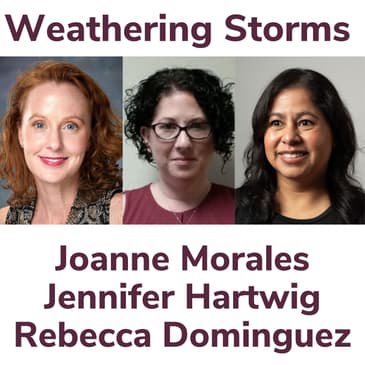
Life gets bumpy in the storms we face. Listen in as Joanne, Jennifer and Rebecca talk weathering storms, getting support and why we don't seek it.
Find out more at:
https://www.linkedin.com/in/jennifer-hartwig-216510163/
https://www.linkedin.com/in/rebecca-dominguez-9878592b7/
https://www.catholiccharitiesaz.org/foster
https://www.facebook.com/CatholicCharitiesAZ
https://www.instagram.com/catholiccharitiesaz/
https://www.linkedin.com/company/catholic-charities-of-arizona/
Guests and the host are not (unless mentioned) licensed pscyho-therapists and speak from their own opinion only. Seek qualified advice if you need help.
Want to learn more about thriving for you, your kids, your families or your colleagues? Pick a time to talk here
[00:00:02] Hello everybody, welcome to another episode of Thriving Adoptees podcast. Today we've got not one, not two, but three guests for you. So that's going to keep me on my toes. It's a while since I interviewed three people in one go. Three great people, three great ladies from Arizona. And I don't think we've had too many people from Arizona. Lots from Texas, but not from Arizona. So we've got Rebecca, we've got Jen and Joanne.
[00:00:31] from Catholic Charities in Phoenix, Arizona. So welcome to the show ladies looking forward to our conversation today. Thank you. So, yeah, the big question around Thriving. What does Thriving mean to you? And perhaps we could start with Joanne on that, please.
[00:00:57] Sure. I mean, I think that's a great question. For me, I really had to put a lot of thought into this when you had let us know about the questions. And for me, I think Thriving is not where you don't have any problems, where you're not like having any challenges. To me, Thriving is where you have a support system.
[00:01:22] You have a sense of belonging, where when you do have challenges and problems, you have people that you can turn to. You have a sense of family, whether it's chosen or however you want to define that, where you can get through problems together.
[00:01:41] Where when life gets difficult, things get challenging, you're not alone. You have people surrounded by you that you can kind of weather the storm with. And that's to me is really thriving where not in the absence of challenges, but in the midst of challenges, you have people and supports and tools that you can use to successfully overcome those.
[00:02:07] Yeah. Yeah. Yeah. I concur with the not the absence of problems. It's how we're doing in the midst of those problems. To what extent are they taking us down? I had a, I had a, I've had some real technical glitches with PayPal over the last couple of days and it's, it's really thrown me. And I've been a bit grumpy to people on the contact centers. Right.
[00:02:36] And this morning I was, I was, I was being, I was being a bit, well, a lot grumpy, right in the middle of it, even knowing that I was being grumpy. So there was an awareness there, but, but it hadn't completely, you know, my anger hadn't completely captured me.
[00:02:59] I, I, I was aware of it, you know, and so I, even as always apologizing to this woman for being grumpy, you know, like, so, so yeah, I think some people think thriving means that we've got it all sorted. No, it's about how we are and, and, and how, for me, it's about how, how, how, how much the, the tricky stuff is taking us down.
[00:03:25] Are we, are we, are we rolling with the, are we rolling with the, the, the, the, the storm to an extent? Is that what you, because you, you talked about weathering storm. I think that's probably what brought up the, the, the, the weather. Yeah. An allergy, John, yeah. Yeah. Yeah, I, I absolutely agree with that. Yeah. And I, I interviewed an adoptee once who, I asked her that question. She said, I said, what does thriving adoptees mean?
[00:03:54] She said, I'm not sure whether I'm thriving yet. And I'm, this, this is a lady called Rebecca. Her name escapes me at the moment. Anyway, she's very active within the adoptive community. She's a strong advocate. She's made a film with Nancy Verrier on the primal wound. She's out there making an impact in the world, helping other people, bringing the adoption triad together, the constellation together to talk about stuff.
[00:04:19] To me, it looks like she's thriving, but maybe, maybe her, her definition of thriving is somewhat different to mine and, and, and further, you know, in that kind of perfection zone. Mm-hmm. Mm-hmm. And, and, and then, so there's going to be frustration really, isn't there? Right.
[00:04:38] If we, if, if, if we're aiming for that perfection zone and we're not easing up until that, then we're going to be, yeah, struggling more even when we're kind of doing all right. Yeah. Yeah. Yeah, I agree. I mean, I think just acknowledging, I think sometimes it's, it's a bit calming to acknowledge, you know, we all have our challenges. Life isn't without its challenges, but it's how we deal with them and how we cope with them and how we survive them.
[00:05:08] And to be thriving is to have support, to have people in place where you can weather that together and kind of, you know, you're not by yourself, but you have people around you. Yeah. Um, yeah. And help you overcome that. Yeah. Yeah. Like you've got each other, right? You've got, and the rest of the colleagues. I interviewed, uh, well, I did a pre-interview conversation with a lady in, where was it yesterday? Um, I can't remember.
[00:05:38] It's totally gone. Maybe North Carolina. Yeah. North Carolina. And she, she, her, her team within adoption of foster care is like 120. And I'm thinking that must be great because thriving adoptees is, is just me, you know? So, um, uh, Jen, do you want to kind of pick up the mantle? What does thriving mean, mean to you?
[00:06:03] So, uh, you know, carry on from where we've been going, where Joanne and I've kind of gone or, or bring in your own perspective, completely different. And totally, totally up to you, Jen. Yeah. I think, I mean, it kind of the first thing that pops into, to my head is, um, opportunities. Thriving means that you have opportunities. And like you were saying, your, um, your other guest was saying, you know, they didn't know what thriving matter.
[00:06:31] They didn't know, you know, you might not know what you want, but you have the options. You have the opportunities in front of you. Those barriers are kind of removed, um, or you have the supports. Like Joanne said, you have your community around you to kind of help you get through the barriers, but you have the opportunities in front of you. Um, and you can just decide, uh, you know, what you want to do, what you want for your life. Yeah.
[00:07:00] Yeah. Yeah. Choice is a big one, isn't it? Mm-hmm. Uh, I, uh, I keep going back to something I heard from a fantastic foster mom a few months ago about the choice. She talks to a teen, older teen foster, foster, foster kids.
[00:07:25] And she says, like, I'm, I'm not, I'm not going to deny your, I'm not going to deny your trauma, but you, you, you've got a choice now. Right. So do you, do you rise above it or do you succumb? And I just thought that was incredibly powerful. So I'm sorry, listeners, if you've heard me saying that too much, but it is all, it is all about the choice. And to, to, to make a choice, we have to see them in the first place.
[00:07:56] And if we don't see them, then we're, uh, well, we would call it in a polite way of saying it in, in, in the UK would be snookered. Right. We, we, we, we, we, we, we, we, we, if we, if we can't see a choice, then we can't make a choice. So until we, we see a choice, then we're just going to keep on going along the same, the, the, the, the same way. And that we, we're going to get more of the same.
[00:08:23] And if that's stuff that we don't want, then. Yeah. So that, that, that's so powerful, setting out a choice, setting out a choice in, in such clear terms is, is huge. Yeah. Having those opportunities and not having any barriers that you can choose. You can, you have the opportunities at life. Yeah. Yeah.
[00:08:55] Rebecca, what, what would you, would you like to add to that? We're going to take it in a different way. Totally up to you. Yeah. You guys have said everything so, so beautifully already. Um, I guess when you first asked that question, what is thriving me? Like for me, honestly, like thriving is the goal, right? Like whether for ourselves or for our, for our kids, like that's where I want my kids to be, or that's where I want to be. I want to be in that, that state where we're thriving.
[00:09:22] Um, so I do see it as the goal and like kind of echoing what you guys were saying is, is as parents, we lay that foundation. We, we kind of give our kids the opportunities, the tools, but we can only do so much. And actually picking up those tools and using those to help ourselves thrive.
[00:09:40] Um, so it, I am echoing what you guys were all in agreement to is, is knowing how to use those opportunities, knowing how to pick up those tools to, to get to our ourselves to that point where we are thriving. But I do think it is a very fluctuating state, like, because it is kind of personal, like you can have that bump in the road where you feel you're not there yet, or it is perceptual lenses, right? Where people think you're thriving, but maybe you're not feeling that.
[00:10:10] Um, but I, I definitely do think it's the goal that we all kind of want to get to, and it can be an up and down goal, but it's definitely where we want to be. Yeah. Yeah. So, um, cause you've got, you've got three kids, right? Two, two older biological kids and a, a younger girl that you adopted from, um, from, from foster care.
[00:10:37] You foster, you fostered her first, is that right? And then you adopted her, is that how it went? Yeah. Yeah. Um, so if, if we bring in the kind of the thriving adoptees perspective, if we put that adoptee lens, uh, on, on, on, on, on, on, on, on, on, on, on, on, on, on, on. on this word of thriving, does that change the definitions? Does that change the way that you see it? What does it mean?
[00:11:06] What does thriving adoptees mean to you? It does because there's... So we were lucky with our daughter because she did come to us from birth. But even then, like there were so many things that we just didn't know about her. We had very limited information about her biological family. So for us, it was kind of hard because I did know going into this, like, and we're still not fully there yet. She's still young. She's nine.
[00:11:34] But we know there's going to be a time where there's going to be a lot more questions. There is going to be a time where, you know, she goes through her own identity issues and wants to know her birth history. And when she was very little, I didn't have any answers. I didn't have anything where I could prepare myself to be able to be there for her when she's asking me these tough questions.
[00:12:00] So again, because thriving is the goal, I needed those tools. So we did do a social media search, basically, in trying to find anyone from her biological family. And of course, who's appropriate? We did try to reach out to biological mom. She never contacted us. We tried her biological grandmother.
[00:12:27] And she was, we did speak, but she wasn't very consistent. And then we eventually found an aunt, her biological aunt, who met her when she was three. And we have a very good relationship with her. She knows who she is. You know, she knows that it's her aunt. And she spends time with her and her kids. Her kids spend time with us. They have a very good relationship. And, you know, and I joke with her.
[00:12:56] I'm like, when she's a teenager and I can't handle her, she's going to you. And she's like, I'll take her, you know, like, so we're kind of like joking around, like it really is going to take this village that we always talk about. It's going to take all of us to really help her through some of these, these tough situations or questions that she is going to eventually face. Yeah. Yeah. I was talking to somebody that works in an adoption agency in Scotland this morning.
[00:13:25] And I was saying, you know, kind of what's the difference between somebody like myself that was placed within five weeks of being born and compared to somebody that's been through the, that's been removed, right? So a child that's been removed from the home.
[00:13:51] And she, because it, and it's going to be, the removal is going to be because of neglect or abuse or something along those, along those lines. And, and she helped me see that it's about the frequency. It's about the number of, the, the number of traumatic events. And often if kids have been, unlike your daughter, Rebecca, if kids have been in the system and
[00:14:21] they've been in a few different, in a different foster home, then there's been that, there's been those multiple traumatic events and trust is eroded with each of, of one of those events and, and, and the trauma magnifies by the number of events. And I thought that that was a really clear way of seeing the difference because that,
[00:14:46] you know, people often say to me, well, it was different in your day and things are more open now. And that's got to be a, that's got to be a better thing. You know, the fact that your daughter is playing with her cousins. I mean, I bet she doesn't call them biological cousins, does she? Right. No, they're just her cousins. Just her cousins. Right. So she's playing with her cousins. And her aunt is just her aunt. Yeah. And her aunt is just her aunt.
[00:15:11] And so, and so these, these kind of slap, these, these loaded terms just aren't, aren't there and, and, and they make things so much more clarity, you know, so much clearer, so much more transparent, you know, we're, we're skipping all the shame off this or the difference of it. You know, we're not, we're not going to need to normalize it later because it's been normalized or, or, or already.
[00:15:42] You, you alluded to that, you alluded to potential stuff down further down the road. And clearly those teenage years are, are tricky for all kids, right? Well, biological or adopted, fostered, whatever it is. Um, one of the things that's on my mind at the moment is the prevention stuff that we do there. Like what, what can we do? What, what can we do?
[00:16:10] How can we build, I don't know, the, the word comes to mind is resilience, but emotional intelligence or resilience. How can we build our kids resilience for those potentially tricky years, um, uh, ahead? And so maybe Rebecca or. Yeah.
[00:16:36] I'll, I'll, I'll answer just again, from my own personal experience and even professionally, like what I have seen that, that seems to work best. Obviously every child is different, but I think you kind of, you kind of made that comment earlier where you said these loaded words, right? These like, I think if we, these words don't have to be loaded if we normalize it from day one, right? Like we adopted again. We were very lucky. We adopted our daughter as an infant.
[00:17:05] Obviously I didn't hold her and say you're adopted, but there's adoption stuff all over our house. You know, I have pictures of her at the court hearing. We have announcements of when she was getting adopted. Like we, we have her birth plate when she was born that had her biological name. Like it's always been on display. It's always been talked about because we wanted it to be a very normal thing and not a shocking thing.
[00:17:30] Five, six years later, it's just always a part of her story, a part of who she is. Um, and we talk about it. Um, we don't force it down, you know, we don't force it on her over the years, three, four, five. I remember at when she was five and in kindergarten is kind of when somebody asked her about it. And so she came home and asked a few more questions. We answer all of them.
[00:17:56] Um, she's asked me questions about her, her biological mother. She's asked for pictures. We've provided it. It's never been a situation where I want her to feel like she can't come to me because I'll get too emotional about it. I want it to be just a very normal part of her everyday life that if she's got questions, we are going to answer all of those questions to the best of our abilities. Um, and I think that's how we provide that stability.
[00:18:26] Cause like you said, trauma obviously affects thriving because stability is part of how you thrive. And so when you've lacked that, especially in those very early years, you're never going, you're, it's going to take a long time to feel stable, much older. And then to be able to really then feel that you could thrive when you've had that lack of stability. Yeah. So it's, it's extra hard.
[00:18:54] Well, not, it's extra focus, intentional focus on the grounding in the early years. Yeah. Um, yeah. Yeah. Yeah. And I think language does matter how we speak about it. One, just openly. Um, it's without that shame, shame, without the secrets, you can thrive when there's no secrets.
[00:19:20] Um, and you're not finding out as an adult or as a teenager, oh my gosh, this happened. Um, but you grew up with it and you grew up with your story. There's no secret. There's no shame. And, and the language that people use that, you know, you were placed for adoption. You know, your birth mother loved you so much that you were placed. You weren't abandoned. You weren't put up. You weren't left. Um, you know, you were placed.
[00:19:48] Um, I think a lot of the language we use is really important. Yeah. Yeah. Um, given, given up. Yeah. You weren't given up. It's a dodgy, it's a dodgy one, isn't it? You know, that's so. Yeah. Yeah. Um, placed is, it's just a, a, a million miles better. Yeah.
[00:20:13] Joanne, have you got anything to add on, add on to that in terms of the thriving adoptees lens or the, or the laying of the foundations for the teen years or anything else? Um, yeah, I, I, I really concur with like Jennifer and Rebecca, but I really like what Rebecca was saying about that stability. Um, because one of our programs is a foster care program where the majority of them are
[00:20:43] teens and they were unaccompanied. So if they came to the U S, um, without, um, family or parents and they're placed in foster care at like 16 and have never, you know, they haven't been parented in a long time. And just what she's saying about that stability. And, you know, with a lot of the teams that we have in this program, people will say, oh, I want to foster a small child. I want a little kid.
[00:21:11] And there's so many teams in foster care. And we've actually had two of our foster families, um, go on. And I would say like symbolically adopt the kids when they were 18. So obviously they're not like formally legally adopted, but there's, there's a court proceeding where they can be, um, adopted in and take their foster families names.
[00:21:36] Um, and I've seen that twice and that's a really beautiful process and incredibly meaningful to the teens. But I think, um, just creating space for them and understanding when we talk about trauma informed, you know, everybody's kind of saying, oh, this is trauma informed care and this and that. And, and it's, it's really just kind of creating that space and allowing that team to, to, to know that they can have good days and bad days.
[00:22:05] And we're not going to just, we're not going to label you as difficult, or we're not going to call you. We're not going to request, um, a removal because you had a really, really difficult day, but like understanding that they're, they're starting their lives over, but they're also rebuilding it at the same time. And, and when we talk about like multiple instances of trauma, like just understanding, like it
[00:22:30] is a process and that stability that Rebecca mentioned is just so essential. And from what I've seen of the best foster parents. And I, like I said, they go on, I've had two that have gone on and kind of symbolically adopted them. Um, it's really allowing them like letting them know, like, Hey, giving them some grace just to be like, yeah, we're going to make mistakes and we're going to have tough days and just that stability.
[00:22:57] And the kids knowing that those foster parents are still there is so key. And, and I think, um, that's where I've seen the most success with the teams is really, really, and, and trust me, they, they can be, you know, they, they can make, some choices that can really push you. I think, um, the best foster parents I've seen. And I don't even, you know, we're talking about words and in a lot of these families,
[00:23:24] they're not foster parents, essentially, maybe professionally by that term. But like when they're really a family, you don't, they're together and they weather that together. And I think that's the big thing with the teams. Um, so I agree with completely with what they're saying, but yeah, with, with the older kids, it's definitely, um, giving that sense of stability. So I think that's the most important thing you can give them. Yeah.
[00:23:53] Well, as you were talking about stability, um, and kids, the one that was coming back to me, the word that was coming back to me was modeling. Right. Um, and, uh, so me and my wife haven't got any kids. So, but I've heard this, I've heard this said a gazillion times and, but it always lands
[00:24:19] for me that kids do what we do, not what we say. Right. So, uh, to me in one word that that's, that that's modeling. And, uh, Joanne, you mentioned a great word grace, right? And it seems so huge because so many of us are so hard on ourselves. Right.
[00:24:45] So we want to, we, we want to extend grace to our kids, uh, and, and, and, and help them be, yeah, not beat themselves up as much as like, I, I, I don't know how to quite try to express it, but how do we, how do we model grace on ourselves? Because I know parents are very tough on each other.
[00:25:15] Sorry, on each other. Ha ha ha. Uh, Freudians sit there. Um, they're very tough on themselves, right? A lot of parents are very well and, and adopted parents are particularly in my opinion, right? Are particularly tough on ourselves. So perhaps, um, Joanne, can you, can you share a little bit about what, since you mentioned that grace word, what does it, what does it mean to you and what helps you give yourself
[00:25:46] more grace? I think it kind of goes back to when I was talking about my definition of thriving. Cause I, I do have a 16 year old son and I joke, like I was a one and done. I have one child, but then I joke and say, no, I actually have 45 with our team foster program.
[00:26:05] Um, so it's, it's kind of funny that way, but I think modeling that means like, I think I'm probably the best thing I can show my son is like, okay, mom's having a bad day. This is how I deal with it. Or I have an obstacle or I'm having, maybe I'm having a difficult situation with someone, whether it be professional, personal, what have you, or I'm disagreeing with someone. I'm modeling how to handle that.
[00:26:35] And like, what tools am I using? It's not like, um, cause you're right. We are the hardest on ourselves, but like, I, it's easy to model when I'm having a great day. That's easy. Right? Like, Oh, I'm having a great day. Everything's going swimmingly, but I think like, Oh, I'm having a hard time. Like, um, what was it? Uh, my son, this is delightful for parents of teens. My son brought bed bugs home.
[00:27:02] So our house had bed bugs, which was, let's just say that was an extra level of challenge. And it was like, you know, I think he got it from school. It came from his backpack and, you know, I don't, you don't really know where they come from. You can't trace it, but it was very frustrating. And we had to get our house heat treated and do all that. And it was like, well, I have a choice. I can either have a meltdown and just completely lose it.
[00:27:30] Cause I'm home with bed bugs and you know, nobody wants that. Right. Or I can be like, okay, we're going to call the pest control. We're going to do this. We're going to bag up our clothes. And it's like, I can look at this negatively, or I can be like, this is okay. This isn't great, but let's deal with it. And A, B, C, D and E. And that's kind of how I'd like to think that I modeled that for my son, but also like our foster kids.
[00:27:58] It's like, it's not, oh, you know, yeah, things are hard. Okay. Let's talk about things we can do or tools we can use, whether it's emotional tools, social tools, physical things, or active things we can do to address it. I think to me, that's kind of the grace is it's not like, yeah, this kind of sucks right now, but let's do it together. If that makes sense. Yeah.
[00:28:24] And I was thinking about how I started the show, talking about my meltdown with PayPal and whether I can give myself a little bit of grace about that. It did lift, actually. I was grumpier at half past nine than I was by 11.30, despite the fact that it still, they
[00:28:54] told me it was fixed and it still wasn't fixed. So something, my mood shifted somewhat in those two hours. Yeah. Grace and choice seem to be natural bedfellows, but obviously beds without bedbugs, but natural bedfellows. Yeah. Yeah.
[00:29:23] Can I add to that a little bit? Go for it. Because as Joanne was talking about that, I really thought the story was going to go and then I lost it on my son, you know, but what I was going to add to that is I have lost it on my kids. I, my boys are teenagers too. I have a 17 year old and a 15 year old and I have lost it on them. I, I, I've always wanted to be that textbook parent, right?
[00:29:51] The one that never says no to your kids, never raises their voice at their kids, right? Like I, I had read all the books and I was going to be that parent. Of course, I'm not that parent, but what I do like to do is when our arguments do get escalated and I do raise my voice or I do yell or I do lose control. I always go back and apologize to them.
[00:30:16] Uh, because that is part of that same thing, that modeling, that behavior. We're not all perfect. We are going to lose patience or control. And, you know, I know my son is just as mad at me as I am at them. So I always take that moment to like 30 minutes later, an hour later, whatever time it takes us to calm down, to go back and say, Hey Noah, I lost it on you.
[00:30:45] Like, I, I think, you know why I shouldn't have lost my patience. I shouldn't have screamed and yelled. These are the reasons why I did it. And honestly, like probably I would say, I wouldn't say he's pervasive teenager. Like at least 50% of the time he's able to acknowledge it back and say, I know mom, I was being rude too. I'm sorry. And we move on. But I always wanted to do that because I didn't always grow up that way, you know, like,
[00:31:14] so I always wanted to at least go back and show him like, I'm just a person too, with all these same emotions that you have. And just because I'm a parent, does it make me in this position of like, I know everything I'm better than you, so to speak. Right? Like we're all human and evolving and learning together. Yeah. Yeah. Jen, have you got anything to add to that?
[00:31:41] Just like in your example, Rebecca, and I think that's so important for your other kids to see that as well. Cause I was just thinking I'd make a point of if that happens even with my husband and I have an argument with my husband that maybe my kids have seen, which that's not good either, but I want them to also see that my husband and I will come back and repair that and we'll make up later. And I want them to see, yeah, we're not perfect. I'm not perfect.
[00:32:10] It's not the absence of, of barriers or obstacles in your life, but yeah, you know, you can lose it, but it is, it's coming back and doing that repair and having them see that as well. Yeah. Yeah. Yeah. The, the, the word that's coming to me as you, as you, as you talk is, is vulnerability and being vulnerable about our feelings with our kids.
[00:32:40] And as I said, me and my, me and my wife haven't got any kids, but this area fascinates me because of work I've done in, in elementary schools where vulnerability was almost like a magic source in terms of connection, communication and empathy with, with, with, with kids.
[00:33:08] And, and that's the only kind of space where I've been involved with a lot of kids because we don't have them ourselves. Um, so I'd be interested in, in hearing your perspectives on that, on, on being vulnerable with, with, about your emotions, about your learnings, about your, what, whatever, what,
[00:33:36] what does, what does vulnerability do? And, and what have you got to say around that subject? Sorry. Take it away. You, you know, you're bright. Uh, you don't need me to give you any more hints. I think, uh, sorry, hints. I'm looking for your, your take on vulnerability really. I will say this.
[00:34:03] Fostering will make you very vulnerable and under, like, talk about a humbling experience. Like you could think you're the best parent in the world and you have all the right tools and you know how to parent. I don't know how many times I've heard this professionally. Like we've raised successfully five kids, six kids. We got this, like taking some foster kiddos and it'll humble you. Um, there's going to be, and this is the things that people don't talk about.
[00:34:32] There are going to be times that you feel you are failing at parenting because we don't understand the trauma that the kids bring in. We don't understand their feelings. Some of the kids can't even vocalize like what they're feeling and experiencing. It is the hardest thing. And it does. You will face moments where you're just like, I am terrible at this. I am failing at this. I can't.
[00:35:00] So it's not just emotionally hard for you to watch kids. It's emotionally hard on you as a parent to feel like you're doing everything wrong and you're failing at it. Um, or I, I remember personally having thoughts of like, we, we just, we can't do it. We just, I found a kiddo that I can't parent. What do we do? Like, it's a very humbling experience to kind of put yourself in that position and realize I can't do this.
[00:35:28] And then of course, find the tools or be able to vocalize that to your team saying I'm really struggling because that's when the help will come. Like that's where you get those tools then to help you succeed in foster parenting. But it is, you have to be very vulnerable to admit when you need help. Yeah. Yeah. I just dealt with that with a family a couple of days ago.
[00:35:57] And I think that vulnerability and being vulnerable opens you up, like you said, to receiving that help. These parents had four teenagers that they're foster children that they have taken in all with different needs, all with different traumas, all with a whole list of therapies and services. And it was just overwhelming. And I think when the foster family just opened up, like we're failing, I can't do this, take them away.
[00:36:24] Like, but just having that conversation, I was able just to listen and validate that. And that just lifted a little bit, just having them, just by them expressing themselves, okay, one step at a time, we can, we can do that. But I don't think it would have happened if she wasn't vulnerable enough to say that this is, this is a lot, this is hard. And then we talked through it. And I think she saw she could do it.
[00:36:54] Yeah. Joanne, have you got anything on that? I mean, I think what they're saying is, is really spot on. It's, it's to me, like the vulnerability is like being able to be really honest with yourself, like where you're at and, and kind of acknowledging. Because I think sometimes as parents, as Rebecca said, you have this like perfect vision of like, oh, I'm going to do it this way and this and this.
[00:37:20] And then of course your child will turn that on its head in like five minutes. And so it's, it's kind of admitting, like trying to be honest about it. Like, yeah, I had a bad day or I didn't do that good. Or, you know, I was talking to my son yesterday and he was like, yeah, I didn't get the grade I wanted in calculus. Da da da da da. And I made a mistake. I go, yeah, I made a mistake. It worked yesterday too. I had programs I was introducing and Jenna laugh.
[00:37:49] And I'm like, you know, the program, one of the programs I'm like, did I miss anybody? And it was one of the programs I support in my head. I'm like, oh gosh, way to go. But I was sharing that with him. So we were both kind of like, yeah, this was tough. So being able to like, yeah, normalize that with your kids instead of like putting this front, like mom knows everything or mother, you know, that old saying mother knows best or whatever.
[00:38:15] Like, no, we don't like we're figuring it out the same as you, but we can figure this out together. Yeah. The topic that's coming into my head as you talk about this is, you know, the asking for
[00:38:32] help one is what I hear from so many professionals is that parents are, and it seems, yeah, parents are slow to ask for help. And they, and you're nodding, they're all three of you nodding. You can't, I'm explaining that because you can't see that listeners. The, the, the late to ask it.
[00:39:01] And it's, it's often, it's really hard at that point. When we're in crisis, it's really hard. The turnaround is going to be really hard at that point. And, and as soon as I say that, I think this is, this is human nature. This isn't an adoptive parent thing. This isn't a parenting thing. This isn't a kid thing.
[00:39:26] This is a human thing that we have a bit of a tendency to put off asking for, for, for help. Um, and, and the question always is like, why, you know, what, why, why are we late to ask for help? Because if, if we can, it, it, it, it's gotta be something that's like some sort of, I'm
[00:39:55] overcooking it here, like a deep seated belief amongst the human race that we should wait. And, you know, well, no, it'll be okay. What, you know, what, what have you, what have you learned around? I think that we should have the answers. We should know. I'm a professional woman in the field. I should know how to do it. I should know how to raise a child. I should know. I should have the answers just as a woman in society. I should know how to do it.
[00:40:22] Or as a professional, you know, I should have these answers, but we don't, you know, and it's okay. Like you brought up that vulnerability. I think it's okay to be vulnerable and say, no, I don't want, I don't have it all together and I don't have all the answers. I need help too. Yeah. We're so modest about what we. Yeah. Rebecca or John, have you got anything to add to that?
[00:40:52] I, Jen brought in the professional angle that I haven't seen, but of course, you know, if you're, if you're a professional as well, that's going to make the should even bigger, isn't it? Mm-hmm. I do sometimes think. Oh, sorry, Joanne. No, you go ahead, please. I was going to say, I do sometimes think that when we measure success, like we think like success is, I did this by myself. Right.
[00:41:22] Like we hear these stories too, like this hero that goes in and he did it by himself or this person who, you know, had this horrific challenge or, and he survived on his own. You know, like we hear all of these like hero stories or success stories. And it's usually about someone who got there by themselves. So I think this idea of asking for help is admitting that I can't get there on my own.
[00:41:51] And it's almost like in the back of our heads, a failure rather than a success. Yeah. But what you don't see is, right. Like I always look at Michael Phelps, right? Like he didn't get there by himself. He had coaches and parents and all, but he celebrated as this individual. And I think that's maybe where some of that idea comes from. Like if I didn't make it by myself, then I failed. Yeah. Wow.
[00:42:18] I'm, you mentioned the sport, sports icon there. I'm thinking about the difference that I see on a soccer pitch. If it's women's soccer versus men's soccer and the celebration is, is far more of a group, a group thing. There's, there's more of it. And there's more, and it takes me right back to the start, Joanne.
[00:42:43] I, you were talking probably three quarters of what you talked about with Thriving was all about group. And not about individual. And the, the, what Rebecca said about, you know, Michael Phelps and, and, and this, you know, there's a cultural thing about pulling ourselves up by bootstraps and doing this stuff. And, and, and the, the, the cult of the individual.
[00:43:13] Whereas you were a million miles away from that, Joanne, when we, when we started on this conversation, whatever, three quarters of an hour ago. Yeah. Yeah. I, I, I would say absolutely. It's about, and I completely agree. I love how Rebecca said that it's, it is absolutely like how we're getting through things together and how we're supporting each other. Like I've seen that professionally, personally, you know, you, you can't really do it.
[00:43:42] If you set yourself up mindfully, like, oh, I have to do this on my own. It's not going to work. It really isn't. So, and I do like what she's saying about like, you know, also giving that credit to the team and recognizing everybody. And that really brings that like sense of family and belonging and cohesiveness, whether it's professionally, personally, what have you. It's like, when we're in this together, you feel more like that.
[00:44:08] Like I know at work, like even professionally, I can say, oh, I'm in this role and I do this, but it's never going to be as meaningful. If it's like, oh, we're a team or we're doing this together. So it's like trying to change that language from like, I, I, I did this to we, we, we, we did this. Like our programs aren't successful because of what me as an individual or anyone as an individual is doing.
[00:44:35] Like when we talk about fostering adoptions, it's about the families and like us being the support to them. So I, yeah, I completely agree with that. It's, it's like the minute you go all completely individualistic, you're, you're, you are going to be harder on yourself. You are going to feel like you're failing because you're by your own. You're looking at it from yourself, just yourself, your own perspective. Yeah. So we're coming in on time.
[00:45:03] Is there anything that you'd like to share that, that I, that I've not, not asked you about? Are we good? No, I would just say, you know, if there's families that are interested in fostering or adopting, obviously we're in Arizona, but we are kind of statewide, you know, feel free to hop on our website.
[00:45:27] We're always looking for families that are well, well, you know, willing to open their homes. And we're at www.catholiccharitiesaz.org if people are interested. I haven't said this for a while, but listeners, there's, there's always links in the show notes, right? I, I, I put together the links and, and bios and social media things, social media handles, et cetera, for, for the guests that are on.
[00:45:56] So, so check, check them out. And thank you. Thank you very much. It's been a, it's been a great, yeah. And I've, I've been a little bit more relaxed somehow, despite having three people to, to, to juggle. So thank you for, thank you for bringing that to the conversation and we'll speak to you again very soon, listeners. Take care. Bye-bye. Thank you.