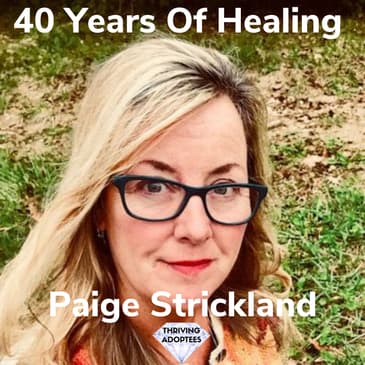
One of the strongest themes in our conversations on healing is that it's an ongoing process. So what do learn over that process that helps us along that process? Listen in as Paige shares what she's done and continues to do to help her along the process.
Paige Adams Strickland (1961- ) was born in Cincinnati, Ohio and adopted at 13 months. In 1987 she began a search for her biological family members. She has a BA from Florida State University in Spanish Education. She has 30 years experience in teaching. Her writing has been featured and won attention from scinti.com, a wordwithyoupress.com, soniamarsh.com and adoptionvoicesmagazine.com.
Listen to her previous interview:
Paige felt ashamed about being adopted when she was younger. Listen to what she's learned over the years to leave this behind. We discuss overcoming stigma, questioning the primal wound and our true identity to feel better, do better and thrive.
https://thriving-adoptees.simplecast.com/episodes/from-shame-to-thriving-with-paige-strickland
Find out more about her at:
https://stricklandp.wordpress.com/author/stricklandp/
https://www.facebook.com/23plas
https://twitter.com/plastrickland23
https://www.instagram.com/paigeladamsstrickland/
https://www.linkedin.com/in/paige-adams-strickland-4819722b/
https://www.instagram.com/akin_to_and_after_the_truth/
Check out her books at:
Guests and the host are not (unless mentioned) licensed pscyho-therapists and speak from their own opinion only. Seek qualified advice if you need help.
Want to learn more about thriving for you, your kids, your families or your colleagues? Pick a time to talk here
[00:00:01] Hello everybody welcome to another episode of Thriving Adoptees podcast. Today I'm delighted to be joined by Paige Strickland looking forward to our conversation page. Glad to be here Simon, thank you.
[00:00:13] So this is the first interview I've done in a couple of weeks. I've been back from, because I've been away on holiday vacation. I like me with a tan, I don't know what it is. I think it's got something to do with in my single days.
[00:00:31] I think I felt a bit more attractive to girls. You feel cooler. Yeah, yeah. And it's pretty mild here in the UK at the moment, but we are going to get some chilly stuff. We've had a real easy February. I mean, it's all relative, right?
[00:00:51] But yeah, usually this we're on, I was mentioning before we were on the air. This is our long weekend that between Valentine's and President's Day in the United States. This is usually in Ohio and Cincinnati, Ohio. This is the worst weather weekend of the entire year.
[00:01:08] Something almost always happens or it just lingers and doesn't go away. And the snow has melted. The sun is out. It's 40, which I don't know the centigrade with that would be. It's, it's what maybe 20 in centigrade. I don't know.
[00:01:25] I'm not sure. I use bugs as them, but I don't know how to come. I don't know. I've got my little app that my phone's plugged in charging right now so I can't cheat.
[00:01:37] But it's like this isn't bad compared to what we usually feel like we're in Alaska right now and it's good. So, healing. We're talking about healing today. So what does healing mean to you, Paige? Okay. And again, it's only my point of view. Indeed. That's what we're after.
[00:02:02] Yeah, so I'm not saying I have all the right answers, but I know what works for me and I'll show you. I was taking, I was writing down notes. Preparation. Yeah. Love this. Love this. Yeah. Mark a little bit.
[00:02:15] I know what worked for me to feel healed and just because I consider myself a healed person in terms of adoption, that doesn't make me the happy adoptee. Okay. Let's put that out there right now.
[00:02:29] I'm at the thinking adoptee, but I think you can be more than one thing also. So for me, it was, it started with attending a cub meeting.
[00:02:44] Concern United BirthParents, CUB, finding my voice, my starter voice because I grew up really, some of it was self-imposed and some of it was society imposed just, I just knew better than to speak out about adoption or talk or ask questions.
[00:03:03] So I kind of went into this emotional hidey hole and just not going to discuss it, going to pretend it doesn't exist. It's not real. That's not me. That's just a word.
[00:03:14] That kind of thing. I've never told friends, you know, and it was like, that was the start of like that coming out of the fog, which for me, that was the healing was finding a place where I could safely speak my mind with other people. Yeah.
[00:03:34] That would not shoot me down or gaslight or whatever term you want to use for that. And then it was... Was there a specific moment like in one of those talks that really hit you?
[00:03:55] I don't know about a specific moment. I just know the first time I went, it was a bigger deal than I imagined.
[00:04:04] And it was one of these where everybody kind of had to go around the room and hello my name is, I'm an adoptee kind of thing or hello my name is and I'm a birth parent.
[00:04:15] Hello, my name is, I'm an adoptive parent. And I had never said those kind of words before to anybody and I was 26, 27, but I mean other than my husband, he's the only person I didn't keep a secret from, but anybody else,
[00:04:33] I never said things like that. I didn't have people, I could say those things too. And that was a huge, huge thing to be able to speak the words and then say either anything I was glad about or what I was not glad about
[00:04:48] or what bothered me or what worried me or the things you think that you're afraid to tell people what you think. And that's what we were able to do.
[00:04:58] And then from there too, it was also being able to ask for help if I want to search what would I do? How would I go about it?
[00:05:07] Because I know you don't just ring doorbells and go down to the courthouse or something you have to. There are ways to make it work. Did you have to plug up a lot of courage to actually book yourself on that? To go to the meeting.
[00:05:24] Yeah, or was that just a no brainer? I think I'd been working up that courage probably my whole life or at least my over age 18 life. Because yeah, it's like, again, I've never been to any kind of a support group before that.
[00:05:43] Didn't have other issues where I had to go to support groups. And so that was big for me to do that. And there were probably 15 or so people in the room which you know, it wasn't like three people sitting there.
[00:05:58] It was like 15 people in there and mixed age ranges from, I don't mean one friend. We're still good friends to this day.
[00:06:09] And you know, we're talking going back almost 40 years that we met there and we were the two youngest people probably in the room and all the way on up and ages up to probably people in their 60s at the time.
[00:06:24] And since where Cincinnati is located, you know, we're border with Indiana and northern Kentucky. So it was people from three different states really that kind of came together in the part of town where it was.
[00:06:37] And it was yeah, I didn't know a soul when I walked in. That's the other thing, room full of strangers. You know, I teach for a living but if you pay me money, it's a little easier when it's kids, you know more than they know, it's easier.
[00:06:52] You know, but a room full of peers. It was like, I don't know what I got myself to here but you know it that was the start of for me it was finding a group, finding people finding even if it's some people come and go and you never see them again in a meeting, you know they got what they needed
[00:07:13] and they're done or they didn't weren't satisfied and they go off. But it's, it's just still having a place I could go once a month and speak my mind and ask my questions.
[00:07:27] That was a big deal. And you know, it's awful there's so many people that don't have things like that it doesn't matter what the issue is it could be.
[00:07:37] It's just a big that you need a support system for, you know, quit smoking or anything, you know, if you don't have the people. I'm working in a school system. Last week we had a threat situation. It turned out to not happen everybody safe.
[00:07:56] A kid spoke up because he found somebody safe he could go to, to say look, I don't know what's going to happen and I'm scared but this is what this guy told me and his friend and I got to tell somebody I can keep this to myself.
[00:08:12] He found people he found somebody he could go to that then they were able to turn it over to the school authorities and the police.
[00:08:20] Everything's, we're safe. Everything's taken care of at this time. And it was just like, so whatever your topic is that you need safe people for whatever you need to have your people whoever they are doesn't matter their age it doesn't matter where they come from or anything
[00:08:38] like that. And, you know, that was a great thing about this these meetings was I was in a room with people who understand and some might view maybe the adoptive parents or even the birth parents as being on the opposing team but really in that room.
[00:08:54] The focus was no we're all, we all got a stake in this we've all got a hand in this and we're all civil in this.
[00:09:02] And yeah so that was a great thing that I could see that, you know, and interact with people and they're all very nice. It was fun to you know, eat or food and eat and hang out.
[00:09:13] And then I guess after that it was, it's like going back for another piece of pie. Now, now that I had people now I wanted to go get my information.
[00:09:25] So that was the next thing and then seeing the information receiving it and then processing it and having that and then be having I've got my group of people and go share my information with them and say looky what I found.
[00:09:37] Look what I found out. Guess who lied. Guess who something right, you know, all that stuff. And then and then I went on the search and found out more information that wasn't on paper and then reading,
[00:09:54] learning, anything I could get any book I could get my hands on and back in the 80s there weren't, there wasn't much. And if it existed it wasn't known either. So, you know, the Betty Jean lifting books are out.
[00:10:09] And I think the Anna Fisher book was out searching for Anna Fisher I think it's called I read those. That was about all that I was aware of that was out but the people had come recommended those books and I happened to have a job, a retail job in at nights and weekends
[00:10:29] and then I went to the mall and then bookstore was right next door so I'm like right and run over there by books.
[00:10:37] And then do you remember any other particular moments of obviously it's going back a while back, but were any particular moments or insights that you had from reading the books the Betty Jean lifting books on you.
[00:10:53] And I was like, wow somebody thinks like I do or somebody somebody has the answers to some of the questions I had that weren't necessarily particular to my birth family but just in the general sense of what do you do.
[00:11:08] How do you react. This is this normal the way I'm feeling that kind of thing so it was another way to find people that they were more or less virtual in the day people.
[00:11:21] It was another way to get some validation for what you know it's been rolling around in your head for so long.
[00:11:29] Yeah, and yeah so yeah so relief that a relief that relief. Yeah, that I'm not I'm not weird. I'm not well maybe I'm weird but not that weird.
[00:11:39] But really, right. Yeah, yeah. Yeah, but yeah I'm like okay you know that kind of thing. Yeah but learning even things about just history at any self education that you can do rather than denying it.
[00:11:55] You know I think is is healthy because then if you want to think what you want to think but at least you've been educated. You know it's like I don't care what people I don't care if somebody's a happy adoptee but are you an educated happy adoptee versus.
[00:12:09] That's just the only thing you think and you don't want to hear what anybody else has to say, you know, kind of thing but yeah it's it's like politics you got to kind of look at everything and then make up your mind, you know, about what's going on.
[00:12:24] So there's so many. Obviously the internet wasn't around when you're talking about. Yeah, there's there's so many virtual groups now. How do you see the difference between the the in personal groups and the and the and the virtual groups.
[00:12:45] You know virtual means you might have a limit to the connection you can have with the person but on the flip side. Okay, take me here in Cincinnati Ohio and your where in England and New York and North England. Yeah.
[00:13:02] I mean, wow, 1000s of miles apart. You know that you couldn't have gotten that long time, you know, and that pool to and you know, coming from by trade I'm a Spanish teacher you know so other people's cultures other way other people live
[00:13:19] not just the language part but just all the things that are similar and different that you don't realize you can learn all those things about people.
[00:13:26] You know, you never know too if you go searching like I did. You're going to find people that may not live in the same kind of culture even in the same country that you have or they enjoy or like different things or
[00:13:43] they know things you know, because of the way they've lived versus the way you live and yeah I mean that's I feel like that helped me, you know to like go at it when I did do my search and when I did reunite to that was another
[00:14:00] part of the healing was being able to and not I get it not everybody gets as lucky as I got but to be able to have you know those relationships and add on to your life in a good way.
[00:14:14] Yeah, so, you know, but I know that you know that doesn't happen for everybody but it do the best.
[00:14:21] Yeah, and I just wanted to mention something on that reunion piece because it doesn't always work out the way that we you know it doesn't always the way that we think we want it to work out.
[00:14:42] And yet we learn. Yeah, we learn even if it doesn't go the way we expected it. So I haven't shared this on the podcast before because I hadn't told my mum about it but and I don't I don't want to I don't think she listens to the podcast but I didn't want to listen to an odd one.
[00:15:06] But I actually got I contacted my birth father completely out of the blue from perspective a few months back and he come he blew me out. I mean he didn't hang up the phone with me. He asked me a few tricky questions.
[00:15:26] And then he said don't don't call this number again. Yeah. Yeah. And yeah, and yeah, you know I ended the call and I'm not going to contact him again. And yet that set me thinking.
[00:15:48] That set me thinking. Number one, I didn't get upset by him blowing me out. So I saw my own resilience in that moment but it also got me thinking about what would life be like if he had married my he clearly didn't love her else he would have stuck with that he would have married her right because they've been 18 five months.
[00:16:14] But what what if he done. What if he done the right thing in inverted commas and married then but he didn't love her so I would have grown up in a in a household where where where the where the dad didn't love them mum and how would that been and how could he have resented me and all this sort of stuff and you know like
[00:16:37] So although it's not what I would have wanted. It has led me to a sense of peace and some new, new thoughts around this right. And if I hadn't done that, I wouldn't have got.
[00:16:59] I would have just, you know, so I'm so I'm this is supposed to be about your learning but it's important that we see the reunion, even if it doesn't go to plan.
[00:17:15] Yeah, can lead to some to some some insights and and of course it sometimes goes completely completely trash but at least we know it goes to hell. We got to hell. But at least kind of like we know when we that's where I was thinking.
[00:17:38] So I was thinking, I would never. If I hadn't asked if I'd done it, then I would have never known and that that never knowing would have would have booked me. Right. Yeah. Yeah, it's it's.
[00:17:56] I mean, that's the one thing I feel like that cub group really prepared me well for expect the unexpected and just put all your fantasies or you are imagining of what these other people are like aside and just like that's like a TV show or you meet
[00:18:15] a celebrity and they turn out to not be like the person you would think they were just because you saw them on a TV show or a movie and or sports or something, you know, and so.
[00:18:27] Yeah, I that really helped to have this community of people that can kind of like give you the warnings you need. Yeah, which it's preventative for healing.
[00:18:40] It's it's preventative care, which is all part of just in general any kind of healing if you think about it, you know, that's so. Yeah. Yeah. People talk about having no expectations going into the union and whether we whether we're actually capable of that I don't know.
[00:19:02] Another another thing that I've had from somebody has been on the show was we've probably done some work right you've done some work before you you you. Got back into you know started on the reunion phase and but that doesn't always happen.
[00:19:23] So although we may have done some work. Our birth parents might not have done any work. So, right, we shouldn't have we shouldn't expect them to have done work.
[00:19:36] And so they might still be stuck in the place where they were all those years ago when they, you know, when they relinquished us you know or when they placed. Yeah. And they, they pretty much.
[00:19:51] I know from what I know when my birth mother ended up deceased, which I had had a gut feeling about that.
[00:19:59] It was totally illogical, but I had this gut feeling that that had happened to her because that would be one explanation for you know, and all it's not like she died in childbirth but she died. 13 or so. Maybe 14.
[00:20:19] But I would, I just kind of in my mind I think that's how I coped when I was a kid was she's probably dead anyway. You know, kind of that kind of thinking and and then it turned out to be real.
[00:20:33] So, but so I was prepared for that when I got that news. And I, my brain went, I knew it all along. Yeah, more. Oh yeah. But I got the rest of her family though so there is that. Yeah.
[00:20:57] And she told everybody which was pretty lucky not every birth parent does that, but she had told everybody in her family. She, you know, had the hope that either she could find me or I could find her although nobody knew how you're going to do it but powerful.
[00:21:20] Yeah. So yeah, whether or not she had any chance herself of healing I've often wondered that. But I don't really know but at least she was able to talk about it with my older sister to prepare her.
[00:21:39] And in case you get a call or a letter in the mail someday. And, you know, it's, I've often thought too like in today's the modern world if I hadn't done the research when I did it in the 80s.
[00:21:55] We would have probably my sisters and I would have found each other on my space and Facebook at some point. And of course ancestry to later life but man I'm glad we got the 30 or so years before all available to us. So, you know, to have that time.
[00:22:20] But yeah, yeah it's, it's, I know my birth father hadn't done any work. He was exactly like me. He was like let's just forget about this. Make like it didn't happen. Yeah. Just move on, you know, he never told his kids.
[00:22:38] He did tell his wife but he did not tell his kids and made his wife's swore her to secrecy so he hadn't done the work. But I was prepared for that also. So yeah, he's he needs a little time and coaching and understanding. Is he still alive?
[00:22:59] He's still in touch with him. He, he, well I'm in touch with the family. He passed away in 2015 but like Super Bowl Sunday which probably means nothing to you on England. But you know we were together that night here so yeah. And with them.
[00:23:15] Well, I've just come back from holiday we were in St. Kitt's so actually Super Bowl Sunday was happening while we were there so we did a little bit of it. Yeah. Yeah. Yeah. I was going to ask where you went to get that chance. The Caribbean. Yeah. Nice.
[00:23:34] Nice. Yeah. And I guess the only other the other thing I wrote down here was that. And you're kind of into the metaphor thing. I get that too from the, from the like okay if you have a like a real wound like like Al.
[00:23:51] I need stitches kind of wound. It'll form a scab and or scar and it's considered healed but you might always have that scar forever. That doesn't really go away so healing is kind of all relative.
[00:24:09] You just get to this point where it's not going to wreck your life or your relationships or your job or anything else going on and you just go with it and you go that's that's a thing that happened.
[00:24:21] Sucks or it's bummer or whatever but here I am now here's what I do now you know it's I can do these things I can do those things I got.
[00:24:32] And again if you've got your people, you got your your safe people, your good people and I count dogs and cats with that too. Yeah. They're real and it's for everybody yeah. So the scar means it's it's been iron right it's not hurting.
[00:24:51] Right right it's not going to stop you from anything if you don't let it. So that's kind of where I was thinking on that. People people say sorry. Yeah it's just you know your healed when triggers don't get you down and keep you down.
[00:25:14] Because that's yeah that's like re-injuring if you re-injure your injury, you know it's it's that's what that is but you know again bounce back from it and have that like you said resilience to just like. You know well crap and then you just go on. Yeah.
[00:25:31] Now I'm be very honest about that cussing helps some people. So people say this thing that time is the biggest healer. Don't say that thing.
[00:25:48] But I don't think it is because I think it's what it what I think it's what happens over that time rather than the time itself right.
[00:26:01] Right it's not the only thing it's part of the process it's part of what can heal but it's it's not the solution for somebody who gets stuck and stays stuck.
[00:26:14] It's so obviously then time isn't helping but it can help if you play it the right way and that's the other things to do that make you feel healed make you feel empowered make you feel like you can get through things or it distracts you from whatever it is that's unsolvable and bothering you.
[00:26:40] Yeah. So I like the bit that you said about being triggered less and and not triggered for so long.
[00:26:50] You said so there's two there's two things that it's less external things upset us number one and when they upset us they upset us for a shorter period of time. We bounce back. Right back quicker. Right. Two different two different things that yeah.
[00:27:15] So if time isn't the greatest healer what do you what do you think is well what do you think of some of them.
[00:27:21] See I think that's different for each person so I think time is a part of it but really having I think having your people is probably at least for me anyway that's that's your biggest one having people you can talk to and be with and feel safe with and comfortable with.
[00:27:41] And again whatever you say whatever you think they won't judge you for it or start an argument.
[00:27:52] I heard something along that point well I hadn't joined the dots together so maybe this will make sense but somebody said it takes it takes an experience to catch an experience right so we've had this experience of relinquishment which we can't remember right. Right.
[00:28:15] Pre pre specifically remember but yeah. Yeah. The body also yeah some of this kind of show it to be to be precise yeah so much like I don't know that I guess I was I was relinquished twice so she.
[00:28:36] I was put into short term foster care for a while and then she then my birth mother had to come and collect me from that short term foster care and take me to the.
[00:28:48] The agency or the council it was so she had to relinquish me twice once to the short term foster.
[00:28:58] Person family and then once to kind of my mum dad I don't have any recollection divide those two because it must have happened at one week in like five weeks or something like that.
[00:29:08] So we don't have any recollection of it but it's an experience right so the experience can only be counted by an experience the experience of being with those people in the room and at the club retreat and that really landed for me because I've been thinking.
[00:29:38] Before you know sometimes I think that I've said that in insight. Is is the greatest healer time isn't the greatest healer insight is so when we see the world differently when we see the world.
[00:29:55] You know when we see like you talked about the validation you said somebody else thinks like us. You bought reading the Betty lift it Betty Jane Lichtenberg somebody else thinks like me right so you have a new thought about your thoughts.
[00:30:15] And that that's validating and a relief I think yeah we kind of so that's one thing and insight can lead you know an insight is a part of our healing but it's almost as if it's bigger than that it's actually an experience.
[00:30:36] Yeah it's an experience the experience of being in the room so it's bigger than just an insight and it's bigger than an insight and that's what we're that's what we're looking for which is why we have to kind of go on on on continue along the trail that you've laid out.
[00:30:56] Yeah. Yeah, and I think. Yeah just the more knowledge you can attain about either your own personal story or the topic of adoption in general, you know the more secure you're going to feel about your thoughts.
[00:31:18] You're going to be less rattled by the people that decide they're going to be negative or just again start up an argument.
[00:31:26] You know you know because you've done done the reading you've done the work, you know, and then I know that the other thing that works for me along with cussing. Find a humor.
[00:31:40] There's, you know, whether you're laughing at stupid rules, stupid things people say you know we could all make a list of all the dumb things people say, you know, and like, Oh my gosh I can't believe somebody blurt that out or you know make that comment or whatever and I mean it's like.
[00:31:59] Yeah, you can find you can you can get peed about it but you can also just go, you know, like what an idiot laugh it off. There's a lot of there's a lot of people get me included right. Get very upset about other people being upset. Yeah.
[00:32:22] I think the other thing that comes to my mind is it is the courage that you've had. Right, the courage at the age of whatever it was 2026 27 to courage to go to the. I started going to the meetings yeah yeah. And it was.
[00:32:41] Yeah I don't I just we had seen something on a TV talk show about adoption and I wasn't going to watch it but my husband was curious and he told you aren't you curious at least. You know, it's a little bit don't you want to.
[00:32:55] And so, huh, right I'll watch if you want to watch it. You know, so we're watching it and then just kind of went.
[00:33:03] You know, the more the more I saw the more intrigued I was and I then I realized it's okay to be interested it's okay you know my husband I can count him among my safe people.
[00:33:16] I can count it but he gets it as much as a non adopted person can get it, but he is it okay. So, yeah okay you're not going to be like aren't you grateful or do any of those kind of remarks you know if I wanted.
[00:33:32] No, he was kind of like, it's that's that's your your story that's your thing. If you want to do it, go for it. You know, so there's a curiosity before the courage or on top of the courage. Yeah for me.
[00:33:49] Yeah, I think the curiosity was whatever happened what happened. I mean, this is not the simple cut drive story that some agency gave my parents. That's all my parents know my friend. I'm sure my parents didn't really lie.
[00:34:02] They were misinformed or just, there were lots of gaps in the information and they had no way of realizing that there are gaps in the information they were given. You know about what happened and why I was really wished and that kind of thing so.
[00:34:21] Yeah, and it was helpful to with my mom's reaction when I told her that you know I'm just going to start doing this and she was well I would do it if it were me.
[00:34:34] You know, that was like one of the most validating things at that time anybody could have said to me, you know because.
[00:34:41] Okay, you know and I trusted her opinion because she's pretty smart and educated person and reasonable that she actually probably would do it if it were her.
[00:34:54] I can see my mom doing that if that had been the case, you know, and so yeah and to this day you know if I'm visiting my mom, she knows about 15 minutes from here and she's going to be 94 pretty soon she's a nursing home.
[00:35:10] But my mom I gotta go my adoption group is meeting tonight. Okay, you know she's cool. She got she knows that's been a huge part now now it's the the that Friday night happy hour that the nap.
[00:35:24] Yeah, does you know that's I just call my adoption group because it's the easiest way to explain it.
[00:35:31] But you know that's or last year when I went to the one in Louisville the live convention, you know, and talk about healing and talk about being with your people. Oh man if you ever I know it cost a fortune to get there but you could ever go at oh my gosh, you know, and they had a podcasters table at the last one.
[00:35:52] So you were podcasting you had a place. So, so that's you're talking about he still healing 40 years on it.
[00:36:04] It's ongoing yeah and now it's like I've made connections I don't want to lose just as if they were friends that I met for any other reason or circumstance, you know it's like when you're in touch with somebody you worked with 20 years ago or something and you're still friends you know it's it's kind of like that.
[00:36:20] And yeah, so I, it's nice to go get reaffirmed it's nice to just go hang out with people that everybody's story is so that's why on my blog.
[00:36:32] I read a lot of books about adopted people and then review them and put it up there and try to copy it to Amazon and you know that kind of thing. And everybody's story is so amazing.
[00:36:46] There's no just like everything there's no two stories that are alike, even if, yeah I went through that same agency my parents did to yeah yeah same year yeah you know it but still it's not going to be the same story.
[00:36:57] So, it's kind of cool and everybody's reunion story. If they have one. They're all unique. So, and that's you just you get to experience all that when you go to those so I can't go to the Denver one it doesn't hit it my spring
[00:37:11] break at school and I can't take off the amount of days that I would have to take off to go to that. But I would have loved to have gone because I've never been to Colorado. So I've met a couple of local adoptees now.
[00:37:30] Because as you say flying to flying to Denver for me would be I don't know, 1000 1000 pounds I don't know what it would be something along those lines.
[00:37:41] Yeah, yeah I've met a couple of a couple of guests that have been on the podcast I've met them based to face now so that's and hopefully we do I will continue to do more of that but 4040 years and you know 40 plus years of healing it's just
[00:37:58] underlines that I'm going nature of it and the richness of it and also know this this richness of the in person. In person contact.
[00:38:15] Yeah, yeah, I mean you connect with the people you know when you've known them now for a few years or whatever. And but then you always meet somebody new that like you go wow. Yeah, it's good or yeah I got more people. Yeah.
[00:38:33] You're talking early on about technology and you know I don't I really don't think that without without COVID I wouldn't be doing this podcast because we wouldn't have had the massive take of zoom and that was to be 4000 miles away or whatever it is to Ohio from from from near
[00:38:52] York. Yeah, so my village is the village I live in is called my village. So I'm not the square of the village. The village I live in is called it's called hun sing or which is a bit of a mouthful but so it's easiest for me to say near near York.
[00:39:09] I remember talking to her and to a fellow adoptee who a while ago and I said so where are you said that I mean I'm in my kitchen.
[00:39:22] I said okay but where about in the country said I'm in the Northwest and I saw where he said it wouldn't be appropriate for me to share that with you.
[00:39:30] I just thought isn't that strange you know we've connected on Facebook but the she clearly didn't feel safe right then I think in.
[00:39:42] It's a tricky, it's a tricky thing so you found safety in that in that in the sorry not in that in that in that face to face face to face group whereas others don't find it.
[00:39:57] Yeah, well unfortunately it's not like I work for the FBI or where I have to be secretive about my life and where I'm at or anything like that or.
[00:40:10] So is is is there anything that you felt that you feel is kind of hindered your healing on over those over those years. Um, not since I started getting active and being able to express my curiosity and my feelings.
[00:40:33] You know it just, it's the negative people that say lack of a better term dumb ass remarks that again I can laugh at it going that's stupidest thing I've heard all day.
[00:40:47] You know, because I know, but other people might not or they're just so burned out on hearing things like that over and over and over they start to wonder well then. Is it me.
[00:41:01] And it's like, no, not you, but it's, you know, you start questioning your own, you know, that that's the worst thing I think for people is just hearing either negative talk or just invalidating speech from other people. It's tough.
[00:41:19] Or you know, isolation again, isolations and whether you know, literal physical isolation like you're not around a soul or your you don't even hang out online you don't know people anywhere you don't have you don't have people you don't have your group.
[00:41:38] You know, people that don't have families around. They're not working or they're working from home and not connected with people. That's hard. That's real hard. Yeah, I mean I've worked from home for a long time. And I did occasionally found it isolating.
[00:42:05] But my, you know, I go for a swim at lunchtime. So sometimes it's just if I haven't spoken to anybody all morning, then it's the connection with those people that the and the swimming pool, the staff and the other
[00:42:21] Swimmers. And I think it is for me, it's important. It's fine. Yeah. And, you know, since I started doing the podcast a couple of years ago, whatever that's that's brought my afternoon's tend to be full with with that anyway.
[00:42:40] So that connection has been a big, a big thing for me. Definitely. Yeah. I mean, that's one of the reasons why I don't really have an exit plan for retiring at work. I like what I do.
[00:42:57] I like the people I deal with every day and what else would I do? Yeah. I don't come and eat junk food all day. You know, so it's a high school presumably if you're a I'm in a junior this year, but I have been in all grade levels.
[00:43:16] Yeah. And all the buildings in my district, but yeah, currently in the junior high junior high. So I've done a bit of a bit of work in elementary schools, what we call primary schools over here in the UK and also in elementary schools in the US.
[00:43:33] I did come over to the US last March, worked in South Carolina in Greenwood, South Carolina.
[00:43:43] And the reason I'm sharing this, I'm kind of revving up to the one of the things I used to talk to these kids about and listen into their experiences as well was around bullying.
[00:43:57] And I think that one of the things, you know, bullies attackers and we think it's personal. And we think they make it personal to us. So for me, surrounding by having buck teeth.
[00:44:14] It was a school that I went to all sorts of little, little silly things but the bullies made it about me. Right.
[00:44:22] When it's really about them and and and the the parallel that I'm drawing here is that you know the dumb ask question comments that you're talking about. It's the same thing. Yeah, it's it's there. We take it personally right.
[00:44:45] Yeah, but it's their ignorance and it's their ignorance or whatever is that lack of manners there for their poor, poor raising you know that so what it is always about them and it's never about
[00:45:05] us and the more deeply we can see that it's about them, the less covered and the less personally will take it.
[00:45:17] Yeah, that's why I'm like, because I've written a couple books but I'm working on another one that's basically done but you're never done to your done kind of thing. But it's more geared to the kids, the reading level of the kids I work with now.
[00:45:37] Oh anybody could read it but you know it's kind of a fifth grade on up book. simpler wording semi book inverse where it's not necessarily all rhyming because there's no way I can be Dr Seuss.
[00:45:53] But, but you know it's that kind of a book and yeah and it addresses the bullying part of it I think that was one of the things that held me back for a long time.
[00:46:06] And being afraid to talk about being adopted was because I knew I went to school with people I knew I could guarantee it.
[00:46:15] And I was like, would he use that against me in some kind of a way and you know whether it was the bastard thing or the people didn't want you thing or that something must be wrong with you thing or that whatever you know, yeah, the idiot say, you know, but yeah.
[00:46:38] That because I've because I've obviously talked to a lot of adults about this and I've talked to a lot of kids about this. And it's a lot harder for us to get this as to not take stuff personally the kids.
[00:46:53] You know when you express it to them they that the penny tends to drop a lot easier to talking to talking to kids. I have a couple of months ago actually I saw some research.
[00:47:08] I don't know whether it was UK or US or where it was, but we are as adoptees more likely to to be bullied. Right. Yeah. Yeah. And because they're picking on that they're picking on anything that makes us different.
[00:47:26] Makes anybody different, you know, having wearing glasses like me. You know, what yeah, like, yeah, money, all kinds of things.
[00:47:38] I think the bullying issues at least here are being addressed in schools more than like when we were growing up and if you even if you did tell the teacher or you told your parents, people just called you a towel tail and to get over it or to just like, well, don't let that bother you.
[00:47:55] Well, how do you not let it bother you? You know, the fact that it does bother you is the reason why you're not pathological and sociopathic yourself, you know.
[00:48:07] No, it's wrong. You know right from wrong and that that's but now they're working with the kids on this so much more and that that it's there's that hidden subversive.
[00:48:20] I don't know if that's the right word where you know there was kind of bullying going on but it's not obvious to other people sometimes and it might be the thing where you exclude somebody from eating with you at lunch.
[00:48:32] And there's no good reason in the world for it.
[00:48:35] There's a you know or everybody shows up wearing a yellow shirt to school and they didn't tell you and you're there in purple and nobody told you that now you feel foolish kind of thing, you know, it's the Internet bullying and stuff like that.
[00:48:51] So it's, it's being addressed now because all the teachers, you know, again, we've all grown up. We know it's real, you know, and we don't have, we don't have people that we can go to to complain about it now but we sure know how to help everybody else up
[00:49:09] and coming. Yeah, we know this is real. We're not going to deny it. We're not going to tell you to just grow up and get over it.
[00:49:15] Because obviously that doesn't work. No, you got to deal with it. I have coping some coping things or again I go back to my safe people thing for the kids and then be open to listening to them talk about what it is specifically and you know you never know
[00:49:35] could be something really severe like a bad threat or you know it's because somebody doesn't have cool shoes. You don't know.
[00:49:43] Taking it back to taking it back to us as grown ups or grown ups inverted commas. I think the answer to us being less triggered by other people is the depth to which we get that
[00:50:11] the depth to which we understand that feelings are only an inside job. They only ever come from us. They don't come to not or it's not the outside world does not cause how we feel inside.
[00:50:33] It's how we feel on the inside and how we act on it and deal with the outside world. Yeah, it goes the other way.
[00:50:46] It's yeah. It's but it's that. But I used to think that understanding was a yes no thing. But it's not. It's a it's a it's a matter of degrees, the degree to which we see that feelings are an inside job.
[00:51:09] And that is an infinite. That's an inflight bit like healing actually. That's an infinite. Yeah, what was helpful. Yeah.
[00:51:25] So, Paige, you mentioned your blog. You mentioned your books. I just want to make sure that everybody knows that in the show notes is a link to the last episode when you kindly came on and a link to your
[00:51:40] link to your socials and a link to your blog in the website of people want to hold in and find out more. Is there anything else you'd like to share something that I've not asked you about?
[00:51:56] No, I mean, I'm pretty good. You know, I'm like, I said, other ways to cope.
[00:52:04] I'm one thing I do that kind of works for me if you can find something creative or just fun to do or, you know, people draw people paint people do clay they, you know, music people which I can't read a note I'm not musical at all.
[00:52:21] All I can do is put on music and rock. Yeah. Did you Did you happen to listen to the podcast with Jill Balti Taylor? Have you heard about her? I'm not sure I may, but when was it. It was a few weeks ago maybe she's a neuroanatomist.
[00:52:46] So she's kind of she but we went into why we explored or she shared why that works right so the right hand that the the inner critic which we adoptees have a particularly strong strongly voiced inner critic right. That's the left brain.
[00:53:13] The inner critic lives in the left brain, whereas the creative, the right hand brain is a creative bit so we're actually connecting with our innate creativity with the right hand brain and music like you said, you know, whatever. That's that's why it works.
[00:53:37] We're moving our focus we're not living out of our left brain in a critic where we're into our right brain. That's expressing our creativity. Yeah, it's it's it's accessing different parts of the brain. Yeah, yeah. Yeah.
[00:53:55] And I don't know, you know, if genetically there is any truth to the musical talent thing. Or if that's more of a cultural thing. Yeah, I don't know how any of that works.
[00:54:10] My dad that raised me he, he couldn't read the notes but he could play by ear and he could play guitar and piano and pretty decently considering you never had a formal lesson in his life.
[00:54:23] And he had an uncle that was only eight years older than him so it was more like having a big brother that he was half raised with.
[00:54:31] And that's who taught him and that guy too I don't think he ever had a formal music education but he, he could play instruments. Just by and but and the uncle's daughter she actually had actual music training, but it came really easy.
[00:54:51] And she was really good at it and the uncle's other two sons, they're, they grew up, you know, they're seven years older than I am so they kind of grew up with all the 60s and 70s rock and they formed their own little bands and all that kind of stuff and, you know, that I don't know if they had formal training maybe in school,
[00:55:12] you know, music when you joined the band in school that they got training that way. But they again it's all like in my dad who raised me family there's a lot of musical people with that ability.
[00:55:26] And I didn't obviously I couldn't inherit any of that the culture didn't bring it to me. And yeah they tried me on piano lessons and I was completely turned off. It just didn't work for you. Didn't work. Yeah. But the writing sure does though right.
[00:55:48] Right and see and that's the funny thing when I found my birth family, I found people who write because what I met one of my cousins and it was, oh my God you write to me too. What are you writing? You know, it was.
[00:56:04] Yeah, so yeah I you wonder if some of those skills and things where they really come from.
[00:56:11] You know, I mean I know you can pick it up in a culture but yeah I would have been that misfit in the couldn't couldn't do it no matter how much your culture tried to make you do something or get you to do something.
[00:56:26] You know, but at least my parents overpush on the music because I had because I was again in foster care for so long.
[00:56:39] My space to move around was very limited to just like the playpen and because there were other kids and it was you know way to deal with a whole bunch of kids at the same time.
[00:56:51] So my motor skills were real lacking. And I was late at doing everything physical so gym class flunky. Talk about something to get bullied for when you suck in gym. Last kid picked right because they know you're going to miss that ball every time.
[00:57:12] You can't make that basket and yeah that kind of thing so yeah that. Yeah, that and everybody my birth father's family, they're sporty people. Right. Okay, so it's like on here I am on the benches again. They both had the sport knowledge and the sporting abilities.
[00:57:35] So, but yeah, so it's it's funny how things work out. Yeah. Well, thanks a lot page and I really enjoyed listening on 40 years of healing and long may continue.
[00:57:54] Yeah, yeah, it's been it's been fun. Yeah, it's even healing to talk like this again, somebody that gets it and hopefully other people out there listening go oh yeah yeah you know it can relate
[00:58:10] and that's what it's all about. Yeah, that's what we're aiming for. Yeah. Thanks page. Thanks. All right. Thanks. Thanks a lot. We'll speak to you very soon. Okay. Bye.