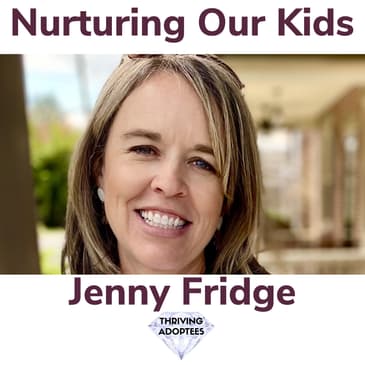
We want our kids to grow. We know we have to nurture them to make that happen. So how do we do that? Listen in as Jenny who has 4 kids including her youngest who's adopted shares what she's learning about nurturing and more...
Connect with Jenny here:
https://www.linkedin.com/in/jenny-fridge-413047134/
https://www.facebook.com/jenny.fridge
https://www.instagram.com/jennyfridge/
Guests and the host are not (unless mentioned) licensed pscyho-therapists and speak from their own opinion only. Seek qualified advice if you need help.
Want to learn more about thriving for you, your kids, your families or your colleagues? Pick a time to talk here
[00:00:01] Hello everybody, welcome to another episode of the Thriving Adoptees podcast. Today I'm delighted to be joined by Jenny Fridge. Looking forward to our conversation. Let's talk as if we haven't been chatting for the last 15 minutes right now. Perfect, I'm ready. So Jenny and her husband Eric have four kids. They're youngest, joined them through adoption, May-Lynn. But you're empty nesters now right?
[00:00:28] We are empty nesters, yes. Our oldest two are married and our youngest two are in college. And Jenny also works at Sanctuary Foster Care. The Sanctuary Foster Care Service it says on this little Zoom thing. Exactly, you said it all. Yes, all important pieces of that title. Yes, very good. Indeed. Indeed. So what does Thriving mean to you Jenny?
[00:00:56] Yes, anticipating that question. I was trying to think of a metaphor or something that just kind of reflects thriving to me and I have, are you familiar with hydroponic gardening? This is where you have like little thin tubes that put the water on into the, yeah. Exactly, yes. I have, it's called a tower garden and I have a tower garden and it's super fun. It's really nice here in Houston weather.
[00:01:25] But the tower garden is 20 gallons of water at its base and then the water is cycled on by a pump every 15 or 20 minutes to bathe the roots in water so that all of the plants on the outside of the tube are able to thrive.
[00:01:45] And it's, it's just a joy to have it right outside of my kitchen door and to watch that, that garden grow even amidst, amid the heat and the elements and maybe a drought and all the things. And that tower gardens, that tower garden, when it is plugged in to bouleharms, when it is plugged into the electricity so that the pump can run,
[00:02:15] it thrives and to watch and to be able to go out and clip lettuce and to clip onions and a number of, of different vegetable it's just, it's, it's a joy to, to watch. And as it starts to grow, you see the thriving. And if I neglect it over time, if I don't go and trim and cut off the things that are ready to be eaten, it's not going to thrive.
[00:02:43] There are things to be done that keep it thriving. So that picture of thriving is something that, like I said, even when there are hard things going on, the elements around that tower garden are hard and heavy and could prevent the plants from growing. It still is thriving.
[00:03:07] And so that's the picture that came to mind after our first conversation and after knowing what you're about and what your podcast is, is, is leaning into this concept of thriving. That was the picture that came to mind. How high is your tower garden? Oh, it's probably six feet. Six feet. Yeah, it has 20 ports. So I can put 20 seedlings all around it of all different things.
[00:03:36] And it's very strategic, what you plant. But it started it during COVID. And it was kind of my, that was my COVID hobby during the pandemic. Yeah. Yeah. So it defies the exterior circumstances. Yes. Yeah. Exactly.
[00:04:00] And yet we, we're obsessed with this idea that the, the external weather determines our internal weather. Right. Mm hmm. Mm hmm. Very true. Yeah. It doesn't have to. It doesn't have to. It's very disempowering now. Mm hmm. For, for, for me.
[00:04:27] There's a waste recycling plant in, on the outskirts of Leeds, which are industrial city, 14, 15 miles from here. And it's, it's huge. Mm hmm. Mm hmm. It's, it's maybe six stories high. Mm hmm. And the whole side of it is green.
[00:04:54] It's, it's got plants, like on the, all, all the way up growing the whole thing. So. And how is that? Because of the. I'm guessing that they've got some kind of tower garden thing going on, like. Yeah. Like, like, like you have just on a, on a, on a, on a grander scale to. Mm hmm. Mm hmm. Um, well, it doesn't, it's in a, it's in an industrial part of town.
[00:05:23] It's not a, by a, a highway, by a, like a, a four lane, two, two lanes are going each way. But, um, it, it, it, it's not camouflaged in. It really, it really sticks out. I'm going into too much detail. But it defies, like you said, it defies everything about what's expected. Yeah. Mm hmm.
[00:05:49] And it needs, there's the nurturing, there's the electricity, there's the water, there's the, there's going on all the time. And then there's the, the, the, the care. Yes. That you're giving it. All of it. Mm hmm. Mm hmm. What about the roots? Mm hmm.
[00:06:19] You know, we think of, we, we think of, uh, I, I'm, I'm thinking of a, an adoptee podcast. Mm hmm. That I've been on. It's called Pulled, Pulled by the Root. Mm hmm. Which is a pretty dramatic. Mm hmm. Doom laden thing, right? Yeah. Pulled by the roots. I'm not familiar with that one. I need to remember that.
[00:06:47] Uh, it's run by, uh, an adoptee called, uh, Heidi, Heidi Marble. Mm hmm. I, I, I, I haven't, I haven't, I was on it a couple of years ago. I haven't really been in touch with, uh, Heidi, Heidi since. Um, but the, you know, there's a, kind of like this, that transplant. I guess, you know, we could, we could look at it as, as, as pulled, pulled by the roots,
[00:07:13] but maybe a, uh, a more gentle way of looking at it would be like transplanted. Right. Mm hmm. Well, and those roots are, are so key. And I'm thinking of the tower garden. There are some of those plants that the roots are just massive. And if they get too long, I actually go in and trim them.
[00:07:41] I can go in through the base and trim the roots because they can become so massive that they suck more water and, and the water, it just, it takes up too much. And so it's interesting how there's a balance, you know, there's, there's a balance in all of that. And these, these roots, when you think of our, our adopted friends, I mean, yourself included,
[00:08:07] your, your roots are still such a part of who you are, but there's, there's still a balance of where are you rooted now? There's a, there's a rootedness in, in our presence right here and now in front of us and not living in the path. That's part of your story. You have to identify that, but we also have to be rooted where we are and planted where we are in the space where, where God has us. And it's messy.
[00:08:36] I just, I think of just, it's a messy process. It's not, um, the adoptee's journey is not, it's not linear. Um, it's not perfect. It's not, um, it's not always what you would expect, but, um, but it's good. And it, it, it, when you're thriving, you can navigate all of those seasons, um, through the mess sometimes. Yeah. Mm-hmm.
[00:09:05] We just had a transition. My number, I said, both of my younger girls are actually in college. My number, the number three girl, she actually just graduated, uh, in May. And, um, to, um, to, to her graduation and my youngest adopted one is, was transitioning to, uh, as I, as I mentioned, be an RA in Germany. And so she had one day to come home from West Texas, from where they go to school to pack
[00:09:33] everything and prepare to leave on Monday for her trip, her entire summer to Germany. She was finishing up a hard semester of nursing school. She did amazing, but it was a big weekend of transition, you know, moving out of the dorm, graduating her sister, preparing for this big move for the summer to another job as an RA transition. And she had a bit of a breakdown. There was, there was a situation with her car and sister, it doesn't matter all the details,
[00:10:02] but she's not generally an emotional kid. As, as a girl, we always laugh about some of her sisters are more dramatic and she's pretty even keel. But this particular weekend, all of those transitions, something in her body just crashed. And, and the, her response was with such emotion and in the middle of, of a whole graduation
[00:10:27] party of people, which again is not her normal default, but I think it's her body just reacting and, and, and responding to transition. And it didn't feel, I don't think it felt safe. Nothing was certain. She wasn't in control. Um, and so we, we're always navigating that process. Um, and all of us do that, but I think our adoptees, their journey is, is a little, as a little more,
[00:10:56] um, I don't want to say harder, but, but maybe, um, it's just uniquely different because their body is remembering things and responding to things from their own roots back to the roots that they have to, um, they have to learn how to, how to do that. And a, and a thriving adoptee, um, is one who's able to do that even in the midst of a meltdown and emotions and all of that.
[00:11:25] She's very self-aware, even in the midst of those emotions, she knew what she was feeling was maybe not, we, we validated the emotion. The reason behind it was kind of silly. And she recognized that, but still had the emotion and that's, that's okay. Um, but it is, it helps as, as her family, as her mom, it helps me to remember, okay, this is just hard and I need to recognize that.
[00:11:55] And I need to live with her in this and help remind her what is true. I think that's the thing when I think of our adopted kids, I think of resilience and, and all of our kids just, I don't know if you've heard of the, the Harvard study on resilience. Are you familiar? I don't know when this was, but they talk about the power of one, the power of one individual for every human that, that reminds me what is true.
[00:12:21] Who is, who is that one person and who, who, who is my, my youngest, who has been that one person or maybe multiple, but really they just need one person to remember what is true and to, to find that place of resilience because of, um, those reminders and, and, and getting up and, and moving forward, even in the hard, messy moments and the, the responses
[00:12:47] of her body and brain, she can get up and keep, keep moving forward. One of the recurring themes on the podcast is that pre-verbal trauma or non-verbal trauma
[00:13:06] can't be resolved in therapy. It's we've got to do, uh, take a somatic approach to it. Um, and, and for me, the,
[00:13:28] some of the, some of the stuff I'm learning on that kind of more somatic-y path is there's, there's the, there's the sensation. Mm-hmm. And there's the naming of the sensation. Mm-hmm. Mm-hmm. Or the meaning that we associate with the sensation. Mm-hmm.
[00:13:52] And they seem to, to me, they seem to be complete, two completely different themes. Two different themes, two different things. There's two different things, meaning the somatic and the, well, there's, you know, there, obviously we're talking about somatic, the body keeps the score as, um, so there is, there is a sensation in the body. Mm-hmm.
[00:14:19] And there is the, the meaning and the reaction to that sensation. Mm-hmm. If, if, if it's just a sensation, it flows through us. But if we resist the temptation, if, sorry, we, if we resist the sensation, we, um, but we kind of, we resist the sensation.
[00:14:47] We see the sensation as a problem. Right. And we don't address the meaning. Well, the, the, the, the meaning is, is, is whatever we give it. It's, it's, it's two different, it's two different, the two different things, the, the, the physical sensation. So you can, you can have, um, if I say to you, spine tingling, right? Mm-hmm.
[00:15:14] You might be getting a picture of, of, of, of, of fear, but spine tingling could also be excitement. It's still, it, it's, it's the difference between the, the, the raw sensation and the meaning that's, the, the, the, the, the, the degree to which we try and push, push it away. I don't, I don't want to,
[00:15:42] I don't want to, I don't want to, I'm, I'm, I'm, I don't like the sensation that's going on for me. I don't really have a, a, a point on this other than the, other than it's, the, the, the two different things. Mm-hmm. Mm-hmm. And that it's real and valid for anyone to feel. Mm-hmm. Mm-hmm. Yeah, it is interesting. It's, it's amazing to me what we have uncovered
[00:16:10] about neuroplasticity and the brain in the last two decades, I guess, maybe, maybe more. Um, it's exciting, but it's, it's still, um, I mean, like the, the tower garden, the hydroponic garden, there's so many pieces that, that play into that for, for healing, for healing the brain and retraining
[00:16:35] the brain. Um, lifelong journey for all of us, truly. We did, when we were foster parents, we had an opportunity to do adult attachment interviews. Are you familiar? Yeah. Oh my word. It was fascinating. I, I thought I knew what was coming when this trained counselor, you know, gave me all of the questions and we walked through it and I was like, yeah, I know what to expect. I'd never done one before, but I thought I knew what to expect. Well, what came out as I'm describing my
[00:17:05] own childhood and my own current patterns of attachment and how it plays out in my foster parenting and parenting was just fascinating. It was absolutely, um, I haven't earned secure attachment, but still lean into some of the, what is, I think the title of the ambivalent preoccupied, um, tendencies of
[00:17:31] attachment. And so it just, it was so good to even in my own, cause I feel like I'm fairly self-aware at my age and having studied everything I have for my kids and our foster and adoptive children, but yet there's still so much I'm still uncovering in my own heart and mind. And, um, it was, it was
[00:17:53] just fascinating. Um, so such a learning experience for me to then recognize that in other people, the people around me are all, they all have experiences and paradigms and lenses. Everybody has a story. Um, that's just, that's, I don't know. That's something the older I get, the more I realize that whether I'm in traffic and somebody cuts me off or, you know, in a coworker conflict or family
[00:18:23] conflict, whatever it is, everybody has a story and they're, they're bringing that story into our relationship. And I need to remember that and show grace for that. Um, and then also navigate it. Well, how do we, how do we, how do we get beyond whatever those, those lenses are to, to what's true? Remember what's true and healthy and good. Um, but it's, it's a lot to consider.
[00:18:50] Yeah. What, what do you mean by truth in this, in this context, Jenny? Yeah. Remembering what is true. I think, um, for our adopted kids, the first and foremost priority, when any of our foster kids walked into our home, you're safe, you know, creating that felt safety. You are safe right now. You may feel like everything is just being pulled out from under
[00:19:20] you, but you're safe. You're not alone. I'm here. Um, you are good. I mean, I think, I think that truth is going to look different and in every context, but, um, we, and we can keep saying the things and, and our brains, I think of the metaphor too, of the, the roadway that, that our brains have these pathways and we just keep having these ruts that we fall into the ruts on
[00:19:48] the side of the road that, um, our brain just, just does that. We, we, we do that and we are staring down and we think we're fine, but, but there's some deep grooves and ruts over here that we just naturally, we naturally do that. And so with our little, I remember our little three-year-old foster child, um, she walked in this house, a very, um, angry little girl, just angry,
[00:20:16] but it was rooted in fear. We were her fifth or sixth home, depending on if you count some moves within her family. And she was three years old. That's that there's no, that's trauma with a capital T. There's no, I don't even know what that, what that fear would, I don't know how that would manifest for me, but for her, it looked like anger. And so she did not like to be alone. She couldn't be alone, even in sleep. She had, we had to enlist the help of a sleep therapist because we were all
[00:20:46] exhausted. She would have night terrors and, um, she couldn't play alone. I couldn't make a phone call, which most of my phone calls were about therapy visits and things for her could not make a phone call because she could not be alone. And so the truth I kept coming back to for her was I'm here. You are safe. Even when she's throwing food and toys and shoes and you name it, um, self-harm
[00:21:12] behaviors, you're safe. I'm not going anywhere. Even when I wanted to run and that, that required some, some somatic skills for me to, to regulate my own self so that I could stay with her and remind her what was true, um, for my kids, for all of my kids, reminding them what is true that, um, they are, you know, they are, we, I often will tell my kids when they, when they would go off to a,
[00:21:42] to a friend's house or overnight or on a trip. And I would say, remember whose you are. And that meant you're a fridge, which means you're, you know, you're part of this family. You're, you're a fridge kid. And that, that means something, but even more for them, it's our faith. And you're a child of God. And, and that does not change wherever you go. And so, um, that's, that's the remembering what is true constantly. And I, my husband does that for me. He has to
[00:22:10] remind me what is true. You're a good mom. I feel like I've just missed it with one of my kids. He'll remind me you're a good mom. You are doing all the things and, um, yeah, don't, don't stop. So those are the things. And it's, and it's about what they hear, not, or what you hear, not what he says, right?
[00:22:37] Mm-hmm. Yeah. Yeah. And it's more than the same thing. It's got to be a doing thing as well. Sure. It, it, it, it, I don't know if you could use the word of a felt sense of safe, safety. Right. Right. It's actually being there and, and helping to keep them safe. Sure. Yeah.
[00:23:00] Yeah. I interviewed a young adoptee, 18, um, called, uh, Isaac last week and he just about to release it, but, uh, he, he came from Ethiopia. He was adopted when he was five. Uh, and he, his first big turnaround moment was when his dad crawled underneath the bed.
[00:23:29] Hmm. With, he, he, he, he was underneath the bed and the dad crawled and somehow fitted under his six foot frame under this bed and, and held, held Isaac. He was with him. Yeah. Um, when, and we, you, you know, I've heard that, that word neuroplastic, neuroplasticity, I can't even do something wrong with it.
[00:23:56] I can't say it. We know what it is. Yes. Um, to me, that is a moment of, I, I, I would, I call it insight or insight or epiphany, right? This, one of my, the slight concern with the word neuroplasticity, although, other than just because I can't say it, not just because I can't say it,
[00:24:24] um, but because it feels, it feels like it needs a guy or a, or a woman in a white coat, right? It needs, it needs, it needs some neuro boffin, right? But it, the neuroplasticity, neuroplasticity is, it is, is about a change that happens in a moment. Mm-hmm.
[00:24:52] And so the space, the space that we're, we, we, we're, we're trying to create is for those insights to, to happen. Yeah. Yeah. It's so hopeful for me. It's just, it just gives me hope that this, this brain, this amazing computer that we have, it, it can be retrained and it's, it's plastic neuroplasticity,
[00:25:21] it's plastic. And so we can form, form it into its, its most healthy place. And it does, it's, it's moments. It's little moment after a moment after moment after moment that, that make healthy, positive changes and growth in the right direction. It's easy if I just say neuro, a neuroplastic moment then. That's better. There we go. That's my way around. That's my way around. There we go.
[00:25:48] Yeah. What, what have been your most neuroplastic moments of, of insight and epiphany? Hmm. Um, uh, so many, honestly, I mean, I still remember bringing our adopted one home. She was 18
[00:26:13] months old and, um, yeah, I get emotional thinking about it. She actually would have nothing to do with me from the moment we got her in China. Actually, she would have nothing to do with me. She wanted my husband, which I've learned since is not necessarily uncommon for some of these, these babies. If you consider that her birth mother essentially abandoned her. And then again,
[00:26:39] when we pulled her from the orphanage, that was the second woman that was, she had one caregiver, a nanny there in the orphanage that was her primary caregiver. And I'm so thankful because there was a strong attachment, but she was essentially twice removed from a, a female character, her caregivers and mother ultimately. And so she bonded. I think my husband felt there was a safety that she felt
[00:27:06] with him that she did not feel with me. And so I still remember when he would literally sneak out of the house to go to work after we came home because she would scream otherwise, if he, if she saw him leave. But there were days that, um, I would be rocking her either. Maybe it was for nap time, just, just rocking her. And she would just melt down in these. And she only did it maybe three times, but
[00:27:34] she would be crying this cry of just agony to the point where I had to lay her at my feet. And she was holding on one ankle while kicking me at the same time. It was, it was the, and my husband was never there. No one else ever witnessed it. I remember calling him and saying, you can't imagine what I just witnessed. And it was, it was her, her body was, I think, grieving and
[00:28:04] over time, we watched her attach and grow into a child that, that doesn't even, doesn't, while adoption is part of her story, she doesn't think of herself as the adopted kid. Like that's not who she, how she identifies. Um, she's beautiful and self-aware, like I said, and yes, she navigates
[00:28:30] identity is still a journey for her. Um, I think there are seasons of that for, I mean, you at 40, that was a big identity moment for you when you realize the teddy bear, the teddy bear moment. Um, so yeah, so I'll, I can, I could describe so many moments with our foster kids that I watched those things happen in their brain that were, um, that were just aha moments for me and for them as
[00:29:00] they were growing through the messy journey of adoption. And what, what were the biggest things that you learned in those aha moments? Um, I think the, the presence going back to the resilience, just the, the importance of me staying in those moments and not running everything in me. I,
[00:29:28] I, I, no one runs to conflict or to trauma or to, to messy, hard things. But I think, I don't know. I don't know if that's what, you know, you look around, I think of a lot of your, your, this community, your, um, guests that you've had on your podcast and I, every one of them, I feel like I could be friends with, and you go to these adoption conferences and different connection points and networks with, with this community. There's just something special. And I
[00:29:57] wonder, is it that we've seen something and we can't look away and, and we all have that. Is it compassion? It's that, it's that, that dad getting under the bed with the boy. It's the, we have to, we have to get under the bed. We have to sit in the hard, we can't run away from it. And, and, and it's in the staying, it's in the compassion, it's in the presence where we get to
[00:30:24] see and be a part of the healing. It's we, we have to, we just, we have to, we can't look away. That's why I do the work I do. Why in this empty nest season, I'm working in the foster care space in this crazy big city of Houston, Texas. It's daunting. Uh, there are days, yes, still that I want to run the other way because it's overwhelming, but I see the value of staying.
[00:30:50] And I see the value of, um, navigating this hard, this, this, all of these trauma informed therapies and all of the brain things. I watch it make a difference. I can see it in the lives of children and families. And I, it, it jazzes me. It gets me excited to, to be a part. Um, because I think
[00:31:15] we're making a difference. I really do together. The collaboration going on in our city is, is just beautiful and I get to be a part of it. Um, it's yeah, that's, that's, I think what I learn is, is just to keep sticking with it. I think the more I know, the less I feel like I know anything. I think there's so much and everybody is, everybody's story is different. So it, it feels overwhelming because just when I think I have the, the aha moment, you know, with Lynette from
[00:31:45] generation O and the opioid exposed children. Oh, here's the thing. Here's the, the response. Here's the tool. Well, then another situation comes along, another kid, another story, and it's going to look different. Um, Eric and I, we've helped facilitate a small group, a connection group with a number of foster adopt and kinship parents. And, um, uh, it's, we have tears every single week
[00:32:14] that we're together. We have tears, but we also have hope. And we just keep sharing stories of hope, remembering and reminding each other. Okay. But this is true. Remember a month ago when you celebrated this and I've been there and this is how we've navigated it. And so I think that's what I've learned is just to stay with it, to be present, to, to get under the bed. Maybe that's the thing.
[00:32:37] That's the visual. Persistence. The Marines, apparently they pride them on, on, on the, uh, the, the, the Marines. We have Marines here in the UK as well. Okay. They're different, a different kind of, um, but they are similar
[00:33:05] kind of elite minded. Yeah. Um, so, so the, but apparently the Marines in the States say that we're the only unit that runs towards the gunfire, right? The other units are running away. Now, I'm sure that that makes them feel good and kind of reinforces that, you know, the elitist kind of
[00:33:31] mindset, whether it's true or not, I don't know. Um, but it isn't that, that's what the kids need to know that you, you're not going nowhere. You're not going anywhere. You're right. Yeah. It's huge.
[00:33:53] But they need to, but it's not just a knowing thing. It's deeper than that. Um, I had this, uh, had this moment on a, uh, uh, went on a retreat before November last year. And it's a week long
[00:34:16] retreat with, uh, uh, guided meditations and Q and A sessions. And, and I, I went, I went for a kind of a somatic experience because I, I didn't think that I could get my comprehend my wholeness
[00:34:44] more than I did. I, you know, I, I thought I've got to the end of the line in terms of logic of seeing my wholeness underneath the trauma. And there was, I asked a question during one of the Q and A's and, uh, the, the, the guy that's leading the retreat Rupert, he looked me straight in, straight in the eyes.
[00:35:14] Uh, and he, he, he, he said, um, you, I mean, he means uppercase Y. Yeah. Who, who I truly am. Um, you, you, you, you were never, you were never traumatized, Simon. And he didn't hesitate like that actually. He was bold as brass, right? Underneath the trauma. He's talking about underneath
[00:35:43] the trauma. So have you come across IFS and Dick Schwartz? No, you've done, you've clearly done some TBI stuff, right? Yes. Which is a Texas thing. Um, yes. Yeah. Do you know David, do you know David Cross that? Oh yes. Yes. Dr. Cross. Yeah. He's, he's a foster, his foster kid that aged out, right?
[00:36:08] And, um, he had one guy actually, you're talking about one guy. So anyway, IFS is another modality and it's an American guy called Dick Schwartz who found it. And he talks about the uppercase S self. Yeah. Who we, who we truly are. Yeah. Underneath the trauma. Underneath the trauma. Yeah. Um, yeah.
[00:36:37] Yeah. Yeah. Underneath the trauma, despite the trauma. Mm-hmm. So he would, another word for what he is referring to is, is, uh, consciousness. Mm-hmm. And so when Rupert looked at me and I said, you, you, you were never traumatized. I got that, I got the, the, my logic went even deeper than I thought. And I didn't think
[00:37:06] I could get it any deeper. Was that a good thing that he said it? Oh yeah. Yeah. Yeah. It's, it was a hearing thing. Mm-hmm. I heard that. Yeah. It was a depth thing. Interesting. Hmm.
[00:37:28] That's good. The, my metaphor for this is some pennies just keep on dropping. Mm-hmm. Hmm. So good. You had time to get away and be quiet. I think there's so many distractions for, especially our younger kids and our teens and our young adults. They don't stop to, um, consider,
[00:37:56] um, that wholeness. Well, people don't point out to them. Yeah. In, in, um, perhaps in some religious settings, they do, but, but in some religious settings, you know, the, the, the, the, the belief is that we're all broken, you know? Um, I struggle with that.
[00:38:25] Yeah. Yeah. Even some of our religious settings are still noisy. So, mm-hmm. That's good that you've got a way to be quiet and to listen. Mm-hmm. So, I, I, I guess I'm talking about the depth of
[00:38:51] felt safety. Mm-hmm. Mm-hmm. The depth of felt safety. And it's not something they believe right away. I mean, it might be something that we keep saying and they hear it, but they don't know it. Like you said, they might not know it. And we just keep saying it. That's, that's the presence. That's, and until they do know it, and that may not come
[00:39:18] while they're in our home, even, um, we, we just keep saying it. And doing it, right? Yeah. Doing it. It's, it's gotta be more about saying it. It's gotta be about. Mm-hmm. Mm-hmm. Yeah. It's gotta, uh, there are, there are rhythms too for myself. I mean, it's, it's, it's applicable for me. There
[00:39:46] are things that, you know, the fake it till you make it. I have rhythms in my day of, um, quiet and rest and meditation and communion and, um, and even play and self-care and all those things. And, and sometimes I don't feel like doing those things, but I keep doing them until, until I do feel like doing them. And so I, and I, I see the results and I see the, the outcomes that are, that are
[00:40:16] positive. So, um, yeah, we just keep doing, doing the things. One of the TBRI thing that keeps on coming back, but for me is this truth that, uh, a, a disre, a disre, a disregulated adult, disregulated parent can't regulate a disregulated child. Exactly.
[00:40:46] So what have you learned about self-regulation? Um, I don't know, the, the biggest thing that, that I am, as we navigate, as we kind of walk this journey with other couples and families, community is huge. Um,
[00:41:10] Um, finding community and support around you. There's a lot of tools, of course we can do to, to self-regulate, you know, whether it's breath work or just sleep or, um, walking away, you know, just even just saying, okay, I need time. We're going to revisit this. You know, if the child's in a safe
[00:41:34] place, taking time before you go back and navigate, whatever the thing is, but having a community around you of like-minded people who can hold you accountable, who can maybe give you support, maybe it's childcare or babysitting for a time so that you can get away, whatever, whatever it is that you need to self-regulate and, and teaching you how to do it, you know,
[00:42:04] to, to share the, the tips and the tricks of how do we, um, how do we self-regulate? What is, what works for you? Because sometimes we're out of ideas and, and, you know, it could be something as simple as a walk every day. Um, of course, sleep is important. Maybe it's journaling, maybe it's
[00:42:26] something creative. Um, but that community, um, it's huge. It's, I, I don't know how, and I know there are a lot of people in our culture today because of technology and a lot of people are isolated. Um, but I think, I think we all long for being a part of something and belonging to something
[00:42:50] that gives us, um, encouragement and resources and tools. So community would be my, I don't know. That's, that's one of those things I'm always encouraging and just shouting from the rooftops, find your people, find those with common values to help encourage you in, in what you're doing. And there's nothing like this community of foster and adopt families that, um, sees each
[00:43:20] other in, in, in ways that others can't. So, um, that's what we're, we're longing for more of that. And in our particular area where we live, we're, we're helping, we're looking to create more of that, um, on a consistent basis. Cause there's a lot of people that feel alone and don't have the resources
[00:43:41] or the tools or, um, um, the, the encouragement to do that well for their kids and they're all drowning. So we need to lift them up. Yeah. We've almost been on like 50 minutes, Jenny, and it seems like about 50 seconds. That time, time is a, is a thief, as they say.
[00:44:09] Is there anything that you'd like to share that I've not asked you about? Uh, I think, I think we covered, I mean so much, yeah. The connection, the community, um, the presence. Yeah. The power of one. I think that the under the bed, I think I'm going to take that
[00:44:34] with me from our talk today. Um, that picture of getting under the bed. Yeah. Cause some, sometimes there's scary things under those beds, especially at night. And, uh, yeah, I, again, I just, I love this community. I, um, I, I, it's wild to me that you are all the way across the pond and, um,
[00:44:56] um, we have all these common friends and, um, and even more just common like-minded hearts for these kids and families. That's, um, yeah, it's, it's pretty cool that I get to do the work I get to do and, um, see the hope that I get to say, I am hopeful. I really am. I'm hopeful for
[00:45:24] all adoptees to be thriving, even in the mess, even in the hard, even in the days when things are overwhelming and, and they're not even sure of their own wholeness. I'm still hopeful. I think it's, there's good, there's good things to come. There's amazing resources. And then all these people that, that are our friends. So thank you. Thank you, Jenny. And, uh, thank you listeners. We'll speak to you again very soon. Okay. Bye-bye.