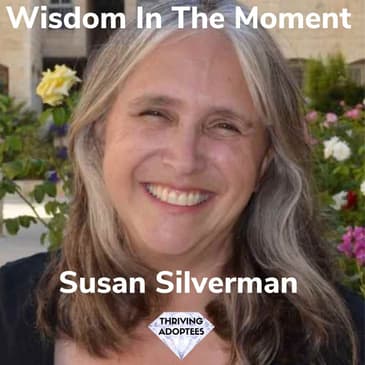
Being told to just raise your kids doesn't sound like a great piece of advice. But it landed profoundly for Susan. She heard it as a pointer to stop trying to think too far ahead. To listen to wisdom in the moment. To stop overthinking. Who doesn't need less overthinking right? Listen in for your own aha moments.
Founder and Executive Director, Susan Silverman grew up in a family that fostered older children, and getting to know kids without a permanent, loving family of their own had a big impact on her. Now, she and her spouse have five children, three were born to them and two were adopted. She is the author of a memoir, Casting Lots: Creating a Family in a Beautiful, Broken World and has been featured in the New York Times, NPR, BBC, ABC, and more. Susan has a BA from Boston University, an Ed.M. from Harvard University, and an MA and Rabbinical Ordination from Hebrew Union College-Jewish Institute of Religion.
Connect with Susan here
https://www.instagram.com/susansilverman7
https://www.facebook.com/2ndnurture/
https://www.instagram.com/2ndNurture
Guests and the host are not (unless mentioned) licensed pscyho-therapists and speak from their own opinion only. Seek qualified advice if you need help.
Want to learn more about thriving for you, your kids, your families or your colleagues? Pick a time to talk here
[00:00:02] Hello everybody, welcome to another episode of The Thriving Adoptees podcast. Today I'm delighted to be joined by Susan, Susan Silverman. Looking forward to our conversation today, Susan. It's going to be a treat, I'm sure. Hi, it's such a joy to be here, thank you. So a number of firsts, listeners, the first guest from Israel on the show and the first rabbi we've had on the show as well. What an honour.
[00:00:29] We've had some pastors, right? We've had some pastors from the States, but we haven't had our rabbi. So that's going to be an interesting one, didn't I? So, and you also, she's the CEO of Sack and Nurture. And as well as that, got five kids, three through biology and two through adoption. So, a wealth of expertise and lived experience to dive into here.
[00:00:58] So, the first question I'd like to start with, Susan, is thriving. What does thriving mean to you?
[00:01:09] Oh, you know, there's never like a, like, there are very few moments of perfection, right? So when I think about thriving, I don't think about like, wow, everything is kind of like just blooming and growing perfectly.
[00:01:30] I feel like, to me, thriving is when you are in a rhythm of life that is really working and when there is love and meaning. So, there are really, there can be hard times, there can be stresses, but if that kind of core, that like river that's running through it is full of, is full of meaning and a rhythm.
[00:01:56] And, you know, I thrive best when I know what I need to do next, right? There are some people who are like, everything's open and like, let's see. And I'm like, okay, I know what my goals are. I know what I'm trying to get done. And I can actually see the steps to get there. That's when I feel like I am thriving.
[00:02:14] So like with second nurture, you know, early on, it was kind of figuring out really, what is this? I know kind of where I want to get and I can see what I want to be, but I have no idea like what are the pieces and what relationships do I need? And that did not, it felt exciting, but it did not feel like thriving.
[00:02:32] But being in it and knowing, okay, this is how we're growing next. And this is how we're branching out and leaving room for that, for the energy of learning to come in and having a way to process that and integrate it into what we're doing. That to me is thriving. Yeah. So it's, it's the end, the end of overwhelm, is it?
[00:02:58] Oh, that's so, I love that. That's interesting. Right. It's, or, or if I was going to like tweak that just a little bit, I love that. It's sort of the, just the right amount of overwhelm. Right. It's like, you still have a challenge. You still got to get somewhere. Something needs to catch up with something else. Right. You know, like either like our, like our pro often for us, it's like our programs are thriving, but then the funding isn't.
[00:03:27] And so it's like getting that to match up and knowing this is what we need to focus on now or seeing that, you know, one of our communities, which is really thriving, but we see like a couple different needs that are different from one another growing inside that. And, and, excuse me a second. Are we on video? No, we're not. We're, we're, we're, we're on video, but the listeners can't see the video. Okay.
[00:03:54] So somebody's joining us in the background. They won't, they won't see that. And, and realizing, okay, there are a group of people who have already adopted and their needs are kind of different from those who are still fostering. And what's the best way to go about that? Right. Because we want them together because that. Sorry. What's okay. Sorry about that. It's all right. I can't hear it at all. Okay, good, good. Sure.
[00:04:22] So the people who've already adopted are really good to the people who are still fostering, but they also need their own space, right? So something like that comes up and then we don't know what to do, but the creative process of that is really meaningful because you're like, how are we going to meet the needs of these different people while also, you know, also keeping them connected? Yeah.
[00:04:45] Right. And so things like that are always coming up. And that to me feels like thriving because it's, it's challenges that we can meet by using our creativity and our like putting our minds together in what like in Judaism, we call Havruta, which is coming together to learn. Right. So, and that the idea being that if more than one person is learning together, it's, it's much greater than the sum of its parts. Right.
[00:05:14] And so I love that with my team being able to, to take a problem and, and really work it out and then know that that, that the, the, that the output of that is going to be meaningful for somebody. Yeah. So what was, was the metaphor that's coming to mind was keeping all the plates spinning, right?
[00:05:41] Keeping all the, keeping all the plates spinning and then deciding which plate we were going to spin next, right? If we're going to put another, another new plate on it or what are we going to change? Are we going to change the design of the plate to a bowl or, you know, like, right, right. But, but how do you, you've talked a lot about the professional stuff, but, you know, when I think about you as a, as a mom of five, five kids and I know they're, they're all in the twenties. All right. Well, your kids are in the twenties just about.
[00:06:11] No, in thirties. In the twenties and thirties. Okay. She started young, listen. The, the, how do you keep all those plates spinning? You've got the professional plates, you've got the familial plates, you've got the nonprofit plates, you've got the rabbi plates, you've got a whole load of rows of, rows of plates going.
[00:06:35] So you're, you're, you're looking at across three, four different areas of your life. I have sufficient, I have sufficient challenge with just the podcast and training, right? That's, that's about, we, you know, and dogs walking couple of dogs, right? That's another challenge for me, but it's coming at you from all angles, right? Right. Life's coming at you from all angles. Yeah, go ahead. Sorry.
[00:07:00] So life, life's coming at you from all angles. So, so, you know, just enough overwhelm rather than the end of overwhelm. Right. So one thing that I've learned not too long ago is I've gained a greater capacity to, to call compartmentalize.
[00:07:29] Right. So for a long time, any anxiety I had in any realm would just infuse me and I felt like unable to do anything. And I've kind of learned, I think mostly through parenting because with kids, like when they're unhappy, like you can't even, like I can't even breathe. And that's still the case, but I've learned better to be able to go, okay, nothing I can do about that kid right now.
[00:07:57] I'm going to focus on what I can do, but I do have control, some influence over. And so that's been like a good skill, although it's quite imperfect. Yeah. So let's, let's move on to the, to, to the kids here then. So what, what comes to mind when you hear the, the phrase thriving adoptees? What, what do you think of that?
[00:08:23] It's interesting. What, if you had asked me that when my kids were little, I would have been like, get into an excellent college, you know, get a graduate degree, you know, this path. And my kids, only two of them went to college at all. In Israel, it's very different. Like at college, isn't sort of like my, my, my community where I was from in the States. It was like, of course you graduate high school, you go to college, you go to graduate school. Like that's the path. Here it's not here.
[00:08:53] You finish high school and you go to the army and you see lots of kids go to college. Lots of kids don't. And my kids thriving to me now is when they're just learning to be content with their lives. They support themselves. And they're like, I feel like they're kind of fully who they are. And I love that. I love looking at them and seeing them just be who they are.
[00:09:21] No, and the kind of the external devices that we've used to kind of measure what success is kind of just fell away. And I just see each of my kids on their path.
[00:09:36] And when they're content and they're living in the world and, and, and, and, uh, um, productive and self-sufficient way, and they're kind of doing them. I'm happy. Like that, all that other stuff is just, it doesn't even feel like part of my world anymore. When did that, you said it fell away.
[00:10:05] Do you remember the moment when that fell away? I do. All right. Okay. I remember there were two things. One was we first moved to Israel and we thought we were only coming for a couple of years and going back. And I said to a friend, um, I said, Oh God, like schooled so hard here in our oldest. Like, what if she can't, um, um, I can't hear any, I can't hear any background. Oh, great. Okay, good.
[00:10:35] Um, school, you're saying schooled so hard. And I said to a friend who was in, I, I, so, so my kids were in Israel. We're going back. We thought we were going to go move back to America. And I was worried about them academically because I was still very much in that mindset. And I said to a friend of mine who's an educator, I said, what should I do? Like about Elisa will come back. She'll be in high school and she's not going to be where she needs to be in America. And my friend said, just raise your kid, just raise your kid.
[00:11:03] And whatever she wants next, you'll figure out with her how to like package it and figure it out and move forward with wherever she is in that moment, just raise her. And all of a sudden I went, Oh my God. Yes. What am I trying to like force her into something that I imagine in the future she's going to want to be. That's how I should parent her right now. And it just like, it just fell away. And I was like, I'm just going to parent my kids. And if there's something they want.
[00:11:29] So for example, my two kids who went to college, neither of them had what they needed to get into college at that moment. Like I sent them to funky schools. Most of my kids I sent to a school called the democratic school where you have no homework, no grades, no graduation, no, you know, like nothing. And one of my daughters, like my older one who went to college, well, our oldest went for a while to Berkeley College of Music and that was audition. So I was like, and she got in and she went. Our next one showed up. This is a school near Tel Aviv.
[00:12:00] She was still in her, in her army uniform on her way back from base. And she went up to the head of the school and she said, hi, I'm Hillel Silverman. I don't have any of the credentials I need to go to your college, but I'm going to represent Israel at the UN one day. And you're going to want to help me get there. And he said, okay, here's my card. And she got into the school. Our next kid, he just like studied for the tests you need to get in, even though he hadn't gone like, and he just worked hard.
[00:12:28] He studied for those tests and he got in his graduations next week. So like, it's true. Like you can, you can just parent your kids who they are and figure it out as you go then. So it's, it's about wisdom in the moment. I love that. That's right. It's wisdom in the moment. And what is it that they say?
[00:12:53] Like, um, uh, depression is perseverating about the past and anxiety is perseverating about the future. Right. Say that again. Depression is perseverating about the past. And anxiety is perseverating about the future. Yeah. Right. And neither one is in our control. Right. I mean, to some extent. And so, yes, exactly what you said.
[00:13:23] That is like the wisdom of the moment. I love that. Yeah. And, and it kind of, it relates back to what you were saying about keeping the, when we're talking about the metaphor, keeping the plates, plate spinning. It's, it's about what, what's going on now and what's, what's next, what next to do.
[00:13:44] It's like the end of overthinking, like being about being in the flow. What can I do? What can I do next? Moving from one task to, uh, to another with what needs to be done now, rather than having a list of 20 things on a to-do list. You know, I'm going to go to another room because I can't really hear you. Okay.
[00:14:13] Well, luckily guests, I know, sorry, listeners, I know that you, you haven't been able to hear what's being gone in the background at Susan's house, but, um, it has clearly been distracting her. So she, we're just shuffling the laptop. Excuse me. I apologize. No, it's okay. My house can be a Grand Central Station sometimes. Yeah. Yeah. Um, I should have started with the other room. Yes. I think that's part of it is sort of like, what are your next steps and, and, and knowing and understanding that.
[00:14:42] And part of it is, um, another thing, this is something my sister said to me, and this was about one of my kids also, where they were struggling socially in school. And my sister said to my daughter, her niece said, this feels like your school right now. It feels like it's the whole world. I promise you, it's not even a drop. It feels like the whole world, but it was actually nothing.
[00:15:09] And that also, like she said it to my daughter, but it really impacted me a lot too. Like, oh, these structures that we think that we're part of and that are our whole world, they're actually, they're actually nothing. There's a lot more out there. Yeah. And to be defined by the conditions that we just happen to be in in that moment doesn't do it, doesn't serve us. Yeah. So it's a sense of perspective then. Yes.
[00:15:39] It's a, it's a, it's a, it's a bigger, it's a, it's a bigger sense of perspective on, on, on the world. Yes. Yeah. Um, the, we, we see, we, we, we spend so much time, so much of our time down in, in, in the, in the weeds. We forget, we, we, we, we missed the, we missed the big picture. Right. And vice versa, right? Like that is true.
[00:16:08] And also that sometimes we're so obsessed with the big picture that we, we don't focus on the things that are in front of us that we're able to do, right? Like this balance between both, I think are right. Yeah. Uh, this was my dad's philosophy teaching me to, to drive, uh, teaching me to drive. And I'm not a particularly good driver, right? I, uh, my spatial awareness isn't very good.
[00:16:37] And I've had quite a few and I'm, uh, the impatience as well, which aren't a great, not a great combination to have when you're driving. But he used to say, you've got to look as far as you can into the distance and then, um, and, and then write at what, what, what's right in front of the, of the headlights of the car. So it's kind of big, immediate, short term, long term, short term, long term. Ah.
[00:17:07] So you've got a different, you can take a, you can look at perspective as a, as a horizontal thing when we're driving or as a vertical thing, like the wood for the trees, seeing the wood for the trees. And, but you've got to go down and you can't just stay in your lofty ivory tower on the top of the tree. You've got to get, you've got to get back into the, down into the dirt and deal with the details of the dirt. But you're, you're constantly flipping between those places.
[00:17:36] Um, it, uh, have you read? Oh, I love that as a metaphor. That's great. Have you read Charlie and the Chocolate Factory? Yeah, the driving, your dad's. Yes, of course. Yeah. Charlie and the Chocolate Factory. And then the, I think the follow-up, the follow-up book was, um, Charlie and the Great Glass Elevator. So the elevate, it's about the elevator. Oh yeah. Oh my gosh. I haven't thought about that in years. But it's the elevator of consciousness.
[00:18:05] It's the elevator of consciousness. And, uh, and you know, you talked about just for the kids just to be content in the moment rather than this kind of putting, this, this putting off of happiness until, until we've got, you know, until we've got the grades, until we've got the college, until, until we've got the job that we want, until we've got the house that we want, until we've got the partner that, that we want.
[00:18:33] The Western world is, is a series of putting off, putting off, I'll be happy when, I'll be happy when, I'll be happy when, rather than I'm going to concentrate on, on, on my contentedness now. Right. And, you know, I'm married to somebody who is so like that, like there can be so many stresses in life and whatever.
[00:19:02] And he'll just be like, and literally like it's, this is usually a metaphor, but literally be like, oh my God, smell this rose. Like he just takes such pleasure in like being in the moment. He's like, he's, you know, an inspiration for me. Like, cause I will be like, who cares about the roses? What about like this thing hanging over her head or, you know? Yeah. That's the tension, right? That's the tension.
[00:19:27] And clearly, I mean, we've, we're, we're 20 minutes in here and we're having this conversation at a time of a really dangerous, tricky time in Israel and in the West.
[00:19:48] So how can we put contentment and that on the edge of World War Three kind of spoke, you know, how can we put those two things together? The, the, our internal contentment and what's going on in the world? I think that's an eternal question.
[00:20:13] You know, I'm not sure that there's ever been, you know, other than moments, but where there's been around the world, no, no threat. I know. I think every, the world that humanity has had to figure out how to live life in the small picture when the big picture can feel very threatening. I also get the sense.
[00:20:42] That's the one thing I love about my work. Yeah, go on. No, please. I get, I get this. I get the sense that the, the media have to make this situation look like, like it's a new threat. Like we haven't been here before. Do they, do they? Right. Yeah. Right. Like, right. And because we have the kind of media we have, I mean, even like when we were kids and
[00:21:11] there was TV, there wasn't anything close to, to this where, you know, as someone who lives in Israel and sees things going around about us that are flat out lies. And I think, wow, that, like that to me, like the existential threat is very frightening, but the, the willingness of the world to believe lies about us is so much more painful to me than that existential threat.
[00:21:41] Cause it's so lonely, you know, and, and the glee. That people take. So that's, that's very painful. Very, very painful for me. Like in terms of how that plays out, like I get frightened essentially, of course, but more than that, it's the sense of demonization. That is just that, that keeps me up at night, but a little bit relates to what I was going to say before, which is that I, one thing I love about my work is that we're able to
[00:22:10] like, look at a vision for how second nurture can, can grow in the United States. And at the same time, we see individual families who are benefiting so much and like, they are their own worlds. Right. And so to be able to lift up an entire world of this child, of this family is just like, I have chills right now because, because it can mean, it can feel like everything.
[00:22:37] So even as the whole world is feeling crazy, when you're in with like a family or a group of families, and you can see that things have turned for them or that they've gotten what they needed. Oh, like it's, it's fuel. And it's a relief, right? It's a relief. Oh, it's a relief in its joy. Yeah. So what, what helped, what's, what helps that, that turnaround?
[00:23:07] What, what helps that turnaround? What is it that, that changes things? You mean for the family or for like our feelings around? For the, for the family. Well, it could be anything. It could be anything. Like we're like as an organization, we, our goal is to take care of the whole foster or foster adopt family. So it could be that they have a bio kid who needs therapy. Well, if that bio kid isn't healthy, then they're not going to be able to foster well or continue fostering.
[00:23:37] Right. And, and we see that whole picture. So we will find a social service partner that will provide free therapy for that child. Right. Right. Sometimes the parents need, need psychological support. And while there's a lot out there that's like, you know, made available for kids in the foster system, at least they have the right to, not that they always get it. Um, there's nothing that's psychological support for the foster parents.
[00:24:01] So we have made partnerships or we got grants between us and a clinical organization so that our parents are getting therapy because how can they be good? I mean, my husband and I have been in parents counseling for 15 years. You know, we like, we constantly need help with one kid or another, you know, and, and our, and our parents counselor who we love so much.
[00:24:30] She said to us at one point, she goes, you know, most people kind of get this after six months or a year. We were 15 years later. But like, if you've got foster kids coming in and out of your house, like how can you not need somebody from the outside to reflect with you? And so we make partnerships and we get grants in order. Oh, wait, so hold on. I'm so sorry. It's okay. Wait, I just say it out loud.
[00:25:01] Okay. Okay. I'm sorry. This is plate spinning. This is real time. This is plate spinning. Um, uh, we're selling our house. And so there's an inspector here for a potential buyer. Okay. No coming into any room. I try to escape rooms, but they're, um, so where was I? You were talking about the, uh, the constant need, the constant need for, uh, for support.
[00:25:30] Uh, and a third. Oh yeah. So, so like how can they not need constant support when they've got foster family, foster kids coming in and out of their house? Some maybe who have been adopted, some maybe who are, um, you know, many with special needs and, you know, and how can they not need it? And so what we do is, as I said, like we make partnerships with, uh, with clinical organizations and we get grants for us and for that clinical organization so that foster parents are getting the therapy they need.
[00:26:01] Yeah. Yeah. So it's really every kind of trying to hold all of that family. One of the challenges that I hear again and again is the fact that people, uh, it's part, it seems to be part of human nature, right? So it's not an adoptive parent thing. It's not a parent thing. It's not, uh, it's not even a foster parent thing.
[00:26:24] It's a human thing that we, we, we tend to kind of put off, uh, we put off asking for help. We wait, we wait, we wait too long. We don't act early enough to, uh, in terms of looking to external agencies, looking to external support. What, what have you learned about that?
[00:26:52] What have you learned about that through your own parenting through second, second nurture? Yeah. So I would say, first of all, I was raised in a, in a therapy loving family, right? So I always have thought like therapy, get help, like zero stigma. Like, in fact, the opposite, like we need to get support and we need support. So if ever my kids have ever said, like, I think I need to see a therapist, like you go for it.
[00:27:22] Like, yes, we're here. We've encouraged them at different times. Um, we're a big believer in it. In terms of second nurture, I think one thing that has helped us to be successful has been that, um, that our vibe is very relaxed, right? It's a very relaxed vibe. So this, the core of what we do are, are, um, meetings, uh, monthly meetings that are
[00:27:51] held in synagogues, even though it's not a Jewish organization. The monthly meetings are held in a synagogue and the members of the synagogue welcome everybody, feed everybody, kind of run the groups. And it's very relaxed. And then when in the, like the kids are in one space and the adults are in the other, and while the adults are in the other, and they're just kind of talking, it's very, um, casual, very honest. And it's very easy in that, in that place for like one parent to say to another, you know what?
[00:28:19] I know a great therapist for this, or for us to say, Hey, would you like us to look for someone to help you with that? And it doesn't feel like this, like, you know, like you have to go into some other therapeutic world. It's just someone who wants to be your, you know, partner in thinking about this. Right. And so I feel like there's so much more of an openness and that, in that, uh, in the kind of the vibe of what we do. Yeah.
[00:28:48] I love that part, partner in thinking. Yeah. But partnering thinking. Yeah. It's, it's seeing the stuff we can't see for ourselves. Maybe this is. Yeah. It's seeing, seeing the stuff that we can't see for ourselves, Susan. Yeah, for sure. Seeing the stuff we can't see for ourselves.
[00:29:17] And I think other people who are like in the same boat as you, like in our groups can say, Oh gosh, you know what? I took me a long time, but eventually I could sort of see it this way, or I'm looking at it that way. And someone looking at a different way and it's just, it's what you get back to with the driving metaphor, right? Like so often, like, especially if you have a kid in crisis, all you can see is what's inside the headlights because it's, it's all so intense and bright right there.
[00:29:44] But then there's a whole, you know, vista and that sometimes other people are say, can say like, I'm lifting your eyes to see this vista and what is out there. And, and maybe you want to, you know, stop here, turn here, you know, have a co-driver for a while. Yeah. So it's about a change in perspective. Yeah. A change of perspective, learning skills.
[00:30:09] Like we have a lot, like we do a lot of stuff online and we do our basis is in person, but we make things available online so that anyone from across the country who's involved in Second Nurture can benefit. Right. And those are, a lot of those are very skill-based, right? Trauma-informed, if you kid, how to find the, the educational supports that you are promised, but may not be getting.
[00:30:35] All these kinds of very practical things are also really important. So it could be a thought partner, but also someone who knows stuff and can say, here's how to get it. So that you're not spending three weeks banging your head against the wall, trying to find the right paperwork and the right person to sign it. We can just get, get, hand it to you. Yeah. It's a shortcut then. It's a short, it's a short. Yeah. A lot of shortcuts really needed. Yeah. Yeah.
[00:31:04] Cause the shortcuts are what it's supposed to be. It's not supposed to be, you know, like families say to us, like a mom would say, I have a full-time job, my kids are a full-time job and the bureaucracy of fostering. So it's not a full-time job. Yeah. How has, how has what you've learned in second nurture impacted your, the way that you raise
[00:31:33] your kids, the way you support your kids? Cause in their twenties and thirties, they're raised to a certain extent, right? I'm laughing because probably what I've learned isn't so much like, right? So it's like showing me like, ah, dang, I wish that like when my kids were little, I knew about this. I wish that, you know, so there's a lot of that.
[00:32:01] Mostly cause my kids are grown, you know? So, you know, working with parents who've got kids who are, you know, mostly under 18. I've learned a lot that I wish I had done. Yeah. And what have you learned about yourself or what are you learning about yourself? Yeah. Yeah. I am.
[00:32:26] I have realized that, and this is something that like my, my parents have always told me, but I never quite got till now, which is, and my husband has said to me so often that like, I don't consider the things that I'm good at to be skills. I don't consider them to be like resume type things, right? I just sort of like take them for granted, but I've learned that they are skills and that they do matter.
[00:32:55] And that, that I'm my capacity to kind of make connections between people and kind of see what could work at, you know, like in an idea that actually, that actually stuff matters. It's not, you know, it's not tested on SATs, right? But it's, it's worthy and it's good. And I've learned to really value that in a way that I kind of dismissed it before. Cause I didn't feel like it was like what the world measured.
[00:33:25] Yeah. So it's almost like we, we can't, we can't see our weaknesses, but we can't see our own strengths either. Right. They feel like, oh, that's just normal. That's just a normal thing. But also there are people who are really good at the things that the world around them measures. I never have been like, I never had good grades. I didn't do well on SATs.
[00:33:49] Like I never had those kinds of the way that like the structure I was raised in measured things. I never was good at that. And that's all I had. That's all I knew. Yeah. And it wasn't until I was an adult, I'm like, oh, actually I have my own kind of brilliance and wisdom and it can be translated into the real world and in good ways. Yeah.
[00:34:16] Do you remember, do you remember when you realized that for the first time? I think part of it is through friendships. Especially once I was like out of my high school world and into college and, and beyond where I had these friends who I admired so much and they just seemed to me so brilliant and amazing
[00:34:45] and that that's what they thought about me. I was like, hmm, maybe I'm, do you have some smart things? You know, maybe I do have some things. Maybe they reach out and they want to know what I thought about something. Really? You know, and, and that kind of like led me forward. And, you know, my dad said something to me once. It sounds like it's unkind, but it really truly wasn't in the moment when, um, I come from
[00:35:14] a very theater kind of family, right? I've got like, my mom was a theater director. Um, uh, she founded the theater in Manchester, New Hampshire, directed it for 25 years. Like my sisters, everybody's in that world. And when I was a teenager, I thought, oh, you know, I'm going to be an actress too. And my dad said, do you think you or this other person, who do you think is more talented? I said, oh, I think she is. And then my dad said, well, do you think she'll ever make it one day?
[00:35:42] And I said, I guess probably not because the odds are against everybody. And he said, then why do you think you'll make it? And in that moment, I kind of went, that's a good point. Like it wasn't, it sounds unkind. It really wasn't. It was kind of like, let, you know, let's think about this, honey. And at that moment, something switched in me where I thought, basically any job that exists out there, somebody else could probably do it better than I could.
[00:36:11] As well or better. So I need to do something that only I can do. And that was amazing for me because I ended up writing for a long time and I ended up teaching, you know, in different configurations. And then I ended up creating second nurture, which nobody else was going to do.
[00:36:35] So it was kind of this realization that like, it's not about some kind of objective work. It's about what am I uniquely going to bring to the world that someone else wouldn't be doing if I didn't do it. Yeah. Yeah. It's huge, isn't it?
[00:36:56] I was thinking about when I was 17, 18, my parents had been out with some friends for dinner on a Saturday night and we were chatting over breakfast on Sunday morning. And they said, oh, this guy, they talked about the couple that had been out with. And they said, let's call him David.
[00:37:21] They said, David's taking, David's going to be going for Oxford and Cambridge exams. You know, the best colleges here in the UK, considered to be the best colleges, right? And why don't you do that? And I said, well, that David, he didn't even pass the exam to get into the school that I did, that I got into.
[00:37:47] And if you, you know, I'm studying alongside kids that are doing the Oxford and Cambridge entry. I said, I'm not as bright as them. But David, he didn't even pass the exam to get into the school that I did. So I really can't see him doing it. You know, I really can't see him doing it. Nor can I see myself doing it.
[00:38:14] But they were just, that other couple were just showing off, talking up their kid, talking up their kid's intelligence. And the kid didn't, David didn't, he didn't get in. You know, he ended up at a third, fourth rate kind of college.
[00:38:40] But his parents were obviously pleased to be kind of talking up their son. Right. But I brought some realism to it. Right. But they, and as I say all that, I think the essence of what Susan was talking about there, you completely went round it, Simon.
[00:39:04] And you're talking about finding, finding the career, finding the vocation, finding the thing that only you can do. And that's way more powerful than me waffling on about academic achievement. Oh, I get it. You get it. I also, I also think, I mean, we have this, we have this TV series in here in the UK.
[00:39:32] It's been going for a lot, an awful long time. It's called, it's called University Challenge. So three, three, two, two teams of three kids. And some of them are doing undergraduates. Some of them are doing graduates. But they, each, each team represents a college or a university. And then there's a question master. And they ask them really, really tricky questions. So if I'm lucky, it's a half hour show, right?
[00:40:02] If, if I'm, if I have a fantastic show, because I'm trying to answer the questions along with them, I might get two answers in 30 minutes. Right. Totally. Yeah. Yeah. But then, but I look at these kids and I thought, would I like to be that kid? Right. Like they're, they're absolute brain boxes. But what I want, what I want to be like them, what I want to hire somebody like them, what I want to boss like them.
[00:40:31] And I think, no, that they're, they're hyper intelligent, but pretty geeky and low emotional intelligence. And robotic kind of, but society's measuring. How do you want to spend your time? Yeah. And I don't know, because I'm into this sort of stuff, right?
[00:40:55] Have you ever, you come across, there's a research, some research done by a Canadian outfit whose name escapes me. But they, they looked at the, the importance of IQ, which is what we're kind of talking about here, versus EQ, emotional intelligence, in terms of the, in terms of success in life.
[00:41:20] And IQ is way, way smaller than EQ. EQ is the difference that makes the difference. Yeah. And yet, what do we do with our kids? Right. We focus them on the IQ.
[00:41:43] I mean, clearly, your kids went to a different school there in Israel, where it was far more about self-expression than it was. Yeah. Yeah. I mean, most of my kids went to this school that was, yeah. It was wonderful. Yeah. And my husband and I knew that we would never ask our kids the question, have you done your homework? It just wouldn't come up. So we figured we should send them somewhere where there is no homework. Okay.
[00:42:10] So what, what can, what's transferable here between the, between raising your kids your way, and I don't know whether you'd even use the word raising, and, and, and finding, finding your own thing with second nurture.
[00:42:34] What the, you were pointing to wisdom before. Wisdom in parenting. It cut out for a second. Yeah. Your what? You, you, you, you were pointing your, your friend, your, your, your friend basically said parent. Oh yeah. Go parent the child. Parent the child. Come from your wisdom.
[00:43:04] Stop overthinking. Kind of just do it. Yeah. Stop thinking about what I think she's going to need in five years. Focus on what she does need now. So that sounds like you're doing that in the nonprofit as well. You're doing that at second nature. That's so interesting, Simon. And yeah, that's very interesting. I never thought about it that way, but I think that's right.
[00:43:31] We're like meeting families where they are right now. The question isn't, how's this kid going to do in the rest of T's? The question is, how are we going to help her be in a family? Be, have connections, make attachments.
[00:43:51] Like it's a much more immediate question than, you know, these big questions that we can't possibly know are going to even be the questions in five years. I'm stumped.
[00:44:19] I'm waiting for the wisdom to, I'm waiting for the wisdom to kick in and ask me the next question. Next question. So you mentioned earlier on about contentment, right? You talked about, you talked to, you talked to one of the key things for thriving was being content. The kids being content.
[00:44:49] So what gets in the way of our contentment? I think, I mean, I know in my family, like depression runs in my family, right? And, and I think there's part of it is this physiological funk that happens that, you know, where like maybe like one of my kids will feel like I can't even move. I just can't move. Right. Right.
[00:45:19] And I'm like, if you take a walk, you'll feel better. And it's like, I can't move. Right. And, and sometimes you just, you have to work through it. Like with this one particular child who that happens to, it'll happen and then she'll, it'll, it'll just lift kind of. So far, it always lifts after a bit. But of course, when stuff like that happens, you can get deeper in a hole in different ways. Right. Right.
[00:45:44] So it's one child, um, my adult children like got really behind on her rent because she wasn't working. Wasn't getting to work. Right. And so then that becomes its own kind of cycle. And I think it's really hard to figure out at what point am I able to take this negative momentum and like, you know, block it, take that breath and then do like.
[00:46:11] Where your dad taught you, like, I see what's right in front of me and this between the two. And, you know, be able to take those steps. And that might mean just making a phone call to your landlord and saying, hey, I know that I'm really behind and here's my plan. It might be, you know, these little things that really, like small steps actually are big steps often. And we forget that.
[00:46:40] We're like, oh, it's just this. It's just a phone call. But it isn't. Like really somebody conveyed this to my kids. And I think they, you know, get it to varying degrees. Is that taking an action, sending that email and then making that connection, that person is going to open up something new that you're like, oh, okay, here's that new opportunity.
[00:47:06] That you couldn't imagine if you're just kind of in your own head. A friend of mine, like I wrote a memoir about the adoption of our older son. And this friend of mine was like a very important guide in my writing it. And she said, here's what your basic story is. Creation, revelation, redemption as a cycle. Right? So you take a step forward, create something.
[00:47:35] That act of creation has revealed something new. And that creation and that revelation are kind of a cycle with each other. But when there's enough of that cycle, those moments of redemption come. Right? So, oh, I have this idea for second nurture. I'm going to call so-and-so. Oh, wow. That rabbi says, you know, we've really been looking for a way to support kids in the foster system. Great. Here's a new partner. I've learned something new.
[00:48:04] Something else has opened. And then that moment of redemption, which is much rarer, right, than the act of creating and then learning from that creation. The first cohort opens up. And like, oh, here's our first moment where, like, our earthly, our, like, heavenly, in a sense, like, metaphorically wish and our earthly actions have just met and taken form. Yeah. I love that.
[00:48:34] I'd suggest a fourth part, which would be connection. Connection. Connection. So the, you know, the revelation, the revelation could be connecting two dots or connecting two people. It could be come from connecting two dots. Yeah. Right. Right. And. Yes. And if I think about what you've. If I think about.
[00:49:03] Taking what you just said and feeding it back to the question that I asked you. Would this question I asked you was what gets in the way of our contentment to use one word that you just used a minute ago was it was overthinking. Overthinking. Overthinking or future thinking. And that would be that relate. That would relate back to the anxiety.
[00:49:33] Your definition of anxiety. Right. So overthinking gets in the way of our contentment now. Yeah. Wanting to think through. Like, good. But right. But thinking that you know. What you're going to. You know what the future is going to be is like you can't. You can't. We can only do our best in working toward it. It reminds me.
[00:50:03] Of something someone said to me that I thought was so powerful. She said. Never. Compare your insides to other people's outsides. And so now like like I have this beautiful picture of the five kids that's like on Facebook. And it just is so it's just so perfect of the kids and they're all with their arms on each other. But when I posted it, what I wrote was just for you to know. We got this great shot.
[00:50:31] Getting here was everyone yelling at each other. Two kids threatening that they're leaving in one minute. So get the shot. It's now or never. Like I just did the whole background because like the presentation just looked like, wow, perfect family. Right. And I didn't want that. I didn't want to be one of those like entities in the world that's like the outside to a to like that everyone wishes they were. Right. So I just put the backstory in writing below it. Right. Because like it's so nothing. It's all messy.
[00:51:02] Yeah. So I don't know. People talk a lot in the UK now about kids, kids, mental health. Right. And it's a big problem. You know, everybody was talking about it's a crisis. And, you know, there's lots of there's lots of gnashing of teeth and concern about it.
[00:51:27] My wife listens to the young people's radio station here in the UK. So she listens to she listens to Radio 1, which is the average demographic is, I don't know, 12 to 18 or 12 to 25. I mean, something like that. Anyway, less than half my wife's age.
[00:51:49] And they've got these really over the top DJs who are just so happy with everything. And everything is so fantastic. Everything. It's like they're on drugs. It's like they're on drugs. Whether they are or not, I don't know.
[00:52:11] But I just think if I'm a young person going through stuff and I'm listening to these DJs and their life is so much more complicated than... Sorry, my emotions are far more complicated than theirs.
[00:52:37] That's going to drive me a little bit nuts because I'm going to be comparing my insides with their outsides. And in this constant positivity that these DJs are in, isn't that a contributory factor to kids being... Having... Yeah. Suspect, shall we say, suspect anticipations of what life's about. Mm-hmm.
[00:53:07] Yeah. There's so much that is the outsides. You know, I think more and more people are learning about the insides, right? Like you hear about, you know, the famous person who's in rehab or died of an overdose. Or, you know, like there's a little bit more I think that maybe is unfortunate and maybe more realistic.
[00:53:32] But yeah, I mean, I remember like as a teenager looking at like 17 Magazine and being like, oh, if only like I was that skinny. Life would be perfect. Right? Yeah. Like it's crazy. Yeah. But we all do it to a certain extent. Yeah. Yeah. Until we don't. Yeah. I mean, I remember my stepmom.
[00:54:00] I was like, I, my parents were divorced and each remarried and they each remarried the most wonderful people in the world. Like I just had four parents who I loved to the ends of the earth. And I remember my stepmom saying to me, oh, honey, these genes I have, like, I just hope I can fit into them before I die. And I said, Janice, you, after you die, you'll get very skinny.
[00:54:29] And you can sit in the middle of the room. And she's like, oh, honey. Yeah. Yeah. What mistakes do you see adoptive parents making in this area of life? It's interesting that, that question. Right.
[00:54:53] Well, that question is interesting because I can, I'll speak for myself, even though it's like. Of course. We can't speak for anybody else. Right. Right. But I mean, I'm in that world. So I do see stuff. But like, um, one of my, like a lot of the stuff that I've learned about in terms of like stuff you can do with kids who are adopted. Like, I really wish I had done with my younger son. I didn't know about them. So I didn't.
[00:55:20] But like something like a life book, like I think would have been very helpful for him. Our older son, I talked to him about it. He's now 27. And I was like, sweetie, like, you think if I had done like a life book or this with you, that with you, it would have been. He goes, mom, I would have fucking killed myself. Like he, and it is his personal. Like he would have hated it. Like, it just would have been like, what? Like, I don't get it. I'm your kid. I like, it would have just made me feel like, why are you doing this with me and not my sisters?
[00:55:50] Like I, he would have hit it. But I do think that my younger son would have benefited from it. So I think if there was like a lesson in that, you know, if I could sum up anything, which I don't think anything sum up, whatever it leads to my mind. Um, it would be that, who knows? There are tools out there. And like in our work, we want to make those tools available. And some of the tools you might be like, oh, you know what? We kind of engage that in it really not for us. And that's fine.
[00:56:18] And then something else could be like, oh, that actually just really clicked for us. That's great. And that same thing that really clicked might not click in a couple of years. And you, you know, you might need just like, let it be for a while. You know what I mean? I think there's like, it's very hard. You know, like there are things that I wish I had done differently with all of my kids. I wish I was better about making them lunch every day for school and not just handing them a couple bucks to buy falafel.
[00:56:46] You know, like, like I think they would have felt more taken care of, you know, stuff like that, you know. But I talked to my kids about it and they're like, you know, or like my, my younger two, my son and my daughter were in the kitchen. And I walked in and my daughter says, mom, we're bonding over how you like, we have a house of ingredients, but not meals. Like, what am I supposed to do with tomato paste and a banana?
[00:57:11] And I said, so sweetie, are you the kind of person who like, whatever situation you're in, you'll figure it out and you will get through it. And she goes, yeah. And I was like, you're welcome. Because you had to figure out what to do with tomato paste and a banana. And you did. Yeah. Brilliant. Yeah. Sounds like a good place to bring it in. Thank you, Susan. Thank you so much, Simon. You're wonderful. Yeah. Really appreciate it.
[00:57:41] Bye. We'll speak to you soon. Let's take care. Bye. Bye.