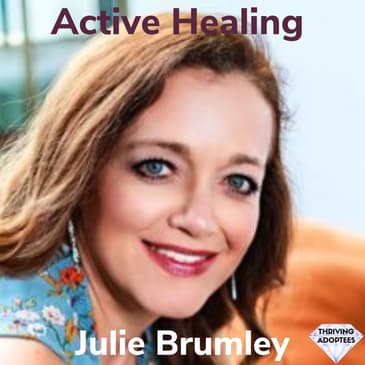
Time and time again I've heard that healing is a very active pursuit. A very conscious decision to make what is unconscious to conscious. Listen as Julie shares profound learnings from her healing journey.
Here's the link to download the items Julie mentioned:
https://cominghometoself.co/social
Here's the link to the book I mentioned
https://www.amazon.com/No-Self-Problem-Neuropsychology-Catching-ebook/dp/B07PLRZVTT
https://www.instagram.com/juliebrumley_/
https://www.facebook.com/julierasbrum
Guests and the host are not (unless mentioned) licensed pscyho-therapists and speak from their own opinion only. Seek qualified advice if you need help.
Want to learn more about thriving for you, your kids, your families or your colleagues? Pick a time to talk here
[00:00:02] Hello everybody, welcome to another episode of Thriving Adoptees podcast and happy 4th of July, Julie Thank you, happy Independence Day Yeah, you celebrate leaving us but we don't celebrate you going Do you know what I mean?
[00:00:20] I didn't know that, well I mean I did know that but that's funny We don't celebrate a departure You'd have a lot of departures to celebrate I think then We would have, yes people have separated in the good old days
[00:00:38] When half of the world was pink with the Was it plain color? Was it red? That was the color of the empire Oh yeah and it was an empire for sure Oh the good old days, what? Yeah, cholera, dysentery Plagues
[00:01:01] Yeah, it's an inventing, the British invented the concentration camp I did not know that, that's fascinating But for the war we didn't do any, we didn't do the gassing but we did invent the concentration camp in the Boer War, right? That's South Africa Wow
[00:01:26] We're looking at colonists, anyway You have just educated me, thank you So we're like 3,000 miles away or about 12 inches by Zoom Right So now we've got the frivolities out of the way We're going to talk healing and does healing resonate with you?
[00:01:51] Very much so, it is something that I think I've pursued in my adult life mostly I don't think I knew in my younger years that I needed healing And for me it's a very active word, it's not something that is past tense
[00:02:13] I will always be healing and so yes, I absolutely resonate with that word Is there a word that you resonate more with? Oh, that's a really good question Maybe the word that popped into my head, so I'm just going with it is transformation
[00:02:32] I think for me when I think of the word healing what I think of is the transformation that has come from all of the things that I have done to heal from the trauma that I experienced
[00:02:45] But I think when I think of the word healing, I honestly think of mind, body and spirit connection For a long time when I started the process of healing back in 2005, so almost 20 years ago
[00:03:03] I was in my early 30s then and I remember seeking out a therapist because I just felt shattered Like I don't know how to survive, I'm a mess, I'm broken, all those things that we can think I'm a nuisance, I'm a burden
[00:03:25] And what I remember was really focusing on the mind piece early on Like everything that was going on in my head and how that kept me And we're going to talk about this a little later I think, but that actually kept me really stuck
[00:03:43] But I didn't know that So for years I really focused on the mind piece The spirit piece has always been really there for me I really have a deep and abiding relationship with God That's how I survive through the things that I've experienced
[00:04:03] And so I think that foundation that was even built by my adoptive mom has really helped me through a lot of this And deepening that connection has helped me But then the biggest shifting piece for me that connected all of that was the body
[00:04:19] And that was in the last three and a half years And what ended up happening was all this mind knowledge that I had That I had created and built up of, I think four or five different therapists Over the course of 2005 all the way to current
[00:04:38] Really most of those, all of them besides the last one had no adoption understanding at all But this body piece, the somatic piece which that's all it means, somatic means body Has actually shifted everything from my brain into my body and this understanding it's been so integrated
[00:05:04] That now I feel like I actually am embodying all of the things that I have learned And honestly, I pursued my master's degree back in 2006 or no Nine because I wanted so desperately to heal
[00:05:20] And I thought if I can heal through learning this stuff then I can help others A pursued a master's degree in counseling for that reason that I'd always wanted to help others And what's so interesting about that is It uncovered all of this stuff
[00:05:40] It was the beginning of me really recognizing What healing was going to be And I didn't know it was this big mountain over here that I needed to kind of overcome
[00:05:52] And so for me it was the small imperceptible shifts of consistency that I made on a daily basis In daily practices Whether that's, you know, writing down five things that I'm grateful for every day and for me it was more like
[00:06:10] Not just, oh yay it's beautiful outside and the trees are green, that's thrilling It's more like, this is going to sound really funny but I have two dogs, we talked about this yesterday And when one of them will come up to me and like want some love
[00:06:24] He'll put his little paw on my lap and then lean into me It's the cutest thing and so sometimes I will write about that Like I'm so grateful for Murphy and how he loves me and how he shows me affection
[00:06:38] It's like actionable things, you know, so there's been that that has been really transformative for me There's been reading and educating myself But the biggest shift, like I said, was the somatic stuff It was learning how to ground doing yoga and meditation daily
[00:07:00] Adding that into my daily schedule So when something may trigger me then I'm able to actually have these tools at my disposal That I'm practicing on a daily basis that keep me regulated So my nervous system and I think most adoptees nervous systems are pretty much on fire
[00:07:21] Like we cycle through a ton of trauma states, fight, flight, bond freeze, flop all the time Because that's how we entered into the world, at least in my experience That's how I did and so it was learning how to regulate those things
[00:07:38] And once I realized this awareness came upon me of, man, I've been in this place for a long time and didn't even know it And I started nurturing my body and listening to what it needed
[00:07:52] And whenever there was pain actually going, huh, I wonder what that means versus going to get an ibuprofen You know, it was actually leaning into what my body was telling me
[00:08:02] And doing those things consistently helped me to kind of what we call in the profession move up the ladder Like be able to titrate myself up the ladder from that flop state of depression and stuckness and numbness of emotion
[00:08:19] And then actually moving up to a place where the term is frolic where I felt like I could actually play and enjoy Whereas before, like sitting down and coloring seems stupid to me
[00:08:32] Like why would I do that? I don't have time for that. I have things to do But it was cool to be able to watch this transformation of myself now looking back and go, well the shift really was adding that somatic piece for me
[00:08:47] And that answers your question Yes, that's it, done. That was a quick episode. Thank you everybody for listening Um, yeah, frolic, right, I like the frolic thing Yeah Like we did an episode a couple of days ago with a comedian and we're talking about laughing at trauma
[00:09:11] And to me it's a relief, right? Do you know like bringing a sense of humor to trauma? Yeah Because we've got these dark foreboding books, the primal wound Yeah Yeah Yeah The journey to the adopted self Yeah, the body keeps the score Score, thank you best of all
[00:09:37] It's going to settle that score and it's going to ruin you for the rest of your life, right? So yeah, what's the ladder? I've heard of a ladder but your ladder is different to mine, I think, I don't know, just checking
[00:09:53] Well, okay, so for me I do a lot of like I'm training in somatics right now to try to help the adopted population that I'm working with But and myself to be honest, but it's called the polyvagal ladder. Have you heard of polyvagal theory?
[00:10:07] I have heard of polyvagal theory, but I've not heard of the polyvagal ladder. So Okay, well the polyvagal ladder is a visual so it literally when when you look it up, you'll see images of a ladder and at the bottom there is the dorsal vagal shutdown
[00:10:23] There's the sympathetic in the middle and then there's the ventral vagal which that's where frolic lives is at the top of the ladder
[00:10:29] And so when we talk about fight flight from fawn freeze and flop, that's kind of a newer one when we talk about those they live in the bottom sections
[00:10:40] They live in you know the dorsal vagal shutdown and what it's I'm using big words what it's based upon is the vagus nerve which is like a master nerve that runs from the base of our skull to the base of our behind basically
[00:10:56] And it manages it has its little you know nerve tentacles that goes everywhere throughout your body and I don't do you know much about the chakra system? No, not into. Okay, into that stuff.
[00:11:10] Well, and it's not like the new way I don't I don't look at it as this new age thing anymore I used to like that's far off it's not so but what I've realized after doing the research that I've done is all it is
[00:11:23] is this connection to the nerve bundles that are a part of that vagus nerve. And so those nerve bundles that start from the root all the way up to the base of our skull, they're kind of like brains in each one of those centers there's seven of them.
[00:11:40] And as we can connect to them and recognize when we don't feel safe, for example, that's of course when we will fight or flight right sometimes freeze. Think about animals in the wild Have you ever heard of Peter Levine.
[00:11:56] Okay, yeah so he talks a lot about when an animal is in the wild. What do they do after they've just, you know, been through trauma they shake, they shake it off.
[00:12:08] And a lot of these things that our bodies naturally want to do we become conditioned to not do them as we get older, because they're weird.
[00:12:22] But the bottom line is our bodies need them. And so, for example, one of the things that I do when I recognize I'm kind of in that flop state on in the dorsal vagal shutdown is I will put my hand over my heart and and be compassionate and go okay.
[00:12:36] What's going on here. Why are you feeling frozen and I start I don't actually like the question why. So what is it about right now that is causing this shutdown feeling in you.
[00:12:47] And I can sit there with it have compassion with it not judge it that's a big one, no judgment just be really curious about it.
[00:12:55] And what that does is I'm sure you've heard the word titrate it titrates you up the ladder and moves you up to the place where you are able to frolic, but you can't do it in like, okay let's say I'm in a shutdown state.
[00:13:10] I'm going to go for a run right now that's not going to do it like you've got to titrate yourself up the ladder with these little imperceptible shifts like I talked about over time to help you come out and climb up. Does that make sense.
[00:13:27] Yes, so the the chakras and the ladder are two different metaphors for the same thing. Pretty much. Yes. And they're very, they're very related.
[00:13:44] They're their nerve plexuses that's what they're called their plexuses inside the body that when we tune into those and actually know what they influence and the organs that they influence and I don't want to go into all of that because first of all I would need to look at
[00:14:02] the body to do that. And I don't want to do that but really educating yourself on that and understanding how they interact with your body and the word is how the nerves innervate the tissue.
[00:14:16] It's so helpful because what's that's done for me for example, I have lower back issues and have had lower back issues for years.
[00:14:26] I've had a lot of people generating discs it's it's a thing. A lot of people have them at my age, but it's been years and when I finally learned about that area which it's the sacred role.
[00:14:41] That's the sacred chakra when I finally learned about that and started leaning into the pain that was there and why it has to do with pleasure, creativity play.
[00:14:51] Allowing any of those in my life. And so there was all of this tension down there and pain, and once I started allowing those things in the pain began to dissipate.
[00:15:04] It was unbelievable and I know that sounds kind of like woo woo wee weird, but I'm telling you it was, it was a shift for me.
[00:15:11] And I'm not saying I'm completely out of the woods my back still hurts, but nowhere near what it did I mean I could, I was like paralyzed and I couldn't get up.
[00:15:19] And so, as I've started to really tune in like a tune to my body and listen to what it needs. I've been able to shift up the ladder. So that's how they connect. Okay, so the tight trade takes me back to school.
[00:15:39] Chemistry. Yeah, and I was in the worst. I was in the worst. I was in the lowest group for chemistry. Yeah, me too. They gave us they gave us the toughest teacher who was a real hard case. Very. Yeah. Yeah, not a motor. Not an inspiration.
[00:16:04] Yeah, I got we do a mock exam to publish exams right in the summer when we're 16. And then we do a mock, you know, six months before to see how you're going to do right. Oh yeah. That's actually really good. That's a good idea.
[00:16:19] It is a good idea. So I got an A in the mock. And he said to me, you fluke that you fluke that if you don't work really hard, you won't get an A in the summer. And I thought that's possibly the stupidest thing I've ever heard.
[00:16:41] Anyway, I got a B. But yeah, so titration takes me back to chemistry and big shout out to I don't think you'll be listening. Yeah, it's cool. It was his first name was Morris.
[00:17:02] And we used to do this when we're in the final two years of school high school, secondary school. We used to do like each class, each form did took it in terms to do an assembly, right?
[00:17:19] So this assembly is the stuff that happens at the start of school day. I don't know if you have that in the call it a home room in in. Yeah, home room. Yeah.
[00:17:28] But but all the but all the, you know, like all the kids going not just 30 in that class. Anyway, so his class did Morris dancing for that for that class. So funny.
[00:17:46] So they put they put all their white, you know, like for the white cricket trousers on and then they got some garters, you know, these these little things put them around the legs. And then you've got some tambourines and sticks and did did Morris dancing.
[00:18:05] Okay, so I guess they would frolic in that.
[00:18:07] So they sure were titration. I remember a titration is you kind of like you got a little glass tube with a stopper on it and you you you squeeze the you squeeze the the bulb at the end of the stocky you put it into the liquid and it sucks it up.
[00:18:22] So that's what that's what titration. Pretty good to remember that right. Yeah, I'm very impressed. You know what's so funny is when I said that what went through my head was he literally I'm like he's going to refer this back to chemistry. I'm a little left brain right.
[00:18:40] So and it was 41 years ago. 41. Yeah, 41 years ago. So that's what it means chemistry. What does it mean in poly bagels?
[00:18:53] Yeah, poly bagel theory basically it's it's the same thing it's being able to so the way that I look at it is let's say you're that test to you personally, you are adding a grounding tool to yourself whatever that may be like I said hand over heart something very simple when I'm in that
[00:19:11] place of complete stuckness that shows my body. Hey, I see you. I hear you. I recognize what you're dealing with right now.
[00:19:21] I got you because so that's you're adding something to that test tube to help you move up to help you suck up integrate whatever it is that you were just talking about so if I make that correlation directly to it.
[00:19:35] That's what I would say now let's say you're in the sympathetic state which in the middle that's like, you have been threatened.
[00:19:43] And you need to run or you need to fight it's one of those then in that situation, you would do something a little bit more up the ladder like I'm going to go for a run.
[00:19:53] I'm going to shape I'm going to stop I'm going to do something physically that relates to whatever it is that I'm feeling threatened by. So that's what I mean by titrating up.
[00:20:06] Yeah, so it's it's it's that moving. It's like the liquid going up the tube. Yes, as the as the movement movement of the ladder. So they are all these things. There's three metaphors there right this titration is one metaphor.
[00:20:26] The ladder is another metaphor. Yeah, and the and the chakras is yeah, yeah, metaphor. Have you heard of. Well, staying on the somatic thing right. Have you heard of kinesiology course. Yeah, have you heard of a book.
[00:20:48] Do we talk about this yesterday. I mean, I've talked about a book called power versus force. No, I have not heard of that book. So that's another ladder. It's a scale of human consciousness.
[00:21:02] Oh cool scale of human consciousness and it goes from zero to 1000 and zero is dead. 20 same. Oh, no I have. I know exactly what you're talking about. Yes, I actually in my program I actually have a picture of that.
[00:21:21] Shame is at the bottom. Yeah. But the guy David Hawkins. Yes, I know exactly what you're talking about. I love that he devised that using kinesiology.
[00:21:33] So the first half of the power versus force book is his kind of methodology, which is can you do I love that I need to get that book because I share his stuff.
[00:21:41] All the time and I do cite him. I'm like, yes. And then the levels of consciousness, his things happening to me things happening by me things happening for me things happening through me. Do you know that?
[00:21:54] I've heard that I haven't seen that put alongside it. And interesting. Oh, it's amazing. He also he is not mentioned on the scale, but it is mentioned in one of the books. He he he calibrates the wag of a dog's tail, the wag of a dog's tail.
[00:22:19] And it calibrates something like 350, 400 500. So we measures it. Yeah, the calibration. Yeah, yeah, yeah, yeah. He calibrates using kinesiology and he calibrates different things. So fascinating. I for me it's like that's the score that I'm looking at.
[00:22:47] Yeah, that's right. Yes, me to look at the doom and gloom. Yeah. He wants to scare the bejesus out of me. Yeah, but what I'm going to look at I'm going to look at David Hawkins and his and his score. And that's, you know, my my average level.
[00:23:05] That is actually really interesting. You saying that make just I had this huge idea of putting that alongside the ladder.
[00:23:13] Because if you do that, that's exactly what happens when you're in shame, you're in flop. But as you move up to enlightenment, then you're at the top of the ladder for all again. I mean, that's perfect. Yeah, those emotions have frequencies. Yes, emotions are frequencies.
[00:23:32] And yet they're all just energy. Mm hmm. Just yep. And we need to release that energy when we hold it, when we don't face it when we stuff it. It's going to push us down the ladder.
[00:23:47] We have to express judging our like I'm judging even me saying I'm keeping the score on the ladder right yeah implicit in that is me judging emotions, which isn't a really great thing to do.
[00:24:03] It's totally not and well that's what I just said it's about non judgment and being curious about them. It's that self compassion. That truly that was probably the tipping point for me, like showing myself compassion, which seems like such a, like every time I say it
[00:24:21] what goes through my head is that just seems like a pad answer. Have you heard that phrase before pad answer.
[00:24:28] I was just wondering, it's like a token phrase. It's like that's what you do or you know if like in the religious circles just pray about it. That's a pad answer.
[00:24:37] It's like not one that's really weighty. But I think what I've learned in this process is no like self compassion shifts us those little imperceptible shifts like when we show ourselves kindness.
[00:24:52] We're mindful of well it makes sense that you are struggling with this right now. You experienced some pretty severe trauma in the first seven weeks of your life. So no wonder you're reacting this way but let's think about that for a minute.
[00:25:06] Are you reacting to a current threat. No. Ah, okay. So it's not reality. You're replaying that on today. Do you need to do that.
[00:25:19] No. Okay, like you see what I'm saying like it's being able to talk to yourself through it like you would a friend almost sitting with yourself in that moment and going okay we're having a big response here why it's not appropriate so let's talk yourself through that and show yourself compassion and then also for me the end of that mindfulness kindness and this is all from Kristen Neff I don't know if you've heard of her she researched self compassion she's amazing and so this is not for me give credit where credit is due.
[00:25:49] But at the end of that is common humanity for me to be able to go now finally for the first time in the last three and a half years this community of adoptees being able to go they get it.
[00:26:00] They understand that's common to our community. I don't feel alone in so it's not keeping me stuck in that place it's me going I've had so much validation from these, you know adoptees while I'm going through my own process.
[00:26:16] But what's interesting is those who aren't adoptees, they don't understand that they cannot relate to that. So I needed to find that community, those people that did get it.
[00:26:28] Because once I started coming out of the fog and getting it. I was like, it's somebody to validate what you know. So anyway, that was a lot. Okay, so where do I go from there's a few different places do you want to pick.
[00:26:43] Let me let me think what the different options are. Yeah, validation. Okay. To me, it seems to me as in in my experience. Yeah, so it's a double edged sword. Sure. Explain tell me more.
[00:27:14] Well, I, my kind of coming out of the fog for the first time moment was me saying to a newish friend a trainer at quite an enlightened kind of person that I would struggle to call her a coach but let's color that just go.
[00:27:44] She's like a horse whisperer and I was doing it. I was doing a communication skills course with her and horses. And I had a 10 temper tantrum. And she said to me, there's something going on for you Simon if you ever fancy chatting about it.
[00:28:09] I'll be a bit for that. So I went to see her and suddenly these words came up my mouth. I was talking about the teddy bear and the fact. Oh yeah. She didn't love me enough to keep me.
[00:28:25] And she, she, she just gave me this affin teddy bears and everything. What she said then, she didn't validate me. She said, I'm a so listeners the dog just went spare and I thought it's the Amazon delivery.
[00:28:52] And if we get a card and you know, my wife's told me to look out for the Amazon guy. If we get carded. I doesn't deliver because I haven't been there to sign for it that I'm going to be in the Stuck on it right.
[00:29:04] So a little break. And so yeah, he, so I said to the, I said to Sarah, she didn't effing love me and that after I think she can tell you better right. And what she said next wasn't oh, you poor dear.
[00:29:23] That must have been really horrible for you or anything like that. She said, I'm a mum Simon and I don't think it would have been quite like that. And I like, am I? Yeah, you're right. Okay, so she she could have validated me.
[00:29:44] But instead her natural reaction was to to coach me to share her share share share her share share her share share her truth. She shared her truth. Yeah. Yeah. And like you're a coach. You know, I've had a lot of coaching.
[00:30:04] I've had a lot of coaching around different stuff and lots of business coaching and kind of self development coaching as well. Right. You said and what a coach does is usually the trade sufficient empathy and they and then they question your beliefs. It's true.
[00:30:27] So validation for me can be a double-edged sword. So there's, there's a relief. You know, I totally, you know, I totally get what you're talking about here and you know, people feel like me other it's not just me that feels like this. I've got validation right.
[00:30:47] I've got some validation that kind of that kind of feels good. That's kind of good. Yeah. It can be, it can be a double-edged sword because it can keep us stuck and who wants to be stuck. You know, you started by talking about talking about pursuing healing.
[00:31:08] Well, pursuing you talked about transformation. This is all about change. Right. So it's, it's, it's letting go. Right. I said this a while, I said that you should say it's all the time, but I've stopped saying it, but I bring it back in.
[00:31:25] So to me, the biggest thing, biggest challenge that we face as adoptees of a certain age, right? Because we're similar kind of age and generation. Yep. It is this belief that we're not good enough. Yep. I heard this Gabor Marte thing. Yes. Oh my gosh, I love him.
[00:31:47] I don't get that much from him, but this, this is a complete bombshell in a brilliant way. Right? He said the feeling that we're not good enough, that is not a feeling. It's a belief. Exactly. And to me, busting beliefs seems to be easier than healing trauma. Right?
[00:32:14] So I, so I, I've, I've, this belief, this belief, this belief is wrong. I need to, or I suspect this belief may be right. I need to put a fine glass on. I need to explore whether this belief is true or not. Right?
[00:32:33] And I need to check it out with some other people and I need to, yeah, I need to do some exploration. You talked about curiosity, I think. Yep. I did. Yep. Right. So to me that seems, that seems eminently doable. But healing trauma, oh healing trauma.
[00:33:01] Oh well, well I need to, I need to do, I need to realize that it's happening on these three levels, mind, body, spirit. I need to get into do all this somatic stuff. I need to, I need to look at my mindset.
[00:33:16] I need to strengthen my, like it's a million, a one, it's a million one things, but nobody talks, nobody talks in our community. I've heard about this being a belief. Oh, believe Simon. I talk about it all the time.
[00:33:36] It's so interesting that you're bringing this up right now. I literally just created a freebie on this exact thing because it is foundational for us. It's called the perspective shift resource. And basically the whole point is an exercise in helping you identify what those beliefs
[00:33:56] are, those subconscious beliefs that kind of run our lives as adoptees, the ones that the people that I've worked with, the things that I've heard is I shouldn't exist. If I mess up, they'll leave or I'll leave first. Mine, one of my biggest ones was I'm defective.
[00:34:18] I'm broken. I'm a mess. I'm a nuisance. I'm a burden. I mean there's many, but these are those beliefs. They're not feelings like Gabor Montes said, their beliefs that literally live in our cellular tissue.
[00:34:35] And until we are able to pull them up to our consciousness and see them and deal with them in an active manner where we can actually shift our perspective from that belief to a new one. And it sounds so basic, but it's not.
[00:34:54] It does shift so much in us. That was a foundational thing for me, was being able to identify what those were. And then where does that belief show up on my body? Like I'm defective. I feel it in my gut. Like there's just, it's a sinking feeling.
[00:35:09] I don't, it's not good. It's not expansive, right? But when I shift that to I'm the best and I'm who I was created to be. If that's what I shifted to, for me right now, I believe that, but there's some
[00:35:22] people who would go with I'm defective and be like, I can't think I'm the best. How about I'm working on or learning that I am the best? Like you just shift your perspective. Now, how does that feel in my body? Ooh, that's different.
[00:35:35] My heart actually feels warm and swells and feels good. Like this is how you begin to, with those tiny imperceptible shifts about beliefs, how you move up the ladder, how you transform, how you change. I am so with you.
[00:35:50] It is beliefs is the basis and that starts here. It starts in the mind. We have to recognize what's subconsciously there. I totally agree with you. And I had an inch and I had, and I had something interesting from a neuro scientist guy. Think it was.
[00:36:12] I used to, I used to think about this a lot, you know, they're, it's the old young quote, isn't it? Kyle Young saying until we make the subconscious conscious. It will drive our life and we will call it fate. Something along those lines. Yeah, yeah, yeah. Yeah. Yep.
[00:36:33] We studied Carl Young in my school. So yeah, totally know what you're talking about. And that's what coming out of the fog is for me. It's when we become conscious of trauma. The trauma has been, we felt it.
[00:36:48] But we, yeah, we felt it but we haven't realized it. I don't know. No, that's exactly right. We felt it our entire life. Yeah. I thought about this earlier. I did speak talking to somebody thinking about stuff in education and advocacy stuff.
[00:37:14] And you know, they talk about being trauma informed. Right? Yeah. Well, we don't need to be trauma informed because we're trauma experienced. Yeah, it's true. It's true. I mean, I put trauma informed on my stuff just because that helps people find me, but it is true.
[00:37:31] I am definitely trauma experienced. Yeah, I like that. That's really good. So this, it is this neuro neuroscientist and the guys called is, I put the, I put the links in the book in there. I've named check this guy before.
[00:37:47] I've tried again show but he didn't answer anyway. And guy called Chris knee power and great, really relatable, really precise, really clear way, way better like a little kind of, I want him on the show because I'm on there. Yeah.
[00:38:07] He says that it's not that it's, it's not that it's subconscious. It's that we haven't got words for it. Yeah. Yes, yes, yes, yes. Absolutely. Because when the trauma happened, we didn't have them. We didn't have them. There was no language.
[00:38:26] But this, and I don't know what, it's an interesting idea that I'm kind of exploring at the moment. Yeah. Because the whole thing like you, right? I did the head stuff first, right? And then a million and one times last year, people told me,
[00:38:47] or you can't talk, talk therapy. Yep. Top therapy can move preverbal trauma because you haven't got the words for it. So there's something very interesting about whether this subconscious is a thing or whether it's verbal, non-verbal to verbal. So I think it's both and.
[00:39:17] You think it's both and? I think it's both. Absolutely. I think they're linked for sure. Anyway, yeah, that's fascinating. We'll look at, but if we look at the, I think we've, the only true, the only truth that we find is our own
[00:39:34] truth, this and the only truth, our own truth is our experience. It's like experience. And a lot of people say Nancy Varrier's book helped me. Yeah. Put words. Put words to my experience. That's what I said. Yeah. So that to me sounds more like the non-verbal to verbal
[00:40:07] thing. Sure. Do you know what I mean? Cause if you weren't, if I wasn't aware of the trauma or if I didn't suspect the trauma, I wouldn't have bought the book. Right. So I must have been conscious of it.
[00:40:21] Well, well, okay, but wait, let's debate this for a minute. Okay. No, that's not. I'm right. Okay. Let's debate it. Well, I mean, I hear you. I think what I'm saying is the way I see non-verbal here is that's the subconscious and the verbal is when we've brought
[00:40:40] it to the conscious. That's how I'm seeing it. Yes. I'm with you and but out of the two models subconscious to conscious, right? Yeah. Yeah. So the non-verbal to verbal, the non-verbal to verbal resonates more in this instance with me than the subconscious to conscious. Yeah.
[00:41:05] No, I can totally hear that when I first did EMDR on this, which I've done it multiple times, but when I first did it on this, that was the hardest piece for me because she kept telling me stop using words.
[00:41:21] Your baby didn't have them and I was like, well, what do I do? I don't know how to, what are you talking about? And she goes, go get a pillow and bring it in here. And I was like, yes ma'am, went and got a pillow, brought it in.
[00:41:36] She took me back to the womb, took me back to what it experienced, what it felt like. And I have never in my life cried like that. It was like these deep guttural screams as, and this sounds really intense. Okay. And it was.
[00:41:54] And at the very end, I'm like screaming into a pillow because you know, I'm in my home doing this. And at the end of it, she goes, we're almost done with the session. I don't want to leave you there.
[00:42:04] And I said, I am so grateful you are leaving me here. This is unreal for the first time I've actually been able to feel, I mean, I felt them when I was a baby, but I was able to consciously experience what that preverbal feeling was like.
[00:42:18] And thank you for that. You have given me a gift today. That's what I told her because that's, that's exactly what you're, that's like a picture of what you're talking about. Right? Yeah. And it's an experience. Yeah. Yeah. Talking isn't an experience. What did you say? No.
[00:42:41] No, no, no. It's not. And that's why I'm sure you've heard somatic experiencing like that's a type of, I wouldn't call it therapy. I'm doing it. Yeah. I think we did talk about it yesterday. That is what that was. It was, she was basically forcing me to experience
[00:42:59] in my body what my mind could not comprehend. And it, that's where the shift began to happen. Was me being able to go, oh, whoa, this is way deeper. Now I get it. No wonder I've had the problems in my relationships. No one, you know what I mean?
[00:43:19] Like everything started to be like so much clearer to me after experiencing that. Yeah. Certainly. I think the, it's the, the busting of a belief can be an experience too. Yes. Absolutely. Gosh, Simon, you're hitting it on all cylinders right now.
[00:43:52] Like when, when this first happened for me, it was probably a year and a half ago. Like I started doing this exercise that I just created. I started doing that. Like I started actually actively trying to bust my beliefs. And so I spent 10 days identifying what they were.
[00:44:14] And then once I identified it, I worked through this system that I came up with, that I'm sharing with people. And it, I just remember feeling this like complete shift in who I was after that. It changed the trajectory of my being.
[00:44:33] I don't know how to explain it. It sounds so weird, but that's exactly what happened. It was a busting out of what I'd had for 40 at that point, eight, nine years, you know? So I think, you know, those, those experiences have a
[00:44:52] certain level of, you know, it's a bit like your ladder, I guess. The can have, you know, the belief you can have. Oh yeah, you can have the Charlton Heston biblical belief that I'm, I'm nicking this from a guy called Michael Neil.
[00:45:13] He, he, he, he risks on this coach guy in the middle of the world. He said, you know, he can, he can, he can have the Charlton Heston biblical epiphanies, right? Or you can have the Homer Simpson, though, you know, and there's everything where in between,
[00:45:32] you know, you can, you can see through something that I'd, a process for busting beliefs. Yeah. That's a new one on me. I'm going to take a look at that. And any input you have for me, I would welcome Simon
[00:45:51] because as an adopter yourself, I would love to know what the experience is like for you. I think the biggest ones for me have happened. Well, you said happen two, happened four, whatever. Like I didn't make them happen. No. I just kept going. Right.
[00:46:13] So I know with them. Well, kept on pursuing it. Yeah. One of my questions, I'll get back to them in a minute. But you kept, keep on going. Right. You know, you have a meltdown and then keep on going or a little bit of a pause, right?
[00:46:30] So I was looking at my adoption file this morning and in there, you know, it's all the letters from doing the tracing and stuff like that. And there's one from the, from the guy at the the post adoption support team who helped me get
[00:46:46] my first, you know, my mother's name, birth biological mother's name. And then there's a letter from him saying it's been a while since we've been in touch, you know, can we be of any assistance? And I probably, I left it alone and, you know, I didn't,
[00:47:02] I had taken a break from it for six months. Sure. Yeah. I think we all do that at some point because I did that. So but we kind of like, we keep, we may have pause, but we keep going, we keep pursuing it.
[00:47:17] And then stuff happens, you know, we find out stuff. We listen to a podcast, we read a book. Yeah, it's so true. We get our adoption file, we get the name, we find out something, we go on the Ancestry and something happens.
[00:47:36] And now belief is changed for us. I don't think we make, I don't think we make the belief, I don't think we make the belief happen. That's why I'm very interested in the process. I guess I think you can be more, it's the openness
[00:47:50] and the curiosity and the willingness to be wrong. Yeah. Absolutely. Even in our talk yesterday. That sounds great. Oh yeah. Who's going to say, who's going to say, so Simon, are you open? Of course not. No, I'm totally shut down. Everybody's going to go, you know, that's what
[00:48:17] you're thinking, the pad answer. Yes, yes. What have you got to show me? Yeah. So, but willingness to be wrong, I think, is perhaps a little bit more precise and a little bit. No, I agree with you. So, what about this? You know, the, who was it?
[00:48:43] It's just interesting to me the other day. You know, if we say, he or she said something like the pursuit of happiness kicks out of our reach. Something like that. The pursuit of happiness. To what extent does the pursuit of healing keep being whole out of our reach?
[00:49:13] I think we can be whole even while we're healing. I think we can be whole, think we can be whole and complete lacking nothing even while we're healing because we're layered people. And there's going to be things that we aren't ready to face.
[00:49:30] We need to continue working up the ladder so that we are ready and they get revealed in time. That's how I see it. So, can you relate back to your three level mind body spirit thing? Yeah, so does it relate? It does.
[00:49:52] Interestingly, I think for me, it was a long period of time that I was able to see that level of consciousness of things happening to me at the bottom where I was steeped in shame and guilt, which are two big emotions for adoptees.
[00:50:10] So, I was there for a really long time. And I stayed in the mind with talk therapy. That's what I did for years. Nobody understanding that adoption or me had impacted me. And then come three and a half years ago.
[00:50:28] Well, and then the foundation for that, like it's interesting. I'm going to have to come up with some sort of picture of this. But the foundation that kept me as you talked about moving forward was my spiritual foundation. That spiritual piece that really my adopted mom kind of
[00:50:45] showed me patterned for me in my life. And I'm so grateful to her for that. Not everybody, you know, they can identify God as their universe, their higher power, divine, however they want to describe it. For me, it's my God.
[00:50:58] And that spiritual foundation helped me to pursue the stuff that was going on in my mind. But I stayed there for a really long time until and those layers stayed subconscious until I began to pursue the body stuff.
[00:51:13] And that started happening three and a half years ago when I did that experience that I just explained to you from my EMDR therapist was the opening of this whole new layer that I was now armed and ready to deal with because I had the head knowledge.
[00:51:31] Does that make sense? Yeah, I think so. I think that, you know, we use this, you mentioned this word somatic experiencing. Yeah. And, and yeah, you talked about, I think different people do different things and then the different therapists do
[00:51:53] different things and they mix different things and they call it different things. So I don't know. Yeah, it's all a bit cryptic. So, you know, I was talking to, I went to see somebody and they were going to do MDR. But was it MDR? I don't know.
[00:52:10] Who knows? But when I looked for a pure play, this is interesting. I looked, so a therapist I saw last year who said that she was thinking of retiring but she wouldn't leave me in the lurch. That left me in the lurch. Okay. And it didn't rock me.
[00:52:32] So that was a good sign, right? That is a good sign. So then I was looking at somebody she was going to do, I could only find one somatic person within a two hour drive with me. It is not common.
[00:52:51] If you call therapist, if you put therapist in, I'd get Oh, of course. A thousand. Put somatic in front of it. But yeah. So it's funny. So going back to the spirit thing. Yeah. You used, you know, he talks about consciousness or high power intelligence. Yeah.
[00:53:15] Does it annoy you when people say God, universe, spirit, whatever you want to call it, it really doesn't matter what you call it. Does that annoy you when they say it doesn't matter what you call it? I don't think it annoys me.
[00:53:32] I think people have their own process. I used to be really judgmental of that. Like it's just God. Can you just name it God, please? Like I used to feel that way. I don't anymore. And I think the reason why I don't anymore is because I
[00:53:48] realize people have to figure this stuff out on their own. I can't force them to believe what I believe. But what I can do is help them lean into spirituality as a way toward wholeness. Everybody needs a spirituality basis. I really believe that no matter what it is.
[00:54:06] You know, for me it is God, but it could be the universe for somebody else. It could be a doorknob for somebody else. I don't care whatever it is that works for you and helps you get to a place of wholehearted living.
[00:54:19] Connecting to that spiritual piece of us is a part of that. Yeah. So listeners, don't do what Simon does and get annoyed by somebody saying it doesn't matter. Do what Julie says. Right? Do what Julie says. Oh, you're so nice. Come up with your own thing, right?
[00:54:41] My longest-term mentor and coach lady who I only see speak to a couple of times. Well, once a year I think. She calls it Humpty. She calls it hunting? No, Humpty. Humpty Dumpty. Like the children's like character. Right? She calls it Humpty.
[00:55:02] So you call it whatever you want. Yeah. As I say, don't do this at home, kids. Don't do what Simon does. Right? Simon. I'm not going to do that. I'm going to do it. I'm going to do it. You don't have to do that.
[00:55:17] I'm going to do it. So I'm going to say, don't do what Simon does. Right? Simon, but I want to say don't judge yourself for doing that. Oh, okay. We could just want to roll and roll. I know. Yeah. Okay. So you completely different subject. Right?
[00:55:41] Cause otherwise I'll start sharing my stuff. And I'm trying to do less of that. Somebody. I'm trying to do less of that. I'm trying to do less of that. So I've, I've, somebody has told me that somebody criticised me for and talk,
[00:55:58] sharing too much of my own stuff and not letting people get a word in edge wise. Well, you haven't done that. Well, I've taken that. I've taken that on the chin. My only excuse is that sometimes I get a little bit excited. My intention is,
[00:56:13] my intention is to let the, the podcast talk or else it would be 500 episodes of just Simon talking to us. If I was the, if I was the Boris Johnson, if I was the, I see what you did there. Adoption podcast. I was going to,
[00:56:33] I was going to actually mentioned another politician. I'll let you guess who that for the end. Right? So, um, you did a career. I'm sorry. You did a qualification in counseling and yet you're a coach. So, yeah, can you explain the difference
[00:56:58] with relation to what we've been talking about? Okay. Uh, let me see if I understand what you're saying. You're wanting to understand the layer of I pursued counseling, but then chose coaching instead. Yeah. And, but I wouldn't, uh, well, no, not really. I, I, well you can,
[00:57:20] you could answer that one. You can answer that question. No, I want to know what you were trying to find. So maybe I didn't hear you right. So I, I'd love you to explain the difference between a counselor and a coach given the,
[00:57:36] the context of our conversation for the last 50 minutes or what it's been an hour. Okay. So a counselor is somebody who is trained in the past. That sounds weird, but basically helping the client dig into what are their roots? What got them to this place?
[00:58:00] So you focus more on the past where a coach, sorry, I'm trying to give you a visual where a coach is embodying empowerment and giving them the strength to find it within themselves, not from their past, but from their present.
[00:58:18] How do I move forward knowing what I know now and become empowered to basically not need this coach anymore? It's similar in counseling in that you're trying to work yourself out of a job, but in coaching, you're really trying to help them find it within themselves.
[00:58:34] And, and you ask a lot of questions like you, you talked about with that coach that had helped you where she said, well, that's not my experience as a mom or however she said it to you. So it's being able to give them a whole different perspective.
[00:58:51] There are similarities. Don't get me wrong. But coaching is much more future minded, whereas counseling is more past minded in my experience. Yeah. And, and yeah, it seems to me there's a load more. So would you, would you see counseling and therapist as would you use those,
[00:59:17] see those people as the same like a synonym? Yes, I would. And just as far more adoptee therapist than there are adoptee coaches, right? As far as I know, yeah. And I think, well, at least what I've seen, trust me, it's hard.
[00:59:35] Like I've had so many adoptees come to me. Do you have professionals and I'm like, I do now because of the connections that I've made. And so there's websites that I can send them to in the States that they can find someone.
[00:59:48] But even then, I think what I've realized is the talking. We've done that our whole life. We need to experience the nonverbal. Let me just bring it back there in order to move ourselves forward to a healing healthy place. We just, we do.
[01:00:10] So there is a piece of going back to the past. There is. If we don't acknowledge that that happened, we're going to stay in the fog. So there is a piece of that. Yes. I find coaching more beneficial personally. So we've been on quite a while.
[01:00:35] I'm thinking what have I not asked you about that you'd like to share? I haven't talked about what keeps us stuck. Oh, sure. Well, for me personally, like I did think about this. Like what for me personally, what's kept me stuck in the past,
[01:00:57] not like in the physical past, but in my own past, what is kept me stuck is being so focused on the mind that I can hide behind and isolate myself within the learning.
[01:01:11] And what I mean by that is let me just spin my wheels reading every book I have. Let me just spin my wheels focusing on other people's problems because, you know, that's my job. And if I do that, then, you know, I can avoid dealing with this.
[01:01:27] So these are two things that kind of came up for me personally. I can easily hide behind gaining knowledge, but not allowing that knowledge to trickle down into my body. That's been where the shift happened. What kept me stuck was all this pursuit, was all this seeking, searching.
[01:01:47] There's nothing wrong with that, but when it's coupled with the body and the spirit, some magic happens. So that's what kept me stuck was spinning my wheels in the talk therapy, spinning my wheels in those things that and honestly, Simon,
[01:02:02] I was doing what everybody told me to do. Yeah. I am a very good obedience person. So like if I go to somebody, I'm like, I'm really struggling. Like I went to one of my past therapists.
[01:02:12] I think I told you this yesterday and I was like, I'm in an impasse. Things are not going well. I don't know what to do. And he was like, you need to go see an EMDR therapist. That's the first thing you need to do.
[01:02:22] You need to do parts work, blah, blah, blah. And I was like, okay, found somebody did it. Like that's what he told me to do. So I did it. Next, he said you're going to need to do body work. I didn't know what the, that was.
[01:02:34] Like I had no idea at the time. And so I was like, okay. And so then I finished with my EMDR therapist and I find a somatic therapist and Simon, I'm sorry to say this, but she was a total quack.
[01:02:47] She, it said somatic in front of everything that she did, but this is what she told me to do. Go put your hands under the water and pay attention to the water. And now that's a grounding tool. Great.
[01:02:57] But you're not helping me deal with whatever it is in my body. She, and then she said, play with Play-Doh. I'm like, what are you talking about? How was that going to help me move through this trauma that's in my body?
[01:03:09] So it was like, and I told my therapist that later and she goes, Oh, Julie, I'm so sorry. That is not what I meant. So once I found, I actually found a somatic coaching program and that coaching program is what helped me understand it. So interesting, but yeah.
[01:03:27] I thought you were going to say, you've told me to put the hands under the water. I've been washing up for my now ex-husband and my two kids for years, and it never did me any good. I can't understand how putting my hands under water is
[01:03:44] going to help me heal pre-verbal trauma. That's what I thought. Well, you know, it's hilarious is that's probably what was going on underneath the surface, but I didn't notice it. So thank you. Thank you for putting words to what I didn't really know yet.
[01:03:59] And just to show that I'm a metrosexual guy. Before we came start this conversation, I was doing the ironing and after I'm going to finish the last last bit of it. I'm so proud of you. So proud of me.
[01:04:17] I do nothing about the house apart from the ironing. I don't always do all of the ironing. So but for some reason, I feel that I need to draw that into you're bringing it full circle. Bring it full circle. Okay.
[01:04:32] So as always, I would urge you to check out the show notes and find out what Julie is up to. And I think when you've got your tool thing you talking about, do you want the perspective shift resource? Yeah. Is that the one that's online already? Yeah.
[01:04:57] It's already all there. Yeah. There's it's all the stuff that I offer is in a link that I'll give to you. But if you want me to, I can single out that link because it's it. I mean, they're all in there.
[01:05:08] Like if you go to the one link, you'll see all the stuff there. So we'll find out on the website. Yeah. And Julie wants some feedback on that. So that would be I do. I really do. I want to make it better for this population for sure.
[01:05:24] Anything else you'd like to share? No, thank you so much for this, Simon. Really it's been an honor and I just was so floored when I got the message from you and I was so encouraged because it is a passion project for me.
[01:05:42] Like what I'm doing right now as a passion project for me and never in a million years would I have foreseen that this would be what I was doing. And I'm just I'm thrilled to be able to be in this community in this place.
[01:05:58] So I really, really appreciate the opportunity to be here with you. You're very welcome. Thanks, Lizards. We will speak to you very soon. Take care. Bye bye.