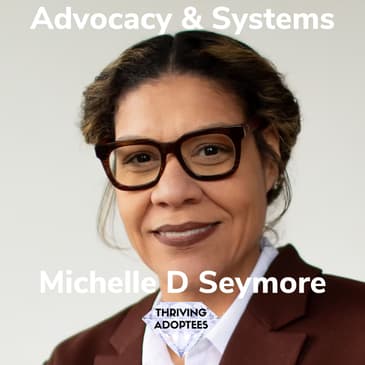
Are you advocating for your child or change? As every parent knows systems can be very tricky to navigate and change. The better we can understand them, the better we can relate with the people we deal with and more likely we are to get what we want. Listen in as
Director of Foster Care and Permanency Michelle shares her inside knowledge on systems, change and more.
Here is a bit about Michelle from her website:
"I'm often asked what brought me to this work; child protection, public service, and anti-oppression efforts. The answer is the same for all: my community's needs, desires, and experiences gave my career direction. Describing myself as a mixed kid from the projects doesn't always get a favorable reaction, but it's the truth and holds no shame for me. Neither do any of the other identities that make me the person I am today.
I hold a Master's degree in public administration from Metropolitan State University and an undergraduate in psychology and women studies. My public services career started with my first professional job out of college as an alternative response case manager on the east side of Saint Paul. That position was my introduction to child protection; quickly discovering the disparities, I realized the change needed would have to come from within the system causing these poor outcomes. Finding my way to spaces and fighting for a seat at the table among decision-makers was not the solution I thought it would be.
As a child protection worker, I found that policies, practices, and statutes interfered with my ability to make decisions in the best interest of families. As a supervisor, I found some of the same challenges, and the team I supported described transgressions in moral code during supervision. As a manager, I started to draw the connection between staff retention and outcomes for families. It became clear that staff supported in making decisions that align with their values remain in high-stakes decision-making positions. The unnamed emotions and blame the system placed on professionals led me to the term Moral Injury. Once I found the name of my experience, I felt empowered, becoming driven to inform the workforce and hold systems responsible."
Here are some links for more info
https://www.linkedin.com/in/michelle-d-seymore-42b0983b/
https://www.michelledseymore.com/
Guests and the host are not (unless mentioned) licensed pscyho-therapists and speak from their own opinion only. Seek qualified advice if you need help.
Want to learn more about thriving for you, your kids, your families or your colleagues? Pick a time to talk here
[00:00:02] Hello everybody, welcome to another episode of the Thriving Adoptees Podcast. Today I'm delighted to be joined by Michelle. Michelle D Seymore. What does the D stand for Michelle? It's the name Devon. And I just always even as a kid love to add that in and it was always what set me different I thought because I had such a traditional name and so do my sisters which I feel like is a whole story.
[00:00:29] I thought you were going to say divine, but we were pretty close there. Pretty close. Absolutely close. Yeah absolutely close. So ladies and gentlemen I met Michelle down in Florida down in Orlando at the Families Rising Conference, but she works out of Minnesota. So she's the director of foster care and permanency for the state of Minnesota.
[00:00:55] A big, a big plate right? A lot on your plate to do that. Yeah. Foster care and permanency. This is a big, it's a big state. Yeah. It's a big state. How many, what's the size in terms of the number of kids in foster care and looking for permanency? Give us a scale.
[00:01:18] You know, I would say last year throughout the state I think about 8,000 children went through foster care. You know, we're doing really good in our numbers as far as keeping youth with family and doing non-traditional placements and family arrangements.
[00:01:46] But yeah, about 8,000 youth that came through the system. We have two major metropolitan areas, Ramsey County and Hennepin County.
[00:01:58] And we're a state operated system, but county administered. So there's that dual partnership that happens with this wide range of population. We also, we have 87 counties and 11 recognized tribes, which we have partnerships with and help to guide the work.
[00:02:24] Right. And so there's a lot of fine lines that are played there. Yeah. So a lot of diplomacy required, I guess, and consensus finding. You know, I would say that historically how the state operated with the counties was very much so a risk aversion approach.
[00:02:52] And so given lots of advice and not as much instruction while counties were asking for real instruction.
[00:03:00] And over the last, I would say three years as we transitioned from the Department of Human Services to the Department of Children, Youth and Families, we've worked really hard to establish a relationship where we walk side by side with the counties, making decisions together and then modeling that co-ownership.
[00:03:29] Right. And what we're hoping is that triples down all the way. Like if we behave that way with counties, then counties will treat their staff that way. Their staff will treat the population that way. And at every step, we will be partnering versus dictating. Yeah. Yeah. Sounds good. Sounds good. So when you hear this word thriving, what comes to mind? What does thriving mean to you, Michelle?
[00:03:58] You know, I think it's personal. I would probably have a couple of different definitions thinking about where I'm applying it. For me as a professional, thriving means being able to push through adversities and still achieve whatever those goals are. That helps me to be able to thrive.
[00:04:27] That creates an environment and a space that is conducive to growth. Right. I think when I think about our systems and what make our systems thrive, our systems, a thriving system relates back to whoever is within those communities. Right. A thriving system is responsive to the needs of the people.
[00:04:56] And then when I just think about the everyday person thriving, I think they get to define that. I think about scaling questions as a practitioner. Scaling questions were always super important. And a lot of times we would stop at what number are you at? But remembering to follow up, how do I get you two numbers above where you were? Or do you even want to go there?
[00:05:24] And a lot of people, they're thriving at the number they're at. And that's great for them. Yeah. When you say scaling numbers, what do you mean, Michelle? Like, give me on a scale of one to ten. Ah, right. Okay. Yeah. So, because, you know, everything's not always 100%. And I love the gray in life and making sure that we can acknowledge the gray that everybody has.
[00:05:52] And if my normal is a three, but today I'm functioning at a four, I might just want you to be glad that I'm at a four. And that feels like thriving to me. And you saying I need to be at a six feels like a four wasn't successful today. But tomorrow it might. Yeah. Right.
[00:06:12] So, it's about not judging others on our scale. Yeah. Yeah. I think there's a lot to being able to, like, we like to talk about meeting people where they are. And, but we use a lot of, and when I say we, I'm talking about systems people, right? I'm always coming from the perspective of serving those.
[00:06:42] And I think that's different than some of the lived experience that, that people identify with, right? Like being an adoptee or adopting. Um, but being that professional that has worked in the system for an extended period of time, I have to remember that I'm only a small part of people's journey.
[00:07:05] And that when they define the path and I support that success is achievable. When I define everything and it's based on me and the books that I read and the, and the other cases that I've worked on and the other families I've met, it's not always achievable. And I'm setting families up for failure. So, giving them that information, where do you want to be?
[00:07:32] What, what makes success for you and how do I help you be there? Or are you there? Right? So, what comes to mind if, if I put adoptees on the end of this, this word thriving to give you the name of the podcast. What, what comes to your mind when you hear that, when you hear this phrase thriving adoptees?
[00:07:56] So, I want to be like, I want, like I have a bunch of, of words that are going through my head and I don't know that it's all the way a sentence yet. I think about connection. I think about, um, understanding.
[00:08:21] Um, like looking in from the outside, I would say a thriving adoptee had their adoption was rooted in addition versus subtraction. That it wasn't, that it wasn't, that there wasn't a, um, secret or shame to it.
[00:08:45] There was open communication, a well-adjusted thriving adoptee has an understanding of where they came from, why they are there and is developing a, where they want to go. Yeah. Yeah. I like, I like the, um, addition versus subtraction because a lot of people say adoption starts with loss.
[00:09:15] Mm-hmm. Yeah. And, and loss is, loss is another word, synonym for subtraction. Yep. Mm-hmm. Yeah. But does it always have to be?
[00:09:28] And how do we create a society that says there's no shame involved in allowing somebody else to be the primary parent of a child you gave birth to and still be involved? Yeah. Like, what does that look like? And how does, how, how do we remove the idea?
[00:09:57] Like, cause I get it. There's a loss that's there. And everything doesn't have to be a loss. It doesn't have to be all or nothing. Yeah. I was talking to a adopted mom yesterday, further over to the, to West of, West of you, uh, over in Utah. And she was talking about the open adoption of her daughter 26 years ago.
[00:10:26] The fact that she was, she, she, she, um, was with, uh, was building her relationship with the birth mother for the last half of the pregnancy. Um, and there hasn't been, there hasn't been a loss because the birth mother continues to be involved.
[00:10:50] And so, you know, these, these ideas are very superficial, sometimes superficial.
[00:11:01] Sometimes they're, these cliches are, uh, are wrong and they are, but, but they kind of get, if we don't challenge them or if we don't consider them, then they can start to paint a pretty dark picture. Right. So people say adoption is loss. Well, not always. Um, adoption is trauma. I mean, that, that's, uh.
[00:11:31] It's not wrong, isn't it? That's, that's strong. Um, you know, I, I, I am trauma. You know, I, there's a, I saw a post from an adoptee who has adopted. She's an adoptive mom as well as having been adopted herself. And she, she put on the head of this post on LinkedIn, I am trauma.
[00:11:54] So these phrases that are, that are shared around, I was going to say the word banded, right? These, these, these words that are shared around can be from people who look like they're authority figures. They can become self-fulfilling. They can. Absolutely. Yeah.
[00:12:21] They, they can shape, they can, um, determine our view. Right. They can, they can determine, to the detriment. Right. Yeah. You know, I, I, my, my child welfare career started out in, um, case management and doing
[00:12:45] that, um, reunification work that I have to tell you, I did not call reunification work until later in my career. It was just case management and my job was either to, um, help a family increase safety and reduce the chances of further maltreatment so that kids could be at home or find a permanency option outside of that family. And it was pretty matter of fact. Right.
[00:13:15] And, um, I, I talk a lot about like my self-preservation in that work really was a lot of, um, after whatever decision was made, everything was great. Like I could walk away and be like, this kid found permanency with this family because this family wasn't able to do it.
[00:13:44] And I didn't, I didn't, I wasn't trained to look at the longevity of permanency. I wasn't trained to, um, assess a family in a way that would support adoption as a addition versus a subtraction because it was systems. Right.
[00:14:13] There were, it was very seldomly infants and a consensual adoption. It was a traumatic experience. And so in the U S when we talk about adoption, it really sucks. We don't offer a lot of space for those successful relationships that started with a, um, a, a man
[00:14:39] and woman saying, I would like to give my baby to another family to raise. And I want to watch them grow up and be a contributing factor in that child's wellbeing. And because we think, and we've put this dominant culture ideology on parenting that we punish poor people and women of color for being in the child welfare system.
[00:15:05] We've already demonized what they look like, how they parent. And so then when a child goes to permanency with another family that we've been saying, you're so great for wanting to take care of this kid from this bad person. It's hard to transition to, but that person has something to offer to those children. That child naming to that child that they came from somebody broken says they're cracked.
[00:15:36] Yeah. Obviously we've got the two extremes and we've got two sorts of, we've got two sorts of adoption here. We're thinking of a private adoption of, uh, of, uh, of an infant and the, uh, the removal of a, a, a baby or a child or a toddler from that, um, from their birth parents because of neglect or whatever reason that is.
[00:16:04] Now, cause you're quite feisty in terms of challenging these, uh, societal stuff and the systemic, you're from what I can gather, right. From the time that we've spoken, you're trying to make the, you're trying to be part of, you're trying to change the system from the inside. Yeah. Yeah. Yeah.
[00:16:31] Um, yeah, it takes everybody, right? Um, I am honored to be able to be a part of the Minnesota African-American Family Preservation, um, Act and Child Welfare Disproportionality, um, initiative and legislation that passed in Minnesota.
[00:16:56] Um, myself and the co-director at, um, DCYF with me are overseeing that implementation and, um, it really aligns with the changes that I have really wanted to see in the system.
[00:17:22] Every step in my career has really been a understanding of how the level I was at was being forced to make decisions that were not aligned with what my value system said. And so it was get a little bit higher and I can change that. Oh no, there's another layer here, get a little bit higher and I can change that. Um, and now I have this opportunity to make this large scale change.
[00:17:51] And, um, even in how we are rolling it out is different than how we've rolled out other legislation in Minnesota. We are involving the community and those most impacted from the beginning of this legislation.
[00:18:10] Um, I'm able to get in front of people who have been impacted by the system, will be impacted later by the system, um, or have a connection to the people who are being impacted. Like there's this whole like ecosystem of community out there, right. That has the answer for their own people.
[00:18:37] And this new legislation has allowed us to go out and talk to these people and bring them to the table from the beginning with an understanding that we would like to reduce the involvement improvement of the system in family decisions. Like it used to be like when grandma came before and started to help out and made sure resources
[00:19:04] were there and, um, allowing kids to stay in their own communities, which is another one of those subtraction versus addition. Like we can take a kid from a family and put them in with another family and surround them with resources there and then put the child back into the family and remove all of the resources and wonder why the child isn't doing as well.
[00:19:33] How do we add those resources to the family once we've reduced whatever the safety threat was? Yeah. It's big stuff, right? It's big stuff. It's big stuff. And my, um, open, bold discussion around the damage that I know not only my system has done,
[00:19:57] but I have done has been part of what has helped me to be able to be in this role and have the opportunity to lead this work. Um, you know, and there was a time when people were like, you are not going to get very far with that mouth of yours. And now it's like people are saying, and I feel honored like that people are like, hold on. I heard some of what you said. How do I put you in a space for you to be able to say some more of that?
[00:20:27] People are relating to the experiences that I've had because I'm not an anomaly all by myself. I'm not just this one person that felt this stuff. Um, it's happening and it's systemic and it's not me. It's not me being weak and nobody's targeting me. The system is targeting, keeping itself doing what it's doing. Yeah.
[00:20:54] So if somebody, if somebody's in Minnesota and they want to get involved in this, how do they, how can they do that? Yeah, there's lots of ways. Um, so great to, for you to ask. Um, there are a couple of big things that are happening and I have to say our African American child wellbeing advisory council is now seeking new members. And so that application is open and that's on the secretary of the state's website.
[00:21:24] That's, um, available to the public. You would just have to click on it and apply applications are going to be reviewed, um, until all seats are taken. There's also a, um, math, the CWA website that shows all of the, um, webinars, um, new information going out, the implementation plan.
[00:21:50] Um, and every one of the statewide work group meetings are open to the public, which has been amazing. Yeah. Let me just take a step back. The, the, so it's the African American. Child and family wellbeing council. Cause I can just Google this and then you don't need to send me the. The links. Okay. I'll send you the link and I'll add them to the show notes. So, so that's one.
[00:22:18] And then the other one that you said. Is MAPA. It's the initials for the Minnesota African American family preservation act and child welfare disproportionality act. There's a website, just the state of Minnesota, when you put in that acronym and it's the state of Minnesota DCYF and it has all of the open forums for all of those other meetings. Okay. So we'll add those. We'll add those in.
[00:22:49] So how do you see the, the, the link between when I, when I, I see like a golden thread for it. If we want the kids to thrive, if we want the adoptees to thrive, if we want the kids in to be, or the carers need, they need to be thriving. If they need to be, if we want them to be thriving, the, the people that support them
[00:23:17] need to be thriving. So that's that, that's that golden, that's that golden thread. What, what, what does that look like to you? Michelle? So, um, that's that additional work that I do with moral injury and kind of, um, having those discussions with removing the onus from myself, right? Um, systems are creating this harm. They are pushing me to do things that do not align with my ethics, my morals, and my values.
[00:23:47] I create spaces in which I can have those discussions and I support workers and supervisors and managers by being able to, um, help them push back and determine what are, what, what is legislation? Where are the rules? What, what made that policy or practice start to come alive? How do we push back at what's doing that and removing it from the actual harm and then acknowledging to the community? These things happen.
[00:24:16] They're here and here are the ways in which we want to rectify that stuff. It's also being able to pull that data together. People will say quite often, like, we've diversified the workforce. So now it's black on black crime. So we can't be racist because there's two black women that are rolling out the African-American Family Preservation Act for the state of Minnesota.
[00:24:44] And the above them are also women of color. Um, and so then the onus becomes on us and that's a huge amount of pressure and a idea that, um, the injured parties should have the solution, right? When I think about that throughout the system and how that looks for, um, our children and our parents coming out of the system, we have to find pride in the work that we do and an
[00:25:13] understanding of who families are and how they work together, right? If I, as a worker, understand that there is pain all the way involved in maltreatment, that parents aren't just bad people out here beating on their kids or that it's a, it's a totality of circumstances. And I build a relationship that circles around the child, that mom and that caregiver can develop
[00:25:43] a relationship that puts the child first. Why do we not allow foster parents to have relationships with children when the kids go back home? Why do we say that's disruptive and confusing? If mom and foster mom got along and had a relationship, I could tell so many stories stories of when it worked, right? But one person has to tell one story of when it didn't work.
[00:26:09] And that is the story that is told over and over and over. We define maltreatment as violence and it's usually not. It's usually not. We identify people who lost kids in the system as less than. And then that message is internalized by the kids, right?
[00:26:36] But the message is given by the system to the foster parents. First of all, we recruit foster parents like, we have all these kids who need good parents. There's some of that, but there's also like really good parents who need mentors. There's also like families who are struggling with being able to have positive, effective discipline for their children.
[00:27:05] There's people who have mental health concerns and need a little more support, maybe not losing their whole family. Yeah. Can I take you back to moral injury? Yeah. So moral injury is the feelings and the impact that one experiences when they have high risk
[00:27:33] decision making authority that impacts other people. And they're not always able to make ethical decisions. I mean, it happens in a lot. A lot of talk around it was really associated to the military. Started looking at it more in social work, probably about 15, 20 years ago, really getting
[00:28:02] more popular over the last five years, especially as we've started to talk about the social work code of ethics and what that looks like. Underpaid, under-resourced professionals working with populations that have high needs and then making decisions based on stuff that is usually harmful to those families, right?
[00:28:29] I talk about it a lot as it associates to race in the United States, but it is as prevalent with poverty as it is with race. I've had this conversation. I have a friend that I've worked with at the state, white lady, that we've always pushed each other to look outside of our own experience, right?
[00:28:54] She worked more on the side of adoption and foster care when she was doing her boots on the ground work, and I was doing more case management. We ended up doing some trainings together. And when we would talk about things, she would talk about feeling judged and not being able to say things when people were giving consequences to families for being poor.
[00:29:20] Because her relationship to poverty would put her out there. To be able to say, no, everybody doesn't have to have toilet paper. Toilet paper was a luxury when I was a kid. And I know you find that disgusting, but that's not a neglect issue. That's a poverty issue. She would say, without me, that we didn't have toilet paper as kids.
[00:29:45] And I'm just like, oh my goodness, how do you defend that? Or I talk about reading court reports. And the same language used about a family is then used in an HR complaint about me. And I'm like, those are very aggressive terms. And where does that come from?
[00:30:12] And not being able to call out, it's because you were conditioned in a system that tells you Black women are aggressive. So your view when you are making decisions about a Black woman's ability to parent is affected by that lens. And that's prevalent in me and that person being described with the same language. Because that's how you view Black women, regardless of the relationship you have with Black women.
[00:30:43] And that moral injury of knowing that and knowing that I signed off on 100 court reports that had that language in it before a complaint was made, where I was able to associate the two. Because I, too, have been conditioned in the same system.
[00:31:00] So it's a clash between what you would do if you had free choice and what the system kind of compels you to do. Is that what it's about? That's the action. I mean, there's also the system not doing with, like, I mean, it's complicated, right? It could be omission. It could be commission, like what I did. And it may be betrayal, right?
[00:31:28] And so that's that commission part that aligned with the system, being a Black woman working in the system who has caused harm to Black families. That's that moral injury there. There's also that omission moral injury that I talked about with my friend not being able to say, that's really not about neglect. That's about poverty. And so not doing anything at all because of where she may be judged in there.
[00:31:57] And then there's that system betrayal, right? Like, I have a lot of colleagues who are like, no, I work in social services to help families. I'm a child protection worker because I want to protect children. But you view their parents as a threat and their parents are their number one protector and protective factor. But you view and they're like, no, but the system says that if I do these things, they'll get their kids back.
[00:32:24] And so I'm helping to make them better parents. But then when they don't get their kids back, the system didn't do what the system was supposed to do. And so there's that part. We can talk about it in law enforcement. Like, we know the data shows us that in child protection, Black women, their children are removed at a higher rate.
[00:32:48] Their children are returned after longer stays in foster care. And they reach permanency quicker than any other ethnic group, right? Removal is at a higher rate for Native American women. But if we talk women of color altogether, they're pretty high.
[00:33:14] When we think about that, and like, my job is to reunify kids. My job is to put families back together. But consistently, Black women are having a harder time achieving what white women are achieving. Why is the system not giving the same outcomes to the... And I'm talking about when the circumstances are the same.
[00:33:44] The outcome is still different. Yeah. So you mentioned pressure earlier on. And, you know, I was thinking about all this added pressure of, you know, what you're talking about, the moral injury and the admission and commission. That it's all adding to the pressure, to the stress that the people in the system are under.
[00:34:12] And therefore, that's going to get transferred to the families, right? Absolutely. Absolutely. Worker turnover. That has an impact on permanency and family outcomes. Worker satisfaction, caseload sizes, worker training, worker expertise, longevity in the field, relationship with the community, right?
[00:34:41] All those things have an impact on the outcomes of families, right? And we don't want to talk about those things. We don't want to acknowledge that the system is harmful. We want to talk about individuals who didn't do the job or the parent that wasn't resourceful enough. Or it's always a blame of the individual. We don't talk about why poverty is so prevalent in certain communities.
[00:35:11] We don't want to talk about redlining. We don't want to talk about our schools being funded by property taxes. So, of course, the kids who live in poor neighborhoods will have substantially less resources than in others. And we want to blame the families. But we don't want to acknowledge all of the totality of circumstances.
[00:35:37] And when I understand those things, then I'm also, you know, it gets so complicated because I'm also that kid that made it, right? Like, I was born to parents in the projects. I was a teen parent. I graduated from high school. Didn't do very well. My first stint in college had to do some reconstructing, figuring things out. I had four kids. That's a big family for the U.S., right? There are all these things.
[00:36:06] First generation college graduate, first generation homeowner, like all these things. And then I'm out here working in my community and you got me on the stand talking about how hard it is for a single parent or a teen parent and all of. But I navigated through it. And having the system use that and be able to be like, but you made it.
[00:36:33] So you should be able to testify that she could make it. I didn't make it all alone. There are so many privileges that I had, although I had all of these circumstances. I came from a two-parent home. I'm a light-skinned Black. There's a difference. I'm biracial. I understand those things in the United States give me an additional layer of privilege. It's a lot, right? It's not a one-man show.
[00:37:03] So before we hit the record button, we were talking about being at effect rather than at cause. And we were talking about the weather and how I find that a really interesting metaphor to think about. To explore the idea or the truth that feelings are an inside job.
[00:37:28] But we're conditioned to believe that there is this thing such as miserable weather. And so we are at effect that the outside world determines our inside world. And yet it doesn't, right? No, it doesn't. It doesn't.
[00:37:57] But we have to know that. We have to know that. And if we've never gotten that message, how do we teach it to ourselves? Like it's that weird resilience question, right? And I've gotten that question. What made you resilient? How did you? Like, I don't know. Like, I don't know. I don't know. I did some stuff. I made some decisions. I won some. I lost some. I continued to try to do. I don't know.
[00:38:26] I don't know. I had a community. I had people around me. Somebody believed in me one day. Like, there's a million and one. And was there hard times and adversarial things and all of that stuff? Yeah, cry me a river. And everybody has different circumstances around them. They have different things that fill their bucket. My experience isn't going to be the experience of everybody else.
[00:38:53] And my determination, my, how I define success is not the same as how somebody else might define success. And, like, my job was always safety. Why did all those other judgments come in? Like, and that's trying to help move the system away from all of those judgments and ideas about people. Like, our job is safety.
[00:39:20] How do we really focus on safety and allow the community to take care of the community? Yeah. One of the very rare occasions, actually, yeah. One of the very rare occasions that I've seen or and heard Americans dissing Brits, right?
[00:39:47] Has been around our welfare. So, it was two guys on a, like, news anchors, perhaps, you know, like on a TV show. And they were actually, they were poo-pooing, right? They were poo-pooing our welfare system and the money that goes into it.
[00:40:16] Now, our system isn't, it doesn't, to me, it doesn't seem to be any better than yours. You know, like, our British system has big, big, exactly. Well, it has big challenges too, right?
[00:40:35] But there's something in part of the American psyche that it is more about. If it's going to be, it's up to me, right? It's pulling us up by the bootstraps and all this sort of philosophy that is usually, you know, it's a positive thing.
[00:41:03] But then these guys were weaponising that to kind of diss our welfare state. And it was really strange for me to hear, you know, how can you criticise the idea of free healthcare for all? I mean, it's like, it's kind of weird.
[00:41:33] Yeah. Yeah. I mean, it's, somebody, I was at a conference and they talked about the phantom service effect. And they're like, we give all these referrals. We tell you about all this help that's out there. And then we give you a bunch of pamphlets. And six months later, we're like, well, why didn't you do any of them? And it's like, you're on the waiting list for all of them.
[00:42:03] It all sounds good. But either they only serve six people a year. There's only this many. There's only, like, there's always a barrier. And we call it the phantom service effect, right? We pretend like we're helping you. And then we pat ourselves on the back for doing it because we provided the pamphlets. But the fact that help wasn't there is really kind of your fault. It's that whole pull yourself up by your bootstraps.
[00:42:32] What if you ain't got no boots? Like, let's talk about that. And instead of saying, how do we help you get boots? The response is, you should have had boots. Shouldn't have boots. It's not my fault you don't have boots. And these kids aren't going to suffer because you don't have boots. So I'm going to put them with a family that doesn't look like them, isn't culturally the
[00:43:01] same as them, but they are more in line with the value system that I say is right. Or they raised their families with what I think made me turn out. And I'm going to put those kids there. And I'm going to cross my fingers and walk away and hope for the best.
[00:43:27] I mean, as a worker, this is horrible as I am the director of foster care and permanency. But as a worker, I have to say, I was like, them are your kids now. Once the adoption took place, that's your family. Those are your kids. You go do it. Today, I'm like, that is horrible. We should have definitely remained involved.
[00:43:52] We should have 100% continued to support that family with resources and advice and a systems of care that would be able to step in if and when they had questions. Yeah. So are you focusing in on this post-adoption area then? I am. I am. Absolutely. Absolutely. Absolutely.
[00:44:22] It is the Cinderella. Mm-hmm. It really is. The adoption, permanency and the fostering world. Yep. Yep. Absolutely. But it also, it feeds the beginning, right? Like the recidivism rate, the generational child welfare involvement. Like we need to invest in the front end.
[00:44:51] We need to invest in the back end. We need to make sure that we're not breeding the next generation of work. Huge stuff. Huge stuff. Huge stuff. Yeah. So is there a question that I've not asked you about, Michelle? I'm sure there's loads, right? But a particularly relevant one.
[00:45:27] No, I, this has been a great conversation. I love that it's thought provoking. I love that there wasn't a script and we came in and had some real discussion. I feel honored to be able to have this conversation and anybody want to hear what I have to say. Yeah. Can I ask you about the kind of the advocacy, the advocacy side?
[00:45:55] And I mean advocacy for an adoptive parent or foster parent listening in terms of their rights. I have interviewed a few parents who have said to me, look, I've had to fight for everything.
[00:46:22] They've felt that dealing with the bureaucracy is a fight and they've been tenacious and fought that. And that's kind of sad, but there's a certain amount of persistence. We have to be, we have to stick at anything that we want to achieve.
[00:46:52] And so, but the idea that it's a fight seems somehow sad. Yeah. And we use that word a lot. I love the question. So where my head keeps going is around this, know who and what you're fighting.
[00:47:22] You're not fighting me. You're not fighting the individual. You're not fighting the position. You are fighting the system. You are more than likely on the same side. Have your frustration with the system and figure out how to pair up and align. We don't always have to agree on everything, but there is a way to move this forward, putting the child at the center and removing the personalization of things. Right.
[00:47:51] Um, I, I talk a lot with people about like, I've always viewed myself as a public servant, um, from the beginning of my career. And I have held myself to a different standard because I understood the privilege and power that being a public servant holds.
[00:48:13] I've always understood that how I interpret an interaction or how I talk about somebody holds more weight than how somebody talks about me. Um, and so, um, everybody doesn't do that. Um, remembering that it's the system and always pushing back that it's the system. I think that's my biggest thing.
[00:48:43] And when you're not tired no more and you're not appalled at the outcomes, then stop. But as long as you are disgusted at the outcomes, please continue to keep coming to the table. Um, I also want to talk about, I guess, I think something about this assimilation that happens. Like I said, I'm a public servant and I work within the system.
[00:49:07] I also report to the commissioner and have the commissioner has the authority through the governor. Like there are some things that I bring people to the table too. And I'm like, get them. Cause I know you can say them and I can't at that particular table, but there's a reason you're at that table. Right.
[00:49:28] Um, and so I think it's the, it's that alignment and, and I think it's, it's super important to remove the person on both sides, on both sides. Like I know you're fighting for you and your people in your exact situation, but you're also fighting for change within a system so that it impacts hundreds of thousands of people as it trickles all over the country. Yeah. Yeah. And systems aren't set up for change, right? They, the whole.
[00:49:58] Yeah. It's, uh, it's ingrained to stay the same. It's, uh, the status quo is what, what systems want. Yep. Yeah. It keeps dominant culture in charge and defining everything.
[00:50:21] It creates and continues the same, um, hierarchy that, um, beats a big system. There's, there's a lot of money that's involved in child welfare. Yeah. Thank you, Michelle.
[00:50:45] And thank you listeners, uh, a very different, a very, a very thought provoking, uh, episode and an insight into what people like Michelle are doing to, to try and drive change from the, from the insight. So from the insight so that they can be the catalyst for the change that we need to see. Thank you for having me. Yeah. Thank you, listeners. Thank you, Michelle. We'll speak to you again very soon. Take care.
[00:51:15] Bye-bye. Bye-bye. Bye-bye.