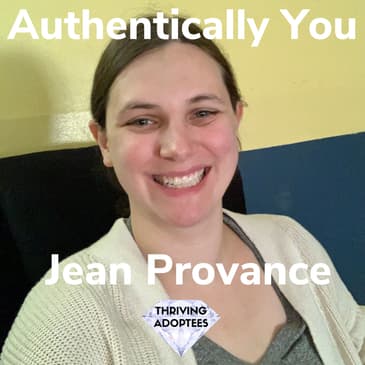
Do you want to do you? Expressing the truth of you are? Feeling the whole of your emotions? Listen in as adoptee and clinical social worker Jean shares her learnings on authenticity so you can do you.
Here's a link to Jean's interview on busting beliefs https://thriving-adoptees.simplecast.com/episodes/jean-provance
Here's a bit about Jean from her website:
Jean Provance graduated with her Bachelor’s degree in visual arts and psychology and then moved forward completing her Master’s degree in social work in 2008. For Jean learning is a lifelong process and continuing her education to deeply specialize in work with trauma survivors especially those affected by adoption and foster care. Jean’s background in visual arts and play therapy allow her to integrate creative interventions that reach children, adolescents and adults alike. She is an EMDR certified therapist. Jean also holds a certificate in adoption counseling. She completed the training to supervise social workers towards their clinical licensure in 2013 and completed SIFI to provide field instruction to MSW interns in 2010. Jean anticipates her play therapy credentialing to be completed in June of 2023.
Jean loves utilizing known strengths and discovering new ones during therapeutic work with clients. She wants sessions to be collaborative, with mutual consent while providing a safe holding environment that allows clients the room they need to grow and flourish.
When Jean isn’t holding space for client’s she enjoys spending time with her family, running, gardening and caring for family pets. Jean continues to work on many artistic projects and is always looking to have some fun.
https://www.featherlightcounseling.com/
https://www.instagram.com/featherlightcounseling/
https://www.facebook.com/profile.php?id=100086935247788
Guests and the host are not (unless mentioned) licensed pscyho-therapists and speak from their own opinion only. Seek qualified advice if you need help.
Want to learn more about thriving for you, your kids, your families or your colleagues? Pick a time to talk here
[00:00:02] Hello everybody welcome to another episode of Thriving Adoptees podcast today I'm delighted to be joined by Jean, Jean Provance Welcome to the show again Jean. Hi thanks for having me. Looking forward to this conversation back again. Jean's got a great memory and last time halfway through the conversation
[00:00:21] My roof light was open and the rain was dripping on me and Jean remembered that I had no memory about whatsoever but we're all sealed up today ladies and gentlemen there is going to be no rain to stop play
[00:00:36] So Jean fell adopted and a social worker and Jean was just saying to me that social workers do not have any specialist training for they don't recognize adoptee, adoptee trauma is a specialist thing that they need to get training in right?
[00:00:56] Well yeah I would say it is a specialty area of clinical practice the same way as substance abuse, as eating disorders, as dissociation that yeah grad school is going to get you through, get you started if your focus is clinical work
[00:01:14] get you into a generalist practice and most of our states have licensing that requires you to do continuing education on you know where you're interested in and they kind of break it down
[00:01:28] But I would say absolutely your basic right out of graduate school training is not enough, right and even like some of the trauma training, right and I'm sure there are other EMDR therapists that are adoptees that would say exactly the same thing is that your basic training is not enough.
[00:01:46] One of the reasons that we're not getting what we need listeners is because the system doesn't recognize this need for a specialist so it's a structural thing that we're talking about here.
[00:02:02] It's all structural right our child welfare laws are structural institutional right and we are in a place where now we're hearing about intergenerational trauma and generational trauma and perpetuating cyclical traumas.
[00:02:20] So, and I think I've said since I've been to graduate school talking and doing some supervision for folks since like, like towards getting their independent clinical license. The courses are doing better. Right we're not teaching ethno cultural issues we're teaching race racism and calling it what it is.
[00:02:44] Recognizing developmental trauma that there's a lot trauma informed is great I love that we're infusing that in but if you really want to be a trauma specialist. You've got a lot more work to do post graduating. Yeah. So, when you're talking to potential therapists.
[00:03:07] Make sure that they know this passion. Yeah, and talk talk to Jean there's a link in the show notes and there's a as a also link of adoptees who are also therapists.
[00:03:22] We'll put a link in there in the show notes to but today we're going to talk about healing from a personal perspective so what does healing mean to you.
[00:03:37] So, right. And I have this like kind of you have Jean the therapist and then you have Jean the mom out in the world and it's all me, but I'm sure my kids and my friends see a very different side of me than like people see me clinically.
[00:03:54] Right. And what I'm thinking about like is healing like a like started a go through BCDF all the way through Z like a just stop beginning end process. I would say probably not.
[00:04:08] Right, but I would say, are you in distress every day, every hour, how much like how big does it feel. Are you heavy all the time, comparatively to like are you happy do you feel good and content most of the time. Right. Anniversary is hard.
[00:04:31] Right for for just humans in general. Right. So, like the anniversary of my grandfather's passing is coming up in April. About a month probably almost exactly a month. I'm going to be deeply sad. And I'm gonna cry.
[00:04:49] Which is part of how I'm like, I'm in a pretty good place because it's real grief and I can be in a place to be like, I am sad, I'm okay to cry I'm okay to be like ugly crying and bitter and I'm just, I'm not gonna cry.
[00:05:06] But it's like, my grandson was very angry, snotty in like tomato face and cry because it's sad. Right he was very important in my life. Right and he was one of the people that was protective and took good care of me. So there's like normative emotional experiences, right?
[00:05:30] And the difference now is I can cry about it. I am not, I need to suck it up and be strong all the time and then be weighed down by the stuff I'm carrying and never talking about, never expressing or don't have language to express. Okay.
[00:05:52] Great, does that make sense? It does. I can sum it up from in a three word sound bite, grace with grief. Yeah, like I'm okay most of the time, right? I just, I came out of a really intense training, three days, you know, six,
[00:06:19] I think it's totaled seven hours a day but we had an hour for lunch and they, you know, put you in small groups, go do some personal work with other therapists who are complete strangers. And it's just heavy because you're sharing and you're like rotating through.
[00:06:33] So it's heavy, right? And I'm like, oh, not working tonight. How to poke my own stuff because everybody has stuff they carry, right? But like being able to say, you know what? I'm not working tonight. I'm gonna lay on the couch. I'm gonna have empanadas
[00:06:51] because that is like, I don't feel good food, right? And to be okay with, hey, what do you want for dinner? I do not wanna have to choose what I'm having for dinner. Please pick something for me. Okay.
[00:07:03] And to have a partner to have my husband be like, I've got it, right? And he just ordered and I was like, oh yeah, empanadas, this is great. I feel good with empanadas, right? And we could totally get into like stuff your face, stuff your feels, sure.
[00:07:18] But I did a whole lot of emoting prior to that and did need some relief, right? So you can be taking grace with emoting and feeling strong, not so pleasant emotions and take space to be like, all right. I'm gonna do a little bounce back
[00:07:35] and feel satiated, feel full, right? And the rested and nourished or nothing else works. Yeah. Right? If I'm talking about healing, it's not static, right? I draw, I journal, I walk, I garden, I have pets, right? And yes, I like to be busy
[00:08:00] and I totally acknowledge part of that is trauma response. Right? But I can be honest about that too, to say like, yeah, you don't become a trauma specialized therapist. You don't have some kind of lived experience where you've sat on the other side of the couch too,
[00:08:20] not just like sitting in a therapist chair is easy. Yeah. Like a barrison, that feels easier. A lot. Why? It's not my stuff. Anything that they're bringing to me isn't mine, right? It could be similar, right? And I understand like the emotion of it, but...
[00:08:46] And there's a lot of like weird things since COVID floating around with therapy where I've had, you know, newly minted licensees under supervision who are like, therapy can't take more than a year. And I'm like, well, who said that? What are you talking about? And they're like, what?
[00:09:02] And I was like, evidence-based is not the be all and all of treatment. If you need more, and the person is telling you they need more than, you know, 12 months, it didn't take just 12 months to get where it's at, generally speaking. Like give them some grace, right?
[00:09:20] And I am very honest with people. I was in therapy for years through graduate school in the beginning of my career, right? Really ugly crying about it, about just like... I know what happened. I was adopted. My mother left me in the hospital.
[00:09:39] The social worker took me from the hospital, met my parents at the adoption agency and handed me over and they took me home seven days later. Well, that doesn't seem terrible. Like why am I an anxious mess? Why this? Why that?
[00:09:54] But if I'm looking like what else makes any sense, right? If we're looking at that, it's like, well, you know that you get to like acknowledge that that was a really big deal, right? I'm gonna adopt you first, right? That's like cornerstone to my identity, right?
[00:10:17] I'm an adoptee. I'm a mom. I am a social worker. I am a trauma specialized therapist. I may play therapist, I'm all of those things, but first the first thing that happened was tragedy. And to not look at it as the tragedy that it is,
[00:10:34] like does lock you up from expressing what's going on, right? So taking the space and the time for me to say like, okay, I don't wanna believe that. I don't wanna believe that that is the thing, right? Cause that's like my whole identity in a nutshell growing up.
[00:10:56] So there had to be something else, but there's not, right? So it makes sense. Okay, now I have some language, but like making the internal connections isn't like simple and straightforward where you're just like, all right, 12 sessions of CBT, have a happy life. I'm good.
[00:11:16] It doesn't work that way, right? And I would say if you have a therapist that's not willing to say like, yeah, I had to do therapy on my own stuff, but I have somebody to talk to. I have consultation groups and things to take care of myself.
[00:11:29] I'd run away from them. Like if I was looking for a therapist and I said, hey, have you been to therapy? Like, you don't have to give me details. Are you willing to go back if something happens to you? And they're cagey about it. They're off my list.
[00:11:45] I want somebody to be very, very real and authentic and be honest that like, you know what? I still have a therapist or you know what? I took a break and if I need to go back, I'm totally willing to go back. I can find someone.
[00:11:56] I know how to access those things. I'm doing consultation, right? Cause really people looking for someone who's adoption competent, they're kind of looking for a unicorn, right? But I'm as a therapist, I'd be looking for someone who is not my professional colleague that I don't work with,
[00:12:16] who treats therapists and is adoption competent and and and like, I'm looking for like the pink unicorn and unicorns or something. And I watch carefully when I don't feel good, right? Am I actually physically sick? Cause sometimes we are. Did I hit like an anniversary point where like,
[00:12:37] oh yeah, this is just emotional stuff or something else really going on that like I need someone to talk to, right? And needing someone to talk to doesn't mean I'm not healed, right? But I'm a human being in a crazy world
[00:12:52] in process of existing and being okay, right? Does that make sense? And a lot of the like healing things in my world have to do with expression and feeling connected and authentic, right? Art is very healing for me. It is grounding, it can be grounding
[00:13:14] or like dissociating where I like, I've checked out from day to day, but it's also very grounding cause it's giving me space to just be totally present with what I'm doing, right? And it's very funny cause Disney does festival of the arts
[00:13:30] in like February or March or so and like it's way too expensive to go down there. So we do family art time. We have farts at home and the kids will now like, they're old enough where they can draw and spend like time where we're like together
[00:13:43] but doing our thing and it's quiet and really nice to see them like creating their own stuff and having like a tool set that I'm not like doing therapy to my own kids, but like they're building tools for themselves.
[00:13:57] Cause that's our job as parents is to make them have the tools they need to survive alone in the world as adults and be okay. So what healing moments come to mind, June? Changing my name, right? That was a really big one.
[00:14:15] Can I take you back changing your name? Yeah. Was there a moment that you realized that you wanted to change your name or can you talk us through the story to that not just the conclusions? So I remember I was taking an artist therapy class
[00:14:35] from my undergrad and we had to do some kind of oral presentation on a topic and how you'd apply art therapy. And I was just like, I'm gonna do an adoption. Why did I know to do that? Cause I was like, I don't know what you would do
[00:14:47] cause I wasn't coding it as like traumatic in any way but I'm like, well there's gotta be something on like foster care or something. I'm curious about this. And it was the first time I had like really like heard adoption as trauma.
[00:14:59] Cause I was like so incredibly anxious and homesick away at college for the first time. Like I never, I had the luxury of like my mom had a house that she had built and we lived there my entire growing up years.
[00:15:12] And kind of at that point also finding the letters for my birth mother, right? Where she referenced Jean and it was like, what? Whoa. Huh? Okay. I had another name. And then as I'm like trying to track it forward a little
[00:15:31] I'm looking at like, I took a group that brief loss and bereavement course where we had to write our own obituary for the class. And I just remember sitting there and being like, well Jean was born and didn't live and Kristen lived but wasn't born.
[00:15:52] So I spent this time of like, Kristen is Jean, Jean is Kristen, Kristen is Jean, Jean is Kristen and trying to like put together like parts of self and like reconcile like am I who I was meant to be? Like does that exist? Right?
[00:16:12] Cause it's total like mental gymnastics to be like, well if I had grown up with my family in Wisconsin that would be a very, very different experience. Right? Like you can hear a Midwestern like North up there almost Fargo accent compared to like,
[00:16:31] I am very New Jersey with like and just even like wrapping my brain around like, wait, I have an accent. What are you talking about? Like cause we didn't travel much. Right? So I remember doing this obituary activity and the professor writing back
[00:16:51] I've never had anyone write like this. I've never had anyone do this, right? Cause it ultimately was like, well if Jean was born but never lived and Kristen lived but was never born, who's here? Who are you mourning? Right?
[00:17:04] And it's all that like identity search for self stuff. And much of like my final, I don't know if you would call it a capstone the art piece that was put in the show to graduate with my undergraduate visual arts degree.
[00:17:18] I had taken the various birth certificates I had and slice them and weld them together. So they were like up on the wall like 18 by 24, larger, like big woven together. And there's multiple birth certificates, right? There's my first amended one. There's the one that was sealed
[00:17:40] that has my original name, my mother's name and then a second amended one that puts my stepfather on it. And in all of the birth certificates weaving them together, the person's name you see is my adoptive mother. Right? And I had put, I photocopied them onto transparency.
[00:17:57] So there was a kind of like a drawer looking so you could see right through them to the wall. Like you could read them, but you could see through them. And like she had no idea what I was doing because I was a sculpting major.
[00:18:09] And so in putting it up on the wall and like laying it out there and I think we called it like identity politics very arty kind of thing. But I remember her like standing at a distance and standing there staring
[00:18:24] and then like cocking her head a little bit and being like, I can see my name. And I'm like, okay. Right? And you could see like the wheels were going but she really never said more than that. But it was like, she was clearly putting something together.
[00:18:44] And we never really talked about it because I don't even know that she'd remember it but it wasn't like an angry response because I was very like very anxious with her to come in and look at it. Right? To like, I put this information out there
[00:19:00] because it's not just me, it's her too. Right? Like it is interwoven with other people but it was all effort to like who am I and connect and be authentic in myself? So in graduate school when they were like, well, you know, we're gonna do roll call
[00:19:18] just let us know how you want to be called. I kind of tried it on in graduate school having them call me Jean. And lots of people had a lot of reaction to it and I'm like, what is not your name? Like it's my name, like deal.
[00:19:33] Like it's mine. Right? You don't get to erase me. I came with a whole lengthy history that you tried to erase and it was totally like standard practice. Right? I'm not faulting my parents for being like, well, but how do we make you part of our family
[00:19:54] other than to give you a name? Right? Like the logic on their end though like wanting to bring in and care and love totally makes sense. But I'm like, okay, but you never asked me and yeah, I was a baby. Okay?
[00:20:10] But I came to you as a whole person with a name and a history and you don't get to erase that. Right? So it was utter chaos and upheaval. Right? And I had tried on Kristin Jean KJ for a while like for people that really were struggling
[00:20:28] to go from Kristin to Jean because I had zero problem attending to it and like when somebody called Jean to turn around and respond to them like there was never any issue attending to my name which I don't know what you make of it
[00:20:42] but I thought it was kind of like, oh cool like that's not an issue because if you've always been called this for 24 or so years are you gonna recognize to like answer? And it wasn't like cause that was the one my husband brought up.
[00:20:57] He was like, well, are you gonna even answer to that if people call you Jean? I'm like, you have to try it. Right? So I kind of tried it on and then had saved up because it was 2000, I graduated in 2008 from graduate school and in 2010
[00:21:13] I got a lawyer to do it because you actually have to appear in court and they published it in the newspaper so you're not like committing fraud or trying to like evade your student loan debt and things like that. But like I had to appear in court
[00:21:27] and my whole thing was I didn't tell everybody upfront what I'm wearing how cause I was like, I don't want anyone to come and contest this and make it an argument because it is my choice. I didn't get to choose my family. I didn't choose adoption.
[00:21:42] I didn't choose anything. And the only thing I can take and claim is me. This is my name. Right? And I did not change my last name. I didn't take my husband's name. Like this is my birth name. It is my name, right?
[00:21:59] Very, very few people call me Kristen. Like I don't even know that I'd answer to it. And it was funny cause one of the nights after the training my son had looked at my husband's YouTube and there's like old videos where he's like, who's KJ?
[00:22:15] And I was like, yeah, that's me. And he was like, oh yeah. Right? Cause he's heard bits and pieces of the story, right? He's asked questions and it's usually like wait a minute. Can you give me a word? Like that's like the underlying when he's asking questions, right?
[00:22:33] So it, like it ripples through things but like in my mind nobody has the right to erase my identity and who I am and where I came from. No matter how ugly it might be, right? Cause I'm sure there are other adoptees
[00:22:47] that came out of other circumstances that were, you know bad, but nobody had the right to erase me, erase my history, erase who I am. So conceptually it was like, I can take this and I'm not gonna let anyone stop me. And people were very angry.
[00:23:05] I didn't tell them upfront that I was changing my name. And I was like, I'm not gonna, I don't owe you an explanation. Yeah. I'm sorry you're hurt, but that is your problem. That is not mine. Yeah. Cause I did this for me.
[00:23:18] That's why I was laughing really, you know, when I, I'm sitting there listening to you, Jean and I'm thinking, why did I laugh there? Do I need to explain why I laughed? Sorry, here I am. I explained why I laughed. But you get that, like you get that.
[00:23:34] Yeah. So what, what did, what did that what did that give you? What, what did that give you that name change? Well, I mean, cause this is me, right? I can't change my experiences. I can't change so many things, right?
[00:23:55] But like part of my hope was I get to have like that authenticity, right? Like my name matches my face. I totally will say like there's a lot of intersections in adoption where like we are marginalized as adoptees because professionals don't understand the impact
[00:24:14] because there's gaslighting questions of like, oh well, you went to a good home, right? And the expectation and the questions that we're going to reaffirm them. And this was affirming me. So there was like a piece of confidence in making that shift.
[00:24:35] Because when I was working at a community mental health center, they actually went toe to toe with the insurance company to make, right? It's very easy to change a last name on it on the insurance card. But the system that the insurance company had
[00:24:49] was not allowing for the first name change because it's not typical. And I just remember being like, I changed my name, I gave you the documents and it's causing a problem at my medical doctor's office because they don't know how to bill.
[00:25:05] For like, I go see the doctor for a checkup and they have to like make the claim match but it doesn't match. And the administrative director was like, like it took, it was the hardest one to get done but I just basically was like, listen,
[00:25:25] you've got to figure it out. Like I don't care who you get on the phone. I don't care how you do it but like I should not have to worry about it because I walked into the social security office, presented my documents and they went,
[00:25:37] okay, you'll get a new one in the mail. I walked in with that to the DMV and they went, oh, okay. And gave me my documents, right? And every place else was just like, okay, cool. Like fax us a copy, fine.
[00:25:50] As long as you're telling us it matches your birth date and your social security number, okay. But the insurance system was very, very difficult where like they had to like, I guess almost go in and rewrite the programming for it because like the text on the phone,
[00:26:06] like they're following a script. They don't know what to do and the supervisor above them's never run into it and, and, and, and right? So like there was absolute ripples elsewhere. Like my adopted brother was so offended, so incredibly offended yelling and screaming.
[00:26:23] And I was in a place where I could be like, I'm not getting screamed out on the phone anymore. I'm hanging up and actually hang up the phone and not just take that kind of like verbal abuse of like you're screaming into a telephone.
[00:26:35] I have to hold it to my ear. No, not, right? I definitely missed a number of Christmases and, you know, adopted family events because they couldn't tolerate their stuff. But that was not about me. That's them, right? Cause they're also viewing this as rejection of them.
[00:26:51] But like I'm, it's not my job to be your therapist too. Like this is me deal with it. So there is like at every turn having to like meet that was very empowering, right? And then there's also this like in that place of privilege
[00:27:11] I'm white, my adopted family is white. They have brown hair and green eyes. So I blend pretty well. Like I don't stand out. So I can not say anything. Like I can hide in plain sight in that regard, right? So there's that privilege spot of I'm not conspicuous
[00:27:28] compared to like my like transracial, transnational adoptees that like it's very clear they're not biologically connected. But it lets me be authentic and it matches. It's congruent to me. So authenticity and congruity and congruity. Congruent, yeah. Big things. I'm just right.
[00:27:54] And this, so my take on the name thing, right? For me, my personal experience on that was I got a piece of paper and it was I was expecting to just read my birth mother's name. But underneath it, it had my name.
[00:28:17] It had my first name too as well. And I remember thinking, oh, I've had, that's kind of curious. I've had two names. If I've had two names, I can't actually be my name. Names are just labels. They're not who I am and they're not who we are.
[00:28:49] They are a label. In my case, put on by other people. I mean, you went back to a previous label that was authentic, that felt authentic to you. That I didn't even cross my mind. I just, my mind went straight to some kind of weird
[00:29:14] pretty way out, way out. Well, and it's really, I'm not my name. And yet that seems... But it's so defining too. Well, yeah, it is until unless it isn't. It wasn't... Right, unless it isn't. It wasn't. Right, but I'm trying to think of the name.
[00:29:40] I feel like it's adopted from the life of me documentary where like the woman they were interviewing does this like back and forth. I am but I'm not, I am but I'm not, I am but I'm not. And to me it was the only...
[00:29:55] It was the thing I could take. Like this is mine. And it's like one of the first things we get is a name. The UN Convention of the Rights of the Child says we're entitled to have a name for a way to be called. Right?
[00:30:13] So to me, like if my mother believed she couldn't give me the things to meet my needs, the one thing she could give me was a name. And I know there are people who were not allowed to name their babies that were not allowed to see
[00:30:30] their babies that were not allowed to hold their babies that did everything to put it away and not connect. Right? But again, that's their journey and this is mine. Right? So it really was like everything feels fragmented and in pieces. So how do I put it together?
[00:30:56] It's all like if I look back at like searching and all of those things that we do as adoptees, a lot of it was how do I be authentically mean? How do I connect to me? Who am I? And it's the personal. So what we're talking about here,
[00:31:15] listeners in by opinion, right? It is a personal definition of healing and a personal path to healing. Yeah, right? Like if you're like totally secure in your adoptive name or like getting married and changing your name, like you do you go be happy in the world,
[00:31:38] go enjoy yourself, but that's how you're like define you how you want. Right? Cause I like there's power to it, but like to me it's something worth to explore for people. Like why is it important? Why isn't it important? Why does this feel the way it does?
[00:31:59] And the expiration is actually more important than the point that we are either, if we're listening to them. It's the journey. It's the journey. Right? Like if I just wanted the ending, I don't have to read the book. I can just read the last couple of paragraphs
[00:32:19] and I know the ending, but like how did I get there? Right? And we all have to go on that different, we have to go on that different journey. Right because it's your life. I'm trying to like, I'm so like,
[00:32:35] and I decided that this must be like a reaction to adoption to be really poor at like putting people in their contexts historically, but like, and I can't even like, I can't place it at all of like, this is your one in precious life.
[00:32:49] What will you do with it? Right? There's no reduce. There's no going back. It's a one way trip. This is my one end precious life. This is it. So what am I gonna do? I can feel all the emotions and I'm glad for the work that I did
[00:33:09] around being able to feel anything. Because if you want emotion, you mute them all. If I can't cry and feel sad, I'm not going to feel the height of joy either. Right? That's what medication does, isn't it? Funny enough. It takes, it numbs.
[00:33:29] It takes the joy, the highs on the road. Trying to get you to a place of balance, right? And I've made quite a shift about medicines, right? If you are constantly in a state where you want to die and you're trying to figure out how to die.
[00:33:49] Yeah, I need you somewhere to be able to tolerate therapy to help you at all. There is absolutely a place for medication. I don't care what tools you use on your journey. That is your choice. And I'm not going to take your right to consent and choose.
[00:34:05] I'm not a doctor and I'm not gonna make the recommendation other than, hey, you probably should talk to your doctor about those things because I'm not the doctor. Right? But the whole thought would be to bring you to a balanced enough place
[00:34:17] so you can actually tolerate doing the deeper therapy work. But yeah, it does kind of keep you in that place. As best I know. I mean, I think that's a psychiatrist question, right? But if you're so blue and down, you can't get out of bed. Right?
[00:34:38] You may not be able to reach for the phone or the tablet to even, we have the luxury of telehealth now. I can't help you if I can't see you, like I'll hear you if you don't have that energy. So there's absolutely a place and validity
[00:34:54] for taking medicine when you need it. Right? With emotion. Because you need to be able to feel to do all the work. It's like emotions physically occupying our body. So if I'm completely detached out of tune with what's going on, I'm not getting anywhere. Right?
[00:35:15] And I'm not getting another chance. I'm not getting younger. Right? And watching kids and seeing how different it is like to watch my kids growing up and being like, oh yeah, we're past the point where this happened. Oh yeah, we're past the point where that happened or this
[00:35:31] or that or the next thing and seeing how different it is for them growing up. And don't get me wrong, it's daylight savings today and this morning, oh boy, they did not want to get up and go to school. Right? And they were, right?
[00:35:48] Disregulated and emoting and we managed it. Wasn't the greatest day, but it's sunny. They're going to have recess outside and they're going to come home and it's fresh from the morning. Like they're allowed to feel too and not be happy all the time. Like it's not required.
[00:36:11] You're so quiet and pensive. I'm just wondering which way to go next. Forward. Yeah. Do other... Was that your biggest healing moment? Or it wasn't a moment, was it? Was that one of the biggest healing changes for you?
[00:36:37] When this decision and then going through with the name change? Reverse change. Changing my name, like changing my name is like one of those fundamental cornerstone things. And if you're talking about having to be numb, right? Because we're brought into families for their need, right? There's...
[00:37:03] This is a rich country. Absolutely, they could change the social welfare system to support people to keep their families intact. Absolutely it's possible. There's just other forces at play, right? So with changing my name, right? There's that authenticity. There's being able to know what's happening
[00:37:28] physiologically in my body that like, oh, this is anxiety, like a feeling. Like, oh, this is like the deep sad. Recognizing that and being able to express it, right? Because all along the expression came out in the art. I have a love hate with art museums, right?
[00:37:48] I have a degree in art. I have a degree in like social work. So I'm looking, right? And then this is kind of this like funny like two sides piece to it. Like I go to an art museum and I'm looking at these things clinically
[00:38:01] and enjoying the art, but I'm also seeing people's pain, right? If you look at Van Gogh's self-portraits, he is diffuse in the background, right? There's a lot. Like he never made a penny on his paintings and you can't buy one now unless you're like
[00:38:20] some rich Jeff Bezos Elon Musk kind of person, right? So I have like that love hate, but like what's been all along is the art is having, right? I couldn't emote, but I could express, right? So the artist- Right, cause there's the surviving first.
[00:38:40] So the art and the expression through art is your second of your- Well, it's like they're fundamental pieces that keep the whole imbalance. Yeah. I had an interesting one on this subject of expressing yesterday. So yesterday here in the UK, it was Mother's Day
[00:39:07] and me and my mum and my wife out for lunch. And she would, at one stage my wife went to the loo and my mum shared something about actually about my sister. And then she asked me and she was looking for affirmation that I was okay.
[00:39:36] She's looking for affirmation that I was okay, that I was feeling okay, you know? Cause she's slightly concerned that and my wife is actually slightly concerned about spending all this time with adoptees and it taking me down. Taking me down.
[00:39:52] And it doesn't, but they are concerned about it. Right? But I was thinking about me growing up and how much freedom I felt to express given their reaction. I didn't feel like I couldn't express but I'm wondering that, did I, didn't I?
[00:40:32] I need to give some thought to that. Yeah. To give some thought to that. So like giving thought to identity and recognizing the different identity journey. It's just yours and mine. It's two different things. And you're not trying to shove my,
[00:40:54] you're not trying to shove your solution onto you. I'm not trying to shove my solution. Sorry, you're not trying to shove it onto me and I'm not trying to shove it onto you. We're accepting each other's journey. And that doesn't happen very often these days.
[00:41:10] No, and that is like, this is the micro piece like the small, right? Cause like the conversation we're having like we've uniquely co-created it right here right now. It's unlike any other thing in any other moment, right? But if I'm saying like I needed to change my name
[00:41:28] and you're saying absolutely I did not to come to a place where I'm like, yeah, that's you. You do you like be happy dude. I love it. I love that for you like genuinely, right? And like I know you can see my face
[00:41:40] and like the listeners cannot, right? But I don't think you doubt like that I'm being genuine. But I think by and large like the macro of it is that's where the adoption community like adoptees as a whole need healing together is to find the like my healing journey
[00:41:59] is different from everybody else's and so is yours and they're equally valid in that. And we're focusing on healing, you know we're focused on healing just by debating, defining, defining our terms. So you were telling me about a conference that you were doing that you're going to
[00:42:22] and the focus is understanding. Because the social workers aren't yet a point. Well, I mean mental health isn't right. Mental health is not at the like, right? We have to do continuing education because new information in light of new information science shifts. Yes. So yeah. Yes. And right.
[00:42:49] So like I have a clinical knowledge and I have a lived experience of like I have come out of like I had to be in survival mode all the time nonstop to a place where like, yeah, I'm healthy. I'm happy. I can thrive, right? And be okay.
[00:43:08] And then to say, hey, this is a lived experience I have it is valid information for those of you that don't have this shared lived experience in light of you being like a genuine ally to help people who do have my lived experience.
[00:43:26] Cause like I very upfront, like I know people want to hear like adoption is the only thing I treat clinically. It is not, I do not have a caseload of clients working with me that are only adoptees, right? Because I need to self-regulate to be fully present
[00:43:45] for the ones that I'm helping, right? And I have only so many, right? If I divided my caseload only so many slots available to do like severe deep trauma work with people because I am a container for other people's stuff.
[00:44:04] And if I don't balance it with other things, right? I will sink into it, right? We have to self-care is not bookends to my day it's infused through my day, right? So no, I don't see only adoptees in my practice or only adoptive families, right?
[00:44:21] But I try very hard not to turn them away but like if that's all you do, like I know my like brethren adoptee clinicians are tired, right? So like the thing I can do outside is to go present at conferences, not adoption conferences
[00:44:39] mental health conferences to say, hey like you need to get bare minimum knowledge competency in this or you're running a great risk of hurting people, right? I did not need a therapist to explore like what is your adopted parents gonna think about you changing your name?
[00:44:58] I don't care. It's not about them. It's about me. Like you need to be present for me, right? So coming together like that education and advocacy piece is a whole other like place that I can be articulate about now that maybe 15, 20 years ago I probably could not, right?
[00:45:20] Jean, I'm sorry to cut you off. No, I... I wrote the, you used the word infusion, right? Or you said infuse, I think. I wrote that down on a walk and walking the dog yesterday. So I'm gonna leave this as a question to the listeners to ponder.
[00:45:46] What would it mean? Or how would it be like to live a life that's infused with healing? It's a really beautiful question, right? Because we've been infused by trauma. Right. What would it be like to live a life? And we are as valuable as anyone else
[00:46:15] as deserving, as good to enjoy. This is our one precious life. Yeah. Right? You deserve to have moments of pure joy and beauty. Right? Because you can't exist in only pain. I don't want people to exist in only pain. Right?
[00:46:41] But yeah, what would it be like to be infused with healing moment, even moment to moment briefly? Is a really, like that is a beautiful question. We're gonna leave it there. Listeners, thank you very much. Jean, thank you very much. Thank you for having me.
[00:47:00] Wonderful to chat with you again. Do this again soon. Take care, bye.