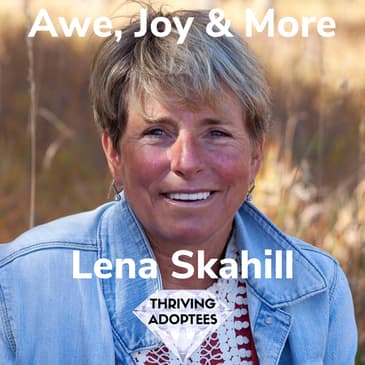
Would you like more joy and awe in your life? Who wouldn't? Listen in as Lena shares how nature brings out awe from within for moments that blow our minds (in a good way). And this is all backed up by the science of awe.
Here are links to the science of awe
https://onbeing.org/programs/dacher-keltner-the-thrilling-new-science-of-awe/
Here is a link to Lena's website
https://www.wildsoulphotographycolorado.com/
Connect with Lena here
https://www.facebook.com/eileenskahill
https://www.instagram.com/eileen.skahill/
Guests and the host are not (unless mentioned) licensed pscyho-therapists and speak from their own opinion only. Seek qualified advice if you need help.
Want to learn more about thriving for you, your kids, your families or your colleagues? Pick a time to talk here
[00:00:02] Hello everybody, welcome to another episode of Thrive, Adoptees podcast today. I'm delighted to be joined by Lena, Lena Skahill looking forward to our conversation today. Yes. You're a bright shining star and I just loved that chat that we had for a couple of weeks ago.
[00:00:17] Yeah me too and you're the same bright shining star. Cool, cool, let's shine together. So healing, does that word resonate with you? And how much does it resonate at all or a lot?
[00:00:32] Well, it lands for me a little bit differently I think partly because of the work I do. I mean I'm a sociologist so the background I have in sociologists is in forms that meaning of the word healing and by that I mean I just think in our culture healing has been corporatized in so many different ways through products and services that you know I think we're often led to believe that if we buy this or try that
[00:01:02] there's a sort of ending like quote unquote ending to the pain as though it's on some kind of linear trajectory with a started endpoint and you follow path, the path of point A to point B and then you're there, you're healed.
[00:01:18] So I think from a cultural standpoint that word is really tricky and so I feel like it's been kind of co-opted and I mean it's not to say that it isn't helpful.
[00:01:29] The word healing isn't helpful or the mechanisms or products or services we can access in order to heal isn't helpful but it's just that feeling or that word healing or healed is incredibly elusive I think and I know that as adoptees especially that healing in whatever way that means to us,
[00:01:51] it isn't linear and it's marked by lots of fits and starts based on the triggers that we experience day to day or year to year month to month so I think that word makes us feel like healing is at best inconsistent and maybe at worst unattainable. Yeah.
[00:02:11] But yeah and I think there's also a lot of pressure in our culture for adoptees to be to feel grateful and be feel lucky about our origin stories so if we don't express the challenges that we face as adoptees or we have feelings that inside of us that we keep inside and that go unexpressed.
[00:02:31] I think we can often put pressure on ourselves along with the cultural expectations that we should just get over it which means healing can never really start let alone advance or ever be finished.
[00:02:43] You know so that's how I resonate with the word healing it comes from a very particular lens with the work that I do and yeah that kind of has how it lands for me when you ask that question. Yeah. It's just it's a metaphor isn't it? Yeah.
[00:03:01] It's a term. Well it's kind of like when people ask you know are you happy or is happiness a real thing? Oh my god I don't know.
[00:03:11] I mean I don't I think it falls under that sort of same category like what is happiness anyway is it even possible?
[00:03:19] And I think healing is kind of in that vernacular that it's just this word that means all kinds of things and I'm not sure any of it's achievable really. So I mean it's called the thriving adoptees podcast not the healing adoptees podcast. Right. Right. Right.
[00:03:38] So we started off with thriving and that came from an idea of a course right so I came up with a I went on a course about creating courses.
[00:03:49] And the marketing mentor who is the reason I do the podcast by the way so shout out to Sammy Blindow. She should have a mnemonic right so I came up with this thrive so thrive was trauma.
[00:04:09] I think it was trauma informed or trauma something for type of trauma H for hope I actually started about hope. Hope and healing and they kind of mixed along the way I was for resilience I was identity which is obviously a big issue for us.
[00:04:25] B is vision for the future so we're going forward and E is empowering others. So it's like well if you're an adopted parent doing the thrive you know you're going to be empowering your kid.
[00:04:36] If you are an adoptee doing this thrive thing you're going to be hopefully lifting other people up like helping other people advocate you know empowering others. That was the kind of idea.
[00:04:47] So the thrive came first and then when it was okay what's what am I going to call the podcast thriving adoptees. And then whatever it was two and a half years in maybe I thought well it's healing that seems to be what everybody's interested in.
[00:05:02] So let's call it healing and let's call it healing for want of a better word. And just to give it focus just just to give ourselves a focus on rather than being trauma obsessed right.
[00:05:19] Let's be healing obsessed let's be focusing let's let's shift our focus let's shift our attention to the light rather than rather than the dark. So there's two ways that two ways do you prefer thriving to healing.
[00:05:38] Yeah I do especially when you told me the the acronym and what each of those words mean letters mean I think I love that actually and I think you know at this stage in my career and in the work I do
[00:05:51] and at my age as an adoptee I feel like I'm really finally doing that personally and also doing that through my work. So I love it I love thrive yeah healing I think is just I just think it's a tricky word in our culture
[00:06:06] and it means so many different things it's also riddled with religion for a lot of people which is fair and so yeah I I don't really use it much but I love the thrive and I love the
[00:06:19] meaning that you put behind it. So what does thriving mean to you then? Well you know for me personally when I consider thriving what we once said healing a minute ago
[00:06:32] but thriving is I'm more drawn to whatever level of peace I can obtain for as long as I can stay in that place. So I have always had a dysregulated nervous system and lived in a very hyper-vigilant state for nearly all my life
[00:06:49] you know first starting growing up in an adoptive home where it was very volatile and then into a marriage that was somewhat similar and made it hard on everyone and then you know I was in reunion and experienced
[00:07:05] sexual abuse and sexual coercion in my reunion so and other overall unhealthy dynamics in those 15 years so all the spaces I've kind of occupied you know throughout my life have never
[00:07:20] felt very safe that that on top of the initial trauma of relinquishment so once I got out of my marriage and out of reunion and have lived mostly by myself the last 11 or so years
[00:07:34] and a lot of therapy and energy work I've slowly learned how to regulate my own nervous system so that I can move into a space that feels safe enough to believe that peace is possible
[00:07:46] or thriving is possible so it's been a long road but but I'm definitely getting there and but really to answer the question more clearly you know for me it's about finding peace which
[00:07:57] is finding a calmness in my body in my mind and being present in the moment in a regulated nervous system which I believe is the only environment where where peace or thriving
[00:08:09] can be obtained it might only last five minutes or 10 minutes for me but when you add those minutes up over a day or a month or a year you know progress is definitely made so yeah for me
[00:08:22] I would equate my word for thriving might just be being at peace so that I can thrive you know to have a regulated nervous so that I can thrive yeah I think it's really hard to do that without
[00:08:37] with the dysregulated nervous system which so many of us adoptees have yeah something I guess I know you're we're going to talk about this your love of nature and that and the open spaces something just popped into my head I'm getting goosebumps on it I don't know
[00:08:56] that's a good sign it was a book I think I listened to it an audiobook by an astronaut who had a kensho experience yeah kensho experience so he was in orbit looking down on earth and he
[00:09:15] had this moment have you heard about this guy well I mean I know the original guy who went to space and photographed earth from space that was a moment of you know that that shit that shook
[00:09:29] all of society to see how beautiful our planet was and what that experience was like for him but that was in the 60s so if this is recent I'm not not this this guy he's an old guy
[00:09:42] well yeah he was an astronaut in the 70s I think he changed he changed career after that I think it was called Greg something Greg Hadfield I don't know I will look at it and put the
[00:09:56] put the right show now but it was it was kind of if you you know I watched a few astronaut shows and I've listened fantastic I love tob hanks and I was just saying on radio recently he's
[00:10:15] he's launching a space exhibition in London right so it's him and a British astronaut having a talk on this radio show about and I can I love the I love the guy and he's
[00:10:32] enthusiastic for it but he was talking also he was talking about to the to this astronaut British astronaut guy and these guys come from often they're like the fighter pilots right that's the route so they go in through a very ultra male ultra rational ultra scientific
[00:10:54] ultra army air force you know like mega intellectual science and and so it's quite a it's quite a thing to go from being an astronaut to being to talking about kensho experiences
[00:11:12] where you know you you realize that the scope of the the scope of the world and and and and the tiniest of our place and in that and you know I'm I'm wondering whether to what extent
[00:11:35] and peace nature brings that peace out of you right yeah so I think it's funny to listen to you try to explain this astronaut and their their view on what they saw from space but because
[00:11:55] it's actually this experience of awe and it's a word we don't we don't use it very often because we have so many different ways of labeling experiences that we have
[00:12:09] that you know like oh that was so awesome or cool or but when we are in a place of being without words that is often what we describe as a situation of awe and and that's
[00:12:22] kind of what I've been working with a lot in this recent study that I started two years ago it's finally winding down sort of but it's a the study is called nurtured by nature adoptee
[00:12:35] and foster care experiences and the healing power of nature and undergirding the whole study is this concept of awe which is steeped in a long and long for a long time in a lot of science
[00:12:50] so there's an enormous body of research now around the science of awe and I can share links with you for your show notes or whatever you need but we know that when we experience awe
[00:13:01] as proven in the science of awe it regulates the nervous system it shuts down the ego center of our brain it literally disrupts the default mode network which is the part of our brain that
[00:13:12] contains all that chatter that disrupts our ability to be present to feel good about ourselves or others it's basically the driver of deregulated nervous systems the default mode network so and I don't want to get too technical but but but we know that working with things like plant
[00:13:29] medicine either recreationally or in a therapeutic setting also alters the default mode network so that we can experience awe so that's why so many people say like if they've had a psychedelic journey of some sort and what they visualize that's what they visualize on psychedelics
[00:13:47] is awe you're experiencing a moment of awe so um you know and of course not everyone wants to use psychedelics especially adoptees or foster care alums as control is super important to us
[00:13:59] but we can all access awe and so the study that I'm referred to the nurtured by nature in healing power of nature explores um nature is a healing modality or thriving modality for adoptees and foster care alums and I've been it's a qualitative photo essay based
[00:14:21] research study so I interview everyone for a couple of hours about their relationship to nature in the context of their adoption journey and our foster journey and um and then I have been kind of crisscrossing different places across the country photographing these adoptees folks in
[00:14:39] places in nature that they love but um yeah so but it's right brain stuff though isn't it it is it's right brain stuff so if um did we talk about this last time so I need this uh
[00:14:56] this a Ted a Ted speakers one of the first Ted speakers Ted X speakers um she's now she was a small name she was the smallest name in the first four that were released or whatever
[00:15:12] or eight whatever the word but um so she's called Jill Baltitaila and her episode has had I think 30 million wow 30 million down low so far um but she like joining the things up
[00:15:29] she had a left she had a left brain stroke she's a neuroanatomist right so she studies the anatomy of their brain and then she had a left brain stroke and the uh there is a place in
[00:15:44] the left brain where our inner critic lives right our language you know the the left hand upside of our brains where our language right is and obviously that's developed over time you know
[00:15:58] that the whereas the right brain has has no language it's more like the open spouts so that that's so for some for me being able to put those two things together and see the logic of it
[00:16:18] it is of I don't know I don't know it just I like the way that I like the way that I understand experience because you know we putting words to experiences and preverbal trauma we can't put
[00:16:34] words to its pre-memory like how big you know like I have a conversation with uh family Karen over today um doing some stuff with uh and we are just like we're one human being
[00:16:51] how can we separate out the in our body there's no way that we can do separate out the preverbal trauma from the trauma that happened in in the adoptive family if if there was such a you know
[00:17:09] if it did happen to us so I got a bit of a summer cold going on me um so we can't separate this out and I was just thinking like to what extent um to what extent we're one person so you can't
[00:17:28] dig it we can't dig it out we can't separate what is to do with relinquishment compared to um what happens in the in the in the home or you know with you with um what happened after
[00:17:44] after reunion and the abuse stuff we it's it's all it's all wrapped up into one into one person yeah but I do think you know I mean I totally agree with that but I also think we live in a culture
[00:17:57] that's very much about reductionism we want to we want things to fit nicely in a compartment space we are not a you know I mean there is a shift I think in the opposite direction of
[00:18:09] trying to see things holistically but we don't live in a culture where that's necessarily encouraged to see things as a whole because if we did we wouldn't be doing a lot of the things we're doing
[00:18:20] across the world right if we if we saw that we feel what other people feel even if we are not living right there next to them you know if we actually embrace that idea of wholeness and
[00:18:31] holisticness and you know what you experience is also what I experience even though I don't live with you you know if we embrace that um we would live a whole different way but so I think
[00:18:42] for adoptees we're experiencing that we recognize all these things are all going on inside us except that we live in a a culture that says well let's separate that out and let's separate
[00:18:53] that out and let's dress that and let's address that instead of you know looking at our bodies and our our lives as a holistic series of events and um yeah I mean it's really about this idea
[00:19:06] of embodiment you know and because adoptees have had these disconnecting experiences in our lives it's really hard for us to be in our bodies to experience embodiment to to even look at ourselves
[00:19:21] as this whole being that's yeah that's dealing with a lot in a culture that just says hey you know that was in the past you know it's the present now like get over that or you know it could have
[00:19:33] been worse or all the different you know all the different things we hear from people that don't that aren't helpful so I don't want to get too off track with what you said but yeah I mean
[00:19:46] yes we are all connected and within our lives are all these experiences that we carry around with us that we can't really separate out and um at the exclusion of all the other ones it's just
[00:19:59] not like that and that's what's so great about the experience of awe right is that well I don't want to interrupt you I want to let you go the direction you're going but um I mean awe is
[00:20:12] accessible for everyone if people can get into an enough embodied space and to be present to realize when they're experiencing it and then to just be in it without needing to label it with
[00:20:25] anything just just sitting with it right and and we know also from research what happens to the body when you experience moments of awe and it doesn't have to be in nature it can be with dance or
[00:20:38] art or music or even you know in the presence of somebody who's passing and in transition and you're watching this experience if that if it happens for you and you're just in awe of
[00:20:49] this person moving from a you know a live body into not a live body so I think that's what I love about awe so much is that it can be found in so many spaces it's accessible to everyone you know
[00:21:04] you don't have to be in a certain socioeconomic class to experience awe or be of certain race to experience awe we can all do it if we can get into our bodies enough um to know when it's happening
[00:21:18] and for me it's not a doing it's a it's a laxing in it yeah and the letting it well so I was just going to say you know from the research I've done over my career I've learned especially
[00:21:29] in this last body of research I have learned that adoptees really struggle with experiencing joy and that means yes letting it in because um for so many of us it's things are going along great
[00:21:43] and we're always in the back of our mind because our hypervigilant state which so many of us can be in that the other shoe is going to drop so oh things are great right now but you know
[00:21:54] something's going to happen and it's going to disrupt this it's going to disrupt this good thing that's going on so we often don't trust it when it comes into our lives so yeah it is a letting
[00:22:05] it's a receiving and an experiencing but also being open and being in our body enough to be open to whatever is coming at us and um and like I said it could be it could be watching the
[00:22:20] birds on the bird feeder for you know two minutes but if you can just stop and be present so that means you're not thinking about the past you're not thinking about the future
[00:22:31] you're just in that moment in your body watching um and letting that moment that experience of all come in and just letting your body sit in it long enough to enjoy it and that takes practice
[00:22:44] it's a practice it's like a it's like a meditation and um and I would just say like for me part of the reason I can get into places of peace fairly often is because I'm also a photographer
[00:22:58] and when I'm behind the camera I am the most present I will ever be at any time um I have I totally lose track of time I am not in the past or the present I'm just right there in the
[00:23:10] moment and I'm mostly a landscape and wildlife photographer so I'm already in spaces of beauty because of that and so for me that's how I thrive is being behind the camera and um or I'm not a great
[00:23:25] meditator seated so moving meditations are super important for me so walking the dog or behind the camera whatever um and just um yeah allowing awe in because I can be present in my body in those
[00:23:43] moments and so I feel super grateful for my ability to photograph and obviously having an able body that allows me to go for a walk or take a long hike or backpack on the Olympic Peninsula which I just
[00:23:56] did last week with an adoptee so I know the privileges I have in being able to do that but I also know everyone can experience it um if they if they're open to it yeah sounds to me like
[00:24:12] you're talking about the absence of ego yeah well that's what awe does it shuts down the ego state disrupts the default mode network allows all of that stuff to go offline so that you can be
[00:24:26] in the present moment that's the science of awe and in a nutshell what you just said it's that's the science of awe but but it's like um the darkness goes when the light comes in isn't
[00:24:45] that I mean yes and maybe it's only a couple of minutes but that couple of minutes adds up and when you learn to let it in and you learn to realize okay I'm I'm in this moment of awe and
[00:24:59] you don't necessarily have to use the word right but that's what the science is it's the science of awe um you can just say like wow that's a beautiful tree and that moment is just a
[00:25:11] minute of shutting out the darkness default mode network ego whatever so that um you can just be in it right and and everything else slips away and it doesn't mean it's a revelation it's a it's a removal
[00:25:27] of avail to show what was always there I mean where I'm going on this to me it sounds like because the left brain is all that there's language and that doesn't exist right that
[00:25:42] doesn't exist when we're born so it's almost you know we're not born let we're not we're not born left with any active left brain you know we haven't got words we don't have any theories we don't have we don't have the
[00:25:59] we don't feel separate no so that that's all left brain stuff which kind of covers over the right brain the right brain stuff is who we truly are that's then covered over by the left brain stuff and then and trauma and there's a part of the brain
[00:26:21] listening to the job of titila there's a part of the brain that is where the inner critic hangs out it's a neurological fact great and adopt these tend to stay we have a tendency to stay in that
[00:26:35] place in that part of our brain um we just do based on our trauma and and uh and the narratives of culture about adoption which are you know we could talk about that for a long time but when
[00:26:52] we're surrounded by this win-win narrative all the time that people tell you how lucky you are and internally you're like but wait you know like am I um am I really because I you know I don't
[00:27:05] have my parents I'm living with people I don't know that my names have been changed I you know all the things that come with our adoptive status right it creates this complete dissonance
[00:27:16] and when we can't talk openly about it which doesn't fit with the win-win narrative so we internalize a lot of that and we stay in that part of that inner critic part of our brain it's a hard thing to shut
[00:27:28] off and it is something we actively have to work on and for me you know I've had lots of therapy and all of that but I can say without question that it's it's my I didn't even know I was doing
[00:27:42] awe right like as a kid I was in nature all the time and I didn't live in the mountains or anywhere just in suburbia but I was always in search of it and I would hands down say that the awe I've
[00:27:56] experienced in the natural world as a child all the way up till now it's what saved me no doubt about it um so I didn't know what awe was as a kid but I just kept saying like I need more of this
[00:28:08] I need more of this I need more of this and I still do and I realize yeah after I've kind of explored more about the signs of awe I'm like oh that's what it was like that's what's kept me you know
[00:28:19] on a path towards thriving you know it wasn't always great um I was yeah it wasn't always great but I know now looking back and having more clarity that that's what kept me alive and I really do
[00:28:32] think and it's become a part of my work which is to try to to take this body of research I've done with adoptees and their and nature as a healing modality for them and undergird it with the
[00:28:45] signs of awe and try to you know put together a published work body of work that will talk about the signs of awe in healing for adoptees or foster care alums and you know maybe just
[00:29:00] it's the smallest thing I can do right to channel thriving in my in my community of my people it's not small at all no but I mean you know like in the big scheme of things
[00:29:13] I mean I'm not out there I'm not out there doing mind-blowing work but I'm like it's the simple things right but this is mind blowing this is mind blowing if you think about
[00:29:23] the mind as being where all that like the if the ego if ego and mind are the same thing you are mind blowing you are you're blowing off the um you're blowing off the trauma to reveal the awe that's
[00:29:38] underneath yeah because I just you know when I I mean I've done lots of research on adoptees over the course of my career and so much of it was so much about the trauma that we've endured
[00:29:51] and and while I think that research is super valuable I'm not regretting having ever done any of it but when I knew I wanted to do probably the last body of research for my academic career
[00:30:02] I knew I wanted it to be about how we experience joy because we don't have enough of it in our lives I mean humans in general but adoptees in particular you know we don't have have not
[00:30:13] had enough of it in our lives and I don't even know that we're fully clear on how we access it so I thought well I teach on the natural world also and I teach on adoption and family studies I
[00:30:25] thought like I'm going to merge these two and talk about the beauty that we experience in our lives and um and try to keep the focus there because I needed that for myself as a researcher and I
[00:30:39] think just as a community we need that for each other to to see so when I have this this study written in written form it's obviously a photo essay based study so it's going to have
[00:30:49] images with it and who doesn't want to see more beauty right so we would not only hear about you know the things and the places that bring us joy but also to be able to visually see
[00:31:00] the beauty of people adopt these all across the country and a couple of people outside of the U.S. yeah I just thought like I this is what I need for myself right now and I think it's what
[00:31:14] we as an adoptee community need is just more joy so that was my way of finding it what about the joy with uh what about the awe and the joy within
[00:31:26] for participants or me or or both or well I we're talking so I'm gonna have to cough again I'll just have to mute for a couple of seconds so we're talking about the the awe of nature
[00:31:44] right we've been talking we've touched on that right um so that's that's the awe without what about the awe within you mean how does it change you internally is that what you mean go where go where you want to
[00:31:59] go it's well I mean as as you feel right intuitively that's where you want it to go well they're all within if I think about it and the way I hear that uh
[00:32:15] is what this study has done for me and and what I think it's doing for the people that I that are in the study and so I'll just start with me um because why not so um
[00:32:30] you're the guest right so I'm the guest so yeah right now I can make it about me so please so I've thrown in lots of lots of curve balls and loads of nice
[00:32:41] it's good it's good it's good I am flowing with it okay so one of the questions that you'd asked is what's gotten in the way of thriving right and and and when I thought about that I thought well
[00:32:51] obviously it's my default mode network and my distracted nervous system like that's what's always got in the way of me thriving or experiencing awe so I mean I don't really I don't mean to make a joke about it but it's the truth um that tape recording for me
[00:33:07] you know that part of the brain is always you're not good enough you know shame blame all overall dislike of myself right that's been running for years and years and years which
[00:33:19] makes it impossible for me to be present right so all of that is what's gotten in the way of me being able to thrive but when I started this research I mean it has changed me in a profound lasting and fundamental way which I would define as awe
[00:33:42] and and it's done that because one even though I have done research with adoptees over the course of my career I never really connected with them it was sort of like a thank you for you know your
[00:33:53] the interview I'll give you the study you know when it's finished and you can read the results etc and that was it but this study I have I finally found my people like I um I have learned
[00:34:10] that a secondary learning from the study outside of awe or maybe folded in with awe is the importance of adoptees in community with each other I I'm sure you know Anne Heffron
[00:34:23] the great writer and writing coach and adoptee she once said to me you know that when adoptees come together amazing things happen and I'm like yes that is completely true after having been doing the study because amazing things awesome awesome things have happened for me personally and having
[00:34:44] friendships with all of these people that are in the study also seeing all the beautiful places across the country I probably otherwise would not have hit right and photographing in there
[00:34:54] and um and realizing for me personally that these were the mirrors I'd been looking for all my life the mirroring I was looking for in my birth families was not there you know looking for
[00:35:11] you know the searching for mirroring we do in our adopted families of course not finding it anywhere but you know then moving into reunion hoping we'll find it there um and the mirroring also comes with not only our our our facial features that we're looking for similarities
[00:35:26] about who we are but also acceptance and belonging and non-judgment and communication and all of those things for me have come from this study I feel like the mirrors I was looking
[00:35:39] for in all of these people I've met in my adoptee community and I have never felt more understood and connected and cared for and nurtured um then I have with these people that
[00:35:52] have been in the study they're just phenomenal so the awe inside is that's for me right that's how it translates for me and and when I think back on well I mean I've been photographing
[00:36:05] people for like a year and a half I'm about to finish up here in the next couple months but when I think about those experiences with other people and the interviews I did with them talking about nature and how it's been an embodiment of their adoption journey
[00:36:20] they all were just like this is amazing I love talking about this or I had forgotten you know how much I really needed the natural world until you started asking me these questions
[00:36:30] and and they were super you know grateful like we always are but they were it changed something in their brain uh which I would maybe categorize as in a moment of awe where they thought like oh
[00:36:43] you know like I never thought about how much the natural world meant to me growing up and how it healed me while I was growing up or kept me alive or and just super grateful for
[00:36:55] the chance to talk about joy you know and then we go on these trips like the backpacking trip we did or sometimes I'll just photograph people in a location and they see themselves in those spots
[00:37:07] and they see themselves photographed and yeah I think it does something to change them I can't speak for them of course but if I think on the things they've said they're like this is wonderful I'm so it's been so nice to talk about what brings me joy
[00:37:23] in addition to the things that I've been through so that was a really long answer to your question about what awe means internally but uh yeah again it's almost something without language
[00:37:37] but I've tried to put some language to it yes you did too much too much maybe sorry no the the idea of the show is for people to talk so yeah well I hope I didn't go off
[00:37:53] in too much of a tangent but yeah no this study has changed my life no doubt forever because these friendships I will have forever and um and I think that's actually not um
[00:38:09] it was not something I anticipated when I started this study at all so um yeah I'm thrilled about it super glad I did it it's been a lot of work but super rewarding and people feel seen you know
[00:38:26] I'd say that's probably the other awe piece of it is like people you'll like you'll fly all the way out here to photograph me and like I will do that you're like wow like I didn't think
[00:38:37] I didn't think I was that important and I'm like you are important you know so and I know that that was my goal in the outset was to have people felt seen to be seen and feel seen
[00:38:51] in the places that they love so much so yeah but you're not talking about you've used it with mirroring but you're you're not talking about a physical mirroring you're talking about I don't know philosophical mirroring maybe or uh no I mean when I say mirroring for me actually
[00:39:13] it's the physical um and it's mmm and it's not about resemblances which is so much of what you know we we've always been searching for in our lives as people that look like us and sound like us etc
[00:39:28] it's more about resemblances and feeling um about things you know to be in the spaces with other adoptees where you're like oh you too you know that mirroring of experience so yeah my coach of mine
[00:39:52] a coach of mine says like hearted people not like minded people like hearted people yeah and I think because we've navigated maybe our whole lives if someone if you haven't either been in reunion or you've not I mean I know everyone's not accepted in the adoption community I
[00:40:12] realize that people who have tried to kind of fold in with other adoptees and it doesn't always work out so and I feel I'm sorry for that and and I'm not saying this what the
[00:40:23] experience I've had is the same one everyone's had so I want to be clear about that but um if you have not had that kind of coming together with other adoptees to have the heart minded
[00:40:38] you've been navigating a space all your life with people who don't are not heart minded like you are because part of what makes us heart minded and connected to each other as adoptees is because
[00:40:48] of our lived experience so if we've been navigating the world around people who are non-adopted you're like okay where are my people you know where are my heart minded people and we search a long time for
[00:40:59] that and sometimes we never find it and sometimes you won't find that in reunion I did not find that in reunion I found the resemblances but I did not find the heart minded people so um
[00:41:11] yeah I think it's particularly important for us to find the heart minded people because we go without it for most of our lives uh but and funny thing happened if I can share this so when we're
[00:41:21] on this backpacking trip I hadn't backpacked for a while and I've been really trying to work on my fitness and not just fitness like losing weight or whatever but part of my experience as an adoptee
[00:41:36] and the abuse and all of that it's kind of it changed my actual body structure I started to get small not only was I feeling small inside but you know my shoulders were curving in my my spine
[00:41:49] was kind of I was becoming small because I felt like that so I'd been working as trainer kind of uncrinkling the can as he called it trying to straighten myself up and you know change my posture
[00:42:01] basically because my adoption experience has changed my posture and I think it does for a lot of us but anyway so I was backpacking with this other adoptee on the coast in Washington and I was
[00:42:13] watching her body I was watching how she moved her body and and I and that was actual physical mirroring for me I was watching somebody carry themselves in a way like that's how I'm supposed
[00:42:27] to carry myself I'm supposed to not only because I had a huge pack on it was heavy and it was to my advantage to be up straight but it was also like wow you know she carries her body in a
[00:42:39] totally different way than I do even though she's had plenty of traumas and adoptee in her life and I don't know I'd never really I'd never seen another adoptee carry their body that way
[00:42:53] I know it sounds kind of kooky but it since I've come home from that trip I'm much more my whole my whole posture has changed and it's stuck which is pretty amazing so yeah in that case
[00:43:07] it was a physical mirroring I was I was watching somebody like me who's had experiences like me move through the world in a totally different way than I had been moving through the world
[00:43:17] and I thought well you know what she can move proud and move strong and move bravely the way she does these 14 miles of hiking then you know what I can do that and and it changed it was like that so
[00:43:33] I know it sounds kind of woo-woo but it was a it was a physical mirroring for me she doesn't know that I haven't told her that yet but it was starting to come to me more and more
[00:43:42] when I got home I'm like that's what happened that was a mirroring I was looking for without even though I was looking for it yeah I mean I'd say it's like holistic then mirroring you're looking familiar in terms of their life-hearted like minded well body-mind connection body-heart
[00:44:04] my heart body-mind that sort of stuff yeah this whole thing yeah I mean I don't want to I don't want to minimize the importance of mirroring that adoptees are always looking for because I
[00:44:14] know not everyone ever not everyone finds that and I know that I'm as difficult as my reunion was I I know my position of privilege from having gotten the answers I was looking for
[00:44:27] it didn't turn out very well but I got what a lot of adoptees might not ever find so I don't want to minimize the value of that mirroring I'm just saying yeah like you said it's a different form
[00:44:38] of mirroring that is more holistic yeah so moments of awe then when did you first become when I mean because I'm sure you've had moments of awe all the way through your life you talked about
[00:45:00] it when you were a kid but conscious moments of awe are different to moments of awe that don't register like when did you first have your do you remember a first register you know like
[00:45:14] this is awe right because it's just a natural thing for a kid but then something happens and we don't see it and then yeah I know I hear I understand the question um thanks because I don't
[00:45:31] know it was asked perfectly I um I don't know if I could I mean part of the problem living in our culture is that we are so we have the need to describe and define and label everything right like
[00:45:50] every single thing so in order to well I won't go down the sociologist path of why we label but I'm sure you know why we do so it creates otherness right if we label everything so
[00:46:02] and we have to find language for everything so I um I don't know if I could say it happens for me every day and I think it's partly because that's partly my photographer's eye
[00:46:20] because I'm looking for light all the time I mean that's what you do when you're a photographer you're looking for the right light and you don't want to be photographing in dark spaces unless you know you're shooting at night or something but I'm always looking for the light
[00:46:36] and um like just now I'm looking at a plant across the room catching the light in a certain way and my mind goes my eye goes immediately to that so I'm always looking for light and I think
[00:46:48] I've always done that even when I was a kid because it was a pretty dark place growing up so I was always in church of light I was outside all the time so um I needed light and
[00:47:04] I don't know I think but if I were going to really try to answer your question with a with some sort of definitiveness I couldn't tell you a moment but I do know when I'm in it now
[00:47:15] when I'm in experiencing a moment of awe now because I've done it so much that I know what's happening to me physiologically when I'm observing something so therefore I know I'm in a moment of awe so when I become present and I'm not thinking about
[00:47:34] anything and I'm just enjoying whatever beauty is in front of me or looking at my dog sleeping on the floor I know I'm there because I'm not thinking about anything else I'm not I don't feel distressed my nervous system is regulated I'm I don't feel anxious I don't
[00:47:54] I'm just there I I mean I wish I could give you I could give you a million moments when I knew I was experiencing awe but the first one no I don't think I probably could remember a first one
[00:48:07] but you know it's not unlike a practice of meditation where the more you do it the more grounded you are right I mean that's why they call meditation a practice so and it builds
[00:48:22] on itself over the years if you're committed to it and so I'm just committed to the action of awe I'm committed to the practice of awe and and it's what's kept me alive I mean really it has I'm and again it's
[00:48:40] it's also a privilege right to have to be able to body to move to see you know but awe can come from anywhere sounds a baby crying that or one laughing or
[00:48:52] you know there's so many different ways we can find it but it means you have to be embodied and that's my goal too is to try to help adoptees become more in their body
[00:49:04] so that they can feel more joy and then you're in your body you're more present and yeah and joy can be let in like you said I don't know if it's Latin so allowing it it's uncovered yeah prevailed yeah but it's not possible without presence
[00:49:33] because if you walk you could be walking by like the most beautiful I don't know ancient gorgeous astoundingly phenomenal redwood growing in the redwood forest and be like oh that's nice
[00:49:48] because somewhere else in your head you're like I ate my job I can't stand my partner I can whatever it is right you can't see that for what it is if you're if that default mode network is
[00:50:01] never taken off offline so it's a practice and for me I just find it awe is a practice I enjoy sitting in meditation is not a practice I enjoy but yeah and I don't want people to get too hung up on
[00:50:24] this word awe I mean there is a literal science of awe and we can put it in the show notes but it's just about paying attention enough to your body and what's happening in your body to know like what like when you say you get goosebumps
[00:50:46] like it might not necessarily be a moment of awe for you but that we can be like oh wow I have goosebumps like this is meaningful to me or or you know looking at a beautiful painting or someone's photograph
[00:50:59] or hearing a song that you that if you can just be in it and hear it and listen and watch it whatever it is you're doing and let it move you in whatever way it's going to move you
[00:51:13] and it might only happen for two seconds but that two seconds matters it teaches the brain something different it means we can reprogram and the and the signs of awe and the results of that
[00:51:27] all prove that it can reprogram the brain and it can change a dysregulated nervous system and that in all the other ways like psychedelics I mentioned those things do that but awe can do
[00:51:43] that too yeah is it connecting with our essence yeah but you got to be aware of your essence yeah yeah you have to be a lot of yeah and I think for adoptees that's really tricky right
[00:52:03] is because like that word in your in the letter identity right like if we're struggling with with our own identity on a very basic level how long does it take for us to find our essence
[00:52:21] you know like that seems to me in my mind an even harder place to reach if we're unsure about our identity does it feel that way to you yeah and I could go off on one on that
[00:52:41] so what I usually so I don't know if you have you seen that the thriving adoptees labor is a diamond yeah yeah so a coach of mine a guy you know went on coaching programs with him
[00:53:00] for a couple years I called Michael Neil from yeah so he's from the east coast he now lives on the west coast in LA somewhere Sandia you know around that and he he talks about a diamond hidden in a pile of
[00:53:21] poo right yeah so it it it's that you know we're born a diamond right and then we somehow we get confused about our identity as a as a diamond and people throw throw manure at us
[00:53:48] throw poo at us we take on pooey beliefs we start to believe that we are the poo so it is and then then we start to think you know there's something wrong with us people
[00:54:04] we start you know we learn comparing ourselves to others we start thinking that we're not as good as other people and this isn't an adoptee coach guy right this is just a coach for for people
[00:54:19] of the world he doesn't he doesn't have a niche as they say um and then we and then one day we figured that out and that we smell and people might not like us people might realize that we are
[00:54:36] shit so we go about our lives and putting nail varnish nail varnish on on our poo which is our pretense to the world so so finding ourselves is an excavation it's an excavation business so it's it's peeling peeling back the varnish the nail varnish
[00:55:06] and then it's going through the the poo and finding the diamond that's hidden underneath so i thought that was a really cool metaphor and then i came up with the adoptee equivalent for me the diamond but i i talked about the diamond being
[00:55:30] concealed in concealed in a clenched fist so the clench fist is is for people who are angry and i have known angry i've known anger i i feel anger when i came out of the fog it was about
[00:55:53] anger towards my first mother which was later blown away right it was later later so the whole thing is like the identity is like separating so the the fist is a metaphor for
[00:56:14] anger and trauma and but the fist is not the natural shape of our hand so if we unfold unfold the fingers it reveals the diamond underneath and it's separating who we truly are the diamond from the trauma which is the fist right so it's it's disidentifying
[00:56:46] as uh jude the jude hung did a yes co-host series with me she talks about the trauma bound trauma bound identity so the trauma bound identity is the is the fist and that and and that
[00:57:02] lights the the diamond so the diamond is is the metaphor for who we truly are now the the diamond doesn't need to go on a self-esteem course right yeah the diamond doesn't need to read any books
[00:57:21] about how to be a better diamond the diamond that sees them the the diamond or all all the the diamond needs to know it is that they're brilliant and they it it's it's baked into the identity of the of the diamond that's what i mean about an
[00:57:46] an uncovering you know it's uh it's connecting it's it's it's seeing our it's seeing our awesomeness right and yeah that makes a lot it's an it's an excavation job it's a it's an uncovering
[00:58:01] it's a it's a revelation it's not an adding on of stuff it's about it's about reduction it's and you know the reduction it's pushing pushing the left hand brain pushing the left hand
[00:58:15] the that piece of art is setting aside that piece of our left brain that says that we're not good yeah it's a it's a very positive form of reductionism yeah and i think you know it makes me think
[00:58:33] about and i don't want to lock in too much just on the on this aw piece although it's important in terms of labeling it as aw but i think what happens when you can have more experiences
[00:58:47] that bring you joy or awe it does a couple of things like for me i have always felt so separate from i just never really felt much of a part of the human world uh part of it i think is just
[00:59:05] was certainly my adoption experience and journey i never felt connected to to people and people weren't safe either so that's a big piece of it like the people i've had in
[00:59:15] my life were never safe i mean my kids are but the people who i needed to trust and yeah the people i needed to trust none of them were safe partners two sets of parents all that so i needed to find
[00:59:31] connections someplace else and um it was a natural world like i've said before you know i've had two mothers and the best mother i ever had is mother earth hands down so nurtured me more cared for me
[00:59:45] more than any mother i ever had but when you are experiencing you know watching three birds dangling from a bird feeder right now i realized like i'm connected to them they're part of me um the trees
[01:00:02] are my family the i mean i and i and i look back on my my photographic portfolio over the years of the things i've photographed and the wild horses in in colorado i've photographed for them for a number
[01:00:16] of the years but it's because they're a family they're a band of you know they they're family and same with all the wildlife here like all the deer i've photographed all the elk i've photographed
[01:00:28] all the they're all connected in this family they're weaved together as family so i think i was always pointing my camera in those directions because i was looking for family
[01:00:40] and i found it in them like i i know it sounds kind of crazy but i couldn't find myself with other people and so i found myself with the natural world i found myself in it and i found myself
[01:00:54] a part of it and i found myself connected to it and so yeah i see it's a very much a sort of native indigenous perspective on the natural world is that they're all our relatives i mean that's how
[01:01:09] native indigenous people view everything in the world is they are all our relatives and so that's i think what yeah i feel like i'm gonna start crying right now i think that's what's kept me
[01:01:21] going is that i have found my connection to in life to things non-human and so i think that the more of that kind of observation we can do with in music and dance and art and nature
[01:01:37] we start to see um what we talked about early on is this idea of wholeness that we are a part of everything and everything is a part of us you mean oneness yeah oneness wholeness oneness for sure is much better word the oneness creates more wholeness
[01:01:56] in ourselves when we can see that we are connected to everything everything around us and i think adoptees aren't needing that so much more than most people because the trauma separates us yeah
[01:02:12] and um so that was my way you know nature was my way of trying to stay whole all my life was that's where i found wholeness like i i used to ditch kindergarten because i could walk myself
[01:02:27] to school i would just not go and go in the bushes and talk in the bushes to the bushes for hours and then when all the kids were going back home i would just jump back in with them and walk home
[01:02:36] so i was doing that a very young age and um yeah i felt seen in the natural world and the reality is it actually does see is like when you're in a space with birds
[01:02:50] they're actually looking at you you know if you're in a space with deer they're paying attention and seeing you so i think somehow i internalized it all that way and i still do frankly but the larger point goes back to this what awe or observation or paying attention
[01:03:09] as mary oliver would say paying attention the poet mary oliver um you know when you pay attention something shifts in you if you're open to it right and if you're embodied and present in the moment
[01:03:25] you're like wow that tree is so beautiful and and it's my you know it's wise it's um i mean we are made of stardust we are made of the earth it's where we came from
[01:03:37] so we are of the earth and and so yeah i think the more moments of awe that we can have the more connected it makes us to each other and to the natural world because it's this disconnect
[01:03:55] we have with the natural world that that allows us to exploit it the way we do which is a whole another topic that i mean i don't want to go political or anything but if we saw you know a
[01:04:09] a mountaintop for its wisdom and its beauty we wouldn't you know mine it to death we wouldn't create you know take the top off and turn it into a mine and desecrate the whole thing
[01:04:23] if we actually saw ourselves connected in that way and those connections create wholeness in ourselves i think so unearthing the diamond like you just talked about i think that can happen when
[01:04:36] we're having moments of awe because one thing we start to learn about ourselves and what we love like i think we sometimes we don't even know anything about ourselves because we don't know
[01:04:46] anything about our history right so trying to create identity trying to find out what it is we love what we love to do what music we like like who we want to love i mean we are not armed with those
[01:05:01] answers so clearly like like non-adopted people are so the more we pay attention and observe and that's sort of a version of scraping away the poo and we find in the diamond like oh wow i didn't
[01:05:17] realize this diamond loved you know being at the beach i didn't know this diamond loved listening to classical music i didn't know this diamond loved you know cats i mean whatever it is like the more
[01:05:30] we pay attention to the world outside of us the more we learn about ourselves and and fall in love with a diamond you know because you can unearth it but then do you fall in love with it
[01:05:42] i mean are you always are you happy with it i don't know i mean i think that's our goal especially as adoptees at least for me i've kind of realized in the last year or so that i needed to love myself
[01:06:03] because i sure as hell didn't start out that way um and i think you know that's what we're being asked to do is to be content with ourselves despite the blemishes or maybe that a couple of nicks
[01:06:24] in the edge of the diamond you know i mean we're not perfect but we're pretty fucking cool and um i want everybody i want my community of people to feel that way about themselves
[01:06:39] yeah me too lovely thanks lean thanks listeners thank you so much it was a wonderful conversation thanks for making me feel things is there anything else you'd like to share um no just that um
[01:07:08] no i'm good uh but i will if you want some information on the science of all i think i sent it to you but yeah you i'd like people to know more about it it's so simple
[01:07:19] yeah like i hate that the word science is actually used because everyone's like oh science but it's not it's so so digestible yeah yeah but thank you so much thanks for the work you do
[01:07:34] it really matters thank you speak to you soon i said okay bye bye okay you too all right bye