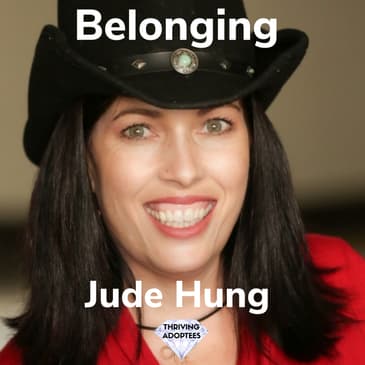
Do you yearn to belong? To feel a deeper sense of belonging? To feel you belong with others? With yourself? What would that mean to you? Listen in as Jude and I dive deep into this profound topic.
Find out about Jude's book here https://www.amazon.com/Girl-without-Tribe-Between-Adoptees/dp/B0DJK4XS9F/
https://www.facebook.com/jude.a.hung
https://www.instagram.com/finding_home_with_jude
Guests and the host are not (unless mentioned) licensed pscyho-therapists and speak from their own opinion only. Seek qualified advice if you need help.
Want to learn more about thriving for you, your kids, your families or your colleagues? Pick a time to talk here
[00:00:01] Hello everybody, welcome to another episode of the Thriving Adoptees podcast and this is the last episode that we're recording of the year Jude.
[00:00:11] What?
[00:00:12] Yeah.
[00:00:12] How exciting.
[00:00:14] So here we are on the 13th of December and we're here with Jude again so the last time we did a podcast was on Zoom.
[00:00:22] The time before that we did it live in Ireland, so a new one. So Jude's just finished a new book listeners and we're gonna, you know, rather than giving you a promo for the book we're gonna explore one of the key themes of the book.
[00:00:47] And Jude read a sentence, a couple of sentences out to me which is the kind of your favorite paragraph I think you said of the book and that we thought that might be an interesting point to bounce off.
[00:01:01] So do you wanna read that?
[00:01:04] Yes.
[00:01:05] Those sentences?
[00:01:06] So before I do that I'm gonna say the title of the book.
[00:01:10] Look I said we weren't gonna do the promotion, straight off promotion of the book right?
[00:01:13] Oh, I just wanted to say the title.
[00:01:16] Okay, go ahead.
[00:01:17] Go ahead.
[00:01:18] So they know what I'm reading from Girl Without a Tribe.
[00:01:21] And it is about an adoptee.
[00:01:23] It's, yeah, so here's the sentence, the paragraph.
[00:01:28] She felt the essence of home, knowing through and through that she belonged everywhere and nowhere, for she belonged to herself.
[00:01:37] Home was wherever she chose to go and for now, it was right here, sipping tea on her couch.
[00:01:42] Yet with each comforting sip, she sensed a new adventure calling her.
[00:01:48] Wow.
[00:01:50] So I'm getting peace, a feeling of peace behind that paragraph.
[00:02:01] And I'm getting a sense of anticipation as well about the future.
[00:02:11] And I'm running, the reason that the peace stands out is because clearly we're not at peace that much of the time.
[00:02:27] Well, as you know, I'm not today, but more and more.
[00:02:32] I think peace is becoming more and more part of my lived experience and my being.
[00:02:38] And I think likely because of the theme that we're talking about today, that belonging, right?
[00:02:46] Like just cultivating belonging within myself.
[00:02:54] So we're talking about more peace and more belonging rather than I don't belong.
[00:03:03] I do belong.
[00:03:05] We're talking about shades of grey rather than black and white.
[00:03:10] Yes.
[00:03:11] Yes.
[00:03:11] And Toko Pa Turner, who's an author, wrote a book called Belonging, Remembering Ourselves Home.
[00:03:18] So you can tell why that rain resonates with me and why I was drawn to the book.
[00:03:24] She talks about belonging as a practice, not so much a feeling.
[00:03:29] And so I think that is a big aha for me.
[00:03:34] And it was also like, well, of course it is because two years ago I consciously chose to begin practicing and connecting to a felt sense of belonging.
[00:03:44] So I've been practicing belonging for two years and after a lifetime of not belonging, of unbelonging.
[00:03:53] And what I have realized as I'm reading the book is that I have actually practiced not belonging.
[00:04:06] Well, so what's the, what's the practice, you know, the practicing side?
[00:04:11] What does practicing mean?
[00:04:13] Yeah.
[00:04:14] Well, as an adoptee, right, it makes so much sense that we would have a pattern belief and practice of not belonging.
[00:04:23] Given that our first experiences in the womb shortly after being born were that of not being welcomed and accepted into our families of origin.
[00:04:37] Right.
[00:04:38] So we would have a sensation of not belonging in our bodies.
[00:04:43] Something's wrong.
[00:04:43] I don't believe I'm supposed to be over there, but I'm over here with this adoptive family that I don't know that these strangers at the moment and I don't belong here.
[00:04:53] So that I think becomes kind of a intuitive knowing.
[00:04:59] And so we keep looking unconsciously for not belonging and it becomes our practice because it just is so like woven into our experience so early that that's our programming.
[00:05:15] And so we look for unbelonging.
[00:05:18] And we practice unbelonging because we keep looking for it to protect ourselves as a survival mechanism.
[00:05:25] Right.
[00:05:25] Of course we do.
[00:05:26] Of course we do.
[00:05:27] And so that's how we have gone through life.
[00:05:32] And so belonging is really foreign.
[00:05:37] And so it's something we must practice.
[00:05:42] So I was listening to a podcast this morning.
[00:05:52] And I, as I do when I'm walking the dog, I will often write an email.
[00:06:01] I write an email to myself with a key point.
[00:06:04] And this seems very, to sum up what you just said.
[00:06:18] So the sentence is the world appearance, sorry, the world appears in accordance with the point of view we bring to it.
[00:06:30] Yeah, absolutely.
[00:06:34] So.
[00:06:36] Another word for practicing.
[00:06:40] As you have outlined it to me, the word that was coming to me as you described it.
[00:06:45] It was almost like a mental rehearsal.
[00:06:53] It's an ongoing mental rehearsal.
[00:06:56] It's an ongoing rehearsal.
[00:06:57] It's an ongoing rehearsal.
[00:06:57] It's an ongoing confirmation bias.
[00:07:02] Right.
[00:07:02] So we're believing what we're noticing the stuff that's in accordance, in agreement with our worldview.
[00:07:18] Yeah, with our beliefs.
[00:07:20] Right.
[00:07:20] And we, we have this bias.
[00:07:22] I really like that word.
[00:07:23] We have this bias that we don't belong.
[00:07:27] Right.
[00:07:28] Because of a very real event that gave us this bias.
[00:07:31] And so we have that belief that we don't.
[00:07:34] And so we, the world, right.
[00:07:36] We look for things to that affirm that.
[00:07:39] And it's really unconscious.
[00:07:41] We don't want to look for those things.
[00:07:43] Right.
[00:07:43] Like we're not purposely doing this, but it, it's there in our, our D I like to call it
[00:07:52] our default programming.
[00:07:53] And so we, to undo that and deconstruct that and come out from that, we have to consciously
[00:08:02] look for moments of belonging and how can I cultivate belonging?
[00:08:08] And when we catch ourselves in, let's say, um, an adoptee support group where we are feeling
[00:08:17] resonance and connection and being understood, we can pause.
[00:08:23] And I'm just giving that as an example and go, okay, I belong here.
[00:08:27] What does this feel like?
[00:08:28] Right.
[00:08:29] Like, so when we can capture moments of belonging, then we can lean into what am I feeling in my
[00:08:35] body?
[00:08:36] Right.
[00:08:37] And, um, but you know, I asked my husband a question because I am reading a book on it.
[00:08:45] And I said, you know, what does belonging feel like to you?
[00:08:48] Because I'm trying to learn and discern and differentiate between the feeling, oh, I belong
[00:08:56] and practicing belonging.
[00:08:58] And he, he was, it was so simple and profound.
[00:09:03] He was like, well, I know where I don't belong.
[00:09:08] And he, and he said, if I go into a chaotic environment, because I don't like that to me,
[00:09:15] a lot of activity or too many people is too much for me, then I don't belong there.
[00:09:21] And, and so to me, it, it shouted that he belongs to himself.
[00:09:27] He knows himself.
[00:09:28] He knows what works for him and doesn't work for him.
[00:09:30] So he belongs to himself and he knows where he doesn't belong.
[00:09:34] And therefore he knows where he does belong.
[00:09:38] He's cultivated a sense of belonging within himself, a strong one.
[00:09:43] Yeah.
[00:09:48] But it seems to me for more instinctual than that, or, or the accidental than that.
[00:09:54] He hasn't, he hasn't cultivated, you know, it's not like he's, it's not like planting a row of seeds,
[00:10:02] you know, like, oh, oh, I've got a vegetable patch.
[00:10:04] I'm going to cultivate them.
[00:10:06] It was, it's more like something that's, you know, that's occurred to him rather than something that he's made happen.
[00:10:14] I absolutely agree.
[00:10:16] He's very intuitive in those, in that way.
[00:10:21] Right.
[00:10:21] He's not cultivated it.
[00:10:23] He's not worked on this, but he has this instinctual knowing.
[00:10:29] And I think it is because for him, he's always had to belong to himself.
[00:10:37] Yeah.
[00:10:38] Another idea that was coming to me as you were talking was,
[00:10:43] have you seen the film Ice Age?
[00:10:47] Yes.
[00:10:48] It's been a really long time, but yes.
[00:10:50] Yeah.
[00:10:50] I've only seen the start of it.
[00:10:52] Okay.
[00:10:53] So at the start of it, there is a small fissure in the ice.
[00:11:03] Yeah.
[00:11:04] Right.
[00:11:05] And then that fissure, that fissure grows.
[00:11:11] So, and I don't quite, I'm not sure quite how it happens, but imagine, imagine, you know,
[00:11:18] you take a little chisel into some ice and you've got a hammer and you, you, you, you, and that's,
[00:11:26] I think something like what happens in the, in the start of it.
[00:11:28] Yeah.
[00:11:29] And, and the hammer goes down on the, on the chisel and the chisel forms a gap that's, you
[00:11:38] know, like two or three millimeters wide.
[00:11:42] And then, then this fissure grows massively from it.
[00:11:47] Right.
[00:11:47] So what starts as a two millimeter fissure becomes a chasm.
[00:11:53] Right.
[00:11:55] And that's what I thought about the, that was the metaphor that came to my mind to show the,
[00:12:04] what the enlarge, what, what the splitting belonging, what the, what the split feels like.
[00:12:14] And, and, and how that's, you know, an unconscious rehearsal.
[00:12:18] So it's the, it starts with that first crack and then expands like crazy.
[00:12:26] And we end up with this, you know, we end up with the, the, the, the still traumatized 65 year old adoptee,
[00:12:36] because it's just got bigger and bigger and bigger as the fissure.
[00:12:40] Yeah.
[00:12:42] I, I can relate to that.
[00:12:45] And have done, you know, because of the awareness of the trauma and have been able to do work to try
[00:12:53] to bring pieces closer together.
[00:12:56] Uh, but have moments where I feel that chasm and, and that can feel really painful.
[00:13:05] We were talking about that, this issue before, weren't we, before we hit record.
[00:13:12] So there's a, on one hand, once you've felt your wholeness, once you felt belonging,
[00:13:22] you're less bothered about the feeling of not belonging.
[00:13:25] Feelings hurt, feelings hurt less.
[00:13:29] When we're clear on who we are, we're less bothered about how we feel.
[00:13:33] Yes.
[00:13:35] And yet also the, the, the pain is, is more painful in some respects because we haven't.
[00:13:45] Um, like, yeah, life has gone from a four to a nine and then four really hurts rather than
[00:13:52] it being a constant four.
[00:13:53] And if people haven't done on any work on themselves, they're just going to be at that steady.
[00:13:59] They're going to be at a general steady state.
[00:14:01] There's going to be less fluctuation.
[00:14:02] Yeah.
[00:14:03] Yeah.
[00:14:04] I think for me, there's been the, like the connecting to and, and cultivating my identity,
[00:14:11] my wholeness, feelings of home in my body, these things, safety, belonging.
[00:14:17] And so in general, if we're looking at that consciousness chart, I'm staying around like
[00:14:26] love, you know, uh, and I dip into like gratitude and joy.
[00:14:32] And so I'm, I'm up here, not down in that four.
[00:14:36] And yeah, my nervous system, if, if there's something that activates it triggers it, it
[00:14:44] can pull me back down right into emotional flashbacks.
[00:14:49] So those lower frequency emotions, and it doesn't feel good.
[00:14:53] And it's like, and I, and so then the resistance comes in, like, I don't want to feel that.
[00:14:58] I don't want to go there.
[00:14:59] I know that place and I don't want to stay there anymore because I have experienced up
[00:15:06] here and this feels great.
[00:15:07] And this is my life now.
[00:15:09] Yeah.
[00:15:10] So the, uh, the, the scale I've got interesting.
[00:15:15] I had somebody talking about this this week and an interesting different view on it, on
[00:15:20] what it, so, uh, the listeners, this is this.
[00:15:23] The scale of consciousness that, uh, Judy's relating to is something from a guy called,
[00:15:32] what's he called?
[00:15:33] Richard David Hawkins, David Hawkins, David Hawkins, scale of court consciousness.
[00:15:39] There is a gap.
[00:15:39] There's two Hawkins right out there.
[00:15:41] There's a biology guy who does Richard Dawkins.
[00:15:44] That's Richard Dawkins, isn't it?
[00:15:45] Now this is David Hawkins, David Hawkins.
[00:15:48] And it's a scale of consciousness.
[00:15:49] And he goes from zero, which is dead to 50, which is shame to a thousand, which is, uh,
[00:15:58] the great religious avatars.
[00:16:00] And the unconditional love is four 50.
[00:16:02] Is it something like that?
[00:16:05] Yeah.
[00:16:05] Like four 32.
[00:16:07] Okay.
[00:16:08] So, so like that, it's just, it's a scale of consciousness.
[00:16:10] Um, he, uh, so I, I heard, uh, I heard somebody say that, that it's not actually a scale of
[00:16:19] consciousness because consciousness is constant.
[00:16:23] It's a scale of mind, which I thought was pretty cool.
[00:16:28] Interesting.
[00:16:30] It's a scale of mind.
[00:16:32] It's about our relative experience rather than the ultimate.
[00:16:37] It's about body mind experience rather than our essence of, of consciousness.
[00:16:45] Yeah.
[00:16:45] I like body mind because it is all these things are what we equate with emotions.
[00:16:53] Joy, gratitude, shame.
[00:16:55] Right.
[00:16:55] So I like the body mind and, uh, yeah, that I think that's really on the nose because our
[00:17:00] state of consciousness is not changing.
[00:17:04] It's, it's an anchored state.
[00:17:06] And that is actually our true essence that we are ever trying, uh, unconsciously and consciously
[00:17:15] to align to that.
[00:17:18] That that's our true state of like the, uh, what would you call that?
[00:17:23] Nirvana or enlightenment.
[00:17:24] And our true state of being and, um, are like homeostasis, like where we're completely well.
[00:17:36] So an interesting point on that.
[00:17:40] It's the differentiation between the nature of our mind and the state of our mind.
[00:17:47] So the nature of our mind is going up and down this scale.
[00:17:52] Yeah.
[00:17:53] But the nature of our mind is constant peace.
[00:17:58] So it's like the, uh, the space within the room rather than the contents.
[00:18:07] Yeah.
[00:18:10] So belonging, going back to your quotes, your sentences, I was getting three, three things
[00:18:24] like, um, belonging with others, belonging in a, in a building home, right?
[00:18:33] But belong, you know, I'm at home, physical place, uh, and self.
[00:18:41] I saw three things, other people.
[00:18:44] Yes.
[00:18:45] A place and ourself.
[00:18:47] So how do those three different things stack for you?
[00:18:52] Right.
[00:18:53] Well, so it's been absolutely correct.
[00:18:57] And that's part of the story because it's based on it's fictional.
[00:19:01] It's fiction, but it's based on my life story.
[00:19:03] And that was my journey was trying to find belonging with others and not really finding what I was looking for there.
[00:19:14] And then I had a, maybe like a love affair with South Korea and felt that I belonged there and had it crumble.
[00:19:25] And so belonging a place like that was before my coming out of the fog experience.
[00:19:34] And yet I was already feeling the term hybrid with Korea.
[00:19:38] And I was using that term.
[00:19:40] Like I felt like maybe I had past life there or something because it was calling to me so strongly and then to have it collapse and crumble.
[00:19:48] Right.
[00:19:49] So where do I belong?
[00:19:50] I thought I belonged here and I don't, uh, it's.
[00:19:54] And so, uh, you know, then to come home and find that it's, it's here.
[00:20:02] This is where I belong.
[00:20:03] I belong in this body.
[00:20:05] Uh, life wants me here.
[00:20:07] I belong to life.
[00:20:09] Right.
[00:20:10] And life belongs to me.
[00:20:11] And so belonging I found was, it was always right here.
[00:20:16] It was self.
[00:20:19] So.
[00:20:22] But this, this is a, uh, a central myth.
[00:20:26] It's a central, it's a central story to so much, so many books.
[00:20:33] Um, and so whether they're religious books or, you know, the wizard of Oz.
[00:20:38] Wizard of Oz.
[00:20:39] Yeah.
[00:20:39] The wizard of Oz.
[00:20:40] She clicks her home.
[00:20:42] She goes on the adventure and she, she hasn't gone anywhere.
[00:20:46] It was all drowned.
[00:20:48] Right.
[00:20:49] And Dorothy is an orphan.
[00:20:51] So this is the orphan story arc.
[00:20:54] This is it.
[00:20:55] This is.
[00:20:56] And so for each of the, this is our story arc.
[00:20:58] So if we, we want to look at narrative or story, our arc is bringing us home to self.
[00:21:07] Yes.
[00:21:09] And to empowerment.
[00:21:10] Right.
[00:21:11] Yeah.
[00:21:12] But that's every, that's everybody's journey.
[00:21:15] It is everybody's journey.
[00:21:19] Um, so.
[00:21:22] People go to, people go to India to, to find themselves.
[00:21:28] Uh, and then realize they didn't need to go there because.
[00:21:33] Go to India.
[00:21:35] Home was right under their nose.
[00:21:36] It's the, uh, was it?
[00:21:39] It's the human journey.
[00:21:41] It really is.
[00:21:43] It's, it's, it's a journey of remembrance, right?
[00:21:46] Remembering truly who we are.
[00:21:49] Um, it's, it's an awakening.
[00:21:52] It's, it's about empowerment and sovereignty of choice.
[00:21:56] It's about, it's, it's about so many things.
[00:21:59] What, what this, what this gives me, I mean, uh, what, what this gives me is, uh, another
[00:22:16] reason, another source, another way home and another way, another way home or a different
[00:22:26] way home in the sense of, so what your book's writing to is the adoptee's journey.
[00:22:39] Yeah.
[00:22:40] And all the, and all those other great texts, um, show it in a different, show it in a different
[00:22:54] way.
[00:22:55] Mm-hmm.
[00:22:59] Yeah.
[00:23:01] This is always the journey.
[00:23:02] Um, but this is, so I think one of my, one of my concerns is if we are always staying
[00:23:17] in the, if we're all, if, if, if all our learning is done in the adoption space, we, we don't,
[00:23:32] we're shutting ourselves out from non-adoptee stuff that can, that can really turbo charge
[00:23:44] our growth.
[00:23:48] Yes.
[00:23:52] In, in doing that, right.
[00:23:56] We, so it's, it becomes adoptees and non-adoptees.
[00:24:01] So we are not belonging to the whole, right.
[00:24:06] We belong over here with only adoptees and only adoptee things.
[00:24:10] And, or we can say, yeah.
[00:24:12] And, and, and we can, we can differentiate, we can split off even more than we can say,
[00:24:16] okay, right.
[00:24:17] Well, no, but I'm a baby scupid era.
[00:24:19] I'm, I'm a very stupid era, uh, uh, domestic infant adoption.
[00:24:24] So I'm different to you and.
[00:24:27] Or I'm into advocacy and I don't, I think adoption should be abolished and right.
[00:24:31] So we can split off even further.
[00:24:33] And, and that's not only an adoptee thing.
[00:24:35] We see that in every group that's out in, in, in community to be part of.
[00:24:42] Tea drinking.
[00:24:42] But one, one thing that I see within the adoption community that we can sometimes do or fall
[00:24:54] into is, and it's, it's so hard to not do this is to think that no one else can understand
[00:25:02] how we feel.
[00:25:03] And yet this journey home, it's in so many books, so many stories of finding self getting
[00:25:11] empowered, right.
[00:25:13] Stepping into purpose.
[00:25:14] Uh, the Rumi quote, right.
[00:25:16] We're all walking each other home.
[00:25:17] These things are very popular and resonate deeply within us for a reason.
[00:25:25] Belonging, you know, Brene Brown's work is all about belonging.
[00:25:29] And it's, she has catapulted right into, um, you know, guru status because it resonates
[00:25:38] deeply with so many people on the planet.
[00:25:41] Why?
[00:25:42] Because this is a struggle for most people and it's hardwired into us to belong.
[00:25:50] Right.
[00:25:51] So, but we had adoptees have not cornered the market on these things.
[00:25:57] And yet I want to hold space for my fellow adoptees because I think when our trauma happened,
[00:26:06] makes it trickier, magnifies it, right.
[00:26:10] It's more amplified within our bodies and emotions and things.
[00:26:14] And so I'm not trying to minimize it, but I know that when I talk with my biological, um,
[00:26:21] adopted sisters, my, they're, they're biological sisters of my adoptive mom.
[00:26:26] And I'm in the middle and they can relate to what I say, right.
[00:26:30] They don't always understand everything.
[00:26:32] And sometimes their eyes glaze over, but for the most part, when I say, I'm not feeling like
[00:26:37] I belong or I don't fit in, they have a lot of compassion for me because they too have felt those things,
[00:26:43] even if it's wasn't as big.
[00:26:52] Because we, but we really, I think we can find home, home is, are you saying home and self are the same thing?
[00:27:05] I feel like home is a state of being like something that I have cultivated, right?
[00:27:17] Home is cultivating sanctuary and safety for myself.
[00:27:21] Home is my peaceful place.
[00:27:24] Home is something that I can create for myself wherever I go.
[00:27:32] So for me, it's more about a state of being than a place or a person, or, um, it's something that I'm creating for myself and connecting with.
[00:27:47] Yeah.
[00:27:49] I know who I am.
[00:27:50] I know what I like.
[00:27:52] Right.
[00:27:52] I know safety.
[00:27:56] I I'm going to protect myself.
[00:27:58] I'm going to nourish and nurture myself and create home.
[00:28:08] I know where I come from.
[00:28:13] And that I'm not talking about my biological family.
[00:28:17] Oh.
[00:28:19] Right.
[00:28:21] See that when, when I talk about us getting clarity from non adoptees, um, I, the, the idea that always, uh, the, the, the, the idea that springs immediately into the world.
[00:28:40] And I'm checking quite a lot at the moment.
[00:28:44] This, um, Dick, Dick Schwartz, Richard Schwartz, IFS.
[00:28:48] Yeah.
[00:28:48] Uppercase S self.
[00:28:50] Yeah.
[00:28:51] Uppercase S self.
[00:28:54] So.
[00:28:55] That's all.
[00:28:55] I agree with that.
[00:28:57] Uppercase S self.
[00:28:58] Now, um, there's a bit more to it, but there's, I, I'm thinking about all the.
[00:29:09] The complexity that we, that we talk about as adoptees, the complexity of identity.
[00:29:17] Right.
[00:29:18] So we can ruminate, we can ruminate, we can debate, we can go on endlessly about identity.
[00:29:28] Or we can just say, well, I actually, I'm talking about, uh, our uppercase S self.
[00:29:34] I'm talking about our essence.
[00:29:36] I'm talking about the bit of us that, that never changes.
[00:29:40] I'm talking about us as awareness or us as consciousness.
[00:29:45] These are all synonyms for the uppercase S self.
[00:29:48] And that's it.
[00:29:49] Yeah.
[00:29:49] I don't need to ruminate on that.
[00:29:51] I don't, I don't need to, I don't need to, uh, as there's a, there's a song from the eighties called the king, uh, the king of wishful thinking.
[00:30:02] Yeah.
[00:30:02] I'll get over you.
[00:30:03] I know it's true.
[00:30:05] I'm sure this ship's not sinking.
[00:30:08] The dead, the dead, the dead, the dead, the dead, because I'm the king of wishful thinking.
[00:30:15] So the reason that that pops into my head is because I think I'm the king of overthinking, not wishful thinking.
[00:30:25] Right.
[00:30:27] So, so I can overthink identity or I could just say, well, yeah, that's that.
[00:30:34] Yeah.
[00:30:35] Um, identity is a very many layered beast, but actually it's really simple.
[00:30:41] What I'm talking about is uppercase S self consciousness awareness.
[00:30:46] That's identity.
[00:30:47] That's done, right?
[00:30:48] Done.
[00:30:48] Thank you.
[00:30:49] So what's your next question?
[00:30:52] I think it's so, yeah, it's, it's so important to, I think, listen, not only to adoptee voices, right?
[00:31:04] I think that's kind of what you're trying to, and to others.
[00:31:07] And I'm saying that that, that, that guy has, yes, totally.
[00:31:13] I'm saying that that, that guy has got, he's got identity off to a T.
[00:31:18] So if we only stay in the adoptee spaces, all we hear is, you know, we're confused about identity and other people tell us they're confused about identity.
[00:31:28] So we all come together and the confusion just.
[00:31:34] Yeah, I think, uh, because even pre fog, like I was in the wellness industry and teaching and stuff.
[00:31:42] And so for me, it was essence.
[00:31:43] I was calling it my essence, right?
[00:31:46] I was connecting with that conscious part of me that never changes.
[00:31:51] And I think.
[00:31:54] Just if we can just know that.
[00:31:57] That that's there, right.
[00:31:59] And begin to.
[00:32:01] Connect with it moment to moment, instead of trying to figure out who we are.
[00:32:05] Just, we have a guide.
[00:32:08] It is our, our mind to body or that is a guide to who we are.
[00:32:14] And it speaks to us all the time.
[00:32:16] And it will tell you what you like, what you don't like.
[00:32:20] And, and the more we tune in and listen to that, the more we.
[00:32:26] Cause it's, it's guiding us into alignment with that, that higher consciousness.
[00:32:31] And so the more we tune in and listen to that, the more we learn who we are along the way.
[00:32:37] And so it could just be like any relationship that we slow build with ourselves and just are committed to it.
[00:32:45] For the long haul.
[00:32:47] Cause that's belonging.
[00:32:48] Long is in the word belonging.
[00:32:50] And it's what we're committed to for the long haul.
[00:32:53] That's what we belong to.
[00:32:54] So I belong to myself.
[00:32:55] I'm committed to me.
[00:32:57] And each moment I'm going to listen in.
[00:32:59] Hey, what do you like today?
[00:33:01] What do you want today?
[00:33:03] What do you need today?
[00:33:04] Right?
[00:33:04] So it's this moment.
[00:33:05] It's a relationship.
[00:33:07] With self.
[00:33:09] And I'm going to get to know that self.
[00:33:13] More and more over time.
[00:33:15] And in this, in the, in my humanity.
[00:33:19] That changes.
[00:33:20] It changes through experiences.
[00:33:22] It changes with age.
[00:33:24] What I liked as a young maiden.
[00:33:27] Or looked for, you know, in relationships in my twenties is not what I'm looking for.
[00:33:33] Cause I turned 57 in one month from today.
[00:33:37] At 57.
[00:33:38] Right?
[00:33:39] Like my needs are changing.
[00:33:42] And, and so it is about relationship with self.
[00:33:47] And I have chosen to belong to me and to take care of me.
[00:33:51] And to cultivate this, you know, sense of belonging within myself.
[00:34:04] I came up with something last week, uh, whilst walking.
[00:34:08] I haven't had anybody to try it on yet.
[00:34:10] So you're the guinea pig on this, right?
[00:34:13] Right.
[00:34:14] I, I was thinking about consciousness and how, how you can, how you describe that and consciousness as home.
[00:34:23] Where we belong.
[00:34:25] So I think you, as I came up with this, right?
[00:34:28] Right.
[00:34:28] So when we're talking about consciousness, we're talking about the, the, the context, uh, us, as a context rather than the content.
[00:34:44] Right.
[00:34:44] So by content, I mean thoughts, feelings, sensations, beliefs, all those.
[00:34:52] Right.
[00:34:52] So, so that's the content.
[00:34:55] Yes.
[00:34:55] Consciousness is the context.
[00:34:57] Yes.
[00:34:59] So it's, it's, uh, what's aware rather than what we're aware of.
[00:35:13] Right.
[00:35:14] And I also got, I came up with this, this question.
[00:35:19] Okay.
[00:35:19] So who's aware of, who or what is aware of the trauma?
[00:35:30] Yes.
[00:35:31] Right.
[00:35:31] We are the observer capital.
[00:35:34] Oh, uh, we are consciousness having a human experience.
[00:35:40] Uh, so we are part, we are all connected in one, right?
[00:35:45] So if you can sit in your body and begin to create a buffer between you and your emotions and acknowledge that you are not your emotions.
[00:35:57] They're things that you feel in your body.
[00:35:59] They're biological, uh, mechanism response system and, you know, chemical and they come and go and they change.
[00:36:10] They're not who you are.
[00:36:11] Right.
[00:36:12] Same with your thoughts.
[00:36:13] Same with your thoughts.
[00:36:14] Come and go and change your same with your beliefs.
[00:36:16] You probably have different beliefs from when you were five.
[00:36:19] So these are part of our experience.
[00:36:22] They're part of our, how we filter and, and, uh, interact with life, but they're not who we are.
[00:36:30] And we can take ourselves back.
[00:36:33] Like as we separate, even our physical body, it's not who we are.
[00:36:38] It's, it's, it's, it's our vehicle.
[00:36:41] It's our container.
[00:36:42] And, and we can begin to, if we're able to buffer from that, really connect with that observer, that awareness within us that is experiencing all these things.
[00:36:56] And that's our essence.
[00:36:59] Like that's who we really are.
[00:37:02] Yeah.
[00:37:04] So, so we are the who that's aware of the trauma.
[00:37:09] We are the trauma itself.
[00:37:10] The trauma is content.
[00:37:14] We are the context.
[00:37:16] Right.
[00:37:18] The, the trauma is an event.
[00:37:20] It's an experience that happened to us and it impacted our beliefs, our emotions, our physicality.
[00:37:31] Right.
[00:37:32] Um,
[00:37:32] Um,
[00:37:34] did I miss anything?
[00:37:35] Yeah.
[00:37:36] So it, it impacted us, but every time that it, it comes up, like, like I was telling Simon, I had an activation of my nervous system this week, but every time that's happening, it has nothing to do with today.
[00:37:50] It's a replay.
[00:37:51] It's an echo from the past.
[00:37:54] It's an emotional flashback.
[00:37:56] It's something that my body's replaying within me.
[00:38:00] It still needs to be resolved and released.
[00:38:04] So it, but it's just a replay.
[00:38:08] And I'm not trying to minimize it because I've really been feeling it this week, but it's not who I am.
[00:38:15] Um, the book's called, uh, the girl without a tribe.
[00:38:29] Yes.
[00:38:30] Um, but there were people around you, but they were like the girl without the tribe.
[00:38:41] It sounds like you just on your own.
[00:38:42] Um, well, that's how I often, right.
[00:38:47] That's how I often felt.
[00:38:49] And throughout the story, she's it's, it's allegorical in that, um, I use like animal tribes as she's born into, she's from a certain animal tribe and she's adopted by another one.
[00:39:06] And, and of course, each tribe has its own ceremonies and rituals and, and, and there's this, you know, lost in translation happening.
[00:39:17] So, and she's looking for her tribe.
[00:39:20] Like, where do I fit?
[00:39:21] Where do I belong?
[00:39:23] And she's not finding it.
[00:39:24] And, uh, yeah, so it's, it's a journey to the self.
[00:39:28] This is a silly question, but it's popped up.
[00:39:31] So there's no, somebody once told me there's no thing, such thing as silly question.
[00:39:34] So why, why didn't you call it the girl with the wrong tribe?
[00:39:39] Because I've always felt like I didn't have a tribe.
[00:39:42] And in the end she choose, well, I don't want to give away, but, but the truth is I, um, it's funny before I came out of the fog, I'm, I'm, I'm, I'm a certified meditation teacher.
[00:39:54] And I started this, uh, meditation group on Facebook and it was called one tribe because at that timeframe, it was like, Oh, find your tribe, my tribe, my, you know, all of this.
[00:40:05] And I find it really divisive, uh, because I do believe that we are all one and connected.
[00:40:11] We're one humanity.
[00:40:12] And we, we have all these labels that we put on.
[00:40:15] Um, but it's not who we are.
[00:40:19] And I think that we, I, I, I have rose colored glasses.
[00:40:23] I believe that we can be more connected and cohesive and unified and find peace and things like that.
[00:40:30] And so the, the tribe thing, I don't think it ever resonated with me because I didn't feel like I had a tribe.
[00:40:38] I'd ever felt like I fit.
[00:40:40] And then I realized we're all the same tribe, all these divisions, even culturally we've made up, we've made this stuff up.
[00:40:48] These things, these dividing lines, these countries, these really were one tribe humanity.
[00:40:54] And, um, yeah.
[00:40:56] So I think that like, I think that runs really deeply in me and I think that's probably why no tribe.
[00:41:04] Yeah.
[00:41:05] So I, as I was listening, I was thinking about the cut through for me on that.
[00:41:14] It's about the difference between a group of people and a tribe.
[00:41:17] So you can be in a, you can be in, you can be in a crowd, but you can be lost in a crowd.
[00:41:23] You can be lost in a crowd.
[00:41:24] So you're in a crowd, but you're lost.
[00:41:26] You're lost in the crowd.
[00:41:27] Yeah.
[00:41:28] That's true too.
[00:41:29] So it's a, it's the difference between you wouldn't be lost in your tribe.
[00:41:34] You could be lost in a group of people.
[00:41:37] So I'm thinking, uh, you know, like a soccer fan in a, in a, um, in a group, a group of rugby fans, right.
[00:41:47] Or football fans or an American in a group of English people.
[00:41:52] You know, you could feel, you could feel lost, but you would never feel lost in your own tribe.
[00:41:58] So it's, it's, it's the girl with the girl with no tribe because.
[00:42:03] With no tribe.
[00:42:04] The girl with no tribe is because she's only in a group.
[00:42:07] She's not in a tribe.
[00:42:08] She doesn't fit into the group in which she's.
[00:42:11] Right.
[00:42:12] Yeah.
[00:42:13] That's definitely there.
[00:42:15] Yeah.
[00:42:16] Transplanted.
[00:42:17] Yeah.
[00:42:17] Yeah.
[00:42:19] So.
[00:42:20] Yeah.
[00:42:23] Yeah.
[00:42:23] I use, I use the tribe.
[00:42:27] I guess that's a metaphor in a way.
[00:42:31] Right.
[00:42:32] Of belonging.
[00:42:33] And the, I think the, the rituals and ceremonies and things that are important in life that also as adoptees.
[00:42:42] We're expected to adapt, you know, and we lose ours.
[00:42:46] And, and so, yeah.
[00:42:52] We practice that.
[00:42:54] We practice that, don't we?
[00:42:55] We rehearse that.
[00:42:57] We have confirmation bias that is enlarging that feeling.
[00:43:02] We're lost in that.
[00:43:04] Don't we get lost in that feeling?
[00:43:08] Doesn't that splinter grow?
[00:43:10] Like we were talking about, you know, the ice.
[00:43:12] I think so.
[00:43:13] Yeah.
[00:43:14] Yeah.
[00:43:14] Right.
[00:43:15] Like.
[00:43:15] Like.
[00:43:16] It starts off small, it gets bigger.
[00:43:18] Yes.
[00:43:19] We get further and further away from her.
[00:43:22] Right.
[00:43:23] And so what's, I guess what's been interesting for me.
[00:43:27] And I don't know why it's been so.
[00:43:29] Um.
[00:43:30] I didn't, I didn't do the reunion thing.
[00:43:33] I didn't feel that I needed to go back and get their ceremonies or rituals or, you know, the history.
[00:43:43] I have some information, but I didn't have that drive.
[00:43:47] I have, I have felt like I just need to create my own.
[00:43:51] Right.
[00:43:52] I'm going to create my own rituals and ceremonies.
[00:43:54] And, um.
[00:43:57] Yeah.
[00:43:58] So it has been a real, like coming home to self and belonging to self and.
[00:44:04] Yeah.
[00:44:06] Belonging to life has been big for me.
[00:44:12] That feels like a good place to bring it in unless there's something that I've.
[00:44:17] Obviously it's going to be a link in the, the show notes listeners to the Amazon page with the book.
[00:44:24] Is there anything else you'd like to share?
[00:44:27] Yeah.
[00:44:28] Uh, no, that feels like a good end to me as well.
[00:44:32] Thank you guys for listening and I'll plug it again.
[00:44:36] The book title is the girl without a tribe.
[00:44:39] Uh, it's, it's between two worlds and adoptees journey and it's fictional.
[00:44:44] It's short.
[00:44:45] And, um, I have, I think a couple of reviews so far and one of them that made me cry.
[00:44:52] It was so beautiful.
[00:44:53] So please pick it up and read it.
[00:44:55] Thanks listeners.
[00:44:56] Thanks, Jude.
[00:44:57] We'll speak to you again in 2025.
[00:45:01] Take care.
[00:45:02] 2025.
[00:45:03] Woo.
[00:45:03] Woo.
[00:45:04] Bye.
[00:45:04] Bye.