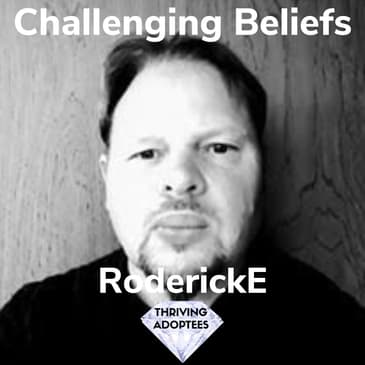
This interview challenged me. And that's a good thing. Introspection and questioning our beliefs can lead to change for the better. A different perspective. A healing perspective. Roderick's perspective is very different. You might find it challenging like I did. Listen in and make up your own mind.
Here's a link to his previous interview: Reconstructing My Identity https://thriving-adoptees.simplecast.com/episodes/reconstructing-our-identity-with-rodericke
Here's more about Roderick.
Roderick Edwards (aka RoderickE) is a multi-genre author of over 25 books on topics as wide ranging as an autobiography of his being left for dead at the hospital at birth and his subsequent adoption at age 4 and reunion with his birth family at age 50. Or a series of books on WW2 cargo pilots that served in India with one of the men returning to the USA to develop the satellite program during the space race with the Soviets. RoderickE also has time travel fictions, books on politics, race relations, religion, philosophy, and poetry. Sometimes called the "Bansky of Books" due to his unexpected style that bypasses the cookie-cutter market-driven fare, you'll be certain to find something you will enjoy, or you will dive into a new genre with seamless crossover.
https://www.facebook.com/rodericke
https://twitter.com/roderickedotcom
https://www.instagram.com/roderickeauthor
https://tiktok.com/@roderickedotcom
https://www.linkedin.com/in/roderick-edwards-56170a24a
https://www.youtube.com/@roderickeauthor
https://truthsocial.com/@roderickedotcom
https://en.wikipedia.org/wiki/User:Roderick_E
https://www.bookbub.com/profile/roderick-edwards
Guests and the host are not (unless mentioned) licensed pscyho-therapists and speak from their own opinion only. Seek qualified advice if you need help.
Want to learn more about thriving for you, your kids, your families or your colleagues? Pick a time to talk here
[00:00:00] Go for this.
[00:00:02] Hello, everybody.
[00:00:02] Welcome to another episode of the Thrive New Doctor.
[00:00:04] Who's podcast.
[00:00:05] Did I and delighted to be joined by Roderick Roderick?
[00:00:08] He looking forward to this.
[00:00:11] Well, I'm sure it's going to be a really different take on healing from you.
[00:00:16] Roderick, you're Roderick the maverick.
[00:00:19] I think Roderick the maverick.
[00:00:21] That could be a new time for a book.
[00:00:24] So fellow adoptee and Dorothyie, you're prolific. You
[00:00:28] love writing, don't you? I have, ever since I was younger, I just would write and spiral
[00:00:33] notebooks and keep them, you know, didn't mount anything, but eventually I started doing
[00:00:38] it for a living. So, yeah. So, um, listeners, uh, regulators will know that Roderick's been on in the past and I'd
[00:00:47] encourage everybody to check out the show notes so you can find out what, uh, what Roderick's
[00:00:51] about. There's some great books on about adoption and other stuff too. So healing, healing,
[00:01:00] what does healing mean to you Roderick?
[00:01:02] Well, that's, that's a tricky one because obviously healing
[00:01:05] means a lot of things to a lot of people, different things.
[00:01:08] First of all, as adoptees, we have to decide,
[00:01:11] what are we healing from?
[00:01:13] Now, a lot of us have been exposed to the book
[00:01:17] that the primal wound, which tells us we're healing
[00:01:20] from our primal wound, a wound that happened before,
[00:01:23] maybe our existence even, our physical being.
[00:01:30] If you've ever read many of my books, I hate trying to tell people what to believe or what to
[00:01:34] think. I always say here's a possibility and here's a possibility and here's a possibility. You come
[00:01:39] to your own conclusion. So I don't want to tell people, adopes do or don't suffer from this parival wound that we're constantly told
[00:01:48] But I know for myself. I've never thought of myself as really damaged goods
[00:01:53] Most of my life now I have found found out as an adoptee that I've always felt lonely
[00:01:58] I don't know if that's a wound or not, you know alone in the world
[00:02:03] Because I didn't know my heritage,
[00:02:05] I didn't know who I was.
[00:02:06] I just, we, as adoptees, maybe we don't all do it,
[00:02:08] but we kind of make up a fiction.
[00:02:10] If you're adopted by a good family, a nice happy family,
[00:02:14] you make up a fiction as to what your background really is.
[00:02:17] Or you ignore it all together.
[00:02:19] I don't know how people handle that.
[00:02:21] But so the first question is,
[00:02:22] what are we trying to heal from, right?
[00:02:26] Yeah, and my kind of questioning question, right, the question is what's wounded?
[00:02:40] Right. Because so there's this presumption and there's a built-in presumption
[00:02:49] if when we're talking about healing, there is something to heal.
[00:02:54] Right. I love your question, what are we healing from? And I'd throw mine into the mix or what's wounded. And I think one of the things that we could do is
[00:03:09] kind of ask ourselves, we've got to come to, I love the tape that you're doing, we've got to
[00:03:14] come onto our own perspective on this. And, you know, I didn't believe that I was wounded
[00:03:27] And I didn't believe that I was wounded until I read the primal wound. I had questions within me about my emotions, but like you, I didn't really feel that. That's not what I would have said about me. So, I'm
[00:03:54] yet to run a podcast and I ask everybody what's about healing. For me, the big thing last year
[00:04:00] was coming up with this idea that healing happens on different levels. So on one level, if we do feel wounded, if we have had,
[00:04:12] we do feel that we've had trauma and we've been psychologically damaged by it,
[00:04:20] then perhaps that healing will go on forever.
[00:04:26] And yet at another level, the essence of who we are isn't wounded.
[00:04:35] It's kind of my take from it.
[00:04:40] And again, we're just exploring.
[00:04:43] My background is a data analyst. So I analyze
[00:04:45] data and I bring up data points all the time and I have all the time in my career and some
[00:04:50] people are like, well, you're going in this direction. You're going, no, I'm just bringing
[00:04:53] up the data point and then we'll talk about where it leads to. I'm not making any argument for
[00:04:56] either way. But my first thing I'm thinking about here is the power of suggestion. As you said,
[00:05:01] you didn't know you were even wounded. You didn't feel like you're wounded until that book told you you're wounded. I don't know if that's a power suggestion
[00:05:09] that it's planted in your psyche or if you really started saying, oh yeah, that's me.
[00:05:13] Oh yeah, that's me. And oh, that's me. It's hard to tell, especially in this day and age
[00:05:17] of TikTok videos. If you've ever been on TikTok, there's a lot of people in there who are
[00:05:22] telling everybody their traumas and traumas and everything else that.
[00:05:25] And it goes on sometimes you'll look back two years and it's just wow, well,
[00:05:29] you haven't healed.
[00:05:30] I'm not talking about adoptees.
[00:05:31] I'm just talking about anybody on there.
[00:05:32] It's pretty, pretty bad on TikTok I thought.
[00:05:35] Yeah.
[00:05:36] I looked at it last, I looked at it yesterday because somebody asked me to
[00:05:43] participate in, into, like, add my take to an adoptees group and I politely
[00:05:51] declined because it didn't feel right to me. I have had some very extreme feelings about my birth mother.
[00:06:05] So, but does that mean I'm traumatized?
[00:06:09] Maybe it doesn't, maybe it doesn't.
[00:06:12] You know, like it is, it's a tricky one.
[00:06:17] And people talk about, you mentioned this data points one.
[00:06:21] And a lot of people bring up this data
[00:06:24] in terms of the increased probability of
[00:06:28] suicide and mental health amongst the adoptee community. So that's a tricky one that people
[00:06:37] might fire back at AU. Is anybody fired that back at you?
[00:06:42] Yes, and I do.
[00:06:44] There's another, as again, at the Data. And I do. There's another as again, that's a dating analyst.
[00:06:46] I found another statistic that's strange too, because, and again,
[00:06:50] there's no judgment in what I'm saying here.
[00:06:51] So please, anyways, listen, I'm not judging anybody for what I'm ready to say,
[00:06:55] especially.
[00:06:56] But I've noticed that adoptees in general,
[00:06:58] maybe it's because we feel alone in the world, a lot of us do,
[00:07:01] that we choose alternate lifestyles.
[00:07:03] There are a lot of transsexual adoptees. There are a lot of transsexual adoptees.
[00:07:05] There are a lot of homosexual adoptees
[00:07:07] that that's already gonna make your life even more difficult
[00:07:10] because that's not accepted if you wanna call that
[00:07:13] in society.
[00:07:14] So not only are you adoptee,
[00:07:16] now you're expressing a view of lifestyles
[00:07:20] that's going to probably get some pushback
[00:07:22] from various people and it seems odd and different.
[00:07:25] Maybe you're doing that because it's a call for help
[00:07:28] or maybe it's who you wanna be.
[00:07:30] I don't know what it is.
[00:07:31] But that, maybe we add that into the mix
[00:07:33] and that's another reason why adoptees
[00:07:35] might have a high suicide rate
[00:07:37] because they tend to select lifestyles
[00:07:39] that are very difficult to live with, I think.
[00:07:42] Yeah.
[00:07:44] And again, I think, I don't know it depends
[00:07:46] what you what you call a lifestyle. I don't know, there's alternative lifestyles
[00:07:55] and an alternative different an alternative or different sexuality and sexuality. And I don't, I know a few gay people, and I'm pretty sure that they wouldn't say
[00:08:10] that that was a choice. That is kind of who they are. That's how people have said they
[00:08:16] developed that and they've expressed it more. I mean, we talk about just simple things like
[00:08:19] adoptees might, you know, do a lot of piercings or they just want to look different. They want to look different than the rest of the world.
[00:08:26] And I think it's an outward expression of their, I don't fit in. And that itself makes them almost a target or something that people look at society looks at and goes,
[00:08:37] Oh, we don't want you, which depresses them even more, you know, if they gauge their ears or they pierce their, or they get tattoos all over them because they want to be different, or they pretend they're, or they're they
[00:08:46] doppetanum, at least you know, where they, they participate in like wickens, witches,
[00:08:50] and things like that. They become outside what we call the norm. I hate to use that word, but
[00:08:54] whatever can use the typical, I guess is better word. The typical that society would reference,
[00:08:59] that makes that even more difficult. So I don't know if it's adoptee status that causes them to be more depressed
[00:09:06] and potentially for suicide or it's adoption
[00:09:09] of those lifestyles or behaviors.
[00:09:12] It's hard to pen down what word I wanna use to describe it.
[00:09:15] So it's a tricky one.
[00:09:18] It's definitely a tricky one.
[00:09:20] I saw some data and I mean,
[00:09:24] data can, I mean as a data analyst you can tell us how
[00:09:28] how much data can be chosen, manipulated, etc.
[00:09:34] Or omitted, or omitted, to say hey here's how many adopt, here's how many adopt these
[00:09:38] commit suicide percentage wise and they don't even factor in all these other things I just
[00:09:42] said that might be the factor. Yeah. So we don't even factory and all these other things I just said that might be the factor. So we don't know. We're looking for simplicity. The one that came to my mind was, have you seen
[00:09:52] that the series on Chernobyl? It's a drama series and when the local Communist Party near the power plant is reporting on the early stages of this meltdown,
[00:10:11] they say that the guide encounters are reading, I can't remember these out numbers, but the guide accounters are reading 200. And the people at the center say,
[00:10:26] the next level up, they say, well, that's okay,
[00:10:30] because that's not a bad score.
[00:10:34] But there's two different guide accounters, right?
[00:10:37] So low level people in the party have a guide encounter
[00:10:42] that only goes up to 200. That's all it measures
[00:10:47] up to. People higher up in the party have a guide you counted that measures up to 3,000.
[00:10:53] Three hours, yes.
[00:10:55] So, the guys with 3,000, the guide you counted that read up to 3,000 assume that the other guys are using that guy you
[00:11:06] counter not the one they don't even know that there's a lower class a lower status
[00:11:13] a lower less accurate and a guy's answer that only measures up to 200 so it
[00:11:19] depends our data or I can't know a our data all depends. But we're always looking for that. Silver bullet
[00:11:26] reads in aren't we? We're looking for silver bullet on any statistics that we're given.
[00:11:31] Right. And so as an adoptee, this can apply to anything actually. When you start seeing
[00:11:35] these statistics by whoever puts them out, whomever puts them out, no matter what it is,
[00:11:39] we're talking politics, social, whatever it is, you need to look at yourself and say,
[00:11:43] how does if you're going to apply it to yourself, does this really apply to me?
[00:11:47] Or is it something else beyond what they're saying here?
[00:11:50] You know, that power suggestion I said.
[00:11:53] So yeah.
[00:11:55] Do you still do you still feel lonely?
[00:11:59] No, not so much because if people know the story from last time,
[00:12:02] I might have found my birth family and I found
[00:12:10] I adopted my sorry my biological sister who was also giving up for adoption at birth
[00:12:16] two years before I was and we're you know we're in relationship friends and stuff like that hang out and we're
[00:12:22] living together so that's replaced that that part has replaced that and blowing my heritage and background so that doesn't that's not so much there Obviously it never goes away because it was still if you want to call it stolen from you
[00:12:28] Or at least kept from you for a long time. It took me a while to become who I am now
[00:12:33] Yeah
[00:12:34] Yeah
[00:12:35] so um
[00:12:38] Part of then if we were gonna call healing right if we're gonna say if we were to gonna define healing as the the lessening of unwanted emotions,
[00:12:51] you know, then we could say, well, you were, you were, you felt lonely, you feel less lonely
[00:12:59] now because you've done this, you've made a connection and that has been part of your
[00:13:07] healing experience if we're going to use it that way.
[00:13:10] Let me clarify the definition you gave said unwanted emotions. I'm not very emotional
[00:13:15] guys, I'd have to be a gay and animals. But I prefer to call them not unwanted emotions,
[00:13:21] but unstable emotions that we allow to become erratic.
[00:13:26] So adopt these. So I'm saying we're talking about how you choose these different behaviors
[00:13:30] or lifestyles that may make your situation worse. Now, when I was growing up, I decided I have
[00:13:37] so much instability in my life. I'm going to make my life as stable as possible. I was married for
[00:13:41] 32 years. My job said I kept very long. I did everything
[00:13:46] I could to make my life very, very stable. And that was my defense, I guess you want
[00:13:51] to call it, to dealing with this unstable emotions that might happen because I'm adopted.
[00:13:58] And but now I don't have to do that so much anymore. I've been able to let go because
[00:14:02] I understand who I am and everything else. Now, I can't speak for people who haven't found the birth reunion to their bylaws.
[00:14:09] They're still there, I think. They have to deal with it and cope with it in a different
[00:14:12] way than I'm not here to tell anybody how to do that.
[00:14:16] Would you say that what you did was a coping mechanism?
[00:14:20] Yeah, definitely a coping mechanism. But it would kept the stability. I think that's
[00:14:24] something we all suffer from.
[00:14:26] But sometimes you have delusions.
[00:14:27] We say, okay, here's the birth family I'm with and here's what they want me to do and
[00:14:32] I'll become part of that and just kind of immerse yourself in that.
[00:14:35] And it could be a happy family.
[00:14:36] It could not be a happy family.
[00:14:37] Who knows?
[00:14:38] However you have to cope with it, you've done coping.
[00:14:41] But I've always said the best way to stop the battle or the wars to step away.
[00:14:46] Peace is just one step away from whatever the wars. The war can follow you. The battle can
[00:14:50] follow you where you go, but you first got to step away from it. A lot of people want to,
[00:14:53] I'm going to fight the system. I'm going to fight the adoption laws. I'm going to, okay,
[00:14:57] you can do all that. But while you're doing that, you're still in the war. So if you ever want to
[00:15:00] heal, you have to step away from the battle for a moment. Otherwise, the arrows are going to keep coming, especially if you encourage them to come.
[00:15:07] How dare you do something.
[00:15:09] I've interacted with adoptees who wanted to abolish adoption.
[00:15:13] I don't know how that works because human nature will always have people for some reason
[00:15:17] that have to relinquish their children.
[00:15:19] Whether they can't handle it mentally or something goes wrong,
[00:15:23] that's always going to be the case.
[00:15:25] You can't abolish adoption.
[00:15:26] We need to fix it.
[00:15:28] So some of the things that cause the problems
[00:15:30] hopefully go away or at least decrease.
[00:15:33] So we're fighting the system
[00:15:38] and on the external part.
[00:15:41] But internally we're fighting our feelings, aren feelings aren't we that's the that's part
[00:15:47] challenge, right? We might believe if I can just fix this
[00:15:50] Nobody else will have to suffer like I am who knows we're gonna make it better for the next guy
[00:15:54] Because again if you had if you've abolished adoption
[00:15:57] How was that gonna work you force the people to keep their children who don't want to or aren't capable of keeping their children?
[00:16:02] I don't know what some of these other adoptees when they talk about abolishing adoptions going to work. I'm not pro adoption,
[00:16:07] but I am pro. For example, one thing I would do different if I could, I would tell anybody
[00:16:14] somebody for adoption, you got until they turn 18 to figure out what to do because if by 18,
[00:16:18] we're going to tell them everything. Some people, wow, really? Yeah, I think that should be. And plus,
[00:16:22] I think if you're going to relinquish anybody for adoption nowadays, you should have to go through a battery. The
[00:16:27] person who's going to link with the mother and the father should go through a battery of test
[00:16:32] about their health, health history. And that should follow the adoptee from day one. We shouldn't
[00:16:37] have to wait and figure out, well, am I anemic? Am I diabetic? All that stuff should just follow me
[00:16:41] from day one. Yeah, even if you even if we don't mention the names of our biological parents.
[00:16:46] Yeah.
[00:16:47] There's a lot in there about the rights to our access.
[00:16:55] Right.
[00:16:56] How do you think that...
[00:17:02] What do you think is the impact of these people trying to change the system?
[00:17:09] How do you see that impact in them?
[00:17:12] My positive was in the United States, not until, well, what about five years ago, did
[00:17:18] they allow that?
[00:17:20] You actually had to wait until your biological parents either agreed to some kind of form
[00:17:24] they had to fill out or they were deceased. And in my case, they were both deceased. So when
[00:17:28] I sent in my form, they sent it back a couple months later or less and told me, here's your
[00:17:34] mother's name. And it was just like magic. It was it wasn't slow. You know, normally when you have
[00:17:39] big major things, it comes slowly. But it's like, here's a piece of paper. And here's who you are.
[00:17:43] That was really shocking to me, because now I had to figure out, you know, you go in a
[00:17:47] tailspin, who is it?
[00:17:48] So again, sort of like you say, I didn't really know and you didn't know that you were really
[00:17:52] as wounded as you were until the show.
[00:17:56] Well, I mean, that's that. The one that always comes back to me is this idea of the pre-verbal part of the trauma.
[00:18:12] So we haven't got words for it.
[00:18:15] And yet so many people are offering us talk therapy, you know, so how can talk, and this is a big realization from talking to
[00:18:29] some therapists last year, you know, like, how can we, how can we, how can talk therapy
[00:18:36] work with pre verbal trauma? You know, we, it's literally, it's trauma that we don't
[00:18:43] have words for.
[00:18:46] And we don't even know what word.
[00:18:47] Why we're suffering a certain thing is we go,
[00:18:49] oh, that's why I do that.
[00:18:50] It might be longer time before you forget that out.
[00:18:53] It's funny because I have this, well,
[00:18:55] I guess she's relative, the younger,
[00:18:57] had nothing to do with adoption,
[00:18:58] but she went to some therapy therapist.
[00:19:00] And the therapist was treating her how to interact with,
[00:19:03] not hostile people, but people that tend to be a little more brash and the therapists recommend that she
[00:19:08] Get really stern look very concerned to say, you know, I don't appreciate the way you're treating me
[00:19:14] Well, that sounds great, but it doesn't really work in the real world
[00:19:17] Especially if the person's already in antagonist they will probably antagonize you more and so that was happening to her
[00:19:22] She was being antagonized more that that method that the therapist gave her to use wasn't working.
[00:19:27] She eventually got to the point where she was
[00:19:28] a little bit brash back and that started working
[00:19:30] because sometimes brash people in tag and estate,
[00:19:33] they want you to put them in their place.
[00:19:36] That lets them know that you're on their level.
[00:19:38] But if you try to, you know, please don't do that.
[00:19:41] So we have to be careful as adoptees
[00:19:43] who were letting into our minds and hearts and souls
[00:19:46] because sometimes these therapists are, they're not even adoptees, they have no idea unless you
[00:19:51] said there's no way of explaining to them. They think they have, they have all the degrees of it,
[00:19:55] they think they can tell us how to handle this, but they really can't. So I think it's good to talk
[00:20:01] to fellow adoptees and see how they've handled it. Yeah, yeah. This is...
[00:20:05] But the question for me on this is always around this pre-verbal trauma, around this
[00:20:13] pre-verbal trauma, pre-unremembered trauma, if it happened. It's a fascinating world where I believe that what we focus on gets bigger.
[00:20:33] And if we're focusing on the trauma all the time, then the trauma is going to get bigger.
[00:20:39] And I wonder how I would have been if I, when I read the primal wound, if I'd gone into
[00:20:50] the Facebook world then and had all these other people reinforcing this, then I did
[00:20:58] a pretty good job of reinforcing it on my own.
[00:21:02] I didn't need anybody else's help.
[00:21:04] I think it's my own. I didn't need anybody else's help. I think it's worse nowadays.
[00:21:06] Because then you have all the social media.
[00:21:07] And it looks like the old phrase,
[00:21:09] misery loves company. You look for it, you're going to get it.
[00:21:12] Yeah. That's why we focus on healing on the podcast.
[00:21:17] Right. I think we've had it to the back teeth,
[00:21:21] you know, about the trauma. I've seen what it's like. I felt what
[00:21:28] it's like when I focus on this stuff. You know, I took, you know, one of my big, big
[00:21:36] questions is, you know, how can this, this abandonment become, become a belief that we're not good enough.
[00:21:47] There's some brain, what started off as, and who can remember how visceral was it?
[00:21:55] I can't remember it at what it was like going into short-term foster care at maybe a week old,
[00:22:04] and then being collected by my birth mother four weeks later,
[00:22:07] and then going into them.
[00:22:09] I can't remember all this,
[00:22:10] but I can feel like we got a new doc last year,
[00:22:14] and this new one didn't cry at night,
[00:22:18] but we've had dogs that cry at night,
[00:22:21] and I'm thinking, well, was I like that?
[00:22:24] What would, you know? So there's this anguish that I may or may not
[00:22:30] have felt, who knows? And then the belief that I'm not good enough, that's essential. So there's
[00:22:41] some thought comes into play here, right?
[00:22:45] Right, right.
[00:22:46] I think I heard that as a data analyst,
[00:22:47] I think we sometimes we overanalyze things
[00:22:49] and then we get caught in that strap of,
[00:22:51] what about this and maybe this and maybe that?
[00:22:53] And maybe there's some things that I can never know this part.
[00:22:56] It's hard to say that, but I can never know this part.
[00:22:59] I'm going to have to let that go.
[00:23:01] Yeah.
[00:23:01] Otherwise, yes, it will tear you up.
[00:23:03] Yeah.
[00:23:04] That's another question I think that we can ask ourselves and encourage people to ask,
[00:23:10] how can this experience of loss become a belief that we're not good enough. It does involve some,
[00:23:26] it does involve, well, it does involve our brains,
[00:23:31] looking for meaning somehow.
[00:23:34] Right, I'm a determinist.
[00:23:36] That means that I believe things happen for a reason.
[00:23:39] Not always, I can't always, we all always know what it is,
[00:23:42] but I believe that.
[00:23:43] At least I use as my philosophy in life.
[00:23:45] It might not be any of me true, but I use it in my philosophy of life.
[00:23:48] So what I've always taken away from this is as an adoptee, it's given me an opportunity.
[00:23:53] Like for example, I'm the author of a lot of different subjects, as you know, genres.
[00:23:57] It's allowed me to be disconnected from what's typically the familial bond.
[00:24:02] Like sometimes you've heard the blood is thicker than water and you never,
[00:24:06] you keep the dirty laundry in the family. Okay, well none of that really applied to me because I
[00:24:11] didn't feel that bond. So I've been able to explore areas and I'm an unbiased way, at least a less
[00:24:16] biased way, that I would have, I had the strong, so to me in a way it's a blessing rather than a
[00:24:22] curse that I was giving up for adoption. I have no bond.
[00:24:26] So I don't know how other people use that, but that's how it does me. It's not like, oh,
[00:24:30] I was rejected and they gave me up and what was me? It's more like, okay, well, this is an
[00:24:35] advantage for me. That's how I've always looked at. Wow. Because we are encouraged to look at, people do talk about looking for the positives
[00:24:50] out of this and such as our resilience.
[00:24:56] So whether the extent of this pre-verbal trauma or what's gone on for us is we have become,
[00:25:08] you know, we've become very flexible and adaptable and like sometimes that seems like it's a strength
[00:25:16] and sometimes that seems like it's a weakness. For me, depending on my mood,
[00:25:25] weakness for me, depending on my mood.
[00:25:27] Depending on my mood. And Annock Dole, that's funny because when I was in school,
[00:25:30] school kids always, they're kinda cruel to each other sometimes.
[00:25:34] And the school kids in my era would say stuff like,
[00:25:37] well, your mama this and your mama that.
[00:25:39] Well, since I didn't really know my mama,
[00:25:42] my biological one, it didn't hurt me, just rolled off.
[00:25:44] Now, I didn't have any connection.
[00:25:46] She could have been all the things they said, because that time I had no idea who she was.
[00:25:50] She could have been just as bad or just as good.
[00:25:52] I had no reason to defend her because I didn't know anything about her.
[00:25:55] So that was kind of an advantage if you want to call it that.
[00:25:58] So something interesting.
[00:26:00] So I heard some stats a couple of months ago, actually, that adoptees are more likely to get bullied.
[00:26:09] And I think bullies tend to pick on people that are different for whatever reason they were.
[00:26:19] They were not part of the tribe. By nature, we are individuals. We are outside the tribe in general. So it's going to convey earlier.
[00:26:26] We're outside of any tribe.
[00:26:28] I mean, you and I are white men,
[00:26:30] but technically we're even in a way more,
[00:26:33] we're depressed, but marginalized than any other group.
[00:26:37] I mean, you could be a black man or a Hispanic man
[00:26:40] who dosed your full history all the way back,
[00:26:42] and we're more marginalized than that to me.
[00:26:45] Because at some point we didn't know who our heritage was. Sure, we can look ourselves in the
[00:26:49] mirror, but we don't know who we really are. We didn't, at least. I think you found your birth
[00:26:53] family too, so at least you know we did background to it. But before that, I felt marginalized. I
[00:26:59] felt like an individual who everybody else was not like me. I couldn't identify with anyone.
[00:27:05] So what meaning did you talk about being a determinist?
[00:27:10] What meaning did you put on being a doctor?
[00:27:15] Again, either meaning I put,
[00:27:16] because it be in terms of that I was here to be,
[00:27:19] to look at the world differently.
[00:27:20] Now again, I'm not trying to get all spiritual
[00:27:22] or anything like that, but I did.
[00:27:23] I did look at the world differently.
[00:27:24] So whether I was put here just because of circumstances,
[00:27:28] I looked at the world differently. I could stand back and look at it from a further perspective
[00:27:32] without being proud of by all the potential things that are going on and not see the, you know,
[00:27:38] the forest or the trees, like they say. So, yeah. And it's still the case, even though I'm now
[00:27:44] coming out of the other side and I am, I know who I am, I have a heritage, but I still able to use that to my advantage.
[00:27:49] Yeah. And how to stop? I'll just not benefit you. I would you say that benefit.
[00:27:55] Well, it's definitely been a thing because if you noticed any invention or innovation that we've ever had in history, most of the least, you know, they are playing the automobile, the computer has been invented not by a tribe, not by a collective, not by a guru, but by some individual who said,
[00:28:09] well, you know what, I'm going to do something different. So as an adoptee, I'm completely
[00:28:13] disconnected from things that might pull me back to, well, I better not do this because the tribe
[00:28:17] might get upset if I do this. If I step out of line, I'm not part of any tribe. So I've been able to
[00:28:21] try and write about different things, for example, and do different things
[00:28:25] without worrying about whether the tribe
[00:28:27] was to pull me back into line.
[00:28:28] So I think that's an advantage.
[00:28:30] It's still an advantage to this day.
[00:28:32] Yeah.
[00:28:33] Yeah.
[00:28:35] But then when there's a lot of adoptees
[00:28:37] are looking for that tribal mentality
[00:28:38] and they'll try to get that by hanging around other adoptees.
[00:28:41] I'm not saying it's good or bad,
[00:28:43] I'm just noticing this is a pattern. So they'll get with a lot other adoptees. I'm not saying it's good or bad, I'm just noticing this is a pattern.
[00:28:45] So they'll get with a lot of adoptees,
[00:28:47] get adoptee groups and that's their new try.
[00:28:50] And that might not be any better than the other tribes
[00:28:53] they could have been part of,
[00:28:54] because now you have this influence.
[00:28:55] It could be better, it could not.
[00:28:57] You just gotta be careful,
[00:28:58] because again, this is our heart and mind
[00:29:00] we're giving over to people.
[00:29:02] To kind of mold and shape and that power of suggesting
[00:29:05] that I told you about that they could easily plant there. Yeah. What's your
[00:29:10] thoughts on validation? Validation from others? Yeah. Well I've always been
[00:29:19] pretty radical individuals but what I do do with validation from others is I
[00:29:24] listen to what they have to say about me or something. And I, instead of getting defensive right away, oh,
[00:29:29] that's not true. I wait and I say, is that true? I ask myself, is that true? What they're seeing me?
[00:29:34] Why am I giving off that perspective? And if more and more people do it, what is that what I want
[00:29:37] to give off? Why am I giving off? Is it true? I keep asking that question. So it's not really
[00:29:41] so much validation that I look for, but I do look for what they're saying, their criticisms and or there or that even their positive things and say, is that true? Is that
[00:29:49] what I want to be? Is that who I want to project? And then I might modify my life based on on those
[00:29:54] assessments. Yeah. Because it seems to me that validation is it can be a double-edged sword. Yes, it definitely is really. I tried to avoid that. It's been, it's been
[00:30:11] That's the point you back in the tripe thing almost. It's
[00:30:14] There's a relief
[00:30:16] there's a relief with
[00:30:19] validation and
[00:30:22] Sometimes but sometimes that can keep me stuck. So I've had a lot of coaching,
[00:30:29] for example. And coaches are usually trying to ask you questions to see through.
[00:30:38] You know, we cut as one of my favorite sayings from a coach I had,
[00:30:45] mentor or coach guy I had like 10 years ago,
[00:30:47] is it's hard to see the picture when we're in the frame.
[00:30:50] Right, that's the bias for a domain.
[00:30:52] Yeah, and so you talked about taking on board
[00:31:00] what people, taking my board, what people say.
[00:31:03] With a, well, not rejecting it out of hand,
[00:31:11] taking an opinion and validating it for yourself, rather than seeing what they said is the truth,
[00:31:18] which I like that actually. I've never thought about doing it quite like that.
[00:31:21] I like that actually. I've never thought about doing it quite like that.
[00:31:25] So what I would say about that, my own take on validation
[00:31:29] is that there's a relief in hearing
[00:31:33] that somebody feels or thinks the same way as me.
[00:31:40] And then I think about all the coaching that's helped me change for the better.
[00:31:49] A lot of that has been based on asking me questions so that I question my own stuff or
[00:31:57] my especially in business, right, on my own.
[00:32:02] My planned activities will, have you thought all the way through?
[00:32:06] What's the consequence of that action?
[00:32:08] Is that what you really want to do?
[00:32:10] Is that really gonna help you?
[00:32:11] Dada, dada, dada.
[00:32:12] And so the question from then leads me to question
[00:32:18] what I'm doing in a good, hopefully proactive.
[00:32:22] That's a good form of validation.
[00:32:24] It's a positive, the negative form of validation
[00:32:27] could be, if you're not like us over here,
[00:32:30] then something else is still wrong with you.
[00:32:32] That's a bad type of validation.
[00:32:34] I think a negative type of validation.
[00:32:35] And sometimes people are looking for that too,
[00:32:37] because sometimes it's an easy way.
[00:32:39] Well, I'm part of this group, and this is what this group does,
[00:32:41] and so I'm normal.
[00:32:42] I'm okay, because this group does that.
[00:32:44] Well, that group might not be helping
[00:32:45] you. That group might be stuck in some part where you now they have you stuck
[00:32:49] there too. So you got to be careful of that. That's not what you're talking
[00:32:52] about. I'm just doing a contract. Well, you're talking with, you're talking
[00:32:55] about it's good because that person's actually trying to make you think
[00:32:58] outside the potential box or frame you're in and let you figure out how to
[00:33:03] get out on your own without telling you how to get out.
[00:33:05] Yeah, that's why I see the double edge sort of validation.
[00:33:10] On one hand, it makes us feel good,
[00:33:13] but on another hand, it can keep us stuck.
[00:33:15] And we fall into the group norm stuff. like at the moment, I put this, we got this focus on healing,
[00:33:33] trying to focus on healing. Everybody tells me it's a good idea. It's a good idea to
[00:33:38] focus on healing, Simon. And yeah, the actions don't seem to be following you somehow.
[00:33:47] Well, again, to me, if I had to say one thing you do to start to heal, just walk away from
[00:33:52] whatever the chaos is.
[00:33:53] Now, I'm not saying it's going to go away.
[00:33:56] Just walk away from whatever it is for a moment.
[00:33:58] Let's say, for example, if you're a woman or a man in a hostile, toxic relationship,
[00:34:04] just if you can, step away from it.
[00:34:06] Don't, I'm gonna get revenge about this person.
[00:34:08] I'm gonna post five TikTok videos
[00:34:10] and I'm gonna take them to, okay,
[00:34:12] you're still in the battle.
[00:34:13] You're still in the battle and you might be right.
[00:34:15] I'm not saying you're not justified,
[00:34:16] but if you wanna start the peace process,
[00:34:19] step away for a moment.
[00:34:20] And then maybe regroup,
[00:34:22] but there's too many times this society tells us
[00:34:24] we have to defend ourselves. We have to fight the good fight. We have to keep on being in this
[00:34:28] struggle. You know, all these accurate, all these words we used that seems to make us
[00:34:34] keep us into the fight instead of making us get to the peace.
[00:34:38] So when did we start thinking that justified anger was a good thing? Or that anger could be justified?
[00:34:46] Is that painful with us forever?
[00:34:48] I mean...
[00:34:49] It's human nature, but that's the one thing.
[00:34:51] Whether I call my ideologies more than religions, but whatever I ideology, adopt what they
[00:34:56] Hindu, Christianity, most of those talk about this peace and the peace usually happens by
[00:35:01] walking away from the fight.
[00:35:04] Jesus says, turn the other cheek or give them your, uh,
[00:35:07] give them your cloak if they want, they steal from you.
[00:35:09] And then you have the Hindus that basically say, don't struggle with this.
[00:35:12] Don't, uh, try to obtain this.
[00:35:13] You have, it's, it's all the same thing in human nature.
[00:35:16] You have, if you want this peace, you have to walk away from the fight for a moment.
[00:35:20] And, and unfortunately by human nature, we want to fight.
[00:35:23] We want to defend ourselves.
[00:35:24] How dare they?
[00:35:25] It's just part of who we are.
[00:35:27] And so that's one reason I've gotten here.
[00:35:29] And it's so peaceful to live where I live
[00:35:31] and to have a simple life.
[00:35:33] That's what I'm trying to do.
[00:35:35] Yeah.
[00:35:36] Yeah.
[00:35:37] I'm thinking of years ago, I used to get the train
[00:35:41] to London for work.
[00:35:42] And people would get on when the train arrived
[00:35:45] into York, people would kind of amble down the platform and get on the train.
[00:35:54] And then the same people when they hit the kind of the energy of London, they would
[00:35:58] be running, they're almost running, they're just walking at a faster pace. You know, because they picked up on the vibe
[00:36:07] around them. And yeah, I was just saying, am I doing that?
[00:36:11] You know, you probably are, unless you insulate yourself and realize and push, push back, I
[00:36:17] said a little bit as, as an adoption, it's an advantage, maybe it's an advantage as you
[00:36:21] look there and see what all the tribes, the various tribes are doing.
[00:36:26] Yeah.
[00:36:26] So, yeah. Yeah. Who's been important to you in coming to your philosophy on life? Where?
[00:36:40] I know you do a lot of writing, but did you do a lot of reading as well? Did you?
[00:36:44] Yes, I do a lot of writing, but did you do a lot of reading as well? Did you?
[00:36:45] Yes, I do a lot of reading.
[00:36:46] I see all the ideologies, religions and stuff as well.
[00:36:49] I'm a synthesis because I'm a data analyst.
[00:36:52] What's the key component between all these?
[00:36:54] Whether we believe they're true or not, like I said, I think it's human psychology and the Bible and the Hindu Vedas, this is humans have been looking at themselves and who they are for a long, long time and why they behave the way they do.
[00:37:06] And so I try to look for why that is and what has been working for us as a psychology.
[00:37:12] And to remain in peace and to live a life that's not constantly out of struggle and
[00:37:17] constantly, that's what they do.
[00:37:19] They walk away from it.
[00:37:20] They walk away from it.
[00:37:21] It doesn't mean you don't help fellow humans or anything, but it's old saying, not to old saying, but you're right on a plane and they say to yourself,
[00:37:28] make sure you secure your mask first before you help others. Well, it's odd, but that's a good
[00:37:34] philosophy in general. If you can't fix yourself, don't go around trying to fix other people.
[00:37:38] First, get yourself stabilized and then you can stabilize your friends, your family,
[00:37:43] everything. But if you're chaotic, you're not helping anybody. Yeah
[00:37:46] so
[00:37:48] What's helped you find that stability?
[00:37:51] Well, obviously
[00:37:53] Finding my sister has lived kind of a chaotic life to my biological sister
[00:37:57] But she's also finally got to the point where she has this philosophy. She calls it collecting the positives
[00:38:02] So we all get upset. We all get you know, let might say things we don't want to say or get angry for dumb reasons. But she
[00:38:09] says, I need to collect the positives. I need to stay positive no matter how even it looks
[00:38:13] unfair. What's happening to me, I need to collect the positives. And that's been a really
[00:38:17] amazing thing on me. I call it the impossible compassion is what she has because it's almost
[00:38:22] impossible to do because it's against human nature to be this compassionate. We want to fight. We want to get our justice. We want
[00:38:28] to get our revenge on people or defense and hers is more like if it happens it happens.
[00:38:33] So not much I can do about it. So I see that in a lot of the ideologies where you're basically
[00:38:40] told to not fight and not struggle. Like, no, that's not my nature. I want to fight, I want to struggle.
[00:38:47] So the the the the the pieces waving the white flag or walking away or both depending.
[00:38:55] It's not so much raving the white flag. It's walking away. So I could if somebody
[00:39:00] expect you to get on the battlefield like you see battles a long time ago that the armies would
[00:39:04] line up on the battlefield because their weapons didn't go very far
[00:39:07] and they'd just stand there for shoot arrows or shoot guns and whoever left standing.
[00:39:11] That's the winner of the battle.
[00:39:13] Well, if that's how battle really works, all you have to do is turn around and walk away.
[00:39:17] It's not waving the white flag.
[00:39:18] It's not giving up.
[00:39:19] It's not surrender.
[00:39:20] It's like, I'm just not going to participate in your battle.
[00:39:21] I don't want to participate.
[00:39:22] I'm walking away.
[00:39:23] Now, can the battle fall?
[00:39:24] You sure it can be prepared for that. But if you want to start the piece, you
[00:39:28] at least have to walk away. Yeah. Yeah. From the battle. So did you read a lot of
[00:39:39] like Greek thinkers when you were growing up and stuff like that? I mean, it sounded
[00:39:44] Yeah, the Greek philosophy is really interesting because basically you have these different
[00:39:48] various gods controlling human beings and doing different things like chess pieces with them.
[00:39:53] And that always, even still to this day, to serve me, I sometimes jokingly say,
[00:39:56] I'm you're going to get yours when I get up there, because I feel like those Greek gods are controlling me.
[00:40:01] How dare you make this happen? Because certain things will happen a certain way.
[00:40:05] I think there's just no way all this can happen the way it's happening
[00:40:08] without some kind of influence that controls it.
[00:40:11] Because it just seems unlikely it's too random.
[00:40:13] So I jokingly say, but who knows?
[00:40:16] Well, I don't think any of us know.
[00:40:18] I'm sorry.
[00:40:19] No matter what religion you think you, I'm not certain any of us know.
[00:40:21] So the first we can do, and I have this floss to you now,
[00:40:24] I try to be honorable and honest. And obviously, honest is objective. We know what that
[00:40:29] is, just don't lie, try not to lie. Honorable is subjective. We all know honorable, we see it even
[00:40:34] from our enemies. We know what it is, but we can't really always define what it is, but we know
[00:40:38] what we see. So I try to be honorable and honest. That is my religion. So yeah, yeah. Tricky, tricky. When, you know,
[00:40:48] what did you call it from your sister? Impossible compassion. Yes, impossible compassion. So
[00:40:53] someday it will be a book, but I don't know. I don't think I'm a good enough disciple yet of that.
[00:40:56] I'm waiting a little longer for I write anything about it. Yeah, I'm thinking about what the,
[00:41:03] I'm thinking about what the, does, does, does impossible compassion also extend to people that have
[00:41:08] lied to us?
[00:41:09] I guess it most given it.
[00:41:10] It does.
[00:41:11] A lot of times you'll, I don't know if you have any children,
[00:41:13] but my child is growing up and then she was growing up,
[00:41:16] I would know sometimes when she was lying to me
[00:41:18] and I'd let her lie to me and I'd let it go to the whole,
[00:41:21] whatever she's going through.
[00:41:22] And then either sometimes I'd confront her with a lie,
[00:41:24] depending what it was, or I'd let her realize that I know in her her own
[00:41:29] way and see how it was pointless. Like when she was younger and she used to say like a lot
[00:41:34] of kids do, I can't wait until I get 18 and move out of here. I said well that's really
[00:41:37] good because as a job as your father my job is to get you to the point where you don't
[00:41:42] need me and you're out when you're 18 or wherever or wherever the adulthood is.
[00:41:46] So it just kind of put a shock look on her face because you expect me to fight with her like most people.
[00:41:51] How do you listen to me? You're in my house. You're going to do what I say. Okay. That's what most parents would do. And then we're, we're, we're, we're, we're.
[00:41:57] No, I want you to be independent. I'm getting you there. So, yeah, takes the... Well, we mean, uh, my message haven't gone any kids, but I guess it takes the...
[00:42:05] It sounds like it takes the sting out of the argument.
[00:42:08] It does, and that's again, that's the whole walking way from the battle.
[00:42:11] Doesn't mean we're gonna not have to engage in battles at some point, but...
[00:42:15] We don't have to gauge in every battle.
[00:42:17] But we definitely don't have to stay in the battle 24-7, like a lot of us want to do.
[00:42:21] You know, I'm an adoptee and a down deer...
[00:42:23] And it's my privilege and my right.
[00:42:25] And I'm going to behave this way because what happened to me?
[00:42:28] How do you people, some adoptees are like that.
[00:42:30] They want to get in people's face as well.
[00:42:32] I mean, just not just adoptees, anybody
[00:42:34] from different traumas you might have.
[00:42:36] How do you, I'm an Asperger sufferer, or I'm this,
[00:42:39] and I demand that you hear me this way
[00:42:41] and demand you identify me this way.
[00:42:43] Well, you keep doing that, you're constantly in the battle and you're constantly at that struggling. You know, it's
[00:42:47] okay to be those things, but why do you always want to be identified by the struggle in this
[00:42:52] this battle? You're never going to have peace. Yeah, what stops us seeing that stuff?
[00:42:59] What stops us saying that stuff? No, what stops us seeing this stuff for ourselves?
[00:43:04] What stops us from seeing this stuff?
[00:43:06] Yeah, seeing the stuff that you're talking about, you think? Well, again, it's introspection,
[00:43:11] what starts with when people say stuff about you or your own stuff? Why am I behaving the way I
[00:43:16] behave? A lot of people don't do that anymore. Like I said, these TikTok videos are just, to me,
[00:43:21] I watch them. Like, that's a person who will have two years of nothing but this
[00:43:25] stuff over and over. It's like, do the average time go, hmm, wonder what people think about this.
[00:43:30] No, because they're taught to, I'm not going to cuss on here, but the F people, you know,
[00:43:34] I'm going to do what I want and how dare they even, and I'm going to be big and bad. Well,
[00:43:37] that doesn't help you. You're still in this battle. Yeah. You know, I'm not telling you to be really
[00:43:41] like a wonderfully nice person, like a Pollyanna person, like you're, you can, I'm not telling you to be really like a wonderfully nice person like a Pollyanna person like you're you can never offend anybody
[00:43:46] But at the same time, why did you go out of your way to constantly be this badass that you know wants to scare people?
[00:43:52] But at the same time, you're also a victim. I see this badass victim
[00:43:57] Thing going on this day all the time on the TikToks and the social media
[00:44:00] It's like I don't get it you can just step away from this and you wouldn't have it anymore.
[00:44:05] But I think they thrive on some of it.
[00:44:07] Because we get more attention if we share troubleservingly.
[00:44:13] Right.
[00:44:14] The Misery Loves Company.
[00:44:15] So I mean, even as adoptees, OK, fine.
[00:44:18] We're adoptees.
[00:44:19] We understand.
[00:44:19] We begin to understand who we are.
[00:44:21] But I think part of it is also we know it inside.
[00:44:24] We don't want to be
[00:44:25] always labeled. Oh, there's an adopted kid. There's an adopted kid. Oh, here's that.
[00:44:30] Just here, her parents left her. Her mom didn't want her. You keep doing that. You want to get
[00:44:37] away from that. You want to be transcended and all these identities, these labels that people put on
[00:44:41] you. And even that you put on yourself sometimes. Yeah. And become a person first.
[00:44:47] So it's the lack of introspection that keeps us stuck in.
[00:44:52] I think it is really the lack of introspection and the lack of being able to say,
[00:44:55] I don't have to fight this battle to step away.
[00:44:58] Those two things together, I think we'll start bringing you peace and healing that we're talking
[00:45:02] about here. But if you're constantly fighting the battle or constantly looking back at the trauma, especially the trauma that you don't
[00:45:07] even know like we talked about earlier, that the un-verbalized trauma, we don't even know if it really
[00:45:13] is. But for once, I think I was told most of the stories, my mother were girls who's trying to hide
[00:45:20] her pregnancy. Later in her life, she was upset as she gave me up. But I don't know the whole story.
[00:45:25] I have no idea how beat up.
[00:45:27] Well, it will make me feel better
[00:45:29] if I feel like she was really beat up about it
[00:45:31] and she really wanted me.
[00:45:32] And I don't know if I will or not.
[00:45:34] I can't fill in those gaps and I'm not going to.
[00:45:36] In data analysis, we call those outliers.
[00:45:39] Sometimes you have the small numbers
[00:45:41] and sometimes you have the big numbers.
[00:45:42] And like these two point data points
[00:45:44] don't match all the other points in between and what typically in data
[00:45:47] analysis you do you set that aside for a moment until you can figure out the truth.
[00:45:50] Instead it seems like as to adopt these we're going to focus on these
[00:45:54] un-resolvable data points that we really can't know.
[00:45:59] Yeah. So what's brought you to peace with those, what's brought you to peace with those what's brought you to peace with those unknowns
[00:46:08] Again, I just I they're out there outliers. I have to say I can't know this
[00:46:12] I mean it's about anything you you can't if like we'll say if you were worried about the end of the world like some people some
[00:46:18] Religious people it could happen tomorrow. You know often told Jesus is coming back tomorrow
[00:46:22] Well if that if you really really believe that in your heart,
[00:46:25] you'd probably sell anything,
[00:46:26] you would never get married,
[00:46:27] you'd never do anything,
[00:46:28] because if you really believed it,
[00:46:30] apparently we don't really believe it,
[00:46:31] because people continue on and do daily lives.
[00:46:33] So you have to realize what you have to set aside,
[00:46:36] you can't know it, you can't let it affect you.
[00:46:39] Sometimes maybe you do know it,
[00:46:40] but what can I do about it?
[00:46:42] I might not people do anything about it,
[00:46:43] so I have to set that aside. Maybe, I'm not saying forget about it, and pretend it doesn't exist, you wanna absorb it, but what can I do about it? I might not people do anything about it. So I have to set that aside. Maybe I'm not saying forget about it and pretend it doesn't exist. You want to
[00:46:48] absorb it into yourself, but you can't dwell on it like an Oprah Winfrey show or something. You
[00:46:55] can't do that. You're just going to be stuck there. Yeah. I know a guy who sold his house in the credit crunch, right? He saw the credit crunch happen ahead of
[00:47:09] time because of the work that he does. So he sold his house thinking that there was going
[00:47:15] to be a correction, a massive drop in the housing market here in the UK and it was going
[00:47:21] to last. And I think there was a drop, but it came back and it's way much
[00:47:26] stronger than it was, whatever, it was 16 years ago. But now, I don't know, now he's kind of stuck,
[00:47:34] because else that he's renting, well, the house that he sold would probably have gone up in value
[00:47:41] doubled or maybe tripled since then. And I don't know whether he's
[00:47:47] got them or need to get back into the market. He's now stuck. He seems to be kind of stuck
[00:47:56] renting now, I think.
[00:47:57] It's like he focused on that that outlier data point and made all his decisions on that.
[00:48:02] Instead of his goal point, here's what they typically are.
[00:48:05] Let's stick with these data points to see what happens. I'm not saying you won't get burped
[00:48:08] sometimes when you do that, but that's a safer route. That's a more stable route.
[00:48:14] I think this finding piece with that, the unknown is a profoundly personal
[00:48:25] The unknown is a profoundly personal thing.
[00:48:32] We've got to find our own pace nobody can kind of give up.
[00:48:34] Right. So we said that at the top of the show,
[00:48:35] there's, I'm definitely not here to say
[00:48:38] what how people cope with things, everything else.
[00:48:40] But I know if you want to find peace,
[00:48:42] you have to cope with them some way.
[00:48:44] You can't keep exacerbating them. You can't keep them stirring them up and fighting and struggling with
[00:48:50] them all the time because you'll never find peace that way. And it just gets worse and worse and
[00:48:54] worse. It's grows and grows and grows. So. Yeah. That's it. Thanks, Roderick. And if you
[00:49:04] want to take another look at something that's completely fresh listeners and a completely different perspective on this then check out Roderick's books and find out more. to the listeners ears and then we can take what helps out of what we can listen to.
[00:49:31] Yes, and I appreciate that seeing you do that over the years and I appreciate that
[00:49:34] Dave, there's no you're not bottling people into a certain perspective, I appreciate that from you.
[00:49:39] Thanks, all right. Thanks listeners, we'll speak to you very soon. Thank you.
[00:49:41] Thank you.