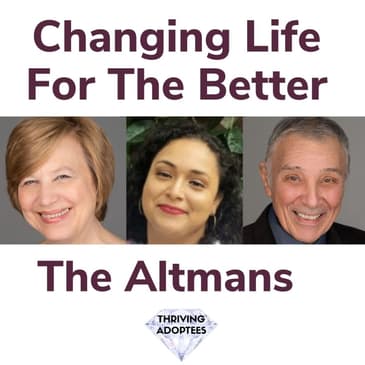
The Altman family was formed by a unique set of circumstances that no-one could have predicted. This episode is a little different to honour that. A profound dive into deep topics. Claire and Stan along with their daughter Stefanie share their learnings on unconditional love, growth and changing life for the better.
Find out more about them and the book they've written together at:
https://www.linkedin.com/in/stefaniemercadoaltman/
https://www.instagram.com/stefandrepeat/
https://www.linkedin.com/in/claire-altman-145b5512/
Guests and the host are not (unless mentioned) licensed pscyho-therapists and speak from their own opinion only. Seek qualified advice if you need help.
Want to learn more about thriving for you, your kids, your families or your colleagues? Pick a time to talk here
[00:00:02] Hello everybody, welcome to another episode of The Thriving Adoptees podcast. Today I'm delighted to be joined by the Altmans, right? So I've got Stan and Claire and Stephanie. Stephanie, to give you a full name, she's a Altman, right? Which is market in Spanish, is it? It is actually, yes. Yeah, yeah. Because I'm familiar with going on Spain on holiday, you know, super Mercado. There you go, it's a market.
[00:00:31] Yeah, we've got a super Stephanie on the show today, along with her mum and dad, Stan and Claire. So, let's start with Stan and Claire. Let's start with Claire, right? For ladies first. What does Thriving mean to you, Claire?
[00:00:55] Well, if I could sum it up succinctly, I think it feels like I'm growing in, you know, in depth of understanding and feeling and just knowing myself. As opposed to feeling stalemated, which I know is not a word, but... Like you mean, would you mean like stuck? Yeah. Um... Stationary.
[00:01:25] Right. So that's what Thriving means to me. Yeah. Yeah. And Stan, what does Thriving mean to you? Well, what it means to me is that the things I do in my life have meaning. Um... That it's not just going through the day, you know, surviving or just doing things that strictly serve me.
[00:01:52] But I do things that at the end of the day, I could say, uh... I added some benefits to somebody's life. I mean, it could be mine. But I think meaning is very important to me. And I... One of the things I do, since I work so much with young people in terms of the university world that I'm in, is to help them find meaning in their life.
[00:02:15] So that's kind of what Thriving means to me is helping young people find agency as I find my own agency. Yeah. Yeah. It's that continuous process. Yeah. Yes. And, um... So, uh... Stephanie, you... Let's check, because Stephanie's an adoptee, listeners, right? So, um... Stephanie was adopted by Stan and Claire after your mother's death, right? That was...
[00:02:45] And then you were living with them for a while before the legal stuff came good, right? Yes. So, if I put the word adoptees after thriving, right, what does thriving adoptees, what comes to mind when you hear that word, Stephanie? Yeah. I think, for me, it's a couple of things.
[00:03:08] I think, um, showing up authentically in life, whatever that means, if it comes to just showing up in your workplace, showing up with your family, you know, your loved ones at home, or, um... Extracurricular activities that one may have, or hobbies, just, um... And also, I think, along with that, having the ability to integrate your story in every facet of your life.
[00:03:30] Um, because, for sure, I think, as adoptives, we recognize that our story is kind of in the forefront of whatever we do, whether it's how we fit into a certain place or, um... You know, people ask us about our last name, but we may not appear as that culture, you know, because Altman is my last name, but I don't appear Jewish. So, people have questions about what that means, right? So we carry a story with us, and I think that's really important to have confidence in that and pride as well. Yeah. Yeah.
[00:03:59] So there's, um... We did an episode last week when we were talking, uh, when I talked to an adopted dad, and he talked about finding our place. And I thought that was great, because we could look at finding our place in the way that Stan's talking about it, like, the meaning, our place, where we can add value in the world, finding our place.
[00:04:22] And finding our place physically, as in finding our place to live, and finding a place to grow up. When our birth mother or birth parents can't, or, um, yeah, can't raise us, right? Your mum died when you were, was it four or six? Yeah, I was actually five. Yeah, so right in the middle.
[00:04:51] I was five years old, yeah, when she passed. Yeah. Yeah. That must have been... Well, how was it? Yeah, I mean, it was certainly tough. I think I was too young to really understand the concept of grief, or even just loss, you know? Because I think when you're, when you're five, your internal hope is that that person will come back. You know, but unfortunately, I mean, it just, reality is just, you know, once you pass, you pass.
[00:05:18] Um, but I think throughout the years to follow, I dealt with it appropriately in therapy and my parents were all huge advocates of just being self-aware and, um, holding grief in a way that wasn't detrimental to myself, you know, but just appreciating the good memories that I had with her in a very short timeframe. Yeah. So, yeah. Do you remember, do you remember your reaction to it, Stephanie? Yeah, I, I have to say I was pretty numb.
[00:05:45] Um, also I didn't, I think there was so much of a chaotic environment that I was already growing up with him that it felt kind of like this was a temporary thing that was happening to her. But obviously, it wasn't. Um, so I, I would say it felt numb, but then it really sudden when I was like seeing the days go by and didn't see her coming back home, you know? And people all across like my family and, you know, my parents and other caregivers that were saying, you know, she, she's in a better place and she's passed on.
[00:06:15] Um, and then just coming up, coming to terms with that as a child, you know, I think it's very hard. I think, you know, when you grow up with a pet and you see them pass, it's one, it's one thing and you learn about the concept of death, but to have your primary caregiver pass away is like a huge hit to the psyche. Right. So, um, it took a little while for me to understand what it meant, you know, but I eventually came to terms that and just dealt with the grief as it came in. Yeah. Yeah.
[00:06:43] Um, I, I remember my father, my adoptive father's dad, my, we, we, we, I called him pop. We called him pop. I remember him dying when I was seven or eight. And I do remember lying on my bed, crying and telling, telling, sharing that the bad news with, with my teddy bear. Right. People know that from, if you listen to the podcast before the significance of the teddy bear, but I remember that.
[00:07:08] I remember that distraughtness, um, and nothing more than that. I don't remember anything more than that. A tricky time now. A tricky time now. And the listeners, um, they've, they've, they've written a, they've written a book, uh, which you can find links to in their show notes. But there's something that's kind of, you, we don't often talk much about the story on the, on the podcast.
[00:07:37] It's mainly about the learnings, but I think in this, in this instance, because it's so unique, um, then it, it needs, it, and it frames the context for the conversation. So, uh, Stan and Claire were running, uh, an organization, started an organization to care for people with HIV AIDS. Right. And. Well, to care for homeless people, but it included people. Okay. Sorry. Yeah.
[00:08:01] So perhaps, Claire, um, can you just give us a little bit of context and how you, how you came into contact with, uh, Stephanie and Stephanie's mom? Well, um, interesting story. We, Stan had taken a leave of absence from Stony Brook University, which is where he was teaching and being an administrator at the time to do a study for the New York state AIDS Institute on the housing needs of people with AIDS.
[00:08:27] Because the city and I guess the state to had figured out that there was some survival rate of AIDS, even though the drug at the time, the only one was this AZT drug, which wasn't very effective. And, um, um, he was doing his study. And so he was doing his study. Some people urged him to also do housing. He tried to raise some money to rent a place from the Catholic church.
[00:08:49] Um, he did raise about $10,000 with some fundraisers, but then the, um, the human cry from the neighborhood who thought that AIDS was transmissible by the air, um, really said, not in my backyard. So, um, the lessor, the church backed away and Stan said to me, if your organization decides to do something for people with AIDS, I'll give you this $10,000.
[00:09:14] So with that big bankroll, we decided, well, we should really do something for people with AIDS. But we looked at the populations that weren't being served. Mostly the services were, this is now the late eighties were for gay men and, um, usually from, you know, Manhattan village, um, more middle-class neighborhoods.
[00:09:37] But we were seeing not only the rise in the AIDS with, um, drug abusers, but also with, um, the mothers. There was a positivity rate for AIDS of about 2% amongst, um, of the infants born in the Bronx, particularly back then, which epidemiologically is a high percentage. So we said, okay, nobody else is doing this.
[00:10:03] We'll try to focus on families with AIDS, which turned out to be mostly mothers. So we parlayed his $10,000 into $16 million and found a building, renovated it, and we created another NGO to run it. And I was the chairman of the board. And the first day we were open, May 3rd, 1991, I'm looking out the window to see if any of the people who said they were coming would come. And the first two people who walked up our stairs were Stephanie and her mom.
[00:10:32] Stephanie was a babe in arms, as it were. She was three months old. And, um, so I felt this instant connection and it kind of grew from there. Um, and, um, immediately I felt very protective of the two of them. We had, we had room for 90 people and we often had 90 people, but interestingly enough, I was really only drawn to be connected with Stephanie and her mother. Yeah. Yeah.
[00:11:03] And that led to, to eventually to the adoption, right? Um, yeah. Yeah. Yeah. There's, there's, there's a lot more, there's a lot more to it. And, uh, I guess that's what the book is going to be. Uh, so people can check, check that out. Um, you, you, you've all, you, you've all touched. Well, Stephanie and Claire, you've touched a little bit on identity and, and, and story and those, and authenticity.
[00:11:29] So what, uh, what does that perhaps, if I could ask you that question, what, what does, what does, what do those terms mean to you, Stephanie? Identity and just identity, you, you, identity, authenticity and story. How do those three things come together for you? Yeah, for sure.
[00:11:52] Um, I think, you know, I, I jokingly refer to myself as a coconut that I am brown on the outside and white on the inside. Like I do carry, and also to pay homage to my Puerto Rican heritage, you know, in the tropical way of that sense. Um, but more seriously, I think on a, on a way that holds, uh, both sides of my story. Right. Um, and when I, I mean, when I just show up in space, I think I was talking to this a little bit earlier, just having confidence.
[00:12:22] If people ask me like where I'm from, I just say, you know, I'm a, I'm, I'm Puerto Rican by, by blood, but I'm also adopted. If the adoption piece does come in and it's appropriate to share. Um, and just, I think, you know, not being shy to, to share with people that I am adopted. I don't think there's any shame at all to, to say that. Um, and I think people, it kind of piques people's interest in terms of like the story that there, that comes with it, you know?
[00:12:49] Um, and then how identity is within that story and how authenticity comes out as well. Yeah. Was there a journey? Cause there's the, there's the humor and then presumably before, before the humor, there was some, there was a, a piece I'm guessing. Yeah. And before the piece, there was a little bit of perhaps, I'm guessing, was there some kind of consummation or confusion or, um, dysregulation around that? Some, some, some upset about that.
[00:13:18] Was that a journey for you to that way right now? Yeah. Yeah, absolutely. And I think to this present day, I still struggle, uh, sometimes with holding both equally in certain spaces or, you know, I'm with, um, Um, I think one side comes out more than other sides do given on this situation. Cause, um, I think it's fair to say I had, I had a pretty, you know, uh, fair exposure to my family of origin.
[00:13:43] So I'm able to hold onto that, uh, Puerto Rican heritage a little bit stronger than if I were a kid, like a toddler or a baby, you know, adopted back then. Um, um, yeah, no, so I think there, there has been maybe dysregulation or not, not, not confusion. Cause I think, um, I, I hold pride in both stories and both identities in that way.
[00:14:07] Um, but it's certainly something that I kind of feel is a inherent limbo or kind of just, it's kind of a, a void space in some ways. Cause it's hard to occupy too, but you know, in certain instances there's, I'm able to lean into one or the other or even both. I mean, it depends on some very fluid or kind of like a chameleon in that, in that way. Yeah. You know? Yeah. So, um, but you, as you say chameleon, you're smiling. Yeah. Uh, yeah.
[00:14:37] And some, some adoptees, uh, are annoyed at having to be chameleon, right? Or, um, some others view it as, as a strength, right? That we can, people say that, you know, we, we grew up having to read the room. So we're good at reading the room and we can be, we can be a chameleon. That's an empowerment thing. That's a superpower thing.
[00:15:05] Um, so what, what's, what is your take on, on chameleon-ness? How do you see it? Superpower? Or a natural by-product? Or, you know, what's your view on that? Yeah, for sure. Um, I think it's a double-edged sword in some ways. I think there is the kind of the superpower aspect to it that is, um, very cool in the
[00:15:32] way that you can, I don't know, just for me, I'm, I'm easily adaptable, I think to, you know, to different settings or situations that I'm in. Um, but I'm also, I think just as a person inherently empathetic. So I'm able to read a room, you know, inherently. And, um, I think that adds to kind of the presence of the strength of being quoted chameleon in whatever case it is. Um, but I think the other side, right, is that, you know, how chameleons change color? Like, what are your true colors as an adoptee?
[00:16:02] You know, in terms of like, what's your inherent quote DNA or like whatever that is. I mean, your, your DNA is inherently just what it is inside biologically, but like, you know, I think it can be a little bit in the U.S. in terms of like where you do fit in, you know? So there is kind of like, you kind of teeter-totter on both ends. So I can appreciate both sides, like the complexity and kind of the frustration that you don't fit into a particular spot or, or space or situation.
[00:16:32] Um, but there is kind of beauty in the way of being, uh, being adaptable and being, um, you know, flexible in ways that maybe others can't be, right? So yeah. So maybe it's about identity is, is more about how we feel about our identity rather than the identity, the identity itself. Yes, for sure. Yeah.
[00:17:01] Yeah. That's a really good way to put it. Right. Cause there, we, we do have ourselves when we have our emotions right around it and how we react or respond rather. Yeah. You know, it's, um, I've never thought about it quite like that to the, to that moment. It, and it goes onto a bigger question or a kind of a similar question for me. It's about, um, you know, if we think about trauma, then there's the, then there's the feeling,
[00:17:32] our feelings about our trauma. Right. So if we, if we are less scared by big emotions coming and going, right. And then we're not trying to suppress the emotions or put a lid on the emotions or we're not explosive about those. So it's more about, it's more about how we feel about our trauma. So if we think, right. Oh, here, here it comes again. What, why won't these feelings of insecurity go away?
[00:18:01] I'm destined to love, you know, like I'm destined to live, you know, live in this trauma for the rest of my life. I'm, I'm snookered. We would say maybe in the British, you know, I'm stuck with it. Right. So it's more, it's more about our feelings towards our identity or towards our trauma than it is to do with the actual, um, trauma or the identity itself.
[00:18:25] And it seems to me that trauma is on one hand, it's very, sorry, identity on one hand is very complex. And on the other hand, it's very simple too. Right. So I, I point to this, I point to this, the, the, the thriving adoptees logo is a diamond. Right. And I say, well, that's, that's, that's, that's our metaphor for who we truly are. That metaphor, that diamond is hidden, sometimes hidden below that as of common.
[00:18:54] But that, that's it really, you know, um, but then we could look at identity on a far more complex way than looking at it. Um, so I want to bring in, uh, you, Claire, if I can, on, on the identity, because you talked about part of thriving is knowing, knowing yourself. So what, what do you mean by yourself when, when you say that?
[00:19:24] Um, I guess it's being comfortable with self, um, in part. And, um, growing up, I grew up in Tennessee and I was always kind of an outlier, um, within my family. Um, they, um, and, you know, I, I, I, from an early age, I mean, it was in the late fifties, early sixties. I grew up around the civil rights movement.
[00:19:53] My family was all Caucasian and I really resonated with civil rights leaders. Um, and at one Thanksgiving dinner, I had brought a, a long playing record of Martin Luther King's speeches. And I put it on the record player and everybody at the Thanksgiving table got up and walked outside in the freezing cold. And I, I was, I guess, you know, comfortable being out an outlier. Um, that's all I can say. Um, there wasn't a whole lot of connection in some ways.
[00:20:22] Um, and, um, so that meant being alone, although I also found friends and people I related to. And so, um, I guess when Stephanie and her mother walked up the stairs to our center, um, I felt confident that somehow there was a connection with these two people.
[00:20:43] Um, so I think it's, um, and I've, you know, the, this facility that we created, this residence, um, there was nothing like it in, frankly, in the country. And, um, so I felt confident knowing who I was that somehow we could pull this off, even though it's a steep, you know, we're taking care of people with very serious illness and so on and so forth.
[00:21:09] And we were responsible for their care, but I thrive because I never doubted that, uh, with help, not by myself, but we could do it. And, um, so I think that's, that's kind of what it's like for me. I've taken on things like that, but knowing that there will always be some people around that can help. Yeah. Yeah.
[00:21:32] Um, so you, have you got any, uh, have you got any idea where the confidence in being an outlier came from? Or do you feel that this was just innate? It's as long as you can remember. Um, as long as I can remember. I mean, nobody told me it was a good thing to be an outlier.
[00:21:56] You know, in fact, they chastised me for that, but, um, somehow it just felt if I followed my internal moral compass about what was right, then it would work somehow. Um, we, um, we got a lot of grief, I guess is not grief in the sort of common sense word. Bush part. Yeah.
[00:22:23] Um, when we created this center, um, the state department of health commissioner was a big supporter of us. But then right before we opened, he had a stroke and died. And so it was like the chickens come home to roost. So all the people in the health department who didn't like us came out and they were, you know, trying to close us down and this and that and the other thing. And, um, somehow it just was in me that we weren't, I wasn't going to give up on, um,
[00:22:53] um, the, in fact, one time the New York times called and said, the health department is called and said, there's one of your residents beating his head against the wall. Can you explain that? I said, well, they got it part, right? It's not a resident. It's me. And because they're driving me crazy. And if you want to the New York times, please be my guest. And they were like, oh no. Okay. Um, but I think also with Stephanie and, um, adopting her Stan and I both, you know, once he got to know her, we both felt committed.
[00:23:22] And, um, some people said this was a kind of crazy thing to do. And we, you know, it perhaps wasn't rational, but we felt that, um, being, you know, none of our friends were doing anything like this. And we were kind of a little bit older in our forties and fifties for adopting a child. And, um, so we just felt sometimes like, if you know, in your heart, it's right. You just do it. Yeah. Mm-hmm.
[00:23:52] Good. Because so much of stuff, so much of the things that we do, um, aren't rational at all, are they? Stan can speak to that because he's the rational one here most of the time, but Stephanie changed that. Oh. She didn't change me from being rational. I mean, I'm, you're sticking with your rationality, right? No, I think what, um, I'm smiling listeners. You can't see that. Maybe you can hear that in her voice. Sorry, Stan.
[00:24:22] No, I think what Claire is referring to is that, um, you know, my growing up was in an environment where my mother was very, very ill. She was, um, she had rheumatic fever as a child and ended up having an extended heart and was, was warned about having a child. And so when she gave birth to me, she was very sick. And, um, as a result, I got a lot of negative feedback from my family.
[00:24:51] In fact, growing up, um, I had so many male cousins that we were being compared against that one of the ways I learned to survive was really suppressing my own feelings about things because it was just too painful for me. And so I worked very much in my life about doing things rationally through my head, not my heart.
[00:25:14] And, um, one of the things with Stephanie is I've often said she never accepted that as an acceptable way to relate to each other. Whenever I would try to close my heart to her, she was like, no, you won't. And, um, it made me kind of recognize that at some point, listening to my head was not always the best advice I would get.
[00:25:38] In fact, uh, my initial reaction to becoming Stephanie's guardian was that this was a terrible idea. Uh, I'd gotten to a point in my life where our two sons from an earlier marriage were out on their own. Um, Claire was doing work in Florida and I had just accomplished some major, uh, achievements at the university. And so I was working out of Florida, Miami Beach.
[00:26:07] And I said, I have such a wonderful lifestyle. Why would we get involved with a four year old girl? Um, and then I realized how much it meant to Claire and I had to sort out, you know, on the one hand my head says no. And then I realized my heart said, if it mattered to Claire, then it ought to matter to me because we're in this together. And so I think at that moment I learned to listen to my heart more.
[00:26:35] And, um, for me, one of the important parts about identity, I spent a lot of my life, you talk about chameleons. I think all three of us share that, that aspect. That is we contorted ourselves to make other people accept us and like us. And then at some point I realized I didn't know who I was anymore because the things that mattered to me were getting sacrificed to make somebody else happy.
[00:27:05] And then when I realized that that wasn't working, I began to really trust my own inner voice more. And, uh, so I think I, I think I think things through a lot. I think I'm pretty organized, but I don't always do the things that one would expect, um, a rational person to do. Yeah.
[00:27:30] Some, some great insights on your, your, your learnings, uh, through raising Stephanie. Um, if we can move back to you, Stephanie, then what, what have been your most kind of significant learning moments, uh, over, over the early period, peers, um, sorry, the early part of your life or whatever part you, you'd like to share in terms of the thriving stuff. Yeah, for sure.
[00:27:59] I think, um, one of those is, I think being unwavering in your story. I think writing this book made me do that, you know, it forcibly was like, okay, this is for the public now to read. It's not just for our family of knowing it and just like our immediate family and friends knowing how we became the family.
[00:28:16] Um, and I think through that, just being confident and whatever that, what, what my story brings, uh, and I hope that I can bring to someone else in terms of just helping them with their thriving, whatever, like, you know, uh, means for them. Um, do you mean determined when you say unwavering, do you mean like, I'm gonna, I'm gonna persistent and I'm gonna stick at it? Is that what you mean?
[00:28:38] Yeah. Yeah. I think persistent, confident, um, being, you know, just authentic in telling your story, not giving sort of a half version, but just the whole, the whole version. Um, again, when it's appropriate and you do feel like you want to share or when I do want to share my story personally. Um, yeah. And just, I think it kind of propelled me into that space because before I was probably more surviving with my story than actually thriving in it, you know?
[00:29:05] Yeah. A lot of people that I've interviewed say it's, it's very, uh, it's very healing. It's very empowering writing story. And it also allows people to get put a bit of distance between them themselves and their story. Yeah. So like, like, oh, the question is right. Are we our story?
[00:29:31] Yeah, I think inherently, I think inherently, we probably are a different version at this, or at least for me, like I'm a different version this present time and day after having written this book for the last, well, it came out in October, but for the last couple of years, we were really working at it. Um, and I think through the process I w I was feeling, uh, in different aspects I'd never realized and also just embracing the adopted identity that I do carry that I really never looked at until now. Yeah.
[00:29:59] And I was like, oh, there's a whole self-exploration area here that I can take part in and volunteering or just relating to other adoptees. Um, but I'm excited to see what comes with it, you know? Yeah. Yeah.
[00:30:11] So I guess you, you know, it's about embracing it push, I guess, pushing away our, or denying our story or our status as an adoptee. That's going to get in the way of our thriving. What, what other obstacles do you, do you see, or have you encountered on the journey to, to thriving Stephanie?
[00:30:39] Yeah, um, absolutely. I think at times there comes with maybe unresolved grief or loss, you know, in terms of the people that I've lost along the way to get to my point of adoption when I was 11. Um, I also think, you know, the, the chameleon aspect, I, or the chameleon phenomenon in terms of like how you do fit in. Um, I think is going to always coincide or be tangent to how.
[00:31:08] I do show up in spaces. Right. Um, so, uh, I think those are probably, probably the two biggest that I can mean personally for me. Yeah. Yeah. And, and when, when you say unresolved, does that mean stuff you've not looked at? Does that mean the grief that you've kind of pushed away or what, what is, what, what, what is unresolved and what does resolution mean to you?
[00:31:35] Right. Yeah. I think, um, probably not unresolved, probably more so in the way of the, the ever present grief that came, especially along with like losing my mom at a really, really young age. You know, I think that's always going to be inherently something that I carry with for the rest of my life. Um, so it's probably just, it's, it's a little bit of the, the more melancholy feelings that I think come with being adopted.
[00:32:03] You know, that are really not a hindrance or, or anything like that, but they're, they're just something that we, at least for me, I can just submit to just having that be another side to my identity that I carry with me. You know what I mean? Yeah. Yeah. And just being okay with that. Being okay with it. Yeah.
[00:32:26] It's been kind of being okay. What, what are my mentors used to say? If, if we're okay with not feeling okay, we're always okay. Right. Exactly. And leaning into the discomfort sometimes or the sadness or whatever. Yeah. Leaning into it. Right. Leaning into it to me, as you're describing it, is another word for resolving it.
[00:32:54] Or perhaps the leaning in comes first and the resolution comes as a, as a, um, an after, an afterthought or through that, through that process.
[00:33:07] Because we talk, we, we hear so much about people trying to, I mean, you, you use the word numb, but we hear of, we hear of adults trying to numb their pain through substances, shopping, you know, the whole, the whole nine, the whole nine yards. Uh, so we're, we're trying to numb stuff. We're trying to suppress stuff. Stan, you talked about keeping, keeping stuff down.
[00:33:37] Uh, I, I recall on this, my, uh, I saw a therapist for a couple of months, maybe 12 years ago, something like that. She gave me the, she gave me the notes, uh, after, at the end of our six sessions.
[00:33:56] There weren't a lot of detail on that, but it says, um, I was thinking about it when you said this earlier, Stan, um, Simon avoids emotions and goes to the safe place of cognition or something like that. Yeah. Yeah. Yeah. So, um, um, embracing, leaning in, leaning into grief is the opposite of trying to push it away or put a lid on it.
[00:34:29] What, what, what do you make of that, Stan? Well, I think that's true. I think one of the things I've learned, um, over the years is that at some point is to just, I think I often describe it to Stephanie as just let the pain and the fear go through you like a wind blowing by. That is, you don't have to hold onto it. It just, you know, it's a transitory moment.
[00:34:56] And so at some point, except the fact that I'm in a place that maybe I don't feel good about something, but it'll pass. Yeah. Um, I think there's, uh, an innate issue that is tied with identity about beginning to at some point, except who you are and love yourself. I remember the first moment I was at some kind of event.
[00:35:20] Um, and it was unusual because there were a lot of people that I would normally try to kind of fit in. Um, and this particular night I didn't feel like fitting in anywhere. I was just sitting by a fireplace. And some attractive woman came over to me and was trying to, um, flirt with me. And I suddenly said to her, no, that's okay. I'm really perfectly happy being all by myself right now.
[00:35:45] And I think becoming comfortable with yourself, um, not being afraid to deal with some of this is, um, um, also I think the thing I learned when I had to make the decision about where are we going to go forward with adopting Stephanie, about realizing that this wasn't about me anymore. This was really about how much I loved Claire. And I had no idea how this was going to turn out.
[00:36:12] And at some point just trust the fact that somehow our love would get us through all of this. And once we decided to do it, we never looked back. Yeah. It wasn't Claire that came to interrupt you by the fireside I'm taking. No, no, no, no, no, no. This was years ago. I was at at Stony Brook. It was one of those pre-Christmas parties where people get wild and decided they can get away with anything. And I, at some point I looked at all of this and I said, this is, this isn't me.
[00:36:43] This is just crazy. Yeah. I've been saying a few, with a few interviews recently that this whole, this whole thing of it, the, the adoption not being about us. Right. And I'm saying, I'm saying this from an adoptive parent perspective. Right. So you're saying the adoption, it wasn't, it wasn't about, it wasn't about you.
[00:37:12] And I've always felt that my parents' adoption of me wasn't about them. It was about me. And this is, for me, this, this, this is a real clear delineation there. We're in a one. And if it's not about us, I don't know.
[00:37:42] We're not, we're not, if it's about us, we're, we're being narcissists, don't we? Well, there's something, yeah. Yeah. I think. If you're on Facebook, every man in the world is a narcissist. I think that's one of the challenges these days. But, you know, that's a real clear indication. Is it about, is it about, you know, to what extent is it about us?
[00:38:10] And I'm thinking of the, the mentor of mine that said, if we're okay, we're not feeling okay. We're always okay. She said to me, well, Simon, you're too wrapped up in, you're too wrapped up in how many people listen. To the podcast. Right.
[00:38:32] I asked her how many copies of her book had, you know, been sold through Amazon or wherever. And she hadn't got a clue. Because she wasn't interested in that. It was nothing to do with, it was nothing to do with her. It was, if I write this book and it helps one person, then that, that, that's enough.
[00:39:01] And I think I've got more peace on, on the, like the podcast downloads than I used to have. Right. But it's still niggling your way there. Mm-hmm. Yeah. Wouldn't it be great if we had more, more time? Yeah. Yeah. Yeah. Sorry, I went off on a bit of a tangent there.
[00:39:28] How, how do you see, how do you see the relationship between trauma and thriving? Perhaps Claire would ask you about that. Well, I, I guess I, I certainly agree with Stephanie and Stan that trauma, I mean, many of us, maybe all of us go through some kind of trauma.
[00:39:56] Um, and if you hold onto it and you think how terrible it was, um, then you're going to feel terrible, I think. Uh, and, uh, while it's not to ignore it, um, um, I think, you know, dwelling on it too much, um, you get stuck in it.
[00:40:18] And if you recognize what it is and it's, you know, my trauma was, um, whatever it was. And, you know, I can now look back and say, well, I got through a lot of things. Um, I didn't resort to shopping or drink or whatever, you know, and so I must have gotten through it.
[00:40:42] And then to be able to really feel like given a gift, um, in our case with Stephanie, which very much outweighs the trauma and brings this great blessing, which, um, was a, you know, had a lot of struggles attached to it when we were sharing custody with her mother's partner and other things, but that, um, I don't look back at those things as being traumatic to me.
[00:41:08] I look at those things as hurdles to be able to get what we wanted to do was to help Stephanie. And a concept that one of, um, I guess I could say mentor, but he's a fellow, Stephen Post, who wrote the forward to our book. Um, a concept he's kind of turned this onto is the idea of adoptive love, which is, you know, basically, I guess you would define it's definitely about the other. And, um, this is not about us.
[00:41:37] It's about, um, the kind of love we feel for Stephanie. Um, and, um, the other thing I, it's a little tangent, but the other thing that I, I know what you're talking about with, you know, counting the listeners to podcasts and in the early days after our book was published, I was looking at, you know, how many are selling and then it stopped mattering.
[00:42:02] And, um, it, um, I think the one thing that came through is a lot of people have commented to us. They didn't write reviews on Amazon or some other place, which maybe would have been nice, but the most, most, um, I don't know, heartfelt review that we've gotten, or at least for me is how many people said, we really appreciated your honesty. And I thought, well, why would you write a book and not be honest?
[00:42:29] You know, but I guess that people do that, but, and it's what Stephanie said, you know, writing the book helped us to, um, come with our feelings and just sort of in some ways without labeling this, make peace with things, um, because we could talk about them and be willing to share them with whoever might hear us or read the book or whatever.
[00:42:53] Um, and that, um, I guess, you know, that's a rewarding thing. Yeah. One of the things that I've been seeing recently through interviews is, is this truth that feelings come and go, like Stan said, um, if we don't hang, I mean, and you said it too, in terms of like hanging onto them.
[00:43:24] So if we, you know, trauma is largely a felt, a felt thing, something that's felt. Our feelings come and go, but we somehow we treat, we designate trauma as something that's kind of ever present. Whereas the feelings seem to come and go, right?
[00:43:52] We, we treat trauma as if it's a monolith rather than the feeling. And I don't know if that is, is that too far out? I don't know. No, I don't. I might express it slightly differently. And so I think for me, the trauma was like an overwhelming experience for which I needed to find a way to stay safe. And so I created this other world in which feelings no longer were part of me.
[00:44:22] And at some point, as I got older, um, and ironically how much of this is really tied to Claire and I finally getting together, but finally realizing that these were artificial walls that I created at a time when I was very vulnerable as a child. And I'm not a child anymore. That is, it's time to let go of the walls. And at some point they were gone.
[00:44:49] And again, it's not that I don't reflect every once in a while on what it meant growing up and kind of in some ways having been an abused child. But, you know, the other side of it is I say to myself, well, it's pretty amazing. I grew up in the South Bronx of New York City, which was a very poor neighborhood. And here I am. I've been a college president. I've been a dean of a school. I've been, you know, I had a career.
[00:45:18] If you would have asked me when I was growing up whether I could aspire to this, I wouldn't even have known what this thing was. Could I have experienced the joy of watching Stephanie grow up and getting ready to get married? I would have told you you were crazy. That's not in my future. And yet here it is. So I think, you know, it's like so many other experiences we have. We then build up a world that we see the world through, which is not real.
[00:45:49] And for me, beginning to see the world as it is, beginning to see people as who they are is very important. And I think that's for me has been one of the most meaningful things in my life now, is that I no longer have to construct these artificial stories about other people I don't even know, or even assume that I know all the answers. Yeah. Stephanie, you were going to say something about trauma and feelings?
[00:46:20] Yeah, I think, you know, I actually, it's a story that I want to have illustrate a point. I think, you know, when you break a bone, you know, and depending on the weather, like, when I was a kid, I broke my ankle, my right ankle during a basketball game. And, you know, to this day, when I go to the gym or whenever it's cold outside, it depends on what's going on. And sometimes that ankle will feel iffy or just feel off.
[00:46:47] And I think trauma is kind of the same way, like we learn how to deal with it and adapt. Because it's going to be like a, it's going to be a scar, I think, that we carry. But we, it may fester, sometimes it may not. And I think it's just going with the flow of how that persists, you know. Yeah. It's a bit of a sore spot, but we adjust and can draw strength from it, if anything, and just forge that whatever bad happened into something hopefully good for us that we get stronger.
[00:47:18] You know. I want to go back to something that you said, Stan, about the walls. You talked about the walls coming down. What was it that brought the walls down? Well, I think it was probably, and this may sound odd,
[00:47:43] at some point I realized that I was spending so much of my life making other people happy and therefore denying parts of myself that I wouldn't do it anymore. And at about exactly the same time, very shortly thereafter, my oldest son decided he wanted to now spend more time in New York City with me. And so I decided to throw a dinner party to invite some other people.
[00:48:09] And I happened to invite Claire, who, we were in the same social circle, but didn't really know each other very well. And over a very short period of time, we really began to connect with each other in ways that I would have never expected. And I would say that experiencing unconditional love from Claire was like a shock because I'd never experienced it before.
[00:48:35] Every one of my relationships, including growing up in my family, had all these conditions on it. I love you if. And in Claire's case, there was no if. Yeah. And I think for me, at the beginning, it was kind of overwhelming. I didn't know how to deal with it. But I think that ultimately said to me that she has my back, which is why when we got around to the question about Stephanie,
[00:49:05] I had to say to myself, if we're really in this together and she always has my back, shouldn't I have her back? And so at that point, my heart prevailed and said yes. Yeah. Yeah. So similar sort of question to you, Stephanie. What was it for you? What was it that eased that pain?
[00:49:31] You know, using your metaphor of the ankle, what's eased the emotional pain rather than the physical pain of your ankle? No, no, for sure. That's a great question.
[00:49:48] I think for me, what was always prevailing was the fact that my parents were always, always open to discussing what was on my mind, I think, as a kid. Because if I had gone to my caregivers at the time of my family born and about anything, I was either chastised. I was either just shut down with no invitation to really explore emotionally what was going on. But it's like, oh, you'll get over it. It's fine. It's fine. Just keep going.
[00:50:18] You know, there's no consideration of like how anything would be dealt with emotionally. It always was suppressed. And I think with my parents now, you know, in the past too, it's always been a very open and honest space that we are able to tap into, which is great. And I think as I showed up a little bit, it wasn't just like me plunging into like, oh my God, this is what's going on with me right now.
[00:50:44] But I was pretty quiet as a kid, but I think as I learned and was urged to just share what was going on with myself internally and also seeing the safety and the trust that was fostered in those moments, I think was, okay, like I can step into this. Like the water is not going to be too hot. I can tread in and just kind of walk in slowly and get deeper, which is, yeah, I think just by little happenstances, that's how I grew into trusting. Yeah. Yeah.
[00:51:16] Happenstances, you mean lots of little events? Lots of little steps, yeah. Yeah, just testing a little bit and a little bit and a little bit, yeah, just to see how okay it was, you know. Yeah. Yeah. So we're coming in on time. I just wondered if, is there anything else that you'd like to share that I've not asked you about? I think one thing I would say, Simon,
[00:51:42] one of the things that many of our friends have said is how lucky Stephanie was in terms of what we've done for her. And Claire and I often have to remind them how lucky we are. Yeah. Because this isn't a one-sided change in life. You know, I mean, she's changed our life for the better. And, you know, we've watched her grow up. And so we get a sense that we've changed our life for the better.
[00:52:08] So I think it's important to recognize that the whole adoption process, if done with an open heart, and I think if done with the honesty that what you're trying to do is raise a child to be a full person, that it's about their growth, not about your possessions, I think it's a win-win situation.
[00:52:32] So I think we're just feeling very blessed over the fact that this all happened. Yeah. Yeah. I mean, that echoes what I think what you said earlier on, right? It's about Stephanie. It's not about you. Right. And for my parents, it was about me, not about them.
[00:52:58] I think that's very important, not just for adoptive parents, but for parents, period. Yeah. That is, your child, your job is not just to own them. Your job is to prepare them to live their own personal life in a way that makes them feel fulfilled. Stephanie, have you got anything to add that I've not asked you about? Yeah. Yeah. I mean, I just wanted to say I really relate to your logo, Thriving Adoptees,
[00:53:27] because I think our story shows kind of the forging that we had to go through, all the burning and the shedding in terms of just, you know, all the circumstances that happened for us to come to the final product, which was this diamond that we all saw in the rough, but we were aiming towards and working towards, you know? Yeah. So I just want to say I appreciate your logo and the thought behind it. And how that really relates to a lot of, I'm sure, adoptee stories too. Yeah. You know, just ours.
[00:53:57] I had a realization last week about the diamond. Like, so I talked about excavating diamond mining, right? So you've got to go through the layers of rock to find the diamond in the physical world. Right. And in the adoptee space, sometimes we have to go through the layers of the trauma to find the diamond under the needle. Exactly. But the diamond was always there. We just hadn't found it. Right. Yeah, exactly.
[00:54:28] And just having the courage to go through it, the excavation process, the processing process, right? And it's an excavation process. And it's as simple and as tricky as that. Yes. Yeah. Yeah? It's layered, for sure. It's layered. So on one level, it's really complicated because of all the layers. But on another level, it's really simple because it was always there right along. We just didn't see it.
[00:54:56] Because somewhere along the way, we picked up this idea that we weren't good enough. Right. Yeah. That's a thought, right? Mm-hmm. That's a belief. We're not born believing anything. No. No. It's true. And I think our stories do formulate ideas of who we think we are, right? Yeah. Until you have to excavate through the stuff. You have to excavate through. Extra stuff, yeah. Yeah.
[00:55:24] And see that the story's not true in some instances, right? The story in our head about who we are. Exactly. It isn't the truth. You know, we've had the wrong track on repeat. Yeah. Exactly. Somebody gave us the wrong record. Somebody gave us the wrong record, yeah. Yeah.
[00:55:50] So we take on what, like, that's what happened to you, right? People were telling you that the stuff was down to you. It's down. People were making it about you, making your mother's illness about you. Right. Good way. Yeah. Thanks, guys. Thanks so much. And thanks to listeners. We'll speak to you if you have a break soon. Take care. Bye-bye. Thank you, Simon. Have a great day. Thank you.
[00:56:21] Bye-bye. Thank you. Bye. Bye. Bye. Bye.