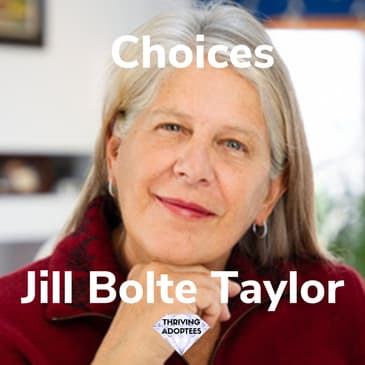
Most of us aren't choosing how we feel most of the time. Most of us aren't choosing what we think most of the time. Our trauma is choosing our thoughts and feelings for us. So how DO we choose? Listen in as neuroanatomist Dr Jill Bolte Taylor dives deep into learning to choose. Fascinating and empowering.
Dr. Jill Bolte Taylor is a Harvard-trained and published neuroanatomist whose research specialized in understanding how our brain creates our perception of reality. She was interested in this subject because she has a brother who is diagnosed with the brain disorder schizophrenia.
As irony would have it, in 1996 at the age of 37, Dr. Jill experienced a severe hemorrhage in the left hemisphere of her brain. On the afternoon of this rare form of stroke (AVM), she could not walk, talk, read, write, or recall any of her life. It took eight years for Dr. Jill to completely rebuild her brain to recover all physical, emotional, and thinking abilities.
Dr. Jill is the author of the New York Times bestselling memoir My Stroke of Insight: A Brain Scientist’s Personal Journey (published in 2008 by Viking Penguin), which is still often the #1 book about STROKE sold in the Amazon marketplace. In addition, her second book WHOLE BRAIN LIVING: The Anatomy of Choice and the Four Characters That Drive Our Life was published in May of 2021 by Hay House and is now readily available.
In 2008, Dr. Jill gave a presentation about her experience with stroke at the TED Conference in Monterey, CA, which was the first TED talk to ever go viral through the internet. TED and Dr. Jill became world-famous instantaneously and that TED talk has now been viewed well over 27.5 million times. This 18-minute presentation catapulted Dr. Jill into the public eye, and within six weeks of presenting that TED talk, she was chosen as one of TIME Magazine’s 100 Most Influential People in the World, she was the premiere guest on Oprah’s Soul Series webcast, and her book My Stroke of Insight became a New York Times bestseller and remained on the list for 63 weeks.
Dr. Jill is passionate about educating the public about the beauty of our human brain, and she is committed to not only helping others find their way back from neurological trauma but is eager to help everyone better understand their brain so they can live their best life. Her Foundation Jill Bolte Taylor BRAINS is dedicated to providing educational services and promoting programs that are related to the advancement of brain awareness, appreciation, exploration, education, injury prevention, neurological recovery, and the value of movement on mental and physical health, as well as other activities that support this purpose.
Dr. Jill remains the National Spokesperson for the Harvard Brain Tissue Resource Center (Harvard Brain Bank), whereby she educates the public about the shortage of brain tissue donated for research into the severe mental illnesses. Since 1993, she has been an active member of NAMI (the National Alliance on Mental Illness), by serving for three years on the National NAMI Board of Directions and later spent over ten years as the president of the local level NAMI Greater Bloomington Area affiliate in Bloomington, Indiana.
https://www.ted.com/talks/jill_bolte_taylor_my_stroke_of_insight
https://www.instagram.com/drjillboltetaylor
https://www.facebook.com/DrJillBolteTaylor
https://www.youtube.com/channel/UCHfUhV_xjrJLPiLZSlTRNvg
Guests and the host are not (unless mentioned) licensed pscyho-therapists and speak from their own opinion only. Seek qualified advice if you need help.
Want to learn more about thriving for you, your kids, your families or your colleagues? Pick a time to talk here
[00:00:00] Hello everybody, welcome to another episode of The Thriving of Doctors Podcast.
[00:00:05] Today I'm delighted to be joined by Jill, Dr Jill Bauti Taylor, really looking forward
[00:00:10] to our conversation today, Jill, yeah.
[00:00:13] Thanks, Simon.
[00:00:14] I'm happy to be here.
[00:00:16] Cool.
[00:00:17] So, Jill is a neuroanatomist.
[00:00:20] Now, I've heard it, did you used to call yourself a neuroscientist and then you became
[00:00:26] a neuroanatomist or... So it's all about the insights that you had about, well, about all sorts of things really. And today we're gonna be looking at that in relation to the Adoptee experience. So as Adoptees, we've got this thing, we suffer this thing called separation trauma.
[00:01:42] And I was looking at a reference to start the conversation
[00:01:46] and I found one on betterhelp.com. machinery, and there is an energy that drives the force of that cell to multiply and divide, and multiply and divide, and it's multiplying the DNA, and then repackaging that DNA inside of new cells. And in the womb, we develop at a part of mom's energy, but now I become a separate energy entity. And then depending on when the separation from mom happens, be it an immediate adoption where there's mom all, if I'm removed physically from mom, there's even a higher level of anxiety. And as a society, we've not a stressful environment, it's stressful for mom because mom needs to who is a biological creature must be experiencing in order to not have attachment. And it's not just not have attachment, but not have attachment for all these external, that is the point at which we all of a sudden now you're and you're protected, right? That womb is very protected and sounds are not clear. They're muffled through through water and light is
[00:11:02] muffled and and and we're we're you know, routinizing in the trauma circuitry where that's not where our power is. It is important to have that circuitry and it is important to have that trauma and it is important to be able to go and reflect upon it, but not to make a lifestyle of it. So no matter what the trauma is that any what I might call healing would be what you might call learning and growing. You're separating us from our story. Well, I'm not separating
[00:13:42] you from it. What I'm saying is it's a story. That's all it is. that's important information. But by looking at that information and realizing, well, that's a story. Okay, how can I know the bigger picture? That gives me the either the impetus toward diving deeper into the story. Oh my God, I can't anytime I see a snake now, I'm going to be filled with fear and I'm
[00:15:05] panic and I'm going to want to kill the animal or I'm going to want to run away or I'm going
[00:15:08] to get paralyzed. Mother a separation of mother and and child and the child has gone off to be the mother's place for adoption. So How does that separation become a feeling that there's something
[00:16:23] Wrong with us there one of the fundamental I thought, oh, that's strange because I've known I was adopted forever. Right. I don't remember being told I was adopted. Right. It's kind of curious that my parents didn't tell me that the teddy bear was from my birth month. And actually, my mum says now that they did tell me that the teddy bear was from my birth month. But for some reason, I didn't remember.
[00:17:41] Probably too young and it didn't register.
[00:17:43] It didn't register.
[00:17:44] Right.
[00:17:45] So then I went to, I was going to see a coach In the adoptee world, we use this term coming out of the fog. Right? So coming out of the fog is when we become consciously aware of something, we become consciously aware of some form of trauma related to our adoption.
[00:19:00] And the woman that I was speaking to at the we are one, and that really struck me because as adoptees we feel that we're not good enough independently, that's going to be cells in my brainstem that tell me to do that and control that. My heart beats by itself. I don't have to consciously tell it to do that. It does that. So I can perspire automatically. So those cells have to be completely wired by
[00:21:41] the time we're born. And then the of course, you have this well of emotion that you're wired for and you are wired for emotion from your past. We carry that circuitry. We are wired to have those experiences. So once you found out that you not
[00:23:02] only were you adopted and you thought that you were okay with
[00:23:05] that or, you know, at least it is really complex as soon as, as which is, you know, you look at society. And why on earth is, is a portion of society trying to keep abortion and pray and information
[00:24:22] about contraception hushed and away from our young children, our young girls so that they to story. But the most important piece here is that we are feeling creatures who think we human beings, we because that feeling tissue is more online and available for wiring when we're born. And it takes years before the circuitry of our thinking comes back comes online. But for me to feel
[00:25:42] abandonment for me to feel anger for me to feel sadness or So what are my options and my options are the other parts of my brain? I can bring my mind to the present moment. I don't feel stress in the present moment because the present moment, if my mind is in the present moment, I can handle whatever comes my way. Right? What happens if I'm sitting here and I'm speaking with you and we can be talking about,
[00:27:03] we can be talking about earthquakes, right? So it's one thing for people, and this is general, this is general, this is why I wrote this book. It is our societal norm across the planet, not everywhere. There are cultures that don't do this, but we routinize, routinize, focus, focus, focus on our trauma. And it's like, that's not the purpose
[00:28:22] of trauma. That's not the purpose of that circuitry me in her womb and allowed me to have life. And I can tell you as a woman that any life that we reproduce, we wish it all of its best.
[00:29:42] Can I provide for that?
[00:29:44] Maybe not.
[00:30:46] So what do I do? I can focus on, okay, I was not adopted out. You know, I had the privilege of living in my god-awful, non-functional, crazy family.
[00:30:54] I had that privilege.
[00:30:56] Well, you don't think about that, do you?
[00:30:58] You have no idea what that family of origin could have been like.
[00:31:02] I was beaten on every day by a brother who would be diagnosed with schizophrenia. biologically programmed to tell the story that has us in those feelings. And if you look at the condition of the world, this is why we're in the condition of the world that we're in, because we're all matter than hell. And we're matter than hell because we haven't been trained that we have these other parts of our brain. And with a little sense of gratitude, I can actually look at you and recognize, well,
[00:32:23] you may have a different color skin, or circuitry. And a tiny little peanut size is telling our story. And how much power are we gonna give the story versus how much if the story's being told and it's making me smaller and smaller and smaller
[00:33:40] or I might have a story that says,
[00:33:43] I'm better than everyone.
[00:33:45] I'm better than everyone.
[00:33:46] And so everyone, for me. So seven years, eight years after having that moment of anger towards my birth mother, I happened to read my adoption file and a letter from her about the the TED talk, my stroke of insight? Yes. Okay. That was actually the first TED talk, the original TED that ever went viral. Wow. So Ted and I exploded in the world together. It was a really important message.
[00:36:22] Um, and I only ask because there, I did do a TED X talk, uh, on the teenage brain.
[00:37:31] because this right brain is we are all one. There's no Americans versus Brits. There's no
[00:37:39] Trump versus Biden's. There's no Labour versus Conservative in the UK. There's no
[00:39:00] Yankee fans versus whatever there. There's no, yeah, yeah. Right. Well, we're, we, everything you just said is true. And, but how can that be true? People are saying, how can we all be connected? How can there not be a this and a that? Well, there is only a this and a that to, because we have these beautiful cells in our left hemisphere
[00:39:04] that does, that is, that are specifically reductive, be functional human beings if we're all just a bunch of energy bulbs. So we're going to be just like a bunch of amoebas floating around smacking into one another would be completely non-productive and something's going to eat us. I mean, right, we have to be able to have a left hemisphere that says I am an individual. And so there's a tiny little group of cells inside of our left brain
[00:40:21] that says I am, I am separate. And it's that same group of cells my dislikes and the stories that I tell myself of oh yeah I'm gonna wear red because I like red and I want my red to match the red up there and all this weird stuff But it's all story right and and if we're highly intuitive you probably don't even notice that I match my flowers Right, but oh, it's so important to my left brain to be able live in a sense of gratitude. Everything shifts because now I'm in my right hemisphere in this sense of gratitude and with that comes a sense of curiosity and that emotional tissue of that right brain of the present moment. So now I'm out here and I can explore and I can explore my dreams and I can connect my dreams to reality and I can make my dreams come true. I can achieve. I can climb the Harvard ladder. I can become a neuroscientist. But my brother's brain gets lost was all the emotional pain from my past. So, so that trauma that circuitry that says trauma trauma trauma make up my story about the trauma. Well, I still have the story about the trauma, but I don't have the power of the emotion supporting
[00:45:42] the trauma. But it wasn't just the trauma and the negative emotions my left hemisphere that I had lost so that I could then regain function and become, have language again, have an analytical brain again, relearn terminology again, all that. So that I could become whole brain. So the gift of me losing part of my own mind
[00:47:02] and then using the rest of my brain to but you know, I mean, because it's circuitry and I want that. I want that because, and this is why this tissue is so important. So many people say, oh, I wish they could just go in and cut that out and I didn't have those feelings anymore. But, but if, if there is a trauma that is still gnawing on you,
[00:48:21] then you need to go and say, what can I learn 50 trillion beautiful molecular cells. I'm, of course, I'm capable of being loved. Do I have abandonment issues? I think we all have abandonment issues because we're not in the womb anymore where we don't like to be vulnerable I have to be vulnerable to loss and the loss of love and the loss of a lover or the loss of of of of attention or loss of of
[00:51:04] being devalued or being and then it's like oh being love. Then that's the circuit that grows. And this is the power that we all have. We have the power to choose who and how we want to be. And I want to be love. And because I want to be love, I'm going to make time on my schedule when a man who I don't know from anybody on the other side of
[00:52:22] planning contacts man says, Can're all confused and more confused.
[00:53:43] Because we're living with this very confused and confusing machine inside of our head
[00:53:46] that tells all these stories that just whip us up looking at all the energies in the past world and I'm painting a picture of my new world. And I'm being very specific in what am I bringing forward into my new world? It's like, you know, there's a lot of things and a lot of people that aren't going to be coming energetically into her new world, because she knows she wants to be loved.
[00:55:01] Yeah.
[00:55:03] And that's how she does it.
[00:55:04] That's how she does it. So
[00:56:03] led naturally to a different question. Now, your left brain is saying,
[00:56:04] but I have a second question.
[00:56:06] I don't want to go over there where she's going,
[00:56:08] but part of me does.
[00:56:10] My right brain says, that's really interesting
[00:56:12] and really curious, so I'd want to go ask her that instead.
[00:56:17] So now you're in conflict, aren't you?
[00:56:19] Between what you planned you were going to do
[00:56:22] and what you really want to do now.
[00:56:24] Well, those are just two different parts of your brain.
[00:56:27] One part of your brain, there's also neurogenesis, the growth of some new neurons. And that helps if you had some kind of a brain wound. And so I'm sure I had some neurogenesis
[00:57:41] when I experienced my stroke in order for those groups of cells to be able to recover. But the is actually cells reaching out and creating new networks, and that's the neuroplasticity. Well, I do have four or five questions that I normally ask, right? Or that I have in my head, right? And I pretty much always start with the first one.
[00:59:00] And then sometimes I follow and ask the rest of them.
[00:59:03] And sometimes I let it go where it,
[00:59:06] and usually I let it go because it is mine. And I didn't want the world to go crazy with, you know, this is whatever I'm projecting onto the world. But, you know, you got to worry about that. But, um, uh, when I lost my left hemisphere, when I lost the left hemisphere, I lost all
[01:00:21] the left hemisphere, I became an infant in and I got more because in the absence of the left brain, which has all the answers, I had none of the answers, which gave me all of the other answers. And in knowing that, and in knowing
[01:01:44] that we are connected to all that, when we see that a belief isn't true. Well, that's one form of insight, yes.
[01:03:02] When we allow ourselves out of the box
[01:03:05] of what wees is that told they should be grateful when they don't feel grateful and that actually makes them feel invalidated. I think like it would do for anybody. I'm angry and valid, right? All that. But so I'm not saying to you, be grateful
[01:05:25] ultimately goes back to my own sense of gratitude of my own life. Now if I have no sense of gratitude for my own life because my mother, whatever the story,
[01:05:32] rejected me and is not with me, is my value based on the story of my mother?
[01:05:41] Is my value based on the story of my of the human brain is what we focus on grows. And if I can get past the negative story that I'm designed to have in that left emotional tissue, if I can get past that and shift back into the sense of,
[01:07:01] I'm grateful for my life.
[01:07:03] I'm simply grateful for my life. He yells the fact of whatever that story is that I tell myself about my past that isn't relevant right now It's not relevant to my present anymore other than in my story And the only thing that's gonna get in the way of us loving ourselves
[01:08:21] Is that little bit of the left brain that you've been talking about tiny little group of shells in the left hemisphere
[01:09:26] I'm a human. I'm not an elephant. I'm not a plant. I'm not whatever. I'm a human
[01:09:29] with a human brain and a human capacity
[01:09:37] Trying to figure out how do I bring the best of me into the world so that I can influence the best in you in the world
[01:09:42] So that we are all projecting the best of what we are into the world instead of our pain
[01:09:45] So we stop fighting with each other
[01:11:00] Yeah present moment. I'm wired for that. And I'm wired for that because that's where my power is. I can't change the trauma. I can change the story around the trauma. But I'm not going to heal the trauma. I heal the trauma by healing my own power and owning my power to bring my is. That's the right thinking part of my brain, my ability to experience love and be connected to all that is is a part of who I'm wired to be right there in the right atmosphere. So if I'm putting all the energy into let's heal the trauma, I can feel
[01:12:22] the trauma. All I can do is tell a different story. And I don't
[01:12:27] really want to heal the trauma's go and look at that trauma.
[01:13:40] Let's go look at that story.
[01:13:41] Let's look at the reality of, okay,
[01:13:44] that triggered my trauma, to talk about this level of depth with your audience because you share something with them and you want to connect with them and you want them to feel connected to you. So, so the trauma serves a connection, which is a beautiful thing. And that's part of the story and that's part of how you heal it. And you say then I tell that story because of that I got to lose the left hemisphere and I got to actually bring more information to the world of science that I care about because now I had this uninhibited, dis-inhibited right hemisphere and I got to live in that blissful euphoria for eight years and then choose to recover and relearn all my science blah blah blah blah. It's just a
[01:16:22] story. What do I do with it? I am this can choose other parts of my brain. Wired for choices. I don't know. I don't want to label it something that would feel ingenuous to your population. I mean, I'm sure that this is one of the deepest