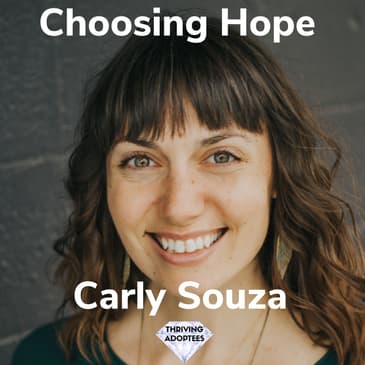
Hope is sometimes in short supply within adoptive families navigating tough stuff. Why is that? How can we overcome fear, choose hope and enjoy a brighter future? Listen is as Carly talks faith, truth and helping kids be who they want to be.
Carly Souza is an adoptive mother and Fostering Hope Director at The Hub in Las Vegas.
Find out more at https://www.linkedin.com/in/carly-souza-aa9a382b/
https://www.facebook.com/thehublv
https://www.instagram.com/thehublv/
Guests and the host are not (unless mentioned) licensed pscyho-therapists and speak from their own opinion only. Seek qualified advice if you need help.
Want to learn more about thriving for you, your kids, your families or your colleagues? Pick a time to talk here
[00:00:02] Hello everybody, welcome to another episode of Thriving Adoptees podcast. Today I'm delighted to be joined by Carly, Carly Souza. Welcome to the show Carly, looking forward to our conversation today. Thank you Simon, me as well. Yeah, so a couple of hours away I was in snowy Alberta via Zoom but now I'm in Las Vegas and it's an unseasonable 70s, 75 you say at the moment. It's lovely.
[00:00:28] Yeah, because when I think of Las Vegas I think it's hot all the time but not right? No we typically have quite cool winters and I think it will cool down in the coming weeks. But it'll get to where we'll have some days that the high is in the 30s. It'll definitely get below freezing especially overnight but it's been a very warm Christmas season so far.
[00:00:52] Yeah. I remember my first trip to the States on business, I went to a conference and it was full of people from all over the States. And the first thing that they did was to compare and contrast their, you know, their weathers because obviously it's, it's a very big place, 3000 miles across.
[00:01:13] So your variety of weather is far bigger than British variety of weather and British variety of weather can be pretty, you know, from the south coast up to top of Scotland can vary a lot. But your, your weather varies a lot more than ours does. It sure does. So from, from external weather to internal weather then I guess is the question.
[00:01:38] What does, oh yeah, first off, just to introduce Carly, listeners, Carly, her and her husband have got nine kids. There's two are biological kids, one adopted from foster, sorry, one, one kidship adoption and then six other adopted kids. So, and you first started from fostering like 18 years ago, I think if I, if I can read my writing. Yeah. Yeah.
[00:02:07] So, thriving, what does, what does thriving mean to you Carly? I feel like my answer to that question has changed a number of times over the years.
[00:02:18] Um, I feel like right now, if I were to say the, um, ideal definition of thriving for myself and for each one of our children would be to be healthy and, um, content in our own selves.
[00:02:38] I feel like, um, a lot of my children who have experienced some really challenging things, um, are, are struggling to, they're struggling to find who they want to be as adults. I think oftentimes when children grow up in foster care, um, there's a narrative that they kind of get stuck in.
[00:03:03] Um, and I think my kids are trying to work out who they are, who they want to be, who they were. Um, and I think it's complicated. I think children who have been in foster care, children who have been adopted have a very unique set of circumstances when it comes to their identity, um, and figuring out where they fit in and who they are. And, um, it would feel like thriving if I could sit around the table with each of my children and have them be so confident in who they are. Yeah.
[00:03:36] Brilliant. Love it. Lots of rich richness there. Yeah. Um, the first thought is, is one, a quote from one of my mentors, a guy called Richard Wilkins, who says that, um, happiness and con sorry, happiness and sadness are merely the hope that the high and low tide of a big C called contentment. Mm. That's good.
[00:04:05] Uh, and contentment's kind of more, I guess it's truer. It's, it's about contentment and about peace rather than, you know, we think of happiness as kind of ecstatic stuff. Well, that's, that, that, maybe not sustainable, right? Yeah. Whereas contentment is kind of more sustainable.
[00:04:35] Yeah. Yeah. And choosing to accept the, the lot almost that you've been given in life and how do you make most of it? Yeah. And healthy was the first word that you used. Right. Yeah. So you, you, you mean physical health, right? Physical health, emotional health, spiritual health.
[00:04:58] Um, I think each of them are, you know, just on a journey as we all are, but I do feel like the, um, the amount of cortisol that runs through all of our bodies when, you know, we're in high stress situations, um, isn't necessarily always healthy. And, um, there's a lot we need to do to combat that. Um, I am in therapy.
[00:05:24] I'm always advocating for all of my kids to be in therapy, even as adults. That's one thing I've told them I will pay for as long as you let me, if you are willing to go to therapy, I'm willing to send you. Um, because I think there's a lot to unpack and a lot to process, um, and to be the healthiest versions of ourself. It is more than just eating well and exercising, but doing internal work as well. Yeah. Yeah. What do you mean by spiritual health?
[00:05:51] Um, you and I have discussed this a little bit prior to this conversation. Um, but I am a person that believes in Jesus and we did raise our children in our local church and, um, we have allowed each of their own faith journeys to be their own. Um, and we've kind of supported them in whatever that looks like. Um, but I strongly believe that God chose each of my children to be a part of my family.
[00:06:18] Um, and, um, by such unique means, not ways that I ever thought, um, they would come to us. And some of my adult children have made a choice at this point in their life to not believe in God. Um, and I hope that that changes at some point, but I think that for now that doesn't change the ability that I have to continue to pray for them.
[00:06:42] Um, but I, I want their faith to be their own. And I've always wanted that, um, their faith linked to my faith doesn't do anyone any good. And so I hope that they each on their own journey and in their own timing, um, get to a healthy spiritual place. Yeah. Yeah. Because I think that's where I found you Carly.
[00:07:09] Um, as I think I may have found you, uh, did you speak at CAFO? Yes. Yes. Okay. So, uh, I do a lot of research to, to find, um, guests on the, on the show and, and that's where I, that's where I found Carly.
[00:07:28] And that's maybe there's been more, there's more, been more, um, believers, shall we say more followers of Christ on the show recently because, because that those, because I reached out to so many people on CAFO, um, uh, to, to, because I think that it brings faith brings an incredible power.
[00:07:54] I think faith, faith, uh, what people say that, um, there's a leadership guy that says that, uh, culture eats strategy for breakfast. Yeah. You know, um, and I think, I think faith. Eat psychology for breakfast in some, in some respects, maybe not quite as extreme as that, but, uh, I think it's incredible. It's incredible, it's incredible power.
[00:08:23] And one of them that I hear talked about, uh, talking to a guy, a lady this week, we're talking about in relation to self-esteem and he, she, or I came up with this idea of God esteem. Hmm.
[00:08:44] So we're kind of, we're, we're, we don't need to create our own, we don't need to create our own sense of self-esteem. If we can, as God's children, we can, we can take that as, as read if we, if we see that. Yeah.
[00:09:06] Cause you were talking about being content in our own selves and that kind of goes to identity and self-esteem and things like that to me. Yeah, absolutely. Yeah. Absolutely. But I mean, it's my faith that, um, brought myself and my husband, both of our faiths into engaging into foster care and adoption in the first place.
[00:09:31] Um, I don't know that it's ever a step that we ever would have taken if it wasn't for the fact that like our faith is very clear about, um, caring for widows and orphans. And essentially in America, an orphan is a child in foster care.
[00:09:47] Um, and so some of the times when, um, I felt very inadequate for the job at hand, um, I wouldn't say some of the time, all of the time when I felt very inadequate for the job at hand, it has been my faith that has carried me through. Yeah. And that is, um, uh, that is a, uh, an insight I've heard from other, from other people. And just to introduce it, uh, to the listeners as well.
[00:10:16] And you, as always check out the show notes, um, Carly, as, as well as having a hands full with these kids, some of whom have flown the nest now. Right. Um, she, she also runs a nonprofit called fostering hope. So check out what, what, what she's doing, uh, in the, in the show notes. So feeling last time we talked, um, um, start of last month, perhaps, you know, you, you talked about this,
[00:10:46] uh, this concern or this, this feeling, feeling like a parenting failure. And that's, that's a tough place to be. Yeah. It is a tough place to be. Um, when we first engaged in foster care, my husband and I were both incredibly young. We brought home. Our first placement was a sibling group of four.
[00:11:14] Um, they were ages seven months, two, three, and five. Um, and my husband and I were both 23. We'd only been married for a few months. Um, we were very young and very naive. Um, and I almost think that that naivety helped us in the beginning because we had no clue what we were embarking on and how incredibly unqualified we were. Um, and I think in the beginning I was like, okay, we can do this.
[00:11:42] Um, I don't know how familiar your listeners are with foster care, but the goal of foster care is reunification whenever it's safe and healthy. Um, and so your goal is to be a temporary caregiver while their first family does whatever necessary to get healthy enough to bring them back home. And so we brought home these four kids with the mindset of sure, it'll be hard to parent four kids this young in life all at once, but you can do anything hard for a short period of time.
[00:12:11] Um, I think when there's an end goal in mind, that end goal being reunification, it was like, we'll just love these kids and we'll, we'll help them as much as possible. And then we'll rejoin them with their, their family. And then we'll do this process again a few times. Um, and that was just not how it worked out for our family. And so that very first sibling group of four never left our home.
[00:12:37] So they were with us through the foster care system for two years, and then we legally adopted them. Um, and I can honestly say on their adoption day that I had no fear. I had complete confidence. They were intended to be our children. Um, I was not worried about the future. And I think that was incredibly naive.
[00:13:05] Um, even two years in and, and experiencing a lot of behaviors and a lot of challenges. Um, I think I just had no clue what was coming. And I think that's a gift because I think had I known, I probably wouldn't have said yes, I would have been too afraid. Um, but I think knowing what I knew on that day was that beyond a shadow of a doubt that God had placed those children into our home.
[00:13:35] And I still believe that. Um, so now it's been nearly 16 years since their adoption was final. Um, and it's been an incredibly challenging season. I think, like I said before, when children who have been adopted become adults and they're trying to find themselves, um, there's so many added layers of complication. Um, and it's so hard for me as a parent not to wonder if I could have done something different
[00:14:04] or better when they were younger to help them solidify who they see themselves as. Um, and to this day, I can't pinpoint anything specifically. Um, you know, no one knows how someone processes internally other than themselves. Um, but I just think, unfortunately for every child that grew up in our home, they grew up
[00:14:34] with not only their own trauma, but the trauma of every other child in our home. And that is not to say at all that I regret any of the children we brought in. I don't. Um, and I still wouldn't do it any differently. Um, but it's been incredibly painful.
[00:15:01] And the faith has sustained you through that. Absolutely. I mean, I, I don't know how anyone on this journey does it without a faith component. Um, like the number of times that I have felt like I'm not going to make it through the rest of the day, let alone to the end of the week or to next year.
[00:15:27] Um, and it has been my faith that has carried me through, um, not only in the comfort that I receive from that. Um, but just in the knowing, like knowing for certain that these were the children that we were intended to have eliminates the question of, is this what I'm supposed to be doing?
[00:15:54] Because I think sometimes in life when things are incredibly hard, incredibly challenging, it makes you question if you're doing the wrong thing. Like, was I ever supposed to engage in foster care in the first place? Was I ever supposed to adopt these children? Um, but because there was so many, um, I mean, I would call them signs, um, that, that we were specifically called to these children.
[00:16:21] Um, if I didn't have that, I think there would be more of a question, but because I have those things, I can go back, um, like in the Christian faith, we call them like an Ebenezer or stone of remembrance. I can go back to times when I know that there was, there was clarity on the situation, something
[00:16:46] maybe that I had been specifically praying for or something that, um, prayers were answered in ways that I could not have manufactured and being able to look back on those moments and say, okay, God, you made it incredibly clear on August the 4th, 2008.
[00:17:14] Um, I can hold onto things like that and I can look back and say, okay, like God doesn't change. And so the same God that said, this is what you were doing all those years ago is still the God that I serve now. Um, and so being able to look back and remember like, okay, I know that you called me to this and, and also being able to look back on the moments where I know God has carried our family
[00:17:39] through incredibly challenging seasons that have, um, healed is probably the wrong word to say. Um, but there has been so much redemption in certain situations with specific children. Um, being able to look back on that is what is carrying me through a current, very challenging season with other children. I think God, if you were able to do it with this kid, then you can do it with that kid. Um, and I hold onto that.
[00:18:10] Yeah. Like a safety net really. Yeah, absolutely. Yeah. Yeah. And we kind of, when I think of, when I think of that, um, the metaphor that came to mind was, you know, doing the, doing the tight walk, tight rope walk and knowing the, knowing the safety nets there.
[00:18:35] Like when you fall the first time you're scared, but then the safety net hold catches you. And then it allows you to be more confident about the future. Absolutely. Absolutely. There was a couple of years ago where my husband and I were visiting, um, Canada and we went to the Capiliano suspension bridge. Are you familiar with that?
[00:19:03] I am not, but I know what suspension bridges are. Yeah. It's, it's just a footbridge, a walking bridge, and it's nearly, I think three or 400 feet up in the air, uh, crossing a Canyon essentially. And I stood there scared to death to cross this bridge. And as I stood there watching visitors cross with fear, I stood there watching all of these national park employees just glide across it. Like it was no big deal.
[00:19:32] And I was able to recognize those people have crossed this bridge so many times. They know it's going to hold them. They have no fear. They have, they probably crossed this bridge dozens, if not hundreds of times a day. And there was only fear in the people that hadn't done it yet. And so I was like reflecting on the fact that just like you had said, when you have this, this trust in something because of what has previously happened, you engage in the future differently.
[00:20:02] And so the first time I crossed the bridge, my palms were sweaty. I was shaking, but I made it to the other side and I was so glad I did. Um, but then the second time when it was time to come back, I was still a tiny bit fearful. It was still very high up. It's still a very small bridge. Um, but I wasn't nearly as afraid as I was the first time because I had done it already. Um, and so I think there's an element of that where, when you've done something so many times,
[00:20:29] um, there's almost a proven outcome. And I think that that is the challenge for me is will that outcome happen in the timeframe that I would prefer? Oh, okay. So this is about patience, right? Absolutely. And, and just because with one situation, with one specific child, we went from a very hard
[00:20:55] season to a very redemptive season in about three years. Um, maybe it will be less time than that, but maybe it will be more time than that. And I don't like that. I would like, I would like this health and healing for all of my children sooner rather than later. And I have to accept that that's not reality and that no one is working on my timeline, right? They're all working on their own timelines. Um, they're all working on their own journey.
[00:21:24] Um, and I have to come to terms with the fact that whatever happens on their journey is not necessarily a reflection of me or my parenting, um, or my own faith values. Um, but it really is their journey and having to give them the space to make all of their
[00:21:49] own choices, regardless of what those outcomes are, um, is something I have to do as the parent of adult children. Yeah. Yeah. Yeah. Yeah. As you were saying, as you were saying that I was thinking about a trip that I took, I think I'd be 19 maybe.
[00:22:16] Um, I, my dad allowed me to, to, to borrow with a little Suzuki Jeep thing, like a Jimny, you know, the little tiny Jeeps, not like a big Wrangler thing, you know, like a Japanese one, like a small engine, right? Like a thousand CC very slow. It only did 70, 65 miles an hour on the flat. Right. So it's a slow, slow thing. And I went off with some friends exploring.
[00:22:44] Well, we, we drove down to Spain in it. Um, and he, he, he did that. He did that thinking it would, it wouldn't be coming back in one piece because I'd already actually written a car off. So, you know, my driving record isn't great, but I, but I remember him talking to me after
[00:23:12] it and I, when, when, when I realized that I thought, when I realized that he was surprised I got back in one piece, I took that as a real insult to my driving, you know, like, um, but he allowed, it allowed me to, to, to do it. And, um, it worked out at that, that, that time actually.
[00:23:40] Um, and we did a few other trips, what, uh, on the continent driving on the continent. One of them didn't work out. The, the, I, um, I broke the car, but, um, that's another story, but this is trust, right? It's all about, it's all about trust and, and they, and the stones of remembrance, but
[00:24:06] you can't see the stones before you see them. Right. They only, you only see them when you, do you, do you see them when you, when you stood on the stone of remembrance? Do you, do you remember us? Do you, do you see it at the time? Do you see it afterwards? Is it a hindsight thing?
[00:24:30] Um, yes, there's been very few peak moments where I realized that it was even a peak moment in the process. Um, I read a book last week, maybe the week before, and one of the quotes was, um, you often see God's work best in the rear view mirror.
[00:24:54] And I think a lot of times in life we, um, maybe it's not even intentionally, but in the moment of anything, whether it's a life lesson, whether it's a, a peak joyful moment, whether it's deep sorrow. I think it's hard to adequately even recognize what a moment is while you're in it. I think very often it's not until we look back that we recognize like, wow, that was a really
[00:25:22] special time or, wow, that was really challenging. I don't know how we made it. Um, but I think having the ability to look back and to just, for me to see the hand of God over my life and to see where, um, he, he really did carry me through some seasons that I feel like in my own strength, I would not have been able to make it.
[00:25:45] I had a realization about those kind of insight moments, those learning moments this, this week. And it was about the fact that they can come in the, most of them come out of the darkest of times or at the darkest of times.
[00:26:12] That, that's when the, that's when the learnings arrive. Yeah. Yeah. So I think one thing I'm having to, to navigate right now, um, is giving, giving my adult children the space that they need to figure out who they are, where they fit into our family, where they want to engage with our family.
[00:26:39] Um, and not kind of forcing my desire of this one big happy family on them, you know, but allowing them to have feelings when they were young, I would often tell them like, you can be thankful that you're adopted and really pissed that you're adopted too. Like you don't have to choose one or the other. Um, and so I think part of their, um, adult struggles are almost feeling like they have to choose.
[00:27:07] Are they a part of our family or are they their own person? Um, and so giving them the space for that. Um, but the, the pain of some of their actions during their process of, of figuring out who they are and what they want as adults, um, is something that I have really, I have just struggled with. It's been really deep grief for me. Um, and I finished this book yesterday.
[00:27:37] Um, and one of the one liners that I wrote down said, understandable behavior and acceptable behavior are not the same thing. So there, there can be reasons, extreme early childhood trauma, um, that is a reason for why they are behaving some of the ways that they're behaving right now.
[00:28:05] Um, and because I have knowledge of their early childhood, I can understand that, but that doesn't mean that I necessarily have to allow them to treat me the way that they are currently. Um, and so I'm navigating this, this journey of trying to protect myself, right.
[00:28:28] And my own health, um, and also trying to constantly extend to them, um, grace and the invitation to come back. And it's like, how many times do you extend that to someone, um, while essentially being a punching bag?
[00:28:51] Um, how many times do you extend that before you say, okay, I have to take a break for myself. Um, I have to get to a healthy enough space before I'm ready to re-engage, um, with this relationship. Because I think for the longest, I thought, well, if I'm the mom, then it's an unending number of times. And I do still think it is, but I don't think it's an unending number of times without a little bit of healing time for myself in the process.
[00:29:23] Yeah. I'm intrigued. Is your therapist a, a believer, a Christian? She is. Yeah. Yeah. Okay. So how do the, how do the kind of, how does the, the, the psychology and the spirituality, how do they combine in a, in, in therapy? Or don't they?
[00:29:53] I mean, what, what's the? Um, I would say at least with the therapist I have right now, who I love, I, but I've only been with her for a few months. Um, I think I more lead the spiritual side. She's done a lot of listening because we're new and I have a lot of years of unpacking to do. Um, she's done a lot, a lot of listening, but there are moments where she has challenged
[00:30:20] me to say, is that really true? Like, is it true? You feel like a failure, but is that true? Did you do what you were called to? And the answer is yes, I did do what I was called to. Um, but it didn't have the outcome that I had hoped for, but there's getting, there's
[00:30:47] getting a truth in your head and getting the truth in your heart and getting the truth in your bones. Yeah. They're very different. I'm not sure of the next question. That's all right. That's all right. It's just been such a journey.
[00:31:10] And I think it is, it's something where I would encourage anyone in the adoption triad, whether you're an adoptive parent, an adoptee, um, a birth parent, this is not the way that God intended it. God intended for every family to be a healthy unit that doesn't have breaks or separation
[00:31:37] or the need for adoption truly, right? If everyone was able to be in a stable, loving home, adoption wouldn't be a thing. Um, but it is because we don't live in a perfect world. And so recognizing that even the pain that we're experiencing right now is because we live
[00:32:01] in a broken world that's full of sin and full of people who make choices that negatively impact others. Um, that's why we are where we are. Um, but I just know as their mom, that until the day I die, I will pray for my kids every day. And I will pray that at one point there's reconciliation within our whole family.
[00:32:26] And I hold onto that hope every day that one day we'll all be around the table again together. Um, maybe just my kids, maybe their spouses, maybe their children. I don't know. I don't know what the future holds, but I would hope that deep down each of my kids would know beyond a shadow of a doubt that I love them and that they were chosen by me, um, that they're chosen by God and that, um, what I want for them back to how we started, what I want for
[00:32:56] each of them is to be healthy, to be healthy. So as we look to the future, the, the, the metaphor that pops back in and ties back to your suspension bridge in Canada is, and stones, right? Stones of remembrance. I'm, I'm seeing, I'm seeing future stones as well.
[00:33:21] And, uh, the, the movie clip that's coming to mind is Indiana Jones and the temple of doom, right? The first one where he's going over a chasm and the, the step, the next step, the stone appears, they're stepping stones, but they only appear it just in time. Right. Yeah. Yeah. And I guess that's about faith for the future. Absolutely. Yeah.
[00:33:50] Taking the next step when you have no idea what's ahead, but just doing the next right thing. Is that cloud cuckoo land? Pardon? Is that cloud cuckoo land? Do you have, sorry, do you have that expression in, in, in, in, in the States? No, you don't. Cloud cuckoo land is, cloud, cloud cuckoo land is, uh, is like, um, Pollyanna land. Yeah. You know, she's Pollyanna-ish, right?
[00:34:20] She's in, she's in, uh, denial. She's in, um, yeah. So, yeah. I think sometimes to be fair, I probably am choosing to be a little naive because that's what carries me through knowing that if I knew the doom and gloom that was ahead, who would want to keep moving forward? Um, so you have to choose hope.
[00:34:46] You have to choose that on the other side, that there's going to be, that there's going to be redemption, that there's going to be a, um, beautiful end to the story. And my hope is that not, not my hope that it is a possibility. My hope that is carrying me through is that in the end for all of eternity, my family will be together in heaven. And I truly believe that.
[00:35:16] And I don't know that there will be full reconciliation in our family while we're here on earth. I hope that there is. I pray that there is, but I don't know that for certain. Um, so I hold on to the hope of heaven. Yeah. I think you just got the title for the, for the interview, choosing hope. Yeah.
[00:35:42] When I, um, release the interviews, I have to have a name. I have to come up with a name. So sometimes I ask people and then sometimes I make it up or sometimes I just take something that they've said. I think, I think that might be, um, that might be it. Right. I want to take you back to, because we're talking about the future. I want to take you back to something that you mentioned over half an hour or so ago.
[00:36:11] Uh, you, you, you talked about, um, the kids being content in their own selves or us being content in ourselves, thriving as being content in our own selves. Uh, and you talked about the kids, uh, struggling with who they want to be. Uh, and, and then the next thing that you said was about being stuck in a, in a narrative.
[00:36:41] So if we're choosing hope, right? Uh, what, what, what, what unsticks, what unsticks us from the narrative? Um, I think choosing to sit down and almost parse out what is reality from what is not. Um, I think for some of my adult children, they've been so influenced by peers that, um,
[00:37:11] this is who you are because of what you've experienced. Um, and I almost think they need to sit down with a pen and paper and say, no, this is who I am. And remember their own, um, successes and the things they've each individually overcome and not you spent this many years in, in the foster care system. And so this is the, um, destination that you're almost ultimately like, um, you're, you're destined to become this.
[00:37:40] Um, and I don't think that's true at all. I think every one of us have the ability to be exactly who God called us to be and exactly what, um, what the world around us needs. I think at this point, our world needs hope. It needs people that are filled with, um, the ability to see a brighter future, not to say, this is where I came from.
[00:38:08] So this is what my destiny is. Um, I think every single one of us have the ability at any moment to choose to do better, to choose to do what's going to be, um, most positive for ourselves and for our communities and for the people we interact with. Um, but I do think sometimes it takes each one of us having almost an assessment of, um,
[00:38:34] who we allow to speak into our lives and whether that's a friend, an actual person, or if that's media or entertainment or, um, culture to be able to say this might be who, um, the world says a 21 year old man should be.
[00:38:58] Um, but I'm going to choose to be different and I'm going to choose to, to make my own path for a healthier future. Um, but I think we've got to walk away sometimes from things or people that are feeding us lies. Um, and I think that's for all of us.
[00:39:19] I think, um, even as an adult who is pretty secure in my identity, that if I'm not careful, I can let other people speak things into my life that are, um, unhealthy. Or I think even if you just watch the news for too long, you can get very, um, down on, on the world right now.
[00:39:44] There's a lot going on, but I think to just look at who, who are the people that I have, um, immediate influence over, you know, who can I, I had a delightful conversation with these two strangers in the post office in the queue, um, earlier this week. And they were both in their late eighties. They had so much life experience and we spent 20 minutes chatting, but I could have stood there on my phone and scrolled through something, or I could have, have made the choice
[00:40:14] to see the people right in front of me and just have a lovely conversation with strangers that I'll probably never see again. Um, but I think it's like getting out of our, getting out of our own heads, getting out of, um, again, what society says is or isn't acceptable right now and just choosing to make the world a better place. Yeah. Have you heard of, have you heard of Byron Katie? Have you heard of her? Mm-mm. She goes as Katie. Yeah.
[00:40:44] Um, and I think her website is thework.com or thework.org maybe, but if you put in Byron Katie, the work, um, I'm, I'm really pointing the listeners to, to this, um, if, if it, if it appeals to you as well, that's great.
[00:41:07] Um, it was the, I'm reflecting back on, on the question, right? Yeah. Is it really true? So Byron Katie has a four-step self-coaching process around that. And it's four simple questions and you'll, you can find the questions at, at the work, whatever it is, thework.com, thework.org.
[00:41:36] And you can also watch Byron Katie asking, asking those questions to different people in video clips. And I think that last time I looked, that's what, what's on as well. And, and it's a, it's a truth, it's a truth checker.
[00:42:00] It's a, uh, and it, it's a, it's a depth and it requires, it requires thoughts and it requires, it requires a bit of time and it requires a bit of, a bit of effort. And I was doing a training with some adopted parents a couple of weeks ago and they, we were going in, we were going into some deep, deepish stuff.
[00:42:29] And she says, you know, like this is really, this is really hard. And I went, yeah, it is doing, doing the work can be hard. Yeah. You've got to be willing. You've got to be. You've got to want the desired outcome enough that you're willing to do whatever it takes to get there, to do the hard work. Yeah.
[00:42:57] And I, I, I, she, I got a bit, I got a bit grumpy on, kind of on the question. You know, I said, look, self-care, self-care, self-care is bubble bath. Self-understanding is, is way deeper than that. You know, like you talked about media stuff, you know, there's loads of influences telling you that this is what it's about, you know, candles and bubble bath.
[00:43:26] And it's, it's garbage. Yeah. You know, I realized a few years ago. Sorry, bubble bath lovers. That's right. I had always thought I'm terrible at self-care because I don't like bubble baths. And I really had this idea that that was the only way to self-care. And it wasn't until the peak of the pandemic that I realized for me, self-care was drinking
[00:43:52] enough water, eating enough protein, getting enough sleep and playing in the garden, having my hands fully submerged in dirt. That was what was self-care to me. That was what allowed me to feel filled up again and ready to continue on in the journey. And I've not, I've not taken a bubble bath since. Who needs them? Who needs them? Sleep is the biggest.
[00:44:18] I mean, the ones that you mentioned, like you mentioned three or four things, sleep and hydration. Like, you know, like I'm the, one of the reasons I've got an excuse here. Now, one of the reasons I was a bit grumpy when I was talking to that woman about self-care and self-knowledge is because I wasn't, I was away from home and I wasn't sleeping. Yeah. I wasn't sleeping very well. So, yeah. But we've, do both listeners, right? If you, if you love bubble baths, have bubble baths.
[00:44:48] I don't actually like sitting in a, in a bath, bubbles or not. I, I, I prefer a, I prefer a shower. But I do love half an hour pounding up and down the swimming pool, right? And that does, that does something for me somehow. Yeah. That's one thing that has taken me into the last few years in this parenting journey to
[00:45:15] understand is really that concept of putting on your own oxygen mask first. Um, I was never very good at that. Um, and I really have started to realize that I'm no good to anyone, my children, my husband, my organization, my community, if I am completely exhausted and barely surviving. And so I have just started to make those things a priority. My husband and I go on a mile long walk every night, walk the dog, just in a, there's a trail behind our house.
[00:45:44] Um, and just the opportunity to be outside, to get some fresh air, to have some movement. Um, but doing that, going to therapy, going to bed earlier than I want to, my preference is to be a night owl, but I know when my body is starting to shut down, I need to be in bed by nine o'clock. And that feels a little bit lame, but the next day I feel like a new person. Um, and so just really listening to my body and knowing, like, if I'm going to continue
[00:46:12] taking care of all of these people, I have to take care of myself first. Yeah. That feels like a spot on place to bring it in, Carly. Unless you've got a question for me. Sometimes I ask that question. Sometimes people have a question. Some people at times they don't. I feel like I asked you so many questions before and I got so many lovely answers. Yeah. Cool. It's really lovely.
[00:46:39] Honestly, I think you're really brave to just email people you don't know and don't know you and make a whole thing of it. It's great. Yeah. Well, it's whatever it takes, right? Yeah. I can't wait to listen. Yeah. Cool. Thanks, listeners. Thank you, Carly. Happy holidays. Happy holidays. Thanks for having me. Pleasure's been mine.
[00:47:09] Thanks, listeners. Goodbye. Happy holidays to you too, if you're listening in that time here.