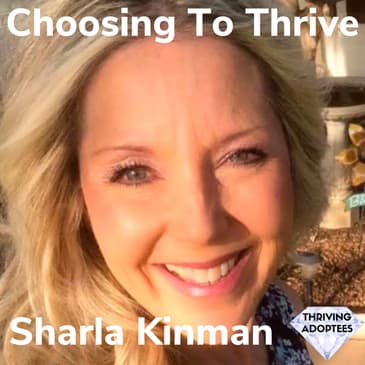
What if you could choose to thrive? Forgive others more easily. Feel spontaneous gratitude from within. Rise above your circumstances. Listen in as adoptee Sharla talks about choosing, her birth mother and much more. This is a truly incredible episode. Listen in with big ears.
https://www.facebook.com/sharla.kinman
Guests and the host are not (unless mentioned) licensed pscyho-therapists and speak from their own opinion only. Seek qualified advice if you need help.
Want to learn more about thriving for you, your kids, your families or your colleagues? Pick a time to talk here
[00:00:02] Hello everybody, welcome to another episode of the Thriving Adoptees podcast. Today I'm delighted to be joined by Sharla Kinman. Looking forward to our conversation today. This is going to be a scream. So Sharla is an adoptee from West Texas and we're very close in age, just a year's difference. I'm more senior and more, what's the word? Mature.
[00:00:32] That's it. It is funny, it is funny Sharla because I end up interviewing a lot of people around our age. Yes, I have noticed this. You've noticed this. Yes. Yeah. But it was a birth mother that brought Sharla and I together, Laura Engel. Lovely lady being on the show.
[00:01:01] So Thriving Adoptees then, Sharla, what comes to your mind when you hear this word? Well, hearing the word thriving to me. Now I'm a literature teacher, a retired literature teacher, reading teacher. That was my specialization when I majored in education. So you asking me that question is right, right up my alley. I love that. Cool.
[00:01:31] So Thriving to me is a person who in circumstances, in any circumstance, but really conjures up an image for me of someone that maybe was in not quite the most ideal circumstance.
[00:01:52] Maybe in a challenging circumstance, but they were able to show tremendous resilience, learn coping mechanisms, cope healthy coping mechanisms.
[00:02:15] Maybe they were in a situation where they were mentored well by someone and they were able to, or we are able to rise above challenges and thrive and grow. I love working in my yard. That's a joy in my life is flowers, planting flowers, tending to flowers.
[00:02:42] And we live in a climate that's not very conducive to that, especially certain varieties of flowers. And so it brings to my mind a plant maybe that is planted in a different environment or different climate and yet is able with certain conditions to thrive.
[00:03:08] One of my favorite stories that I taught in junior high was a book called The Witch of Blackbird Pond. And long story short, it's about a young girl who has lost everything and she has nothing. And she's forced into a situation where she feels she has no choice but to flee. She lives in Barbados and she knows nothing of the new world,
[00:03:35] but she has an aunt family that lives, is trying to make their life in the new colony. And at one point in the story, she compares herself or maybe another character compares her to this bulb that was given as a gift. And it's a flower that should not be blooming.
[00:03:59] It should not be thriving in this cold winter climate. But yet there it is. And it's so obvious, right? It just like sticks out. And so I guess in my mind, that's what I think of someone when I think of someone that's thriving. Yeah. Do you like your metaphor? Yeah. Yeah. It just kind of came to my mind. Yeah. Yeah.
[00:04:29] Yeah. Yeah. Yeah. You mentioned a mentor of mine. You talked about underground daffodils, right? Yes. Yeah. Underground daffodils. So you and I, right? You and I are stood in your backyard, right? Just imagine that we're not 4,000 miles away on a Zoom call, right?
[00:04:58] But we're standing at the backyard and we're saying, Yeah. Yeah. Life's great. We're full of joy despite it being a Monday, right? You know. And there's a, and the world's looking good. The weather's nice. Everything in the garden, everything in the garden is rosy, right? Everything in the garden is rosy, right?
[00:05:23] And there's an underground daffodil ball, right? Yeah. That can't see the sun. Mm-hmm. Mm-hmm. And we can hear that underground daffodil going. Shane, you're lying. Life is dark. I can't see my way forward. It's scary down here. You're liars. Mm-hmm.
[00:05:49] Well, it's just because that's still an underground bulb, right? Mm-hmm. That doesn't mean the sun's not there. It doesn't mean that the sun won't shine. And within that bulb is the ability, despite maybe the circumstances it finds itself in, the ability to flourish, to grow, to thrive. Yeah.
[00:06:17] It's still there to some extent. The bulb hasn't seen what we've seen. Well, and- The world is dark where that bulb is. And I think about where I live and in my climate, we experience drought a lot. And, you know, no amount of water from the water hose is going to do what the rain does,
[00:06:47] the way the natural rain nourishes. So I know, like you're saying in your metaphor, for people, we may be, you know, planted, so to speak, as in adoptees into families. We may be planted in different families or soil or conditions. So, yeah. Yeah.
[00:07:16] It's a seeing thing. Thriving is a seeing thing. Yeah. And I'm not sure if this is going along with what we're saying, but I think one of the things that I've learned through 57 years of life,
[00:07:39] even more so in the last probably five to six years, is it's a choice. I know that might come across. I'm a very empathetic person, a very, very deep feeling person, a very, very compassionate person,
[00:08:07] high levels of mercy towards people. But for me, because you asked me what I thought thriving was, I believe there are different levels, of course. And because that's life, there are ebbs and flows in life where, yes, like you're saying, the sun is shining or, you know, whatever it is that fills your cup that day.
[00:08:37] So you may feel a little more thriving that day than others. But really thriving is when those days aren't that way. And I've heard it likened to like a cup of tea. And you're holding that cup of tea. And it's what happens when someone bumps you and that tea spills out.
[00:09:02] Like what's going to come out when things are not so picturesque or so wonderful? And I've, I personally have come to learn. And I think I kind of have lived this way my whole life and didn't even totally realize I was living my life this way. It's a choice we have to choose. Because our environment and our circumstances are not always going to be ideal. They're not.
[00:09:31] That's life. That's just life. Whether you are raised in your biological family with the people that you are biologically related to or you are not, everyone experiences those times where things are going to bump you and your tea is going to spill out of your cup. Yeah. So for me, if I'm thriving, it's not always because my circumstances are what I want them to be.
[00:09:59] It's because I'm trying to make an intentional, conscientious choice to not let those things overwhelm me and take over and bring me down. So you're saying that it's thriving despite circumstances? Yes, it sure is. Trying to. Trying to. Trying to. Yeah.
[00:10:26] Because we started the conversation before I hit record. We were talking about internal weather versus external weather, right? There is a difference. Whereas there is. Because I can't do anything about the external weather.
[00:10:48] There is not one thing that I can do to control the temperatures, which I wish I could because I don't like it when it's 103 like it was here on Saturday. I can't do anything about that. I can't control the dirt. We get dirt storms here. And I don't like them. And there's not one thing I can do to control it.
[00:11:12] But I can try to do something, make conscientious decisions and conscientious choices about my own, as you say, internal weather. Yeah. You talked about resilience. Yes. Which is. That is, I guess, is that thriving despite circumstances? That's choosing. Absolutely.
[00:11:41] I feel like resilience, which was actually a vocabulary word lesson that I taught based on a novel that one of my classes read. It was about a pilot, an American pilot shot down in enemy territory.
[00:12:06] And much of, that's my dog, much of that book is all about the circumstances that he's in. Now, he knew, he knew going into that, right, that there may be a chance that he would be in danger. But so much of that book was about resilience. And I'm trying to think about how that word was.
[00:12:36] And it conjures up imagery for me again. But they were working on how to design aircraft that could withstand the impact of being hit by birds. And they were trying to create a material, right, that wouldn't crack, that wouldn't break.
[00:13:03] And one of the things the kids thought this was so funny that they were doing to try to test this is they would put frozen chickens or frozen meat into a mechanism that would shoot them out at a very strong trajectory.
[00:13:23] I think it was they were trying for the canopies, you know, over the pilots, because the last thing you want is a, at that rate of speed, a bird to hit the canopy, crack the canopy or hit, hit the pilot. And they were, they finally did it.
[00:13:44] And they made a material that would, you know, give with the force and then retain its shape. And so that's what I think of when I think of resilience. Like things are going to come at you. They're going to hit you hard.
[00:14:02] There's a potential for danger, but you can, you find a way to withstand those things in life that come at you and hit you hard or take you by surprise. And you're able to, I mean, the word bounce back is not, that phrase is not exactly what I'm looking for, but that's what conjures up in my brain.
[00:14:30] Now, that doesn't mean that there might not be little evidence left, right, of a little crack or something that compromised you mentally or physically. You know, it's like a scar left there that reminds you of a wound.
[00:14:54] But you, you manage to, you know, persevere through that. Do you, does, do any occasions of your own life kind of come to mind when you're thinking about this topic? Oh, sure. Absolutely. Failures. Failures.
[00:15:20] When I was, when all I wanted to be was a mother. And there were quite a few painful things along the way, including losing two babies. Not being able to pass certain tests to be a teacher.
[00:15:46] And how hard that was for me and the things that I had to try to do in order to accomplish that. And the people who came around me and helped me. And I wasn't alone doing those things. Loss of people in my life. Yeah. Loss of, yeah.
[00:16:13] Loss of, of, of things that I never thought I would lose. And how to face those realities and choose to just do the best I could under those circumstances. Sure. Yeah. And you became a grandchild, right? Yes. Yes. Yes.
[00:16:41] In fact, you bringing that up. I never really talked much about being adopted. It was not. I always knew I was adopted, but it wasn't a part of my identity, I guess you would say. That wasn't where my identity was rooted. I was adopted at some point when I met my husband and we became friends first.
[00:17:08] And then, you know, over time realized that we had feelings of love for each other that were above friendship. So at some point in my relationship with him, I shared with him that I was adopted. But it was never a major focus of any kind. My children, who are now 31 and 28, have always known I was adopted.
[00:17:31] But it's never been a, an all-encompassing, all-consuming thing. I mean, I have a couple of vague memories of asking my parents about it. I do remember crying to my dad one time about it. You know, where is my mother? Is she okay? What has happened to her?
[00:17:55] But I don't, it's never been an, uh, this overwhelming thing that, you know, like it can be for some people. And a couple of months ago or at some point, he and I were talking about something. And I don't even remember, remember now what we were talking about.
[00:18:17] But I said to him, these were my exact words, if my placement through the county children's home and the lot, the family that raised me. And, you know, there is loss. Adoption is rooted in loss. I don't think I ever really realized that to some degree till the last few years.
[00:18:47] But if those things transpired in order for me or the result is that I'm here at this place in my life to have the family I have, to have the children I have, and to have the grandchildren I have, I literally would do it all over again 100 times to, to have my children, to have my grandchildren.
[00:19:17] They are one of the greatest gifts and my husband that I've ever been given. So I, that's part of, you know, my story. Yeah. I heard this thing that sent chills down my spine, I don't know, six months ago. And what you're sharing there kind of reminds me of it.
[00:19:41] And this guy said, I was listening to an audio book. And he said, what if your destiny is right where you're at right now? What, what if, or maybe, what if your destiny was to be right where you're at right now?
[00:20:09] And maybe it took some of the circumstances that were out of our control to, to be in this moment. Um, I, I don't, you know, going back to what you were saying about thriving, there are some negative voices.
[00:20:34] Uh, as with any topic, there's going to be positive and negative voices. But my, the majority of my life for probably 52 years, all I ever heard about adoption were positive voices, positive comments, positive thoughts.
[00:20:59] And only recently have I been exposed to, I mean, I didn't know that anybody had any negativity towards adoption. That wasn't a part of my experience or a part of my world. And so when I hear people talk about it negatively, I don't quite know how to settle with that.
[00:21:20] Because I, in no way think it's perfect or rainbows or unicorns and butterflies. And I, and I'm not trying to portray that, but it goes back to what we were saying a few minutes ago. And that is that I just, it's not that I'm living in denial or I'm trying to pretend something didn't happen that did happen.
[00:21:47] And I'm, I'm aware that the times that we were born in, the time I was born in, the state, the actual state I was born in was not kind and favorable towards single pregnant unwed mothers.
[00:22:07] And I'm aware of how hard it was for her and the loss that it was for her and for myself. And so kind of what you said a minute ago, I was, I was in the kitchen at, in the childhood home that I grew up in.
[00:22:34] My parents are aware I'm, I'm actually in reunion with much of my biological family. This is a more recent thing. And they know I've been very honest with them and have shared with them. They, they've even met some of them. And I just, which I know cannot be easy, but my mother especially has been very, very gracious.
[00:23:00] And I just looked at her and I said, mom, I just want to tell you something. I want to express something to you. I wouldn't change a thing. If I could go back and change it, I wouldn't change it. There's not anything I would change. Even though I know there's been pain and this, I wouldn't change it. And she just kind of sat there.
[00:23:29] I'm a much more emotional person. It's not that she doesn't feel it inside, but she's a little bit more frank. Part of that's probably because she, the time she grew up in, in her generation. But she said, well, I would hope not. And I thought to myself, oh, mother, you know, you know, if my children said something to me like that, I would just be, I would be overcome with emotion.
[00:23:57] And I would start crying and I would put my arms around them and I would say, that's one of the greatest things you could ever say to me. Thank you so much, you know. But, you know, that was just, and maybe I thought about it later and I thought, you know, she knows me pretty well. And so probably the words I was saying didn't, didn't surprise her. She knows me. So the fact I'm saying it is like, okay, you know. Yeah.
[00:24:27] Next. Next. Yeah. Yeah. And I'm not wired like that. I'm still thinking about it. And she's probably not thought another thing about it. If she has, she's very internal with her thoughts. She feels things, but she's not an overly expressive person about it. Very, very different for the most part from the family that I grew up in.
[00:24:58] And I was always aware of that. But I look enough like my family. Personally, I'm very petite and my mother is as well. Blonde. They have a biological son that was nine, almost nine when I was born. He's blonde. My mother's blonde. It was, if people didn't know, they would have never known.
[00:25:29] So those, those people that are talking negatively about adoption or, or they're saying that, that we can't thrive. They're, they're the underground daffodils, right? To some degree. And I don't even think that some of them say they can't thrive.
[00:25:55] I've heard many of them say, because of, of what they've been through, they, they have learned a lot about resilience. Yeah. And a lot about thriving despite their circumstances. And I've learned in my life. And man, I don't like it one bit. But we grow the most in the valleys.
[00:26:25] We don't grow the most on the mountaintops. And man, that's a hard part of life because where do we, where do we want to be most of the time? Don't we want to be on that mountaintop enjoying the beautiful views and the trees and the fresh air? But we have to climb it to get there. And there are parts about this life and that are hard.
[00:26:54] And sometimes those valleys last a really long time. And sometimes we're, sometimes we, depending on what the particular situation is, we may never completely get out of that valley. We, we learn to thrive in it or we don't. Or we don't. Or we don't. Or we don't.
[00:27:22] So what, what stops us thriving then? Well, that's a really good question. I think it goes back to what I said a few minutes ago about choice. We, we're all on this planet.
[00:27:47] We're all facing triumphs and tragedy. We all have to choose how we are going to get through it, how we're going to respond to it.
[00:28:05] But I also think it really is also related to the relationships that we have, the support system that we have. I have, the, I have many encouragers in my life. And they're not always, it's not always pretty. You know, sometimes they have to tell you the hard truth, right?
[00:28:35] Yeah. And you might not like it and you have to choose if you're going to hear the truth. And are you going to stay stuck? You know, in neutral, so to speak. Are you going to, going to put it in reverse? Are you going to, um, I'm a believer in Christ.
[00:28:58] And I'm thinking about Paul's words right now where he talks about, and I'm paraphrasing, but he talks about, you can't, you can't look behind you. It's not that you can't learn from your past or learn from the past. You absolutely have to learn from the past. But he just talks about pressing on, pressing on.
[00:29:20] And I believe there's more to life than what's just here and what we can see with our eyes. I believe there's more to it than that. And so part of thriving for me is just pressing, pressing on. A mentor of mine once said that the past is a place of reference, not a place of residence. You don't have to choose to live there.
[00:29:52] Yes, I think about the, the last words of communication between my biological mother and I, I've never met her. Um, we've exchanged one letter each. And then the last correspondence I had with her was by email and she was not very kind.
[00:30:17] And essentially, in her words were, um, when you were placed in the arms of your family, I walked out of the hospital. I put it behind me. Um, I want to leave it there. And she said, I don't want to block you, but I will.
[00:30:48] And I just, you know, my first response was, wow. I mean, I'm a words person. So I was very taken aback by her words. And in honest, in all honesty, my first reaction to that was, I've always been thankful, which using the word grateful with adoption. Yeah.
[00:31:16] I have learned, man, some people take great exception to that, but I'm not going to apologize for saying it because that's how I feel. And no one's told me to be grateful in this situation. Um, I'm, I'm grateful that she was not the person that raised me. And, and some might say, well, you don't know what she was like. You don't know if she would have been different. Well, no, I don't.
[00:31:40] All I can know is in that moment, the way she spoke to me, I thought to myself, I would not have thrived in an environment. If she were this kind of person speaking to me, I would have really struggled a lot. Then the next thing I thought was, well, how sad. That's really sad.
[00:32:04] Um, she may have forgotten that in her original letter, she wrote me, she said, yes, to this day, I have thought of you. So she initially vulnerably shared that with me. And then later contradicted herself by saying I walked out of the hospital and didn't think about it again.
[00:32:27] So what that tells me is she is not in a place where she's going to choose to thrive, so to speak, in this situation. She expressed to me that really she felt like she had no other choice but to do what she did because she wanted to do what was best for me. And no really other options seemed available to her.
[00:32:56] So she was a victim of the time, so to speak, under that situation. Even her own sister, who was really the only person in the family besides her mother that knew, says this. But now, see, she has the opportunity to make a choice to not reside there, as you said. And that's not the choice she's making.
[00:33:25] Where she could, um, have a new opportunity and make a different choice under those circumstances. But for whatever reason, she can't, she won't. And I think it, it really is just a matter of choosing. And this is what she's choosing. And I'm determined.
[00:33:55] I have shared with my husband and very close people to me, including my children. If I catch myself thinking of myself as a victim, even though I was, I refuse to stay in that mindset. I refuse to, to stay there. I don't want to stay in that place.
[00:34:23] I want to grow from that. I want to rise above that. And I, that's a choice that I want to make. And it's not because I'm saying I want to be better than her, if that makes sense. But I want to be a better me. I want to make choices to be the best version of my own self that I can be.
[00:34:49] And I think her words kind of still ring in my head sometimes and remind me that I'm, I am in this time and in this place and in this circumstances. And I can make those choices. I won't allow my circumstances to dictate who I am.
[00:35:16] That feels like the perfect place to bring it in, Charla. Okay. It's very powerful. Thank you. I don't, I think that's, that's it, right? Okay. Anything else? Anything else?
[00:35:46] Thank you very much, listeners. Thank you so much. It's really nice to meet you, to put a face to the voice. And it's an honor to spend part of my morning just getting to talk to you and being asked questions. I enjoyed, I enjoyed that a lot. Me too. Thanks, listeners. We'll speak to you again very soon. Bye-bye.