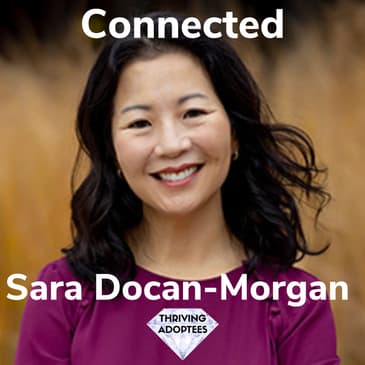
Do you want to feel more connected? Listen in as transnational adoptee Sara shares how she found that feeling of connection with her birth family. You're going to want to listen to the very end. She touches on profound and surprising insights that will touch you even if you're not a transnational adoptee.
Sara Docan-Morgan (PhD, University of Washington) is Professor of Communication Studies.
Dr. Docan-Morgan's work has been published in Adoption Quarterly, the Journal of Family Communication, the Journal of Social and Personal Relationships, Communication Quarterly, Family Relations, and the Journal of Korean Adoption Studies, as well as in edited volumes. Her research focuses on how personal identity and family identity are formed, maintained, and negotiated through discourse in both adoptive and birth families. She teaches courses in interpersonal communication, family communication, gender and communication, communication and race, research methods, and intercultural communication, and directs senior thesis projects.
Sara is a transnational Korean adoptee who was adopted at the age of 4 months. She has been in reunion with her Korean family since 2009.
https://tupress.temple.edu/books/in-reunion
https://www.instagram.com/esjaydm/
https://www.linkedin.com/in/sara-docan-morgan-8642175/
https://www.facebook.com/sara.docanmorgan
Guests and the host are not (unless mentioned) licensed pscyho-therapists and speak from their own opinion only. Seek qualified advice if you need help.
Want to learn more about thriving for you, your kids, your families or your colleagues? Pick a time to talk here
[00:00:00] Hello everybody, welcome to another episode of The Thriving Adopties podcast.
[00:00:06] Today I'm delighted to be joined by Sarah, Sarah, Dokan Morgan.
[00:00:09] Welcome to Thriving Adopties, looking forward to our conversation today, Sarah.
[00:00:13] Thank you, and me too.
[00:00:14] Thanks for having me.
[00:00:16] So Sarah and I connected listeners towards the end, yeah, the middle of last year, so
[00:00:22] about six months or so ago. So having really thought about the things that have perhaps caused you pain or hindered you in the past, so that cognitive component, I also think of it as an emotional component being able to feel the way of those things, but actually are a piece of your story so that you can synthesize those things. So that's kind way, as probably bifits, you're a professor, aren't you? You're a professor of
[00:04:20] communication studies. So you've got that clarity and there's a logic kind of that sent out.
[00:05:28] I'm at in the moment and that's okay. And then not putting a timeline on it. I recall when
[00:05:37] I, my mom died in 2003, my adoptive mom, and I recall sitting in my therapist's office at the story. And so I think healing also involves an honesty about the wounds that we are, you know, most of this relinquishment trauma is pre-verbal triggered a like a rejection thing within me seems bigger than the stimulus itself. And, or maybe doesn't make sense. And then to say, oh, okay, that, that makes sense because't thinking, oh, this is because I'm adopted and I was abandoned as a baby, but certainly that explanation makes sense of that pre-verbal abandonment that I experienced at four months old. So I think that part of that healing process is to,
[00:13:25] It makes sense with the benefit of time.
[00:13:31] Stuff makes sense and as we explore things. And maybe that's kind of proof
[00:13:36] of the ongoing nature that you,
[00:13:39] of the healing stuff, of the healing process.
[00:13:43] Yeah, I think so.
[00:13:44] And I think that, you know,
[00:13:46] maybe something is gonna happen today pieces I guess. And that takes you back to that point that you mentioned about this two-show pass. So in the moment it's clearly that wisdom doesn't always come to us but hopefully that comes to us faster and more of the time with age. birth family and also somebody who has lived in Korea, my birth country, for two years age. And so you really, you can be friendly with people who are older than you,
[00:17:42] but you can't really be friends, friends,
[00:17:45] with people who are older than you the same way doesn't keep me from continuing to be in reunion with my Korean family. But it is this kind of push-pull of fondness toward Korea and then sadness. And so I tell people whenever I of counterintuitive though, isn't it? The fact that you think the more time you spend that, or sorry, I would.
[00:20:23] I would think the more time that you spend can't express. So I think, as you see how people
[00:23:04] move through the world and experience relationships and what that said your name and your birth date. And so I just assumed that that was the final word. And so I never even really thought about searching at all.
[00:24:22] And of course, this is all pre-internet.
[00:24:24] So there weren't, and there weren't documentaries
[00:24:26] about adoptees in Korea finding their birth families something inside of me click or relax in a way that I didn't I almost felt like I didn't physically exist in a weird way and so
[00:27:03] when I met my brother one of my brothers for the first time it was like he looks. And so then that gives me, you know, I like his smile, I like his face. And it sounds funny, but then that makes me feel more love for how I look, you know, and not like I'm, you know, spending hours doing selfies or looking in the mirror constantly. But it
[00:28:23] just gave allowed me to see myself as inherently connected to. I've heard that, that idea of I've heard people say another, I can't remember who it was, somebody fairly recently said to me, I didn't feel that I physically existed until you had this genetic mirroring, I think is one of the terms that people use for
[00:30:56] they couldn't see the ships because they had no imprint in their brain, no concept of a boy? And so to see someone who really looks like me and to see people who are genetically linked toward me, that was extremely healing. Yeah, and then to further
[00:33:25] I'm getting the sense that this people stuff is by far and the family stuff.
[00:33:33] That that's the far by far the most profound part of your healing.
[00:33:38] I mean, you couldn't you couldn't you can't break down a healing in like a pie chart. So that it's into right. Well, it's for me, having friends who listen and help and care and ask questions who make me laugh. For me also having my biological children has been extremely
[00:35:01] healing in many ways. And then my partner, my husband has also brought a lot of healing I would say from my perspective that I something came up for me right listening to you and I've never heard the term before but I've just made it up right it's called healing envy
[00:36:20] right. social worker that she never even knew that I would see. And she'd written, I did get to meet her and spend time with her. But I almost feel
[00:40:16] Yeah. So I'm getting goosebumps now. I mean down my arm because I believe that there's part of us, you know, I'm into that.
[00:41:25] It tends to be the psychological that dominates.
[00:41:29] Yeah, I think, well, and I think, you know, people,
[00:41:33] I think religion has such a negative connotation in many Western liberal circles.
[00:41:39] And I don't know that it needs to be, you know,
[00:41:42] I know that it doesn't need to be a specific religion
[00:41:45] or a specific of Eastern cultures, this idea that you honor the ancestors and that that's a physical thing that you do. I think in the US, especially we lack that reverence for the past in a lot of ways.
[00:43:04] And so I don't ever to become a lot of ways. Do you think that to use your word violence to ourselves,
[00:45:42] do you think that that hinders our healing?
[00:46:48] grow up feeling isolated as an adoptee feeling that nobody else maybe or not very many people really understand your experiences. But yoga and many religions teach us that to be in community
[00:46:57] is a really important powerful thing.
[00:48:06] person or I feel like I should maybe I think some people will say like, oh, I feel like I should want to search, but I don't or I feel like I should, you know, speak Korean and I don't or I feel like
[00:48:13] I should have been to Korean. I haven't. And I think that in a lot of ways that comparison and
[00:48:20] this idea that there's a right way to be see people doing, especially with regard to public image, as opposed to being directed by your inner voice and what you want to do, then I think that can cause challenges.
[00:49:41] I think the other thing that can be really challenging
[00:49:44] with regard to healing too though,
[00:49:45] that I just thought of is, and investing in relationships that are supportive and have healthy boundaries is very important. And that when people have relationships that are characterized by, you know, unhealthy communication or damaging or dismissive communication, then that's that can inhibit healing. unconscious conscious it would direct your life and you will call it fate and that was the quote that like to share that I've not asked you? Yeah, not that I can think of I think a lot of it is all about
[00:54:48] And we just move to different pit stops, or we just keep moving. And it's all okay.
[00:54:50] It's all okay.
[00:54:52] And when we're moving, you said, I liked what you said about something.
[00:54:56] You said we're non-grasping.
[00:54:58] Mm, non-grasping, yeah. search. That's fine. But don't be too attached to that because you don't know how you might feel in five years or whatever, you know, whatever it might be that we try not to grasp too hard to certain ways of being because we're always changing. Yeah, and we can change our mind as well.
[00:56:21] Absolutely. So that goes back to the fluidity.