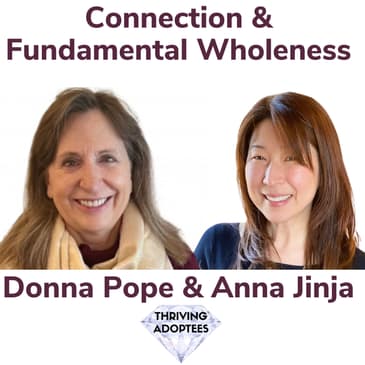
What if we are whole despite all that's happened to us? How does connection help us heal? Listen in as Anna, Donna and I dive deep into two profound questions....
Here is Anna's first interview: https://thriving-adoptees.simplecast.com/episodes/anna-jinja
Anna used to spread hate about herself being adopted and did everything she could to avoid talking about it. Now she runs a podcast and discusses adoption all the time. So what changed? Listen in as we talk identity, transracial adoption and most of all, being authentic.
Anna Jinja Mather was adopted from Seoul, Korea, and grew up in Iowa. Her heart is filled with love for people and their stories. By sharing her adoption story and all that she is learning to help her navigate through personal and professional challenges, she hopes that this will lead us to believe, accept, and value the inherent worthiness of all people.
Anna invites you to join her learning adventure by listening to the people and creative content that makes her feel at home in this world.
Check out her book https://www.amazon.com/Adopting-Grace-Anna-Jinja-ebook/dp/B0DJZPQ44K
https://www.facebook.com/annajinjashow
https://www.instagram.com/annajinjashow/
Here is Donna's first interview: https://thriving-adoptees.simplecast.com/episodes/purpose-in-the-pain-donna-pope
Are you suffering right now? It probably - or definitely - doesn't feel like it, but finding the purpose in that pain somehow makes it more bearable. The earlier we can see that purpose the sooner the pain can ease. Join Donna and I as we dive in life changing insights and shifts in perspective. Donna is an adoptive mother, executive director of an adoption agency and podcaster.
Here's a bit about Donna from her agency's website:
Donna is an irreplaceable member of our adoption agency, dedicated to aiding women who are contemplating placing their child for adoption. Helping women through an unexpected pregnancy has become her life’s journey. She is seldom “off duty.” On weekends she communicates with birth mothers to aid them with their financial concerns or traveling to a hospital to ensure they are receiving the best medical possible.
Her resolute dedication and heartfelt compassion make her an essential figure in supporting these women throughout their entire journey.
Donna ensures that every person who works at Heart to Heart Adoptions treats birth mothers and adoptive families with respect and compassion. She insists on a non-judgmental approach to every situation. She creates a safe and nurturing space for them to share their concerns, dreams, and worries. By approaching each individual with empathy and without judgment, Donna ensures that these exceptional women have the necessary guidance and resources to make well-informed decisions.
Donna’s expertise within the Utah Adoption Agency lies in her ability to find the perfect match between birth mothers and adoptive families, making her an invaluable asset to our agency.
Connect with her here:
https://www.linkedin.com/in/donna-pope-41652ba/
Explore her podcast here:
https://www.instagram.com/voicesof_adoption/reel/DLH-sYjJPf4/?__d=1
https://voicesofadoption.podup.com/
https://www.instagram.com/voicesof_adoption/
Find out more about her podcast here:
https://hearttoheartadopt.com/
https://www.facebook.com/HeartToHeartAdoption
https://www.instagram.com/hearttoheartadoptions/
Guests and the host are not (unless mentioned) licensed pscyho-therapists and speak from their own opinion only. Seek qualified advice if you need help.
Want to learn more about thriving for you, your kids, your families or your colleagues? Pick a time to talk here
[00:00:04] Hello everybody, welcome to another episode of the Thriving Adoptees podcast. Today I'm delighted to be joined by Donna and Anna. So Anna Jinja and Donna Pope have both been on the show before. Listeners, you may remember their past interviews. If you don't, right, look in the show notes and there's links to their interviews.
[00:00:24] So we've come together today to have a three-way conversation about wholeness. But before we get into that, if you haven't met them before, Anna Jinja is a, we're all podcasters, right? We're all podcasters, we're passionate about adoption. Anna has her own podcast and she is an adoptee.
[00:00:49] Donna is an adopted mum and she also runs an adoption agency. Is there anything beyond that that you want to share with the listeners? Maybe we start with Anna. Yeah. Is there anything else you want to share with the listeners about you and your background? I think that since my journey of really not talking about my adoption story for nearly four decades,
[00:01:14] and then just being forced as we talked in our episode through the pandemic to be able to start talking about my adoption story. What I realized is making connections with you, Simon, and with Donna, is that the importance of community and knowing that I'm not alone and being able to articulate what are all the things that were swirling in my heart and mind for those four decades where I refused to talk about it and to be able to connect with people to help me understand why is it that I do the things that I do?
[00:01:43] I decide the things that I decide has a lot to do with my adoption story. And to be able to be brought into community by Simon and by Donna, it helps me to be able to constantly emerge into the person that I want to become. And I can't do that if I am constantly in a state of denial or just refusing to have knowledge that helps me along the way.
[00:02:06] And so what I've discovered since, you know, being on your show, Simon, and being on your show, Donna, and engaging with your content is that all these stories out here are meant to connect us to be able to help us heal. That's one of the things I love about Simon is that he's really focused on healing and connection, which is great.
[00:02:26] And then more recently being on Donna's show of just being able to, I think Donna asked great questions to be able to think about my own story, but connected to a bigger community. And so I just, I love that we are connected in a way that helps us to be able to share stories and information and resources. So thank you for both of you for what you do for the Adoption Constellation. And same to you, Anna. Yeah, yeah, of course. Yeah.
[00:02:55] So Donna, what would you like to share? Well, I, I appreciate very much what Anna's saying. And it's been a joy to get to know both of these people because sometimes when you're working as a professional in the adoption community, you get a lot of negative stuff. You get a lot of pushback of you're ruining people's lives and that kind of stuff. And I don't feel like I'm ruining people's lives.
[00:03:22] Now, sometimes my kids maybe think I'm ruining their lives, but the, they're, the bottom line is that. Biological parents sometimes, sorry, biological kids. I feel the same way. Sometimes feel the same way. Is this a human, is this a human issue rather than an adoption issue? It's very, just saying. We got a, we got a lead the other morning from a 14 year old girl. And she says, I'm putting myself up for adoption.
[00:03:52] I hate my mom. And so I, I think everybody feels these ways sometimes, but you hear so many times trauma, trauma. And, and, and there's trauma. There's, I don't deny that.
[00:04:08] But the question is when your life feels like it sucks and you just don't feel good about who you are, where you are, who your family is, who your parents are, the, the circumstances of your life. Well, what do you do about it? And, and there, there's two ways to go. You can go out and say to the world, I hate this world. This is a stupid world. I hate it. I hate my life. I hate, and you can do that. And, and that's one way to do it.
[00:04:38] Or there's another way to do it. And that's, try to find ways to heal yourself. Try to find ways to connect with other people, to help them heal with you. That, that's the alternative way. And people choose those, or they just sink into their own despair. And, and that's an, an option as well.
[00:05:00] But the thing that I have loved about meeting these two is, is they're choosing to try to heal and community. Yeah. And people don't see that choice. Right. If people could see the choice, they'd make the choice. They're, they're, they're not choosing.
[00:05:24] Um, this, uh, so my kind of first big foray into, what should we call it? Personal development or spirit, uh, spiritual development, whatever you want to call it. Like I spent a week with, uh, with, uh, a, a lady called, um, Liz Ivory, Elizabeth Ivory. And her, her now husband, Richard Wilkins.
[00:05:51] And we spent five days looking at the stuff that we would have chosen differently. Look, realizing that most of the time, most of us, most of our lives hadn't been choosing. Right. We hadn't, we hadn't been choosing. We hadn't been choosing what, choosing what we thought.
[00:06:13] We hadn't been choosing how we feel and we didn't, and we choosing what, what we do, but we didn't know any better because we couldn't see another choice. And to put this really simply, the metaphor that they, that they, uh, that Richard and Liz talked about is, uh, it's about, it's like underground daffodils. Right. So here it's spring. Um, we're recording this on the 28th of April. It's spring here in the, in, in the UK. Okay.
[00:06:40] And imagine, uh, Anna and Donna and I were all together rather than just being on zoom. We were sat in, in, in, in my garden. What you call, what you guys call a yard. We call a garden. We, we stood in the, we stood in the yard, stood in the garden and we're saying, isn't it great? Isn't the weather great? Isn't it fantastic that the sun shining? And the, the, meanwhile, there are some underground daffodils still below the surface. They haven't come up yet.
[00:07:09] And they're saying, you're lying. You're lying. We can't see the sun. We can't see the sun, Simon. We can't see the sun, Anna. We can't see the choice, uh, the, the, the, the, the sun, Donna. You, you, you're liars. You're liars. But it's just because they're underground. They haven't broken through the dirt or what you call the dirt. We call the soil, right? They haven't broken through yet. They haven't seen the choice. It isn't a conscious thing, right?
[00:07:39] Most of the time we're not choosing what we think, feel, or do. What I, I, I learned, um, and we can't always do that, but we can choose more. We can choose more of the time. If we, if we see a choice, there's, there's, there's more than one option. Um, and we, we, we can choose what we're doing, but that's, I've only been doing this
[00:08:06] like 19 years, choosing a little bit more, choosing a little bit more. I'm curious, Anna, how you came to poke your head out of the dirt. I'm going to call it soil just for you, Simon. But poke your head out of the soil. So that, I mean, if you're a little Daffodil seed and you can't, you, you don't know there's anything up there. You don't know there's sun up there. How did you get so that you poked your head out?
[00:08:37] Well, I think that, um, to speak to what Simon was saying, I think pain equals paralysis. I mean, so it wasn't, I wasn't able to make choices because I was just paralyzed or underneath the soil or whatever it was that just was actively choosing not to engage with my adoption story. So I had therapists that would say, I think you, Anna, that we need to talk about your adoption story and just explore that this might be a source of pain.
[00:09:03] That's causing some, you know, consequences for, for how you're living your life. And I always refuse to accept that invitation by therapists to explore that. And so it was constantly, it was somewhat of a choice because I was saying, no, thank you. I'd rather explore this. And I think where it comes to, it was like, are you prepared to be able to talk about the things that you have been denying for so long? And, you know, it was right during COVID.
[00:09:30] I think that I was trying to fill air, um, you know, I was at the community radio station. I was one of few that were allowed in the station. And so I had to fill air. And so then it was somewhat, you know, I'm like, I'm not going to talk about my adoption story. And the universe is like, oh yes, you are. I'm like, nope. And so why didn't you want to Anna? Why? What was keeping you from doing that? Well, I was just, uh, uh, talking yesterday about how I wore sunglasses, uh, as a teenager
[00:09:59] because I wanted to conceal the shape of my eyes that identified that my country of origin was South Korea. And part of that was because what I wanted was to be a normal teenage girl in the Midwest. And anything that said, you are not part of, uh, this group that you're not going to be accepted, then I would deny it because I wanted so desperately to be loved, to belong, to be invited to parties and to friend groups.
[00:10:27] And I felt like if I talk about my adoption story and I show the things that are clearly different about me, then I will be rejected. It all comes from the fear of being rejected. And so when I started talking about the story and actually other people started to talk about their adoption stories, it connected me again to that, going back to that community of like, I'm not alone. Um, I'm not going to be rejected.
[00:10:53] And so the more that I could feel safe about embracing those parts of my identity that I feared that would cause me to be abandoned again, rejected again, it caused me to be able to accept the invitation to choose, to be able to have a conversation with Simon, with Donna about things I refused to talk about before. But I think you have to feel safe to be able to emerge before you'll make that choice.
[00:11:21] Well, I would, I would add a question on you, on that, Anna. Was, was trauma choosing then rather than anything else? Was trauma choosing you to? Yeah, I think it certainly was the barrier, right? And I didn't even know the terminology for adoptee trauma until really started this process. And also just in my life, there were a series of things that happened that, um, that distracted
[00:11:49] me from the adoptee trauma where I, you know, grew up in a household that had some issues. I had, I was dealing with addiction, not myself, but with family members and friends that had addiction issues. I had, I had, um, you know, a family member that, that abused me. And so all that trauma on top of trauma, I didn't know what trauma I didn't care about how to identify it. I just was trying to survive.
[00:12:19] See, I think there's a lot of fear there and I can just imagine people that may be listening to this and I, on the one hand say, well, just grow and just, well, you can't do that. You can't just grow. Um, there has to be the right conditions. There has to be that, like you said, the safety, there has to be those things.
[00:12:45] And I don't know that mentally and cognitively we can just grow. I think that, that there requires some elements of our environment, like our soil, like moisture, like those kinds of things that allows us to grow. Simon, I'm curious as to what, you know, those elements to be. Yeah. Thanks.
[00:13:14] Catch you on the line. Yeah. It's, it is, it is environment, you know. Um, I think one of the challenges as, uh, Anna's highlighted is, is, is really, you know, like when, when you get a, some, you go to some coffee shops and you can see the layers of
[00:13:40] coffee in a latte macchiato, you've got different layers, right? You can separate the layers, right? So those layers could be the, the layers of our, of, of our trauma. Right. But we can't see the separation because when we, it's been, it's all been stirred up. Right. It's all, it's all been stirred up before it settles out.
[00:14:11] So trauma, trauma is trauma, like coffee's coffee, latte macchiato is latte macchiato. But the, um, the, the hopefulness bit for me is in seeing that we're the glass, not its contents. Right. So it's a separation between the, uh, the, the trauma that we feel and the essence of who we are.
[00:14:40] It's a separation between feelings and, and, and trauma and identity. And we don't see that. We don't see that until we see that, until some slightly weird bloke comes up with the idea that coffee is trauma and the glass is us. Right. It's a, it's a, it's a metaphor. It's a metaphor for, for, for, for who we are.
[00:15:07] And, but we can't, it's hard to see the picture when we're in the frame as a, an old mentor of mine used to say, it's hard to differentiate who we are from the trauma that we feel. Cause we're, we're, we're lost in it. We're, we're, and people say I'm lost in thought. Well, we're lost in trauma. It's like, um, if you've ever been in, ever been in this, in the sea and got knocked over by the wave and been taken underneath it.
[00:15:36] And, uh, and, and, and it's spinning round, right? The, the, the, the, the wave's spinning round and we don't know whether we're looking up or down. Trauma is very disorientating. Um, we, we can't all learn. Um, we have to, we have to take baby steps to, to, to be the, the surfer, right? Who's on the surfboard, who's riding the wave rather than being lost in it.
[00:16:06] Um, it's what, one of the challenges I think is that what, you know, relinquishment trauma gets mixed up with, may I say, shit parenting trauma, right? It's all, it's all lost. It's, it's all trauma, trauma's all trauma. Like, like that, that the whole thing is coughing just in different levels. So it's all about the environment that, that we grow up in.
[00:16:36] Um, and I didn't realize that I'd got kind of lucky. I, I got, I got lucky with my parents. I got a lot luckier. I'm sure some people got luckier than I did. I'm sure people, a lot of, I know a lot of people got a lot less lucky than, than, than I did. But it's that, the, the, the, uh, the emotional intelligence, um, the, the emotional intelligence,
[00:17:05] the consciousness, the aware, self-awareness, the contentedness of the adoptive family plays a huge role, um, in it. And, um, and to, to, to bring back, to bring back to some, some, some stuff that Anna's talked about, I've heard this time and time and again, again, from transracial adoptees who, who
[00:17:33] grew up in white areas, right? And, and, and so they, the, the, the surroundings feel strange. They don't have the role models and we feel like we, they feel like they stuck out. They, and they're confused. Adoptees, transracial adoptees have told me, Asian adoptees have told me that they feel like a, um, a banana yellow on the outside and what, uh, yellow on the outside and white on the inside.
[00:18:02] And it's really con it's really confusing. Um, African, uh, transracial adoptees, uh, uh, African-American say that they feel like a coconut, like brown on the outside, white on the inside. And it's all very, very, um, confusing. So I think we've got to look at the environment within the adoptive, um, within the adoptive family. And we've got to look at the, the, the environment in which we grew up in that's particularly,
[00:18:33] um, uh, particularly important for transracial, um, uh, adoptees. I think Donna too, I think that, you know, when you're asking for the conditions, what are the conditions to be able to accept that invitation to start healing from your trauma? And I think one of the conditions is that you have to have trust. You're going to have to be able to trust the people that are around you, the people that love you and your environment to be able to make that decision.
[00:18:59] I think it's much like things when it comes to health, like for eating and diet. We all know that if you eat an Oreo cookie versus an apple, that there will be consequences for that decision, but we constantly, or I do, I'll pick the Oreo cookie over the apple all the time. So I think we, sometimes we know what a healthy, what, what we want to be. And we want to be able to trust relationships to go out there and not respond in a way that
[00:19:28] is, um, from a place of trauma, but a place of trust and kindness and compassion. But we don't know how to do that unless the condition of trust is there to be able to say, I trust myself, first of all, that I know that I want the best for myself and for the others, and that I'm going to trust the other person that they want the best for me as well. And to be able to have that kind of partnership to be able to say, I want you to be the best person that you can be. And my therapist used to say, pain is pain.
[00:19:58] I don't have to compare my trauma to another person's trauma. I can just know that all of us experience trauma in some way or the other. Nobody goes through life and says, I'm born. I'm happy for the rest of my life. And I die. That's just not the way our world works. So it is figuring out how do we navigate in a way that is able to say, your pain might be different because it comes through the adoption lens. My pain might be because I come from a poverty lens where I didn't know where my next meal was from.
[00:20:28] That pain though, if like, how do we be able to help support each other? And that I trust you to know that you've got my back and that you're going to give me information that helps me be able to be my best self. Simon does that in his show all the time with the guests that he presents and the book that he put together or the collective group of all those within the adoption constellation to provide advice and guidance. I trust that Simon is going to put together a book that has good advice and kindness and to be able to connect.
[00:20:58] Donna, the same for you. I know as a adopted mother and somebody who cares passionately about like healing and being able to do that. I'm going to trust when I listen to your show that there's going to be information and guests that help me connect, excuse me, connect to parts of who I am. That might be different, but I'm going to be able to say, I recognize that because I feel that and I'm going to trust to be able to listen to one more episode to be able to have clarity about how do I, how do I heal?
[00:21:29] And we are constantly in a state of becoming. It's not like we're done one and done. Like we have this information and we're all healed and we're all good. I think I'm doing good. And the next thing I know I'm like on a binge eating Cheetos, Oreos and Ben and Jerry's. And, uh, and I'm like, well, I made that decision. And the next day, let me try and drink some more water and, and heal again from the bad choices that I made. But I think that that condition of trust is so important.
[00:21:57] I can't, if I can't trust that the world or the people around me, I am not going to be my best self. I'm not going to heal. I love that. Um, I'm thinking about your word, Simon contented. Um, you, you said that for someone to, for an adoptee to feel comfortable, they need to be in a home that's contented. I, you don't think of that word very often. And I think, what is a contented home?
[00:22:26] Um, uh, this weekend, I, I, I planted a almond tree. I'm super excited about this almond tree. Um, so I planted it and they, they gave me a guarantee that if I did it right, they would, the tree wouldn't die. And so I planted it and everything was happy. And then I went out and my dogs had dug clear down into the roots of the almond tree. And I thought, my almond tree is not contented.
[00:22:53] I, I, and, and I, of course, put the, to put the soil back in and blocked it. So the dogs couldn't dig that again. And I think about how often in our lives we get dug up, something digs us up and we're no longer, we're, we're exposed. Our roots are exposed. We're exposed and we're traumatized. There are things that have dug us up and we're no longer.
[00:23:20] So I putting that soil back in, calming things down. And, and I think many people live in life. They live lives and in homes that there's never calm. It's always something stirring things up. In fact, they live their lives that if there's calm, they look for things that will stir them up because they're more comfortable.
[00:23:47] Simon, why are people, how does that happen? Well, people talk about a big connection between drama and trauma. Right. I remember watching a travel program years ago and it was a holiday show, holiday travel program. And they, the holiday that they were featuring, you know, it's like a magazine show.
[00:24:16] So they look at, you know, a hotel in Spain, they look at, they're looking at a writer's retreat in, in, in, here in the UK. So you go, you don't just go on holiday and lie on a beach. You, you go and connect with other writers and do some writing. And they said, write, write, write a, the teacher, a facilitator said, write a story about two people
[00:24:46] sitting on a park bench, agreeing with one another. And you go, this is a super boring story. Exactly. So you think of, you think of, oh, what's the show? The life is like a box of chocolate. I mean, that whole story is around this, him telling the story of his life, but there was a lot of trauma in it. Forrest Gump. Yeah. Yeah. Forrest Gump. Yeah.
[00:25:16] Yeah. So, um, I had this idea of wholeness asking you guys about wholeness. And Donna, you're giving Simon all the tough questions. I'm like, I didn't get that one. Well, let him give you the wholeness one. Well, right. So I've, I've got this, I've got this idea. My, my kind of mantra at the moment is trauma informed, wholeness aware and thriving obsessed.
[00:25:46] Okay. Let's do it again. Trauma informed. Trauma informed. Right. Okay. Wholeness aware. Wholeness aware. Yeah. Thriving obsessed. Okay. So I'm aware of my trauma. Uh, I want to be, come whole. Well, what, what if you're whole already? Okay. Then I want to, I want to thrive. I want to thrive.
[00:26:16] I want to move forward. But wholeness is a seeing thing. Okay. It's a thing we become aware of. Right. We become, we become aware of our wholeness. Let me just take a step back. Right. Because I think. I think you need to, because you've lost me already. Okay. So wholeness is seeing. Okay.
[00:26:42] So we've become trauma obsessed. I believe as a society, right? Everything's triggered. Right. My latte marciato wasn't hot enough. It's, it's triggering, you know? So we've become trauma obsessed.
[00:27:05] We've gone from the, the, the, the, the arc of the adoption narrative as we've gone from trauma blind, right? To, to, to trauma aware. We started becoming trauma aware about the adoption trauma with Nancy Verrier and a Primal Wound book in when it was published in 1993. So we've gone from trauma blind to trauma aware and 1993 to 2026.
[00:27:33] So we're even, can I do that somewhere in my head? 33, 33 years later, I think we're still pretty, we've become trauma obsessed. It's kind of trauma all the way. Right. And I'm, I'm suggesting a new way forward, which is to be trauma informed. Nobody's denying the trauma. Not going to deny anybody's trauma.
[00:28:00] We've all had it, felt it, know it intimately, right? I'm just saying, what if we could be wholeness aware? We could be aware of the wholeness underneath our trauma. Underneath our trauma. Or maybe behind our trauma, right? We could be wholeness aware. To see our wholeness.
[00:28:29] To see that, that trauma rather than cutting us, right? The, the, the word trauma is cut from the Greek for wound for cut. Rather than it cutting us, it has concealed us. Rather than harming us, it has hidden us. Because that's what I think trauma does. It, it, it hides us.
[00:29:02] No, I'm, I'm. It's availing. It's, it's availer. It, it, it, it, it's, it's like the best metaphor that I've come up with this so far, right? It, it, and it is rock, paper, scissors. Rock, paper, scissors. So we're the rock, okay? Trauma is not the scissors. It's the paper.
[00:29:33] Okay. So I'm going to back up here and, and just see if I, I'm understanding you. So all the time people get mad at me and they'll say, you talk about adoption being love. Adoption is not love. Adoption's trauma. Quit saying it's love. And, and, and, and I, I hear what they're saying when they're saying that.
[00:29:57] They're saying, you are dismissing what I'm feeling with your love stuff. You're dismissing that I'm hurting. And I, I get that. I get that. At the same time, I get that. I don't want them to get swamped in that and stay, as you're saying, Simon, hidden by that. Because there are positive things.
[00:30:25] So if we acknowledge as we have, okay, this has been tough. This is really a hard thing for you to have gone through, but I don't want you to stay there. I don't, I'm not saying that it's not real. I'm just saying, is there a way to move forward, to get uncovered? And so that's where your wholeness comes, idea comes in. Well, it's my wholeness idea.
[00:30:53] So it's, I call it, I call it fundamental wholeness. Fundamental wholeness. And, and I'm saying, I'm, I'm not denying trauma. I'm saying that trauma hides who we are. It doesn't hurt us.
[00:31:17] So the, the, the, the rock, paper, scissors analogy is saying that trauma is, is more like trauma is the paper, not, not the scissors. So it's, it's an unveiling process, right?
[00:31:38] So we're, we're, we're unfolding, we're unfolding the paper that has, that, that has hidden the rock. It's hidden who we, it's hidden who we are. Trauma hides us. It, it, it, it, it veils our essence. It doesn't damage our essence because, you know, we're talking about, people talk about
[00:32:06] time being the, the, the, the greatest healer. Well, if there's nothing changes over that time, there's no healing. Healing is about change and the, and, and the, the biggest healing insight that we can, so it's, it's about insight rather than time, right? So, and the, the biggest insight that we can have is that we are whole underneath our trauma.
[00:32:37] I think of Anna and her wearing sunglasses. Woo, talk about veiling. Talk about covering. And, and when invited by her therapist to talk about her adoption, she just, no, no, I'm keeping this hidden. Um, because of that fear. Okay. So, Simon, how do you invite people to? Into that? Yeah.
[00:33:07] Well, the, uh, Einstein said the biggest question that we ask ourselves, we can ask ourselves is, is the world for us or against us? Okay. The biggest question we can ask ourselves is, is the world for us or against us? If we've got, if we're viewing life through trauma glasses, right? The world looks really, really unfriendly. Oh, very against us. Okay.
[00:33:35] So, uh, one, one way that we can talk about healing is a, a, a change of glasses, a change of perspective, a, a, a, an insight, right? So I'm just giving you different metaphors for sight, for insight, a sight from within, something that we see for ourselves. Now I've had, I've had that insight.
[00:34:02] I've also had the insight that there's no such thing as a secondhand insight. We have to see it for ourselves. We have to see it for ourselves. That's why the underground daffodils, the underground daffodil bells, they can't see the sunshine. So they think that we're lying. And we go, no, it's really bright out here. Because they can hear, they can hear us through the soil, right?
[00:34:30] They can hear us through the soil, but they can't see the sun, sun, sunlight. So it's a seeing thing, you know, shifts time after time. You know, you've done loads of episodes. I've done loads of episodes, right? It's when we have, when, when we, when there's a shift in our perspective,
[00:34:50] when we realize that we can trust somebody, for example, I see, I see, I can trust Simon. Somebody, somebody, I was interviewing, not interviewing, talking to potential guests yesterday. And she said, well, how do you, you know, what care, what care regime do you put in into place after people have been on the show?
[00:35:19] And I was like, what? I said, people, I meet people first. I meet people first. And I ask them if they want, and we spend some time together. We get to know each other. And then they book a time to come on the podcast. If they don't feel safe with me, then they're not going to book a time to come on the podcast.
[00:35:49] And if they say something after the podcast and they say, actually, Simon, I didn't, I didn't, I don't think I came across very well in that conversation. I was in a bad space that day. I will say, okay, no problem. I won't publish the, I won't publish the interview.
[00:36:11] But if it, so it's about seeing, it's about, it's about trust as, as Anna has, has said. It's about connection, as you've said, Donna, and about the environment. And it's a seeing thing. Insights are a seeing thing. It's a shift in our perspective. So, somebody could say, right, well, I'm not sure whether I trust that guy, Simon.
[00:36:42] I'll have a chat with him and make sure that I can trust him. And yeah, okay. You know, I've heard enough about him. I know enough about his stories. I can say I trust him. I'm going to go ahead and book a time to come on his podcast. It's a seeing thing. And the biggest thing that we can see is our wholeness. But we've got a society that has gone from trauma-blind to trauma-aware, trauma-informed and trauma-obsessed.
[00:37:09] We have not yet become wholeness-aware. We're not seeing this thing called fundamental wholeness. We're not seeing our fundamental wholeness or feeling whole underneath our trauma. So, I'm interested in wholeness and seeing that we are whole underneath our trauma.
[00:37:39] Feeling whole underneath our trauma. Our feelings, trauma is largely a felt thing. And it comes and goes like storms come and go. But the storms don't damage the skeleton. So, I'm curious how Anna has gotten more whole.
[00:38:06] Well, I think that the concept that you're talking about, Simon, I teach a course and it uses sunglasses and glasses as a way to talk about mindset. So, we put on our different glasses and that gives us a different mindset about how we approach a problem or a situation. In the podcast that I do, I talk about how everyone might feel that they're unworthy, which is another word for wholeness.
[00:38:31] And that you can't come into this world with more worth than what you have coming into this world. You are always worth something. There's nothing going to be a, if I get a CEO title, that means I have plus five worthiness. If I lose my job, that means minus 10 worthiness. We are worthy. We are whole. And so, nothing can take that away from us. Now, I think that trauma, I think it was interesting, Simon, how you talked about how
[00:39:00] trauma can be the paper instead of the scissors that cuts at you. It feels like cuts. So, like the trauma as a child and as a teenager definitely felt like physical cutting away of like who, it felt painful. It felt like a cut. I could feel the physical manifestations of trauma. But I think what you're saying, Simon, is just so important for adoptees or for anyone who feels like they
[00:39:28] can't move beyond the trauma, like you're saying, Simon, is that you are whole, you are worthy, and that nothing can take away the fact that you are on this earth. And you're meant to be here because you're here. And so, if you take all the things that happen to you to like think that you mentally, that is a subtraction game of like I am less than,
[00:39:54] and then you're at negative five or zero, that's where it becomes harmful because you don't want to come out and see the sunlight because you're afraid. And when Donna, when you were talking about those that have experienced trauma, who just like when they get to a peaceful place because they've known how to operate within trauma, they generate it for themselves because they know how to function within that cycle of trauma or whatever that is kind of thing.
[00:40:20] And again, it's figuring out like who are the people and what are the things, what are the music, what are the poems that help you, guide you to moving beyond that, to like stretch out beyond your comfort zone, which there are lots of people who feel comfortable operating within chaos because they know how to function. They know how to survive. So, of course, they're not going to leave that because I don't know how to function within without dysfunction.
[00:40:49] And I think shows like this, I think people like you are guides to be able to say, yes, this is where you are. And here's the information and the resources that I can help you to be able to stretch out and just like test us, as Simon would say, test the waters. And then it feels a little bit better. And so you're going to come out to maybe your knees and then maybe you'll go to your chest. And then the next thing, maybe you're swimming.
[00:41:15] But I just remember another therapist saying that trust is earned. You can't just say, trust me and then throw somebody into the end of the pool and say, because I'm trusting, I'm letting you learn how to swim by just throwing you into the deep end.
[00:41:33] And so I think, again, it is this relational experience of how do we how do we find community and connection with the resources that we have, knowing that I should eat the apple instead of the Oreo cookie or whatever it is kind of thing. Yeah. And we need to connect with people further along the way than us. Right. So you talked about CEOs and self-worth and all those sort of things.
[00:42:03] Right. Yeah. So I want to learn from somebody that's further along the way. From me. I don't want to I want to I want to I want to connect with people who've got knowledge that they can share. I don't I don't I don't want to connect.
[00:42:26] I don't want to try and learn from people that are behind me because they've they've not got anything for me to to to to learn from. I don't want to. So if I'm if I'm going to a space with fellow fellow adoptees. Right. I want to go into a space that is that is moderate moderated by somebody that knows their onions.
[00:42:51] Right. That's somebody that somebody that sees their wholeness, that feels whole, that is that is whole. I don't want to go into a Facebook group full of people that are still underground daffodils because I'm not going to learn from I'm not going to learn from those people. So if I would. Oh, go ahead.
[00:43:19] I mean, like if I wanted to if I wanted to. We talked about creative writing and going on that holiday. Right. Right. So I want if I was wanting to learn to write, I want to learn from a writer. I wouldn't want to learn from somebody. I wouldn't want to learn from a five five year old kid that that can just put a few scribbles on a page.
[00:43:49] Well, I just would say, yes, you definitely want to look for guides to be able to who are who are, you know, a little bit ahead of you or a lot ahead of you. I'll just say that I met with a young person who's 18 years old, transracial adoptee. And and I sat with her. And what I learned is like that she is experiencing the same thing I did 30 years ago, which is amazing to me.
[00:44:15] And what I learned from this young lady is that we are almost like a restarts again, where like we think that we've come so far. And yet she's experienced the same kind of discriminatory statements about how she looks, about how she experiences high school. And so those things are part of the human experience. And what I realized just seeing with her is that sometimes it is just being with that person.
[00:44:43] And I could provide I am probably I am ahead of her in many ways. But just sitting and being with her in those moments was learning for me to be able to think back about what does it mean to experience the world for the first time? And that creative that creative interchange of like processing it through her eyes was meaningful and a learning experience for me, because you think, you know, you think, you know. And then I'm like, I had no idea.
[00:45:11] And then on a funny level, I'm like, well, I'm totally out of touch about who the current musicians are, artists and the slang, because I was like, YOLO. And she's like, what? You're stupid. So I've interviewed, I've had the honour of interviewing some younger adoptees recently. Three of them.
[00:45:36] One guy, a domestic adoptee adopted from foster care, who had been through incredible trauma, abused by his brother. Right. And I've interviewed a guy. So that's a guy called Trent Taylor. I've interviewed a transracial adoptee from two transracial adoptees, Wilson Munsterman.
[00:46:06] Yes. Yeah. And the other one was Katie Pickard. So she's she was born in India. Wilson. I can't remember where Wilson was born. Why was Wilson born? And I think and he's in Nebraska right now. Yeah. So just interviewed him recently. Amazing young man. Amazing. But so Wilson's like maybe 18, 19. Katie's like 18, 19.
[00:46:33] Trent's maybe 26, 27, something like that. Incredible wisdom and just living, thriving, just exuding wholeness, especially Katie. Like, you know, I talk about, you know, we talk about becoming enlightened, right? People become enlightened, right? If you are the light. Then you don't need to become enlightened.
[00:47:03] You're already light. And I think that I think trauma and darkens us, right? So it's like a it's like a veil, like a veil over our over our light bulb. There's no dimmer switch on that light that we are. And Katie comes on. It's five o'clock in the morning, her time in South Dakota. Right. And I'm interviewing her and she is just beaming light. Right.
[00:47:33] Like the trauma that veiled her has gone. It's visceral. I can like that. And then I think, is this just a one off? Has she had a lot of coffee this morning? And then I interview her again and she comes on exactly the same, you know, like five o'clock in the morning. And she's beaming. She is whole. She is bright. She is light.
[00:48:01] And trauma didn't turn down that dimmer switch. It just hid her. It veiled her. She went through incredible, incredible stuff as a teenager, questioning her identity. You know, the whole caboodle and incredible story. But whole bright light beaming, living it.
[00:48:30] Whether she could, whether she could express it, I'm not sure. But it put it into words. I think she did a pretty good job. But it was more about who she was, how she showed up, how big her smile was, how twinkly her eyes were. It was a sight to behold. And this is an 18, 19 year old kid, right? How did he get that way? How did this happen?
[00:49:00] Simon, how did this happen? How did he go through trauma? All those three people, all those three that I've mentioned there are all deeply religious. And that has played a huge part of their healing journey.
[00:49:28] But it's not a prerequisite, right? I'm not a religious person.
[00:49:43] But I know that it's all about our identity, our essence, our core, our light. It's thriving and it's all about that. It's not about our psychology. Our psychology is how we think, how we feel.
[00:50:12] That word that you said, mindset earlier on. Yes, spot on. That all these psychology, mindset, thoughts, feelings. Yes, right? But they're not who we are. Our thoughts and feelings, they come and go. We're the space in which they come and go. It's about, it's far more to do with who we are than how we feel.
[00:50:42] The psychology that has added to us. The trauma that is added to us. And then we're just scraping it. We're scraping it away, right? The thriving adoptees logo is a diamond as a direct challenge of this field that so many of us have. We don't think that we are good enough, right? We think that we are unworthy, right?
[00:51:07] That a diamond is buried deep underground through underneath layers and layers of rock and trauma. Sorry, layers of rock, right? And I think adoptees are just the same. It's those layers of trauma. The layers of trauma in the rock, like the layers of trauma in the coffee cup I was talking about.
[00:51:34] And so it's an excavation job, right? The diamond was there all the time. It's just buried underneath that rock. It's about who we are and the layers of trauma that hide us. And it's an excavation job. We're going through the layers, like you, Anna, going through on the therapy, right? You're going through the layers of, going through, digging through the layers of the trauma.
[00:52:04] And you're uncovering, you're revealing your essence. So what those three adoptees had in common is they had taken a dig, had gone digging through their layers of trauma and seen who they were, right? The difference, so all metaphors kind of run out of steam, right?
[00:52:30] So a diamond's worth is set by the market, right? So if it's this carat, if it's this size, this number of carats, right, it's worth this. Our identity as us is set by us. We get to choose. We get to choose.
[00:52:58] The clearer that we can see who we truly are, the more we're worth. Well, and diamonds are also created by pressure. And so they can't, you know, they don't exist by just like being floating around. There's pressure exerted to be able to like create that diamond.
[00:53:26] And that pressure, sometimes there are life circumstances. It's the reaction to life's pressures to be able to like, how do we respond? And some of it, I think Donna is that we are constantly trying to, in the state of becoming and being able, and part of that becoming is starting to choose yourself, to fall in love with yourself and figure out what are the bits that make me, me. And accepting those things.
[00:53:53] I just was saying to my husband, I'm like, I just listened to a podcast with this woman who is blonde. She's probably five foot nine, supermodel. And I'm like, oh, I wish I could be that. And if I wanted to do that and constantly use that as a measure of what a worthy person is, I'm going to fall short every single time. And so it is trying to figure out like, so this is what I've been given in this lifetime. These are my circumstances. This is my trauma.
[00:54:23] Blending that in. And whenever I talk about trauma, all the things that happen to me, I hope make me more compassionate. So when I see somebody else is hurting, I can recognize it and say, I know that pain. I know that trauma. You are not alone. And it might be completely different, but let me walk with you. Someone said to me the other day, which I'm stealing it from someone else. We're all just walking each other home. That's what we're doing. That's what those three young people are doing.
[00:54:49] If that's their framework is that they are Christians, that they're all walking each other home. And if you're not a Christian, then as human beings, we are all walking each other with our own stories and saying, and you know, Donna, when you were talking about the person who's like frustrated with adoption as love and that it doesn't seem to recognize the trauma that's connected to the very start of our lives. The very start of our lives are being rejected and abandoned. Even if it is for a good reason, you are still being rejected and abandoned.
[00:55:19] There are lots of mothers who say, I will hold on to my baby. There's nothing that would separate me from my child. And yet for us, there were circumstances that, yes, you are. I cannot be with you for whatever the reason is. And so that comparison of the mother who's in dire poverty and war circumstances and still holding on to her child and my biological mother said, I can't do it. Then why? And that why haunts many adoptees.
[00:55:49] And so I, but all of us ask why, why am I not good enough to be in a relationship with a spouse where he leaves me for a younger woman? Or why did I get fired from the job? Because I didn't able to perform in a way that my boss wanted me to. We all experienced that rejection. And it's figuring out, like Simon said, to lift that veil to say, we are whole. We are going to thrive. We are going to be obsessed. We're going to be thriving, obsessed.
[00:56:18] Because we know if we do that, life is so interesting. We get to be curious about the things that make us want to pop up and say, feel the sunshine and say, okay, I'm going to join you other little daffodils. I love that. And I'm thinking about those three. You could say they're deeply religious. And I would say they're deeply connected.
[00:56:43] They're deeply connected to a God, to a higher power that leaves them feeling, I am of worth. If not, if I'm not of worth to anybody else, I'm of worth to my God, to my father, to Jesus Christ. And they feel that in their very bones. I'm of worth to them. And we look at AA and we think about the first principle of AA is that we acknowledge there's a higher power.
[00:57:14] Which means I have somebody else I can grab onto. And so, I mean, you talk about, I don't want to learn from a fifth grader how to write. I want to learn from someone better than I am how to do something better. And so, people with that deeply religious connection are thinking, I want to learn from a God how to be better.
[00:57:39] Because that is great power that I can hold onto and walk with. That would make me feel whole. Feels a good place to bring it in, ladies. Yeah. Bring it in. This has been fun. This has been fun. I hope you've enjoyed it too, listeners.
[00:58:06] I guess if you've turned off, you know, you're not listening to this anymore. So, you know, we're preaching to the converted to bring it on. Right. Thank you, Anna. And thank you, Donna. And listeners, we'll speak to you again very soon. It's okay. Bye-bye. Bye. Bye.