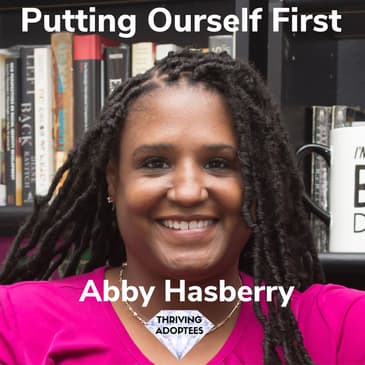
Who do you prioritise? Whose needs come first? Putting ourself first is seen as selfish and therefore, bad. Listen in as Abby and I discover constructive selfishness. Abby also shares her reflect, release and re-invent process that's empowered her as a transracial adoptee.
Dr. Abigail Hasberry splits residence in Texas and Maryland. Her work focuses on examining and developing a person's identity, experiences, passions, and support networks. Abby prides herself on being able to support people as they plan to meet and exceed their potential. She provides a safe and supportive space where her clients are guided to growth by enhancing their confidence, knowledge base, and network. Dr. Hasberry deeply understands her clients’ passions and listens for the things that are not said. "I am also my clients’ biggest cheerleader and problem solver all at once."
Here's the link to Abby's book https://adoptingprivilege.com/
Here's the link to the book Abby mentions https://www.amazon.com/Mis-Education-Negro-Carter-Godwin-Woodson/dp/B09WHKKMNT
https://www.instagram.com/d.e.a.r._abby/
https://www.linkedin.com/in/abigailhasberry/
https://twitter.com/DEARAbbyEdu
Guests and the host are not (unless mentioned) licensed pscyho-therapists and speak from their own opinion only. Seek qualified advice if you need help.
Want to learn more about thriving for you, your kids, your families or your colleagues? Pick a time to talk here
[00:00:02] Hello everybody, welcome to another episode of Thriving Adoptees podcast. Today I'm delighted to be joined by Abby, Dr Abby Hasberry. She's been on the show and she's back for more so it must have been okay the first time around Abby. It was great, yes. I'm glad to be back. And she's back and the reason that she's back is that you've just put your heart and soul into this book right? Yes. And it's called Adopting Privilege. So what is Adopting Privilege Abby?
[00:00:32] Yeah, for me, when I think about adopting privilege, I think first about the privilege of adoptive parents to be able to claim and raise a child that is not their own. And that privilege is usually associated with whiteness and with affluence and with, with like Western philosophies and often with Christianity as well. And so that's my first thinking when I started thinking about the privilege that my parents had when they adopted me.
[00:01:01] But as I started thinking more about it, I then started to think about my association or my, I don't know, my, the fact that I was privileged adjacent is what I like to call it. Being a Black transracial adoptee adopted by a white family who had education and means and all of the things.
[00:01:21] And so in my critique of privilege, I also had to recognize the privileges that I have in education, in my experiences, and the fact that I've lived all over the world and traveled all over the world. And so I wanted to make sure that my book, which is a real critique about adoption and specifically transracial adoption and relinquishment as well.
[00:01:43] But I wanted to make sure that that critique was balanced with me recognizing the good, recognizing the things I've benefited from, but also really critiquing the industry itself. And so that is why I named it Adopting Privilege, because it is all about the privileges and who gets to be a mother and how that happens in our societies. Yeah. So before we hit record, Abby and I were talking about self-awareness.
[00:02:10] Sounds like you've done an awful lot of self-awareness and soul searching to do this book, right? Yeah, it was really important to me to write it from a very healed place. I've read some work out there from adoptees who are angry and just it's hard to hear that message and it's hard to really hear from that space.
[00:02:31] And so it was important to me to really write from a healed space, which is part of the reason why I stopped writing this book in 2017 and kind of finished it over the last few years, because things that have happened since then are way too recent and I don't feel like I've processed them completely and correctly. And so it was really important that that was part of it is just having that self-awareness. And the book is about my process and how I healed a lot of the things that happened to me.
[00:03:00] Yeah. So what does that process look like? Yeah, for me, I call it my R3 framework. So it's reflect, release and reinvent. And so it's about really taking the time in meditation, in writing, journaling, all of the things to really reflect on all the experiences that I've had, reflect on the relationships that I have in my life, the ones that have come and gone,
[00:03:27] and then releasing the things that don't serve me, really coming up with like a way to just kind of say it's OK that these things happen or these people left my life or I'm going to put up boundaries around these things that don't serve me. And then reinventing who I want to be as a direct result to releasing those things. And that reinvention really came from me moving so often. I really learned to reinvent myself every time I moved, every three to five years growing up. And then as an adult marrying a man in the military, I moved a lot.
[00:03:57] And so reinventing myself became kind of a theme of my life. And so it just became part of my process of let's make me come into this thing intentionally. And now that I know better, do better and just be the best version of myself every time I can. Yeah. When you say reflect, what popped into my head, and I'm not sure who used this, where I heard this metaphor from,
[00:04:26] but it was the idea of seeing the people with trauma, seeing the world through a trauma lens. Right. So, and the idea is, well, talking about interesting, like color and race, you can't see, you can't see white snow through orange tinted glasses. Right. It looks, it looks orange.
[00:04:58] So when, when, when we're, what have you learned about, shall I say, taking the trauma, trauma glasses off for reflection? Because if, if we're reflecting from, if we're reflecting with our trauma glasses on, we're just going to kind of spin our wheels and we're not going to get, get further forward. What, what does reflecting look like from a clearer perspective?
[00:05:26] So seeing through plain glasses rather than trauma? Yeah. It really involves processing through the trauma first and then seeing the world from many different perspectives. And so when I talked originally about adopting privilege and how I thought about privilege from many different perspectives, my reflection is also through that. And so it involves taking ownership of the things that I know I have responsibility for,
[00:05:55] and then also allowing other people to have ownership of the things that I can recognize that they have ownership for. And then my responsibility is also to offer grace. And so that I'm not reflecting at it through a really traumatized place, but our place where I believe that most people have really good intentions. They just may not have, may not act well. They may be acting from their trauma places. And so their good intentions can be very harmful and have really negative impacts.
[00:06:21] And so when I think about my adoptive parents, that's the lens that I look through is understanding that they had a good, they had good intentions. They really did love me. They just came at it. Broken people. First. And also people who just didn't understand the world, how the world worked and thought that they knew better. And so while their intentions were good and the love was strong, the impact was really, was often very harmful. Yeah.
[00:06:48] Do you remember the first time you saw that, that thing that you're calling grace? Because we have to see it, right? Yeah. I think I learned to practice it before I recognized it. And I think I learned to practice grace out of necessity because of some of the harm that was, that I experienced at the hands of my family.
[00:07:13] And knowing that I am, that at some point in my life, I recognize that you can't judge someone on the worst day of their life or their worst decision or the worst thing they've done. You've got to look at their whole body of work and judge them on that. And I think that that came from isolated incidents that happened in my childhood where my parents really failed me, combined with all of the good things that they did and the things that they gave me.
[00:07:39] And at some point, probably in adolescence, I just was able to look at their whole body of work and give grace to them. And that allowed me to then put up boundaries around how much I shared about myself with them, but not in a negative or harmful way, but just in a way that protected me and allowed me to see them with that grace. I don't remember exactly when it was. I think it was probably around adolescence, though. Yeah.
[00:08:05] When you talk about, you talked about multiple perspectives from this reflect. And what came to mind as I was listening to you say that, it's because as a childish kind of perspective would be all about me, me, me. Yeah. It's all about me. It's all about me. Me, me, me. And we're not.
[00:08:32] In that moment, clearly, we're not looking at other people's perspective. What's helped you take that, see the world through those different lenses, those different perspectives?
[00:08:55] I think it is almost taking that childish kind of me, me, me and centering myself in my life and allowing other people to just be a part of that. And so in centering myself in my life, then it's like, what is best for me? It's best for me to not live in anger. It's best for me to not have resentment. It's best for me to see people for who they are and allow them to be who they are and not expect them to be something else.
[00:09:20] And so I think that in a way it was kind of this, what do I need to be healthy and happy and whole? And what I need in order to do that is to really look at people from all their perspectives so that I'm choosing the narrative or the message that best serves me. And so sometimes that narrative is ugly and harmful, but I have to find that part of it that serves me and doesn't hurt me. I think that that really is that. It's almost from the same place. Yeah.
[00:09:50] So it's like constructive selfishness because normally we think of selfishness as kind of negative and, I don't know, self-defeating. Yeah. But this is more like selfish realisation. Yeah. Preservation, probably. Preservation. Yeah. Yeah. Preservation. Preservation.
[00:10:17] How do you think being a birth mother as well as being an adoptee plays into this? I was thinking about, because I was thinking about that multiple perspective and that question. And I was also thinking, can I ask this question in a sensitive way? You don't have to. In a sensitive way.
[00:10:45] But in a way that creates a meaningful answer. Because how would you know how your ability to see multiple perspectives would have been different if you hadn't been a birth mother? You know, it's almost like impossible to answer a question. Yeah. Yeah.
[00:11:12] It definitely plays a huge role in that, in my adoptee perspective. Actually, it plays a huge role in both ways. And I say that because when I found the son I relinquished in 2010 or 2011, I can't remember which. He has been in and out of my life three times. And so there are years where he has no contact. We're in that one of those spaces right now. I think it's been about two and a half, maybe three years since we've had contact with him.
[00:11:38] And so as a birth mother searching and desperately wanting anything, any kind of contact, any information, I have to place myself in my adoptee role and understand how it feels to be bombarded with these new people and the emotions of how, you know, how do I feel about this person? What do I even call them? And so I also have to respect that.
[00:11:58] And so it has given me the ability to just sit in the center of his storm and let him kind of, you know, be whatever he needs to be in that moment. And I don't know that I would have had the ability to do that if I was not also an adoptee understanding the trauma of adoption as well as a birth mother.
[00:12:18] And I think that as an adoptee and having my birth mother reject me when I found her in 2017, she wants no contact and wrote me a letter saying, like, I don't want anything to do with you. I'm also able to sit in that same space because I understand that she hasn't done her work as a birth mother. I understand what relinquishment is, how it feels, how it grows over the years. And so I can give her grace in that space as well because I have both perspectives. Yeah.
[00:12:47] So it wasn't a silly question at all then? No, not at all. That's a great question. I'm kind of delighted to hear that. And also, well, I knew it wasn't a silly question because the quality of what you did answer was just awesome, right?
[00:13:05] Let's dive into the race stuff, though, because you mentioned it at the time at the outset and part of the adopting privileges as the whiteness. And obviously, I'm a white guy. So what do I know about this? Right. So I have other transracial adoptees that I've interviewed.
[00:13:36] One has an Asian South Korean adoptee I interviewed said that she felt like a banana, yellow on the outside and white on the inside. And that was those are her words, right? That's her metaphor. What about you? You've talked.
[00:14:00] I mean, that's a very simplistic metaphor that kind of sums up the confusion. And I can grasp. I can kind of grasp that to a certain extent. It's nice and simple. It helps me understand it. Despite my privilege of being a white guy. Right. But what about you?
[00:14:30] What does this white privilege and you being privileged adjacent, can you unpack all that? I can't think of a great question. Yeah, sure. That's not going to be a problem because, you know, you're only a drink. So my my mom did one thing really great in that she taught me to look at race critically from a very young age.
[00:14:58] She prepared me to think about how the world would look at me. And she would talk about other people's perceptions and what they might be and how what other people said I was wasn't necessarily what I was and that I shouldn't be who I wanted to be no matter what. But that was that was a really good thing for her to do for me in order to navigate the world. It also I used it against her at times because she had some very racist views at times that she or I guess covertly racist.
[00:15:27] I don't think she even thought of them as racist, but it allowed me to also see some of the things that she did that weren't OK. But what it also did is it really made me think from very young where I where I situate like where I was situated. Where did I fit in the world specifically around race?
[00:15:44] And so while often transracial adoptees feel more of their white culture, I was always looking for black culture, looking for black faces, looking for black mirrors, even though my parents didn't provide them. It was really important to me. It was almost like I knew that there was this door to this culture that had been locked and I was going to kick it in and get in there somehow and figure out how to do that, which I really did in middle school.
[00:16:12] I've always felt very, very proud of my blackness about black history. I've always wanted to know more. I've always associated really strongly with black people, even though I will say my mother's attempt was to raise me very white and a very white culture in white neighborhoods, white schools with my three adoptive my three siblings who were all biological. So my parents were all white and my parents had no black friends.
[00:16:40] They didn't take me to anything black or do anything black. And but there was something in me that just always knew. And I really do think it was part of my mom speaking to me from like three and four years old about who I was and how I navigated the world and how others might see me. And I think she was trying to prepare me for a very racist society to navigate it well. But I don't think she recognized that it would also make me want to know more about blackness.
[00:17:09] Yeah. So it's very sounds like it's a very complex thing for you, for your mom. Yes. Yes. She would get very angry when other people talk to me in any way that was any had any hint of racism. But she would do things, too, especially as I was a teenager and was really very much into my black identity and black culture. And I think she felt locked out from a lot of my life. There were a lot of ways she couldn't relate to me.
[00:17:38] And so her reaction was often from a place of stereotypes and negativity. And so she did some of the things that she warned me that other people would do. So she's like projecting. Yes. Projecting her anger. Yes. I guess it's a release. Maybe on some level it's a release valve for her to project the anger onto somebody else. Yes.
[00:18:07] And probably she's confused about it, too. Yes. And scared, probably, about just losing me. Yes. Lots of things. Yeah. Do you think she... We talked about self-awareness before I hit record. Do you think she was aware of the confusion? No. I think that she really believed... One of the... I know that she really believed in nurture over nature.
[00:18:34] She told me that she believed that if she raised me in this white family and white society, that I would be culturally white. She also had a very... It's the 70s. She had a very colorblind mentality. And so she thought, if I don't see color, then that, you know, everything will be okay. And that she would raise me in a way that wouldn't be... Race wouldn't be involved in it. And so I know she was very unaware of her own beliefs and of society that way. Was that really confusing for you, then?
[00:19:05] This... This... Was her... Did her confusion confuse you? I think that it made me want to seek clarity more than it confused me. And I think that the only real confusion was... I didn't understand how she didn't have any of the self-awareness. How are you not aware of things that you're saying when you're preparing me to critically think through what other people are saying? How are you not doing the same?
[00:19:32] I think that that was the most confusing part for me. Yeah. Yeah. So her confusion prompted you to clarity. It didn't confuse you. Yes. There's some big... There's some big stuff there for you to see that as a kid somehow. And it was a... You know, and having read parts of the book, not the whole of the book.
[00:20:02] I guess it was a symptom... This confusion that she had about race was... And self-awareness and race was a symptom of a more broader lack of self-awareness. Yes. 100%. Yeah. I was talking to my brother, my adopted brother, her biological son, actually yesterday. And he said that my mom died two years ago.
[00:20:30] And on her death certificate, he realized she was born somewhere where she never told us that she lived. And it was actually where my dad was born as well. And she used to make him feel bad about being from a lower class area. And to find out she was actually born in the exact same place, she was just trying to... Just...
[00:20:52] She built an idea of who she was in the world and what beliefs she had about affluence, about education, all of those things. She had this whole image of who she wanted to be in the world. But I don't think it matched who she was at the core and how she was raised as a child. And so I think a lot of that self-awareness was really, really deep. Or that lack of self-awareness was very deep. So it sounds like shame at her roots.
[00:21:21] Shame at her upbringing, the location of her. Yes. Yeah. Yeah, one of my mum and dad's friends comes to mind on this in terms of very intense, nothing to do with race, but very intense social climbing. Yeah. And very intense pride.
[00:21:52] Yes. You know, yeah, pride. This woman was given a Mercedes and rejected it because that's far too old a car for a 40-year-old woman like me. With a lot of... She didn't say it quite as... Yes.
[00:22:21] But yeah, so severe social shame at the background and desire to show off wealth and affluence. I guess the difference between... On one level, different between new money and old money. Yes. Yes. Yeah. And my mum's was really wrapped around education as well. That was her... The one thing that she really cared about.
[00:22:48] And we used to call her an education snob because if you weren't highly educated, she had less... You could tell that she didn't have as much respect for people. And did she... Was that one of her own failings or had education been a lever for her social climbing? Yeah. She was a teacher. She had a master's degree and was a teacher, an English teacher in private schools and some college teaching. So I think that it was just...
[00:23:17] I think that's where she excelled. And so that's where she found respect. Yeah. Yeah. I was just thinking that I was going off on a bit of a tangent really about this social climbing woman. But the next... The word that I wrote down to next to whiteness was affluence. Yes. It is kind of on topic to a... Yes. ...to a certain degree.
[00:23:40] So we've talked a lot about reflect and self-awareness. The other word that you used on reflect was processing. Yes. What was that? What was that to you? What is it that you were processing? So when I think about when something happens, an incident happens and you have the flight
[00:24:06] and fight responses and the freeze, all of those things don't allow us to process what is happening. It's like a stopping point. And so when you think about trauma, it's when those stopping points happen and it stops in your body and lives somewhere in your body. And that's where we get stomach aches and headaches. And for me, it's tension in my jaw. And for me, it's processing through those things and not hitting that stopping point, but getting all the way through the end of it.
[00:24:35] And so when I process through what happened to me, it really is looking at all the sides of it, looking at how it happened, what happened, why it happened, who are the players and the thing that happened, how it's changed my life, how I want to navigate through it and be better on the other side. It's really just allowing myself to feel the full impact of whatever the thing is or the person or the situation and getting to the other side of it and almost not necessarily
[00:25:03] a resolution, but like a clarity. Yeah. So you're talking a lot about logic. Um, and, uh, you mentioned earlier on about, you're talking about meditation. So, you know, clearly you've, you've looked at the kind of the brain stuff and the more Eastern approach. Uh, have you done much in, in, you talked about the, the, around your jaw, have you done much around somatics and release? Have you done that sort of stuff?
[00:25:34] Yeah. So I do, I practice, um, brain spotting as a therapist. And so that is all about somatic and brain healing together. And so, yes, I do do that. I do practice a lot of that. Um, part of that, I would, the, I think the, it really is important to me to feel what is going on in my body and to process that, to understand it so much so that when I feel something in my body first, I know that attention is coming after. And I usually feel it in my body before I recognize it in my brain. So yeah, that is very important to me.
[00:26:03] So brain spotting is also about body spotting. It's not just, yeah. Yes, absolutely. Yeah. And what, how's that, what, what's that changed for you? Do you get, so what I mean is really, do you still get that tension in, in the jaw or is it, have you, is that gone or did you just spot it earlier? What, what, what does that look like? Yeah, I would say I spot it earlier.
[00:26:31] I think that's just kind of my go-to when attention's coming, I can start to feel it there and then I'm like, okay, what is going on? And how am I feeling about this thing? It allows me to, to then address it and not just like clench my teeth through it, but actually to slow down and address whatever it is that I'm going through. So no, I, tension never goes away. We all have things and triggers and all of that, but it is just in, in how I'm able to deal with it now that I wasn't before.
[00:26:58] So it's, it's, it's not being about trying to get rid of that symptom. No, absolutely not. No, no. In the same way that, um, so I've, I've sprained my ankle several times and every time I sprain it, my husband says, well, why don't you get some ice and some aspirin? And I say, I always say, no, my body needs to heal it. I need to feel that it hurts so that I don't do more damage by putting pressure on it. And the swelling is what I need.
[00:27:27] Why would I take aspirin to take away swelling and then put a compression sock on my body's doing the thing it needs. And that's the same thing that I feel about the tension is that it's like a warning that something is really stressing me. And so now it's time to stop, take a second and process through it and let my brain do what my brain knows how to do already. Because we, when it comes to feelings, often we want to push them away. Push them away. Yes.
[00:27:58] Yeah. And physical, physical sensations. We want to push them away. I heard something last, um, on a podcast last week actually about this. It was about, I think, sum it up in a few words. It was about being comfortable, being uncomfortable. Yes.
[00:28:28] And, and this, this guy is quite, I've heard, I've heard a few of his episodes of his podcast and he's quite a heady kind of a guy, but he gave a really great body. And he gave a really great body. And he gave a really great body. Which was to get in the shower and turn it on cold.
[00:28:53] And notice how your, how your mind was fighting against this cold. And then notice how the, how it settled down. Yes. For a while. And, uh, what, K2, I did, the, the swimming pool that I go to had one of these cold plunge
[00:29:22] tanks. Yes. Uh, and I, I jumped into that. Most people kind of walk into it, but there's no way I could walk into it and just, you know, feel the cold on one foot, you know, I just had to jump into it. Uh, and I think the first time I did it, I managed 40 seconds. Yeah. And then, and then the next day I thought I'd give it a go again. And I stayed in for two minutes and that's the max, right? They said two minutes.
[00:29:49] And then I did that every, every day for a, I did that every day for a week. And then I thought, well, I've kind of done that. You know, I don't, I don't know. Um, what, what comes to your mind around this, this somatics stuff and this, what about body, body stuff? That our body often knows it before our brain knows it. Um, that's definitely one thing that I've noticed with myself and with my clients is
[00:30:18] that I can see in their body when we're talking that something's coming up before they can even articulate what the thing is that's coming up. Um, and also that our body and our brain knows how to take care of us if we just let it. And it's when we fight against it that we really run into trouble or stress and trauma and all of the things. Yeah. So how would you see that? We're talking about physical sensations, right?
[00:30:47] How would you see the same sort of thing for more emotive feeling based stuff? Yeah, you can see it in people's eye movements. You can see it in their facial expression, the things they do with their mouth, swallowing. Um, there's lots of ways to see that even in, in our, just, you can see emotions physically, um, often before you hear what they are. And so being able to really attune with someone and see that in their face and then be able
[00:31:16] to say, Hey, take a second, um, go inside and tell me what's going on. They are then often able to stop the stopping, um, and articulate what it is they're feeling and kind of process through that and work through it. Yeah. What about looking at the, that same thing from, uh, more like a self-diagnosis rather than a diagnosis from you as a, as a, as a therapist?
[00:31:43] So one of the things that I give my clients, um, homework is, is to really pay attention to the things in their body. And when you have, so if someone identifies, like, I feel things in my stomach often. Okay. So take a second when you feel it, what's going on in that moment, remember what it is. So that, that stomach may be, um, anxiety or nervousness where the jaw may be tension or, or like anger, or you may feel your hands clenching and that may be when you're sad.
[00:32:12] So I, I like for my clients to be able to almost like diet, you said, diagnose what their bodily symptoms are for their different emotions so that they can really recognize those things as they come up on their own outside of our, our, um, therapy hour. Yeah. So in a, perhaps a more simple word, I use the word diagnosis, right? So that's, um, what you're talking about is more tuning in.
[00:32:37] Would that be a, be a, uh, uh, an easy way of putting it simple way of putting it? I just, as you were describing that, um, I thought just for a bit of fun, have you been, obviously we're looking at each other on zoom now. Um, so have you seen anything in, in me? 39 minutes. I haven't been looking for, for the tension parts.
[00:33:06] I can tell when you are thinking of a question. Uh, definitely. Yeah. Yes. But no, no, I haven't been trying to, to therapize you in this minute. Can you feel when I'm getting nervous about the question? Yes. Can you? That you, you can feel that I, when I feel nervous, I'm getting nervous about not coming to the answer. Yeah. Yeah. That's interesting because I don't, I don't feel that.
[00:33:36] I feel I give myself, I feel space in these, in, in this, in this conversation. I've, the last conversation I did for, in the last hour was with, with a, uh, another therapist, but we were talking about adoptive parents and self-awareness for adoptive parents. Yeah. And in that, in that space, I feel, I feel I'm not, because I'm not an adoptive parent. Yeah. Yeah.
[00:34:06] I, I grasp, I feel a little bit more stress or urgency because I want to come up with something that is adoptive parent relevant when I'm not an adoptive parent. But when we're talking as fellow adoptees, I'm not, I'm not worried about, I'm not worried about that. Maybe I'm worried about the race stuff though. Maybe that's going on. That's when I saw. Yeah. That's when you saw it. Yeah. Yeah.
[00:34:35] Cause I'm, I'm outside of my knowledge zone, my comfort zone. So let's, let's dive straight into the, uh, into, into my uncomfort zone. Okay, let's do it. Um, what have I not asked you, uh, what, what have I not asked you about this, this whiteness
[00:35:02] of adopting privilege that you're dying to share with the listeners? I think the thing that I, I often share that I want to share every time is that if you are considering adopting a child from a different race, country, religion, all of those things, um, my saying is that you have to fall in love with that country, race, religion more than you even love the child.
[00:35:27] And so it's not about you have a child now who's of a different nationality or race. It's now your family is multiracial or multicultural. Um, and I think that we as adults do a good job when we marry someone from another culture or religion of becoming a multicultural family and really understanding that. But when we adopt children, it's like the child has the responsibility to be that thing by themselves. And so it's like a white family with a black child instead of a multi race family.
[00:35:57] And so it's really important for adoptive parents to really consider themselves a multi whatever family. And for them specifically to really love that culture, the language, the food, the songs, the history, the people, um, just as much as they love their child. And I know that that's a mistake that my parents made. They, they did not embrace blackness or black culture in that way. Yeah. But it's still, it's never too late to do that. No, no, it's never too late.
[00:36:27] It's a, it's a tricky one. So that, you know, you're talking about pre-adoption, uh, which would be ideal. You're talking about preparation. And that was tricky with the last conversation I had as well, because I'm thinking, well, I don't know how many people listen to the podcast before they decide to adopt. But I would imagine not, I would, I would imagine the majority of people listening to it have already adopted. That's why it's, it's never too late to fall in love.
[00:36:57] Um, and maybe some self-awareness around that piece or, or, you know, we're bringing that to, we're bringing that to their, uh, to their attention. So we've talked about reflect, we've talked about release. What about reinvent? Or no, hold on a minute. Let me take it back a bit. We've talked, I think we've talked quite a lot about reflection. I think maybe we've talked less about release.
[00:37:25] Well, we have been talking about release last 10 minutes. Yeah. Two bits justice. Do we move on to reinvent or? I think so. The most important thing for me to just, for me to say about releasing is really just releasing the things that don't serve you. If it doesn't feel good, if it doesn't make you better, it's okay to not have it be part of your life. Um, I, I really believe in boundaries, but I also believe that boundaries should be a thing that you set that other people aren't necessarily aware of.
[00:37:53] And what I mean by that is I, I didn't show up in my house with my mom as an adult, as very, like my, with my black identity up front and center. That was not because I knew that wasn't a thing that she would relate to or understand. I knew that it would feel isolating to her if I showed up in that way. And so there were things about myself, about my, my, my black woman-ness that I didn't share with my mom, um, up until she passed away.
[00:38:21] And that was a boundary that I set in order to make me more comfortable, but also because I knew that it would cause, um, a rift between the two of us, but it wasn't a boundary that she never knew about. I never said, I don't get to show up fully in this space because you are, you know, you haven't figured out your own whiteness. That, that was not the point of my boundary at all. If the point of my boundary was to preserve our relationship. And so that's one thing I would like to say about that kind of release in establishing
[00:38:50] boundaries that for me, when you establish boundaries, it's about preserving relationships and not about, um, ending them. Yeah. So you made a conscious choice to be chameleon, to, to, to, to avoid, to avoid the conflict or to. And I don't think it was necessarily chameleon because it was who I was when I was raised in that house. I was, I was the same person to her from when I was a child.
[00:39:18] So she just didn't get to see parts of me that evolved past that. So reinvention then what's, what's that about? So I really want to show up in the world intentionally and, and want to really think about it. I think that one of the things that came out of social media that I actually can embrace, I really social media and I are not the best friends.
[00:39:45] Um, but one of the things that I can embrace is the idea of branding. Um, and so branding yourself and really being intentional about how you show up in the world. And for me, that's part of what my reinvention was, is deciding who I wanted to be and how I wanted to show up and how I wanted to treat people, what I wanted my relationships to look like. Um, I heard someone say once, um, don't, don't defend yourself, define yourself.
[00:40:10] And so for me, part of that reinvention is defining who I am, um, where I, where I want to be, who, how I want to be in relationship with people. Um, all of those things are part of it. And when you think about identity, identity is not only who you are, but it's how other people see you, um, and how you want to be seen. And so for me, reinventing is making sure that all those three parts of identity are coming to one. They're all one.
[00:40:38] They are aligned with that same. So who, how, what I believe to, I am, how other people believe, perceive me and how I want people to perceive me. I want all of those things, three things to be aligned. And that's part of that reinventing. Yeah. That's pretty complicated. It can be.
[00:40:59] I, I, um, I once, I heard something from a British politician, um, and clearly a white guy, you know, um, something like, uh, uh, other people, uh, other people's perceptions
[00:41:26] of me is not my business or my reputation is none of my business or how other people see me is, is none of my business. So kind of like he was going on full hard on in terms of authentic, his stuff. And I can't quite, I kind of quite like that. Maybe it's just the simplicity. And then when I hear what you said, I like complexity, like, geez, how do I do? How would I do that?
[00:41:56] What'd you make of all, what'd you make? Yeah. Is it, am I making it more complex than it actually is? Um, not necessarily. I do understand the idea of the other people's, what other people think of me as none of my business in that, um, in that, like not needing to show up in a way that other people want you to show up. Um, but what I believe is that I'm showing up in a way that I want people to see me.
[00:42:21] And so they are seeing me in that way because I'm showing up that way in every space that I am in, um, the way I'm writing, the way I'm speaking, the way I'm thinking, it's all aligned. And so that, that is, it's me. I'm presenting one, one piece intentionally. So I have misunderstood it. It's about consistency rather than about complexity. Yeah. Okay. So that it's in, it's in, uh, yeah, as you say in, in alignment. So yeah, I've just, I've over, I've overthought it.
[00:42:51] Yeah. Yeah. Yeah. I don't think it's, it's, I think it can be complex to, to pull off or to do, um, because we come with these unhealed parts and trauma. And so that they often, our emotions take us out of who we want to be. We act in a way that isn't in alignment with what we believe and isn't in alignment with how we want to be perceived. Um, and that's about doing the work so that we don't, we find a way to come to spaces and to come to conflict and all of that as the same person.
[00:43:21] Yeah. Um, so I'll just share a little bit about what I saw. What, what I saw for me quite, uh, quite significantly. I don't know how long ago it was. I think it's probably like two and a half years ago. I was talking to, uh, an adoptee and I was talking about the number of downloads of this
[00:43:50] podcast and expressing some frustration that other people get more downloads. And he said something about not getting quantity mixed up with quality. Absolutely. Absolutely. And the revelation that came to me on the back of that is that I have to do this podcast
[00:44:19] in the way that I think it is of most benefit that in terms of depth, right? Yeah. It's about depth. It's about learnings. Um, it's less about stories. It's less about distraction. Like I think, I think some, yeah, other people do it, do it in different ways, but to kind
[00:44:47] of like, I have, I kind of like have to do that. I have to do this podcast in the way that I think it, it, it's best and be okay with that being a niche. Yes. Yes, absolutely. That being a, with a, okay. With this being a niche podcast, it's not getting millions of downloads, right? Yeah.
[00:45:12] Um, so I'm just thinking that was the, that was the kind of self-reflection piece that came to me in terms of an example of alignment and consistency. Does anything come to, to, to your mind in terms of, uh, an example of what we've been talking about from your own life?
[00:45:43] Yeah. And so I think that the, the phrase I use, the don't defend yourself, um, define yourself thing is that that's when I really learned that. And so I was, um, a school principal and there were many cases where parents would come angry, um, to me. And, and that phrase always, it just resonates with me in that I wanted to show up no matter
[00:46:07] how people came to me or even at me in that, in that time, I wanted to show up the same way with confidence and poise and consistency. Um, and from all of those places, no matter how the energy was coming towards me. And so I always define myself as someone who was going to be reasonable and consistent and confident and fair. Even if someone was screaming at me or threatening, um, to call the news on something that was a policy or whatever it was.
[00:46:37] And it was really hard at times when people were really questioning your character in your office, in your school. Um, but it was really important to me to define who I was in that moment and to not step outside of that. And so that was really when this kind of, where I would say I kind of really became a really good, really good at doing this really good at defining who I was, was learning how to stay so poised.
[00:47:02] And the one moment that really defined it for me was I was in the hallway at dismissal time and a parent was yelling at me, like screaming at me right in my face. And my teachers were walking by and my, my assistant principals were walking by and no one stopped to see if I was okay. And so afterwards and after the whole confrontation was over, um, I went back in my office and just kind of slumped down in my chair and someone came in and just started talking to me. And I was like, did you not to see that? And they were like, yeah, but you look so confident.
[00:47:32] Poise. I thought you had it. And so the thinking about that, like I showed up even in that space when I did not internally feel that way at all. I still showed up in that space, um, in the way that I wanted people to see me. And they did see me that way, even though internally, that was not what I was feeling in the moment as someone was yelling at me. Yeah. You, you mentioned the word poise a couple of times there and I, I'd written it down. Well, I wrote it down when you said it first and then you said it again.
[00:48:00] Um, uh, and I, the, the juxtaposition that came to my mind was your mother's, your adoptive mother's lack of poise. Often. Compared to, you know, you know, when, when in the face of injustice, what you saw it like somebody, uh, racist, racism. Yeah. She, she, she got very angry about that.
[00:48:26] So maybe that was, maybe that was, um. Yeah. Learned reaction from what I did. Oh, yeah. I, I, um, I remember my wife's uncle, who's a, was a great guy. Um, he, he, uh, he died unfortunately a couple of years ago.
[00:48:51] He, he had an alcoholic, his father was an alcoholic, uh, and just terrible, terrible dad. And when, so this, the, the, the guy that we're talking about that, that I'm talking about that died when, when, when Brian, Brian had, his firstborn was a son and he's probably early forties now.
[00:49:22] Seeing, uh, seeing his son for the first time, he had this inside this aha. Or this commitment that it, it, it came to him spontaneously, right? It wasn't a planned thing. Taking it, taking his son into his arms for the first time.
[00:49:43] He, he, he realized that he was not going to parent his son like he had been parented. Yeah. Yeah. And I think we take both sides of it. There are things that my mom did that I absolutely did take that I saw that were amazing. I think one of them was like thinking critically, um, also her relationship with me in that,
[00:50:08] um, it was a safe space for me to, to come flawed to her when I needed her. And that was, that's something I've taken with my kids is that no matter how they come to me or what the issue is, they can bring it to me flawed. Um, I think that the, the one area where my mom did not excel in that were things that made her uncomfortable around race for sure. But when it was things like going out and if, so I went out to a party and I snuck out of
[00:50:37] my house in high school to go to a party with friends and then my friends were drinking. And so I didn't want to go back home or ride with them. And so I called my mom at 2am and she was just like, aren't you in the house? And no, I snuck out. I'm at this party. Can you come get me? And they, my parents came and got me no questions asked. And I did not get in trouble. They said, make better choices, but that, um, that allowed me to know that it was a space, safe space for me to make mistakes, but to make them safely and to get help.
[00:51:07] And that was something I've taken into my own relationship with my children for sure. And so while I've learned what not to do, definitely from seeing both my parents kind of have, um, volatile personalities at times, um, I also have learned a lot of what I want to do from them as well. Yeah. And that's part of that balanced and finding that healed place and giving grace and seeing that whole body of work, um, of a person and not just their bad moments. Yeah.
[00:51:34] I saw something on, um, social. I'm not a fan of it either. Like, um, I saw something on social, uh, an adoptee saying, uh, I've never known unconditional love. And for some reason that popped into my head as you were describing some of the better
[00:52:00] parts of your, of your adoptive mom's attitude, behavior, should we call it? Um, what, what, and, and, and, and as you, as you shared that positive bit, I thought I haven't asked any questions about the, the, the, the, the better part of your moms, your adoptive mom's nature. I thought that's interesting. I've got some negative, but you bad going on.
[00:52:29] Um, but what, what do you think, what, what comes to mind in terms of this, this thing, alleged thing, unconditional love? Yeah. I, I have struggled with, with feeling that way as well. Um, but I can, I can pinpoint moments where I definitely saw it. And so is that unconditional if it's just moments, maybe not.
[00:52:56] Um, but, but I can pinpoint moments where I felt fully and deeply loves. Um, when I think about my own children and I think about unconditional love, I, I do love them unconditionally, no matter what, what I don't always like their choices and I don't always like the things that they do or how they show up. And so I, I, I would wonder if they always feel unconditional love or if they would say that they have felt it in moments in the same way.
[00:53:25] Um, because there are times when I haven't agreed with the things that they're doing or how they're behaving. Yeah. What would you say about grace, um, in the face of conditional love? In the grace in the face of conditional rather than, uh, so I guess what I'm saying is okay, okay, okay, okayness in the, in the absence of unconditional love. Yeah.
[00:53:54] I think that it really depends on the situation because there were times there, there are certain family situations where just, it just isn't there at all. The love and the safety isn't there. Um, there were times in my family where love and safety was not there, but there were more times when it was, um, but they, they, so I, I have given a lot of grace to my parents for the times when they did not show up in a way that they needed to, or even really severely
[00:54:24] harmed me. Um, that doesn't mean that they're not accountable in my mind for the things that they did, but it means that I can still be in relationship with, with them with boundaries because I know that there were times when they absolutely did show up. And so that's where that grace shows up. Um, but they absolutely in my book, I have was, I am completely vulnerable and honest about the times when they really, really specifically, my dad harmed me in a way that is unforgivable.
[00:54:51] Although that moment is unforgivable, his entire parenting over my entire life. He's, um, he's still alive now, um, that I have to find grace for the rest of those moments. Yeah. Yeah. I, I think that's incredible knowing what little, having read a little of the book, what you're alluding to.
[00:55:18] Um, and I think somebody asked me to plug something on social media today with no, with no context to, and I, I don't know, nobody listens to me anyway. So, you know, is it going to be, is it going to be the same way? It's five people.
[00:55:37] Um, you know, um, but, uh, I, I'd encourage, I encourage people to, to, to get, get your book because what you're describing is incredible. Given what you describe in the book, what you've been talking about for the last hour. So it's absolutely incredible given what he did.
[00:56:08] Yeah. So I said, it's a, it's a tease rather than a plug. Yes. I mean, um, it's been an absolute delight. Is there anything else that you'd like to share that I've not asked you about? Um, no, I think we've, we've covered a lot. Um, no, I just encourage people to, to do their work, go to therapy and learn to take up space, um, but navigate that space with responsibility and consistency. Yeah.
[00:56:38] I've got one last question for you and I've never asked a question before. Um, yes, I totally agree. Do the work listeners. We've got to, I've been doing my work 18 years now, so no, no, no sign of stopping. Um, what's your favorite book for doing the work book, book about doing the work or the most influential book that you read? I don't know that I have a favorite one book.
[00:57:04] I think that it depends on the, the, the, the season of my life. What, what really resonates with me. Um, I liked what happened to you because I think it talks about some of that trauma stuff, um, in a way that is easily read or understood or taken in. Um, personally for race, racial issues, the book that changed how I looked at myself in the world was, um, the miseducation of the Negro by Carter G. Woodson. And that just changed.
[00:57:32] It, it, it reinforced my mom's teaching about thinking about race critically, thinking about societal structures critically. And I think that it's not necessarily just a book about race, but a book about systems and institutionalized systems and all of the isms within systems. And it just taught me to really look at the world in a different way. So I would say that that would be. Miseducation of the Negro, do you say? Yes. Yeah. Okay.
[00:57:58] So I'll, I'll put a link in the show notes to, to it on, uh, uh, Amazon or whatever. And so people, if you're driving or doing something where you can't write it down, it's there for you. Um, thanks, Abby. Absolutely. Thank you for having me. You're a star. Thank you listeners. We'll speak to you again very soon. Take care. Bye-bye.