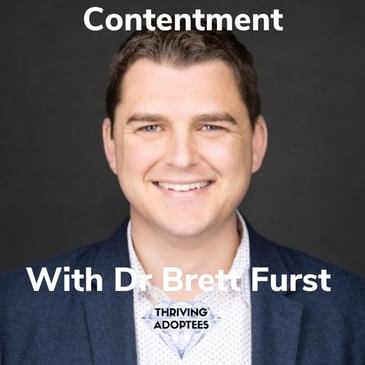
What if we were content with being content? OK with feeling OK? Searching for happiness prolongs the search. Listen in as Brett and I dive into the big sea of contentment. The one between the high tide of happiness and the low tide of a low mood.
Here's a link to Brett's previous interview https://thriving-adoptees.simplecast.com/episodes/how-adoptees-change-safety-addiction-more-with-dr-brett-furst
Here's some info on Brett and the Center he works at from their website.
Dr. Brett Furst holds a B.S. in Child and Adolescent Development from The University of California, Davis, an M.A. in Marriage and Family Therapy from Chapman University, and is a Licensed Marriage and Family Therapist. He has his Doctorate in Psychology from Alliant International University. Dr. Furst is a fully trained, EMDRIA approved, Eye Movement Desensitization and Reprocessing (EMDR) therapist. Dr. Furst, in addition to his focus on the underlying causes of addiction, specializes in academic and educational difficulties, and provides supportive services to those clients pursuing continuing education at PACE, including managing ADHD symptoms, proper study habits, and processing difficulties, from a therapeutic lens. Therapeutically, Brett comes from a Gestalt perspective, placing emphasis on the exploration of the authentic self and how inauthenticity and the negative personas clients create contribute to their unhealthy habits and the disconnection from themselves through substance. Dr. Furst has worked at several local treatment facilities where he has customized several young adult curriculums. Brett has also developed one of the first experiential poetry groups, and finds group work to be some of the most rewarding he has done. He enjoys spending time with his family and dog, and exploring new parts of his native Orange County.
https://www.linkedin.com/in/brettfurst/
At PACE Recovery Center, we believe in empowering our clients to fulfill their own particular dreams. We believe that Positive Attitudes Change Everything. Our trained addiction treatment staff will help our clients identify their specific recovery goals, and help them achieve them. From our home base in Orange County, we also provide in-depth mental health services that address the root issues driving addiction and mental illness. Once men leave our program, they have all the tools they need to thrive in recovery.
Giving Men the Skills for Sobriety
Long-term sobriety is more than simply not using alcohol or drugs, it is about living life. Helping our clients develop life skills, educational aims, or vocational goals not only teaches them about responsibility and accountability, but also helps improve their self-esteem.
https://www.instagram.com/pacerecovery/
https://www.facebook.com/PaceRecoveryCenterLLC
https://www.pacerecoverycenter.com/
Guests and the host are not (unless mentioned) licensed pscyho-therapists and speak from their own opinion only. Seek qualified advice if you need help.
Want to learn more about thriving for you, your kids, your families or your colleagues? Pick a time to talk here
[00:00:02] Hello everybody, welcome to another episode of Thriving Adoptees podcast. Today I'm delighted to be joined by Brett, Brett Furst. Looking forward to a conversation, it's been a long time since the last one right? Yeah, yeah it's been a minute but I'm happy to be back. Good to see you my friend, good to see you. So, thriving, what does thriving mean to you Brett?
[00:00:24] For me and kind of the work that I do, I feel like a lot of people, and to kind of change the word a little bit, and I promise I'll get back to it, it's my ADHD. But for me, a lot of clients come in, this is like a classic therapy problem, they come in and say I want to be happy, right? I want to find happiness, I want to be happy more, all that kind of stuff. And all that is great, right? I'm not knocking it. But one thing that I feel like a lot of people miss out on is the idea of like being content.
[00:00:52] And being content means, for me, and it's kind of, it comes from a lot of different sources, but it's the idea of like being okay with being okay. Especially in, you know, the culture today, you know, I come from like American culture, a lot of it is like, if you say you're content, it means that you're lazy. It means that you're just giving up on getting more. It means that you're not okay with doing the next thing, right? You're just going to sit and be chill and whatever. And that's seen as a bad thing, which I think is toxic.
[00:01:22] So, you know, the idea of being content and be able to sit in your own skin, you know, for a few minutes, just being okay. That to me is like the most beautiful thing. So if you can be content, that would be thriving to me. Because you understand where you're at, you understand, you know, where you're at in space, where you're at mentally, where you're at with people around you, your attachments, you know, all of that, you have that understanding.
[00:01:50] And being content doesn't actually mean that you don't want more. You can be content and want more. It's just your contentment shouldn't be based on whether you get more or not. So I could still want, you know, a promotion, but my promotion or me getting the promotion shouldn't make or break my like attitude or my well-being for the day, for the month of the year. Yeah. Yeah.
[00:02:16] A big mentor in my life a while ago used to say, he used to say, between the high tide of happiness and the low tide of sadness is a big C called contentment. Mm-hmm.
[00:02:38] So I think that's big, isn't it? Because chasing happiness is going to kind of elude us. And thinking that X is going to bring us happiness, that we're going to, to use your example, we're going to somehow be able to extract happiness from that promotion that we get.
[00:03:08] Well, happiness, that sort of happiness only has a half-life of a couple of minutes, hours, days, weeks. Mm-hmm. And then what next? Then we're on a hamster wheel looking for the next thing, right? Yeah, exactly. And that's where like, you know, happiness is supposed to be fleeting. That's the point. That's why it feels good and exciting when it happens. If it happened all the time, it wouldn't be special anymore, right?
[00:03:37] It wouldn't be something to strive for. But it's that, you know, exactly that, that high tide or low tide. If you can have that middle and be able to return to it when those things in life happen that make you happy or sad. You know, the promotion in and of itself isn't bad. That can contribute to your level of contentment after the initial like honeymoon phase happiness stuff wears off. If then that's contributing to contentment, you know, you're making more money, you're being more productive, you know, whatever. You feel like you're achieving something great that adds to your contentment. But if you assume that you're going to come in every day and be like, hell yeah, this is the best day.
[00:04:07] You know, I love that. Right. That's not going to happen just because you got the promotion or the new car or, you know, whatever. Right. Or the reunion. Right. Yeah, exactly. The reunion might go into some sort of honeymoon phase and then that may wear off as well. And who knows how the reunion is going to be going. Yeah.
[00:04:33] If we're if we're kind of staking our future happiness on what's going to be what might happen in the in the future, then we're kind of what we're like, we're hostage to the future rather than being content in the moment. Right. Well, you're hostage to your expectations. Right. And especially with reunions. Right. I've seen it, you know, a million times where clients are like they have this idea and it's I always I always, you know, tell them that it's impossible not to have expectations.
[00:05:03] Right. It's impossible for anything in life. But let's take a reunion as a great example of that. It's impossible to have at least a little bit of expectations floating around in there. But the goal is to have those and understand that they are based in something other than what's actually happening and then be able to still experience what's happening. Right. Contentment happens when you're able to experience the here and now like as it is. Right. We call that like authenticity.
[00:05:28] And so, you know, when it comes to reunion stuff, especially because there's all these like mentalized ideas of how these relationships are going to go. You know, you can have an attachment to the idea of somebody as opposed to what they actually are. You know, all these things swimming around. It's OK that you have those. Those are natural. It's just figure out a way. And it's more just recognizing and separating them of like, OK, I feel this. I expect this. All that kind of stuff. I'm still going to put that to the side and then see what it's like in reality.
[00:05:56] Because, yeah, we're hostage to our expectations all the time, even if it's on the basics of like, I expect this to make me happy. I expect this to make me fulfilled. I expect if I find out this knowledge about myself or my genetics or my story or, you know, my bio family or my adoption story, then I will feel totally complete now. And that rarely happens. Not to say don't go do it if you want to go do it. It will help.
[00:06:20] But your sense of completeness can't come from a singular source. And that's what stops people from thriving or feeling content is they feel like if only I could blank, then I'll feel better. And that is almost never the case, if ever. Yeah. So we when do we get this idea from that the outside world world causes our happiness? Yes. There's a lot of different theories, the big, the big giant one is like capitalism, right?
[00:06:50] Like, I know that's like this big, giant word. But, you know, we're constantly sold on this idea that if you can just do blank, you'll be happy. We're sold pictures of shiny, happy people all the time. But that in kind of the in the kind of this not like sinister way on purpose, but it's it's coupled with most people have a complete lack of insight into their own internal stuff and why they're unhappy in these ways or how they could change it internally.
[00:07:14] Right. So if you don't have the tools or the ability to see internally and see, oh, yeah, some of this stuff is what's making me discontent. Right. Or not thriving or not feeling OK, then you're going to look and be like, well, I just don't feel OK. But look, those people look OK. Or I think if I do this, then I'm going to be OK. Or if, you know, I, you know, do these certain steps or whatever, I'm going to be OK. And then you do that and then you're not. It's like, OK, well, what's the next one? What's the next one? What's the next one? What's the next one? What's the next one? Right.
[00:07:41] Because if we just think this is how I am and I can't change it. Right. Then I got to look externally. And also, right, the other theory is that humans are we're designed to essentially be as efficient as possible. Right. We're going to make as few changes as possible to get the maximum amount of outcome. And so do I want to go to therapy for a couple of years and be uncomfortable the whole time and talk about things that I've actively avoided or passively avoided?
[00:08:08] Or do I want to buy a new car? One of those is a lot easier to do than the other. So we kind of usually pick the easier option. That's just how humans are. And that goes back to like caveman days. But like we usually pick the easier option. Yeah. And I think it's also that there is an experience when we get that new car or new car issues. Oh, yeah. Yeah.
[00:08:31] And and and we. We what's actually happening is the the end of the seeking. The joy is in the end of the seeking rather than the acquisition of the object, but we don't. It's like a attribution error. Is it? Is that what they call it? Yeah. Yeah. Yeah. You're yeah. You're you're basically like assigning the source of the wrong thing.
[00:09:02] And it's not even that like even in itself, right? Like buying a new car is cool. Right. Like I get the shiny thing or getting a package from Amazon or whatever. Right. Like that's where, you know, there's people that are actually having addictions. They have a new package outside their door every day. And so it's that like you get that burst. Right. Because that bridge is real. Right. It's a cool thing. You're excited. It's new. It's happy or whatever. Even take it for like a new relationship. Right. That honeymoon phase in the first like two to four months of being in a relationship. That part is supposed to end, though. Right.
[00:09:30] It has to phase out. But a lot of people don't make it past that two to four months because they feel like when the energy and the excitement and like the mushiness goes down that. Oh, we're not actually we might not actually like each other might not be in love because it doesn't have like that adrenaline excitement part anymore of it being new and shiny. But that's OK. You're supposed to have sort of like a it's OK, period. So, yeah, that can be applied to a lot of things. But, you know, that we look for those humans in general look for short term solutions before they look for long term ones.
[00:10:00] That's where like addiction comes from. That's where a lot of things come from is is we can conceptualize a short term solution. That's easy for us to grasp. The long term one is more difficult. Yeah. But isn't the the comes a point when when we when we realize it, when the insight lands heavily enough that the outside world doesn't make us happy. Mm hmm. Then like I used to think the insights were kind of once and done.
[00:10:28] And to me now, it's it's something that is it's a more and more profound depth of an insight. So there's stuff that I see with my eyes. Then, you know, I say a glimpse of an insight and then maybe something that goes on in my head, like a thought or a theory, then something that goes gets deeper.
[00:10:53] And I feel it in my heart and then and then I get it in my bones and then I forget it. Right. Yeah. Well, and that's where, like, you know, we see these like reminders in our life and that sort of, you know, when I say like, you know, insight is like 30 percent of the work. Right. It's it's a vital percent and you can't get to 100 percent of being OK without it. But. It's the all right, I have this insight.
[00:11:20] I know why I do the thing, but now let's see the ways in which that thing is impacting me. It's like a time machine, right? Like this thing happened in the past or multiple things. How is it affecting me in the present? Right. And then you start to see, oh, I think it's this and this and this and it's affecting this and all that kind of stuff. And then we have to kind of reverse engineer it. OK, it's affecting the way that I am in relationships, the way that I argue with my partner or whatever. Right.
[00:11:46] OK, how can I argue differently with my partner so I don't keep reinforcing the thing that led me to do that behavior in the first place? Right. Because that's how we take the strength out of, let's just call it the trauma. Right. And so that's how we make it not have as much of an impact. It's always going to be there. It's always going to be traumatic as it should be because it was. But you can reduce the impact, therefore making it weaker in the present by changing the behavior that the trauma is impacting.
[00:12:13] Yeah. So what do you think of this idea of a size of an impact rather or a depth of an impact rather than seeing that all insights are the same? Yeah. And that's where, like, you know, there's some things where, you know, sometimes the insight doesn't come right away. Sometimes it takes a while. Sometimes it's bigger and more like and then everything kind of expands from there.
[00:12:42] Or sometimes it's the little ones along the way and you kind of tie the knot or you even can understand it. A lot of clients have this where they understand it logically. Right. When they get to that point in session. But then it's just the connecting it part like takes forever. Right. To real life. I have a client right now and she fully understands that she's a love and sex addict and like all these things. And she knows why she knows 100 percent why. But that's still like doing the behaviors in real time.
[00:13:08] That part is hard. So it's the there's all these different kinds of levels of insights. People discount their own insight to of like, oh, well, I think it's because of this, but it's dumb. It shouldn't be because of that, because that was small and didn't matter and I should be OK. And then they don't see the impact of the future. So there's all these different versions. I remember one of those like gasping insights. I was running an adoption group at one of the addiction treatment centers that I work at. And this client had been in the group for, I don't know, four or five months.
[00:13:37] And he didn't really say anything ever. And then I was in the middle of talking about something. He goes, I'm like, what? And he goes, I think I have attachment problems. I was like, my guy, like that's what we've been talking about for the last like five months, both individually in session and in group. I'm happy it hits you. Now let's do something about it. Right. But sometimes it comes like that. Sometimes it comes in in, you know, little drips and fits and starts. And, you know, it was a good day. We get there. Yeah.
[00:14:07] So what what what helped what's helped you see this? What do you call it like this in a sovereign in a sovereignty or I'm you know, I am thinking because you're California. Right. The the guy that's that helped me see this as a guy being on a couple of group courses with nothing to do with adoption. Also, I read listen to a few of his books.
[00:14:36] The so the books called the Inside Out Revolution by a guy called Michael Neal. The so the the the the the the the car doesn't make us happy. It it's arrival signifies or means the end of the seeking.
[00:15:04] And the end of the seeking kind of reveals our happiness rather than the purchase of the car. Causing our happiness. Yeah. How have you seen that? What what what led you to that? A lot of my stance with my clients is sort of like the world is how it is. Right. What do we do about it from our end? Right.
[00:15:33] Right. And so that's sort of the same thing as you're saying. Right. Is like we can only control the internal part of us. Right. There's going to be things in life that are good, bad, happy, sane. Right. And to understand that all those things are valid to exist. It's what we do with them that matters. And for me, that came from at least personally was like understanding, OK, like I felt very uncomfortable for most of my life. I had no idea why, you know, I'd externalize it. I'd look for, you know, other things that kind of distract me. You know, those sort of things. Right.
[00:16:02] Like relationship addiction stuff when I was younger, you know, all those sort of things to try and change. OK, if I can control someone or something outside of me, then I'm going to be OK. Right. If I can create a lot of people have this idea, if I can create this environment where no problems happen, then I won't have any problems. Right. And that's not a functional, realistic or even possible way to live life. And so it becomes. All right. The world is going to be how it is.
[00:16:29] I can control certain elements that I can put myself around certain people or not around certain people, you know, those sort of things. Right. But there are there is a randomness to the world that we can't control. So the only thing we can control is how we view those things. Right. And validate those things the way that we view them. Right. Even if those emotions come internally. Right. Doesn't have to squash them or control them or turn them into something else. We can accept them for what they are because they have validity on their own. We don't have to listen to them all the time, though.
[00:16:56] We can choose what we want to do with them despite them existing. I would even argue that the internal thing is something that we can't fully control either. Right. But we can decide what we want to do with how it's feeling. We can feel the emotion. The emotion is going to come. But what we do with it is what matters. Yeah. So that's you creating a little space between kind of trigger and response. Is that how you see it? Basically, yeah. I mean, it's it's any emotion. Like if I feel anxious. Right.
[00:17:25] When I'm about to go do something or this makes me sad or, you know, I feel like I want to just get out of here and, you know, go eat some McDonald's, which I know is bad for me or whatever. Right. Like I can feel that feeling. I can know where that feeling is coming from. I can respect that feeling, which is the part that gets missed a lot is like a lot of people, if they feel anxious, like, oh, it's stupid that I'm feeling anxious. I should be fine. Well, it doesn't matter what you should be. It's what you are. You are anxious and that's fine. Or you're feeling anxious, which is fine.
[00:17:52] You don't have to let it control what you do next, though. You still can. You can say like, yeah, I'm anxious and I want to get out of here, so I'm gonna get out of here. Fine. But at least you're drawing a choice. You're not letting it push you to the point where you don't have a choice anymore. Right. Because if you try and squash it, you're trying to ignore it or you lean into it, it's going to eventually ramp up until it takes control because it's trying to keep you safe. It's trying to get you to do something.
[00:18:16] But if you can acknowledge it, respect it and then choose what you want to do with it, that allows you some mastery over it, basically. Right. And then if you can show the anxiety, depression, whatever, that it doesn't need to be as strong as it is, doesn't need to hang around as much. It won't you won't feel as much pressure about it. And so it's kind of like conditioning it to be heard at lower volumes.
[00:18:38] Yeah. So in that answer, you just made a distinction between being I think it was being anxious and feeling anxious. So you're separating out who we are from how we feel. Yeah. Yeah. That was that was a correction I had to make for myself. Right. Because I've been so used to, especially when I was young, saying like, you know, I'm anxious.
[00:19:05] It's yeah, that is part of what I'm feeling. Right. Very rarely ever are humans ever feel only feeling one thing at a time. Right. In addition to that's kind of a change in the language in like therapy world recently, which I agree with is to say, like, I'm feeling anxious. Even we do diagnostics. We don't say someone is autistic. We say someone has autism. Right. It changes the nature of the identity that we're placing on another person. The same goes for ourselves and the emotions that we're feeling.
[00:19:34] Yeah. And and yet there's this idea that. As as adoptees, our trauma can be so subconscious and can be so overwhelming, we believe it is us. Mm hmm. Yeah. And I've seen that mistake made by a lot of especially like older adoptees who, you know, they didn't it was closed adoptions and have much information, you know, baby scoops or stuff.
[00:20:03] They they attribute a lot to just like everything is bad because I was adopted. OK, a lot of things might be bad the way that you view things might be bad, but the totality and the the the power that you're giving it. It is a very powerful, real thing that people need to do. Absolutely. But to say that it is all encompassing and that everything in my life stems from this singular thing. Right. There's going to be multiple elements to it. There's going to be things that have happened in your life to reinforce it.
[00:20:33] There's going to be things that you've learned to believe about yourself. There's all these things where it kind of expands and grows into other things. And then, you know, all those influences. But to put all your eggs in one basket for anything, one emotion, one identity, one belief, any of that is is almost always flawed. Yeah. And that's a at a very profound level. Right. We are not our trauma.
[00:20:59] Like, how do we how do we see that? How do we you know what? What are the keys that unlock that trauma bound identity? So for me, it's it's changing things in the present. Right. You might know, OK, I have this trauma and this is why I do this stuff. But again, it's that like changing stuff in the present. OK, like I run away from relationships too soon. OK, what if next time you feel like running away?
[00:21:26] You stay in it for one week longer. Right. Or you check with somebody who you trust. Hey, should I stay in this relationship longer or am I being am I being overreactive or am I being appropriately reactive? Right. Like those sort of things. Right. Like push the boundaries just a little bit. Don't be unsafe with it, but push the boundaries just a little bit. Oh, I never get close to any of my coworkers because I believe they're always going to leave me. OK, share an anecdote about your weekend with somebody and do that once a week for the next month and see what happens.
[00:21:55] Right. Like challenge those little fears, challenge those little things because you're capable of it. Right. Sometimes we get stuck in this absolutism of like I am broken because I was adopted or I can't have good relationships and can't is an absolute. It means you cannot. You might be to change it even to say I'm afraid of having a healthy relationship. I'm afraid of getting close to people. I'm afraid of letting down my guard.
[00:22:22] I'm afraid of whatever that changes it just a little bit. It changes it from it is an absolute cannot happen impossibility to. Part of me is choosing not to do it because of my fear. And then at that point, you have a choice. I can lean into my fear and not do it or I can challenge my fear and challenge my fear.
[00:22:43] Yeah. And. Don't we struggle to lean into our feelings, isn't that isn't that the root of cause of the addiction? A lot of things. Yeah. Yeah. I mean, it's it's all everyone does it right. Addicts on chemicals or anything else or just regular people. We all avoid and dissociate and do things to not to think about things, which sometimes is OK. Right. I'm not about I'm not like anti decompressing at the end of the day or, you know, distracting yourself a little while.
[00:23:11] It's just when that becomes your only way of dealing with something, that thing then grows and grows and grows and grows and grows and grows until it shuts you down. Right. Because it needs to be heard. It needs to be thought about. It needs to be experienced. So, yeah, I mean, it was there's there's a time to distract. There's a time to face. It has been your whole life that you've been distracting yourself. OK, then that's something you got to look at. But a metaphor I've been using a lot recently that I've kind of developed in the last year or so is the idea of the monster under the bed.
[00:23:39] Right. When you were a kid and you thought there was a monster living on your bed, the longer you didn't look under the bed, the scarier the monster became. Right. You keep building it up and building it up and building it up in your mind. You know, you don't look under the bed or in the closet or whatever, because it's this big, scary thing. You just run this fantasy. Right. And it mutates. The same thing happens with not facing these things that we're afraid of facing. Right. Right. Facing, you know, how you might be in a healthy relationship. Right.
[00:24:03] How you might be in all these different situations. If you've been running from doing those or running from certain feelings in yourself for decades sometimes. Right. Uh, then. It just has grown and you just run from it because that's what you've been doing the whole time. You don't even know what it is anymore. You don't know what it looks like if you're actually going to turn around and look at it. Um, but because you've been running from it for so long, it's just grown and grown and mutated and become this big, scary thing. It's become your monster under the bed.
[00:24:30] And the habit has become fixed in that. Mm hmm. You've essentially conditioned yourself. Right. Like Pavlov. Right. Like the more you don't look, the more you're not going to want to look. And then the stronger the thing becomes. Right. Take take trauma. Right. The more you the more behaviors you do in the present that are because of your trauma, the more your trauma starts to believe, oh, it's good that I'm here because you keep acting in this way to protect yourself from this thing happening again. Therefore, I should stick around.
[00:25:00] Right. So the more you reinforce it, it's it's the need for it to stick around, the more it's going to stick around and we go around and around and around. Yeah. Yeah. But we're we're really it's becoming a what do they call it? Self-fulfilling prophecy. Absolutely. Yeah. Yeah. And I've had clients to that, too. Right. Take I keep mentioning relationships. It's an easy way to to do it. A lot of adoptees have trouble with that of.
[00:25:24] I can't find good people. I can't have a good relationship. Therefore, I'm going to pick somebody less than good. And then I'm in that relationship. And then what does that do? It reinforces that I can't get anybody good because all I keep doing is being in bad relationships. And then round and round and round we go when really the fear is if I have something good and that ends, that's really going to hurt. If I pick someone toxic and that ends, OK, it sucks. But I also knew that I was going to happen.
[00:25:50] That's why I picked it in the first place. But if I pick somebody good, that one's going to really hurt if it ends. And then I might think I really am broken as opposed to just sort of kind of believing that I am and, you know, playing into it. That would be like real confirmation, even though none of that's actually true. But we feel like it would be a real confirmation that I'm broken if I mess up a good thing. Yeah. So beliefs are key, a key thing here. I've heard them. I like your metaphor, too. And I love the monster under the bed.
[00:26:19] I've heard beliefs. A metaphor for beliefs as as bouncers, bouncers for the brain. Right. They don't let new they don't let new ideas in. And if we don't have an insight and then take action, then we don't have. We don't do anything different and we get the same same results.
[00:26:45] How do you just beliefs don't get a lot of discussion in adoptee land? It's mainly it's mainly trauma. Right. And I came up with this a couple of years ago that. So to me, that is a big deal because I think it's.
[00:27:12] It's it seems easier to me to bust a belief than it is to change a trauma. Right. Oh, yeah. Yeah. Well, and trauma itself necessarily shouldn't change. Right. Like what happened was traumatic. It should still feel a little bit traumatic whenever you think back on it or look at it, because that's a normal response to a thing that was traumatic. Right. The thing you're talking about beliefs. Right. In the therapy that I do, I come from like a gestalt lens.
[00:27:42] It's a type of therapy. And Fritz Perls, who kind of created gestalt therapy, talks a lot about problematic shoulds. Right. It's all the things that we feel like society, parents, friends. But more importantly, internally, we tell ourselves that we should or shouldn't do or should or shouldn't be. Right. And that's the same as those beliefs. Right. It's those things that I should be this way or I shouldn't do this. And therefore, we try and match those and nothing real is coming in.
[00:28:10] We're just trying to project out and become those shoulds and meet all of them, which is usually impossible. We tie ourselves in knots and do it. But yeah, it's that it's that same idea. But yeah, trauma should feel traumatic. Hopefully it doesn't become overwhelming and like life consuming and all that kind of stuff. When you think back to something bad that happened, it should feel kind of bad because it was. Yeah.
[00:28:36] When you're talking about the shoulds and the gestalt theory, what popped into my head was like the the if you looked at this IFS part stuff. Yeah. So what what came to my head is is an argument between the two parts or between me and we've got loads of parts, but an argument between two parts. One that says I should be over this by now.
[00:29:06] And the other the the the other part that that says I'm OK as I am and that they're at war somehow in terms of is that. Yeah, basically. Right. So so the way that the should looks at it is similar to that is the shoulds come from the outside. Right. And not all of them are bad. Right. The dumb one that I always bring up when I talk to clients about this is like I shouldn't murder people. OK, we probably should keep that one. Right. Like that's a good one to hold on to.
[00:29:33] But it's usually the most of them are passive and silent and we don't know that we're trying to meet them. Right. So I have my clients like let's write out a list of all the problematic shoulds that you think that you have. Right. And some we keep and some we don't. But the shoulds come from the outside mostly. Right. Even if they're ones that are we're telling ourselves they came from somewhere outside in the first place. Right. Because no one is born thinking like, oh, I should, you know, do my taxes better or whatever. Right. I should make more money. Right. We learn that over time.
[00:29:59] I should be a straight A student. I should, you know, not talk about my trauma. I should be OK. I should, you know, all these things. Right. Those things are should be natural. Right. I know I just said should. But yeah, it's it's the idea of you are always at war with your authentic self in trying to meet all of those shoulds unconsciously. If you do it consciously. Fine. Right.
[00:30:22] Right. Like for me, authentically, when I'm doing therapy or as I'm talking to you right now, for the most part, I am roughly the same as I am at home with my daughter. Right. But there are definite differences. Right. Or with my friends. Right. Or when I'm talking to clients. Right. There's going to be differences, but the core is still the same. No one from my outside life is going to look at me and be like, who the hell is that guy? My friends might think that I sound smarter and they didn't know that I could talk like this when I talk about therapy stuff. They're like, who's that dumb dumb that, you know, knows what he's talking about or sounds like he does at least.
[00:30:53] But yeah, it's it's that idea of like, I know that I should at work. Hurts less or whatever, or that I should, you know, do that, but I know that I'm consciously meeting those things. Authenticity per gestalt comes from knowing where you end and the game begins. The game is everything outside. The game is a social game. It doesn't mean you don't play the game. It just means know when you're engaging in it and where you are different from it. Some theories call it differentiation parts. You know, they all have their version of it. But yeah.
[00:31:23] Yeah. But the the the uppercase S of Dick Schwartz's IFS, it wouldn't have any shoulds, would it? Right. Theoretically, or for me, at the very least, like an English thought, it's more understanding which ones you're you're you're picking. Right. Because like having no shoulds at all. Right. I guess like when you internalize them and be like, my moral code says that I shouldn't murder people. Right.
[00:31:50] OK, cool. Yeah, good. Is that it should? Yeah. Is it one that you constantly place on yourself? Yes. So that's OK. Right. Like there is there are rules that the goal of being authentic or content or thriving for me and my clients is never to be like, screw all the rules. I'm going to do whatever I want. No one can ever impact me. It's saying like, yes, things impact me. So it goes from caring about everyone's opinion to choosing whose opinions you want to care.
[00:32:16] Right. Or caring about no one's opinions to caring about or none of the rules to care to choosing what rules you want to care about. You know, all those different things. Yeah. So the shoulds and beliefs are pretty tied in together. Yeah. Yeah. Yeah, I'd say so. So you you talked about writing a list of all the beliefs. Yeah. Have you got any other kind of tactics? Ticks in this space?
[00:32:44] Yeah. So kind of in working on authenticity, one thing to understand about authenticity is that authenticity is not about finding yourself, about finding who you're not. And removing those pieces, whatever is left over is going to be you. Right. So people often find there's a lot of like self-help stuff out there, like go find yourself. Right. Which is great. They mean well.
[00:33:07] But for me, whatever you find that you feel like is going to define you is automatically going to be constricted. Right. We don't have the language to describe ourselves or other people in their totality. So any words we say like I am this. That's going to be flawed because that thing can't encompass all of you. Right. The example I give is that if I were to sit here and write all of the words, if I spent 24 hours writing every word that I feel like describe me.
[00:33:35] Right. And I fill pages and pages and pages of words. And those pages were given to somebody that's never met me before. And that person read all the words. They would still have no idea what it was like to interact with me. Right. They would know a list of words that describe me. They would know therapist and father and friend. Right. But that that those words don't describe what it is like to know me and interact with me and see me. Right. So any word that we find that says I am this. You can find words that are a part of you.
[00:34:05] Father, therapist, all this kind of thing. Those things impact my authenticity and impact who I am. But they are not the totality of me. There is no totality of me. We are always fluid. We are always in flux. Yeah. And but another take on that, who am I, would be about take like taking off layers of layers of clothing,
[00:34:25] like taking off our our our roles, taking off our feelings, taking off our thoughts, taking off our beliefs. Yeah. Getting to the what what Dick Schwartz would would talk would call the uppercase. The IFS guy would call the uppercase self, the unconditioned self. The yeah.
[00:34:54] And I think that's where I differ a little bit from like the unconditioned is like it's impossible, I think, to be like fully unconditioned. But for me, it's less about being unconditioned and more about understanding and choosing which things you want to be conditioned by, basically. Right. Like. Am I conditioned by my wife that I've been together with for now the last 15 years? Absolutely. Right.
[00:35:18] There's things about my relationship and about myself that have changed because of my proximity and relationship to her as they should be. Right. But I can understand those and see those and choose them or reject them. Right. So it's it's allowing certain conditions to come in. It's allowing certain things and having choice. That's the theme of a lot of things I talk about. I mentioned here a lot, but like having choice in what you do with these things that are going to exist. But I'm that would be more like your personality rather than your uppercase self. Right.
[00:35:49] Yeah. I mean, that's like the manifestation of it. Right. Like it's it's but for me, like those things kind of become one. Right. Like authenticity, self, all those things, those are constantly fluid and flux. Um, they change literally second to second. Right. Depending on which research you look at. The lowest number that I found is humans filter 11 million pieces of data for a second. Right. So that's sensory information, internal information, everything. Right.
[00:36:17] So per second, we have to filter through 11 million. Some say four billion. Some say 400 billion bits of information per second. And so even if we're filtering out 99.999% of the 11 million, there's still little bits coming into us every single second that we're conscious, basically, and even unconscious sometimes, too. So we're constantly being changed in these kind of microscopic ways, as we should be. We're always fluid. We can't pinpoint ourselves and we shouldn't be able to. Yeah. I think we're different. I think we're different.
[00:36:47] Agree to differ on that one. Yeah. Yeah. I, uh, I, I'd be talking about the difference between, uh, what, what's aware compared to what we are aware of. Mm-hmm. So the content of the screen rather than the screen itself. Yeah. Yeah. And that's where, like, there are going to be things that you're going to be unaware of.
[00:37:17] There are going to be things that you don't have insight to, or someone has to point them out to you, or you might never gain insight into because no one's going to point them out to you. Right? One of the biggest curses of being a human is that we can never experience ourselves as other people experience us. Right? We can see ourselves on video. We can see ourselves in a mirror. Right? But that's all the same thing. Right? So we never fully understand how we are experienced or how we are externalizing. Yeah.
[00:37:44] One of the things that has been worrying me recently is the amount of re-traumatization that we're doing to ourselves. Mm-hmm. There's, this really, I've mentioned this a couple of times on the podcast recently. Like, I think, so we're recording this on a Monday, listeners, and this happened to me like two or three months ago on a Monday.
[00:38:11] It was, I've been looking on Facebook and I've seen all this stuff out there and all the, you know, adoptee advocates trying to get our trauma recognized, validated by others.
[00:38:27] And it all landed on me, on my shoulders one Monday afternoon that exposing myself to that is traumatizing me. And it ain't just me. Mm-hmm. There's a lot of that going on. Well, there's a lot of, a lot of that going on in a lot of different spaces.
[00:38:55] Not just for adoptees, but yeah, especially for adoptees, there's a lot of that going around. Not trying to be political with it either, but especially in America, I have parents of adoptees that are asking me, hey, is my child that I adopted internationally going to be safe right now? Are they going to get deported? Can they take away their citizenship because they weren't born here? Right?
[00:39:16] So that's like a whole new level of trauma just for the parents who already went through the trauma of adoption and the adoptee went through the adoption trauma, you know, back, you know, 20, 30, whatever years ago. 15, 18, 19, 20, whatever, however old the kid is. Right? So, you know, there's that stuff on top of already everyone just talking about the fact that adoption is a trauma regardless of circumstance, which I completely agree with. But yes, that is re-traumatizing to have that come up again. So it's just, it's everywhere. Yeah.
[00:39:49] But again, like part of the goal is less about like, yes, our world is more traumatizing right now, I think in general, right? That's just a general statement than it has been in a very long time, if ever. Unfortunately, a lot of the answer is like, yes, it is that way. Now, what do we do about it? Yes, you are being re-traumatized. What do we do about it?
[00:40:13] And there's a lot of good theories, a lot of new therapy, psychological theories that say like, let's acknowledge that the world is a mess. Let's acknowledge that the world is actively trying to keep you down in certain ways. Now, what do we do with it? As opposed to like, no, if you believe in, you know, do this, everything should work out fine. Like that, that doesn't get you as far as it used to anymore. Um, so it's what do we do with it as it is, as opposed to do with it how we might want it to be. Yeah.
[00:40:41] So less exposure to it, clearly. Less exposure and, you know, you're, you can't totally avoid it. So then it's, you know, what do you do with the exposure that you get? Yeah. Feels like a good place to bring it in, right? Sure. Yeah. Um, unless there's anything you'd like else to like to add? No, I always appreciate you having me on. Enjoy talking about this stuff. So I'm happy to do it. Yeah. You're a star. Thanks listeners.
[00:41:10] Thanks Brad and we'll speak to you again very soon. Yeah. Thank you.