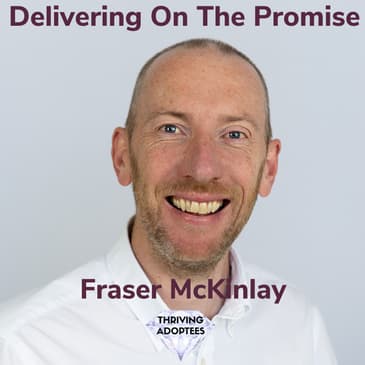
The Promise is that Scotland's children and young people will grow up loved, safe and respected. This episode dives into how Fraser, his team and partners are delivering on that. We explore resilience, expectations and more.
Fraser has been Chief Executive of The Promise Scotland since September 2022. Prior to that, he spent 16 years working for Audit Scotland, including ten years as Controller of Audit and Director of Performance Audit and Best Value.
Before joining Audit Scotland, Fraser was a public services consultant in Edinburgh and London. He specialised in leadership, change management, facilitation and process improvement.
Fraser is committed to systems change, focusing on how public money is spent more effectively to enable better lives for children, young people, care experienced adults, families, and communities.
Here's the link to Adoption UK's Barometer https://www.adoptionuk.org/news/record-crisis-levels-for-adopted-people
More at:
https://www.facebook.com/ThePromiseScotland/
https://www.instagram.com/thepromisescotland/
https://www.youtube.com/@thepromisescotland617
https://www.linkedin.com/in/fraser-mckinlay-b2b48122
Guests and the host are not (unless mentioned) licensed pscyho-therapists and speak from their own opinion only. Seek qualified advice if you need help.
Want to learn more about thriving for you, your kids, your families or your colleagues? Pick a time to talk here
[00:00:02] Hello everybody, welcome to another episode of Thriving Adoptees podcast. Today I'm delighted to be joined by Fraser, Fraser McKinlay. Looking forward to our conversation today Fraser. Yeah, likewise Simon, thanks for having me. You're very welcome my friend. So, thriving, what does thriving mean to you Fraser? It seems to me that's one of those simple sounding questions but when you actually give it a bit of thought, it's quite tricky to answer.
[00:00:28] I mean, so for me Simon, thriving in the context of well anyone's life but I suppose in particular children and young people. I guess it's about being able to live the life that you want to lead and do that, you know, well and happily and surrounded by love I think. So that for me and you know, I'm sure we'll come on to talk a bit about The Promise but The Promise talks about
[00:00:57] all children in Scotland growing up love safe and respected and being able to fulfil their potential. And I think if we can achieve that, then that for me would be a pretty good indication of thriving.
[00:01:10] Yeah. It is a tricky one to define and I think, you know, 550 episodes later of the podcast, you know, if somebody put me on the spot, I'd be like, oh, you know, like where do I go? Where do I go from here?
[00:01:33] Because your own answer to the question, there's so much richness there for it. So what you do is slightly different to what many of our guests are about.
[00:01:48] So why don't you tell us a little bit more about The Promise because people might not have heard about it and then we can tie that into the love and the potential and the parts that were really salient in your definition.
[00:02:07] Sure. So for people who don't know, in 2017, the first minister of Scotland at the time announced a root and branch review of the care system in Scotland for children, young people.
[00:02:19] And that became the independent care review, which took three years, chaired by my boss, Fiona Duncan, who's heard five and a half thousand different stories from people in and around and working with the care system. In February 2020, the care review published its reports and the main one of which was called The Promise.
[00:02:46] And really set out the vision for what Scotland needs to do and needs to change and must be like in order for, as I mentioned earlier, all children of Scotland to grow up loved, safe and respected. And the promise Scotland subsequently then the organisation and I work for.
[00:03:08] So, we'll set up in 2021 and our job is to ensure that the conclusions of the independent care review, the ambition and vision of the promise is delivered. So our job is to ensure that everyone that has responsibility for the care system and all the systems next to the care system are all heading in the right direction to deliver the promise by 2030. So that's what we're about, Simon, and at the heart of all of that, all the way through the care review, all the way through our work.
[00:03:35] We hold the voices of the people in and around the system at the heart of all that we do to make sure that that's the focus of the work. And so that as change is being delivered, it's those voices that are actually still driving the change. Yeah. So why don't you take a slightly different tack?
[00:03:57] Because you've talked about these voices and you've set out the, you set out your agenda very clearly and you've talked about the world, the word change. So perhaps what do you, what are you looking to change so that kids meet their potential? So in a nutshell, Simon, the change is about for the promises about two things.
[00:04:25] The first is about doing more to ensure that families can stay together in the first place. And therefore, fewer children having to go into this thing we call the care system. Although, as the promise points out, it's not really a system at all. It's a bunch of stuff that kind of works or sometimes doesn't. But that's the first thing. And the second thing is if there are circumstances in which children do need to be looked after away from their families,
[00:04:53] then that experience is as positive and as full of love as it possibly can be. So in a nutshell, those are the two things that the promise is all about. So the change that we talk about is really looking at the kind of work and the kind of support that children, young people, families, adults need to build loving, resilient, safe, thriving homes and communities and to ensure that, you know, families can stay together more often.
[00:05:23] And then there are other changes about the care system itself, which are designed to ensure that if children do need to be looked after away from their birth family, that, as I say, they have the best possible experience around that and the experience as close to a childhood as anyone else would experience. So in a nutshell, those are the things. Now, there's loads in that in terms of how you do it and stuff.
[00:05:46] And it's why we are equally interested in questions like, you know, poverty, housing, homelessness, you know, mental health, all these kind of what we would call adjacent systems. So it's not just about this thing that we would recognise as the care system in a little box. It's all the other stuff that feeds into that. It's all the other things that bring pressure on families and children, young people, that mean that family breakdown happens, that we're also interested in, because if we're genuinely keeping the promise in that,
[00:06:15] that prevention work is absolutely critical. Yeah. What did, what did the kids or the teens, the young people, as perhaps a more politically correct way of saying that, what did, what sort of things were they talking about in terms of obstacles to their thriving?
[00:06:44] So, I mean, a real range of things, Simon, as you can imagine, but you also begin to pick on themes. So, you know, we know that families and children who come from backgrounds that experience real poverty are much more likely to end up in the care system, like 20 times more likely, or something like that, to end up in the care system if you're from one of the least deprived communities, sorry, most deprived communities as opposed to least deprived. So there's no doubt that
[00:07:13] poverty and deprivation brings pressures on families, which inevitably, not inevitably, but can result in real pressures, which can result in families breaking down and parents struggling to look after kids. Mental health, alongside that, you might often find, you know, addiction, alcohol, drugs. Now, I am always very careful to say that, of course, none of these things are inevitable, right? But the stats do tend to demonstrate that if you have been born into and grown
[00:07:42] and start your life in communities and in households that experience more of those things, you are more likely to end up in the care system. And once you're in the care system, we know again from the data that you are more likely to experience those things through your life. So that's the cycle that we are trying to change. So I think in terms of the obstacles that children, young people experience in terms of their ability to thrive, Simon, you'll know this, given all the podcasts you've done, like, you know,
[00:08:11] it's never the child's fault, right? Whatever happens, stuff is happening in their lives and in their communities and the people around about them. It's not their fault. So, so that's why we're as interested in the environmental stuff as we are in, you know, making sure that, you know, foster care services are run really well, that residential children's houses are run really well. You know, those, those bits are critically important for the kids that end up in the care system. We're also really interested and keen to shift
[00:08:41] the stuff that's actually meaning that they're ending up in that situation in the first place. Yeah. So this, it's clearly, it's a huge agenda that you've got. Huge agenda, quite, I don't know, how would I sum up? Yeah. Challenging. It's a challenging agenda. All of those things, yeah. What are you doing? Yeah. And so I'm interested
[00:09:10] in what, changing, changing the tack slightly on this. You've got lots of obstacles in your, in your way. You've got lots of different stakeholders that you need to engage with. So if we look at it from a leadership perspective, like your own leadership, what are the factors that are important
[00:09:38] for you thriving and for you reaching the potential that you want to reach? So more, more of a kind of a personal question as a leader of an organisation with a big and challenging agenda. What's important to you in terms of your own thriving? Yeah, there's a question I don't think about very often, which maybe tells you some things from the get-go.
[00:10:08] So I think, so I've been doing this job for two and a half years now. So, and without going into loads of background, interestingly, I don't have any background in, you know, children's services or the care system. My background was actually as an auditor. I worked for the public audit agency in Scotland for 16 years or so. So it's been a very steep learning curve, got loads of stuff wrong, made loads of mistakes and you learn from them. So the things that help me thrive, it's about, it is about having a good team
[00:10:37] and a good support network and being able to speak to people and asking questions. And for me, you know, as a leader, not pretending, you know, the answers is important. You know, asking people when you're not sure, I think is really critical. One of the first team sessions I had here, it was probably, you know, a whole team session when I took the team away. I sat them down and said, so I think I've slightly underestimated this task and overestimated my ability to do it because that was how it was, that was how it was feeling.
[00:11:10] And so there's something about bringing a bit of humility to the job, I think. The other thing that's critical for me is retaining that sense of the voice of the children, young people and families that we are here to serve. And, you know, quite a lot of my time, virtually all of my time is spent in meetings with people in government or local authorities or other stakeholder organizations. And that's really important because we're all about trying to shift the system. We're not about individual,
[00:11:40] you know, areas of practice so much. But it can be quite easy to then feel quite disconnected and quite kind of far away from what's happening in people's lives and what people who are trying to deliver and support people on the front line are also experiencing. So I also try and make sure that I build in, you know, pretty regular time with people who are, you know, who are living in and around the care system because it's, you know, that's the thing that, you know, on the days and there are many when you feel like
[00:12:09] you're pushing water up a hill, you can remind yourself that actually this is why this is important and this is why you need to read. So there's something for me in all of that, Simon, about perspective and the things that I get frustrated about day in, day out are nothing compared to what a lot of people are dealing with. And the other thing just, finally, without buying on too much about it is, you know, I'm lucky enough to have three kids that are now aged between 13 and 20 and we have a very privileged life
[00:12:40] and the other thing that allows me to thrive in the job and to retain that sense of perspective is genuinely believing that everybody should have the same opportunity and the same kind of experience that my three kids have had and that's a big motivating factor for me just because you happen to have been born into a certain place or into a certain family shouldn't, you know, dictate how the rest of your life goes and I'm afraid at the moment too often. But again, by no means an inevitability
[00:13:09] at all but, you know, it's that whole thing if it's not good enough, if it's not good enough for my three kids then why should it be good enough for anyone else? Yeah. So does it bring, is there a stark contrast there between the privilege and this, you know, I think other people have talked about this as in a horrible kind of media soundbite way postcode lottery, postcode lottery stuff
[00:13:39] and then a mentor of mine for the last coming up 20 years is Glaswegian and she worked in economic development and like probably 30 years ago and there was, there was a lot of challenges there and she saw some of the data that looked at the postcodes and people thriving in life, you know. So is there a sense
[00:14:09] that your own, that word privilege that you use, that's brought into stark contrast by the stuff that you hear? Yeah, sure. And it's, and I use that word because I think it's important that I acknowledge it, right? So there's no doubt that, you know, I haven't experienced a lot of the things that the families that spoke to the care, to the care that we for example are experiencing and so it's really important
[00:14:39] not to, I mean, I make a point of not really, you know, I would never say and therefore I understand all of that thing but it is really important that you listen to experiences, that you, you learn from them, that you have, that you have empathy with that and, and then, and then you, and then my job is not to go, well isn't that terrible, it's an outrage, although it is quite often but then to go, okay, well what needs to change to make that better? Yeah. So that's the focus
[00:15:09] for me, Simon, is about saying and, and to be rooted and connected in those stories and those voices. Yeah. And the care review spoke to five and a half thousand people as I say or heard five and a half thousand stories but, but didn't use it, didn't use specific stories we came up, they came up with an idea called composite stories so, so you know, so it's all real stuff but it's, and it's, it's no one and it's everyone and they've been a very powerful tool for us to talk about the kinds of things that children, young people and families experience as they go through the care system
[00:15:39] because there's no doubt that living, that lived experience and testimony is incredibly powerful although I would say that I think we, you know, I think one needs to be really careful about how we do that and one thing we don't do is just repeatedly ask people to tell us their stories because, you know, that's not helpful and actually we know, I mean, your point about post codes and stuff in Glasgow and other places we have known for a very long time where the inequality exists in places and, you know, it's, it has just proven
[00:16:09] incredibly difficult to do something about that for all sorts of different reasons. Yeah. So, you mentioned being an auditor. How do, because, you know, I think of audits, I think of very, a lot of rigour, a lot of attention to detail, a lot of logic, a lot of checking, a lot of discipline to that whole, to that whole thing and how does that, how does that help you
[00:16:39] in terms of accountabilities and, I guess, measuring, measuring progress to what you're trying to achieve? Yeah. So, so first of all, I should say, in case anyone watches this, I was a slightly unusual auditor and I'm not an accountant. So when people say attention to detail, really, that's not his thing. I would, I would, guilty as charged, my lord. But, but what it did,
[00:17:07] but what it does give me, I think, is first of all, a pretty deep understanding of how public services in Scotland works and that's important because, you know, when I worked, when I worked there, I had oversight of auditing. I did all the non-financial audit work, the kind of performance audit, value for money stuff and so we direct us all public services in Scotland, all councils, all health boards, all everything. So proper understanding how those systems work is important. Really understanding things like really boring, aniraki things, Simon, like governance and accountability,
[00:17:37] like really matters in this context because, I was speaking to someone last week and they had an interesting perspective when they said that the system, the care system holds families and young people to account all the time. You know, the system expects families to do things in certain ways and if you don't do the things that the system expects you to do, there are real consequences and we were observing that there's virtually no mirror, there's no, there's no reverse of that. It's incredibly difficult for,
[00:18:07] never mind individual children, young people or families but any of us really to genuinely hold systems to account in some of this space I think is a really challenging question and that's one of the things that we are really interested in. How do you bring a focus of accountability? How do you need to change how decisions are made? How do you, it gets into really important questions like where power lies. how do we shift power towards community, towards families, towards children,
[00:18:37] young people and away from always sitting, the power sitting with the statutory authorities. Now of course, quite appropriately, legislation has given power to individual organisations and in some cases individual people and that's really important but there is something about the balance of that power that needs to shift. So I think my background and experience I think has served me pretty well getting into some of that stuff and as you say one of the big things we are working on is how do you actually,
[00:19:06] how is Scotland going to know that the promise is being kept and we published a thing last year which is the data bit of that so there are indicators, numbers of children in the care system, number of children in foster care, number of foster carers, a whole range of different indicators you can pull together that gives you a picture of how we're doing but the next bit of the work is actually to say yeah but to what extent is that change being felt in people's lives? Where's that qualitative and
[00:19:35] experiential thing because while there are some really important process-y, governance-y, you know, accountability changes that need to be made the promise is all about relationships, it's all about being loved, it's all about how you feel and your experience as a, you know, whichever stage you're at in your family or your childhood and that's the stuff
[00:20:03] that is obviously trickier to measure but without it we're not going to have a real sense of whether the promise has been kept or not, that's the stuff that really makes the difference. Yeah, so what would you say to somebody that's listening if they were an advocate so you're kind of, it seems that you're within the public sector trying to drive more change
[00:20:33] in the public sector to ensure that this promise is kept and I can, when I was hearing from you in terms of your understanding of the sector I was thinking about how that means that you can have richer conversations with people because they know that you know your onions, right? what would you say to somebody who is perhaps
[00:21:02] more removed from the system trying to get, trying to advocate for themselves as an adoptee or for their kids if they're an adopted parent what would you share with them in terms of learnings from that advocacy perspective? So I think one of the things that the promise does and this is important
[00:21:32] because in Scotland everyone has signed up to it, all political parties signed up to it, all local authorities are signed up to it, everyone agrees that the promise vision is the way to go and it is pretty detailed in places is that it can allow people to go along to whichever engagement they're having and saying well this is what the promise expects to happen and for example if you're an adopting family then it says quite a lot actually about what you should expect to have in terms of the support
[00:22:02] before throughout the process of adoption but as importantly getting away from the sense that once the adoption's finalised that actually that's it and we can just walk away and leave them thanks very much because you're a family now so we don't really need to that's that the promise says quite a lot about what what adopted children and adopted families should expect in terms of the kind of support that they can have as a family the kind of support for helping
[00:22:31] you know the child the young person understand their life stories all of that stuff that we know too often doesn't happen there's a lot about adoption breakdown as well so if nothing else I think it can be used as a bit we do hear this all the time people feel able to go in and say no wait a minute this isn't what I'm experiencing is not what this thing says should be happening right now now that doesn't fix it automatically people don't go ah yes you're quite right here
[00:23:00] like have all this brilliant support of course that's not that simple but I think what we find quite often both for people working in the system but also people experiencing it whether that is adoption whether it's foster care whatever it is is it gives people like a bit of a galvanizing framework almost to say no actually this is this is this thing here and it's it's written down everyone's signed up to it and this is what I think I'm entitled to expect now there is
[00:23:30] still a bit of a gap between what the promise says and what you are like legally entitled to statutorily entitled to but at least it's an extra thing that people can can go with which people have said they've found really quite helpful and for some folk has opened up a different kind of dialogue and has ended up helping them get better support now of course our argument would be the people in those positions shouldn't have to do all the running right this should just be standard
[00:24:01] but given that we are in that kind of transition and we are trying to unpick generations worth of a scare system that works in a particular way hopefully it can help people just add a bit of weight to what they're trying to do have you seen this Adoption UK barometer have you seen that yeah and it's reported country by country and what I mean by country listeners is as in the report
[00:24:31] that it's a different set of statistics for Scotland than it is for England I'm going to link to that in the show notes listeners because I haven't come across anything we've got quite a lot of listeners in the US and Canada right so there is no equivalent in there is no equivalent in the US and that would be an interesting thing for people
[00:25:00] to look at in terms of the US but it looks at how people are doing and it's got the data on well-being and support I think it'd be yeah yeah enormously helpful piece of work when Adoption UK produced that it's a bit of a state of the nation isn't it as to how that's going yeah and say it is a state of the nation
[00:25:30] and they measure it year in year out so it'd be interesting to see how that changes and whether it changes across the different countries because England and Scotland have got very different approaches to this stuff to this area yeah yeah yeah you
[00:25:59] mentioned at the top in terms of realising our potential and you also use the word resilience which is a biggie you know I've got I've developed this Thrive a framework called Thrive from all the conversations that I've had you've had 5,000 I've had more than like 500 so interesting dynamic but the R in
[00:26:29] the Thrive framework stands for resilience and I'm just wondering what resilience means for from a with a professional resilience of young people and maybe your colleagues and maybe yourself so let's take it from a young person's perspective first if I may Fraser what does resilience mean for you
[00:26:59] from that point the first thing I always say when we're talking about resilience Simon is that we first of all shouldn't expect children and people to have to be so resilient so I think there is a bit of a thing that says everyone needs to be more resilient and you're like well yeah but it would be nice if we didn't have to be quite so resilient all the time because that would suggest that things are a bit easier than they are
[00:27:28] so for me there's a kind of like everyone in whatever walk of life and wherever your background needs a degree of resilience because bad stuff's going to happen in your life and you need to be so I think some people call it bounce back ability don't you that sense that how you respond to things how you move past things that's really important and of course that's an important part of life I suppose but there's no question that depending on sometimes where you live or the family that you get in or whatever the expectations around being resilient are enormously high
[00:27:59] and actually I'll talk about something we are spending a lot of time on which is that point at which young people are transitioning from care into what people would call independent living so you know around we know that the data tells us that typically care experienced young people move into so-called independent living much earlier than non-care experienced young people so you know it's getting a bit older now but you know
[00:28:27] 16, 17, 18 you know there's this expectation I was chatting to someone another day about a 16 year old who has been put in a flat in a place she didn't know and the general sense is you can just get on with your life then like that's I mean that's bonkers my 20 year old is third year university and you know as I mentioned privileged transition all of that stuff
[00:28:57] the notion that you would just send them at the door at 16 and say you know thanks very much we'll see in a year's time is madness so there's no doubt that there's a real difference in expectation around resilience I think with care experienced young people and people who are leaving care in particular because they've experienced whatever they've experienced in their childhood and because of the trauma and because they are incredibly resilient that we expect more resilience
[00:29:27] to go on through their lives and that can't be right so resilience is a really important thing but I think I guess my only note of caution long-winded way of saying is that I think there is a risk that we rely on it too much that we expect people to be resilient and therefore you can deal with whatever is thrown at you that's definitely not what we mean it is that kind of innate sense of being able to navigate the way through life when stuff happens that we all need is that so there is a levelling out of expectation around resilience I think
[00:29:56] would be quite an important thing I think you're spot on on the expectation thing and I haven't heard it expressed quite that way so thank you for that that's landed for me one of the things that I think of when people say in adoption circles we say that love isn't enough and there's this idea
[00:30:25] that adopted parents are just going to love on their child and that's going to be enough and this is shown to be naive and love is not enough and it sounds like I'm going to get into some sort of soft rock pop song here doesn't I look forward to that I'll leave that till the end of when we switch off the recording right and I'm getting now Thompson Twins what is
[00:30:56] love your time I don't know definitely not people say love is not enough and I say well you've talked about being loved as part of the promise and I always think well it's a really good place to start though right it's a really it's a really good place to start so just flipping back to resilience again
[00:31:25] what have you learned more from a more personal perspective would you say in terms of resilience or as you say that great word bounce back or bounce back ability so I mean I mentioned earlier Simon the learning curve that I've been on and the thing about my old job which I loved and it was a real privilege to do is that you are inevitably quite removed from the front line from actually
[00:31:54] engaging with families from engaging people who are working in the front line so that wasn't really our job so there's no doubt that when I came into this job and I've been involved in the care review for a bit so it's been a gradual process but there's no doubt that being in a job where you are and I'm still distant from it don't get me wrong I am clearly not a social worker or a family support worker so I'm still miles away from it but there was a period where I
[00:32:24] was finding that really tough and I found myself you know because I go out people ask me to go and speak at things and do stuff so I was doing those things and I was finding myself welling up all the time and I was thinking this is a weird thing what's happening here and people were being very nice about it and saying oh it's nice to see a chief executive showing a bit of emotion and I was like yeah up to a point you don't want the chief executive department scotland sobbing everywhere all the time this is Scotland people you're known as tougher
[00:32:54] right this is a thing so the reason I mention all of that being less open about assignment is that that's when I clocked the fact that I needed to pay more attention to my own resilience because I had been doing stuff as you do with all the stuff that you do and it was beginning to take its toll a little bit so I think
[00:33:44] I focus on thing you can begin to reach out a little bit so and as I say I'm very lucky in that you know I have all the capacity and the resource to be able to do those kinds of things right so so so so so it's about you know and you mentioned the team so one of the things that I think is really important in my team but also obviously in the wider workforce because the promise talks a lot about workforce and the phrase we use is holding the hands of those that hold the hands so making sure that
[00:34:14] the people who are the paid and unpaid workforce who are alongside families and young people have the kind of resource and the capacity and the resilience to do the stuff that they need to be so they have the capacity for love right because if you're absolutely exhausted and completely fried then that can be really hard to take the time to build those relationships so you know trying to find ways of making sure there's a bit of down time making sure there's a bit of an
[00:34:49] to switch off sometimes and to not have them looking at night times and first thing in the morning and all that kind of stuff because it's important that we find ways of to some extent the promise is happening quickly in one sense because we've said we need to be done by 2030 so it's always a 10 year program in another way it's not quick enough because that's a long time
[00:35:19] we need to sustain ourselves to see that through and beyond because the work doesn't stop in 2030 so there is definitely something about ensuring that we're not going so flat out that people don't have the legs to keep going one of the things that I love your phrase helping the hands what was it helping the hands that help the hands to
[00:35:49] I was thinking about the end result is all about the young people so from our perspective here on the Thriving Adoptees podcast it's about the adoptees so it's about the adoptees and for the kids to be thriving the adults in their life their caregivers family need to be thriving and for them to be thriving the organisations that support them need to be thriving
[00:36:19] and I hear so much about challenge within the public sector so I was at a conference in London last week but I hear it from the states as well so with what's happening in the government circles there there's a whole host of uncertainty and financial challenges
[00:36:48] things that are changing because of the leadership so it's not this isn't just a UK thing just an English thing or an American thing does that burnout for want of a better word how do you see that being addressed within the
[00:37:18] system or being you said earlier on it's not a system it's a series of connected individuals and organisations I I it's definitely one of the key things Simon it's the one it's one of the key things that we need to get right if the promise is going to be kept and
[00:37:57] to remember that the workforce in the context of the promise and the care system is enormously wide so it is teachers it's social workers it's family support people it's you know anyone that comes into contact with children and families you could argue have a job and keep the promise right so and that's even before you get into the important roles of unpaid carers and families and everyone else so but there is some kind of technical stuff that needs to happen in terms of investment
[00:38:28] around organisations you mentioned the public sector a few times I would include the voluntary third sector in that because they play an enormously important role in delivering services and supporting families we see all over the country and one of the challenges they have kind on one level not terribly exciting but critically important if you're only able to employ people for 12 months at a
[00:38:58] time and you're employing a family support team and we're banging on about how relationships are critically important for these families and you're only able to employ people for 12 months at a time and every April comes around and there's a question mark about whether that person is going to be able to continue then that's not just a governancy problem for the charity that's a problem for the family and for the thing that we're trying to deliver so if you can unlock longer term funding that gives these organisations more certainty which
[00:39:28] allows them to be more confident in bringing people on which in turn allows them to do the work in genuinely relational ways that we would all want then that's a better thing all round but shifting the gigantic oil tanker that is the way public money works in this country UK wide is a very difficult thing because we have got ourselves locked into a cycle of annual funding and quite often even shorter term
[00:40:08] time pressure and work loads and all that can start but ensuring there is space for reflective practice all the stuff that everyone knows is good practice when it comes to people working with children young people and families making sure the time and space is available for training and development for taking time out to learn from your colleagues and other parts of the country quite a lot of the stuff we do is to learn things and there
[00:40:45] is something about a quantum and there is also a big leadership and culture piece which I could bang on the forever but the whole workforce challenge is not straightforward if it was simple we would have done it a long time ago and finally Simon I think
[00:41:29] it we we we need to think about how we need to shift that money and those are going to be difficult decisions in the unlikely event that all of a sudden we're going to have a fountain of cash turned on somewhere I think some of those tricky decisions about choices and where we invest the money is really critically important
[00:41:58] Thank you for pointing out that missing third sector that I didn't mention given the breadth of these stakeholders that you're dealing with one of the questions being at the back of my mind when we spoke last time and speaking today is that diplomacy piece and communication and you talked about the critical importance of expectations in terms of expectations and resilience
[00:42:28] of our kids but in terms of expectations what are you learning in terms of that communication your own things and people and you have to be okay with that so we're in a privileged
[00:42:58] position in some ways in this organisation because we were specifically set up so while we're funded by government we operate arms like Scottish government so we sit in a unusual space in the middle so we're not really third sector we're not really public sector we're not Scottish government we're not
[00:43:46] done the organisation really in Scotland whose only interest whose singular agenda item is to ensure that the conclusions of the independent care review and the promise are delivered we have no other organisational interest beyond that thing so of course we need to do that in ways that is diplomatic to use your word that's empathetic I'm big on empathy people are really committed to this time and actually it just is really hard it's not that people
[00:44:16] aren't trying it's just that it's really hard and there's loads of things that are making it harder so we need to be understanding of that but we also need to be able to call it out sometimes and we also need to be confident in speaking truth to power and saying actually that isn't what the promise expects and if you do that you're not going to reach the ambition of the promise so that's our job so that quite often makes us not terribly popular but the way we manage that I
[00:44:46] hope in case I don't know if anyone will be listening to this from people I know but you never know that's why we've spent quite a lot of time over the last few years trying to build those trusted relationships with people and to bring a degree of humility and empathy to the work because at the points at which it is going to get scratchy and it will get scratchy inevitably if we are doing our job properly people know where we're coming from people know that we're not doing
[00:45:15] it without thinking people know that we're not doing it just to give people a hard time we're doing it because our job is to ensure that the promise is delivered and so I think it's the groundwork around that communication and engagement that's critically important to build those kind of relationships so that when those difficult conversations need to happen people can get where we're coming from I suppose brilliant that feels like a good place to bring it in
[00:45:45] as always listeners check out the show notes for a link to the promise and see what Fraser and his colleagues are up to unless there's anything else that you'd like to share something that I haven't asked you about Fraser before we wrap it up no thanks Simon it's been a nice opportunity to reflect on some of that stuff actually so I appreciate that yeah that's great and thank you too listeners I hope you find this useful a slightly different episode but we like to mix up a little bit so thanks for listening
[00:46:16] take care