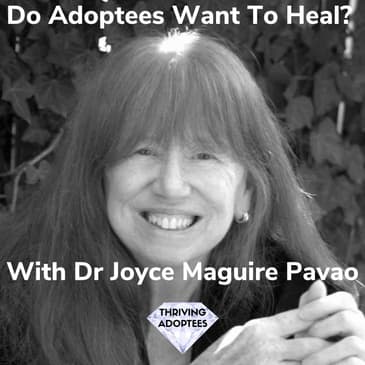
Do adoptees want to heal? Is healing even possible? Listen in as Joyce and I explore rarely asked questions about trauma. Why? To catalyse fresh insights for you on trauma's impact. I learned lots of from this and hope you do too.
Here's the link to Joyce's previous interviews:
https://thriving-adoptees.simplecast.com/episodes/joyce
https://thriving-adoptees.simplecast.com/episodes/joyce-advocacy
Here's a link to a replay of Advancing Your Advocacy For Adoptees https://www.youtube.com/watch?v=4y-8Id3NajI
Dr. Pavao has done extensive training, both nationally and internationally. She is a lecturer in Psychiatry at Harvard Medical School, and she has consulted to various public and private child welfare agencies, adoption agencies, schools, and community groups, as well as probate and family court judges, lawyers, and clergy. Additionally, she has worked closely with individuals and families touched by adoption, foster care, and other complex blended family constructions.
She has developed models for treatment and for training using her systemic, intergenerational, and developmental framework, The Normative Crises in the Development of the Adoptive Family, and her book, The Family of Adoption (Beacon Press), has received high acclaim.
Dr. Pavao has received many awards and honors, including the Children’s Bureau/U.S. Department of Health and Human Services Adoption Excellence Award for Family Contribution (2003) and the Congressional Coalition on Adoption award for Angels in Adoption (2000).
http://www.pavaoconsulting.com/
https://www.facebook.com/Dr.JoyceMaguirePavao
https://twitter.com/GetKinnected
https://www.linkedin.com/in/kinnect/
Guests and the host are not (unless mentioned) licensed pscyho-therapists and speak from their own opinion only. Seek qualified advice if you need help.
Want to learn more about thriving for you, your kids, your families or your colleagues? Pick a time to talk here
[00:00:02] Hello everybody, welcome to another episode of the Thriving Adoptees podcast. Today I'm delighted to be joined by a repeat guest, probably the first person to come back three times for more, I don't know. Hello Joyce, Dr Joyce Maguire Pavao. Always good to talk Joyce. Always good to talk.
[00:00:19] It's great to be here Simon.
[00:00:20] Great to be here. So Joyce shot me a message a month or so ago with a really interesting question for us to debate. And the question is whether adoptees want to heal or not. Is that the question that we're talking about?
[00:00:41] Well, we are. And I think that's the hook. There, you know, it's, there's a lot to say about it. And we can dive right in if you like.
[00:00:50] Yeah. So perhaps, can you give us a bit of background to what led you to that question?
[00:00:57] Yes, of course. You know, I've been a therapist specializing in adoption as an adoptee for over 50 years.
[00:01:06] I started clinics that, you know, provided services for adoptees and I wanted to do it so that all the services weren't coming from placement agencies because I felt that there was a conflict of interest.
[00:01:22] So just to give you a little background, and it's not only my own experience personally or my own experience professionally, but there were 24 people working in my clinic.
[00:01:35] So a lot of clients, families, individuals, couples with an adoption or complex blended family situation passed through.
[00:01:46] So I got to see a lot of different things.
[00:01:49] I want to start out by saying, in no way am I diminishing or dismissing the trauma and the real serious loss and the horrible things that have gone on in the business of adoption.
[00:02:08] I don't want that to be ignored.
[00:02:11] I don't want that to be ignored, and I'm not trying to gloss over it by what we're going to talk about in any way, shape or form.
[00:02:18] And I think that's important because I've been happy is a funny word to use, but of late, we've had a lot of exposés.
[00:02:29] China has shut down adoptions to the United States, Korea, a frontline piece about Korea's bad behavior and the ways they were doing adoption, which is no more bad behavior than many other countries.
[00:02:44] And both the sending and receiving countries were a part of that.
[00:02:49] And then I went to an event where the Irish special advocate was there and we saw the film Stolen about the children who were stolen from mother baby homes, et cetera, et cetera.
[00:03:03] And so it goes on and on and on.
[00:03:06] And we had something this week on 60 Minutes about the Italian Catholic Church moving of children.
[00:03:14] So there's no question that we have been, you know, doing nefarious things with the lives of children under the guise of saving them or protecting them or whatever words want to be used.
[00:03:28] And I want to make a clear cut line between the business of adoption and the people who end up in adoption.
[00:03:36] The business of adoption should be totally dismantled.
[00:03:41] And and we should do some very serious things with all of this information of late.
[00:03:48] And and this isn't what we're going to talk about today, but I want to acknowledge it.
[00:03:52] That's why I'm starting out with it.
[00:03:53] So so I think it's important to keep your policy in one pocket and to really work on changing what's wrong.
[00:04:04] But then if you're being a therapist and you're working with individuals and we're going to focus more on adoptees.
[00:04:11] But this is true for working with adoptive parents and birth parents who are often not very knowledgeable about what they're in the middle of either.
[00:04:19] And I think that working with the individuals, you have to have some grace for that situation in order to help the people in it to heal.
[00:04:33] So these are two different pockets.
[00:04:36] And we're going to talk about the healing pocket today.
[00:04:38] And one of the things that I've noticed, and I don't know the reasons for this.
[00:04:45] I never liked research.
[00:04:46] I mean, I love the product of research when it's done well and when it can benefit us.
[00:04:51] But I myself never like doing statistics or doing research.
[00:04:57] I've learned how I've been involved in work at Harvard and other things, but it's not my favorite thing.
[00:05:04] So just know that.
[00:05:06] However, I think that what we've seen over the years, and for me, it's been about 55 years of clinical work in the field and 78 years of my life as an adopted person.
[00:05:20] And what I've seen is that we're taught to go along in a certain way and to allow that to be our track.
[00:05:34] I want to just read you two or three little quotes just to acknowledge this, and then I'll get to our real work.
[00:05:42] This is a quote by Anne Heffron that I like.
[00:05:46] When your birth certificate has changed and when your name has changed and when you are asked not to search for your parents, you learn it's not okay to be you.
[00:05:55] This is not a small thought.
[00:05:57] This changes everything.
[00:05:59] It makes existing in a rooted, deeply meaningful way a dream other people get to live.
[00:06:07] So there's a dreamlike quality, and B.J. Lifton always talked about this too.
[00:06:12] There's a dreamlike quality in how we exist when we're not told the things we need to be told.
[00:06:20] We know that adopted people attempt suicide four times more than non-adopted and are overrepresented in drug treatment and mental health facilities.
[00:06:32] And yet our society insists that it's a better life.
[00:06:36] So we know that there's a lot going on and that adoptees are coping in ways that aren't healing and aren't helpful.
[00:06:44] Trauma doesn't make people stronger.
[00:06:46] It damages their nervous system.
[00:06:48] It hijacks their digestive tract.
[00:06:50] It keeps the person in a constant loop of hypervigilance.
[00:06:54] To tell someone they are stronger because of trauma is to deny what it has cost them to survive.
[00:07:03] So I think I'm going to just throw out these little things for you to think about, and then we're going to get right back to the beginning.
[00:07:10] Teaching young adoptees about honesty and integrity while withholding their personal truths creates a disconnect that fosters mistrust.
[00:07:21] And the final thing, two final things.
[00:07:24] Grief is like glitter.
[00:07:26] You can throw a handful of glitter into the air, but when you try to clean it up, you'll never get it all.
[00:07:32] Even long after the event, you will still find glitter tucked into corners.
[00:07:36] It will always be there somewhere, just as grief is.
[00:07:41] So the other two things disenfranchise grief.
[00:07:46] A loss that is not openly acknowledged, socially validated, or publicly mourned.
[00:07:52] In other words, a loss where society itself fails the griever by simply not recognizing their right to grieve.
[00:08:02] So all of these things have produced in adoptees a numbing of themselves.
[00:08:09] And, you know, B.J. Lifton used to talk about the good adoptee and the bad adoptee.
[00:08:14] The good adoptee is people pleasing and going along with this completely.
[00:08:20] The bad adoptee may be acting out and may be the adoptee that ends up in a treatment center or ends up attempting suicide because they're aware earlier than the good adoptee of what's been going on.
[00:08:34] This doesn't have anything to do with how good or bad their adoptive parents were.
[00:08:40] And I want to say that again.
[00:08:42] In some cases, the adoptive parents were dreadful.
[00:08:45] We know there are groups that are investigating all of the harmful things that have been done to adoptees, and that is real.
[00:08:54] There are also wonderful people who have done their best to give their child by adoption everything they could possibly have and have loved them.
[00:09:03] So all of these feelings have more to do with what's happened to the whole adoptee than to what's happening in the current life of the adoptee.
[00:09:16] And they may have everything or nothing to do with the birth parent and what happened in utero and what happened prior to the adoption.
[00:09:24] But all of this is important to know.
[00:09:27] It's all there, and it has been held at bay, and it has been something that we've had to figure out along the way.
[00:09:35] There's an awakening these days.
[00:09:38] I think social media, DNA, there are so many things that have made it less possible to keep secrets.
[00:09:45] And so things are being revealed at a very fast rate.
[00:09:52] But what I notice in my work, and what I want us to talk about a little bit, is that when one has all of this trauma, all of this loss, all of this devastating disconnect to deal with,
[00:10:12] they deal with it in different ways.
[00:10:15] Every adoptee has a different disposition, a different personality, a different experience.
[00:10:20] And so they deal with it in different ways.
[00:10:23] And I would be the last one to say there's a formula, a way that we should go about our healing.
[00:10:31] So each person would do that.
[00:10:33] But I worry, and this is the crux of what we want to talk about.
[00:10:39] I worry that many adoptees get stuck in the process of their grief or their healing, and it becomes familiar and comfortable,
[00:10:51] and they end up living there in that place instead of moving on.
[00:10:59] And I'm not surprised that we do that, because moving on would be moving again, being placed somewhere new.
[00:11:08] We long for settling, for just being normal, for just being fine.
[00:11:16] And so I get it completely.
[00:11:18] But I have worked with many, many adoptees that have the opportunity to move forward,
[00:11:25] but pull back and stay in the comfort of their loss, their grief, their trauma, and their pain.
[00:11:34] And I think they need to for a certain period of time.
[00:11:38] But there is a time when they could move out of that.
[00:11:44] And I think it's a very hard thing to do if you fear abandonment, you fear loss, you fear change,
[00:11:53] you fear the unknown, because you've known it only too well.
[00:11:58] So that's a very quick rendition of where I'm coming from.
[00:12:03] I really want to emphasize that in no way am I trying to make light of things.
[00:12:12] In no way do I think people are choosing this in some kind of weird way to hurt themselves.
[00:12:20] I just think it's important for us to look at this,
[00:12:24] because we may be keeping ourselves from the growth and shifts and changes that we need.
[00:12:33] Wow. Where do you go from that?
[00:12:38] I think what came to mind was a metaphor from my favourite,
[00:12:48] he doesn't like to be called a teacher, but my favourite author, let's call him that,
[00:12:51] my favourite author, who is not an adoptee,
[00:12:56] but yet who is, in my opinion, the best describer of the human condition and identity,
[00:13:16] the guy called Rupert Spira.
[00:13:19] So what he talks about is the moth drawn to the flame.
[00:13:30] Okay. So the flame is the metaphor for our true self, our uppercase S self,
[00:13:45] as Dick Schwartz would call it from internal family systems,
[00:13:50] what other people would call consciousness, what some people might call spirit,
[00:13:55] what other people call awareness.
[00:14:00] And that flame is who we truly are.
[00:14:05] And the moth is the separate self, the sense of self, the ego,
[00:14:19] the separate self, the finite self.
[00:14:24] So what the moth wants more than anything else,
[00:14:30] it is the peace and happiness of the uppercase S self.
[00:14:40] The moth is drawn to that.
[00:14:44] It gets so close and then it knows it has to die.
[00:14:51] It has to die into the flame.
[00:14:54] So it pushes back.
[00:14:57] And this is why people, I think, sometimes push back.
[00:15:06] They stay stuck.
[00:15:10] And there is, it's a fear of death.
[00:15:16] It's a fear of death.
[00:15:17] The moth fears death.
[00:15:21] And so it keeps on going and it keeps on going and it keeps on getting close
[00:15:25] and then backing off, getting close and backing off,
[00:15:27] getting close and backing off.
[00:15:28] And so it's not a, it's a fear of death thing.
[00:15:34] It's not a choice thing.
[00:15:38] And yeah, so that's how I, that's how I see it.
[00:15:47] It wants, it wants to be whole and it wants to be its uppercase self,
[00:15:54] you know, who it, who it truly is.
[00:15:57] But it faces, it's scared of death because it has to die to become, become one.
[00:16:11] Be, be who it truly is.
[00:16:17] Well, I really like, I've never read anything by Rupert, but I will have to.
[00:16:21] And I love the metaphor.
[00:16:23] And I, I'm thinking, you know, I wrote a foreword for a book about suicidality and adoption
[00:16:30] recently.
[00:16:31] And the young man.
[00:16:33] Excuse me?
[00:16:34] With, with, with Beth, Beth Syverson.
[00:16:36] Yes.
[00:16:37] Yes.
[00:16:37] And, and, and Joey, her son.
[00:16:40] I spent a little bit of time talking to him because I wanted to be sure that this was okay
[00:16:47] with the adoptee.
[00:16:49] And one of the things that I loved was his language.
[00:16:53] He talked about his memories of feeling suicidal as a younger child.
[00:16:59] And, um, he talked about wanting to unalive himself.
[00:17:06] It wasn't really about death.
[00:17:09] It was about being unalive.
[00:17:12] And I think for adoptees, I've watched this over the years.
[00:17:16] I don't really believe many, some of them want death.
[00:17:21] They just want to end the life they're in and have their true life.
[00:17:26] And I, I agree with you, with your, um, comparison, your metaphor, because I do think that adoptees
[00:17:37] don't move on as easily because they are afraid of who will they be next.
[00:17:44] They had no choice over their last transition into a whole new life, a whole new person,
[00:17:50] a whole new culture, maybe a whole new language, a whole new race to be connected to.
[00:17:57] Um, it's, you know, it's frightening after having gone through that and lived through it
[00:18:03] for as long as they have to imagine they would have to do something like that over again.
[00:18:09] Yeah.
[00:18:10] And yet, and yet over.
[00:18:14] So I've interviewed what 450 people plus for the podcast now, uh, how many of those are
[00:18:19] adoptees?
[00:18:20] I would take your guess, maybe 350, but 350 people have met me first, right?
[00:18:27] Cause we're, I always meet people first.
[00:18:29] I have an hour with them too.
[00:18:30] So we talk about what we're going to talk about on the podcast.
[00:18:33] Uh, uh, and, um, they, we get to know each other and they feel comfortable about it.
[00:18:38] And in all, I've only had one person that I've had that initial conversation with then
[00:18:47] decide not to go on the podcast.
[00:18:50] And so 350 plus have come onto the podcast and to talk about thriving or to talk about
[00:18:59] healing.
[00:18:59] So there's clearly a massive disparity out there.
[00:19:04] Um, it's a spectrum of trauma.
[00:19:08] It's a, it's a spectrum of, of, of, of trauma.
[00:19:12] And for, for me, the, um, the biggest question, uh, the, the, the biggest question is rather
[00:19:28] than do adoptees want to heal the more logical question to me?
[00:19:33] Well, cause wouldn't everybody want to heal?
[00:19:35] Wouldn't everybody want to thrive?
[00:19:37] Um, uh, the, the question that comes into my mind is, do they think it's possible?
[00:19:46] And I would say that there's so much, um, there's, there's, there's so much thought out
[00:19:59] there that it is impossible.
[00:20:04] So it's not that I don't want to heal.
[00:20:07] It's, I don't think it's possible.
[00:20:10] Um, we, uh, yesterday I interviewed, uh, Sherry Eldridge and, uh, she, she's come in from
[00:20:17] a place where, um, um, we're, we're, we're broken and not just adoptees.
[00:20:25] Um, all of us, uh, she's coming from a religious place and for her, uh, wholeness is only possible
[00:20:35] in heaven.
[00:20:36] So that sets up a, uh, an, a, a huge, and to me, what, what feels like an impossible, um, hurdle
[00:20:50] to, to, to mountain to climb.
[00:20:52] So do we, do, do we think it's, do, do we thought, do we think it's possible to heal?
[00:20:59] Do we think it's possible to thrive?
[00:21:02] And we're getting so much from, from, um, from social media that says, no, this is impossible.
[00:21:10] We're stuck with it.
[00:21:11] We're getting it.
[00:21:11] Not only are we getting it from social media, we're getting it from other, um, religious
[00:21:18] organizations, other, uh, you know, like other, uh, influential people.
[00:21:26] So yeah, I want to thrive, but I can't.
[00:21:30] Everybody tells me that I can't.
[00:21:32] Everybody's throwing all these statistics at me that saying that, that, that's reminding
[00:21:39] me, that's re-traumatizing, that's reminding me of, of how bad that is.
[00:21:44] Now that comes from a great place.
[00:21:46] It, it, those statistics need to be aired because as you say, the system needs to change.
[00:21:53] But I, you know, I had, frankly, to speak frankly, I had this moment, uh, three, three
[00:21:59] or four months ago when suddenly all the weight of the, um, all the, all the weight of the
[00:22:08] re-traumatizing factors, re-traumatizing content, um, of, of, uh, uh, uh, that, that, that happened
[00:22:18] on social media landed on my shoulders.
[00:22:21] It was a Monday night, uh, Monday afternoon.
[00:22:24] And I, I, I, I, I thought, well, if, if, if this is half what people feel, I, I, I get an,
[00:22:37] I, I, I'm getting an insight here into why people think that it's impossible to heal and
[00:22:44] why people think it's impossible to thrive.
[00:22:48] Well, you know, I think this is very interesting in so many ways because we're given information
[00:22:57] and I wish I could find it.
[00:22:59] I'll send it to you when I do, but Penny Callen Partridge is a poet and an adoptee wrote a beautiful
[00:23:06] poem about research and how important it is to find out who's doing the research, what their,
[00:23:13] uh, title is in the world.
[00:23:16] Um, what, who's paying for the research and what do they want out of it?
[00:23:23] Uh, because you'll get very different results, uh, depending on those things.
[00:23:29] And it's, it's important to know that.
[00:23:32] So when you mentioned, and, you know, I don't mean in any way to disparage religion, but when
[00:23:38] you look at all the recent, uh, you know, revelations about what's happened in the world
[00:23:46] of adoption and what hasn't been researched well, because it might end up with huge, uh,
[00:23:53] huge money for reparations.
[00:23:56] Um, we have to wonder who is the therapist working with those clients and what do they
[00:24:04] have to gain from buying what they've been sold and not looking into what else is there.
[00:24:11] Another example, because I don't want to, I don't want to harp on religion at all, except
[00:24:17] that it's come up so much in the recent exposés.
[00:24:21] Um, the other thing is, uh, say an adoptee is told whether this is a truth or a falsehood
[00:24:28] that the birth mother died in childbirth and the birth father died in a plane crash.
[00:24:33] Um, that adoptee in my experience as a therapist has little to no interest in searching because
[00:24:43] they believe people are dead.
[00:24:46] Um, and what, what, uh, uh, what an adoption competent therapist might do is to say, this
[00:24:54] is a search for yourself, capital S.
[00:24:57] It's not a search for those birth parents.
[00:25:01] And even if they're deceased, it doesn't mean you don't have other relatives.
[00:25:05] It doesn't mean other people can't tell you the stories or give you the information that
[00:25:11] will fill in the picture.
[00:25:13] And it also isn't necessarily true what you've been told because we know that many agencies
[00:25:22] had floods and fires and so many of them had floods and fires that maybe those stories
[00:25:30] are not true.
[00:25:31] Maybe they were fabricated to make the story of adoption seem better.
[00:25:36] Not always.
[00:25:37] And I, I'm, you know, but these are, these little things that aren't, these are not blanket
[00:25:44] statements at all, but any kind of attempt to keep the truth from the adoptee for various
[00:25:55] reasons or from the adoptive parents or from the birth parents is going to create a situation
[00:26:02] that continues to keep things tamped down and not to allow them to grow and to move and to
[00:26:11] heal.
[00:26:12] So I think that we just have to be really, really open-minded about what the truth might be,
[00:26:21] um, in order to help the adoptee to find their truth, to find their self, to find their story.
[00:26:31] Yeah.
[00:26:32] Yeah.
[00:26:32] And the uppercase S self is whole.
[00:26:38] Yes.
[00:26:39] The uppercase S self is whole.
[00:26:43] Yes.
[00:26:46] And that's the search.
[00:26:49] It is.
[00:26:50] That, that, that's the search.
[00:26:52] There's such wisdom in what you just said there.
[00:26:54] And that's why I'm going on about it, right?
[00:26:56] Like that's the search.
[00:26:58] That is the search.
[00:26:59] That's the search.
[00:27:01] Or, but, but, but the uppercase S is, it is, is hiding in plain sight.
[00:27:07] It, it, it's, it is, it is, it is an ex, it's an excavation job.
[00:27:14] And which is why I love my metaphors, you know, the, the rock, paper, scissors on, right?
[00:27:23] So the rock, paper, scissors, kids game.
[00:27:26] The rock is, is our uppercase S self.
[00:27:29] And then we've got a, we've got two other, two other players in the game.
[00:27:34] We've got the scissors and we've got the paper.
[00:27:39] Now, if we're, if, if we're saying that the scissors represent trauma, then the rock wins because it, you know, but nobody's denying the trauma.
[00:27:59] The trauma is the paper that conceals us.
[00:28:06] So the uppercase S self is concealed.
[00:28:11] It's not damaged.
[00:28:13] It's harm.
[00:28:14] It's hidden, not harmed.
[00:28:17] It's eclipsed.
[00:28:19] It's eclipsed, not cut.
[00:28:22] It, it, the, the search is the, the, the search for the, the, and it's more like an excavation job rather than a, you know, it's about, it's a seeing job.
[00:28:34] It's a bit seeing the uppercase S self, which is why, why I, I love the IFS stuff because it, it, it, it, it blends the essential.
[00:28:47] The uppercase S stuff with the psychological, which is all about our emotions and our, and our psychology.
[00:28:54] But that's the, that's the thing.
[00:28:58] But we have to see our uppercase S self for ourselves.
[00:29:04] We have to experience our uppercase S self for ourselves.
[00:29:08] We have to feel our uppercase self for ourselves.
[00:29:11] Nobody else can make us do it.
[00:29:15] Make, make us see it, feel it.
[00:29:19] Yeah.
[00:29:20] Believe it.
[00:29:23] That, and, and going back to the, yeah.
[00:29:32] So let me, let me let that sit down.
[00:29:36] I don't know how, how much sense that makes to you.
[00:29:41] Absolutely.
[00:29:42] Absolutely.
[00:29:42] I, you know, you can also take control of, of those things that are hiding and burying and hurting the self capital S the rock.
[00:29:59] You know, the paper covers the rock.
[00:30:04] The scissors can cut the paper.
[00:30:06] The scissors can also be the search.
[00:30:08] That can be, you know, the surgery that gets you to the self that's, that's there.
[00:30:16] There's so many different ways of looking at a metaphor and making it work in your best interest.
[00:30:24] You know, I think that the most dangerous thing is believing anything is final and true.
[00:30:37] Because most things are evolving and it's important that we give ourselves the grace again to look at these things and to figure out, you know, what's real and how to get to what we need.
[00:30:53] How to move in the, in the space that we've been given to get to a healing place.
[00:31:01] So I want to go back to the question that we asked at the start.
[00:31:06] Do adoptees want to heal?
[00:31:08] And then the next question that came to us, do adoptees feel that, you know, do adoptees believe that healing is possible?
[00:31:17] And I'm going to say, I'm going to put my neck out here and say, there's lots of them that don't.
[00:31:25] And the reason that I say that is because I, I know, uh, other people's, um, listener numbers.
[00:31:37] And mine are lower.
[00:31:40] So, uh, why, uh, and I, and I, and I, I know that I've been accused of, uh, being toxically positive.
[00:31:49] And so I, I think that the, the, the, the listener numbers reflect what a lot of people think about healing and thriving, that it's a, a pipe dream.
[00:32:08] You know, Simon, the thing is that adoption has taught us that there's either right or left.
[00:32:14] There's either this or that.
[00:32:16] If you're talking about healing, then you're dismissing the trauma.
[00:32:20] The reason I started our conversation the way I did was to make it very clear that I totally get the incredible trauma, the horrific loss, the grief, all of the things that are a part of adoption.
[00:32:35] And some of them are not revealed to us until a certain point in our lives.
[00:32:40] And I think a lot of people feel that if you're talking about healing, you're dismissing all of the reality of the pain and loss that's been there.
[00:32:52] And what I wanted to make clear is I'm not dismissing that that needs to be looked at, but we also need to look at the wellbeing.
[00:33:02] It is this, you know, are you able to be your best possible self?
[00:33:08] Are you able, is your quality of life what you need it to be?
[00:33:14] And I would say the question may be, um, do you dare?
[00:33:21] Are you afraid of healing?
[00:33:24] What are you going to lose?
[00:33:25] If you heal, you've lost so much.
[00:33:28] Are you afraid you'll lose more if you do the things you need to do to heal?
[00:33:35] Are you afraid you'll lose yourself again?
[00:33:38] It's not just a fantasy.
[00:33:39] You lost your whole self at birth when you were moved to a different family, as if you were in the witness protection program and you became this other person.
[00:33:50] You don't have the wherewithal to do that again.
[00:33:54] And that isn't what needs to be done, but that's what the fear is.
[00:33:59] Okay.
[00:34:00] Because you are a combination of all of the things that you've been and that you've become.
[00:34:09] So I've been seeing a somatic experiencer for the last six, seven, maybe nine months, something like that.
[00:34:16] I went to see her last week or maybe the week before.
[00:34:20] And I was in complete bits.
[00:34:22] I was in complete bits as more of the trauma that was subconscious became conscious.
[00:34:37] So I was in floods of tears.
[00:34:45] It was about not being understood.
[00:34:53] Essentially, it was about being somebody not understanding.
[00:34:57] And I could pinpoint loads of loads of other instances of not feeling understood by looking back on my life.
[00:35:12] So when I talk about healing, I feel that psychologically we'll all be healing forever.
[00:35:28] And I include myself in that, which is why I'm still persevering.
[00:35:38] This is why I'm still seeing this somatic experience already.
[00:35:41] So I'll be healing psychologically forever.
[00:35:46] And yet the uppercase self is whole.
[00:35:51] So I'm not denying the trauma.
[00:35:57] I'm saying that we are not our trauma.
[00:36:01] And for me, there's been a whole, the felt sense of safety of the uppercase self is far bigger, far bigger to me than me, than the psychological suffering.
[00:36:29] It's like a pea and a boulder, like a garden pea, a green pea.
[00:36:35] It's like a pea and a boulder in terms of the importance of this stuff to me.
[00:36:44] So I can bounce the uppercase self, seeing the uppercase self, feeling the uppercase self, believing in the uppercase self, identifying with the uppercase self.
[00:37:01] For me, that dwarfs the psychological stuff.
[00:37:10] That's just how it is for me.
[00:37:15] It dwarfs it.
[00:37:17] And it's almost like a safety net.
[00:37:21] So when I'm falling, I'm not as scared of death, unliving, to coin Joey's phrase.
[00:37:38] So just a bit of background in case people don't know.
[00:37:41] And check out Beth Cyberson.
[00:37:45] She's been on the show.
[00:37:46] I've been on hers greatly.
[00:37:47] Adoptive mum.
[00:37:48] Joey's a transracial, transnational adoptee, I think.
[00:37:53] I'm not sure which phrases he used.
[00:37:57] And they have co-authored this book, which Joyce did the prologue for, about adoptees and suicidality.
[00:38:07] So, yeah, that's kind of where I sit.
[00:38:19] And there's great work being done around that IFS stuff.
[00:38:27] So Cathy McKechnie, who's also been on the show, Adoptee and Therapist to Adoptees, like yourself.
[00:38:32] She hasn't got the years that you've got on the show.
[00:38:37] And I never realised the size of your practice with 24 people.
[00:38:42] That's huge.
[00:38:46] Yeah.
[00:38:47] So very important being work done by everybody on understanding suicidality, understanding of the case itself.
[00:39:01] We have to be, you know, there's a jargon, isn't there?
[00:39:05] The jargon is being trauma-informed.
[00:39:07] They use that.
[00:39:08] Well, in schools, they say, you know, the staff have to be trauma-informed or whatever.
[00:39:13] But we're adoptees.
[00:39:15] We don't need to be trauma-informed.
[00:39:17] We're trauma-experienced.
[00:39:20] But we need to be trauma-educated.
[00:39:29] Do we?
[00:39:30] And healing-educated too.
[00:39:34] Healing-obsessed.
[00:39:35] Trauma-informed.
[00:39:36] Trauma-responsive.
[00:39:37] Trauma-cognizant.
[00:39:38] I disagree with one thing, Simon.
[00:39:41] I do think adoptees need to be trauma-informed because often they're in a deep sleep.
[00:39:49] What's now called the fog, what we call the ghost kingdom.
[00:39:54] I mean, there's a way that we are, as I talked about in the very beginning, that we are kept low and we're not aware.
[00:40:04] So there is a process that needs to happen.
[00:40:08] For adoptive parents, for birth parents, so many people feel that they're being attacked.
[00:40:15] If we talk about any of this, we're saying that they did something wrong.
[00:40:20] The birth parents did something wrong or the adoptive parents did something wrong.
[00:40:24] And in some cases, they did.
[00:40:26] But in many cases, it's a bigger situation.
[00:40:30] It's what we did to children.
[00:40:34] I'm going to read you one other thing that I really like.
[00:40:38] I like other people's words, so they're not just mine.
[00:40:45] Here.
[00:40:50] James Baldwin, who is quite prolific, said,
[00:40:56] The children are always ours, every single one of them, all over the globe.
[00:41:02] And I am beginning to suspect that whoever is incapable of recognizing this may be incapable of morality.
[00:41:12] Wow.
[00:41:13] And I think this is really important because we have continued as a civilization, not just one country, all countries, to treat women and children in a certain way.
[00:41:29] We've gotten better and worse at various points in history.
[00:41:32] But there is a way that children should be seen and not heard and can be taken and placed and can be used for the crops or can be used for nefarious situations.
[00:41:47] I mean, there are so many ways that children are disrespected when it really is important that we see them as the future and we see what we're doing to them.
[00:42:01] So I think, you know, a lot of this, the people involved take personally and feel like they're a part and they are unbeknownst to them in many instances, a part of what has happened.
[00:42:17] But we can change that over here in my first pocket.
[00:42:21] But meanwhile, we've got to take care of the people who are already in this system and who have had things done to them, who have been removed, who have been moved out of a family, put in another family and not seen as who they are in the process.
[00:42:41] And so they can't see themselves as who they are.
[00:42:46] And that's a grave disservice to a human being.
[00:42:51] So that is something we have to look at and change.
[00:42:56] Meanwhile, we can't just put all our energy into that because it won't happen overnight.
[00:43:03] We've got to take care of the people already in it.
[00:43:06] And the people already in it need to be worked with by people who can give them the support and the help that they need and the reality that they need.
[00:43:17] Not to keep telling them lies and untruths.
[00:43:20] Not to keep saying, oh, look at the better life that you have.
[00:43:24] Look at how this has worked out.
[00:43:26] We've done the right thing.
[00:43:28] Well, you know, two things can be true at once.
[00:43:32] It may have cured many ills in your life, but it may also have destroyed a piece of the capital S self.
[00:43:46] Wow.
[00:43:48] I agree on the trauma informed, the need for trauma informed adoptees.
[00:43:59] I totally agree.
[00:44:00] And, you know, I was going to, can I change my mind, Joyce?
[00:44:04] Yeah, of course.
[00:44:04] Because, you know, we need to understand it.
[00:44:14] And there's lots of doing that.
[00:44:17] But, you know, trauma education isn't healing education.
[00:44:22] They're two different things.
[00:44:23] Understanding trauma helps us understand trauma.
[00:44:28] Trauma education helps us understand trauma.
[00:44:30] Trauma, trauma.
[00:44:31] It doesn't, is there some healing in that?
[00:44:34] Maybe.
[00:44:35] But, you know, what we're focusing on, what I'm trying to focus on is healing education and thriving education.
[00:44:41] So, after a while of nine months or so of focusing solely on healing, I have changed tack and broadened back out again to thriving.
[00:44:55] You know, that's the question.
[00:44:57] Because we get into all sorts of metaphorical juggling around.
[00:45:03] But I'm going to ask Kathy McKechnie on this, actually, the IFS lady, whether she believes that the uppercase S self can have a chunk removed from it.
[00:45:29] Because I've got my opinion, but I'm not 100% sure.
[00:45:33] And it would be interesting to hear that.
[00:45:38] I also think, Simon, that everybody, as I said in the beginning, everybody's different.
[00:45:42] Everyone has different pacing.
[00:45:44] They're different people.
[00:45:45] And for some people, some of these ways of moving may be the best way to get to a place of healing.
[00:45:53] For many people, they need to go through the trauma and come out the other end of the tunnel to be able to go through the healing.
[00:46:01] We all do.
[00:46:03] Yes.
[00:46:03] We all do.
[00:46:05] Yeah.
[00:46:05] But I think some people, there are different modes of doing that, different ways of doing it.
[00:46:11] And different things appeal and work for different people.
[00:46:16] So I just think it's hard when you find something that's great for you that you want everyone to experience it.
[00:46:27] But it may not be where they're at yet, or it may not be where they're going to be.
[00:46:34] So I just think it's really important to be open to the various forms of healing, the various pacing of healing, and the various mode that works best for a certain individual.
[00:46:49] Yeah.
[00:46:49] And that's why we interview so many different people on the show, to give people different ways, different ways, different insights, different whatever they call them, people to call them tools, strategies, all those different things.
[00:47:09] Yeah.
[00:47:11] But I'm bringing this, I brought this together into this Thrive framework.
[00:47:17] It's not a roadmap, because a roadmap would say you do this, this, and this.
[00:47:21] It's not steps that would say this, this, and this.
[00:47:23] But creating this Thrive framework.
[00:47:27] Which is great.
[00:47:29] Which gives different things for different people, and yet draws on some of the themes that, well, draws on as many of the themes as I've soaked them in over the last three and a half years,
[00:47:45] from all the conversations that I've had.
[00:47:49] So that's what we're sharing on the webinars, and that's where the focus is.
[00:47:55] And that's kind of our lane here on Thriving Adoptees.
[00:48:00] I think that's great.
[00:48:01] I think it really, it does expose people to many different modalities, many different ways.
[00:48:07] I think it's terrific.
[00:48:08] I think you're doing very important work.
[00:48:12] And you too, Joyce, right?
[00:48:14] You know, yeah.
[00:48:19] Thank you.
[00:48:20] Thank you for the work that you do.
[00:48:21] Thank you.
[00:48:22] Thank you.
[00:48:23] And thank you, listeners.
[00:48:26] We'll speak to you very soon.
[00:48:28] Unless you've got anything, if you've got anything else you'd like to add, Joyce?
[00:48:31] Oh, no.
[00:48:31] I think we covered a good deal.
[00:48:33] We did.
[00:48:34] Cool.
[00:48:35] Thanks a lot, listeners.
[00:48:36] We'll speak to you soon.
[00:48:37] Take care.
[00:48:37] Bye-bye.
[00:48:38] Bye-bye.
[00:48:38] Bye-bye.