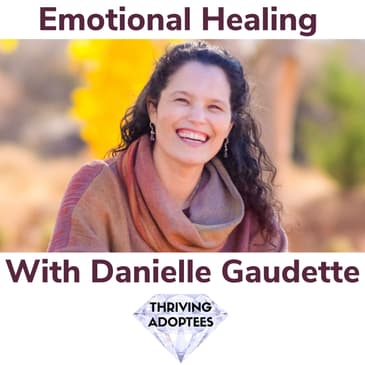
What we resist persists. How about more freedom instead? Listen in as Danielle dives into emotional freedom, what it means and how we enjoy it. Profound and practical. Here are two of Danielle's previous interviews on Thriving Adoptees:
https://thriving-adoptees.simplecast.com/episodes/upping-our-empathy-game
https://thriving-adoptees.simplecast.com/episodes/seeing-our-untarnished-soul
Danielle Gaudette is an emotional healing coach and author of, Healing Tree: An Adoptee’s Story About Hurting, Healing and Letting the Light Shine Through.
She is a 24-year Body & Brain trainer and coach, as well as a certified practitioner of Emotional Freedom Techniques. She has dedicated her life to helping others do the work she is committed to doing for herself: the work of transforming their relationship with their emotional suffering and, in doing so, uncovering the innate light of self-love within.
Bringing over two decades as a master trainer, she gently guides her clients towards inner healing and self-acceptance with understanding and compassion.
Danielle is available to work with anyone in the world through online sessions and you can reach out to her via my website if you'd like to get in touch.
https://www.daniellegaudette.com/
https://www.facebook.com/danielle.gaudette.33
https://www.facebook.com/DGhealingtree
https://www.instagram.com/danielle.gaudette/
Guests and the host are not (unless mentioned) licensed pscyho-therapists and speak from their own opinion only. Seek qualified advice if you need help.
Want to learn more about thriving for you, your kids, your families or your colleagues? Pick a time to talk here
[00:00:02] Hello everybody, welcome to another episode of the Thriving Adoptees podcast. Today I'm delighted to be joined by Danielle, Danielle Gaudette. So this is third time or fourth time on the show? I can't remember. It's at least third. It's at least third. Yeah. So, and it's a delight. It's always a delight to see the big smiling face. Yeah. Thanks. Yeah. Your big smile.
[00:00:29] Big smiling face sounds not right, does it? Big smile. Yeah. What I mean is a big smile. Thank you. I appreciate you. So Danielle sent me a little message and said that she's doing a lot of work on emotional freedom technique. And so we're kind of going to explore that. We're going to riff on that to use Daniel's. Daniel's.
[00:00:57] But I guess we've got to start by, you can't riff about a technique, but maybe it's easier to riff about emotional freedom itself. Right? So what does emotional freedom mean to you? Yeah, I think that's a really good point. And I love this as a starting place because that's what it's all about, right?
[00:01:22] So for me, personally, in my life, I was definitely a prisoner of my emotions, a slave to my emotions.
[00:01:32] I mean, I still am sometimes, but it's I'm really interested in this inner process of learning to sort of shift our relationship with our emotions, because I was formerly drowning in mine and then discovered that I don't have to be drowning and that there's ways to discover freedom. So I would say emotional freedom.
[00:01:55] I would say emotional freedom is freedom from the drowning, freedom from drowning in the belief that all of this is so real and so true. And it's it's it's the end all be all of my worth, my value, my existence. You know, I I have experience of having really extreme emotional reactivity that way.
[00:02:21] So the freedom is getting free from the emotion, the beliefs, the negative thought patterns and habits that can control us and keep us stuck. And I've met a lot of adoptees on my journey, so I can't speak for all of them. But me as an adoptee was highly sensitive.
[00:02:43] So this practice of emotional freedom and emotional freedom techniques has been like hugely instrumental in supporting me with my own inner wound processing. Yeah. Yeah. Yeah. Have you heard of Brian Ferry? No, I have not. Have you heard of Roxy Music? No. No. Okay. So Roxy Music was a band, is a band, started in the 70s.
[00:03:12] And the lead singer is a guy called Brian Ferry. Brian with a Y, whether that makes a difference, I don't know. Brian, Brian Ferry. And he, he had a big hit in big ish hit for him in 1985 with a song called Slave to Love. Hmm. Hmm. Okay.
[00:03:37] Which was me and my wife's first, first dance, you know, at the wedding. Hmm. 1997. So when, when you said slave to emotions, Hmm. I just went there with slave to love. Well, now was that like a positive angle on it? If you used it as your wedding song? Yeah. Okay. Okay. Okay. Well, if you like to be a slave to love, then that's a positive thing.
[00:04:05] But a lot of people, I mean, I, again, I can mostly speak for myself, but I think it's universal. We feel stuck with an emotion. Love would be an emotion that perhaps we were happy to be a slave to. Yeah. Unless of course, love led to hurt or hate or pain, you know, in some way it's those painful feelings that we don't like to be enslaved by.
[00:04:34] And sometimes we just don't know how to get out of it. No, we don't. Yeah. We don't. Well, we use the how word. So we're looking, we're looking for a logic, which we're trying to fight, fight, fight a feeling with logic. That's right. How do I, and that doesn't work, does it? No, that's not, that's not helpful.
[00:05:03] And that's been my personal discovery for, with my own internal landscape, but also with, you know, helping so many students and clients over the years, like everyone's doing that, right. That resistance, that fight with myself, but that doesn't set us free. Right. It's like, how can I be free from something if I want to be in a wrestling match with it and entangled with it? Right.
[00:05:30] Have you heard of, I heard this a couple of months ago and I listened to the same podcast again. So we re heard this, this term. Have you heard this term psychological freedom? No, but that's an interesting term. It's a nice, interesting thing. So it's more about our relationship with our feelings. Yes. Than the feelings themselves. Yes. Yeah.
[00:05:58] So it's about how much wiggle room we have. So what that would mean to me is, I, you could say, I hate my insecurity. Mm hmm. And, or you could say, I'm okay with my insecurity. Mm hmm. That would be. Yes. Right. It's, it's about psychological flexibility.
[00:06:28] So it's not about the emotion itself. It's about our feelings about, it's our feelings about our feelings. Yes, that's right. I a hundred percent agree. Um, but when I hear the word psychological, just in general, it's, it's, it becomes cerebral. Yeah. Intellectual process. Indeed.
[00:06:53] That's, that was not, um, easy for me on my journey to just, you know, intellectually, can't I just shift here? And I love that word transforming. Um, that that's kind of my tagline. And just as a coach in general, I want to help people transform their relationship with their emotions. So exactly what you're talking about, but I couldn't use intellect to, to do that transformation. It's the wrong tool. It's the wrong tool. Yeah.
[00:07:23] Yeah. Clearly. Clearly it's the wrong tool. Our intellect, you know, in a light between our intellect and our feelings. Yeah. We are always going to win. They're going to get stuck. Yeah. And some people can, some people can really, um, compartmentalize intellectually, but eventually at some moment, I mean, we are emotional beings. Emotions flow through our body, kind of like the weather on the earth.
[00:07:50] So if we compartmentalize too much and we don't allow ourselves to feel, I think that can lead to problems, whether it's emotional or even physical problems down the road. Yeah. But isn't, isn't that the kind of the big thing for us as adoptees with this pre verbal trauma? Mm hmm. And verbal means words. Words means thoughts. Mm hmm. Thoughts means heads. Mm hmm. Brains.
[00:08:20] Yes. Right. So, and so, and so many well-meaning therapists, change workers, whatever, have, have said that they can help us. But then verbal, verbal, verbal therapy doesn't work for trauma that's pre verbal. It just, it's totally the wrong tool. Mm hmm. But people have been taking lots of money offers for lots of years, for lots of decades, for
[00:08:48] lots of years, lots of centuries in terms of because they have our best intentions that they have to do, and do they need the money as well, right? Mm hmm. But it's a big, it's a big message that we keep on banging the drum about on thriving adoptees, right? Mm hmm. Don't do the head stuff. Don't do the mouth stuff. Do the body stuff. Yes. Right, right, right.
[00:09:15] So the somatic or emotional freedom stuff. Yeah. Yeah. So how, so how does that kind of emotional freedom stuff, emotional freedom, how does that relate to say our, how does that relate to our bodies and what other people would call somatic stuff? Yeah. Yeah. Really good question. So this is called emotional freedom techniques.
[00:09:44] That's the official name, as I understand it. And it's a, it's a very simple technique using tapping. And there's many ways to tap. I've been tapping for 25 years, but this specific way is tapping on particular acupressure points around the head, face, chest, hands. So we're getting in to the energy field here. And that is the answer to the question.
[00:10:12] The energy field is like a connector that brings us into the body. Like, how are we holding on to emotion in our body? How are we holding on to trauma in our body? Energetically. That, that experience is gone. It's over. It's past. It's long. It's long. How many times has the earth rotated since, you know, it's long gone. Right. But where is it still existing and very real for us?
[00:10:41] Holding it energetically in our bodies. So when we tap on these energy points, we start to move that energy flow. Like anything that's stuck starts to flow. It's the same system as acupuncture. People use energy in modalities like Reiki. I mean, it's very common and popular because you, you can heal that energetic field.
[00:11:10] You can move energy, balance energy, release energy. And then what's that going to do? That's going to make your body physically feel lighter, freer from that stuck heavy, whatever was becoming, you know, toxic. The more we hold onto it, the more toxic it becomes. So the body feels lighter. The mind feels lighter. Energy is like a beautiful bridge between the mind and body, which I didn't know anything about before I started my journey long ago.
[00:11:41] And when I realized that I was like, it's a miracle. Like it's a miracle medicine instead of getting consumed with, oh, this emotion. And I have this and this, I did this and this trauma and she did that. And I can, and I can get really deep and dark with that realizing this is stuck in me as energy.
[00:12:04] And if I move the energy, the problem starts to dissolve without, I don't even have to like dig into the garbage that much deeper. The problem starts to release. So that's the somatics of it. Okay. So you're going, you're going big on energy. Yes. Well said. I'm very big on energy and I love the, I have been, which is what made me curious about emotional
[00:12:34] freedom techniques because I was like, oh, they're tapping and moving energy. And when I practice it myself, it's the same. It's this, it's any energy movement is the same kind of experience where you can really. Clean, clean something and become free from something that maybe you don't even know how to name it. But you can move it in your body. There's all kinds of techniques to be able to move things that you don't even have to name.
[00:13:03] You just feel, you feel something. You can't describe it. Yeah. So you talked about that. You can go really deep and dark. You said dark. Did you say? I can go dark down the rabbit hole. Yeah. That's certainly in my character. Yeah. Yeah. Very much. So for sure.
[00:13:28] So I, I think that's when, when we're people talk about, you know, missing the first chapter of my story. Now adoptees talk about that, right? I think, and, and we've got all these people around us, right?
[00:13:59] And, and we can, and we can, the darkness can get darker and. That's true. That's true. Yeah. Because you're nurturing unhealthy beliefs at that moment. And you and I have talked about this a lot because we've talked about the soul and the the self that is the, the self that is the untarnished self.
[00:14:28] So, uh, the self that is injured and wounded. If we become. Too identified with that self. It can really become a trap. Yeah. So it's another place where emotional freedom is needed. Yeah. I think it's a fine line for me, this validation versus reinforcement. Mm hmm. Mm hmm. Mm hmm. Mm hmm.
[00:14:58] And I see a lot of it and it, it lands on me sometimes. Mm hmm. And I think, well, it must be doing the same for, for others. There's this desire to have what a trauma that has been, has not been recognized by so many, by so long in our desire to get them to. Yeah.
[00:15:28] Recognize it. Don't, don't, aren't we kind of like emphasizing it too much ourselves? Yeah, I understand. That's why I am much more interested in healing, inner healing than I am like external. Act activism. And I don't want to poo poo that in any way.
[00:15:54] I just, again, total, I think it's all perfect personal preference and we need balance. But I found from the beginning, at the beginning of my journey, if I'm too much like, you know, you need to see how hard it is for me. And like this, I'm making myself, I'm, I'm going in the opposite direction of healing for myself.
[00:16:17] I'm kind of solidifying, cementing something inside that I don't, I don't, I want to be free from that thing. I don't, I want, I want to find the truth, the true truth on the other side of it. I don't want to be bound by this illusory prison of my feelings. I don't know why I had this sense since I was like 22, 23, like way at the beginning of my journey.
[00:16:43] So I ran full force in that direction of inner healing, inner processing. And those who are doing a lot of external activism and fighting. Yes, we have to be careful. We have to make sure to always be looking at myself and seeing what I'm feeling and what emotion I'm acting on.
[00:17:06] Because, you know, we're putting that out there and we're also strengthening it inside of us as we do that. How good do you think we are at doing what you just said? Yeah, I mean, who, who's we like all of humanity? No, I meant adoptees. I meant adoptees. Well, adoptees are human.
[00:17:34] So if we start with all of humanity as a, as a really whole, we're not doing a very good job, obviously, because we can see the state of the world, right? So now if we narrow in to the adoption community, I don't know if I'm paying enough attention completely to answer that well, but it does seem like.
[00:17:55] It does seem like it may be a weakness to really be able to look at, look in and own and not make more meaning out of our feelings and hurts than there needs to be, because that's what we do as humans. And then as adoptees, you know, I'm just going to say this right now.
[00:18:23] So I was reading, I was, I was leading a class for adoptees and I was reading a little bit through the Primal Wound book. And there was just one section that I found to be very interesting for the work that I was trying to relay, which was about the ego. And how I think there is a, again, I don't know the science of it.
[00:18:47] So forgive me any listeners who do, but there is a certain age where the ego in a healthy way comes online, like proper. But for, for a relinquished baby, the ego might come online right away because there's just no protector there. Even if it's just for a short moment, the self senses that.
[00:19:10] So the ego, which is really the part of self that protects us, keeps us safe, things all in control so we can survive in this world. That ego self came online, like prematurely is how it's put in that book. And I thought that's so interesting because that's what I feel when I examine myself.
[00:19:36] My ego self seems to be a little bit more amplified and a little bit more, you know, on high alert and kind of more reactive. Then maybe some of my non-adoptee friends, what I notice. And that's it really. So that's the journey just to, just to realize that.
[00:19:58] And then, like you said, make a, transform our relationship, like make a healthier relationship with our ego rather than listening to that voice and believing in it and following it. And, you know, fighting for it, it makes us, it makes us suffer more. It makes me suffer more. I don't know how you feel, Simon, but it makes me suffer more. Yeah, it does. It makes me suffer more.
[00:20:25] And it's a, I believe it's a danger that we're, we're not, that danger isn't flagged very often. You know, it's, you know, as soon as I said slave to love and Brian Ferry, right. And you asked a question about it. You know, I was thinking about being a slave to love as in a slave to love outside ourselves. Right.
[00:20:52] I need, I need that person to, you know, I need that person to complete me. You know, was I, I was talking about somebody about this recently. I can't remember what, actually on a podcast recording or just a conversation. I was watching some Ray Donovan, did a show, Ray Donovan.
[00:21:22] There was a character in the show basically saying that the girl's trying to break, the girl's breaking up with him and he's trying to rescue the situation. And he's coming across really, really desperate. Right. You complete me. I'm nothing without you. And I'm just thinking, well, that's not going to work, is it? Yeah. Hmm.
[00:21:48] And so if we're looking for the, if we're looking for outside, you know, looking outside for somebody to make us happy, it's going to be a tricky space. Right. Yeah. So in, and I heard, I heard somebody talk about this. We're summing this up beautifully.
[00:22:17] My favourite author guy, he said, Rupert Spire, he said, there comes a space, there comes a time at which we stop using the world in service of our happiness. And we use our happiness in service of the world. Yeah. So we're looking to share. We're looking instead of, instead of looking to extract love. Right. Extract love.
[00:22:46] And we look to share love. Yeah. That's right. Mm hmm. Mm hmm. Yeah. And it's, it's a starting point of all healing and what you're talking about. Like we have to turn our attention from outward, looking at, trying to get. From even looking at the past or the future or the people or the world or this family.
[00:23:13] Healing starts when I turn my awareness towards myself. What do I feel? That's the only thing that I can do anything about. I can't do anything about any of them. So if I want them to change or be a certain way, and then I'm going to be happy and then I'm going to feel loved. It's completely impossible. So looking at myself, oh, what do I feel? What blocks me from my own love that lives inside of me?
[00:23:41] My own peace that lives inside of me? Because we all have that living in our heart. I mean, that's why people love babies, right? You just, you feel it when you hold a baby. There's that, just a feeling of that original, very, very pure nature. Sure, we all have that inside. We can't find it unless we look at ourselves. So I like emotional freedom techniques because we're moving the stuck energy and stuck emotion that's covering that.
[00:24:10] So we have to look at ourselves in order to even start the process. The process doesn't work for anybody who doesn't want to look at themselves. And then we clear that clear, clear. It's like clearing the clouds or whatever analogy you want to use. And then we reconnect with that original self. And that's like the most healing and empowering thing. Because then I got it from myself. Nobody can take it away from me. Indeed.
[00:24:40] I just want to take you back to that word ego. Because as you were describing it, it struck me that I've never heard it described like that. It's like we've all got a very different definition of ego. Yeah.
[00:25:02] And something that landed for me today, I was looking at something to do with sin, right? You know, like I was talking to somebody yesterday about one of my challenges with religion is, you know, they say that we're all born, the Catholics say we're all born sinners. And I'm thinking, you know, you just described this baby, right?
[00:25:29] But what they mean, what they mean by sin is not, you know, not wrong on purpose. It just, they just mean mistaken that we've mistaken our human body or our body mind for our soul. I think that's kind of what. Yeah. Okay. All right. We've forgotten. We've forgotten. Yeah.
[00:25:56] So it's about an error rather than a mistaken identity rather than a bad person. And I think ego maybe is another one of those words that kind of gets misdefined. I don't know what the word is.
[00:26:26] I want to talk about, you used the word transform as well. And I think we use the word transform to signify a big change, don't we? That's how it's used. But it means something deeper than that, though, doesn't it? Isn't it? Isn't it about, you know, beyond form?
[00:26:53] Isn't it something like spirit or, you know, formless? Hmm. You know, I wasn't. That's interesting. I never, like, thought of it, the word that way. But I like that word most of all because it's a deep shift. It's a shifting of my complete and total way of seeing it, understanding it.
[00:27:20] It's like a shifting of my own paradigm with that particular feeling or aspect of myself. And what ends up happening is, yes, what you're talking about. Like, we see it now in a new way, which kind of shines a light on it. And we can see it in a way where we become free from it and maybe perhaps see more of the
[00:27:44] true, like the truth of that feeling, the truth of that belief. So it does have that spiritual element of, and these words are all, like, every word is a trick word, right? Truth is a, you know. Trick word, yeah. Ego. I know. Everyone's going to interpret in so many ways. But so a different way of describing it is, like, deactivating it and seeing it without the power we've given it.
[00:28:13] And then it kind of becomes neutralized. Yeah. And that takes me on to where I wanted to go, I think. The next thing that occurs on the back of that is, like, judging of emotions and judging of feelings and judging of sensations. Yes. And so the idea came to me that, you know, we're talking about freedom from. Mm-hmm. But what about freedom with, right?
[00:28:43] Just not fighting stuff? Well, yeah. Okay. So, yeah, that's where the maybe misunderstanding comes in. What is freedom from, right? Freedom from is freedom from the judgment of. Freedom from how are, I said at the beginning, we're enslaved by or imprisoned by or controlled by. How are we controlled by that? Yeah, because of our reaction to it. And reaction includes judgment.
[00:29:10] It includes criticism of it because we judge it. It includes the story that we tell ourselves because we feel it, right? All these things that we add, that's really what we have to get free from. Because emotion is just emotion. It's just flowing. It's literally like the weather of the earth inside of us. We have our own weather. It's coming. It's going. You know, one day up, down.
[00:29:39] Like the heart flows like this. Emotion is very healthy and natural. It's part of being human. So, it's not that we're never going to feel emotion again, but we become free from our habitual unhealthy reaction towards the emotion, which includes judgment. So, we can live free alongside with those emotions. Yes, what you said is true.
[00:30:05] So, when you say emotions, do you mean, because you're talking about AFT and stuff that's in the body, I'm thinking about, I think you mean, you know, well, the only example that came to my mind was that horrible feeling that we get in the pit of our stomach, right?
[00:30:28] So, it has a bodily form to it. Yeah. Not just, like, it's not just in our hearts, it's in our body.
[00:30:47] So, for example, today, I had a conversation with somebody to do some work for me. And I expressed exactly, he was responding to a job post that described exactly what I wanted to do. And he says, well, I have a call. So, I have a call with the guy and I repeat to him what I want.
[00:31:15] And then he tries to change my brief. So, I've given him my brief on a website. I've given my brief to him on a Zoom call. And now he's trying to change the brief. And I feel a heat within me. Yes, right.
[00:31:42] I feel a heat with, it's not, it's an embodied thing. I'm feeling like, why aren't, like, I've just told you what I want. And then when I say to him, I'm sorry, we're going to have to end this. Because I know what I want.
[00:32:01] And then he comes back trying to gaslight me and making me wrong for not wanting something that I don't want. Like, I'm wrong because I don't want what he wants to sell me. I want to let him do it. And he's trying to make it into a massive job. Because that. Right. He is. But I feel it. I feel it emotionally.
[00:32:31] I feel it in my body. It's not just, it's got some charge to it. It's got something to it. Yeah. Yeah. So something I've said to my students many times over the years, which I think is kind of a fun way of looking at it, is like, if you took an emotion and you could like crack it open, we could like do surgery on it. Right. What is an emotion made out of? How do we call it?
[00:33:00] Like, why do we know this? I'm having an emotion. It's made of two things. One is what you're saying, a feeling in the body. And the other one is some kind of information, story, belief in our mind. So why that's surging, that heat inside your belly. I am 100% certain if we really went in, he's not listening to me. He's gaslit.
[00:33:29] I don't feel safe with this guy. He's threatening me. I'm clear what I want. You know, he's trying to take advantage. There's a story. And then the story perpetuates the feeling in the body. And then the uncomfortable feeling in the body perpetuates more emotional reaction. Now I'm irritated. Now I'm agitated. I got to get out of here. I'm mad at you now. All this stuff starts happening. So it's an emotion is made of those two things. If we really can get down and be like, oh, neutralize.
[00:33:59] I have a feeling in my body. I have this information. And kind of clear. Especially the information part. Because really that's the more painful part for everybody. If we clear that, body feels more comfortable. And then we don't run into the trap of adding a million more emotions on top of it. Right? So now you're irritated and you hang up and you're in a bad mood. And maybe you say something to the next person or whatever. You're an off day and people always. And you're thinking about the past.
[00:34:28] Who knows where that leads? That leads to all kinds of places. This is what I'm talking about. Not emotional, not freedom. So then we became a slave to that. Do you know what I mean? Yeah. So if we tap, right? If I was your EFT practitioner and the next session you had was me. And you're like, oh, Danielle, this guy, he just. Then we need to listen. Okay, what's really going on? What are you feeling? All right. And then we tap on that.
[00:34:56] We face the feeling directly. So it goes back to what you were saying earlier. Like allow yourself to feel it. Face the feeling. Let's not be cerebral. Let's feel it. And where is it in the body? Let's, you know, address that and face that. And we're going to tap on all the points. And we're going to kind of talk our way through that. And then my job as the coach is to kind of guide that. Guide those prompts. Try to catch what's really going on here.
[00:35:25] Oh, maybe Simon's desire to control his situation got threatened. And so let's clear some of that. And we just clear and clear and clearing until at the end you feel, oh, it's not an issue for me anymore. I can take it, leave it. I can say whatever I need to say, but not from a highly emotionally activated place. That's where the technique becomes helpful in a situation like that. Does that make sense? Yeah. Yeah.
[00:35:55] And the emotion being in the body and also it's like information in the body. Does that make sense? Yeah. Yeah. Yeah. Yeah. Because you know me, I can tangent on far away from the original topic and then try to come back around. So just making sure you're... I think you're ultra in the ultra space. I think you're right, right on the money. Yeah. Yeah. Yeah.
[00:36:23] So that's what it's all about. And it's like internal cleaning. Who doesn't need that? You know, we take a shower every day for, again, our outer part, but we don't think about cleaning our inner part. Yeah. Can you say that, because it's a technique, right? So this is a podcast, which is a discussion. So there's a fundamental challenge there.
[00:36:47] Can you share a story about your own healing on that?
[00:37:10] So when I think about healing, I kiss on a bloke and I'm a bit left brainy. I'm more left brainy. You're more right brainy, I think. I think. Is that about fair? Could be. Yeah. I think you're probably right. I'm definitely right brain. Okay. Right. Yeah. Okay. Cool.
[00:37:35] So when I think, I often we're going to something like, well, I think about healing and so people say that time is the greatest healer. Time is the greatest healer. But then if there's no change, right? There's no change over that time. There's no healing. That's true. Yeah. And so what are we talking about here? We're talking about insights, right?
[00:38:02] Insights or change is the biggest healer. Insights or changes. Okay. A change of mind or a change of heart. Yeah. A change of body. That's right. A change within our body. Um, so that, that would be kind of my take on what, what healing is when I'm coming at it from a kind of left brainy way. Uh huh. How, how, what does it mean?
[00:38:31] What does it mean for, for you? Is it that freedom? Is it what? Yeah. I like, it's a lot about feeling free from it in my mind and heart and body. So it no longer, I'm no longer falling into the delude, delusion of it. It's like, it's like I had some lenses on my eyes and then suddenly they're removed and
[00:38:59] I see more clearly and how that influences me is, yeah, my heart feels lighter. My body feels lighter and healthier. Sometimes my body, even if I'm having a cold or something, it heals faster. And I would say one of the most beautiful things is my transformation first with my relationship with myself, because my relationship with myself was really hairy in the beginning of like, cause I was just so hard on myself. I was just so critical.
[00:39:29] And so there was so much self-blame. So learning to love myself and transform that. And then that had a huge impact on my relationships with others. And if I bring it all back around to being adopted, it had a huge impact. The hard, hard inner work that I've done, healing work has had a huge impact on my relationship with my birth mother.
[00:39:53] Because at the beginning of that relationship, I mean, I was just on autopilot, but it was not like a healthy place to be. And so many triggers came up. This is like 1998. I met her. So this is 27 years of triggers and falling into pits and climbing out and trying again and happy and then hurt and like, oh my God, what a roller coaster it's been.
[00:40:23] But I can sincerely say that at this moment, even since the last time I saw you, I have the most healthy and harmonious relationship with my birth mother that I have ever had. And it's because I've done so much work and somehow amazingly that energy has kind of flowed out. And she also has shifted inside of that.
[00:40:51] I don't, but only because of my way of talking or presenting or relating to, you know, when you're hurt by someone or mad at someone or blaming someone or even in your mind, even if you never say it out loud, that person feels that energy, right? So this creates more like contention in relationships.
[00:41:16] So harmonizing my relationship with myself has like hugely helped me in my communication with her. And just actually, I just don't have, I'm from like 120% down to maybe like 10% remaining of like activation. If I even think about her, it was so big for so long. And now I just feel love and a sense of like wishing well.
[00:41:45] And so when I communicate with her, it's just so much more like happy and harmoniously, naturally. We're just, we're just like enjoying each other. Yeah. There's no more of those little like bumps. And in my book, I talked about little mini minefields that I have to cross every time I communicate with her, but I don't feel them the same way. It's changing. It's transforming like all the time. Yeah.
[00:42:14] Have you ever had a, have you ever had a, um, a change in energy during a, seeing somebody face to face or, or seeing them on, on zoom where they look different? Yes, I have. I have experienced that. Yeah. That people, you can see it in their face when there's an energetic shift.
[00:42:48] Yeah. But what about when you see them differently? They look different to you. If I see someone and they look like they've shifted. Yeah. Yeah. I, it's so beautiful. I can, I feel I, then I get the benefit of their, of their positive shift, right? I might feel more peaceful or more light or more open.
[00:43:14] The reality is we're really interconnecting with each other energetically whenever we meet, even on zoom, we don't know it. We don't realize it. So I get the benefit from your inner healing transformation a hundred percent. So usually I just feel the joy of that and the gratitude of that, whether I was part of that or not at all. And you're just doing your journey.
[00:43:41] I, I feel that's so like heartwarming for me because that's my, that's the work that I want to do in this world is letting people have that experience and be empowered by that. So is there anything else that you'd like to share that I've not asked you about, Danielle? I think I, I think I, I think I talked about a lot.
[00:44:11] It's really fun to kind of flesh it out on a deeper level. So thank you for doing that with me. And just one thing, you know, you mentioned zoom, we've talked about EFT. Can you do it over zoom? Yes. Yeah. I'm completely an online coach at the moment. It's all online. Yeah. And so I work one-on-one and I also work with groups.
[00:44:37] So, um, I just, you know, as part of my kind of launch, I did a few group taps as well. It's, you don't go as deep, you know, one-on-one, it can really kind of catch what's going on specifically for you and customize it for you. But in a group tap, at least people can get some exposure to it and feel that feeling again, somatically of that shift in their body, which is what we're really going for. Indeed. Indeed. Yeah.
[00:45:04] So, uh, as always listeners, there's links in the show notes so you can check out what Danielle's doing and thank you again. Yeah. Thank you, Simon. Yeah. Thank you very much. Lots of love listeners. We'll speak to you very soon. Take care. Bye. Okay. Take care. Bye-bye. Bye.